Spandidos Publications Logo
  • About
    • About Spandidos
    • Aims and Scopes
    • Abstracting and Indexing
    • Editorial Policies
    • Reprints and Permissions
    • Job Opportunities
    • Terms and Conditions
    • Contact
  • Journals
    • All Journals
    • Oncology Letters
      • Oncology Letters
      • Information for Authors
      • Editorial Policies
      • Editorial Board
      • Aims and Scope
      • Abstracting and Indexing
      • Bibliographic Information
      • Archive
    • International Journal of Oncology
      • International Journal of Oncology
      • Information for Authors
      • Editorial Policies
      • Editorial Board
      • Aims and Scope
      • Abstracting and Indexing
      • Bibliographic Information
      • Archive
    • Molecular and Clinical Oncology
      • Molecular and Clinical Oncology
      • Information for Authors
      • Editorial Policies
      • Editorial Board
      • Aims and Scope
      • Abstracting and Indexing
      • Bibliographic Information
      • Archive
    • Experimental and Therapeutic Medicine
      • Experimental and Therapeutic Medicine
      • Information for Authors
      • Editorial Policies
      • Editorial Board
      • Aims and Scope
      • Abstracting and Indexing
      • Bibliographic Information
      • Archive
    • International Journal of Molecular Medicine
      • International Journal of Molecular Medicine
      • Information for Authors
      • Editorial Policies
      • Editorial Board
      • Aims and Scope
      • Abstracting and Indexing
      • Bibliographic Information
      • Archive
    • Biomedical Reports
      • Biomedical Reports
      • Information for Authors
      • Editorial Policies
      • Editorial Board
      • Aims and Scope
      • Abstracting and Indexing
      • Bibliographic Information
      • Archive
    • Oncology Reports
      • Oncology Reports
      • Information for Authors
      • Editorial Policies
      • Editorial Board
      • Aims and Scope
      • Abstracting and Indexing
      • Bibliographic Information
      • Archive
    • Molecular Medicine Reports
      • Molecular Medicine Reports
      • Information for Authors
      • Editorial Policies
      • Editorial Board
      • Aims and Scope
      • Abstracting and Indexing
      • Bibliographic Information
      • Archive
    • World Academy of Sciences Journal
      • World Academy of Sciences Journal
      • Information for Authors
      • Editorial Policies
      • Editorial Board
      • Aims and Scope
      • Abstracting and Indexing
      • Bibliographic Information
      • Archive
    • International Journal of Functional Nutrition
      • International Journal of Functional Nutrition
      • Information for Authors
      • Editorial Policies
      • Editorial Board
      • Aims and Scope
      • Abstracting and Indexing
      • Bibliographic Information
      • Archive
    • International Journal of Epigenetics
      • International Journal of Epigenetics
      • Information for Authors
      • Editorial Policies
      • Editorial Board
      • Aims and Scope
      • Abstracting and Indexing
      • Bibliographic Information
      • Archive
    • Medicine International
      • Medicine International
      • Information for Authors
      • Editorial Policies
      • Editorial Board
      • Aims and Scope
      • Abstracting and Indexing
      • Bibliographic Information
      • Archive
  • Articles
  • Information
    • Information for Authors
    • Information for Reviewers
    • Information for Librarians
    • Information for Advertisers
    • Conferences
  • Language Editing
Spandidos Publications Logo
  • About
    • About Spandidos
    • Aims and Scopes
    • Abstracting and Indexing
    • Editorial Policies
    • Reprints and Permissions
    • Job Opportunities
    • Terms and Conditions
    • Contact
  • Journals
    • All Journals
    • Biomedical Reports
      • Information for Authors
      • Editorial Policies
      • Editorial Board
      • Aims and Scope
      • Abstracting and Indexing
      • Bibliographic Information
      • Archive
    • Experimental and Therapeutic Medicine
      • Information for Authors
      • Editorial Policies
      • Editorial Board
      • Aims and Scope
      • Abstracting and Indexing
      • Bibliographic Information
      • Archive
    • International Journal of Epigenetics
      • Information for Authors
      • Editorial Policies
      • Editorial Board
      • Aims and Scope
      • Abstracting and Indexing
      • Bibliographic Information
      • Archive
    • International Journal of Functional Nutrition
      • Information for Authors
      • Editorial Policies
      • Editorial Board
      • Aims and Scope
      • Abstracting and Indexing
      • Bibliographic Information
      • Archive
    • International Journal of Molecular Medicine
      • Information for Authors
      • Editorial Policies
      • Editorial Board
      • Aims and Scope
      • Abstracting and Indexing
      • Bibliographic Information
      • Archive
    • International Journal of Oncology
      • Information for Authors
      • Editorial Policies
      • Editorial Board
      • Aims and Scope
      • Abstracting and Indexing
      • Bibliographic Information
      • Archive
    • Medicine International
      • Information for Authors
      • Editorial Policies
      • Editorial Board
      • Aims and Scope
      • Abstracting and Indexing
      • Bibliographic Information
      • Archive
    • Molecular and Clinical Oncology
      • Information for Authors
      • Editorial Policies
      • Editorial Board
      • Aims and Scope
      • Abstracting and Indexing
      • Bibliographic Information
      • Archive
    • Molecular Medicine Reports
      • Information for Authors
      • Editorial Policies
      • Editorial Board
      • Aims and Scope
      • Abstracting and Indexing
      • Bibliographic Information
      • Archive
    • Oncology Letters
      • Information for Authors
      • Editorial Policies
      • Editorial Board
      • Aims and Scope
      • Abstracting and Indexing
      • Bibliographic Information
      • Archive
    • Oncology Reports
      • Information for Authors
      • Editorial Policies
      • Editorial Board
      • Aims and Scope
      • Abstracting and Indexing
      • Bibliographic Information
      • Archive
    • World Academy of Sciences Journal
      • Information for Authors
      • Editorial Policies
      • Editorial Board
      • Aims and Scope
      • Abstracting and Indexing
      • Bibliographic Information
      • Archive
  • Articles
  • Information
    • For Authors
    • For Reviewers
    • For Librarians
    • For Advertisers
    • Conferences
  • Language Editing
Login Register Submit
  • This site uses cookies
  • You can change your cookie settings at any time by following the instructions in our Cookie Policy. To find out more, you may read our Privacy Policy.

    I agree
Search articles by DOI, keyword, author or affiliation
Search
Advanced Search
presentation
Oncology Letters
Join Editorial Board Propose a Special Issue
Print ISSN: 1792-1074 Online ISSN: 1792-1082
Journal Cover
November 2012 Volume 4 Issue 5

Full Size Image

Sign up for eToc alerts
Recommend to Library

Journals

International Journal of Molecular Medicine

International Journal of Molecular Medicine

International Journal of Molecular Medicine is an international journal devoted to molecular mechanisms of human disease.

International Journal of Oncology

International Journal of Oncology

International Journal of Oncology is an international journal devoted to oncology research and cancer treatment.

Molecular Medicine Reports

Molecular Medicine Reports

Covers molecular medicine topics such as pharmacology, pathology, genetics, neuroscience, infectious diseases, molecular cardiology, and molecular surgery.

Oncology Reports

Oncology Reports

Oncology Reports is an international journal devoted to fundamental and applied research in Oncology.

Experimental and Therapeutic Medicine

Experimental and Therapeutic Medicine

Experimental and Therapeutic Medicine is an international journal devoted to laboratory and clinical medicine.

Oncology Letters

Oncology Letters

Oncology Letters is an international journal devoted to Experimental and Clinical Oncology.

Biomedical Reports

Biomedical Reports

Explores a wide range of biological and medical fields, including pharmacology, genetics, microbiology, neuroscience, and molecular cardiology.

Molecular and Clinical Oncology

Molecular and Clinical Oncology

International journal addressing all aspects of oncology research, from tumorigenesis and oncogenes to chemotherapy and metastasis.

World Academy of Sciences Journal

World Academy of Sciences Journal

Multidisciplinary open-access journal spanning biochemistry, genetics, neuroscience, environmental health, and synthetic biology.

International Journal of Functional Nutrition

International Journal of Functional Nutrition

Open-access journal combining biochemistry, pharmacology, immunology, and genetics to advance health through functional nutrition.

International Journal of Epigenetics

International Journal of Epigenetics

Publishes open-access research on using epigenetics to advance understanding and treatment of human disease.

Medicine International

Medicine International

An International Open Access Journal Devoted to General Medicine.

Journal Cover
November 2012 Volume 4 Issue 5

Full Size Image

Sign up for eToc alerts
Recommend to Library

  • Article
  • Citations
    • Cite This Article
    • Download Citation
    • Create Citation Alert
    • Remove Citation Alert
    • Cited By
  • Similar Articles
    • Related Articles (in Spandidos Publications)
    • Similar Articles (Google Scholar)
    • Similar Articles (PubMed)
  • Download PDF
  • Download XML
  • View XML
Case Report

Fusion PET-CT detection of neurolymphomatosis originating from primary breast lymphoma: A case report and literature review

  • Authors:
    • Liying Xu
    • Yunfeng Zhou
    • Dasheng Qiu
    • Salman Shams
  • View Affiliations / Copyright

    Affiliations: Department of Radiology, Zhongnan Hospital of Wuhan University, Wuhan 430071, P.R. China, Department of Oncology, Zhongnan Hospital of Wuhan University, Wuhan 430071, P.R. China, Department of PET/CT, Hubei Cancer Hospital, Wuhan 430079, P.R. China, Department of Radiology, Zhongnan Hospital of Wuhan University, Wuhan 430071, P.R. China
  • Pages: 973-975
    |
    Published online on: August 3, 2012
       https://doi.org/10.3892/ol.2012.840
  • Expand metrics +
Metrics: Total Views: 0 (Spandidos Publications: | PMC Statistics: )
Metrics: Total PDF Downloads: 0 (Spandidos Publications: | PMC Statistics: )
Cited By (CrossRef): 0 citations Loading Articles...

This article is mentioned in:


Abstract

Neurolymphomatosis (NL) is an extremely rare manifestation. Involvement of the cranial and peripheral nerves is an unusual manifestation of NL which is occasionally difficult to diagnose using conventional imaging modalities. A 45-year-old female in complete remission from primary breast lymphoma presented with multiple neurological symptoms. 18F-FDG PET/CT revealed multiple nodular hypermetabolic lesions along the cranial and peripheral nerves, which corresponded to the patient's neurological symptoms. These findings suggest that 18F-FDG PET/CT successfully detects the infiltration of cranial and peripheral nerves by lymphoma.

Introduction

Primary breast lymphoma (PBL) is a rare condition which affects less than 1% of patients with non-Hodgkin’s lymphoma (NHL) and constitutes less than 2% of all extranodal NHLs (1). Neurolymphomatosis (NL) is a rare manifestation characterized by the infiltration of peripheral nerves, nerve roots, nervous plexuses or cranial nerves by malignant lymphocytes (2). Involvement of the cranial and peripheral nerves is an unusual manifestation of NL which is occasionally difficult to diagnose using conventional imaging modalities. 18F-FDG PET/CT is being increasingly used for the diagnosis and staging of NHL and it also appears to be a highly sensitive diagnostic method for facilitating the identification of NL (2). The present case report describes a patient in complete remission of PBL who demonstrated increasing uptake of 18F-FDG in the cranial and peripheral nerves, suggestive of NL. Informed consent was obtained from the patient prior to the study.

Case report

A 45-year-old female was admitted complaining of headache, impaired hearing on the right side, bilateral facial hypesthesia, decreased vision, diplopia, lumbodorsal pain and weakness in both inferior extremities. The patient had been diagnosed with stage IIb non-Hodgkin’s lymphoma in her left breast two years previously, which was identified as a CD20-positive diffuse large B cell phenotype following lumpectomy. A total of 8 cycles of R-CHOP chemotherapy led to complete remission. However, following 16 months, the patient developed multiple neurological symptoms. Cerebrospinal fluid (CSF) analysis revealed increased protein (325 mg/dl) and the cytology was positive for malignant lymphocytes. CSF tests for tuberculosis, viruses and fungi were negative.

Whole body 18F-FDG PET/CT was performed to assess the extent of relapse. The patient fasted for at least 6 h prior to undergoing scanning and the fasting blood sugar level was <6.1 mmol/l. To prevent muscular radiotracer uptake, the patient was instructed to sit without speaking and avoid strenuous activity prior to the examination and following injection of the radioisotope. A standard dose of 18F-FDG 0.1 mCi/kg was intravenously injected 60 min prior to scanning. The data were acquired with a combined PET/CT in-line system (GE Discovery STE 16) with the following parameters: section thickness 3.75 mm, pitch 1.0 and FOV 70 cm. 18F-FDG PET/CT revealed multiple nodular or linear hypermetabolic lesions along the right acoustic nerve [maximum standardized uptake value (SUVmax), 7.98; Fig. 1A], bilateral trigeminal nerves (SUVmax, 8.91, 10.25; Fig. 1B), the optic chiasm (SUVmax, 4.73; Fig. 1C), the left nerve root of T11/12 (SUVmax, 4.79; Fig. 1D), the right nerve root of T12/L1 (SUVmax, 4.52; Fig. 1E) and the right adrenal gland (SUVmax, 4.05; Fig. 1F), while CT imaging revealed that the right adrenal gland and optic chiasm were normal. 18F-FDG PET/CT also revealed increased FDG uptake in the left retroperitoneal space (SUVmax, 5.48; Fig. 1F) where CT identified a strip-like soft tissue lesion between the left adrenal gland and abdominal aorta. Although a nerve biopsy was not performed, relapse of lymphoma and NL were diagnosed by 18F-FDG PET/CT and positive CSF cytology. The symptoms were markedly relieved following two cycles of R-CHOP chemotherapy.
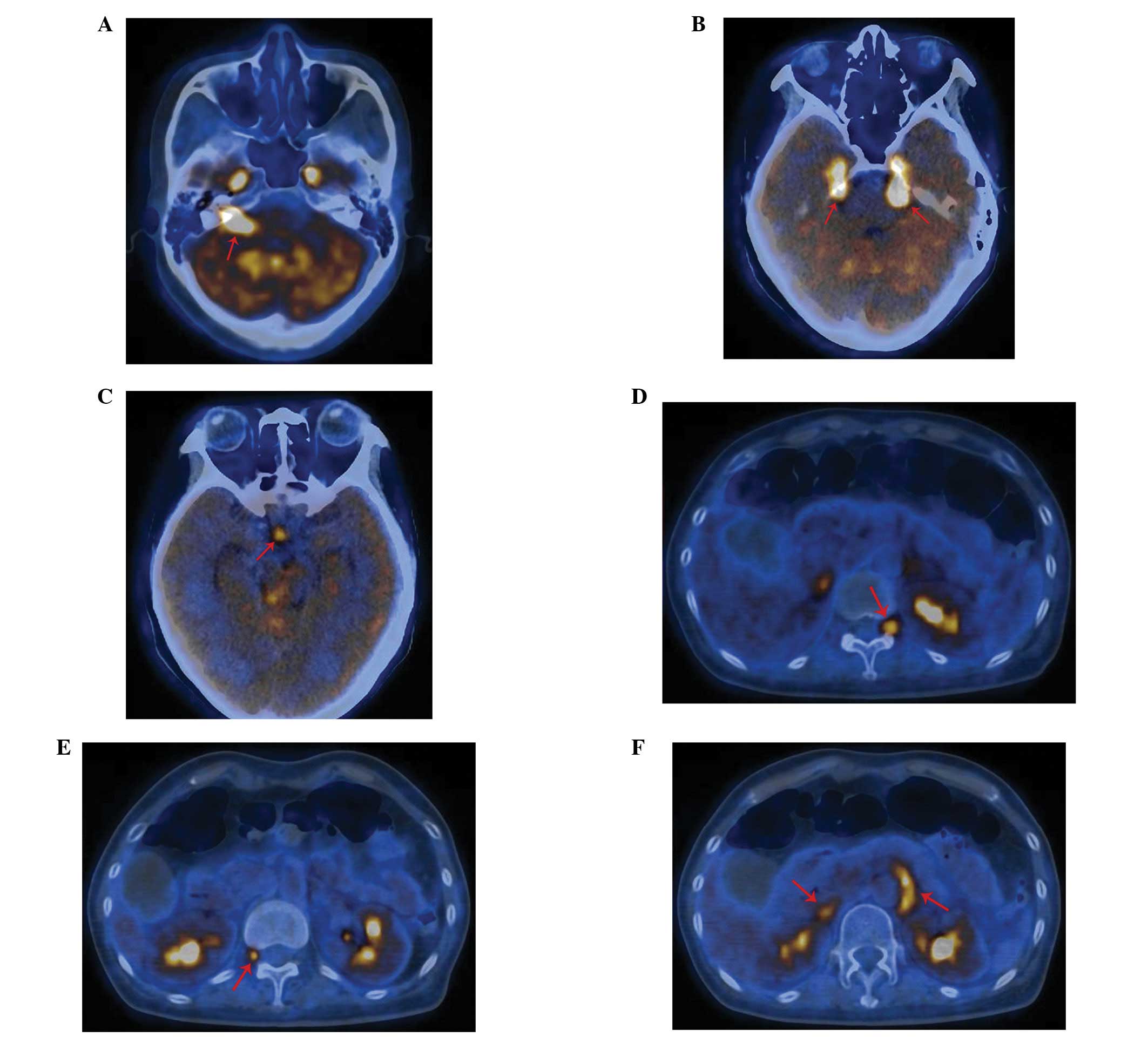
Figure 1

18F-FDG PET/CT images showing linear or nodular hypermetabolic lesions (red arrow) involving multiple cranial and peripheral nerves, corresponding to the patient’s complex neurological symptoms, including impaired hearing in the right side, bilateral facial hypesthesia, decreased vision, diplopia, lumbodorsal pain and weakness in both inferior extremities. 18F-FDG PET/CT showing increased 18F-FDG uptake along (A) the right acoustic nerve, (B) the bilateral trigeminal nerves and Meckel’s caves, (C) in the optic chiasm. 18F-FDG PET/CT showing increased 18F-FDG uptake in (D) the left nerve root of T11/12, (E) the right nerve root of T12/L1, (F) a strip-like soft tissue lesion between the left adrenal gland and abdominal aorta.

Discussion

PBL is used to define malignant lymphoma primarily occurring in the breast in the absence of previously detected lymphoma localizations. The most common type of PBL is the diffuse large B cell type. In this case, the patient, without a notable medical history, presented with a rapidly growing mass in the left breast. A systemic examination revealed no extramammary lymphoma and a lumpectomy was performed. Histopathological and immunohistochemical findings confirmed a diffuse large B cell type lymphoma.

NHL may involve the nervous system at every level, including the peripheral nerves, spinal nerve roots, spinal cord, meninges and brain. NL is a rare manifestation of malignant lymphoma in which the malignant lymphocytes infiltrate the peripheral nervous systems. NL is usually disclosed in proximal sites, including roots, spinal ganglia, nervous plexuses and proximal trunks (3). The involvement of the cranial and peripheral nerves in patients with PBL has rarely been documented. A study of 84 consecutive patients with PBL treated in 20 institutions identified that 12 patients suffered from a relapse in the central nervous system, but no patients presented with relapse in the peripheral nerves (4). In the present case, the chief complaints included multiple neurological symptoms, which were consistent with certain pathological changes in the nervous system. Further examinations were performed to assess the involvement of the nervous system and the extent of relapse.

Diagnosis of NL is often difficult and depends on the histopathological identification of infiltrating malignant lymphocytes in the affected nerves. However, nerve biopsy may yield false negative results despite the widespread lymphomatous infiltration of peripheral nerves (5). CSF cytological examination may lead to a false diagnosis since only a minority of NL cases reported present with positive CSF cytology at the initial diagnosis. Alternatively, imaging studies are of great value in diagnosing NL prior to histopathological confirmation. In the past, the imaging evaluation and follow-up of lymphoma patients was based solely on the findings from contrast-enhanced CT. However, contrast-enhanced CT has limited sensitivity in detecting lymphomatous involvement of normal-sized lymph nodes, bone marrow, spleen and extranodal tissues (6). Magnetic resonance imaging (MRI) is the most commonly used modality in the diagnosis and therapy of patients with lymphomatous infiltration of nerves. A retrospective study by Grisariu et al (2) of 50 patients with NL revealed that 18F-FDG PET/CT and MRI was positive in 84 and 77% of patients, respectively. While MRI typically shows the enlargement and enhancement of affected nerves, it does not always provide optimal visualization of lymphomatous involvement of peripheral nerves. In such cases, 18F-FDG PET/CT provides additional information that aids the correct identification of recurrence or exclusion of other diseases (7). In a previous systematic review, the overall sensitivity and specificity of 18F-FDG PET/CT for the initial staging of NHL and Hodgkin’s disease were 97 and 100%, respectively (8). A case report of NL on 18F-FDG PET/CT and MRI findings demonstrated that 18F-FDG PET/CT detected peripheral nerve infiltration by malignant lymphoma earlier than MRI (9). A study by Bronstein et al (10) indicated that 18F-FDG PET/CT is useful in diagnosing the malignant involvement of the peripheral nerves, particularly when findings from anatomical imaging (MRI or CT) are negative. The advanced technique of 18F-FDG PET/CT provides improved anatomical details of less commonly involved peripheral nerves, particularly in cases with NL. However, similar to MRI, 18F-FDG PET/CT also has diagnostic limitations. 18F-FDG uptake is highly sensitive for tumors but is not specific and may also be observed in any process where the rate of glycolysis is increased, including infection or neoplastic diseases. According to Hong et al (9) and Bronstein et al (10), the diagnosis of NHL required integrated clinical information from 18F-FDG PET/CT as well as CSF cytological examination.

In the present case, CT imaging revealed the enlargement of multiple cranial and peripheral nerves, while PET imaging revealed increased 18F-FDG uptake along these nerves. Subsequently, positive CSF cytology also aided the diagnosis of NL. The diagnosis was confirmed following careful integration of all the relevant clinical findings from 18F-FDG PET/CT and CSF cytological examination. The symptoms, including headache and lumbodorsal pain, were markedly relieved following two cycles of R-CHOP chemotherapy.

In cases of known treated malignancy involving the peripheral nerves, follow-up by 18F-FDG PET/CT has the advantage of high sensitivity in detecting local recurrence. Therefore, it is recommended that 18F-FDG PET/CT should be performed to evaluate the possibility of NL in patients with a history of lymphoma presenting with neurological symptoms.

References

1. 

HS MasonV JohariDE MarchGM CrisiPrimary breast lymphoma: radiologic and pathologic findingsBreast J11495496200510.1111/j.1075-122X.2005.00167.x16297110

2. 

S GrisariuB AvniTT BatchelorNeurolymphomatosis: an International Primary CNS Lymphoma Collaborative Group reportBlood11550055011201010.1182/blood-2009-12-25821020368468

3. 

S KahramanH SabuncuogluO GunhanMA GursesS SirinA rare reason of foot drop caused by primary diffuse large b-cell lymphoma of the sciatic nerve: case reportActa Neurochir (Wien)152125128201010.1007/s00701-009-0339-919415174

4. 

V StefoniA BroccoliC PellegriniE DerenziniM FinaPL ZinzaniCNS recurrence of primary mediastinal large b-cell lymphoma after complete remissionJ Neurooncol95135139200910.1007/s11060-009-9898-019381440

5. 

MJ van den BentHG de BruinGM BosG Brutel de la RivièrePA Sillevis SmittNegative sural nerve biopsy in neurolymphomatosisJ Neurol24611591163199910653308

6. 

FM PaesDG KalkanisPA SiderasAN SerafiniFDG PET/CT of extranodal involvement in non-Hodgkin lymphoma and Hodgkin diseaseRadiographics30269291201010.1148/rg.30109508820083598

7. 

H PalmedoH UrbachH BenderFDG-PET in immunocompetent patients with primary central nervous system lymphoma: correlation with MRI and clinical follow-upEur J Nucl Med Mol Imaging33164168200610.1007/s00259-005-1917-616220304

8. 

E Even-SapirG LievshitzC PerryY HerishanuH LermanU MetserFluorine-18 fluorodeoxyglucose PET/CT patterns of extranodal involvement in patients with Non-Hodgkin lymphoma and Hodgkin’s diseaseRadiol Clin North Am45697709vii2007

9. 

CM HongS-W LeeHJ LeeNeurolymphomatosis on F-18 FDG PET/CT and MRI findings: A case reportNucl Med Mol Imaging457678201110.1007/s13139-010-0070-824899982

10. 

Y BronsteinS TummalaE RohrenF-18 FDG PET/CT for detection of malignant involvement of peripheral nerves: case series and literature reviewClin Nucl Med3696100201110.1097/RLU.0b013e318203bb0e21220969

Related Articles

  • Abstract
  • View
  • Download
  • Twitter
Copy and paste a formatted citation
Spandidos Publications style
Xu L, Zhou Y, Qiu D and Shams S: Fusion PET-CT detection of neurolymphomatosis originating from primary breast lymphoma: A case report and literature review. Oncol Lett 4: 973-975, 2012.
APA
Xu, L., Zhou, Y., Qiu, D., & Shams, S. (2012). Fusion PET-CT detection of neurolymphomatosis originating from primary breast lymphoma: A case report and literature review. Oncology Letters, 4, 973-975. https://doi.org/10.3892/ol.2012.840
MLA
Xu, L., Zhou, Y., Qiu, D., Shams, S."Fusion PET-CT detection of neurolymphomatosis originating from primary breast lymphoma: A case report and literature review". Oncology Letters 4.5 (2012): 973-975.
Chicago
Xu, L., Zhou, Y., Qiu, D., Shams, S."Fusion PET-CT detection of neurolymphomatosis originating from primary breast lymphoma: A case report and literature review". Oncology Letters 4, no. 5 (2012): 973-975. https://doi.org/10.3892/ol.2012.840
Copy and paste a formatted citation
x
Spandidos Publications style
Xu L, Zhou Y, Qiu D and Shams S: Fusion PET-CT detection of neurolymphomatosis originating from primary breast lymphoma: A case report and literature review. Oncol Lett 4: 973-975, 2012.
APA
Xu, L., Zhou, Y., Qiu, D., & Shams, S. (2012). Fusion PET-CT detection of neurolymphomatosis originating from primary breast lymphoma: A case report and literature review. Oncology Letters, 4, 973-975. https://doi.org/10.3892/ol.2012.840
MLA
Xu, L., Zhou, Y., Qiu, D., Shams, S."Fusion PET-CT detection of neurolymphomatosis originating from primary breast lymphoma: A case report and literature review". Oncology Letters 4.5 (2012): 973-975.
Chicago
Xu, L., Zhou, Y., Qiu, D., Shams, S."Fusion PET-CT detection of neurolymphomatosis originating from primary breast lymphoma: A case report and literature review". Oncology Letters 4, no. 5 (2012): 973-975. https://doi.org/10.3892/ol.2012.840
Follow us
  • Twitter
  • LinkedIn
  • Facebook
About
  • Spandidos Publications
  • Careers
  • Cookie Policy
  • Privacy Policy
How can we help?
  • Help
  • Live Chat
  • Contact
  • Email to our Support Team












