Introduction
Chronic myeloid leukemia (CML) is an acquired
myeloproliferative disorder that originates in an abnormal
pluripotent bone marrow stem cell and is consistently associated
with the presence of the Philadelphia (Ph) chromosome, usually
leading to a BCR-ABL gene fusion. The Ph chromosome is the result
of a balanced t(9;22)(q34;q11) translocation, and is observed in
more than 90% of CML cases, with variant Ph translocations being
observed in the remainder (1). The
BCR-ABL fusion gene is formed by the transposition of the 3’
portion of the ABL oncogene from 9q34 to the 5’ portion of the BCR
gene on chromosome 22, and this fusion gene encodes a
constitutively active tyrosine kinase (2).
The progression of CML from the chronic phase (CP)
to blast crisis (BC) is frequently associated with non-random
secondary chromosomal aberrations, including +8, i(17q), +19 and an
extra Ph chromosome (3).
The isodicentric Ph chromosome [idic(Ph)] is a rare
cytogenetic aberration formed by the duplication and fusion of two
identical Ph chromosomes with retention of their centromeres.
Idic(Ph) chromosomes have been previously observed in CML patients
(4–10).
Targeted therapy has been realized with imatinib
mesylate (IM) (Glivec, formerly STI571), which forms a complex with
the ABL part of the fused gene and inactivates it (11). IM is a highly effective therapy that
has demonstrated a complete cytogenetic response in 87% of patients
with newly-diagnosed CP CML (12).
A complete hematological response with IM therapy has been observed
in 95% of patients with CP CML following failure of interferon-α,
71% of accelerated phase (AP) patients and 31% of patients in
myeloid blast crisis (BC) (13–15).
Resistance to chemotherapy occurs as a result of
increased expression of the BCR-ABL kinase from genomic
amplification, clonal chromosomal evolution, or mutations in the
ABL kinase of the BCR-ABL gene affecting drug interaction or kinase
activity (16).
In the present study, we describe a rare case of
isoderivative Ph chromosome [ider(22)]-positive CML, which was
further characterized by fluorescence in situ hybridization
(FISH) and reverse transcription-polymerase chain reaction
(RT-PCR). The patient did not respond to IM chemotherapy.
Materials and methods
Case report
A 33-year-old male was diagnosed as suffering from
CP CML. In May 2010, the white blood cell (WBC) count of the
patient was 25.5×10⁹/l, consisting of 78.5% neutrophils,
16.8% lymphocytes and 4.7% monocytes. The platelet count was
432×109/l and the hemoglobin level was 14.1 g/dl. A
previous physical examination revealed splenomegaly, loss of weight
and fever. The patient was treated with IM at 400 mg/day for a
total of 54 months, following which the previous relevant symptoms
appeared to have improved. In July 2011, the patient presented for
the second time with a WBC of 14.6×10⁹/l consisting of
46.1% neutrophils, 27.7% lymphocytes, 22.2% monocytes, 0.9%
eosinophiles and 3.1% basophiles. The platelet count was
117×109/l and the hemoglobin level was 13.3 g/dl. The
serum lactate dehydrogenase (LDH) level was 613 U/l (normal level
up to 414 U/l) and the serum alkaline phosphatase level was 83 U/l
(normal level up to 128 U/l). The patient was treated with IM at
800 mg/day for a total of 6 months. The patient had a brother
diagnosed with CML in 1994 who succumbed following 6 months of
chemotherapy.
Cytogenetic analysis
Chromosome analysis using GTG-banding was performed
according to standard procedure (17). A total of 20 metaphase cells derived
from the unstimulated bone marrow of the patient were analyzed.
Karyotypes were described according to the international system for
human cytogenetic nomenclature (18).
Molecular cytogenetics
FISH using a LSI BCR-ABL dual-color dual-fusion
translocation probe (Abbott Molecular/Vysis, Des Plaines, IL, USA)
was performed according to the manufacturer’s instructions
(17). Furthermore, a probe
specific to all acrocentric short chromosome arms (midi54) was
applied as previously reported (19). A total of 20 metaphase spreads were
analyzed using a fluorescence microscope (AxioImager. Z1 mot,
Zeiss, Hertfordshire, UK) equipped with appropriate filter sets to
discriminate between a maximum of five fluorochromes and the
counterstain DAPI. Image capturing and processing were carried out
using an ISIS imaging system (MetaSystems, Altlussheim,
Germany).
Immunohistochemistry
The immunohistochemical tests were performed on
Carnoy fixed cell suspension as previously described (20). A rabbit polyclonal to CENP-B
antibody (Abcam, Cambridge, UK) was used to stain all centromeres.
The specific staining of the active centromeres was performed with
the anti-CENP-C antibody. FITC-labeled goat anti-rabbit IgG and
CyTM3-conjugated AffiniPure goat anti-guinea pig IgG (Dianova,
Hamburg, Germany) were applied as secondary antibodies.
Reverse transcription-polymerase chain
reaction (RT-PCR) for BCR-ABL fusion transcripts
RT-PCR was carried out as previously described
(21).
Results
Karyotyping was performed following the chemotherapy
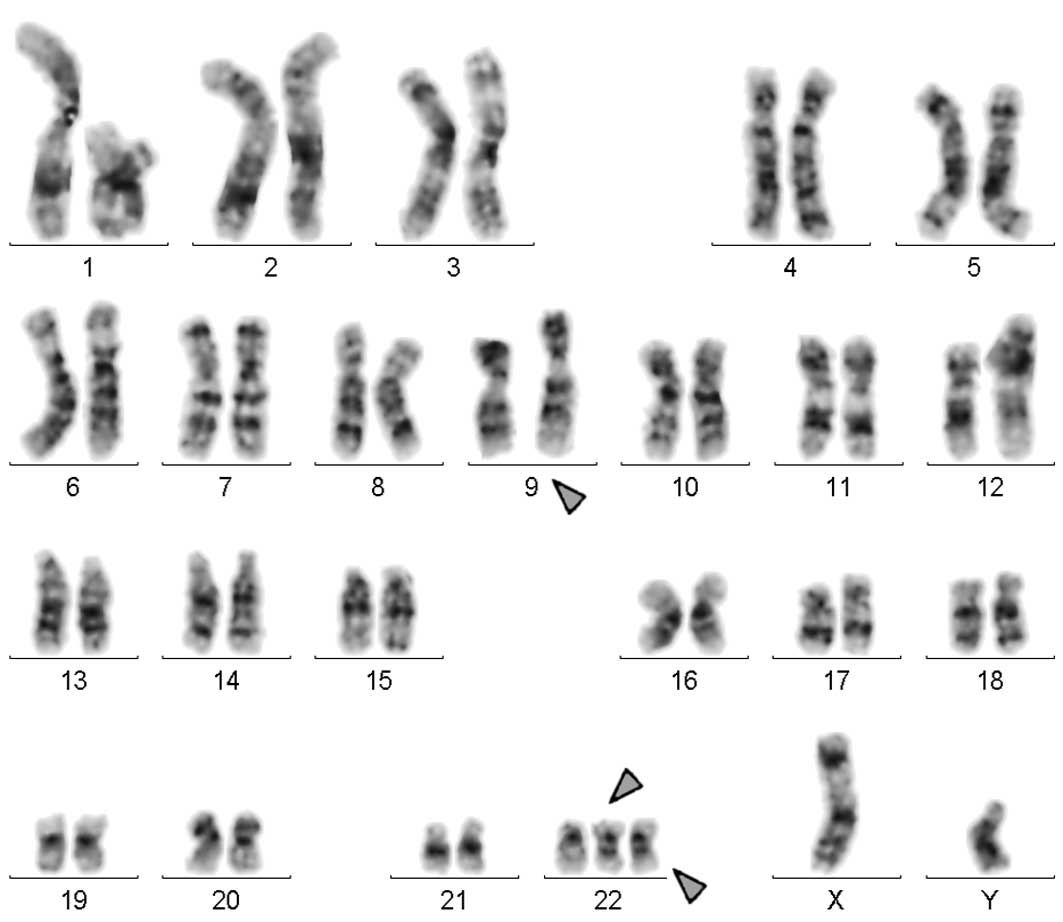
treatment, revealing the following karyotypic changes. A complex
karyotype 47,XY,t(9;22),-22,+der(22)×2[13]/46,XY, t(9;22)[7] was
determined by GTG-banding (Fig. 1)
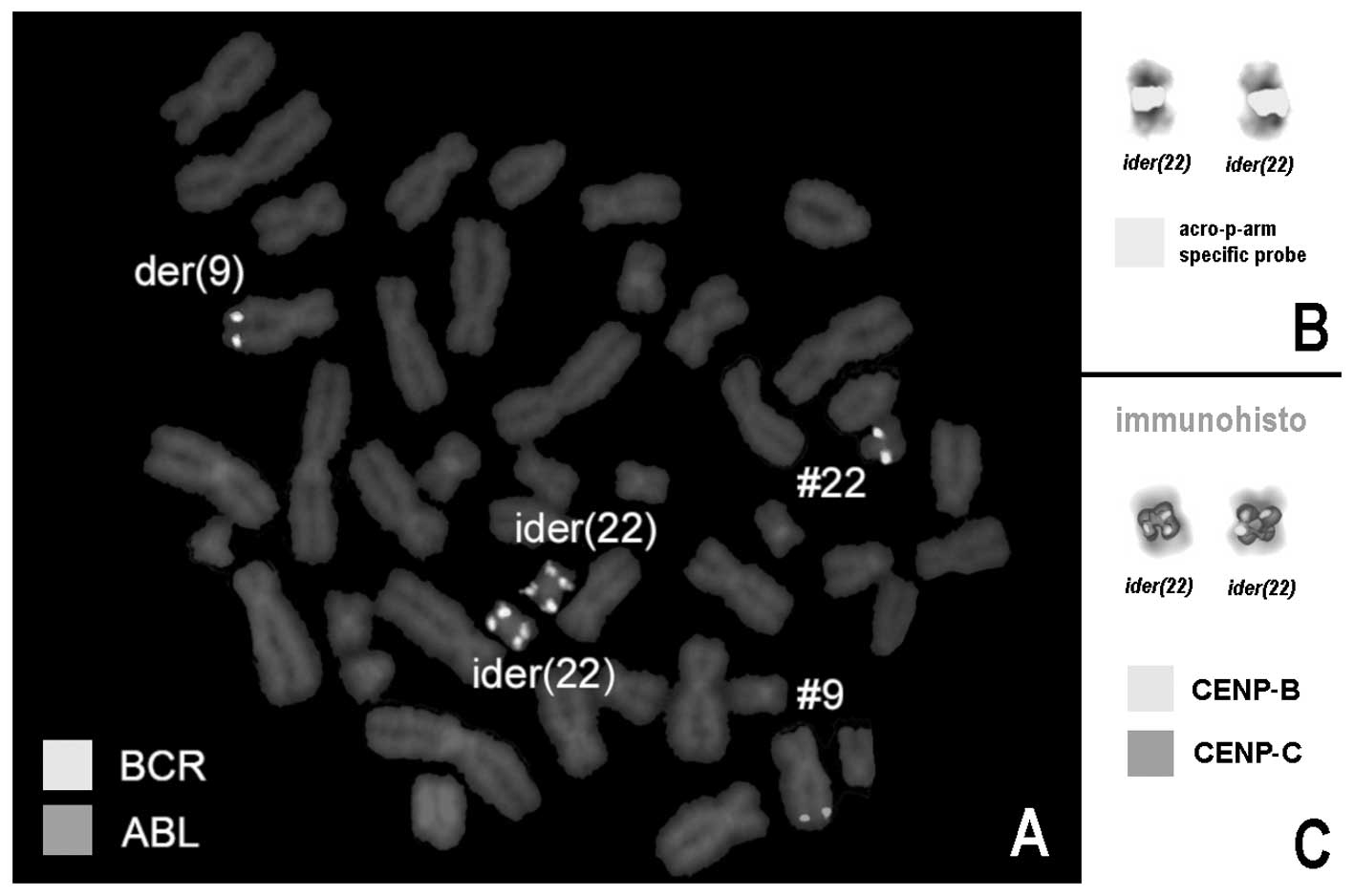
and was further specified by molecular cytogenetic studies
(Fig. 2A and B). Dual-color FISH
using a probe specific to BCR and ABL revealed that two atypical Ph
chromosomes with four BCR-ABL fusion genes were present, i.e.,
there were two isoderivative chromosome 22 [ider(22)] and the final
karyotype obtained was: 47,XY,der(9)t(9;22)(q34.13;q11.23),-22
+der(22)(9qter->9q34.13::22q11.23->22p12∼13::22p12∼13->
22q11.23::9q34.13->9qter) ×2[13]/46,XY,t(9;22)(q34;q11)[7].
RT-PCR analysis of the fusion transcript revealed a
band corresponding to the b3a2 transcript (data not shown).
Immunohistochemistry revealed that the two
centromeres on ider(22) were active (Fig. 2C).
Discussion
According to the literature, reports of idic(Ph)
chromosomes in CML have been infrequent, with most of them formed
as a result of a fusion in the short arm of chromosome 22. From a
cytogenetic viewpoint, idic(Ph) chromosomes formed by fusion at
band q11 have rarely been observed, and have been reported in CML
(4–9) and in acute lymphoblastic leukemia
(ALL) (10).
Idic(Ph) chromosomes appear to be created by fusion
or translocation of double Ph chromosomes (6). Furthermore, in certain cases of CML,
idic(Ph) chromosomes are also duplicated, and double or triple
idic(Ph) chromosomes are found (4,6,7). The
formation of idic(Ph) chromosomes may play a crucial role in the
amplification and heterogeneity of the BCR-ABL gene, leading to
resistance to IM therapy in CML patients (8). However, the resistance can be primary
or secondary (following an initial response). The two types of
resistance occur most frequently in the BC phase of CML (7). Multiple mechanisms of resistance to IM
have been described (10).
Cytogenetic studies often provide evidence of the
progression of disease at an earlier phase than hematological
markers. It is known that the expression of BCR-ABL is elevated in
progenitor cells in the BC phase, compared to the CP phase of CML
(22). While the findings involving
the peripheral blood and bone marrow of the patient were suggestive
of CP CML, given the presence of multiple copies of the idic(Ph)
chromosome, it was possible that cytogenetics indicated the
progression of the disease towards an accelerated phase. Despite
the absence of mutations in the drug-binding site, the presence of
multiple copies of the BCR-ABL oncogene is indicative of a poor
prognosis and higher possibility of resistance to drug treatment
(23).
The causative factor in the formation of
isodicentric chromosomes is unknown. Isodicentric chromosomes may
lead to breakage and reunion cycles during mitosis, potentially
forming ring chromosomes and thus leading to genomic instability
and heterogeneity in the cell population. Furthermore, these
isodicentric chromosomes may be heterogeneous in copy number,
leading to the amplification and duplication of the hybrid BCR-ABL
genes on the idic(Ph) chromosome. Gene amplification and genomic
heterogeneity are known to be associated with drug resistance
(6,24). To the best of our knowledge, no
acquired dicentric chromosome has yet been studied for its
centromeric activity. Notably, in the two ider(22) both centromeres were active.
According to previous studies on inborn dicentrics the two
centromeres are active if a distance between approximately 1.4 and
13 Mb is present; in case of distances larger than 15 Mb one
centromere becomes inactive (20).
The problem of gene amplification and genomic
instability may be overcome by administering higher doses of IM to
patients who develop this subcategory of IM resistance (8). However, if IM is evident in the
etiology of the chromosomal breakpoints, inducing non-random
breakpoints at the subtelomere or telomere region of the
Philadelphia chromosomes, alternative therapies should be
investigated. The elucidation of these specific disease mechanisms
may assist in yielding additional therapies, possibly to be
co-administered with IM (8).
In conclusion, we reported a rare case of
isoderivative Ph chromosome-positive CML in AP, which was further
characterized by FISH and RT-PCR. The patient did not respond to IM
chemotherapy.
Acknowledgements
We thank Professor I. Othman, Director
General of the Atomic Energy Commission of Syria (AECS) and Dr. N.
Mirali, Head of the Molecular Biology and Biotechnology Department
for their support. This study was supported by the AECS and in
parts by the Stefan-Morsch-Stiftung, Monika-Kutzner-Stiftung and
the DAAD (D/07/09624).
References
|
1
|
O’Brien S, Thall PF and Siciliano MJ:
Cytogenetics of chronic myelogeneous leukaemia. Baillieres Clin
Hematol. 10:259–276. 1997.
|
|
2
|
Shtivelman E, Lifshitz B, Gale RP and
Canaani E: Fused transcript of abl and bcr genes in chronic
myelogenous leukemia. Nature. 315:550–554. 1985. View Article : Google Scholar : PubMed/NCBI
|
|
3
|
Anastasi J, Feng J, Le Beau MM, Larson RA,
Rowley JD and Vardiman JW: The relationship between secondary
chromosomal abnormalities and blast transformation in chronic
myelogenous leukemia. Leukemia. 9:628–633. 1995.PubMed/NCBI
|
|
4
|
Whang-Peng J, Knutsen TA and Lee EC:
Dicentric Ph1 chromosome. J Natl Cancer Inst. 51:2009–2012.
1973.
|
|
5
|
Becher R, Ohl S, Schaefer UW, Wendehorst
E, Quiskamp F, Mahmoud HK, Schüning F and Schmidt CG: Clonal
evolution with isodicentric Ph1 chromosome in Ph1-positive CML:
karyotypic conversion after bone marrow transplantation. Blut.
48:247–250. 1984. View Article : Google Scholar : PubMed/NCBI
|
|
6
|
Kovacs G, Georgii A and Mainzer K: Three
isodicentric Philadelphia chromosomes in acute phase of chronic
myeloid leukemia: a case report. Cancer Genet Cytogenet. 20:29–33.
1986. View Article : Google Scholar : PubMed/NCBI
|
|
7
|
Pernice F, Squadrito G, Saitta A, Mazza G
and Musolino C: Isodicentric Philadelphia chromosome in accelerated
phase of chronic myeloid leukemia. Cancer Genet Cytogenet.
66:113–116. 1993. View Article : Google Scholar : PubMed/NCBI
|
|
8
|
Szych CM, Liesveld JL, Iqbal MA, Li L,
Siebert S, Asmus C, O’Malley J, Lee A and Wang N: Isodicentric
Philadelphia chromosomes in imatinib mesylate (Gleevec)-resistant
patients. Cancer Genet Cytogenet. 174:132–137. 2007. View Article : Google Scholar : PubMed/NCBI
|
|
9
|
Li Ming Chua C, Tan YY, Chua SP, Ma HB,
Koay E, Li Min Poon M, Liu TC and Gole L: Multiple copies of a rare
rearrangement of Philadelphia chromosome in a chronic myeloid
leukemia patient: a case report. Cancer Genet Cytogenet. 199:66–68.
2010.PubMed/NCBI
|
|
10
|
Yamamoto K, Nagata K, Morita Y, Inagaki K
and Hamaguchi H: Isodicentric Philadelphia chromosome in acute
lymphoblastic leukemia with der(7;12)(q10;q10). Leuk Res.
31:713–718. 2007. View Article : Google Scholar : PubMed/NCBI
|
|
11
|
Gambacorti-Passerini CB, Gunby RH, Piazza
R, Galietta A, Rostagno R and Scapozza L: Molecular mechanisms of
resistance to imatinib in Philadelphia-chromosome-positive
leukaemias. Lancet Oncol. 4:75–85. 2003. View Article : Google Scholar : PubMed/NCBI
|
|
12
|
O’Brien SG, Guilhot F, Larson RA, Gathmann
I, Baccarani M, Cervantes F, Cornelissen JJ, Fischer T, Hochhaus A,
Hughes T, Lechner K, Nielsen JL, Rousselot P, Reiffers J, Saglio G,
Shepherd J, Simonsson B, Gratwohl A, Goldman JM, Kantarjian H,
Taylor K, Verhoef G, Bolton AE, Capdeville R and Druker BJ; IRIS
Investigators: Imatinib compared with interferon and low-dose
cytarabine for newly diagnosed chronic-phase chronic myeloid
leukemia. N Engl J Med. 348:994–1004. 2003.
|
|
13
|
Kantarjian H, Sawyers C, Hochhaus A,
Guilhot F, Schiffer C, Gambacorti-Passerini C, Niederwieser D,
Resta D, Capdeville R, Zoellner U, Talpaz M and Druker B:
Hematologic and cytogenetic responses to imatinib mesylate in
chronic myelogenous leukemia. N Engl J Med. 346:645–652. 2002.
View Article : Google Scholar : PubMed/NCBI
|
|
14
|
Talpaz M, Silver RT, Druker BJ, Goldman
JM, Gambacorti-Passerini C, Guilhot F, Schiffer CA, Fischer T,
Deininger MWN, Lennard AL, et al: Imatinib induces durable
hematologic and cytogenetic responses in patients with accelerated
phase chronic phase chronic myeloid leukemia: results of a phase 2
study. Blood. 99:1928–1937. 2002. View Article : Google Scholar : PubMed/NCBI
|
|
15
|
Sawyers CL, Hochhaus A, Feldman E, Goldman
JM, Miller CB, Ottmann OG, Schiffer CA, Talpaz M, Guilhot F,
Deininger MWN, et al: Imatinib induces hematologic and cytogenetic
responses in patients with chronic myelogenous leukemia in myeloid
blast crisis: results of a phase II study. Blood. 99:3530–3539.
2002. View Article : Google Scholar : PubMed/NCBI
|
|
16
|
Hochhaus A, Kreil S, Corbin AS, La Rosée
P, Müller MC, Lahaye T, Hanfstein B, Schoch C, Cross NCP, Berger U,
Gschaidmeier H, Druker BJ and Hehlmann R: Molecular and chromosomal
mechanisms of resistance to imatinib (STI571) therapy. Leukemia.
16:2190–2196. 2002. View Article : Google Scholar : PubMed/NCBI
|
|
17
|
Al-Achkar W, Wafa A and Nweder MS: A
complex translocation t(5;9;22) in Philadelphia cells involving the
short arm of chromosome 5 in a case of chronic myelogenous
leukemia. J Exp Clin Cancer Res. 26:411–415. 2007.PubMed/NCBI
|
|
18
|
Shaffer L, Slovak M and Campbell L: ISCN
(2009): An International System for Human Cytogenetic Nomenclature.
S. Karger; Basel: 2009
|
|
19
|
Trifonov V, Seidel J, Starke H, Martina P,
Beensen V, Ziegler M, Hartmann I, Heller A, Nietzel A, Claussen U
and Liehr T: Enlarged chromosome 13 p-arm hiding a cryptic partial
trisomy 6p22.2-pter. Prenat Diagn. 23:427–430. 2003. View Article : Google Scholar : PubMed/NCBI
|
|
20
|
Ewers E, Yoda K, Hamid AB, Weise A,
Manvelyan M and Liehr T: Entromere activity in dicentric small
supernumerary marker chromosomes. Chromosome Res. 18:555–562. 2010.
View Article : Google Scholar : PubMed/NCBI
|
|
21
|
Al-Achkar W, Wafa A, Ali BY, Manvelyan M
and Liehr T: A rare chronic myeloid leukemia case with Philadelphia
chromosome, BCR-ABL e13a3 transcript and complex translocation
involving four different chromosomes. Oncol Lett. 1:797–800.
2010.PubMed/NCBI
|
|
22
|
Barnes DJ, Palaiologou D, Panousopoulou E,
Schultheis B, Yong AS, Wong A, Pattacini L, Goldman JM and Melo JV:
Bcr-Abl expression levels determine the rate of development of
resistance to imatinib mesylate in chronic myeloid leukemia. Cancer
Res. 65:8912–8919. 2005. View Article : Google Scholar : PubMed/NCBI
|
|
23
|
Le Coutre P, Tassi E, Varella-Garcia M,
Barni R, Mologni L, Cabrita G, Marchesi E, Supino R and
Gambacorti-Passerini C: Induction of resistance to the Abelson
inhibitor STI571 in human leukemic cells through gene
amplification. Blood. 95:1758–1766. 2000.PubMed/NCBI
|
|
24
|
Campbell LJ, Patsouris C, Rayeroux KC,
Somana K, Januszewicz EH and Szer J: BCR/ABL amplification in
chronic myelocytic leukemia blast crisis following imatinib
mesylate administration. Cancer Genet Cytogent. 139:30–33. 2002.
View Article : Google Scholar : PubMed/NCBI
|