Spandidos Publications Logo
  • About
    • About Spandidos
    • Aims and Scopes
    • Abstracting and Indexing
    • Editorial Policies
    • Reprints and Permissions
    • Job Opportunities
    • Terms and Conditions
    • Contact
  • Journals
    • All Journals
    • Oncology Letters
      • Oncology Letters
      • Information for Authors
      • Editorial Policies
      • Editorial Board
      • Aims and Scope
      • Abstracting and Indexing
      • Bibliographic Information
      • Archive
    • International Journal of Oncology
      • International Journal of Oncology
      • Information for Authors
      • Editorial Policies
      • Editorial Board
      • Aims and Scope
      • Abstracting and Indexing
      • Bibliographic Information
      • Archive
    • Molecular and Clinical Oncology
      • Molecular and Clinical Oncology
      • Information for Authors
      • Editorial Policies
      • Editorial Board
      • Aims and Scope
      • Abstracting and Indexing
      • Bibliographic Information
      • Archive
    • Experimental and Therapeutic Medicine
      • Experimental and Therapeutic Medicine
      • Information for Authors
      • Editorial Policies
      • Editorial Board
      • Aims and Scope
      • Abstracting and Indexing
      • Bibliographic Information
      • Archive
    • International Journal of Molecular Medicine
      • International Journal of Molecular Medicine
      • Information for Authors
      • Editorial Policies
      • Editorial Board
      • Aims and Scope
      • Abstracting and Indexing
      • Bibliographic Information
      • Archive
    • Biomedical Reports
      • Biomedical Reports
      • Information for Authors
      • Editorial Policies
      • Editorial Board
      • Aims and Scope
      • Abstracting and Indexing
      • Bibliographic Information
      • Archive
    • Oncology Reports
      • Oncology Reports
      • Information for Authors
      • Editorial Policies
      • Editorial Board
      • Aims and Scope
      • Abstracting and Indexing
      • Bibliographic Information
      • Archive
    • Molecular Medicine Reports
      • Molecular Medicine Reports
      • Information for Authors
      • Editorial Policies
      • Editorial Board
      • Aims and Scope
      • Abstracting and Indexing
      • Bibliographic Information
      • Archive
    • World Academy of Sciences Journal
      • World Academy of Sciences Journal
      • Information for Authors
      • Editorial Policies
      • Editorial Board
      • Aims and Scope
      • Abstracting and Indexing
      • Bibliographic Information
      • Archive
    • International Journal of Functional Nutrition
      • International Journal of Functional Nutrition
      • Information for Authors
      • Editorial Policies
      • Editorial Board
      • Aims and Scope
      • Abstracting and Indexing
      • Bibliographic Information
      • Archive
    • International Journal of Epigenetics
      • International Journal of Epigenetics
      • Information for Authors
      • Editorial Policies
      • Editorial Board
      • Aims and Scope
      • Abstracting and Indexing
      • Bibliographic Information
      • Archive
    • Medicine International
      • Medicine International
      • Information for Authors
      • Editorial Policies
      • Editorial Board
      • Aims and Scope
      • Abstracting and Indexing
      • Bibliographic Information
      • Archive
  • Articles
  • Information
    • Information for Authors
    • Information for Reviewers
    • Information for Librarians
    • Information for Advertisers
    • Conferences
  • Language Editing
Spandidos Publications Logo
  • About
    • About Spandidos
    • Aims and Scopes
    • Abstracting and Indexing
    • Editorial Policies
    • Reprints and Permissions
    • Job Opportunities
    • Terms and Conditions
    • Contact
  • Journals
    • All Journals
    • Biomedical Reports
      • Information for Authors
      • Editorial Policies
      • Editorial Board
      • Aims and Scope
      • Abstracting and Indexing
      • Bibliographic Information
      • Archive
    • Experimental and Therapeutic Medicine
      • Information for Authors
      • Editorial Policies
      • Editorial Board
      • Aims and Scope
      • Abstracting and Indexing
      • Bibliographic Information
      • Archive
    • International Journal of Epigenetics
      • Information for Authors
      • Editorial Policies
      • Editorial Board
      • Aims and Scope
      • Abstracting and Indexing
      • Bibliographic Information
      • Archive
    • International Journal of Functional Nutrition
      • Information for Authors
      • Editorial Policies
      • Editorial Board
      • Aims and Scope
      • Abstracting and Indexing
      • Bibliographic Information
      • Archive
    • International Journal of Molecular Medicine
      • Information for Authors
      • Editorial Policies
      • Editorial Board
      • Aims and Scope
      • Abstracting and Indexing
      • Bibliographic Information
      • Archive
    • International Journal of Oncology
      • Information for Authors
      • Editorial Policies
      • Editorial Board
      • Aims and Scope
      • Abstracting and Indexing
      • Bibliographic Information
      • Archive
    • Medicine International
      • Information for Authors
      • Editorial Policies
      • Editorial Board
      • Aims and Scope
      • Abstracting and Indexing
      • Bibliographic Information
      • Archive
    • Molecular and Clinical Oncology
      • Information for Authors
      • Editorial Policies
      • Editorial Board
      • Aims and Scope
      • Abstracting and Indexing
      • Bibliographic Information
      • Archive
    • Molecular Medicine Reports
      • Information for Authors
      • Editorial Policies
      • Editorial Board
      • Aims and Scope
      • Abstracting and Indexing
      • Bibliographic Information
      • Archive
    • Oncology Letters
      • Information for Authors
      • Editorial Policies
      • Editorial Board
      • Aims and Scope
      • Abstracting and Indexing
      • Bibliographic Information
      • Archive
    • Oncology Reports
      • Information for Authors
      • Editorial Policies
      • Editorial Board
      • Aims and Scope
      • Abstracting and Indexing
      • Bibliographic Information
      • Archive
    • World Academy of Sciences Journal
      • Information for Authors
      • Editorial Policies
      • Editorial Board
      • Aims and Scope
      • Abstracting and Indexing
      • Bibliographic Information
      • Archive
  • Articles
  • Information
    • For Authors
    • For Reviewers
    • For Librarians
    • For Advertisers
    • Conferences
  • Language Editing
Login Register Submit
  • This site uses cookies
  • You can change your cookie settings at any time by following the instructions in our Cookie Policy. To find out more, you may read our Privacy Policy.

    I agree
Search articles by DOI, keyword, author or affiliation
Search
Advanced Search
presentation
Oncology Letters
Join Editorial Board Propose a Special Issue
Print ISSN: 1792-1074 Online ISSN: 1792-1082
Journal Cover
September 2013 Volume 6 Issue 3

Full Size Image

Sign up for eToc alerts
Recommend to Library

Journals

International Journal of Molecular Medicine

International Journal of Molecular Medicine

International Journal of Molecular Medicine is an international journal devoted to molecular mechanisms of human disease.

International Journal of Oncology

International Journal of Oncology

International Journal of Oncology is an international journal devoted to oncology research and cancer treatment.

Molecular Medicine Reports

Molecular Medicine Reports

Covers molecular medicine topics such as pharmacology, pathology, genetics, neuroscience, infectious diseases, molecular cardiology, and molecular surgery.

Oncology Reports

Oncology Reports

Oncology Reports is an international journal devoted to fundamental and applied research in Oncology.

Experimental and Therapeutic Medicine

Experimental and Therapeutic Medicine

Experimental and Therapeutic Medicine is an international journal devoted to laboratory and clinical medicine.

Oncology Letters

Oncology Letters

Oncology Letters is an international journal devoted to Experimental and Clinical Oncology.

Biomedical Reports

Biomedical Reports

Explores a wide range of biological and medical fields, including pharmacology, genetics, microbiology, neuroscience, and molecular cardiology.

Molecular and Clinical Oncology

Molecular and Clinical Oncology

International journal addressing all aspects of oncology research, from tumorigenesis and oncogenes to chemotherapy and metastasis.

World Academy of Sciences Journal

World Academy of Sciences Journal

Multidisciplinary open-access journal spanning biochemistry, genetics, neuroscience, environmental health, and synthetic biology.

International Journal of Functional Nutrition

International Journal of Functional Nutrition

Open-access journal combining biochemistry, pharmacology, immunology, and genetics to advance health through functional nutrition.

International Journal of Epigenetics

International Journal of Epigenetics

Publishes open-access research on using epigenetics to advance understanding and treatment of human disease.

Medicine International

Medicine International

An International Open Access Journal Devoted to General Medicine.

Journal Cover
September 2013 Volume 6 Issue 3

Full Size Image

Sign up for eToc alerts
Recommend to Library

  • Article
  • Citations
    • Cite This Article
    • Download Citation
    • Create Citation Alert
    • Remove Citation Alert
    • Cited By
  • Similar Articles
    • Related Articles (in Spandidos Publications)
    • Similar Articles (Google Scholar)
    • Similar Articles (PubMed)
  • Download PDF
  • Download XML
  • View XML
Case Report

A novel BRCA1 mutation in a patient with breast and ovarian cancer: A case report

  • Authors:
    • Josefa Salgado
    • Marta Santisteban
    • Cristina Gutiérrez
    • Carmen Gil
    • Maitane Robles
    • Adriana Viedma
    • Ana Patiño-García
  • View Affiliations / Copyright

    Affiliations: Clinical Genetics Unit, University Clinic of Navarra (CUN), Pamplona, Navarra 31008, Spain, Department of Oncology, University Clinic of Navarra (CUN), Pamplona, Navarra 31008, Spain
  • Pages: 725-727
    |
    Published online on: July 3, 2013
       https://doi.org/10.3892/ol.2013.1440
  • Expand metrics +
Metrics: Total Views: 0 (Spandidos Publications: | PMC Statistics: )
Metrics: Total PDF Downloads: 0 (Spandidos Publications: | PMC Statistics: )
Cited By (CrossRef): 0 citations Loading Articles...

This article is mentioned in:


Abstract

Germline mutations in the human breast cancer genes BRCA1 and BRCA2 account for a substantial proportion of familial, early-onset breast and ovarian cancers. The present study reports a novel disease-causing BRCA1 mutation, nucleotide 3020insCT/c.2901insCT, in a 55-year-old Spanish female with breast and ovarian cancer. This frameshift mutation creates a premature stop codon at amino acid 1000, leading to a truncated BRCA1 protein. To the best of our knowledge, this mutation has not been previously described in the Breast Cancer Information Core (BIC) database or the published literature.

Introduction

Hereditary breast and ovarian cancer (HBOC) is an autosomal dominant syndrome with incomplete penetrance. The two most commonly mutated genes in HBOC are BRCA1 and BRCA2, which are essential components of the double-strand break repair system (1). Almost 3,500 cancer-associated mutations, scattered throughout the two genes, have so far been reported in the Breast Cancer Information Core (BIC) database (http://research.nhgri.nih.gov/bic/). The present study reports a new germline nucleotide 3020insCT/c.2901insCT mutation detected in the BRCA1 gene. In general, germline mutations in known breast cancer risk genes account for ~20% of breast cancers associated with a family history. It is therefore crucial to identify these individuals to offer appropriate cancer management and understand the contribution of BRCA1 and BRCA2 mutation-associated risks.

Case report

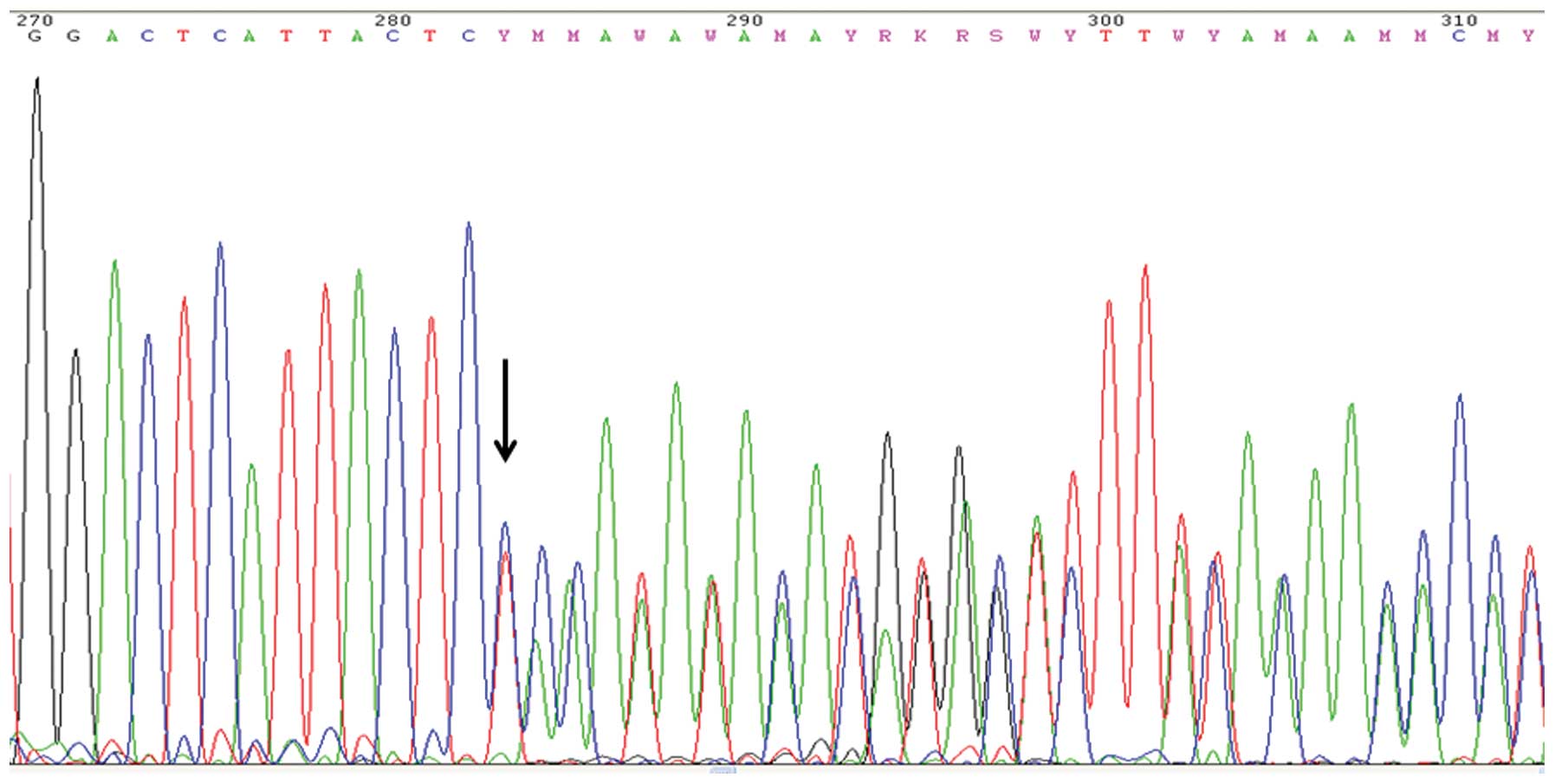
A 55-year-old non-Ashkenazi Spanish female diagnosed with breast cancer (at 51 years old) and ovarian cancer (at 55 years old) and treated at the University Clinic of Navarra (CUN; Pamplona, Navarra, Spain), was transferred to the genetic counseling unit. The clinical history of the patient lead us to consider the possibility of HBOC syndrome. Following verbal and written informed consent, genomic DNA was extracted from a peripheral blood sample and the BRCA1 and BRCA2 genes were sequenced on an automated analyzer (ABI PRISM® 3130XL; Applied Biosystems, Foster City, CA, USA). The results were compared to the consensus wild-type sequences (Genbank NM_007294.2 for BRCA1 and Genbank NM_000059.1 for BRCA2). A 3020insCT/c.2901insCT frameshift mutation was identified in exon 11 of BRCA1 (Fig. 1). The insertion was confirmed by repeated analyses including reverse-primer sequencing. A BRCA1-Multiplex Ligation-dependent Probe Amplification (MLPA) analysis was performed, in order to investigate whether the mutation was able to lead to an exon rearrangement. The results indicated that none of the BRCA1 alleles showed deletion and/or duplication (results not shown).

Figure 1

Chromatogram of breast cancer (BRCA)1 exon 11 showing the 3020insCT/c.2901insCT in the heterozygous state (arrow) in the peripheral blood of the patient.

Genetic analysis was recommended to the only other individual at risk in patient’s family, namely the twin sister, and the analysis showed that she did not carry the mutation.

Discussion

A 3020insCT/c.2901insCT frameshift mutation in exon 11 of the BRCA1, which has yet to be reported in the BIC database, was detected in a 55-year-old non-Ashkenazi Spanish female diagnosed with breast and ovarian cancer. Since other family members were not available for genetic analysis, the segregation of the mutation could not be established. From the literature available, it may be deduced that the mutation leads to the deletion of the coiled-coil domain and BRCA1 C terminus (BRCT) domains of the BRCA1 protein. The coiled-coil region is critical for transcriptional activation through its interaction with the basic leucine zipper (bZIP) domain of the JunB protein. In vitro and in vivo experiments suggest that this BRCA1-JunB interaction is particularly important for the suppression of ovarian cancer (2). The lack of the coiled-coil domain in the present patient may have been closely correlated with the development of the ovarian cancer. However, BRCA1 has a pivotal function within the BRCA1-associated genome surveillance complex through the coordination of the actions of damage-sensing and executive repair proteins. Solyom et al(3) showed that the Abraxas protein serves as a central organizer of a large BRCA1 holoenzyme complex. Abraxas directly binds, via its phosphorylated C terminus, to the BRCA1 BRCT motifs, linking BRCA1 to a core protein complex dedicated to ubiquitin chain recognition and hydrolysis at DNA double-strand breaks (3,4). Moreover, BRCT domains in BRCA1 are able to bind DNA strand breaks and ends in vitro, which is enhanced by the formation of the BRCA1-BARD1 heterodimer (5). The structural studies of Kobayashi et al showed that the BRCT domain partially inserts into the major groove and makes extensive contacts with the DNA backbone (6), suggesting the possibility that proteins with BRCT domains may act as DNA sensors and transducers of DNA damage response signaling. The mutation identified in the present study would markedly compromise these functions, with profound biological consequences. The premature stop codon at amino acid 1000 leads to a truncated protein that has 70% of its normal length. The advantage of having mutant BRCA1 human breast cancer cell lines is that the impact of pathogenic human mutations may be evaluated in the context of a human genetic background. A previous study of 41 human breast cancer cell lines identified a BRCA1 mutant cell line, SUM149PT, with a nucleotide deletion at position 2288 (7). The resulting truncated BRCA1 protein lacked the C-terminal BRCT and coiled-coil domains similar to the present patient. Nuclear BRCA1 protein expression was not detectable in the cell line, therefore corroborating the tumor suppressor function of BRCA1 and the pathogenicity of the mutation.

The next step was to search for bibliographic evidence of the present mutation in BRCA1-knockout animal models. The homozygous loss of BRCA1 generally leads to early embryonic lethality, although it is possible to extend the viability though the removal of p53 function. Among the range of models available, McCarthy et al designed truncated human BRCA1f22-24/p53+/− mice (harboring the second BRCT domain), that develop estrogen receptor-negative (ER−) and progesterone receptor-negative (PR−) tumors lacking HER2 protein overexpression and gene amplification (8). This phenotype is similar to 64–90% of human BRCA1-mutation breast cancers, so called ‘triple negative’ breast cancers. The immunophenotypic features of the present patient’s tumor indicated a noticeably different pattern, being ER+, PR+ and ErbB2-negative. It has been reported that 10–36% of BRCA1 mutation-related invasive breast cancers are, in fact, ER+. Furthermore, BRCA1 mutation carriers who are older or post-menopausal at the time of the diagnosis of breast cancer are more likely to have an ER+ breast cancer (9,10). With regard to the origin of these ER+BRCA1-related breast cancers, Lim et al observed the expansion of a committed luminal progenitor population, containing ER+ and ER− cells, in preneoplastic tissues of BRCA1 mutation carriers and proposed the luminal progenitor cells as the cell of origin for BRCA1-associated cancers (11). In mouse models with the deletion of BRCA1, the expression of ER in the resulting tumors appears to depend on whether BRCA1 is deleted at an earlier or later stage of cell differentiation (12–14). These studies suggest that BRCA1-deficient ER+ tumors may derive from BRCA1 loss in an ER+ luminal progenitor cell.

Another key point is the therapeutic approach for ER+BRCA1-associated breast cancers. Given the availability of effective therapies that exploit defects in homologous recombination, such as PARP-1 inhibitors and cisplatin, it is increasingly important to determine whether these therapies are likely to be effective in ER+BRCA1-mutant cancers. A recent study by Kaplan et al indicated that ER+BRCA1-related breast cancers are indistinguishable from ER−BRCA1-related cancers in their nuclear expression of PARP-1, suggesting that ER+BRCA1-related breast cancers may respond well to drugs that exploit BRCA1 deficiency (15). ER+BRCA1-related breast cancers appear to be a unique group and efforts should be made to identify the individuals for whom estrogen-modifying agents are likely to be particularly effective.

Acknowledgements

The authors are grateful to all patients and their families.

References

1 

Narod SA and Foulkes WD: BRCA1 and BRCA2: 1994 and beyond. Nat Rev Cancer. 4:665–676. 2004. View Article : Google Scholar : PubMed/NCBI

2 

Hu YF and Li R: JunB potentiates function of BRCA1 activation domain 1 (AD1) through a coiled-coil-mediated interaction. Genes Dev. 16:1509–1517. 2002. View Article : Google Scholar : PubMed/NCBI

3 

Solyom S, Aressy B, Pylkäs K, et al: Breast cancer-associated abraxas mutation disrupts nuclear localization and DNA damage response functions. Sci Transl Med. 4:122–123. 2012.PubMed/NCBI

4 

Wang B, Matsuoka S, Ballif BA, et al: Abraxas and RAP80 form a BRCA1 protein complex required for the DNA damage response. Science. 316:1194–1198. 2007. View Article : Google Scholar : PubMed/NCBI

5 

Simons AM, Horwitz AA, Starita LM, et al: BRCA1 DNA-binding activity is stimulated by BARD1. Cancer Res. 66:2012–2018. 2006. View Article : Google Scholar : PubMed/NCBI

6 

Kobayashi M, Ab E, Bonvin AM and Siegal G: Structure of the DNA-bound BRCA1 C-terminal region from human replication factor C p140 and model of the protein-DNA complex. J Biol Chem. 285:10087–10097. 2010. View Article : Google Scholar : PubMed/NCBI

7 

Elstrodt F, Hollestelle A, Nagel JH, et al: BRCA1 mutation analysis of 41 human breast cancer cell lines reveals three new deleterious mutants. Cancer Res. 66:41–45. 2006. View Article : Google Scholar : PubMed/NCBI

8 

McCarthy A, Savage K, Gabriel A, Naceur C, Reis-Filho JS and Ashworth A: A mouse model of basal-like breast carcinoma with metaplastic elements. J Pathol. 211:389–398. 2007. View Article : Google Scholar : PubMed/NCBI

9 

Foulkes WD, Metcalfe K, Sun P, et al: Estrogen receptor status in BRCA1- and BRCA2-related breast cancer: The influence of age, grade, and histological type. Clin Cancer Res. 10:2029–2034. 2004. View Article : Google Scholar : PubMed/NCBI

10 

Tung N, Wang Y, Collins LC, et al: Estrogen receptor positive breast cancers in BRCA1 mutation carriers: Clinical risk factors and pathologic features. Breast Cancer Res. 12:R122010. View Article : Google Scholar : PubMed/NCBI

11 

Lim E, Vaillant F, Wu D, et al: Aberrant luminal progenitors as the candidate target population for basal tumor development in BRCA1 mutation carriers. Nat Med. 15:907–913. 2009. View Article : Google Scholar : PubMed/NCBI

12 

Poole AJ, Li Y, Kim Y, Lin SC, Lee WH and Lee EY: Prevention of Brca1-mediated mammary tumorigenesis in mice by a progesterone antagonist. Science. 314:1467–1470. 2006. View Article : Google Scholar : PubMed/NCBI

13 

Liu S, Ginestier C, Charafe-Jauffret E, et al: BRCA1 regulates human mammary stem/progenitor cell fate. Proc Natl Acad Sci USA. 105:1680–1685. 2008. View Article : Google Scholar : PubMed/NCBI

14 

Ginestier C, Liu S and Wicha MS: Getting to the root of BRCA1-deficient breast cancer. Cell Stem Cell. 5:229–230. 2009. View Article : Google Scholar : PubMed/NCBI

15 

Kaplan JS, Schnitt SJ, Collins LC, et al: Pathologic features and immunophenotype of estrogen receptor-positive breast cancers in BRCA1 mutation carriers. Am J Surg Pathol. 36:1483–1488. 2012. View Article : Google Scholar : PubMed/NCBI

Related Articles

  • Abstract
  • View
  • Download
  • Twitter
Copy and paste a formatted citation
Spandidos Publications style
Salgado J, Santisteban M, Gutiérrez C, Gil C, Robles M, Viedma A and Patiño-García A: A novel BRCA1 mutation in a patient with breast and ovarian cancer: A case report. Oncol Lett 6: 725-727, 2013.
APA
Salgado, J., Santisteban, M., Gutiérrez, C., Gil, C., Robles, M., Viedma, A., & Patiño-García, A. (2013). A novel BRCA1 mutation in a patient with breast and ovarian cancer: A case report. Oncology Letters, 6, 725-727. https://doi.org/10.3892/ol.2013.1440
MLA
Salgado, J., Santisteban, M., Gutiérrez, C., Gil, C., Robles, M., Viedma, A., Patiño-García, A."A novel BRCA1 mutation in a patient with breast and ovarian cancer: A case report". Oncology Letters 6.3 (2013): 725-727.
Chicago
Salgado, J., Santisteban, M., Gutiérrez, C., Gil, C., Robles, M., Viedma, A., Patiño-García, A."A novel BRCA1 mutation in a patient with breast and ovarian cancer: A case report". Oncology Letters 6, no. 3 (2013): 725-727. https://doi.org/10.3892/ol.2013.1440
Copy and paste a formatted citation
x
Spandidos Publications style
Salgado J, Santisteban M, Gutiérrez C, Gil C, Robles M, Viedma A and Patiño-García A: A novel BRCA1 mutation in a patient with breast and ovarian cancer: A case report. Oncol Lett 6: 725-727, 2013.
APA
Salgado, J., Santisteban, M., Gutiérrez, C., Gil, C., Robles, M., Viedma, A., & Patiño-García, A. (2013). A novel BRCA1 mutation in a patient with breast and ovarian cancer: A case report. Oncology Letters, 6, 725-727. https://doi.org/10.3892/ol.2013.1440
MLA
Salgado, J., Santisteban, M., Gutiérrez, C., Gil, C., Robles, M., Viedma, A., Patiño-García, A."A novel BRCA1 mutation in a patient with breast and ovarian cancer: A case report". Oncology Letters 6.3 (2013): 725-727.
Chicago
Salgado, J., Santisteban, M., Gutiérrez, C., Gil, C., Robles, M., Viedma, A., Patiño-García, A."A novel BRCA1 mutation in a patient with breast and ovarian cancer: A case report". Oncology Letters 6, no. 3 (2013): 725-727. https://doi.org/10.3892/ol.2013.1440
Follow us
  • Twitter
  • LinkedIn
  • Facebook
About
  • Spandidos Publications
  • Careers
  • Cookie Policy
  • Privacy Policy
How can we help?
  • Help
  • Live Chat
  • Contact
  • Email to our Support Team