Spandidos Publications Logo
  • About
    • About Spandidos
    • Aims and Scopes
    • Abstracting and Indexing
    • Editorial Policies
    • Reprints and Permissions
    • Job Opportunities
    • Terms and Conditions
    • Contact
  • Journals
    • All Journals
    • Oncology Letters
      • Oncology Letters
      • Information for Authors
      • Editorial Policies
      • Editorial Board
      • Aims and Scope
      • Abstracting and Indexing
      • Bibliographic Information
      • Archive
    • International Journal of Oncology
      • International Journal of Oncology
      • Information for Authors
      • Editorial Policies
      • Editorial Board
      • Aims and Scope
      • Abstracting and Indexing
      • Bibliographic Information
      • Archive
    • Molecular and Clinical Oncology
      • Molecular and Clinical Oncology
      • Information for Authors
      • Editorial Policies
      • Editorial Board
      • Aims and Scope
      • Abstracting and Indexing
      • Bibliographic Information
      • Archive
    • Experimental and Therapeutic Medicine
      • Experimental and Therapeutic Medicine
      • Information for Authors
      • Editorial Policies
      • Editorial Board
      • Aims and Scope
      • Abstracting and Indexing
      • Bibliographic Information
      • Archive
    • International Journal of Molecular Medicine
      • International Journal of Molecular Medicine
      • Information for Authors
      • Editorial Policies
      • Editorial Board
      • Aims and Scope
      • Abstracting and Indexing
      • Bibliographic Information
      • Archive
    • Biomedical Reports
      • Biomedical Reports
      • Information for Authors
      • Editorial Policies
      • Editorial Board
      • Aims and Scope
      • Abstracting and Indexing
      • Bibliographic Information
      • Archive
    • Oncology Reports
      • Oncology Reports
      • Information for Authors
      • Editorial Policies
      • Editorial Board
      • Aims and Scope
      • Abstracting and Indexing
      • Bibliographic Information
      • Archive
    • Molecular Medicine Reports
      • Molecular Medicine Reports
      • Information for Authors
      • Editorial Policies
      • Editorial Board
      • Aims and Scope
      • Abstracting and Indexing
      • Bibliographic Information
      • Archive
    • World Academy of Sciences Journal
      • World Academy of Sciences Journal
      • Information for Authors
      • Editorial Policies
      • Editorial Board
      • Aims and Scope
      • Abstracting and Indexing
      • Bibliographic Information
      • Archive
    • International Journal of Functional Nutrition
      • International Journal of Functional Nutrition
      • Information for Authors
      • Editorial Policies
      • Editorial Board
      • Aims and Scope
      • Abstracting and Indexing
      • Bibliographic Information
      • Archive
    • International Journal of Epigenetics
      • International Journal of Epigenetics
      • Information for Authors
      • Editorial Policies
      • Editorial Board
      • Aims and Scope
      • Abstracting and Indexing
      • Bibliographic Information
      • Archive
    • Medicine International
      • Medicine International
      • Information for Authors
      • Editorial Policies
      • Editorial Board
      • Aims and Scope
      • Abstracting and Indexing
      • Bibliographic Information
      • Archive
  • Articles
  • Information
    • Information for Authors
    • Information for Reviewers
    • Information for Librarians
    • Information for Advertisers
    • Conferences
  • Language Editing
Spandidos Publications Logo
  • About
    • About Spandidos
    • Aims and Scopes
    • Abstracting and Indexing
    • Editorial Policies
    • Reprints and Permissions
    • Job Opportunities
    • Terms and Conditions
    • Contact
  • Journals
    • All Journals
    • Biomedical Reports
      • Information for Authors
      • Editorial Policies
      • Editorial Board
      • Aims and Scope
      • Abstracting and Indexing
      • Bibliographic Information
      • Archive
    • Experimental and Therapeutic Medicine
      • Information for Authors
      • Editorial Policies
      • Editorial Board
      • Aims and Scope
      • Abstracting and Indexing
      • Bibliographic Information
      • Archive
    • International Journal of Epigenetics
      • Information for Authors
      • Editorial Policies
      • Editorial Board
      • Aims and Scope
      • Abstracting and Indexing
      • Bibliographic Information
      • Archive
    • International Journal of Functional Nutrition
      • Information for Authors
      • Editorial Policies
      • Editorial Board
      • Aims and Scope
      • Abstracting and Indexing
      • Bibliographic Information
      • Archive
    • International Journal of Molecular Medicine
      • Information for Authors
      • Editorial Policies
      • Editorial Board
      • Aims and Scope
      • Abstracting and Indexing
      • Bibliographic Information
      • Archive
    • International Journal of Oncology
      • Information for Authors
      • Editorial Policies
      • Editorial Board
      • Aims and Scope
      • Abstracting and Indexing
      • Bibliographic Information
      • Archive
    • Medicine International
      • Information for Authors
      • Editorial Policies
      • Editorial Board
      • Aims and Scope
      • Abstracting and Indexing
      • Bibliographic Information
      • Archive
    • Molecular and Clinical Oncology
      • Information for Authors
      • Editorial Policies
      • Editorial Board
      • Aims and Scope
      • Abstracting and Indexing
      • Bibliographic Information
      • Archive
    • Molecular Medicine Reports
      • Information for Authors
      • Editorial Policies
      • Editorial Board
      • Aims and Scope
      • Abstracting and Indexing
      • Bibliographic Information
      • Archive
    • Oncology Letters
      • Information for Authors
      • Editorial Policies
      • Editorial Board
      • Aims and Scope
      • Abstracting and Indexing
      • Bibliographic Information
      • Archive
    • Oncology Reports
      • Information for Authors
      • Editorial Policies
      • Editorial Board
      • Aims and Scope
      • Abstracting and Indexing
      • Bibliographic Information
      • Archive
    • World Academy of Sciences Journal
      • Information for Authors
      • Editorial Policies
      • Editorial Board
      • Aims and Scope
      • Abstracting and Indexing
      • Bibliographic Information
      • Archive
  • Articles
  • Information
    • For Authors
    • For Reviewers
    • For Librarians
    • For Advertisers
    • Conferences
  • Language Editing
Login Register Submit
  • This site uses cookies
  • You can change your cookie settings at any time by following the instructions in our Cookie Policy. To find out more, you may read our Privacy Policy.

    I agree
Search articles by DOI, keyword, author or affiliation
Search
Advanced Search
presentation
Oncology Letters
Join Editorial Board Propose a Special Issue
Print ISSN: 1792-1074 Online ISSN: 1792-1082
Journal Cover
November 2013 Volume 6 Issue 5

Full Size Image

Sign up for eToc alerts
Recommend to Library

Journals

International Journal of Molecular Medicine

International Journal of Molecular Medicine

International Journal of Molecular Medicine is an international journal devoted to molecular mechanisms of human disease.

International Journal of Oncology

International Journal of Oncology

International Journal of Oncology is an international journal devoted to oncology research and cancer treatment.

Molecular Medicine Reports

Molecular Medicine Reports

Covers molecular medicine topics such as pharmacology, pathology, genetics, neuroscience, infectious diseases, molecular cardiology, and molecular surgery.

Oncology Reports

Oncology Reports

Oncology Reports is an international journal devoted to fundamental and applied research in Oncology.

Experimental and Therapeutic Medicine

Experimental and Therapeutic Medicine

Experimental and Therapeutic Medicine is an international journal devoted to laboratory and clinical medicine.

Oncology Letters

Oncology Letters

Oncology Letters is an international journal devoted to Experimental and Clinical Oncology.

Biomedical Reports

Biomedical Reports

Explores a wide range of biological and medical fields, including pharmacology, genetics, microbiology, neuroscience, and molecular cardiology.

Molecular and Clinical Oncology

Molecular and Clinical Oncology

International journal addressing all aspects of oncology research, from tumorigenesis and oncogenes to chemotherapy and metastasis.

World Academy of Sciences Journal

World Academy of Sciences Journal

Multidisciplinary open-access journal spanning biochemistry, genetics, neuroscience, environmental health, and synthetic biology.

International Journal of Functional Nutrition

International Journal of Functional Nutrition

Open-access journal combining biochemistry, pharmacology, immunology, and genetics to advance health through functional nutrition.

International Journal of Epigenetics

International Journal of Epigenetics

Publishes open-access research on using epigenetics to advance understanding and treatment of human disease.

Medicine International

Medicine International

An International Open Access Journal Devoted to General Medicine.

Journal Cover
November 2013 Volume 6 Issue 5

Full Size Image

Sign up for eToc alerts
Recommend to Library

  • Article
  • Citations
    • Cite This Article
    • Download Citation
    • Create Citation Alert
    • Remove Citation Alert
    • Cited By
  • Similar Articles
    • Related Articles (in Spandidos Publications)
    • Similar Articles (Google Scholar)
    • Similar Articles (PubMed)
  • Download PDF
  • Download XML
  • View XML
Article

KRAS mutational status analysis of peripheral blood isolated circulating tumor cells in metastatic colorectal patients

  • Authors:
    • Cristina Gutiérrez
    • Javier Rodriguez
    • Ana Patiño-García
    • Jesús García-Foncillas
    • Josefa Salgado
  • View Affiliations / Copyright

    Affiliations: Clinical Genetics Unit, University Clinic of Navarra, Pamplona, Navarra 31008, Spain, Department of Oncology, University Clinic of Navarra, Pamplona, Navarra 31008, Spain, Jiménez Díaz Foundation, Madrid 28040, Spain
  • Pages: 1343-1345
    |
    Published online on: August 23, 2013
       https://doi.org/10.3892/ol.2013.1544
  • Expand metrics +
Metrics: Total Views: 0 (Spandidos Publications: | PMC Statistics: )
Metrics: Total PDF Downloads: 0 (Spandidos Publications: | PMC Statistics: )
Cited By (CrossRef): 0 citations Loading Articles...

This article is mentioned in:


Abstract

The present study describes an optimized method for isolating peripheral blood circulating tumor cells (CTCs) and performing KRAS mutation analysis. The approach combines isolation of peripheral blood mononuclear cells and immunomagnetic labeling with CD45 and CD326 human microbeads with KRAS analysis performed with a Therascreen KRAS kit by quantitative PCR. KRAS mutations were detected in the CTCs of patients with metastatic colorectal cancer (mCRC). CTCs may represent an alternative to invasive procedures and their analysis may be representative of the current disease status of the patient. This proposed analysis may be performed in a daily clinical practice.

Introduction

Colorectal cancer (CRC) is one of the most significant worldwide public health problems (1). During the natural course of the disease, ~50% of patients may develop metastasis and up to 25% of these present with metastatic disease at the moment of diagnosis. Advances in the treatment of metastatic colorectal cancer (mCRC) include the development of new antitumoral agents, including epidermal growth factor receptor-targeted monoclonal antibodies (EGFR-mAbs) and tyrosine kinase inhibitors, and the use of biomarkers. The KRAS mutational status is currently the only biomarker that is predictive of the response to therapy using EGFR-mAbs that have been validated for clinical practice in mCRC and recommended by the National Comprehensive Cancer Network (NCCN) 2012 Guidelines (version 1, 2012) (2,3). However, not all mCRC patients with wild-type KRAS respond to EGFR-mAb treatment, which may be due to alterations in other genes, including BRAF, PIK3CA and PTEN(4,5). Furthermore, numerous studies have shown discordance in the KRAS mutational status between the primary tumor and the metastatic lesions (6–8). Thus, the study of KRAS in metastases may have clinical relevance and may, at least partly, explain the resistance to EGFR-mAbs in patients with KRAS wild-type primary tumors. Metastasis involves the concept of circulating tumor cells (CTCs) that are associated with the colonization of distant organs. Since the study by Ashworth in 1869, in which malignant cells that were similar to the primary tumor were identified to circulate in the peripheral blood (9), increased efforts, particularly in recent years, have focused on the development of reliable methods for the enrichment and identification of CTCs (10–12). The present study describes an easy, affordable procedure using magnetic labeling that allows the isolation of an enriched CTC fraction from peripheral blood and, furthermore, the analysis of the KRAS mutational status of the CTCs. A comparison between the KRAS mutational status in CTCs and the corresponding tumor tissue was performed.

Materials and methods

Patients

A total of 23 mCRC patients who were in remission or whose primary tumor KRAS mutational status was available in the patient clinical records were selected for this study. Ethylenediaminetetraacetic acid (EDTA)-anticoagulated peripheral blood (10 ml) was obtained from each patient, all of who exhibited disease progression. This study was approved by the ethics committee of the University Clinic of Navarra. All the participants provided their informed consent prior to blood sample extraction.

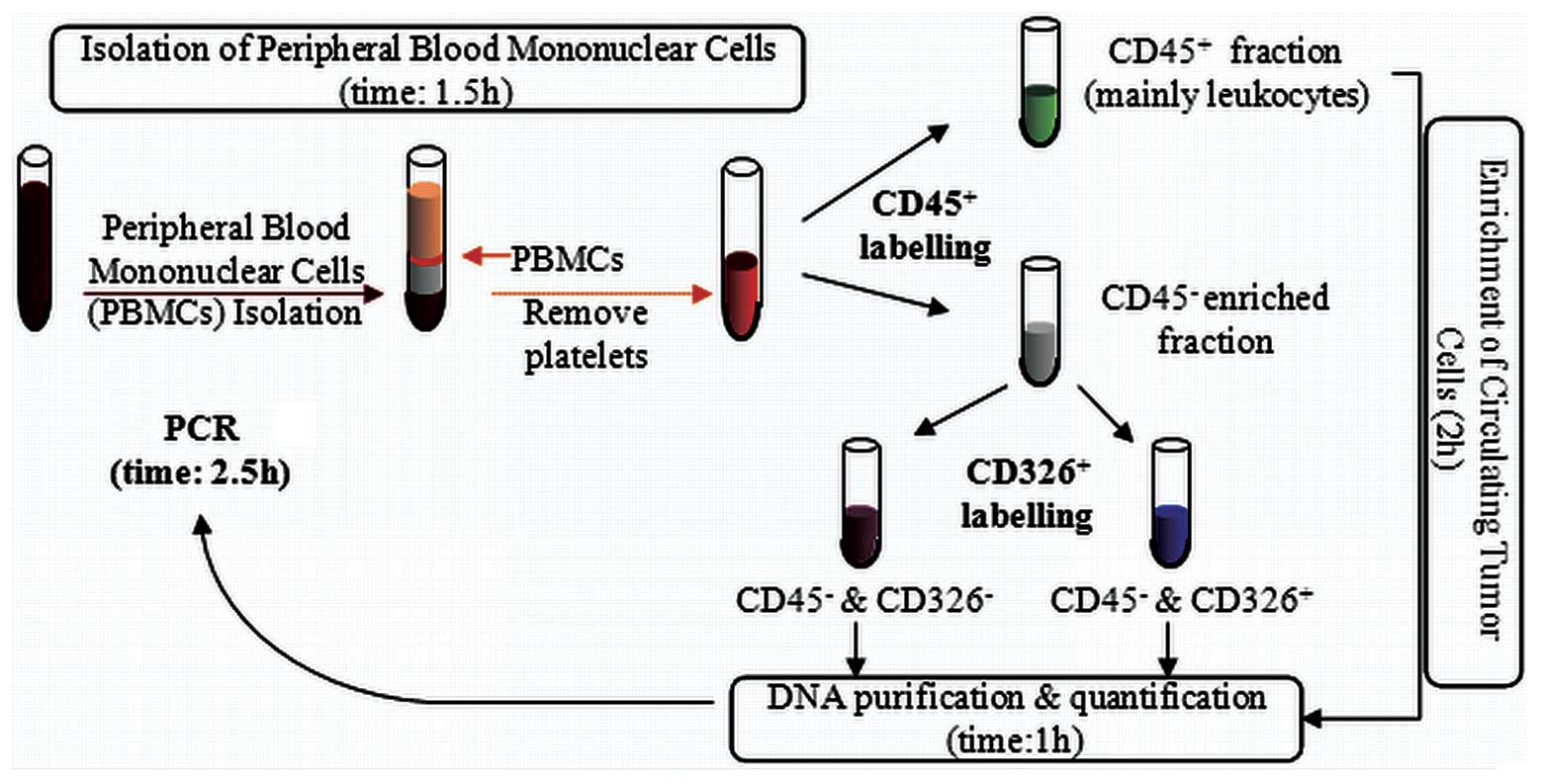
Isolation of peripheral blood mononuclear cells (PBMCs; time, 1.5 h)

When working with anticoagulated peripheral blood, PBMCs should be isolated using density gradient centrifugation. Ficoll-Paque™ Plus was used for this purpose (17-1440-03; GE Healthcare, Buckinghamshire, UK). The blood samples were diluted with saline serum (ratio, 1:1) and gently added on the top of the Ficoll-Paque Plus medium (ratio, 2/3 blood:1/3 Ficoll) taking care not to mix the two layers. Following centrifugation for 20 min at 400 × g, the PBMCs that were located at the interface layer were collected by inserting the pipette directly through the plasma (alternatively, the upper plasma layer may be removed and the PBMCs may be collected). The PBMCs were washed twice with saline serum and centrifuged for 8 min at 300 × g. Buffer A was added to the PBMCs, which were then centrifuged at 200 × g for 10–15 min. Buffer A consisted of phosphate-buffered saline (PBS; pH 7.2), 0.5% bovine serum albumin (BSA) and 2 mM EDTA). This step was repeated twice.

Enrichment of circulating tumor cells (time, 2 h)

CD45 Human MicroBeads (130-045-801; Miltenyi Biotec GmbH, Bergisch Gladbach, Germany) were used for the enrichment of the epithelial tumor cells from the peripheral blood by the depletion of the CD45+ cells. The cell number from the previous step was measured and following centrifugation at 300 × g for 10 min and complete aspiration of the supernatant, 80 μl buffer A and 20 μl CD45 MicroBeads per 107 total cells were added, mixed and refrigerated (4–8°C) for 15 min. Following a wash step with 2 ml buffer A per 107 cells (300 × g for 10 min), 500 μl buffer A was added (up to 108 cells). The cell suspension was loaded onto a separator column that was placed in a magnet (MiniMACS Starting kit; Miltenyi Biotec). The magnetically-labeled CD45+ cells were retained within the column. The unlabeled cell fraction (CD45− fraction) that was enriched in the epithelial tumor cells ran through.

CD326 epithelial cell adhesion molecule (EpCAM) Human MicroBeads are used for the enrichment of epithelial tumor cells

The cell number from the CD45− fraction that was obtained in the previous step was measured and following centrifugation at 300 × g for 10 min and complete aspiration of the supernatant, 300 μl buffer A and 100 μl FcR reagent (120-000-442; Miltenyi Biotec) per 5×10⁷ total cells were added and mixed. A total of 100 μl CD326 Microbeads were added per 5×10⁷ total cells, mixed well and refrigerated at 4–8°C for 30 min. Following a wash step with 5–10 ml buffer A per 5×10⁷ cells (300 × g for 10 min), 500 μl buffer A was added up to 108 cells). The cell suspension was loaded onto a separator column placed in a magnet (MiniMACS Starting kit; Miltenyi Biotec). Subsequent to the labeling and separating procedures, three cell fractions were obtained, CD45+, CD45−/CD326− and CD45−/CD326+. A schematic of the procedure is shown in Fig. 1.

Figure 1

Schematic procedure of the KRAS mutational status analysis of peripheral blood isolated CTCs in mCRC patients. PCR, polymerase chain reaction; CTCs, circulating tumour cells; mCRC, metastatic colorectal cancer.

DNA purification and quantification (time, 1 h)

The QIAamp® Mini kit (51101; Qiagen GmbH, Hilden, Germany) was used for DNA purification from the cell fractions that were obtained previously. The procedure was performed as described in the QIAamp Mini kit instructions. DNA quantification was performed using the NaNoDrop-2000/2000c Spectrophotometer (Thermo Fisher Scientific Inc., Waltham, MA, USA), following the manufacturer’s instructions.

KRAS mutational status analysis (time, 2.5 h)

All DNA was analyzed for a set of seven KRAS point mutations, 12-Ala, Asp, Arg, Cys, Ser, Val and 13-Asp, using the Therascreen KRAS kit (870011; Qiagen GmbH). The analysis was performed on a quantitative PCR instrument (Rotor-Gen Q; Qiagen GmbH).

Results and discussion

Blood samples were studied from 23 mCRC patients whose primary tumor KRAS mutational status was available. Following the enrichment of the CTCs, three fractions were obtained, CD45+, CD45−/CD326− and CD45−/CD326+. The KRAS Mutation kit detected seven specific KRAS mutations using a region of the KRAS exon-4 as a control. The CD45+ cell fraction contained mainly leukocytes, thus, a signal appeared in the control assay that corresponds to the KRAS exon-4, but no KRAS mutation was detectable, since somatic mutations were only present in the fraction that contains the CTCs, if detectable. The CD45−/CD326− and CD45−/CD326+ cell fractions exhibited a signal of the KRAS exon-4 control due possibly to the residual mononuclear cells; however, the amplification signal appeared at a higher cycle compared with the corresponding CD45+ since the expected mononuclear cells amount was low. The CTCs were identified in the CD45−/CD326+ cell fraction and, therefore, the KRAS mutations, if detectable by the kit, appear in this fraction. The present study identified a correspondence between the primary tumor-KRAS status and the CTC-KRAS status in 17 patients (15 wild-type and two mutated). In five cases, the tumor-KRAS mutation was not detected in the CTCs. In those patients, a low concentration of CTCs explained the results as their DNA concentration was below the kit detection limits. Notably, another discrepancy was identified in one patient (case CR6), who demonstrated a KRAS wild-type in the primary tumor and a KRAS-12Ala mutation in the CTC enriched cell fraction (Fig. 2). In this case, another scenario should be proposed. It is known that in a minority of cases (5–10%) the KRAS mutational status is heterogeneous and may vary between the primary tumor and the metastasis (13). In a recent study, Bossard et al defined a KRAS mutational mosaicism, with 4 out of 18 patients showing KRAS status discordances between the primary colorectal cancer and the metastasis (14). The biological significance of this mosaicism is unclear, but indicates diverse metastatic potentials in various populations of tumor cells and/or the acquirement of mutations during or following metastasis. Bouchahda et al proposed that KRAS mutations may be acquired late during the metastatic phase of colorectal cancer more frequently than currently recognized (15). Furthermore, since CTCs may be considered as an intermediate step in colonization, their metastatic potential depends on a number of genetic abnormalities that may include the acquisition of a KRAS mutation. Therefore, the CTC-KRAS-Ala mutation that was identified in a patient from the present study may lead to an improved adaptation to adverse conditions, migration and colonization of distant tissues. By the end of the present study, the CR6 patient developed hepatic metastasis (tissue from metastases not available) and a change from anti-EGFR to Irinotecan-based treatment was considered. Future studies examining large series and examining KRAS, BRAF, PTEN and PI3K may provide valuable insight into the carcinogenesis and metastasizing patterns of mCRC, thus guiding treatment options for patients.

Figure 2

Image of the CTC-KRAS mutational status for patient CR6. The CD45+ cell fraction (mainly leukocytes) provides a positive signal for the control assay corresponding to KRAS exon-4. The CD45−/CD326− cell fraction exhibits a positive signal of the control assay corresponding to KRAS exon-4. The CD45−/CD326+ cell fraction exhibits a positive signal of the control assay corresponding to KRAS exon-4 and a signal for the KRAS-12Ala mutation. CTC, circulating tumour cell.

In summary, the present study indicated that the isolation and analysis of CTCs from the peripheral blood of mCRC patients, using a minimally invasive, relatively economical and optimized method, may have high clinical relevance. There are limitations to the procedure, since during epithelial to mesenchymal transition, the expression of epithelial markers on CTCs, such as EpCAM may be downregulated and become undetectable (16). CTC studies represent an alternative to invasive procedures and their analysis may become a prognostic factor, acting as a ‘liquid biopsy’. CTCs are able to survive chemotherapy and may indicate a lack of therapeutic efficacy, allowing the early end of ineffective treatments and providing a representation of the current disease status of the patient.

Acknowledgements

The authors would like to thank all the patients that participated in this study.

References

1 

Jemal A, Bray F, Center MM, Ferlay J, Ward E and Forman D: Global cancer statistics. CA Cancer J Clin. 61:69–90. 2011. View Article : Google Scholar

2 

Allegra CJ, Jessup JM, Somerfield MR, et al: American Society of Clinical Oncology provisional clinical opinion: Testing for KRAS gene mutations in patients with metastatic colorectal carcinoma to predict response to anti-epidermal growth factor receptor monoclonal antibody therapy. J Clin Oncol. 27:2091–2096. 2009. View Article : Google Scholar

3 

Jimeno A, Messersmith WA, Hirsch FR, Franklin WA and Eckhardt SG: KRAS mutations and sensitivity to epidermal growth factor receptor inhibitors in colorectal cancer: practical application of patient selection. J Clin Oncol. 27:1130–1136. 2009. View Article : Google Scholar

4 

Sartore-Bianchi A, Bencardino K, Cassingena A, et al: Therapeutic implications of resistance to molecular therapies in metastatic colorectal cancer. Cancer Treat Rev. 36(Suppl 3): S1–S5. 2010. View Article : Google Scholar

5 

De Roock W, De Vriendt V, Normanno N, Ciardiello F and Tejpar S: KRAS, BRAF, PIK3CA, and PTEN mutations: Implications for targeted therapies in metastatic colorectal cancer. Lancet Oncol. 12:594–603. 2011.PubMed/NCBI

6 

Artale S, Sartore-Bianchi A, Veronese SM, et al: Mutations of KRAS and BRAF in primary and matched metastatic sites of colorectal cancer. J Clin Oncol. 26:4217–4219. 2008. View Article : Google Scholar : PubMed/NCBI

7 

Kosakowska EA, Stec R, Charkiewicz R, Skoczek M and Chyczewski L: Molecular differences in the KRAS gene mutation between a primary tumor and related metastatic sites - case report and a literature review. Folia Histochem Cytobiol. 48:597–602. 2010.

8 

Baldus SE, Schaefer KL, Engers R, Hartleb D, Stoecklein NH and Gabbert HE: Prevalence and heterogeneity of KRAS, BRAF, and PIK3CA mutations in primary colorectal adenocarcinomas and their corresponding metastases. Clin Cancer Res. 16:790–799. 2010. View Article : Google Scholar : PubMed/NCBI

9 

Ashworth T: A case of cancer in which cells similar to those in the tumours were seen in blood after death. Aust Med J. 14:146–149. 1869.

10 

Gerges N, Rak J and Jabado N: New technologies for the detection of circulating tumour cells. Br Med Bull. 94:49–64. 2010. View Article : Google Scholar : PubMed/NCBI

11 

Alunni-Fabbroni M and Sandri MT: Circulating tumour cells in clinical practice: Methods of detection and possible characterization. Methods. 50:289–297. 2010. View Article : Google Scholar : PubMed/NCBI

12 

Lustberg M, Jatana KR, Zborowski M and Chalmers JJ: Emerging technologies for CTC detection based on depletion of normal cells. Recent Results Cancer Res. 195:97–110. 2012. View Article : Google Scholar : PubMed/NCBI

13 

Baas JM, Krens LL, Guchelaar HJ, Morreau H and Gelderblom H: Concordance of predictive markers for EGFR inhibitors in primary tumors and metastases in colorectal cancer: A review. Oncologist. 16:1239–1249. 2011. View Article : Google Scholar : PubMed/NCBI

14 

Bossard C, Küry S, Jamet P, et al: Delineation of the infrequent mosaicism of KRAS mutational status in metastatic colorectal adenocarcinomas. J Clin Pathol. 65:466–469. 2012. View Article : Google Scholar : PubMed/NCBI

15 

Bouchahda M, Karaboué A, Saffroy R, et al: Acquired KRAS mutations during progression of colorectal cancer metastases: Possible implications for therapy and prognosis. Cancer Chemother Pharmacol. 66:605–609. 2010. View Article : Google Scholar : PubMed/NCBI

16 

Wicha MS and Hayes DF: Circulating tumor cells: not all detected cells are bad and not all bad cells are detected. J Clin Oncol. 29:1508–1511. 2011. View Article : Google Scholar : PubMed/NCBI

Related Articles

  • Abstract
  • View
  • Download
  • Twitter
Copy and paste a formatted citation
Spandidos Publications style
Gutiérrez C, Rodriguez J, Patiño-García A, García-Foncillas J and Salgado J: KRAS mutational status analysis of peripheral blood isolated circulating tumor cells in metastatic colorectal patients. Oncol Lett 6: 1343-1345, 2013.
APA
Gutiérrez, C., Rodriguez, J., Patiño-García, A., García-Foncillas, J., & Salgado, J. (2013). KRAS mutational status analysis of peripheral blood isolated circulating tumor cells in metastatic colorectal patients. Oncology Letters, 6, 1343-1345. https://doi.org/10.3892/ol.2013.1544
MLA
Gutiérrez, C., Rodriguez, J., Patiño-García, A., García-Foncillas, J., Salgado, J."KRAS mutational status analysis of peripheral blood isolated circulating tumor cells in metastatic colorectal patients". Oncology Letters 6.5 (2013): 1343-1345.
Chicago
Gutiérrez, C., Rodriguez, J., Patiño-García, A., García-Foncillas, J., Salgado, J."KRAS mutational status analysis of peripheral blood isolated circulating tumor cells in metastatic colorectal patients". Oncology Letters 6, no. 5 (2013): 1343-1345. https://doi.org/10.3892/ol.2013.1544
Copy and paste a formatted citation
x
Spandidos Publications style
Gutiérrez C, Rodriguez J, Patiño-García A, García-Foncillas J and Salgado J: KRAS mutational status analysis of peripheral blood isolated circulating tumor cells in metastatic colorectal patients. Oncol Lett 6: 1343-1345, 2013.
APA
Gutiérrez, C., Rodriguez, J., Patiño-García, A., García-Foncillas, J., & Salgado, J. (2013). KRAS mutational status analysis of peripheral blood isolated circulating tumor cells in metastatic colorectal patients. Oncology Letters, 6, 1343-1345. https://doi.org/10.3892/ol.2013.1544
MLA
Gutiérrez, C., Rodriguez, J., Patiño-García, A., García-Foncillas, J., Salgado, J."KRAS mutational status analysis of peripheral blood isolated circulating tumor cells in metastatic colorectal patients". Oncology Letters 6.5 (2013): 1343-1345.
Chicago
Gutiérrez, C., Rodriguez, J., Patiño-García, A., García-Foncillas, J., Salgado, J."KRAS mutational status analysis of peripheral blood isolated circulating tumor cells in metastatic colorectal patients". Oncology Letters 6, no. 5 (2013): 1343-1345. https://doi.org/10.3892/ol.2013.1544
Follow us
  • Twitter
  • LinkedIn
  • Facebook
About
  • Spandidos Publications
  • Careers
  • Cookie Policy
  • Privacy Policy
How can we help?
  • Help
  • Live Chat
  • Contact
  • Email to our Support Team