Introduction
Lung cancer is the main cause of cancer-related
mortality in Eastern Asia and worldwide (1). Lung adenocarcinoma accounts for ~70%
of non-small cell lung cancer and is now becoming more frequently
detected (2). Recent studies have
demonstrated that lung adenocarcinoma is a genetically and
clinically heterogeneous tumor with malignant behaviors (2,3).
For patients with advanced lung adenocarcinoma,
treatment with pemetrexed in combination with cisplatin is
recommended for the first-line therapy (4). However, the response to
cisplatin/pemetrexed treatment varied among patients (4,5).
Certain patients benefit from the cisplatin/pemetrexed regimen,
whereas others react with no remission or progress rapidly. The
distinct clinical outcome may be largely dependent on the
individual variation (3,6). In this regard, the prospective
identification of those patients who are mostly likely to respond
to cisplatin/pemetrexed using prognostic markers are required.
Evidence from clinical studies has shown a strong
association between the cytokeratin 19 fragment (CYFRA21-1) and its
prognostic value in lung adenocarcinoma. Park et al
(7) showed that high preoperative
CYFRA21-1 may be a determinant for a poor prognosis in patients
with lung adenocarcinoma who have undergone surgery. By contrast,
Ono et al also identified that the serum levels of CYFRA21-1
may also possess prognostic indications for patients diagnosed with
advanced lung adenocarcinoma (8).
Other studies have also shown the prognostic value of squamous cell
carcinoma (SCC) antigen (9–11), carcinoembryonic antigen (CEA)
(11–13), carbohydrate antigen 125 (CA125)
(11,14) and even neuron-specific enolase (NSE)
(15) in non-small cell lung
cancer. It has also been shown that the most effective way of
evaluating prognosis is dynamically, by comparing pre- and
post-therapy results (16,17).
Leptin, mainly synthesized by adipocytes (18), is a pleiotropic molecule that is
involved in tumorigenesis and the progression of lung cancer
(19–21). Recent evidence indicates that leptin
shows a prognostic value for the overall survival rate in patients
with gastric adenocarcinoma (22),
hepatocellular carcinoma (23) and
colorectal adenocarcinoma (24).
The aim of the present study was to evaluate whether
serum levels of leptin, CEA, CA19-9, CA15-3, CA125, CA72-4,
CYFRA21-1, NSE and SCC have prognostic indications in patients with
lung adenocarcinoma who are treated with cisplatin/pemetrexed
chemotherapy in the first-line setting.
Materials and methods
Patients and treatment
A total of 49 previously untreated patients with
histological evidence of primary lung adenocarcinoma or mucous
adenocarcinoma who were admitted to the Oncology Department of the
Chinese PLA General Hospital (Beijing, China) in 2012 were
prospectively enrolled. The study was approved by the ethics
committee of the Chinese PLA General Hospital. All patients
provided written informed consent. The following variables were
recorded: Age, gender, body mass index, tumor histology, Eastern
Cooperative Oncology Group (ECOG) performance status and other
associated clinical parameters. All patients were treated with
first-line cisplatin/pemetrexed chemotherapy. Only 27 patients who
received at least four cycles of first-line treatment with the
cisplatin/pemetrexed chemotherapy were eligible. A total of 22
individuals who refused or reported inability to collaborate were
excluded. Computed tomography was performed to assess tumor
response by the Response Evaluation Criteria in Solid Tumors
criteria, version 1.1 (25).
Measurement of serum leptin and routine
tumor biomarker levels
Serum samples were collected within 2 h and stored
at −80°C. Tumor biomarkers, including CEA, CA19-9, CA15-3, CA125,
CA72-4, CYFRA21-1 and NSE, were measured using
electrochemiluminescence immunoassays (E170; Roche Diagnostics,
Basel, Switzerland). Serum SCC was measured using a microparticle
enzyme immunoassay (i2000; Abbott Diagnostics, Lake Forest, IL,
USA). All tests were performed according to the manufacturer’s
instructions. The cut-off points for each tumor biomarker,
determined by the manufacturer, were as follows: CEA, 5 μg/l;
CA19-9, 37 U/ml; CA15-3, 30 U/ml; CA125, 35 U/ml; CA72-4, 10 U/ml;
CYFRA21-1, 4 ng/ml; NSE, 24 ng/ml; and SCC, 1.5 ng/ml.
The serum leptin levels of 27 patients and age- and
gender-matched healthy controls were measured using
radioimmunoassay kits as previously described (26).
Statistical analyses
Statistical analyses were carried out using SPSS
16.0 (SPSS, Inc., Chicago, IL, USA). Data are presented as the
mean, median and range. The difference of serum leptin levels among
the groups were examined using one-way analysis of variance.
Spearman’s co-efficient was used for correlations of the associated
quantitative data. P<0.05 was considered to indicate a
statistically significant difference.
Results
Patient characteristics
The patient characteristics are presented in
Table I. The majority of patients
were elderly and predominately male (mean age, 50 years; range,
30–69 years; female to male ratio, 7:20). All 27 patients were
diagnosed with adenocarcinoma. A total of 21 patients (77.8%) were
classified as stage IV, four patients (14.8%) as stage IIIB and the
remaining two patients (7.4%) with an unknown stage. All patients
had a good ECOG performance; 17 patients with ECOG=0 and 10 with
ECOG=1. Only two patients were diagnosed with weight loss.
 | Table ICharacteristics of the 27 lung
adenocarcinoma patients. |
Table I
Characteristics of the 27 lung
adenocarcinoma patients.
| Characteristic | Values |
|---|
| Age, years |
| Median | 50 |
| Range | 30–69 |
| Gender, n (%) |
| Male | 20 (74.1) |
| Female | 7 (25.9) |
| Smoking habit |
| Smokers | 13 (48.2) |
| Ex-smokers | 9 (33.3) |
| Non-smokers | 5 (18.5) |
| Weight loss, kg |
| ≤5 | 25 (92.6) |
| >5 | 2 (7.4) |
| ECOG performance
status |
| 0 | 17 (63.0) |
| 1 | 10 (37.0) |
| Stage, n (%) |
| IIIB | 4 (14.8) |
| IV | 21 (77.8) |
| Unknown | 2 (7.4) |
| Histology, n (%) | 27 (100) |
Association between routine clinical
tumor markers and its prognostic value in lung adenocarcinoma in
response to cisplatin/pemetrexed chemotherapy
To identify the association between routine clinical
tumor markers and its prognostic value, the patients were divided
into three groups according to their response to the
cisplatin/pemetrexed chemotherapy treatment. Among these 27
patients, nine retained stable disease (SD) following four cycles
of cisplatin/pemetrexed, whereas nine had a partial response (PR)
and nine had progressive disease (PD). All of them were confirmed
by clinical and radiological assessment. The routine serum tumor
biomarker levels were analyzed at diagnosis in the PR, SD and PD
subgroups. All tumor biomarkers, including CEA, CA19-9, CA15-3,
CA125, CA72-4, CYFRA21-1 and NSE, showed no clear difference among
the PR, SD and PD subgroups; Table
II.
| Table IIVariations of associated tumor
biomarkers among the PR, SD and PD subgroups. |
Table II
Variations of associated tumor
biomarkers among the PR, SD and PD subgroups.
| Parameters | PR (n=9) | SD (n=9) | PD (n=9) | P-value |
|---|
| CEA (μg/l) | 54.60±4.77 | 232.82±6.13 | 31.19±3.64 | 0.295 |
| CA125 (U/ml) | 208.97±3.57 | 295.29±4.55 | 938.37±12.68 | 0.368 |
| CA153 (U/ml) | 56.43±5.89 | 29.58±1.55 | 31.01±2.79 | 0.181 |
| CA199 (U/ml) | 22.02±3.48 | 527.27±13.30 | 45.69±7.94 | 0.372 |
| CA724 (U/ml) | 7.31±2.44 | 15.45±1.92 | 2.84±0.47 | 0.281 |
| CYFRA21-1
(ng/ml) | 110.19±10.74 | 6.39±5.35 | 13.68±15.18 | 0.414 |
| NSE (ng/ml) | 20.63±7.17 | 22.79±1.08 | 16.50±2.74 | 0.696 |
| SCC (ng/ml) | 0.98±0.37 | 3.60±1.44 | 0.87±0.51 | 0.492 |
Association between serum leptin and its
prognostic value in lung adenocarcinoma in response to
cisplatin/pemetrexed chemotherapy
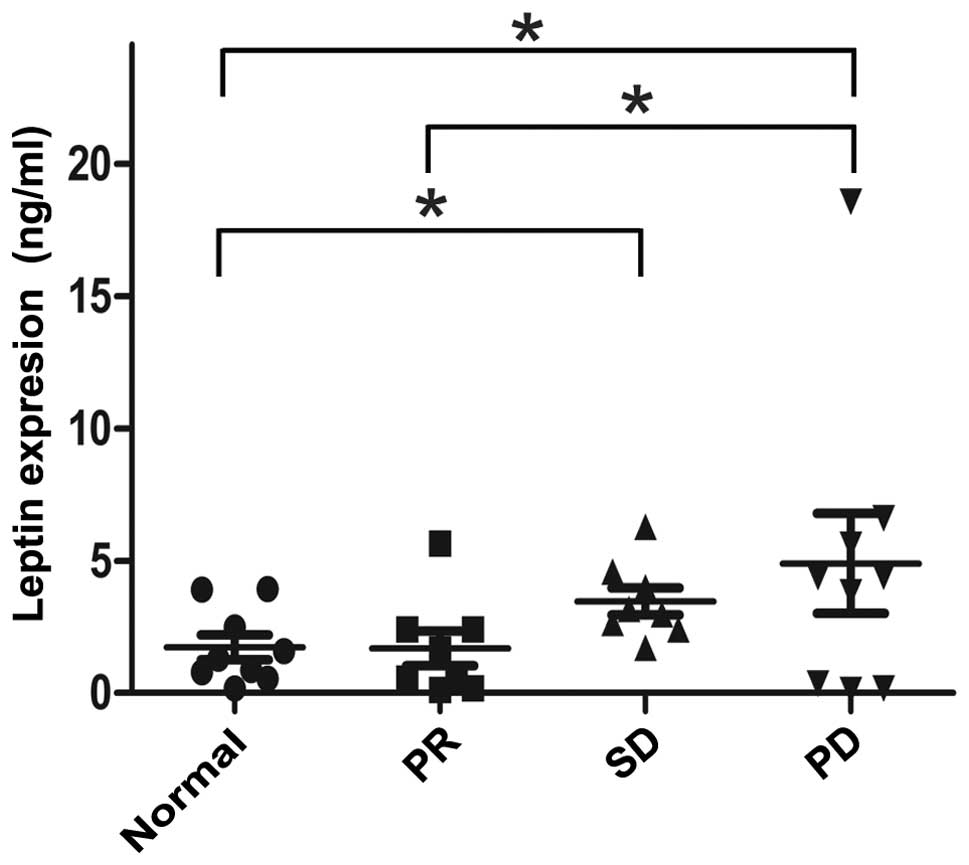
Serum leptin levels at diagnosis were determined by
a radioimmunoassay. A statistically significant difference was
observed among the PR, SD and PD subgroups; Fig. 1. The serum leptin levels at
diagnosis were significantly higher in the lung adenocarcinoma
patients showing PD compared with patients in the PR subgroup; 6.19
(0.36–18.57) versus 1.69 (0.12–5.64) ng/ml, P=0.021; Fig. 1. The serum leptin levels of the
healthy controls and patients with PD were almost the same; 1.73
(0.18–3.93) versus 1.69 (0.12–5.64) ng/ml. Fig. 1 also shows significant elevated
serum leptin levels in patients with PD compared with controls;
6.19 (0.36–18.57) versus 1.73 (0.18–3.93) ng/ml, P=0.009. In
addition, the leptin levels were higher in the patients with SD
compared with controls; 3.47 (1.71–6.27) versus 1.73 (0.18–3.93)
ng/ml, P=0.013.
To demonstrate the correlation between the leptin
levels and routine clinical tumor markers in lung adenocarcinoma in
response to cisplatin/pemetrexed chemotherapy, Spearman’s
correlation was performed between the serum leptin levels and the
routine tumor biomarkers, including CEA, CA125, CA15-3, CA19-9,
CA72-4, CYFRA21-1, NSE and SCC. Regarding the assessed parameters
(Table III), only serum SCC
showed a direct correlation in association with serum leptin
levels; r=−0.398 and P=0.012. No statistically significant
associations between serum leptin and other routine biological
parameters were found.
| Table IIISpearman’s correlation coefficient
between the serum leptin and tumor biomarkers. |
Table III
Spearman’s correlation coefficient
between the serum leptin and tumor biomarkers.
| Clinical
parameters | Correlation
coefficient | P-value
(2-tailed) |
|---|
| CEA | −0.023 | 0.885 |
| CA125 | −0.025 | 0.883 |
| CA153 | 0.007 | 0.966 |
| CA199 | −0.048 | 0.761 |
| CA724 | 0.175 | 0.288 |
| CYFRA21-1 | −0.110 | 0.493 |
| NSE | −0.168 | 0.308 |
| SCC | −0.398 |
0.012a |
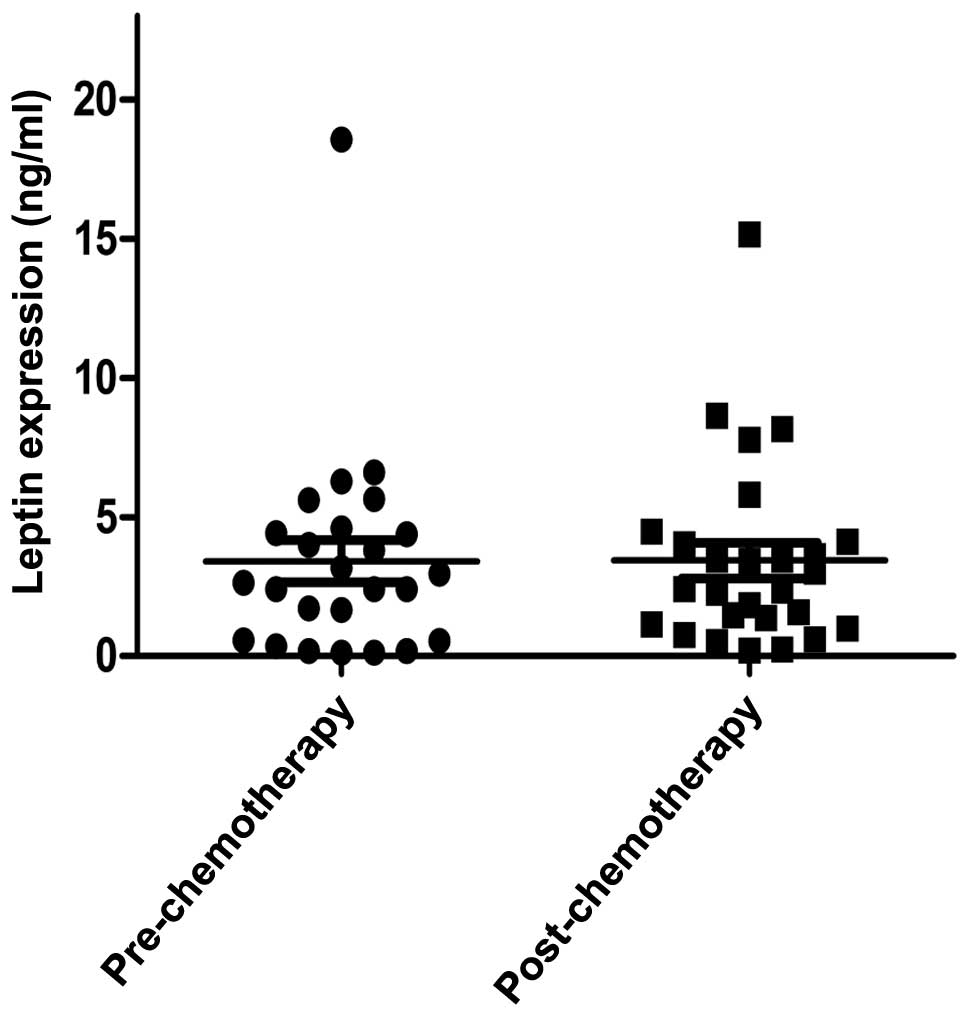
Furthermore, the change of serum leptin levels were
evaluated during chemotherapy. There was no statistically
significant difference pre- and post-chemotherapy; Fig. 2. However, when the patients were
divided into PR, SD and PD subgroups, it was found that the change
of serum leptin during cisplatin/pemetrexed chemotherapy
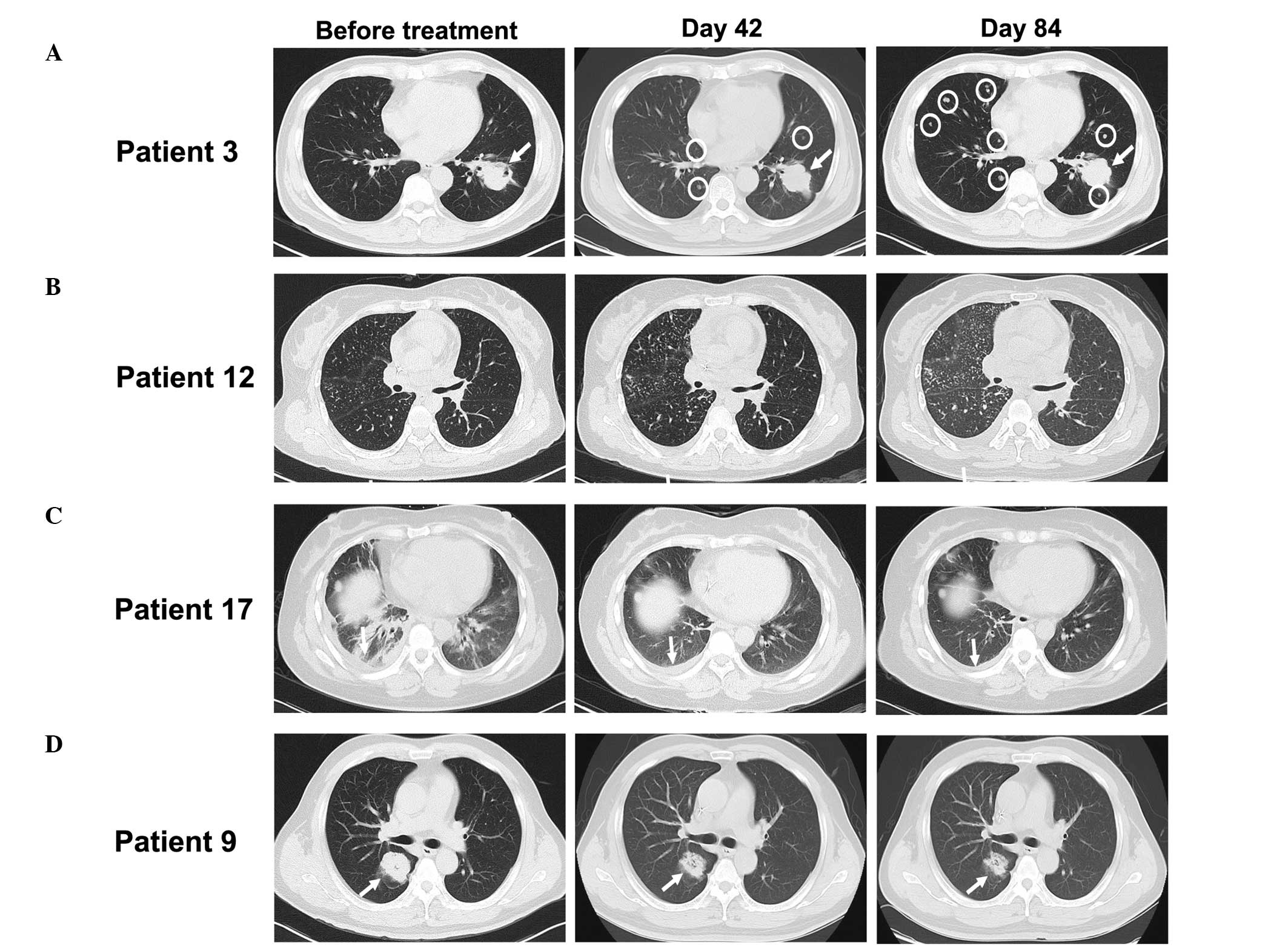
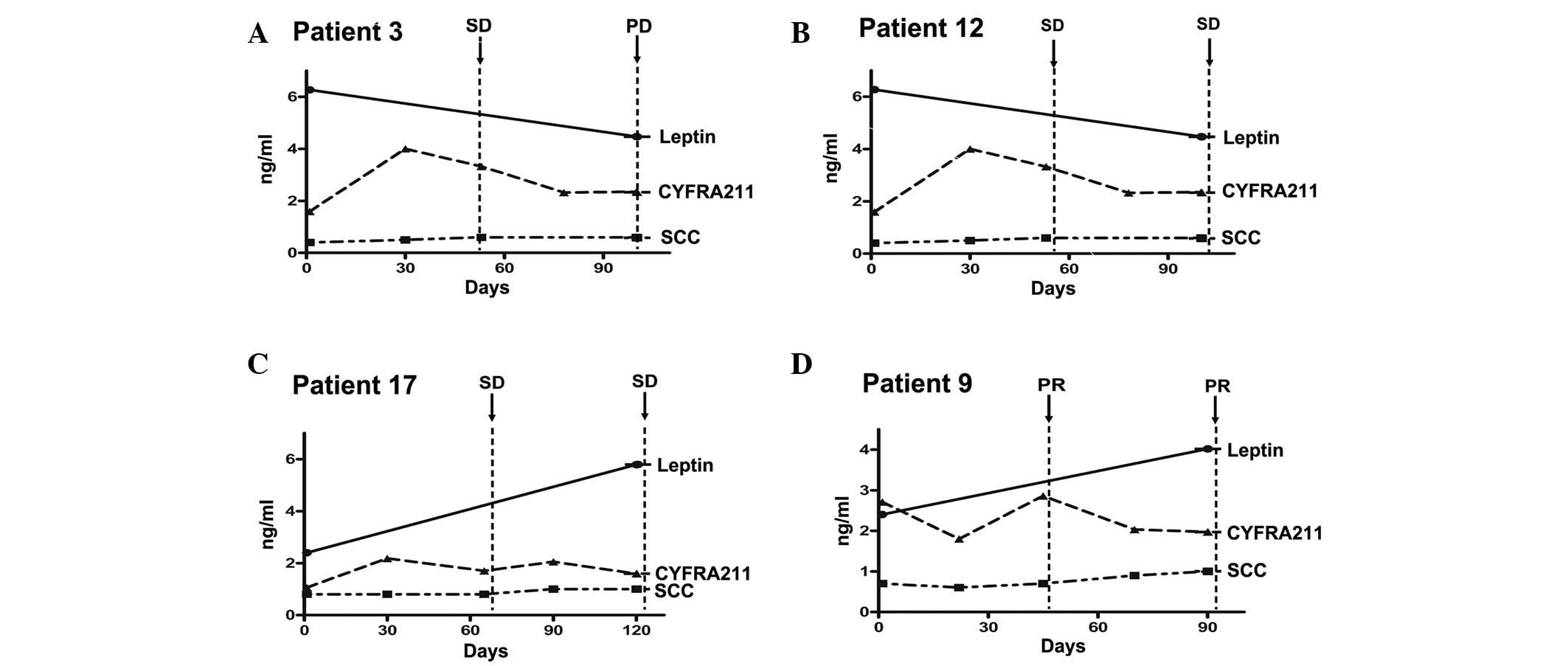
corresponded to chemotherapy responses. The application of
cisplatin/pemetrexed chemotherapy provided a significant decrease
in serum leptin levels in eight out of nine patients with PD
(Figs. 3A and 4A). The serum leptin levels increased in
seven of nine patients with PR (Figs.
3D and 4D). Regarding the
patients with SD, patients with exacerbated tumor burden (5/9)
showed an obvious reduction in serum leptin levels (Fig. 3B and 4B), while patients in remission (4/9)
showed an increase in serum leptin (Figs. 3C and 4C).
The data comparing the serum leptin, SCC and
CYFRA21-1 values were also available across four serial time points
during chemotherapy for all 27 patients. The serum SCC levels were
slightly elevated at one or more time points in almost all patients
following cisplatin/pemetrexed chemotherapy; Fig. 3. CYFA21-1 exhibited no regular
expression pattern, corresponding to responses to
cisplatin/pemetrexed during chemotherapy; Fig. 3.
In conclusion, a trend towards an improved prognosis
was observed in patients with lower serum leptin levels at
diagnosis and an increase during cisplatin/pemetrexed
chemotherapy.
Discussion
In the present study, the serum leptin level was
demonstrated in patients with lung adenocarcinoma to show a trend
that corresponded to the cisplatin/pemetrexed chemotherapy
response. This is the first study, to the best of our knowledge,
that demonstrates that serum leptin has prognostic indications in
patients with lung adenocarcinoma who are treated with
cisplatin/pemetrexed chemotherapy in the first-line setting.
Cisplatin/pemetrexed has a well-established clinical
activity in lung adenocarcinoma (27). Clinically, the majority of
oncologists consider cisplatin/pemetrexed as a standard
chemotherapy regimen for patients with lung adenocarcinoma. Several
studies have demonstrated the association between the ERCC1, RRM1
and CHFR genes (28–30) and its prognostic value in response
to platinum compounds, gemcitabine and taxanes. However, the best
markers in predicting the response to cisplatin/pemetrexed
treatment remain a matter of debate. The results of the present
study showed that the level of serum leptin has a prognostic value
for differentiating the treatment benefit of cisplatin/pemetrexed.
Lower leptin levels at diagnosis were followed by PR, while higher
leptin levels were followed by PD. This indicated that the serum
leptin expression may be associated with the response to
cisplatin/pemetrexed. Previous studies are consistent with the
prognostic value of serum leptin for overall survival rates in
patients with gastric adenocarcinoma, hepatocellular carcinoma and
colorectal adenocarcinoma (22–24).
The results in our studies revealed the potential role of serum
leptin as a prognostic marker in response to the
cisplatin/pemetrexed chemotherapy. This finding would be of great
significance for the adjustment of the chemotherapy regimen
according to the serum leptin level in the near future.
Notably, the results of the present study showed a
significant change of serum leptin that corresponded with
chemotherapy responses. Inconsistent with this, a study by Tas
et al (19) indicated that
the serum leptin level was decreased owing to the chemotherapy
effect. Although the numbers of patients with varied responses were
limited in the present study, a significant decrease in serum
leptin levels were observed in eight out of nine patients with PD.
Serum leptin was clearly elevated in seven out of nine patients
with PR. However, the reduction of leptin was regardless of the
response to chemotherapy and did not reach a statistical
significance (P=0.06) in the study by Tas et al (19). In addition, the studies by Tas et
al (19) and Kerenidi et
al (31) showed that serum
leptin levels in lung cancer patients were lower when compared with
healthy individuals. The results of these studies are inconsistent
with the present study and may in part reflect the various
populations tested and the inherent variability in quantifying
serum leptin using ELISA and radioimmunoassay.
In conclusion, the results of the present study
indicate a strong association between serum leptin level and its
prognostic value in patients with advanced lung adenocarcinoma
during cisplatin/pemetrexed chemotherapy. Considering the small
number of patients, future studies with pro rata patients are
required to further confirm the prognostic value of serum leptin.
The findings of the present study will aid the understanding of the
mechanism of patient response to the cisplatin/pemetrexed
combination and aid the development of a novel prognostic
marker.
Acknowledgements
This study was supported by the National Science
Foundation (grant 81071413) and the National High-tech Technology
Research and Development Program (2011aa 02A 111), China.
References
|
1
|
Parkin DM, Bray FI and Devesa SS: Cancer
burden in the year 2000. The global picture. Eur J Cancer. 37(Suppl
8): S4–S66. 2001.PubMed/NCBI
|
|
2
|
Okada M: Subtyping lung adenocarcinoma
according to the novel 2011 IASLC/ATS/ERS classification:
correlation with patient prognosis. Thorac Surg Clin. 23:179–186.
2013. View Article : Google Scholar : PubMed/NCBI
|
|
3
|
Raparia K, Villa C, DeCamp MM, Patel JD
and Mehta MP: Molecular profiling in non-small cell lung cancer: a
step toward personalized medicine. Arch Pathol Lab Med.
137:481–491. 2013. View Article : Google Scholar : PubMed/NCBI
|
|
4
|
Nuijten MJ, Aultman R, de Carpeño JC, et
al: An indirect comparison of the efficacy of bevacizumab plus
carboplatin and paclitaxel versus pemetrexed with cisplatin in
patients with advanced or recurrent non-squamous adenocarcinoma
non-small cell lung cancer. Curr Med Res Opin. 27:2193–2201. 2011.
View Article : Google Scholar : PubMed/NCBI
|
|
5
|
Dinglin XX, Huang Y, Liu H, et al:
Pemetrexed and cisplatin combination with concurrent whole brain
radiotherapy in patients with brain metastases of lung
adenocarcinoma: a single-arm phase II clinical trial. J Neurooncol.
112:461–466. 2013. View Article : Google Scholar : PubMed/NCBI
|
|
6
|
Tímár J: Role of contemporary pathological
diagnostics in the personalized treatment of cancer. Magy Onkol.
57:26–32. 2013.(In Hungarian).
|
|
7
|
Park SY, Lee JG, Kim J, et al:
Preoperative serum CYFRA 21-1 level as a prognostic factor in
surgically treated adenocarcinoma of lung. Lung Cancer. 79:156–160.
2013. View Article : Google Scholar : PubMed/NCBI
|
|
8
|
Ono A, Takahashi T, Mori K, et al:
Prognostic impact of serum CYFRA 21-1 in patients with advanced
lung adenocarcinoma: a retrospective study. BMC Cancer. 13:3542013.
View Article : Google Scholar : PubMed/NCBI
|
|
9
|
Takeuchi S, Nonaka M, Kadokura M and
Takaba T: Prognostic significance of serum squamous cell carcinoma
antigen in surgically treated lung cancer. Ann Thorac Cardiovasc
Surg. 9:98–104. 2003.PubMed/NCBI
|
|
10
|
Hatzakis KD, Froudarakis ME, Bouros D, et
al: Prognostic value of serum tumor markers in patients with lung
cancer. Respiration. 69:25–29. 2002. View Article : Google Scholar : PubMed/NCBI
|
|
11
|
Bréchot JM, Chevret S, Nataf J, et al:
Diagnostic and prognostic value of Cyfra 21-1 compared with other
tumour markers in patients with non-small cell lung cancer: a
prospective study of 116 patients. Eur J Cancer. 33:385–391.
1997.PubMed/NCBI
|
|
12
|
Rubins JB, Dunitz J, Rubins HB, et al:
Serum carcinoembryonic antigen as an adjunct to preoperative
staging of lung cancer. J Thorac Cardiovasc Surg. 116:412–416.
1998. View Article : Google Scholar : PubMed/NCBI
|
|
13
|
Seregni E, Foa P, Bogni A, et al:
Evaluation of the soluble fragments of cytokeratin 19 (CK19) in
non-small cell lung cancer (NSCLC). Oncol Rep. 3:95–101.
1996.PubMed/NCBI
|
|
14
|
Diez M, Torres A, Pollán M, et al:
Prognostic significance of serum CA 125 antigen assay in patients
with non-small cell lung cancer. Cancer. 73:1368–1376. 1994.
View Article : Google Scholar : PubMed/NCBI
|
|
15
|
Riesener KP and Schumpelick V: Ultrasound
diagnosis in abdominal trauma - how much experience does the
surgeon need to perform ultrasonic diagnosis? Langenbecks Arch
Chir. 377:205–206. 1992.(In German).
|
|
16
|
Cristofori R, Aimo G, Mengozzi G, et al:
Tumor markers kinetic in malignant lung neoplasms. J Cardiovasc
Surg (Torino). 40:299–305. 1999.PubMed/NCBI
|
|
17
|
Yoshimasu T, Miyoshi S, Maebeya S, et al:
Analysis of the early postoperative serum carcinoembryonic antigen
time-course as a prognostic tool for bronchogenic carcinoma.
Cancer. 79:1533–1540. 1997. View Article : Google Scholar : PubMed/NCBI
|
|
18
|
Cammisotto PG, Bukowiecki LJ, Deshaies Y
and Bendayan M: Leptin biosynthetic pathway in white adipocytes.
Biochem Cell Biol. 84:207–214. 2006. View
Article : Google Scholar : PubMed/NCBI
|
|
19
|
Tas F, Duranyildiz D, Argon A, et al:
Serum levels of leptin and proinflammatory cytokines in
advanced-stage non-small cell lung cancer. Med Oncol. 22:353–358.
2005. View Article : Google Scholar : PubMed/NCBI
|
|
20
|
Ribeiro R, Araujo A, Lopes C and Medeiros
R: Immunoinflammatory mechanisms in lung cancer development: is
leptin a mediator? J Thorac Oncol. 2:105–108. 2007.PubMed/NCBI
|
|
21
|
Karapanagiotou EM, Tsochatzis EA, Dilana
KD, et al: The significance of leptin, adiponectin, and resistin
serum levels in non-small cell lung cancer (NSCLC). Lung Cancer.
61:391–397. 2008. View Article : Google Scholar : PubMed/NCBI
|
|
22
|
Zhao X, Huang K, Zhu Z, Chen S and Hu R:
Correlation between expression of leptin and clinicopathological
features and prognosis in patients with gastric cancer. J
Gastroenterol Hepatol. 22:1317–1321. 2007. View Article : Google Scholar : PubMed/NCBI
|
|
23
|
Wang SN, Yeh YT, Yang SF, Chai CY and Lee
KT: Potential role of leptin expression in hepatocellular
carcinoma. J Clin Pathol. 59:930–934. 2006. View Article : Google Scholar : PubMed/NCBI
|
|
24
|
Guadagni F, Roselli M, Martini F, et al:
Prognostic significance of serum adipokine levels in colorectal
cancer patients. Anticancer Res. 29:3321–3327. 2009.PubMed/NCBI
|
|
25
|
Sato Y, Watanabe H, Sone M, et al; Japan
Intervention Radiology in Oncology Study Group-JIVROSG. Tumor
response evaluation criteria for HCC (hepatocellular carcinoma)
treated using TACE (transcatheter arterial chemoembolization):
RECIST (response evaluation criteria in solid tumors) version 1.1
and mRECIST (modified RECIST): JIVROSG-0602. Ups J Med Sci.
118:16–22. 2013. View Article : Google Scholar
|
|
26
|
Lin J, Gao XN, Yan GT, et al: Endogenous
leptin fluctuates in hepatic ischemia/reperfusion injury and
represents a potential therapeutic target. World J Gastroenterol.
16:5424–5434. 2010. View Article : Google Scholar : PubMed/NCBI
|
|
27
|
Fleeman N, Bagust A, McLeod C, et al:
Pemetrexed for the first-line treatment of locally advanced or
metastatic non-small cell lung cancer. Health Technol Assess.
14(Suppl 1): 47–53. 2010.
|
|
28
|
Lord RV, Brabender J, Gandara D, et al:
Low ERCC1 expression correlates with prolonged survival after
cisplatin plus gemcitabine chemotherapy in non-small cell lung
cancer. Clin Cancer Res. 8:2286–2291. 2002.PubMed/NCBI
|
|
29
|
Besse B, Olaussen KA and Soria JC: ERCC1
and RRM1: ready for prime time? J Clin Oncol. 31:1050–1060. 2013.
View Article : Google Scholar : PubMed/NCBI
|
|
30
|
Pillai RN, Brodie SA, Sica GL, et al: CHFR
protein expression predicts outcomes to taxane-based first line
therapy in metastatic NSCLC. Clin Cancer Res. 19:1603–1611. 2013.
View Article : Google Scholar : PubMed/NCBI
|
|
31
|
Kerenidi T, Lada M, Tsaroucha A, et al:
Clinical significance of serum adipokines levels in lung cancer.
Med Oncol. 30:5072013. View Article : Google Scholar : PubMed/NCBI
|