Spandidos Publications Logo
  • About
    • About Spandidos
    • Aims and Scopes
    • Abstracting and Indexing
    • Editorial Policies
    • Reprints and Permissions
    • Job Opportunities
    • Terms and Conditions
    • Contact
  • Journals
    • All Journals
    • Oncology Letters
      • Oncology Letters
      • Information for Authors
      • Editorial Policies
      • Editorial Board
      • Aims and Scope
      • Abstracting and Indexing
      • Bibliographic Information
      • Archive
    • International Journal of Oncology
      • International Journal of Oncology
      • Information for Authors
      • Editorial Policies
      • Editorial Board
      • Aims and Scope
      • Abstracting and Indexing
      • Bibliographic Information
      • Archive
    • Molecular and Clinical Oncology
      • Molecular and Clinical Oncology
      • Information for Authors
      • Editorial Policies
      • Editorial Board
      • Aims and Scope
      • Abstracting and Indexing
      • Bibliographic Information
      • Archive
    • Experimental and Therapeutic Medicine
      • Experimental and Therapeutic Medicine
      • Information for Authors
      • Editorial Policies
      • Editorial Board
      • Aims and Scope
      • Abstracting and Indexing
      • Bibliographic Information
      • Archive
    • International Journal of Molecular Medicine
      • International Journal of Molecular Medicine
      • Information for Authors
      • Editorial Policies
      • Editorial Board
      • Aims and Scope
      • Abstracting and Indexing
      • Bibliographic Information
      • Archive
    • Biomedical Reports
      • Biomedical Reports
      • Information for Authors
      • Editorial Policies
      • Editorial Board
      • Aims and Scope
      • Abstracting and Indexing
      • Bibliographic Information
      • Archive
    • Oncology Reports
      • Oncology Reports
      • Information for Authors
      • Editorial Policies
      • Editorial Board
      • Aims and Scope
      • Abstracting and Indexing
      • Bibliographic Information
      • Archive
    • Molecular Medicine Reports
      • Molecular Medicine Reports
      • Information for Authors
      • Editorial Policies
      • Editorial Board
      • Aims and Scope
      • Abstracting and Indexing
      • Bibliographic Information
      • Archive
    • World Academy of Sciences Journal
      • World Academy of Sciences Journal
      • Information for Authors
      • Editorial Policies
      • Editorial Board
      • Aims and Scope
      • Abstracting and Indexing
      • Bibliographic Information
      • Archive
    • International Journal of Functional Nutrition
      • International Journal of Functional Nutrition
      • Information for Authors
      • Editorial Policies
      • Editorial Board
      • Aims and Scope
      • Abstracting and Indexing
      • Bibliographic Information
      • Archive
    • International Journal of Epigenetics
      • International Journal of Epigenetics
      • Information for Authors
      • Editorial Policies
      • Editorial Board
      • Aims and Scope
      • Abstracting and Indexing
      • Bibliographic Information
      • Archive
    • Medicine International
      • Medicine International
      • Information for Authors
      • Editorial Policies
      • Editorial Board
      • Aims and Scope
      • Abstracting and Indexing
      • Bibliographic Information
      • Archive
  • Articles
  • Information
    • Information for Authors
    • Information for Reviewers
    • Information for Librarians
    • Information for Advertisers
    • Conferences
  • Language Editing
Spandidos Publications Logo
  • About
    • About Spandidos
    • Aims and Scopes
    • Abstracting and Indexing
    • Editorial Policies
    • Reprints and Permissions
    • Job Opportunities
    • Terms and Conditions
    • Contact
  • Journals
    • All Journals
    • Biomedical Reports
      • Information for Authors
      • Editorial Policies
      • Editorial Board
      • Aims and Scope
      • Abstracting and Indexing
      • Bibliographic Information
      • Archive
    • Experimental and Therapeutic Medicine
      • Information for Authors
      • Editorial Policies
      • Editorial Board
      • Aims and Scope
      • Abstracting and Indexing
      • Bibliographic Information
      • Archive
    • International Journal of Epigenetics
      • Information for Authors
      • Editorial Policies
      • Editorial Board
      • Aims and Scope
      • Abstracting and Indexing
      • Bibliographic Information
      • Archive
    • International Journal of Functional Nutrition
      • Information for Authors
      • Editorial Policies
      • Editorial Board
      • Aims and Scope
      • Abstracting and Indexing
      • Bibliographic Information
      • Archive
    • International Journal of Molecular Medicine
      • Information for Authors
      • Editorial Policies
      • Editorial Board
      • Aims and Scope
      • Abstracting and Indexing
      • Bibliographic Information
      • Archive
    • International Journal of Oncology
      • Information for Authors
      • Editorial Policies
      • Editorial Board
      • Aims and Scope
      • Abstracting and Indexing
      • Bibliographic Information
      • Archive
    • Medicine International
      • Information for Authors
      • Editorial Policies
      • Editorial Board
      • Aims and Scope
      • Abstracting and Indexing
      • Bibliographic Information
      • Archive
    • Molecular and Clinical Oncology
      • Information for Authors
      • Editorial Policies
      • Editorial Board
      • Aims and Scope
      • Abstracting and Indexing
      • Bibliographic Information
      • Archive
    • Molecular Medicine Reports
      • Information for Authors
      • Editorial Policies
      • Editorial Board
      • Aims and Scope
      • Abstracting and Indexing
      • Bibliographic Information
      • Archive
    • Oncology Letters
      • Information for Authors
      • Editorial Policies
      • Editorial Board
      • Aims and Scope
      • Abstracting and Indexing
      • Bibliographic Information
      • Archive
    • Oncology Reports
      • Information for Authors
      • Editorial Policies
      • Editorial Board
      • Aims and Scope
      • Abstracting and Indexing
      • Bibliographic Information
      • Archive
    • World Academy of Sciences Journal
      • Information for Authors
      • Editorial Policies
      • Editorial Board
      • Aims and Scope
      • Abstracting and Indexing
      • Bibliographic Information
      • Archive
  • Articles
  • Information
    • For Authors
    • For Reviewers
    • For Librarians
    • For Advertisers
    • Conferences
  • Language Editing
Login Register Submit
  • This site uses cookies
  • You can change your cookie settings at any time by following the instructions in our Cookie Policy. To find out more, you may read our Privacy Policy.

    I agree
Search articles by DOI, keyword, author or affiliation
Search
Advanced Search
presentation
Oncology Letters
Join Editorial Board Propose a Special Issue
Print ISSN: 1792-1074 Online ISSN: 1792-1082
Journal Cover
October 2014 Volume 8 Issue 4

Full Size Image

Sign up for eToc alerts
Recommend to Library

Journals

International Journal of Molecular Medicine

International Journal of Molecular Medicine

International Journal of Molecular Medicine is an international journal devoted to molecular mechanisms of human disease.

International Journal of Oncology

International Journal of Oncology

International Journal of Oncology is an international journal devoted to oncology research and cancer treatment.

Molecular Medicine Reports

Molecular Medicine Reports

Covers molecular medicine topics such as pharmacology, pathology, genetics, neuroscience, infectious diseases, molecular cardiology, and molecular surgery.

Oncology Reports

Oncology Reports

Oncology Reports is an international journal devoted to fundamental and applied research in Oncology.

Experimental and Therapeutic Medicine

Experimental and Therapeutic Medicine

Experimental and Therapeutic Medicine is an international journal devoted to laboratory and clinical medicine.

Oncology Letters

Oncology Letters

Oncology Letters is an international journal devoted to Experimental and Clinical Oncology.

Biomedical Reports

Biomedical Reports

Explores a wide range of biological and medical fields, including pharmacology, genetics, microbiology, neuroscience, and molecular cardiology.

Molecular and Clinical Oncology

Molecular and Clinical Oncology

International journal addressing all aspects of oncology research, from tumorigenesis and oncogenes to chemotherapy and metastasis.

World Academy of Sciences Journal

World Academy of Sciences Journal

Multidisciplinary open-access journal spanning biochemistry, genetics, neuroscience, environmental health, and synthetic biology.

International Journal of Functional Nutrition

International Journal of Functional Nutrition

Open-access journal combining biochemistry, pharmacology, immunology, and genetics to advance health through functional nutrition.

International Journal of Epigenetics

International Journal of Epigenetics

Publishes open-access research on using epigenetics to advance understanding and treatment of human disease.

Medicine International

Medicine International

An International Open Access Journal Devoted to General Medicine.

Journal Cover
October 2014 Volume 8 Issue 4

Full Size Image

Sign up for eToc alerts
Recommend to Library

  • Article
  • Citations
    • Cite This Article
    • Download Citation
    • Create Citation Alert
    • Remove Citation Alert
    • Cited By
  • Similar Articles
    • Related Articles (in Spandidos Publications)
    • Similar Articles (Google Scholar)
    • Similar Articles (PubMed)
  • Download PDF
  • Download XML
  • View XML
Article

Analysis of TMEM174 gene expression in various renal cancer types by RNA in situ hybridization

  • Authors:
    • Xiujun Zhang
    • Fen Hu
    • Lijun Meng
    • Lixia Gou
    • Mengmeng Luo
  • View Affiliations / Copyright

    Affiliations: College of Life Sciences, Hebei United University, Tangshan, Hebei 063000, P.R. China, Department of Environment and Chemical Engineering, Tangshan College, Tangshan, Hebei 063000, P.R. China
  • Pages: 1693-1696
    |
    Published online on: July 30, 2014
       https://doi.org/10.3892/ol.2014.2393
  • Expand metrics +
Metrics: Total Views: 0 (Spandidos Publications: | PMC Statistics: )
Metrics: Total PDF Downloads: 0 (Spandidos Publications: | PMC Statistics: )
Cited By (CrossRef): 0 citations Loading Articles...

This article is mentioned in:


Abstract

Transmembrane protein 174 (TMEM174) mRNA is easily detectable in human kidney tissues and activates AP‑1 and promotes 293T cell proliferation. In the present study, RNA in situ hybridization was used to detect TMEM174 gene expression in various malignant renal cancer and normal renal tissues. The results showed that TMEM174 exhibits differential expression in renal tissues, with a high positive rate of expression in squamous cell carcinoma with necrosis, papillary renal cell carcinoma and transitional cell carcinoma, and a low positive rate of expression in clear cell carcinoma, interstitial nephritis, undifferentiated carcinoma, retroperitoneal metastatic clear cell carcinoma, adrenal gland metastatic clear cell carcinoma, pelvic cavity metastatic chromophobe carcinoma, severe atypical hyperplasia of transitional epithelium and hyperplasia. Extremely weak expression was exhibited in collecting duct carcinoma, Wilms' tumor, chronic pyelonephritis, acute pyelonephritis, cancer adjacent normal renal tissue and normal renal tissue. In conclusion, the TMEM174 gene exhibited high expression levels in certain renal carcinomas, which may indicate that TMEM174 may have a significant role in the development and progression of these renal carcinomas.

Introduction

Transmembrane protein 174 (TMEM174) is a type III transmembrane protein that lacks a clear signal peptide. The N and C terminals are located inside of the cell. TMEM174 was originally identified from a large gene pool by high-throughput cell screening technology. This technique is used for the isolation of functional genes and for the analysis into the mechanisms of gene function (1). Dependent on its transmembrane helices, TMME174 overexpression is able to promote the transcriptional activity of activator protein 1 (AP-1), which is partly mediated by the ERK pathway (2). Our previous study demonstrated high TMEM174 expression in the kidney and also revealed its potential involvement with renal cancer based on its capacity to stimulate cell proliferation (2). The kidney is vital for the maintenance of the salt and water balance within the body, in order to keep a stable internal environment, i.e., for homeostasis. However, the expression of TMEM174 in renal cancer and normal renal tissues remains to be elucidated. In the present study, RNA in situ hybridization was used to detect the TMEM174 gene expression in various malignant renal cancer and normal renal tissues. The aim of this study was to provide a theoretical basis for the molecular mechanisms of the development of kidney cancer.

Materials and methods

Tissue microarray

Tissue microarrays were purchased from Shaanxi Chao Ying Biotechnology, Ltd., Co. (Xi’an, China). Information on each specimen, consisting of patient age, gender, organization, pathological diagnosis, clinical grade, tumor-node-metastasis classification, clinical stage, specimen type and result information, was available. TNM staging, clinical staging and pathological grading were determined based on the American Joint Committee on Cancer manual (3). Specimens were used from a total of 208 cases, including 178 cases of renal cancer and nephritis, 20 adjacent tissues and 10 normal tissues.

Preparation of digoxigenin-labeled probes for RNA in situ hybridization

The sense and anti-sense probes that matched the TMEM174 core responding sequence were as follows: Anti-sense, 5′-GAGCATTGTGTTATTATATCAG*AATA GCCTCTAGCGAGGGAGAGAGTATATT-3′DIG and sense, 5′-ATATACTCTCTCCCTCGCTAGAGGC*TATTCTGATA TAATAACACAATGCTCA-3′DIG. The asterisks indicate that the 3′ terminals were labeled with digoxigenin. All probes were synthesized by Shanghai Sangon Biological Engineering Technology and Services Co., Ltd. (Shanghai, China).

RNA in situ hybridization

Hybridization procedures were performed in this study with the RNA&ISH kit (KD2084, Roche Diagnostics, Indianapolis, IN, USA), based on the manufacturer’s instructions, with certain modifications. The glassware was washed, rinsed in distilled deionized water and autoclaved prior to use. Gloves were worn when the glassware and slides were handled to prevent RNase contamination of the tissue. The hybridization conditions were as follows: Probe concentration, 10 ng/μl; antibody titer, 1:400; washing temperature, room temperarture; dyeing temperature, 37°C; and dyeing time, 2 h. Deparaffinized sections were mounted on Denhardt-coated glass slides (D2532; Sigma Aldrich, St. Louis, MO, USA) and treated with pepsin (0.25 mg/ml in DEPC H2O-HCl; Sigma Aldrich) for 30 min in a 37°C water bath. The treated sections were then processed for in situ hybridization at 42–47°C for 24 h. The hybridization mixture contained the labeled oligonucleotide probe, 50% formamide, 10 mmol/l Tris-HCl, 1 mmol/l vanadyl-ribonucleoside complex (94740; Sigma Aldrich), 1 mmol/l CTAB (855820; pH 7.0; Sigma Aldrich), 0.15 mol/l Nacl, 1 mmol/l EDTA (pH 7.0), 1X Denhardt’s mixture and 10% dextran sulfate. Subsequent to hybridization, the slides were washed three times, for 30 min each time, in 0.1 mol/l Tris-buffered saline (TBS) at room temperature. The slides were then treated with TBS [100 mmol/l Tris (pH 7.5) and 150 mmol/l NaCl] containing a 1% blocking reagent (Roche Diagnostics, Shanghai, China) and 0.03% Triton X-100 for 30 min at room temperature, and incubated for 30 min with antidioxigenin alkaline phosphatase-conjugated antibodies (Roche Diagnostics) diluted at 1:4,000 in TBS containing 0.03% Triton X-100 and a 1% blocking reagent. Subsequent to being washed three times, for 15 min each time in TBS and 0.05% Tween 20, the slides were rinsed in a diammonimum phosphate (DAP)-buffer [100 mmol/l Tris (pH 9.5) 100 mmol/l NaCl, 50 mmol/l MgCl2] and hybridization signals were subsequently visualized using nitroblue tetrazolium and 5-bromo-4-chloro-3-indolyl phosphate as substrates [DAP-buffer (100 mmol/l Tris, pH 9.5, 100 mmol/l NaCl and 50 mmol/l MgCl2) in 10% PVA (341584; Sigma Aldrich)].

Results

Association between TMEM174 expression and renal pathological cell types

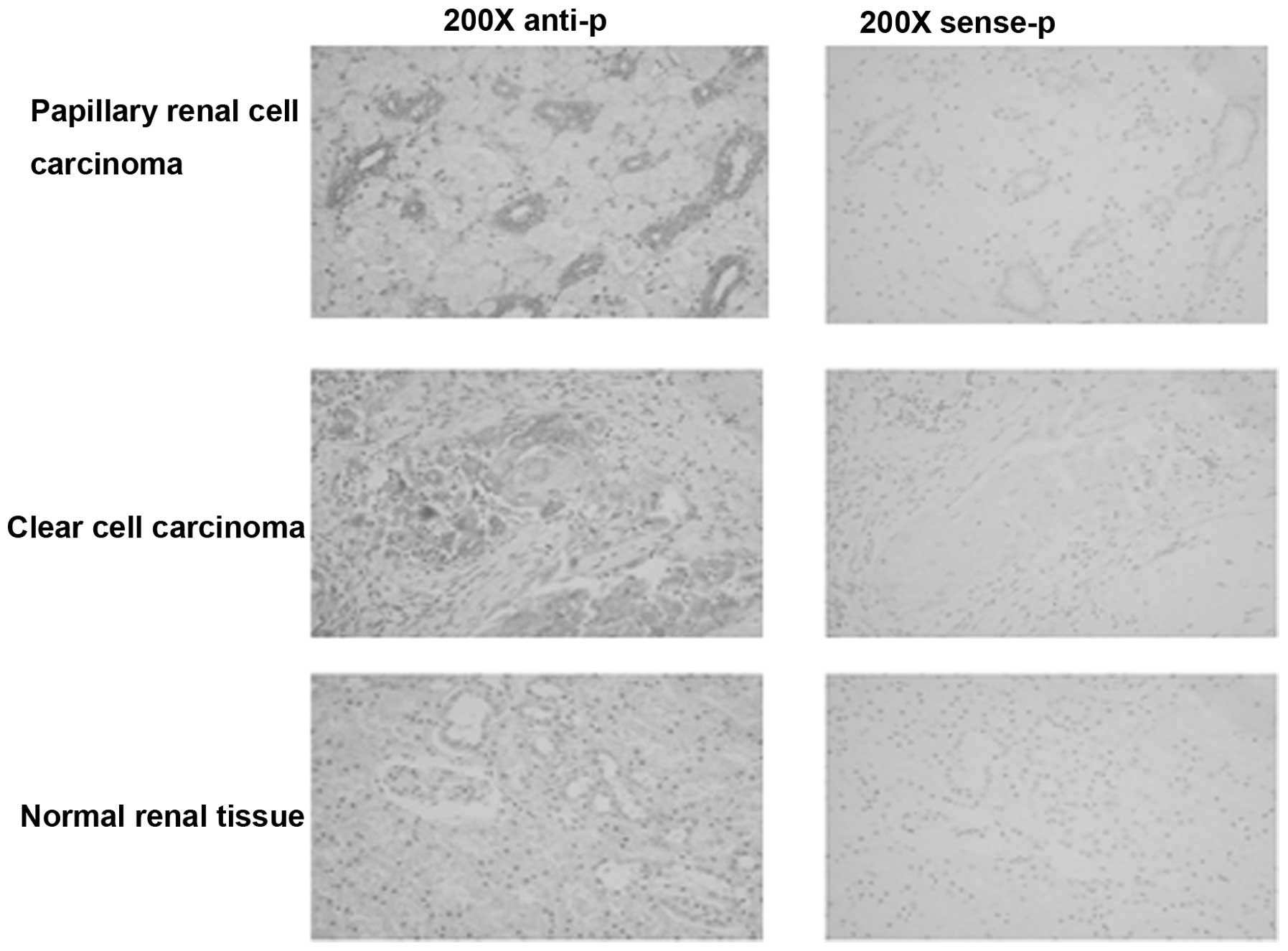
TMEM174 gene expression in the various malignant renal cancer and normal renal tissues was detected by RNA in situ hybridization. As shown in Table I and Fig. 1, TMEM174 exhibits differential expression in renal tissues. TMEM174 had a high positive rate of expression in squamous cell carcinoma with necrosis, papillary renal cell carcinoma and transitional cell carcinoma, and a low positive rate of expression in clear cell carcinoma, interstitial nephritis, undifferentiated carcinoma, retroperitoneal metastatic clear cell carcinoma, adrenal gland metastatic clear cell carcinoma, pelvic cavity metastatic chromophobe carcinoma, severe atypical hyperplasia of transitional epithelium and hyperplasia. Extremely weak expression was observe in collecting duct carcinoma, Wilms’ tumor, chronic pyelonephritis, acute pyelonephritis, cancer adjacent normal renal tissue and normal renal tissue.

Figure 1

RNA in situ hybridization showing expression of TMEM174 in differing tumor tissue samples. The expression of TMEM174 was significantly high in papillary renal cell carcinoma and renal clear cell carcinoma. Extremely weak expression was observed in normal renal tissue. TMEM174, transmembrane protein 174; p, probe.

Table I

Association between TMEM174 expression and renal pathological cell type.

Table I

Association between TMEM174 expression and renal pathological cell type.

Renal tumorsNumber of tumorsTMEM174 mRNA-positive rumors (0–1+/1+/2+/3+), nTMEM174 mRNA-negative tumors, n
Clear cell carcinoma5924 (9/12/3/0)35
Collecting duct carcinoma40 (0/0/0/0)4
Squamous cell carcinoma with necrosis109 (0/5/3/1)1
Wilms’ tumor204 (4/0/0/0)16
Papillary renal cell carcinoma2020 (3/8/9/0)0
Transitional cell carcinoma3532 (5/16/11/0)3
Undifferentiated carcinoma44 (2/2/0/0)0
Retroperitoneal metastatic clear cell carcinoma44 (0/4/0/0)0
Adrenal gland metastatic clear cell carcinoma44 (1/3/0/0)0
Pelvic cavity metastatic chromophobe carcinoma22 (0/2/0/0)0
Hyperplasia (sparse renal tubule tissue)22 (0/2/0/0)0
Severe atypical hyperplasia of transitional epithelium22 (0/2/0/0)0
Chronic pyelonephritis22 (2/0/0/0)0
Acute pyelonephritis21 (1/0/0/0)1
Interstitial nephritis64 (4/0/0/0)2
Cancer adjacent normal renal tissue2010 (10/0/0/0)10
Normal renal tissue104 (4/0/0/0)6

[i] Staining was scored using a 0–3+ scale. 0 indicates no staining; 0–1+, indicates trace staining that is weaker than 1+, but stronger than 0. Scores of 1+, 2+ and 3+ indicate an increased intensity of staining. Sub-regions excluding necrosis, macrophages and infiltrated neutrophils and lymphocytes were selected and scored. The intensity score for an array spot is the average of all its sub-regions. TMEM174, transmembrane protein 174.

Association between TMEM174 expression and renal pathological clinical stage

The association between TMEM174 expression and renal pathological clinical stage was analyzed. As shown in Table II, the THEM174 expression rate was 58% in phase I tissue samples, 50% in phase II tissue samples, 71% in phase III tissue samples and 50% in phase IV tissue samples.

Table II

Association between TMEM174 expression and renal pathological clinical stage.

Table II

Association between TMEM174 expression and renal pathological clinical stage.

Clinical stagenTMEM174 positive rate, %
I10858
II2650
III1471
IV450

[i] TMEM174, transmembrane protein 174.

Discussion

Each year in the United States, nearly 55,000 individuals are diagnosed with kidney cancer. In order to be effectively treated, an early diagnosis and effective surgical therapy are required. In more advanced-stage cases with involvement of the renal vein and lymph nodes or invasion through the renal cortex, surgical therapy frequently fails (4–8). Kidney cancer cell progression is a coordinated process that comprises cell cycle dysregulation and a specific gene expression program to determine tissue identity (9). The TMEM174 gene is highly expressed in the kidney tissues.

The AP-1 transcription factor is a heterodimeric protein formed from proteins of the c-Fos, ATF, c-Jun and JDP families. In response to a range of stimuli, including cytokines, stress, growth factors and viral and bacterial infections, AP-1 regulates gene expression (10). The cellular transcription factor cAMP-response element binding protein (CREB) binds to specific DNA sequences referred to as cAMP response elements (CREs), thereby regulating downstream gene transcription (11). TMEM174 overexpression has been shown to enhance the transcriptional activity of AP-1 and promote cell proliferation (2). In addition, our recent studies demonstrated that the CREB and AP-1 transcription factors are involved in the transcriptional regulation of the TMME174 gene (12).

When antibodies are not available, RNA in situ hybridization is a useful method that allows the determination of the transcriptional expression pattern of a gene (13). With this technique, the expression of multiple RNA species may be assayed using distinct RNA-labeled probes, or the RNA and protein localization within larval tissues may be examined. In the present study, RNA in situ hybridization analysis was used to detect the expression of TMEM174, and the results showed that its expression is varies among differing renal tissues. These results indicate that TMEM174 may have a significant role in the development of renal cancer.

Acknowledgements

This study was supported by grants from the National Natural Science Foundation of China (nos. 81072093, 30671092 and 81302323) and the Natural Science Foundation of Hebei Province (nos. C2009001260, C2014209140 and C2013209024).

References

1 

Wan D, Gong Y, Qin W, et al: Large-scale cDNA transfection screening for genes related to cancer development and progression. Proc Natl Acad Sci USA. 101:15724–15729. 2004.

2 

Wang P, Sun B, Hao D, Zhang X, Shi T and Ma D: Human TMEM174 that is highly expressed in kidney tissue activates AP-1 and promotes cell proliferation. Biochem Biophys Res Commun. 394:993–999. 2010.

3 

Greene FL, Page DL, Fleming ID, et al: AJCC Cancer Staging Manual. 6th edition. Springer-Verlag; New York: 2002

4 

Eto M and Naito S: Molecular targeting therapy for renal cell carcinoma. Int J Clin Oncol. 11:209–213. 2006.

5 

Costa LJ and Drabkin HA: Renal cell carcinoma: new developments in molecular biology and potential for targeted therapies. Oncologist. 12:1404–1415. 2007.

6 

Stillebroer AB, Oosterwijk E, Oyen WJ, Mulders PF and Boerman OC: Radiolabeled antibodies in renal cell carcinoma. Cancer Imaging. 7:179–188. 2007.

7 

Mellado B and Gascón P: Molecular biology of renal cell carcinoma. Clin Transl Oncol. 8:706–710. 2006.

8 

Weight CJ, Kaouk JH, Hegarty NJ, et al: Correlation of radiographic imaging and histopathology following cryoablation and radio frequency ablation for renal tumors. J Urol. 179:1277–1283. 2008.

9 

Chen X, Ruan A, Wang X, et al: miR-129-3p, as a diagnostic and prognostic biomarker for renal cell carcinoma, attenuates cell migration and invasion via downregulating multiple metastasis-related genes. J Cancer Res Clin Oncol. May 7–2014.(Epub ahead of print).

10 

Hess J, Angel P and Schorpp-Kistner M: AP-1 subunits: quarrel and harmony among siblings. J Cell Sci. 117:5965–5973. 2004.

11 

Bourtchuladze R, Frenguelli B, Blendy J, et al: Deficient long-term memory in mice with a targeted mutation of the cAMP-responsive element-binding protein. Cell. 79:59–68. 1994.

12 

Hu F, Meng Y, Gou L and Zhang X: Analysis of promoters and CREB/AP-1 binding sites of the human TMEM174 gene. Exp Ther Med. 6:1290–1294. 2013.

13 

Jensen E: Technical review: In situ hybridization. Anat Rec (Hoboken). 9–May;2014.(Epub ahead of print). DOI: 10.1002/ar.22944

Related Articles

  • Abstract
  • View
  • Download
  • Twitter
Copy and paste a formatted citation
Spandidos Publications style
Zhang X, Hu F, Meng L, Gou L and Luo M: Analysis of TMEM174 gene expression in various renal cancer types by RNA in situ hybridization. Oncol Lett 8: 1693-1696, 2014.
APA
Zhang, X., Hu, F., Meng, L., Gou, L., & Luo, M. (2014). Analysis of TMEM174 gene expression in various renal cancer types by RNA in situ hybridization. Oncology Letters, 8, 1693-1696. https://doi.org/10.3892/ol.2014.2393
MLA
Zhang, X., Hu, F., Meng, L., Gou, L., Luo, M."Analysis of TMEM174 gene expression in various renal cancer types by RNA in situ hybridization". Oncology Letters 8.4 (2014): 1693-1696.
Chicago
Zhang, X., Hu, F., Meng, L., Gou, L., Luo, M."Analysis of TMEM174 gene expression in various renal cancer types by RNA in situ hybridization". Oncology Letters 8, no. 4 (2014): 1693-1696. https://doi.org/10.3892/ol.2014.2393
Copy and paste a formatted citation
x
Spandidos Publications style
Zhang X, Hu F, Meng L, Gou L and Luo M: Analysis of TMEM174 gene expression in various renal cancer types by RNA in situ hybridization. Oncol Lett 8: 1693-1696, 2014.
APA
Zhang, X., Hu, F., Meng, L., Gou, L., & Luo, M. (2014). Analysis of TMEM174 gene expression in various renal cancer types by RNA in situ hybridization. Oncology Letters, 8, 1693-1696. https://doi.org/10.3892/ol.2014.2393
MLA
Zhang, X., Hu, F., Meng, L., Gou, L., Luo, M."Analysis of TMEM174 gene expression in various renal cancer types by RNA in situ hybridization". Oncology Letters 8.4 (2014): 1693-1696.
Chicago
Zhang, X., Hu, F., Meng, L., Gou, L., Luo, M."Analysis of TMEM174 gene expression in various renal cancer types by RNA in situ hybridization". Oncology Letters 8, no. 4 (2014): 1693-1696. https://doi.org/10.3892/ol.2014.2393
Follow us
  • Twitter
  • LinkedIn
  • Facebook
About
  • Spandidos Publications
  • Careers
  • Cookie Policy
  • Privacy Policy
How can we help?
  • Help
  • Live Chat
  • Contact
  • Email to our Support Team