Spandidos Publications Logo
  • About
    • About Spandidos
    • Aims and Scopes
    • Abstracting and Indexing
    • Editorial Policies
    • Reprints and Permissions
    • Job Opportunities
    • Terms and Conditions
    • Contact
  • Journals
    • All Journals
    • Oncology Letters
      • Oncology Letters
      • Information for Authors
      • Editorial Policies
      • Editorial Board
      • Aims and Scope
      • Abstracting and Indexing
      • Bibliographic Information
      • Archive
    • International Journal of Oncology
      • International Journal of Oncology
      • Information for Authors
      • Editorial Policies
      • Editorial Board
      • Aims and Scope
      • Abstracting and Indexing
      • Bibliographic Information
      • Archive
    • Molecular and Clinical Oncology
      • Molecular and Clinical Oncology
      • Information for Authors
      • Editorial Policies
      • Editorial Board
      • Aims and Scope
      • Abstracting and Indexing
      • Bibliographic Information
      • Archive
    • Experimental and Therapeutic Medicine
      • Experimental and Therapeutic Medicine
      • Information for Authors
      • Editorial Policies
      • Editorial Board
      • Aims and Scope
      • Abstracting and Indexing
      • Bibliographic Information
      • Archive
    • International Journal of Molecular Medicine
      • International Journal of Molecular Medicine
      • Information for Authors
      • Editorial Policies
      • Editorial Board
      • Aims and Scope
      • Abstracting and Indexing
      • Bibliographic Information
      • Archive
    • Biomedical Reports
      • Biomedical Reports
      • Information for Authors
      • Editorial Policies
      • Editorial Board
      • Aims and Scope
      • Abstracting and Indexing
      • Bibliographic Information
      • Archive
    • Oncology Reports
      • Oncology Reports
      • Information for Authors
      • Editorial Policies
      • Editorial Board
      • Aims and Scope
      • Abstracting and Indexing
      • Bibliographic Information
      • Archive
    • Molecular Medicine Reports
      • Molecular Medicine Reports
      • Information for Authors
      • Editorial Policies
      • Editorial Board
      • Aims and Scope
      • Abstracting and Indexing
      • Bibliographic Information
      • Archive
    • World Academy of Sciences Journal
      • World Academy of Sciences Journal
      • Information for Authors
      • Editorial Policies
      • Editorial Board
      • Aims and Scope
      • Abstracting and Indexing
      • Bibliographic Information
      • Archive
    • International Journal of Functional Nutrition
      • International Journal of Functional Nutrition
      • Information for Authors
      • Editorial Policies
      • Editorial Board
      • Aims and Scope
      • Abstracting and Indexing
      • Bibliographic Information
      • Archive
    • International Journal of Epigenetics
      • International Journal of Epigenetics
      • Information for Authors
      • Editorial Policies
      • Editorial Board
      • Aims and Scope
      • Abstracting and Indexing
      • Bibliographic Information
      • Archive
    • Medicine International
      • Medicine International
      • Information for Authors
      • Editorial Policies
      • Editorial Board
      • Aims and Scope
      • Abstracting and Indexing
      • Bibliographic Information
      • Archive
  • Articles
  • Information
    • Information for Authors
    • Information for Reviewers
    • Information for Librarians
    • Information for Advertisers
    • Conferences
  • Language Editing
Spandidos Publications Logo
  • About
    • About Spandidos
    • Aims and Scopes
    • Abstracting and Indexing
    • Editorial Policies
    • Reprints and Permissions
    • Job Opportunities
    • Terms and Conditions
    • Contact
  • Journals
    • All Journals
    • Biomedical Reports
      • Information for Authors
      • Editorial Policies
      • Editorial Board
      • Aims and Scope
      • Abstracting and Indexing
      • Bibliographic Information
      • Archive
    • Experimental and Therapeutic Medicine
      • Information for Authors
      • Editorial Policies
      • Editorial Board
      • Aims and Scope
      • Abstracting and Indexing
      • Bibliographic Information
      • Archive
    • International Journal of Epigenetics
      • Information for Authors
      • Editorial Policies
      • Editorial Board
      • Aims and Scope
      • Abstracting and Indexing
      • Bibliographic Information
      • Archive
    • International Journal of Functional Nutrition
      • Information for Authors
      • Editorial Policies
      • Editorial Board
      • Aims and Scope
      • Abstracting and Indexing
      • Bibliographic Information
      • Archive
    • International Journal of Molecular Medicine
      • Information for Authors
      • Editorial Policies
      • Editorial Board
      • Aims and Scope
      • Abstracting and Indexing
      • Bibliographic Information
      • Archive
    • International Journal of Oncology
      • Information for Authors
      • Editorial Policies
      • Editorial Board
      • Aims and Scope
      • Abstracting and Indexing
      • Bibliographic Information
      • Archive
    • Medicine International
      • Information for Authors
      • Editorial Policies
      • Editorial Board
      • Aims and Scope
      • Abstracting and Indexing
      • Bibliographic Information
      • Archive
    • Molecular and Clinical Oncology
      • Information for Authors
      • Editorial Policies
      • Editorial Board
      • Aims and Scope
      • Abstracting and Indexing
      • Bibliographic Information
      • Archive
    • Molecular Medicine Reports
      • Information for Authors
      • Editorial Policies
      • Editorial Board
      • Aims and Scope
      • Abstracting and Indexing
      • Bibliographic Information
      • Archive
    • Oncology Letters
      • Information for Authors
      • Editorial Policies
      • Editorial Board
      • Aims and Scope
      • Abstracting and Indexing
      • Bibliographic Information
      • Archive
    • Oncology Reports
      • Information for Authors
      • Editorial Policies
      • Editorial Board
      • Aims and Scope
      • Abstracting and Indexing
      • Bibliographic Information
      • Archive
    • World Academy of Sciences Journal
      • Information for Authors
      • Editorial Policies
      • Editorial Board
      • Aims and Scope
      • Abstracting and Indexing
      • Bibliographic Information
      • Archive
  • Articles
  • Information
    • For Authors
    • For Reviewers
    • For Librarians
    • For Advertisers
    • Conferences
  • Language Editing
Login Register Submit
  • This site uses cookies
  • You can change your cookie settings at any time by following the instructions in our Cookie Policy. To find out more, you may read our Privacy Policy.

    I agree
Search articles by DOI, keyword, author or affiliation
Search
Advanced Search
presentation
Oncology Letters
Join Editorial Board Propose a Special Issue
Print ISSN: 1792-1074 Online ISSN: 1792-1082
Journal Cover
November-2014 Volume 8 Issue 5

Full Size Image

Sign up for eToc alerts
Recommend to Library

Journals

International Journal of Molecular Medicine

International Journal of Molecular Medicine

International Journal of Molecular Medicine is an international journal devoted to molecular mechanisms of human disease.

International Journal of Oncology

International Journal of Oncology

International Journal of Oncology is an international journal devoted to oncology research and cancer treatment.

Molecular Medicine Reports

Molecular Medicine Reports

Covers molecular medicine topics such as pharmacology, pathology, genetics, neuroscience, infectious diseases, molecular cardiology, and molecular surgery.

Oncology Reports

Oncology Reports

Oncology Reports is an international journal devoted to fundamental and applied research in Oncology.

Experimental and Therapeutic Medicine

Experimental and Therapeutic Medicine

Experimental and Therapeutic Medicine is an international journal devoted to laboratory and clinical medicine.

Oncology Letters

Oncology Letters

Oncology Letters is an international journal devoted to Experimental and Clinical Oncology.

Biomedical Reports

Biomedical Reports

Explores a wide range of biological and medical fields, including pharmacology, genetics, microbiology, neuroscience, and molecular cardiology.

Molecular and Clinical Oncology

Molecular and Clinical Oncology

International journal addressing all aspects of oncology research, from tumorigenesis and oncogenes to chemotherapy and metastasis.

World Academy of Sciences Journal

World Academy of Sciences Journal

Multidisciplinary open-access journal spanning biochemistry, genetics, neuroscience, environmental health, and synthetic biology.

International Journal of Functional Nutrition

International Journal of Functional Nutrition

Open-access journal combining biochemistry, pharmacology, immunology, and genetics to advance health through functional nutrition.

International Journal of Epigenetics

International Journal of Epigenetics

Publishes open-access research on using epigenetics to advance understanding and treatment of human disease.

Medicine International

Medicine International

An International Open Access Journal Devoted to General Medicine.

Journal Cover
November-2014 Volume 8 Issue 5

Full Size Image

Sign up for eToc alerts
Recommend to Library

  • Article
  • Citations
    • Cite This Article
    • Download Citation
    • Create Citation Alert
    • Remove Citation Alert
    • Cited By
  • Similar Articles
    • Related Articles (in Spandidos Publications)
    • Similar Articles (Google Scholar)
    • Similar Articles (PubMed)
  • Download PDF
  • Download XML
  • View XML
Article

Oncolytic adenovirus-expressed RNA interference of O6‑methylguanine DNA methyltransferase activity may enhance the antitumor effects of temozolomide

  • Authors:
    • Xin-Jun Chen
    • Kai Zhang
    • Yong Xin
    • Guan Jiang
  • View Affiliations / Copyright

    Affiliations: Clinical Laboratory, The Second Affiliated Hospital of Xuzhou Medical College, Xuzhou, Jiangsu 221002, P.R. China, Department of Radiotherapy, Affiliated Hospital of Xuzhou Medical College, Xuzhou, Jiangsu 221002, P.R. China, Jiangsu Key Laboratory of Biological Cancer Therapy, Xuzhou Medical College, Xuzhou, Jiangsu 221000, P.R. China
  • Pages: 2201-2202
    |
    Published online on: August 12, 2014
       https://doi.org/10.3892/ol.2014.2442
  • Expand metrics +
Metrics: Total Views: 0 (Spandidos Publications: | PMC Statistics: )
Metrics: Total PDF Downloads: 0 (Spandidos Publications: | PMC Statistics: )
Cited By (CrossRef): 0 citations Loading Articles...

This article is mentioned in:


Abstract

Temozolomide (TMZ) is an example of an alkylating agent, which are known to be effective anticancer drugs for the treatment of various solid tumors, including glioma and melanoma. TMZ acts predominantly through the mutagenic product O6‑methylguanine, a cytotoxic DNA lesion. The DNA repair enzyme, O6‑methylguanine DNA methyltransferase (MGMT), which functions in the resistance of cancers to TMZ, can repair this damage. RNA interference (RNAi) has been previously shown to be a potent tool for the knockdown of genes, and has potential for use in cancer treatment. Oncolytic adenoviruses not only have the ability to destroy cancer cells, but may also be possible vectors for the expression of therapeutic genes. We therefore hypothesized that the oncolytic virus‑mediated RNAi of MGMT activity may enhance the antitumor effect of TMZ and provide a promising method for cancer therapy.

Perspective

As a relatively recently identified alkylating (methylating) agent, temozolomide (TMZ) has become a focus of attention, most notably in malignant glioma and melanoma treatment (1,2). Resistance to TMZ occurs following prolonged treatment and therefore poses a major therapeutic challenge. A key mechanism of the resistance to TMZ is the overexpression of O6-methylguanine-DNA methyl transferase (MGMT) (3). MGMT repairs the TMZ-induced DNA lesion, O6MeG, by removing the methyl group from guanine to a cysteine residue (4). Suppressing MGMT activity, therefore, could enhance the cytotoxicity of TMZ against melanoma and glioblastoma multiforme (4).

In previous years, we have focused our research on oncolytic virotherapy. Oncolytic viruses exhibit selective replication and lysis in tumor cells, while also amplifying the expression and functions of therapeutic gene in the tumor microenvironment (5). Two main strategies are used for oncolytic adenovirus generation. One strategy is the deletion of the viral element that is required for replication of the virus in normal cells, but is dispensable in tumor cells, such as ONYX-015 or ZD55 with E1B-55K gene deletion (6,7). The other strategy is the use of a tumor-specific promoter to drive the gene that is required for viral replication (8). In clinical trials, the E1B 55-kDa-deleted oncolytic virus, ONYX-015, or the ONYX-015 derivative, H101, have exhibited encouraging anticancer activity when combined with chemotherapy (9).

RNA interference (RNAi) technology is able to downregulate targeted genes and has been evaluated as a potential therapeutic strategy in human cancer therapy (10). The knockdown of DNA repair genes by small interfering RNA (siRNA) and virally delivered short hairpin RNA (shRNA), can sensitize various cancer cells to chemotherapeutic agents in vitro (11). A previous study has shown that the use of siRNA to transiently transfect nasopharyngeal carcinoma cells and glioma cells results in the inhibition of MGMT gene expression and increased sensitivity to bis-chloroethylnitrosourea (12). Similarly, a study by Kato et al (13) revealed that the transduction of TMZ-resistant glioma cells with a LipoTrust™ liposome, which contains siRNA to inhibit MGMT gene expression, enhanced the sensitivity of the glioma cells to TMZ.

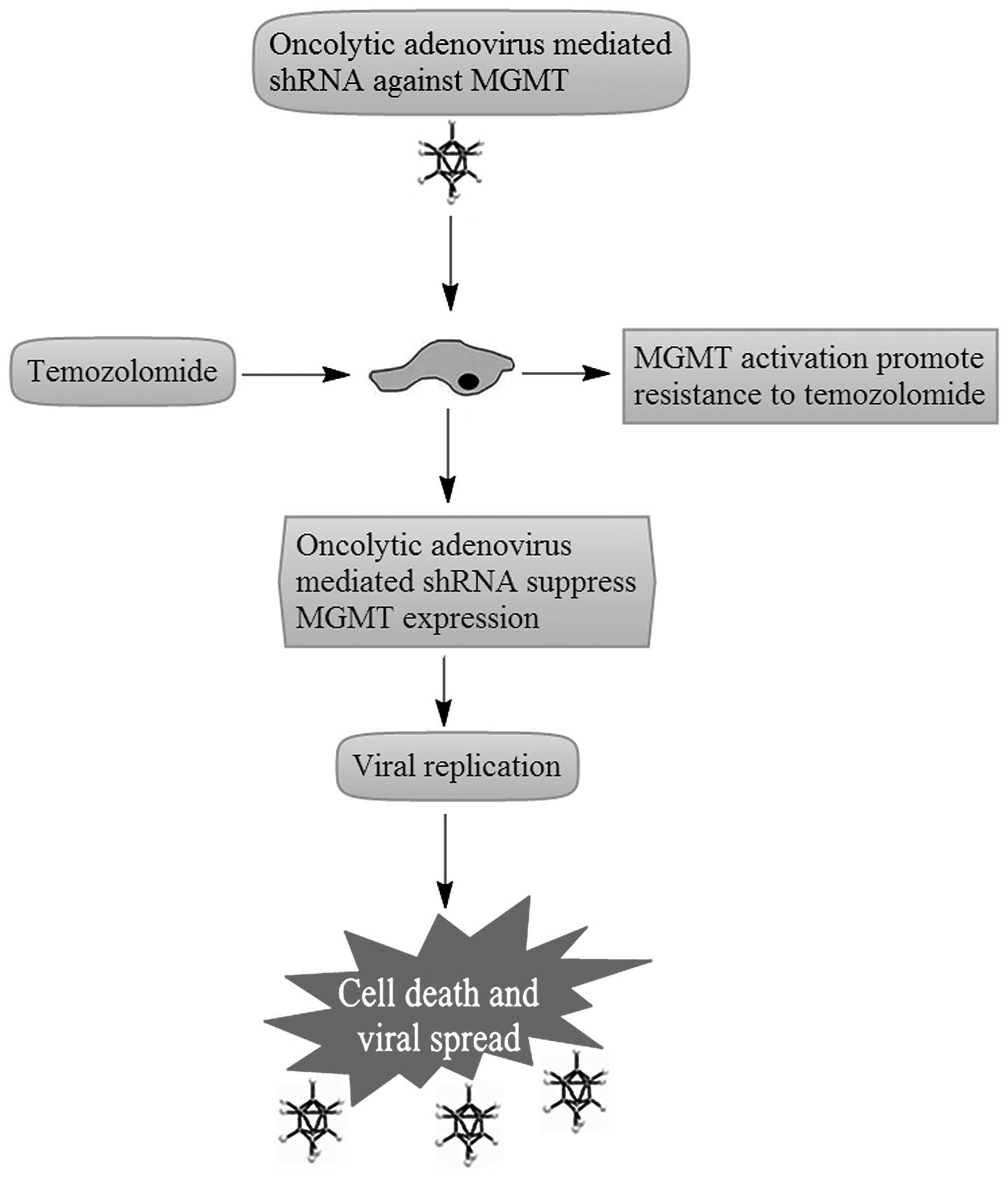
Zheng et al (14,15) focused on the production of several shRNA constructs using an oncolytic virus for delivery. Examples of these constructs included siRNAs against Ki67 and hTERT, which were observed to act as antiproliferative and apoptotic inducers in cancer cells. shRNA delivery via armed oncolytic viruses has potential for enhancing antitumor efficacy as a consequence of synergism between viral replication and oncolysis and shRNA antitumor responses (11). When conveying shRNA, oncolytic viruses are expected to effect a marked reduction in the tumor MGMT level, which should result in an increase in the cytotoxicity of TMZ (Fig. 1).

Figure 1

Schematic representation of MGMT downregulation by oncolytic adenovirus-armed shRNA to overcome temozolomide resistance in cancer cells. Following oncolytic adenovirus infection and replication, the inserted shRNA can target the DNA repair protein, MGMT, in tumor cells and multiply from several 100-fold to several 1,000-fold, in parallel with viral replication. The oncolytic adenovirus-armed shRNA targeting MGMT offers the advantage of an enhanced shRNA-mediated antitumor response through its intrinsic oncolytic activity. MGMT, O6-methylguanine DNA methyltransferase; shRNA, short hairpin RNA.

We hypothesize that the effects of the oncolytic virus-mediated RNAi of MGMT activity may enhance the cytotoxicity of TMZ in tumors for the following reasons: Firstly, the use of armed oncolytic viruses to deliver shRNA combines the advantages of gene therapy and virotherapy. The inserted shRNA can target the DNA repair protein, MGMT, in tumor cells and multiply by several 100- to several 1,000-fold in parallel with viral replication. The oncolytic adenovirus-armed shRNA targeting MGMT also offers the advantage of enhancing shRNA-mediated antitumor responses through its intrinsic oncolytic activity (10). Secondly, as a delivery agent that couples shRNA expression with viral replication, oncolytic adenoviruses can minimize the effects of off-target activity in normal cells, and facilitate, sustain and regenerate shRNA expression within the tumor microenvironment (15). Thirdly, as oncolytic adenovirus vectors and chemotherapeutic agents act by different mechanisms, there is a synergistic or additive effect rather than cross-resistance on the death of tumor cells (5).

The combination of these advantages and possibilities suggest that using oncolytic adenoviruses to deliver therapeutic shRNA targeting MGMT protein may be a powerful technique for overcoming resistance to TMZ in human cancers. This may result in a significantly enhanced antitumor outcome through MGMT-knockdown and viral oncolysis.

Acknowledgements

This study was supported by a grant from the National Natural Science Foundation of China (grant no. 81372916).

References

1 

O’Reilly SM, Newlands ES, Glaser MG, et al: Temozolomide: a new oral cytotoxic chemotherapeutic agent with promising activity against primary brain tumours. Eur J Cancer. 29A:940–942. 1993.

2 

Bleehen NM, Newlands ES, Lee SM, et al: Cancer Research Campaign phase II trial of temozolomide in metastatic melanoma. J Clin Oncol. 13:910–913. 1995.

3 

Plummer ER, Middleton MR, Jones C, et al: Temozolomide pharmacodynamics in patients with metastatic melanoma: DNA damage and activity of repair enzymes O6-alkylguanine alkyltransferase and poly(ADP-ribose) polymerase-1. Clin Cancer Res. 11:3402–3409. 2005.

4 

Fan CH, Liu WL, Cao H, et al: O6-methylguanine DNA methyltransferase as a promising target for the treatment of temozolomide-resistant gliomas. Cell Death Dis. 4:e8762013.

5 

Jiang G, Xin Y, Zheng JN and Liu YQ: Combining conditionally replicating adenovirus-mediated gene therapy with chemotherapy: a novel antitumor approach. Int J Cancer. 129:263–274. 2011.

6 

Bischoff JR, Kirn DH, Williams A, et al: An adenovirus mutant that replicates selectively in p53-deficient human tumor cells. Science. 274:373–376. 1996.

7 

Heise C, Hermiston T, Johnson L, et al: An adenovirus E1A mutant that demonstrates potent and selective systemic anti-tumoral efficacy. Nat Med. 6:1134–1139. 2000.

8 

Rodriguez R, Schuur ER, Lim HY, et al: Prostate attenuated replication competent adenovirus (ARCA) CN706: a selective cytotoxic for prostate-specific antigen-positive prostate cancer cells. Cancer Res. 57:2559–2563. 1997.

9 

Garber K: China approves world’s first oncolytic virus therapy for cancer treatment. J Natl Cancer Inst. 98:298–300. 2006.

10 

Chu L, Gu J, Sun L, et al: Oncolytic adenovirus-mediated shRNA against Apollon inhibits tumor cell growth and enhances antitumor effect of 5-fluorouracil. Gene Ther. 15:484–494. 2008.

11 

Jiang G, Li LT, Xin Y, et al: Strategies to improve the killing of tumors using temozolomide: targeting the DNA repair protein MGMT. Curr Med Chem. 19:3886–3892

12 

Kuo CC, Liu JF and Chang JY: DNA repair enzyme, O6-methylguanine DNA methyltransferase, modulates cytotoxicity of camptothecin-derived topoisomerase I inhibitors. J Pharmacol Exp Ther. 316:946–954. 2006.

13 

Kato T, Natsume A, Toda H, et al: Efficient delivery of liposome-mediated MGMT-siRNA reinforces the cytotoxity of temozolomide in GBM-initiating cells. Gene Ther. 17:1363–1371. 2010.

14 

Zheng JN, Pei DS, Mao LJ, et al: Inhibition of renal cancer cell growth in vitro and in vivo with oncolytic adenovirus armed short hairpin RNA targeting Ki-67 encoding mRNA. Cancer Gene Ther. 16:20–32. 2009.

15 

Zheng JN, Pei DS, Sun FH, et al: Inhibition of renal cancer cell growth by oncolytic adenovirus armed short hairpin RNA targeting hTERT gene. Cancer Biol Ther. 8:84–91. 2009.

Related Articles

  • Abstract
  • View
  • Download
  • Twitter
Copy and paste a formatted citation
Spandidos Publications style
Chen X, Zhang K, Xin Y and Jiang G: Oncolytic adenovirus-expressed RNA interference of O6‑methylguanine DNA methyltransferase activity may enhance the antitumor effects of temozolomide. Oncol Lett 8: 2201-2202, 2014.
APA
Chen, X., Zhang, K., Xin, Y., & Jiang, G. (2014). Oncolytic adenovirus-expressed RNA interference of O6‑methylguanine DNA methyltransferase activity may enhance the antitumor effects of temozolomide. Oncology Letters, 8, 2201-2202. https://doi.org/10.3892/ol.2014.2442
MLA
Chen, X., Zhang, K., Xin, Y., Jiang, G."Oncolytic adenovirus-expressed RNA interference of O6‑methylguanine DNA methyltransferase activity may enhance the antitumor effects of temozolomide". Oncology Letters 8.5 (2014): 2201-2202.
Chicago
Chen, X., Zhang, K., Xin, Y., Jiang, G."Oncolytic adenovirus-expressed RNA interference of O6‑methylguanine DNA methyltransferase activity may enhance the antitumor effects of temozolomide". Oncology Letters 8, no. 5 (2014): 2201-2202. https://doi.org/10.3892/ol.2014.2442
Copy and paste a formatted citation
x
Spandidos Publications style
Chen X, Zhang K, Xin Y and Jiang G: Oncolytic adenovirus-expressed RNA interference of O6‑methylguanine DNA methyltransferase activity may enhance the antitumor effects of temozolomide. Oncol Lett 8: 2201-2202, 2014.
APA
Chen, X., Zhang, K., Xin, Y., & Jiang, G. (2014). Oncolytic adenovirus-expressed RNA interference of O6‑methylguanine DNA methyltransferase activity may enhance the antitumor effects of temozolomide. Oncology Letters, 8, 2201-2202. https://doi.org/10.3892/ol.2014.2442
MLA
Chen, X., Zhang, K., Xin, Y., Jiang, G."Oncolytic adenovirus-expressed RNA interference of O6‑methylguanine DNA methyltransferase activity may enhance the antitumor effects of temozolomide". Oncology Letters 8.5 (2014): 2201-2202.
Chicago
Chen, X., Zhang, K., Xin, Y., Jiang, G."Oncolytic adenovirus-expressed RNA interference of O6‑methylguanine DNA methyltransferase activity may enhance the antitumor effects of temozolomide". Oncology Letters 8, no. 5 (2014): 2201-2202. https://doi.org/10.3892/ol.2014.2442
Follow us
  • Twitter
  • LinkedIn
  • Facebook
About
  • Spandidos Publications
  • Careers
  • Cookie Policy
  • Privacy Policy
How can we help?
  • Help
  • Live Chat
  • Contact
  • Email to our Support Team