Introduction
Colorectal cancer (CRC) is the fourth leading cause
of cancer-associated mortality in males and the third leading cause
in females worldwide (1). It is
estimated that 1,200,000 new cases of CRC and 608,700
CRC-associated mortalities occurred in 2008 (1). As >95% of patients with CRC would
benefit from curative surgery if diagnosed at an earlier or
precancerous stage (2), it is
important to develop highly sensitive and specific assays to detect
CRC earlier, which are non-invasive, inexpensive and easy to
perform. To date, a large number of methods have been developed for
the early detection of CRC, including endoscopic examinations and
blood- and stool-based tests (2).
Colonoscopy is regarded as the gold standard procedure due to its
capacity to identify and remove precancerous and cancerous lesions.
However, due to its invasiveness, patient compliance with this
procedure is poor. Although various blood tests using protein,
cytological, microRNA and DNA markers have been investigated, the
majority are not suitable for clinical application (3). The main approach used for CRC
screening worldwide is the fecal occult blood test (FOBT) (3). However, the sensitivity of the FOBT
for CRC diagnosis is only 26% for the detection of carcinoma and
12% for advanced adenoma (4).
Furthermore, FOBT presents the risk of false-positive results in
patients with hemorrhoids, ulcers and inflammatory bowel disease
(5–7). To avoid the disadvantages of the FOBT,
more sensitive and specific screening methods are required.
A variety of fecal molecular markers, including
mutations of oncogenes and tumor suppressor genes, microsatellite
instability and microRNA and DNA methylation may increase the
sensitivity of CRC screening (8–14). In
particular, the fecal long DNA assay appears to present a valid and
reliable method for the detection of CRC (15–19).
Long DNA is DNA from cancerous or precancerous cells, which is shed
from dysplastic mucosa, and thus maintains a longer-fragment DNA
form due to its resistance to the apoptotic process (20). By contrast, during the apoptotic
process, DNA is cleaved and a 200 bp DNA fragment is yielded
(21). Although various advanced
technologies have been applied to analyze long DNA markers in
stools, such time-consuming and expensive methods are not
appropriate for the screening of CRC. In the current study, a long
DNA assay was performed using polymerase chain reaction (PCR) and
electrophoresis and the combination of different long DNA markers
was found to increase the diagnostic performance of this method for
CRC detection.
Materials and methods
Clinical samples
Stool samples were obtained from 54 healthy
volunteers and 130 patients with CRC prior to surgical treatment.
The clinicopathological features of the patients are shown in
Table I. The mean age of the
patients was 68.1 years (range, 37–94 years; 84 males and 46
females). A total of eight patients exhibited stage 0, 47 exhibited
stage I, 24 exhibited stage II, 33 exhibited stage III and 18
exhibited stage IV CRC according to the Japanese Society for Cancer
of the Colon and Rectum staging system (22). A total of 40 patients had
right-sided CRC (proximal CRC) involving the cecum, ascending colon
and transverse colon and 90 patients had left-sided CRC (distal
CRC), involving the descending colon, sigmoid colon and rectum. The
study protocol was approved by the ethics committee of Yamaguchi
University Graduate School of Medicine (Ube, Japan) and informed
consent was obtained from each patient and the volunteers.
 | Table ISummary of the clinical patient data
(n=130). |
Table I
Summary of the clinical patient data
(n=130).
| Clinical
Parameters | n |
|---|
| Gender |
| Male | 84 |
| Female | 46 |
| Mean age, years
(range) | 68.1 (37–94) |
| Stage |
| 0 | 8 |
| I | 47 |
| II | 24 |
| III | 33 |
| IV | 18 |
| Tumor site |
| Ascending colon | 27 |
| Transverse
colon | 13 |
| Descending
colon | 9 |
| Sigmoid colon | 43 |
| Rectum | 38 |
DNA extraction
Fecal specimens were obtained from Yamaguchi
University Hospital (Ube, Japan) and stored at −20°C prior to DNA
extraction. Fecal samples were thawed and 100–200 mg of fecal
samples were used for DNA extraction. The DNA was extracted using
the QIAamp DNA Stool Mini kit (Qiagen, Hilden, Germany) according
to the manufacturer’s instructions. Extracted DNA was diluted to a
final concentration of 20 ng/μl.
PCR
PCR was performed for four different genes,
including adenomatosis polyposis coli (APC), B-raf proto-oncogene,
serine/threonine kinase (BRAF), Kirsten rat sarcoma viral oncogene
homolog (KRAS) and p53 for the stool long DNA tests. The PCR
reaction was performed using 40 ng of DNA, 1X Buffer II (Applied
Biosystems Life Technologies, Foster City, CA, USA), 1.5 mM
MgCl2, 0.8 mM dNTPs, 1 μM of each primer, 3% dimethyl
sulfoxide, and 0.25 U AmpliTaq Gold DNA polymerase (Applied
Biosystems Life Technologies) in a total volume of 10 μl. The
primers used are shown in Table
II. Cycling conditions included preheating at 95°C for 7 min
followed by 45 cycles of denaturation at 95°C for 45 sec, annealing
at 60°C for 30 sec and extension at 72°C for 1 min. β-actin
(Fasmac, Kanagawa, Japan) was amplified as an internal control. The
PCR products were then electrophoresed on 2% agarose gel and
visualized by ethidium bromide staining.
| Table IIPrimer sequences used for polymerase
chain reaction. |
Table II
Primer sequences used for polymerase
chain reaction.
| Gene | Primer sequence | Primer
Tm,°C | Bp, n |
|---|
| APC | Forward:
5′-TATGCGTGTCAACTGCCATC-3′ | 63.2 | 800 |
| Reverse:
5′-CTCTGTTTTGGCGACGTCTA-3′ | 63.8 | |
| KRAS | Forward:
5′-AGACTTGGGAGTCTTCGATCC-3′ | 63.3 | 800 |
| Reverse:
5′-CTTACTGGCACCTAGGTTAG-3′ | 64.0 | |
| BRAF | Forward:
5′-CCATAGCATGAAGGCAGGTT-3′ | 63.8 | 800 |
| Reverse:
5′-CGTGTCGGTTTCAATCACGT-3′ | 63.2 | |
| p53 | Forward:
5′-TCACCATCGCTATCTGAGCA-3′ | 64.7 | 800 |
| Reverse:
5′-AAACCCTGTCCTCAGTCTCTAG-3′ | 63.8 | |
| β-actin | Forward:
5′-TCATCTTCTCGCGGTTGGC-3′ | 68.8 | 103 |
| Reverse:
5′-CGGTTGGCGCTCTTCTACT-3′ | 66.9 | |
Statistical analysis
Statistical analysis was performed using GraphPad
Prism version 6.0 and GraphPad InStat version 3.0 statistical
software (GraphPad Software, La Jolla, CA, USA). To compare
variables, Pearson’s χ2 and Fisher’s tests were used and
P<0.05 was considered to indicate a statistically significant
difference.
Results
Long DNA
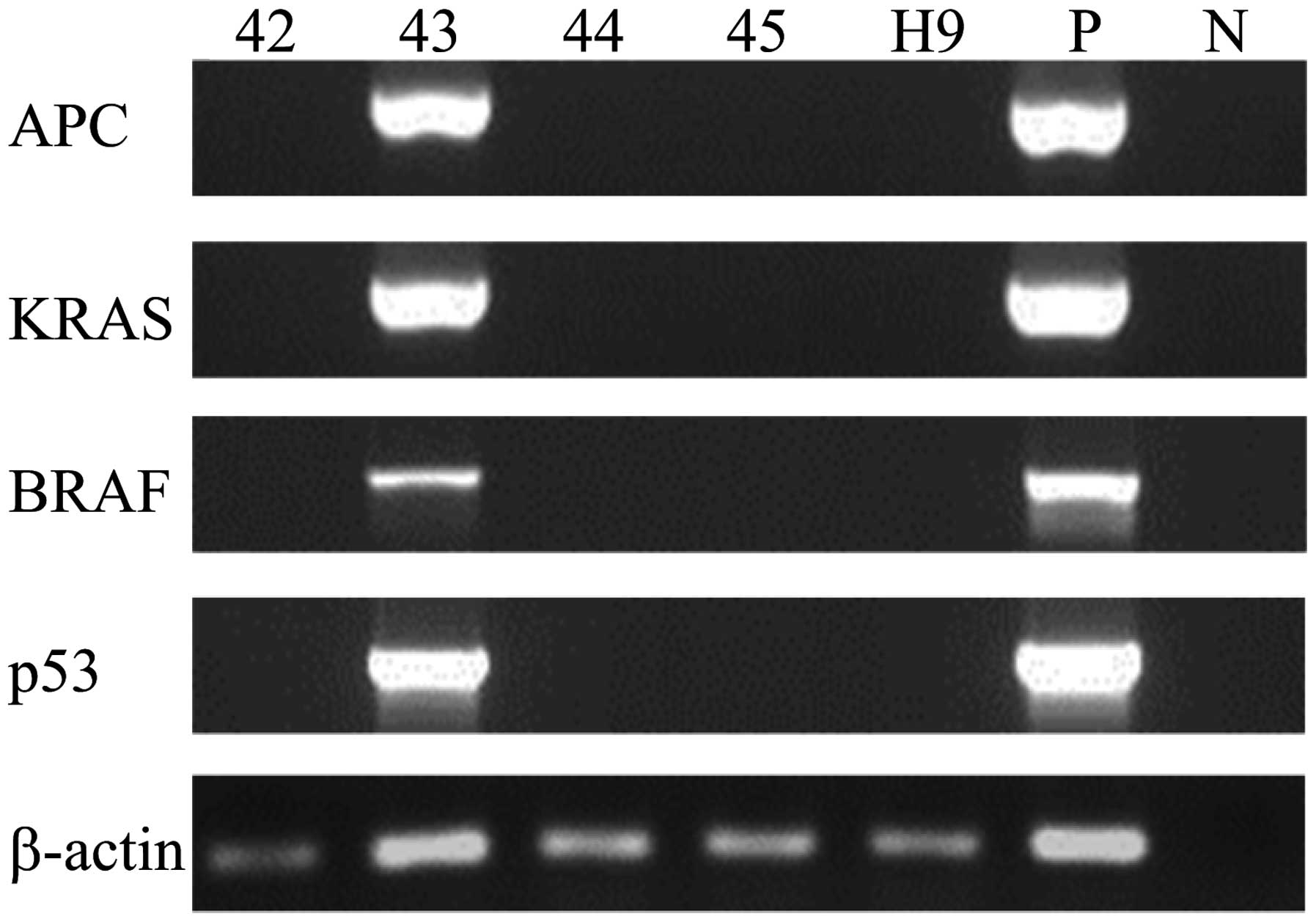
A representative result obtained from the long DNA
assays following gel electrophoresis is shown in Fig. 1. The frequency of long DNA of the
four genes was significantly higher in the feces of the CRC
patients than that of the controls (Table III). APC long DNA was
identified in the feces of 60/130 (46.2%) patients with CRC and
1/54 (1.9%) of the controls (P<0.0001). KRAS long DNA was
identified in 50/130 (38.5%) CRC patients and 1/54 (1.9%) controls
(P<0.0001). BRAF long DNA was identified in 51/130
(39.2%) CRC patients and 0/54 (0.0%) controls (p<0.0001).
p53 long DNA was identified in 44/130 (33.8%) CRC patients
and 0/54 (0.0%) controls (P<0.0001). Furthermore, a combination
of the four genes exhibited a sensitivity of 56.2% and a
specificity of 96.3% for the detection of CRC (P<0.0001).
| Table IIIComparison of long DNA with
clinicopathological parameters. |
Table III
Comparison of long DNA with
clinicopathological parameters.
| Clinicopathological
parameters (n) | APC, n (%) | KRAS, n (%) | BRAF, n (%) | p53, n (%) | Biomarker panel, n
(%) |
|---|
| Patients |
| CRC (130) | 60 (46.2) | 50 (38.5) | 51 (39.2) | 44 (33.8) | 73 (56.2) |
| Control (54) | 1 (1.9) | 1 (1.9) | 0 (0) | 0 (0) | 2 (3.7) |
| P value | <0.0001 | <0.0001 | <0.0001 | <0.0001 | <0.0001 |
| Gender |
| Male (84) | 42 (50) | 33 (39.3) | 35 (41.7) | 30 (35.7) | 50 (59.5) |
| Female (46) | 18 (39.1) | 17 (37.0) | 16 (34.8) | 14 (30.4) | 23 (50.0) |
| P-value | NS | NS | NS | NS | NS |
| Tumor site |
| Proximal (40) | 11 (27.5) | 7 (17.5) | 8 (20.0) | 7 (17.5) | 15 (37.5) |
| Distal (90) | 49 (54.4) | 43 (47.8) | 43 (47.8) | 37 (41.1) | 58 (64.4) |
| P-value | 0.0072 | 0.001 | 0.0033 | 0.0093 | 0.0069 |
| TNM stage |
| 0 (8) | 3 (37.5) | 2 (25.0) | 2 (25.0) | 2 (25.0) | 3 (37.5) |
| I (47) | 23 (48.9) | 21 (44.7) | 21 (44.7) | 16 (34.0) | 29 (61.7) |
| II (24) | 10 (41.7) | 9 (37.5) | 11 (48.5) | 10 (41.7) | 12 (50.0) |
| III (33) | 13 (39.4) | 11 (33.3) | 12 (36.4) | 9 (27.3) | 16 (48.5) |
| IV (18) | 11 (61.1) | 7 (38.9) | 5 (27.8) | 7 (38.9) | 13 (72.2) |
| P-value | NS | NS | NS | NS | NS |
Association between long DNA and
clinicopathological parameters
The association between long DNA and
clinicopathological features is shown in Table III. No significant difference was
identified between long DNA and gender or tumor stage. The
frequency of long DNA was significantly higher in the feces of
patients with distal CRC when compared with that in the feces of
patients with proximal CRC. APC long DNA was identified in
49/90 (54.4%) patients with distal CRC and 11/40 (27.5%) patients
with proximal CRC (P=0.0072). KRAS long DNA was identified
in 43/90 (47.8%) patients with distal CRC and 7/40 (17.5%) patients
with proximal CRC (p=0.0010). BRAF long DNA was identified
in 43/90 (47.8%) patients with distal CRC and 8/40 (20%) patients
with proximal CRC (P=0.0033). p53 long DNA was identified in
37/90 (41.1%) patients with distal CRC and in 7/40 (17.5%) patients
with proximal CRC (P=0.0093). Furthermore, one or more of the four
long DNAs was identified in 58/90 (64.4%) patients with distal CRC
and 15/40 (37.5%) patients with proximal CRC (P=0.0069).
Discussion
In the current study, the efficacy of fecal long DNA
as a potential marker for CRC screening was demonstrated. Longer
template DNA is an epigenetic phenomenon that is consistent with
the known abrogation of apoptosis that occurs with CRC (20,23).
It is hypothesized that nonapoptotic cells are exfoliated from
neoplasms (24), however, by
contrast, colonocyte shedding from normal mucosa is relatively
sparse and sloughed cells appear to be largely apoptotic (20,24).
In addition, apoptosis of normal cells rapidly occurs following
detachment from their basement membrane (25). As the cleavage of DNA by
endonucleases into fragments of 180–200 bp (21,26) is
an attribute of apoptosis, it follows that human DNA in normal
stools would exist primarily in fragmented forms. However, the
stools of CRC patients are also expected to contain nonapoptotic
long DNA. In the current study, a long DNA assay based on PCR of an
800 bp length amplicon of APC, KRAS, BRAF and
p53 genes was performed for CRC screening. These genes were
selected based on the study by Kalimutho et al (14), however, the primers were redesigned
to yield a shorter amplicon size than that used in the previous
study (1015–1340 bp) (14). The
sensitivity of the long DNA assay using a combination of the four
genes was increased when compared with that of each single gene
alone. In addition, the sensitivity was higher in distal CRC than
in proximal CRC. The effective detection of distal colon neoplasms
is critical, as >70% of CRCs occur in the distal colon (27).
Alu-based PCR (Alu-PCR) and quantitative-denaturing
high performance liquid chromatography (QdHPLC)-PCR methods have
also been used to detect fecal long DNA for CRC screening (14,28).
The sensitivity of Alu-PCR was marginally lower (44.0%) and its
specificity was marginally higher (100.0%) when compared with the
results of the present study (sensitivity, 56.2%; specificity,
96.3%) (P<0.0001) (28).
QdHPLC-PCR, which evaluates PCR amplicons of the same four genes
used in the present study (APC, KRAS, p53 and BRAF) (14), exhibited a higher sensitivity
(78.6%) and a marginally lower specificity (91.6%) for CRC
screening when compared with the results of the present study
(sensitivity, 56%; specificity, 96%) (P<0.0001). The predominant
disadvantage of QdHPLC-PCR is the requirement for expensive
equipment, which results in costly tests. By contrast, the method
used in this study requires only a thermal cycler and an
electrophoresis device, thus allowing the detection of the long DNA
with minimal expense.
In conclusion, the current study indicates that the
detection of fecal long DNA by PCR and electrophoresis is a valid,
feasible and inexpensive method for the identification of patients
with CRC, particularly in patients with distal CRC. However, as
sensitivities of 56.2% for the detection of CRC and 64.4% for the
detection of distal CRC by the long DNA assay alone require
improvement, further optimization of the long DNA assay in
combination with other methods including FOBT and other stool DNA
tests are needed for future clinical use. In addition, further
studies of long DNA assays for the identification of patients with
advanced adenoma are also required.
References
|
1
|
Jemal A, Bray F, Center MM, Ferlay J, Ward
E and Forman D: Global cancer statistics. CA Cancer J Clin.
61:69–90. 2011. View Article : Google Scholar : PubMed/NCBI
|
|
2
|
Pawa N, Arulampalam T and Norton JD:
Screening for colorectal cancer: established and emerging
modalities. Nat Rev Gastroenterol Hepatol. 8:711–722. 2011.
View Article : Google Scholar : PubMed/NCBI
|
|
3
|
Di Lena M, Travaglio E and Altomare DF:
New strategies for colorectal cancer screening. World J
Gastroenterol. 19:1855–1860. 2013. View Article : Google Scholar : PubMed/NCBI
|
|
4
|
Ahlquist DA and Shuber AP: Stool screening
for colorectal cancer: evolution from occult blood to molecular
markers. Clin Chim Acta. 315:157–168. 2002. View Article : Google Scholar
|
|
5
|
van Turenhout ST, Oort FA, Terhaar sive
Droste JS, et al: Hemorrhoids detected at colonoscopy: an
infrequent cause of false-positive fecal immunochemical test
results. Gastrointest Endosc. 76:136–143. 2012. View Article : Google Scholar : PubMed/NCBI
|
|
6
|
van Rossum LG, van Rijn AF, Laheij RJ, et
al: Random comparison of guaiac and immunochemical fecal occult
blood tests for colorectal cancer in a screening population.
Gastroenterology. 135:82–90. 2008. View Article : Google Scholar : PubMed/NCBI
|
|
7
|
Velez JP, Schwesinger WH, Stauffer J, et
al: Bidirectional endoscopy in patients with fecal occult blood.
Surg Endosc. 16:117–120. 2002. View Article : Google Scholar : PubMed/NCBI
|
|
8
|
Luo X, Stock C, Burwinkel B and Brenner H:
Identification and evaluation of plasma microRNAs for early
detection of colorectal cancer. PLoS One. 8:e628802013. View Article : Google Scholar : PubMed/NCBI
|
|
9
|
Carmona FJ, Azuara D, Berenguer-Llergo A,
et al: DNA methylation biomarkers for noninvasive diagnosis of
colorectal cancer. Cancer Prev Res (Phila). 6:656–665. 2013.
View Article : Google Scholar
|
|
10
|
Calistri D, Rengucci C, Bocchini R, et al:
Fecal multiple molecular tests to detect colorectal cancer in
stool. Clin Gastroenterol Hepatol. 1:377–383. 2003. View Article : Google Scholar
|
|
11
|
Leung WK, To KF, Man EP, et al: Detection
of epigenetic changes in fecal DNA as a molecular screening test
for colorectal cancer: a feasibility study. Clin Chem.
50:2179–2182. 2004. View Article : Google Scholar : PubMed/NCBI
|
|
12
|
Dong SM, Traverso G, Johnson C, et al:
Detecting colorectal cancer in stool with the use of multiple
genetic targets. J Natl Cancer Inst. 93:858–865. 2001. View Article : Google Scholar : PubMed/NCBI
|
|
13
|
Leung WK, To KF, Man EP, et al: Detection
of hypermethylated DNA or cyclooxygenase-2 messenger RNA in fecal
samples of patients with colorectal cancer or polyps. Am J
Gastroenterol. 102:1070–1076. 2007. View Article : Google Scholar : PubMed/NCBI
|
|
14
|
Kalimutho M, Del Vecchio Blanco G,
Cretella M, et al: A simplified, non-invasive fecal-based DNA
integrity assay and iFOBT for colorectal cancer detection. Int J
Colorectal Dis. 26:583–592. 2011. View Article : Google Scholar : PubMed/NCBI
|
|
15
|
Loganayagam A: Faecal screening of
colorectal cancer. Int J Clin Pract. 62:454–459. 2008. View Article : Google Scholar
|
|
16
|
Ahlquist DA: Molecular detection of
colorectal neoplasia. Gastroenterology. 138:2127–2139. 2010.
View Article : Google Scholar : PubMed/NCBI
|
|
17
|
Boynton KA, Summerhayes IC, Ahlquist DA
and Shuber AP: DNA integrity as a potential marker for stool-based
detection of colorectal cancer. Clin Chem. 49:1058–1065. 2003.
View Article : Google Scholar : PubMed/NCBI
|
|
18
|
Kalimutho M, del Blanco GV, Gravina P, et
al: Quantitative denaturing high performance liquid chromatography
(Q-dHPLC) detection of APC long DNA in faeces from patients with
colorectal cancer. Clin Chem Lab Med. 48:1303–1311. 2010.
View Article : Google Scholar : PubMed/NCBI
|
|
19
|
Calistri D, Rengucci C, Molinari C, et al:
Quantitative fluorescence determination of long-fragment DNA in
stool as a marker for the early detection of colorectal cancer.
Cell Oncol. 31:11–17. 2009.
|
|
20
|
Bedi A, Pasricha PJ, Akhtar AJ, et al:
Inhibition of apoptosis during development of colorectal cancer.
Cancer Res. 55:1811–1816. 1995.PubMed/NCBI
|
|
21
|
Arends MJ, Morris RG and Wyllie AH:
Apoptosis. The role of the endonuclease. Am J Pathol. 136:593–608.
1990.PubMed/NCBI
|
|
22
|
Japanese Society for Cancer of the Colon
and Rectum. Japanese Classification of Colorectal Carcinoma. 8th
edition. Kanehara & Co., Ltd; Tokyo: pp. 172013
|
|
23
|
Tsujitani S, Shirai H, Tatebe S, et al:
Apoptotic cell death and its relationship to carcinogenesis in
colorectal carcinoma. Cancer. 77(Suppl 8): 1711–1716. 1996.
View Article : Google Scholar : PubMed/NCBI
|
|
24
|
Ahlquist DA, Harrington JJ, Burgart LJ and
Roche PC: Morphometric analysis of the “mucocellular layer”
overlying colorectal cancer and normal mucosa: relevance to
exfoliation and stool screening. Human Pathol. 31:51–57. 2000.
View Article : Google Scholar
|
|
25
|
Sträter J, Wedding U, Barth TF, Koretz K,
Elsing C and Möller P: Rapid onset of apoptosis in vitro follows
disruption of beta 1-integrin/matrix interactions in human colonic
crypt cells. Gastroenterology. 110:1776–1784. 1996. View Article : Google Scholar : PubMed/NCBI
|
|
26
|
Peitsch MC, Mannherz HG and Tschopp J: The
apoptosis endonucleases: cleaning up after cell death? Trends Cell
Biol. 4:37–41. 1994. View Article : Google Scholar : PubMed/NCBI
|
|
27
|
Caldarella A, Crocetti E, Messerini L and
Paci E: Trends in colorectal incidence by anatomic subsite from
1985 to 2005: a population-based study. Int J Colorectal Dis.
28:637–641. 2013. View Article : Google Scholar : PubMed/NCBI
|
|
28
|
Zou H, Harrington JJ, Klatt KK and
Ahlquist DA: A sensitive method to quantify human long DNA in
stool: relevance to colorectal cancer screening. Cancer Epidemiol
Biomarkers Prev. 15:1115–1119. 2006. View Article : Google Scholar : PubMed/NCBI
|