Spandidos Publications Logo
  • About
    • About Spandidos
    • Aims and Scopes
    • Abstracting and Indexing
    • Editorial Policies
    • Reprints and Permissions
    • Job Opportunities
    • Terms and Conditions
    • Contact
  • Journals
    • All Journals
    • Oncology Letters
      • Oncology Letters
      • Information for Authors
      • Editorial Policies
      • Editorial Board
      • Aims and Scope
      • Abstracting and Indexing
      • Bibliographic Information
      • Archive
    • International Journal of Oncology
      • International Journal of Oncology
      • Information for Authors
      • Editorial Policies
      • Editorial Board
      • Aims and Scope
      • Abstracting and Indexing
      • Bibliographic Information
      • Archive
    • Molecular and Clinical Oncology
      • Molecular and Clinical Oncology
      • Information for Authors
      • Editorial Policies
      • Editorial Board
      • Aims and Scope
      • Abstracting and Indexing
      • Bibliographic Information
      • Archive
    • Experimental and Therapeutic Medicine
      • Experimental and Therapeutic Medicine
      • Information for Authors
      • Editorial Policies
      • Editorial Board
      • Aims and Scope
      • Abstracting and Indexing
      • Bibliographic Information
      • Archive
    • International Journal of Molecular Medicine
      • International Journal of Molecular Medicine
      • Information for Authors
      • Editorial Policies
      • Editorial Board
      • Aims and Scope
      • Abstracting and Indexing
      • Bibliographic Information
      • Archive
    • Biomedical Reports
      • Biomedical Reports
      • Information for Authors
      • Editorial Policies
      • Editorial Board
      • Aims and Scope
      • Abstracting and Indexing
      • Bibliographic Information
      • Archive
    • Oncology Reports
      • Oncology Reports
      • Information for Authors
      • Editorial Policies
      • Editorial Board
      • Aims and Scope
      • Abstracting and Indexing
      • Bibliographic Information
      • Archive
    • Molecular Medicine Reports
      • Molecular Medicine Reports
      • Information for Authors
      • Editorial Policies
      • Editorial Board
      • Aims and Scope
      • Abstracting and Indexing
      • Bibliographic Information
      • Archive
    • World Academy of Sciences Journal
      • World Academy of Sciences Journal
      • Information for Authors
      • Editorial Policies
      • Editorial Board
      • Aims and Scope
      • Abstracting and Indexing
      • Bibliographic Information
      • Archive
    • International Journal of Functional Nutrition
      • International Journal of Functional Nutrition
      • Information for Authors
      • Editorial Policies
      • Editorial Board
      • Aims and Scope
      • Abstracting and Indexing
      • Bibliographic Information
      • Archive
    • International Journal of Epigenetics
      • International Journal of Epigenetics
      • Information for Authors
      • Editorial Policies
      • Editorial Board
      • Aims and Scope
      • Abstracting and Indexing
      • Bibliographic Information
      • Archive
    • Medicine International
      • Medicine International
      • Information for Authors
      • Editorial Policies
      • Editorial Board
      • Aims and Scope
      • Abstracting and Indexing
      • Bibliographic Information
      • Archive
  • Articles
  • Information
    • Information for Authors
    • Information for Reviewers
    • Information for Librarians
    • Information for Advertisers
    • Conferences
  • Language Editing
Spandidos Publications Logo
  • About
    • About Spandidos
    • Aims and Scopes
    • Abstracting and Indexing
    • Editorial Policies
    • Reprints and Permissions
    • Job Opportunities
    • Terms and Conditions
    • Contact
  • Journals
    • All Journals
    • Biomedical Reports
      • Information for Authors
      • Editorial Policies
      • Editorial Board
      • Aims and Scope
      • Abstracting and Indexing
      • Bibliographic Information
      • Archive
    • Experimental and Therapeutic Medicine
      • Information for Authors
      • Editorial Policies
      • Editorial Board
      • Aims and Scope
      • Abstracting and Indexing
      • Bibliographic Information
      • Archive
    • International Journal of Epigenetics
      • Information for Authors
      • Editorial Policies
      • Editorial Board
      • Aims and Scope
      • Abstracting and Indexing
      • Bibliographic Information
      • Archive
    • International Journal of Functional Nutrition
      • Information for Authors
      • Editorial Policies
      • Editorial Board
      • Aims and Scope
      • Abstracting and Indexing
      • Bibliographic Information
      • Archive
    • International Journal of Molecular Medicine
      • Information for Authors
      • Editorial Policies
      • Editorial Board
      • Aims and Scope
      • Abstracting and Indexing
      • Bibliographic Information
      • Archive
    • International Journal of Oncology
      • Information for Authors
      • Editorial Policies
      • Editorial Board
      • Aims and Scope
      • Abstracting and Indexing
      • Bibliographic Information
      • Archive
    • Medicine International
      • Information for Authors
      • Editorial Policies
      • Editorial Board
      • Aims and Scope
      • Abstracting and Indexing
      • Bibliographic Information
      • Archive
    • Molecular and Clinical Oncology
      • Information for Authors
      • Editorial Policies
      • Editorial Board
      • Aims and Scope
      • Abstracting and Indexing
      • Bibliographic Information
      • Archive
    • Molecular Medicine Reports
      • Information for Authors
      • Editorial Policies
      • Editorial Board
      • Aims and Scope
      • Abstracting and Indexing
      • Bibliographic Information
      • Archive
    • Oncology Letters
      • Information for Authors
      • Editorial Policies
      • Editorial Board
      • Aims and Scope
      • Abstracting and Indexing
      • Bibliographic Information
      • Archive
    • Oncology Reports
      • Information for Authors
      • Editorial Policies
      • Editorial Board
      • Aims and Scope
      • Abstracting and Indexing
      • Bibliographic Information
      • Archive
    • World Academy of Sciences Journal
      • Information for Authors
      • Editorial Policies
      • Editorial Board
      • Aims and Scope
      • Abstracting and Indexing
      • Bibliographic Information
      • Archive
  • Articles
  • Information
    • For Authors
    • For Reviewers
    • For Librarians
    • For Advertisers
    • Conferences
  • Language Editing
Login Register Submit
  • This site uses cookies
  • You can change your cookie settings at any time by following the instructions in our Cookie Policy. To find out more, you may read our Privacy Policy.

    I agree
Search articles by DOI, keyword, author or affiliation
Search
Advanced Search
presentation
Oncology Letters
Join Editorial Board Propose a Special Issue
Print ISSN: 1792-1074 Online ISSN: 1792-1082
Journal Cover
July-2015 Volume 10 Issue 1

Full Size Image

Sign up for eToc alerts
Recommend to Library

Journals

International Journal of Molecular Medicine

International Journal of Molecular Medicine

International Journal of Molecular Medicine is an international journal devoted to molecular mechanisms of human disease.

International Journal of Oncology

International Journal of Oncology

International Journal of Oncology is an international journal devoted to oncology research and cancer treatment.

Molecular Medicine Reports

Molecular Medicine Reports

Covers molecular medicine topics such as pharmacology, pathology, genetics, neuroscience, infectious diseases, molecular cardiology, and molecular surgery.

Oncology Reports

Oncology Reports

Oncology Reports is an international journal devoted to fundamental and applied research in Oncology.

Experimental and Therapeutic Medicine

Experimental and Therapeutic Medicine

Experimental and Therapeutic Medicine is an international journal devoted to laboratory and clinical medicine.

Oncology Letters

Oncology Letters

Oncology Letters is an international journal devoted to Experimental and Clinical Oncology.

Biomedical Reports

Biomedical Reports

Explores a wide range of biological and medical fields, including pharmacology, genetics, microbiology, neuroscience, and molecular cardiology.

Molecular and Clinical Oncology

Molecular and Clinical Oncology

International journal addressing all aspects of oncology research, from tumorigenesis and oncogenes to chemotherapy and metastasis.

World Academy of Sciences Journal

World Academy of Sciences Journal

Multidisciplinary open-access journal spanning biochemistry, genetics, neuroscience, environmental health, and synthetic biology.

International Journal of Functional Nutrition

International Journal of Functional Nutrition

Open-access journal combining biochemistry, pharmacology, immunology, and genetics to advance health through functional nutrition.

International Journal of Epigenetics

International Journal of Epigenetics

Publishes open-access research on using epigenetics to advance understanding and treatment of human disease.

Medicine International

Medicine International

An International Open Access Journal Devoted to General Medicine.

Journal Cover
July-2015 Volume 10 Issue 1

Full Size Image

Sign up for eToc alerts
Recommend to Library

  • Article
  • Citations
    • Cite This Article
    • Download Citation
    • Create Citation Alert
    • Remove Citation Alert
    • Cited By
  • Similar Articles
    • Related Articles (in Spandidos Publications)
    • Similar Articles (Google Scholar)
    • Similar Articles (PubMed)
  • Download PDF
  • Download XML
  • View XML
Article Open Access

Acute thrombocytopenia: An uncommon complication occurring following transarterial chemoembolization in a patient with neuroendocrine hepatic metastases

  • Authors:
    • Pingkun Xie
    • Zheng Yuan
  • View Affiliations / Copyright

    Affiliations: Department of Radiology, Ningbo Beilun People's Hospital, Ningbo, Zhejiang 315800, P.R. China, Department of Radiology, Shanghai 85 Hospital, Shanghai 200052, P.R. China
    Copyright: © Xie et al. This is an open access article distributed under the terms of Creative Commons Attribution License.
  • Pages: 247-249
    |
    Published online on: May 19, 2015
       https://doi.org/10.3892/ol.2015.3232
  • Expand metrics +
Metrics: Total Views: 0 (Spandidos Publications: | PMC Statistics: )
Metrics: Total PDF Downloads: 0 (Spandidos Publications: | PMC Statistics: )
Cited By (CrossRef): 0 citations Loading Articles...

This article is mentioned in:


Abstract

Neuroendocrine tumors are a group of carcinomas that secrete various polypeptides with hormonal activity. A significant percentage of patients already have hepatic metastases at the time of initial diagnosis, and 80‑90% of these tumors are inoperable at the time of presentation. Transarterial chemoembolization (TACE) is the preferred approach for the management of neuroendocrine hepatic metastases. Although the technique is relatively safe, it is associated with several complications. The present study reported the case of a patient with neuroendocrine hepatic metastases who developed acute thrombocytopenia following TACE. To the best of our knowledge, acute thrombocytopenia occurring after TACE in a patient with neuroendocrine hepatic metastases has not been previously reported. In the present study, the hypothetical etiopathogenetic mechanisms were also discussed.

Introduction

Neuroendocrine tumors (NETs) are a group of carcinomas that secrete various polypeptides with hormonal activity (1). These tumors arise from the amine precursor uptake and decarboxylation system, and have been identified in the gastrointestinal tract (entrochromaffin cells), the lung (Kulchitsky's cells, bronchus) and the pancreas (islet cells) (1–3). NETs are slowly growing tumors with an indolent course. A significant percentage of patients already have hepatic metastases at the time of initial diagnosis, and 80–90% of these tumors are inoperable at the time of presentation (4,5). The presence of distant metastases is associated with a poor prognosis for neuroendocrine tumors: patients with carcinoid NETs have a 5-year survival rate of only 22% (6). Liver metastases from NETs are invariably hypervascular, with a blood supply primarily from the hepatic artery. This feature, combined with the fact that the liver has a dual vascular supply, provides a good rationale for the use of hepatic transcatheter arterial embolization (TAE) to treat these metastases by inducing tumor ischemia. For higher metastatic load, TAE or chemoembolization (TACE) is the preferred approach for the management of symptomatic and local tumor control, as well as for improvement of the survival rate (7). Following a study by Moertel et al (8), which demonstrated a higher disease regression rate and a longer duration of regression with systemic chemotherapy following hepatic arterial occlusion than with occlusion alone, TACE (which used chemotherapy in addition to the embolic material) has often been favored over TAE. There is no consensus on the most effective chemotherapeutic agent for use in this procedure. Various chemotherapeutic agents, including doxorubicin, streptozocin, 5-fluorouracil, mitomycin C, cisplatin, and a combination of these agents have been used to perform TACE for hepatic metastases of NETs (9). However, there were no significant differences in the response rate to these agents (9). Complications of TACE are moderate in the majority of patients, with post-embolization syndrome being common. The present study reported the case of a patient with neuroendocrine hepatic metastases who developed acute thrombocytopenia following TACE, and discussed the hypothetical etiopathogenetic mechanisms involved.

Case report

A 56-year-old male, who had undergone surgical resection of a NET of the pancreas 17 months earlier, was admitted to the Fudan University Shanghai Cancer Center (Shanghai, China) for the treatment of multiple liver metastases from NET. Written informed consent was obtained from the patient for participation in the present study. The liver lesions were first observed 16 months after surgery. TACE was scheduled 1 month after the initial diagnosis was confirmed by histopathological examination of a needle biopsy. TACE was performed according to the following protocol: a selective 5-F catheter was introduced, and visceral angiography was carried out to assess the arterial blood supply to the liver and to confirm patency of the portal vein. Selective proper hepatic angiography revealed innumerable hypervascular tumors located throughout the liver. In order to treat lesions in the whole liver, the right and left hepatic arteries were separately catheterized using a coaxial technique and microcatheters (2.8 F; Terumo Corporation, Tokyo, Japan). Hepatic artery infusion chemotherapy was performed using cisplatin 60 mg and floxuridine 1,000 mg (both from Zhejiang Hisun Pharmaceutical, Taizhou, China). Next, chemoembolization was performed using drugs mixed at a 2:1 ratio of epirubicin (60 mg; Zhejiang Hisun Pharmaceutical) and non-ionic contrast material (5 ml; Ultravist; Schering, Berlin, Germany) to iodized oil (8 ml; Lipiodol Ultra Fluide; Laboratoires Guerbet, Paris, France). No adverse events were noted during the interventional therapy.

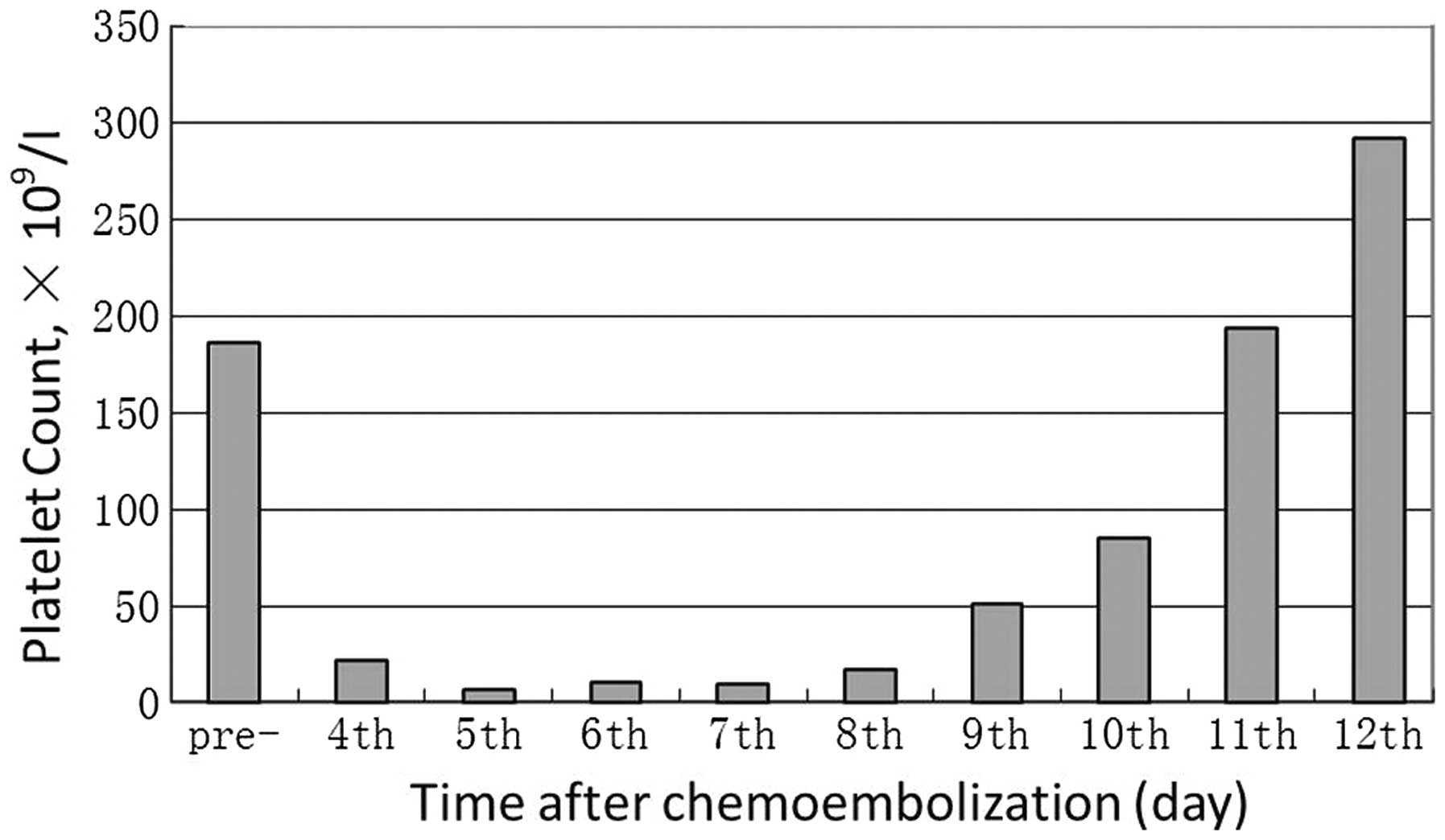
Full blood counts were within normal ranges before the patient's treatment: hemoglobin, 159 g/l; white blood count (WBC), 5.2×10⁹/l; and platelet (PLT) count, 186×109/l. Four days after administering chemoembolization, hematological examination revealed the following results: hemoglobin, 158 g/l; WBC, 5.1×10⁹/l; and PLT, 22×109/l. Five days after administering chemoembolization, the PLT count was 7×10⁹/l. Since grade 4 thrombocytopenia was diagnosed, platelet transfusions were administered. However, the PLT counts remained at levels below 10×109/l in spite of a total platelet transfusion of 20 units. Anti-nuclear antibody was negative, and no evidence of disseminated intravascular coagulopathy was observed. The platelet-associated immunoglobulin-G (IgG) level was 734 ng/dl. A clinical diagnosis of autoimmune thrombocytopenia was made. Therapy with 40 mg/day dexamethasone and 20 g/day immunoglobulin for five days were started on the seventh day after performing chemoembolization. The number of platelets increased immediately, with the PLT count being 51×109/l and 85×109/l on the second and third days after starting the steroid. Subsequent PLT counts remained stable at levels over 150×109/l (Fig. 1).

Figure 1.

Temporal correlation between development of immune thrombocytopenia and transarterial chemoembolization.

Discussion

The complications observed with TACE and TAE in the treatment of neuroendocrine hepatic metastases vary in the literature. Associated problems include liver abscesses, transient hepatorenal failure, pleural effusion, sepsis, bowel ischemia requiring surgery, septicemia requiring antibiotic therapy and hepatic infarction. Post-embolization syndrome is a further less severe adverse reaction, and is observed in the majority of patients. It may also cause a fever that subsides within a few days, leukocytosis, abdominal pain that may require morphine, and a transient increase in liver enzymes, particularly transaminases and lactate dehydrogenase, which tend to return to normal within a few days to 2–3 weeks. Increased bilirubin levels have also been noted. Ischemia of the biliary tree has been reported occasionally following embolization. In addition, elevation of alkaline phosphatase has been observed. The most appropriate means of reducing post-embolization syndrome is by keeping the patient well hydrated and in supportive care (10).

In the case reported in the present study, four days after administering chemoembolization, hematological examination revealed an abnormal PLT count (22×109/l). Thrombocytopenia was initially believed to have been caused by prolonged myelosuppression induced by chemotherapy. However, despite extensive repeated transfusions, thrombocytopenia was not improved, and there was no leukopenia during chemotherapy. It is unlikely that other factors may have caused thrombocytopenia. The diagnosis of immune thrombocytopenia was made based on the results of the elevated platelet-associated IgG level and the response to dexamethasone and immunoglobulin therapy.

Immune-mediated thrombocytopenia resembling idiopathic thrombocytopenic purpura accompanied by additional morbidities is known as secondary autoimmune thrombocytopenia (11). Common causes of thrombocytopenia in solid tumors are myelosuppression secondary to chemotherapy, bone marrow infiltration with malignant cells and increased peripheral utilization or destruction of platelets due to disseminated intravascular coagulation. Immune-mediated platelet destruction as a cause of thrombocytopenic syndromes in patients with solid tumors was first described by Kim et al (12). However, no antibody or kinetic verification tests were performed in this study. Schwartz et al (13) reported on eight patients with solid tumors having immune-mediated thrombocytopenia, and revealed evidence of antibodies attached to autologous platelets by radioimmune and release antibody assays. Further studies reveal that the frequency of accompanying solid tumors in patients with autoimmune thrombocytopenia is 5.6–12.9% (12,13). Autoimmune thrombocytopenia has been observed in a number of solid tumors, including breast, lung, prostate, testis, kidney, skin and ovarian cancers. However, elevated platelet-associated IgG levels may also be induced by drugs (14). Therefore, in the case presented here, it was concluded that the elevated platelet-associated IgG may have been associated not only with tumors but also with drugs.

In conclusion, we have presented a case of immune thrombocytopenia in a patient with neuroendocrine hepatic metastases, which developed following TACE, and which was difficult to differentiate from thrombocytopenia caused by myelosuppression. We recommend that immune thrombocytopenia is considered in the differential diagnosis of thrombocytopenia in cancer patients.

Acknowledgements

This study was supported by grants from the Science Technology Commission of Shanghai Municipality (nos. 0952nm03400, 11nm0504000 and 124119a0100) and the National Natural Science Foundation of China (nos. 81301218 and 81301262).

References

1 

Loewe C, Schindl M and Cejna M: Permanent transarterial embolization of neuroendocrine metastases of the liver using cyanoacrylate and lipiodol: assessment of mid- and long-term results. AJR Am J Roentgenol. 180:1379–1384. 2003. View Article : Google Scholar : PubMed/NCBI

2 

Venook AP: Embolization and chemoembolization therapy for neuroendocrine tumors. Curr Opin Oncol. 11:39–44. 1999. View Article : Google Scholar

3 

Kress O, Wagner HJ, Wied M, et al: Transarterial chemoembolization of advanced liver metastases of neuroendocrine tumors: a retrospective single centre analysis. Digestion. 68:94–101. 2003. View Article : Google Scholar : PubMed/NCBI

4 

Proye C: Natural history of liver metastasis of gastroenteropancreatic neuroendocrine tumors: place for chemoembolization. World J Surg. 25:685–688. 2001. View Article : Google Scholar : PubMed/NCBI

5 

Blonski WC, Reddy KR, Shaked A, et al: Liver transplantation for metastatic neuroendocrine tumor: a case report and a review of literature. World J Gastroenterol. 11:7676–7683. 2005.PubMed/NCBI

6 

Modlin IM and Sandor A: An analysis of 8305 cases of carcinoid tumors. Cancer. 79:813–829. 1997. View Article : Google Scholar : PubMed/NCBI

7 

Vogl TJ, Naguib NN, Zangos S, et al: Liver metastases of neuroendocrine carcinomas: interventional treatment via transarterial embolization, chemoembolization and thermal ablation. Eur J Radiol. 72:517–528. 2009. View Article : Google Scholar : PubMed/NCBI

8 

Moertel CG, Johnson CM, McKusick MA, et al: The management of patients with advanced carcinoid tumors and islet cell carcinomas. Ann Intern Med. 120:302–309. 1994. View Article : Google Scholar : PubMed/NCBI

9 

Madoff DC, Gupta S, Ahrar K, Murthy R and Yao JC: Update on the management of neuroendocrine hepatic metastases. J Vasc Interv Radiol. 17:1235–1249; quiz 1250. 2006. View Article : Google Scholar : PubMed/NCBI

10 

Touzios JG, Kiely JM, Pitt SC, et al: Neuroendocrine hepatic metastases: does aggressive management improve survival. Ann Surg. 241:776–783. 2005. View Article : Google Scholar : PubMed/NCBI

11 

Bussel JB: Autoimmune thrombocytopenic purpura. Hematol Oncol Clin N Am. 4:179–191. 1990.

12 

Kim HD and Boggs DR: A syndrome resembling idiopathic thrombocytopenic purpura in 10 patients with diverse forms of cancer. Am J Med. 67:371–377. 1979. View Article : Google Scholar : PubMed/NCBI

13 

Schwartz KA, Slichter SJ and Harker LA: Immune-mediated platelet destruction and thrombocytopenia in patients with solid tumors. Br J Haematol. 51:17–24. 1982. View Article : Google Scholar : PubMed/NCBI

14 

Kelton JG, Meltzer D, Moore J, et al: Drug induced thrombocytopenia is associated with increased binding of IgG to platelets both in vivo and in vitro. Blood. 58:524–529. 1981.PubMed/NCBI

Related Articles

  • Abstract
  • View
  • Download
  • Twitter
Copy and paste a formatted citation
Spandidos Publications style
Xie P and Yuan Z: Acute thrombocytopenia: An uncommon complication occurring following transarterial chemoembolization in a patient with neuroendocrine hepatic metastases. Oncol Lett 10: 247-249, 2015.
APA
Xie, P., & Yuan, Z. (2015). Acute thrombocytopenia: An uncommon complication occurring following transarterial chemoembolization in a patient with neuroendocrine hepatic metastases. Oncology Letters, 10, 247-249. https://doi.org/10.3892/ol.2015.3232
MLA
Xie, P., Yuan, Z."Acute thrombocytopenia: An uncommon complication occurring following transarterial chemoembolization in a patient with neuroendocrine hepatic metastases". Oncology Letters 10.1 (2015): 247-249.
Chicago
Xie, P., Yuan, Z."Acute thrombocytopenia: An uncommon complication occurring following transarterial chemoembolization in a patient with neuroendocrine hepatic metastases". Oncology Letters 10, no. 1 (2015): 247-249. https://doi.org/10.3892/ol.2015.3232
Copy and paste a formatted citation
x
Spandidos Publications style
Xie P and Yuan Z: Acute thrombocytopenia: An uncommon complication occurring following transarterial chemoembolization in a patient with neuroendocrine hepatic metastases. Oncol Lett 10: 247-249, 2015.
APA
Xie, P., & Yuan, Z. (2015). Acute thrombocytopenia: An uncommon complication occurring following transarterial chemoembolization in a patient with neuroendocrine hepatic metastases. Oncology Letters, 10, 247-249. https://doi.org/10.3892/ol.2015.3232
MLA
Xie, P., Yuan, Z."Acute thrombocytopenia: An uncommon complication occurring following transarterial chemoembolization in a patient with neuroendocrine hepatic metastases". Oncology Letters 10.1 (2015): 247-249.
Chicago
Xie, P., Yuan, Z."Acute thrombocytopenia: An uncommon complication occurring following transarterial chemoembolization in a patient with neuroendocrine hepatic metastases". Oncology Letters 10, no. 1 (2015): 247-249. https://doi.org/10.3892/ol.2015.3232
Follow us
  • Twitter
  • LinkedIn
  • Facebook
About
  • Spandidos Publications
  • Careers
  • Cookie Policy
  • Privacy Policy
How can we help?
  • Help
  • Live Chat
  • Contact
  • Email to our Support Team