Spandidos Publications Logo
  • About
    • About Spandidos
    • Aims and Scopes
    • Abstracting and Indexing
    • Editorial Policies
    • Reprints and Permissions
    • Job Opportunities
    • Terms and Conditions
    • Contact
  • Journals
    • All Journals
    • Oncology Letters
      • Oncology Letters
      • Information for Authors
      • Editorial Policies
      • Editorial Board
      • Aims and Scope
      • Abstracting and Indexing
      • Bibliographic Information
      • Archive
    • International Journal of Oncology
      • International Journal of Oncology
      • Information for Authors
      • Editorial Policies
      • Editorial Board
      • Aims and Scope
      • Abstracting and Indexing
      • Bibliographic Information
      • Archive
    • Molecular and Clinical Oncology
      • Molecular and Clinical Oncology
      • Information for Authors
      • Editorial Policies
      • Editorial Board
      • Aims and Scope
      • Abstracting and Indexing
      • Bibliographic Information
      • Archive
    • Experimental and Therapeutic Medicine
      • Experimental and Therapeutic Medicine
      • Information for Authors
      • Editorial Policies
      • Editorial Board
      • Aims and Scope
      • Abstracting and Indexing
      • Bibliographic Information
      • Archive
    • International Journal of Molecular Medicine
      • International Journal of Molecular Medicine
      • Information for Authors
      • Editorial Policies
      • Editorial Board
      • Aims and Scope
      • Abstracting and Indexing
      • Bibliographic Information
      • Archive
    • Biomedical Reports
      • Biomedical Reports
      • Information for Authors
      • Editorial Policies
      • Editorial Board
      • Aims and Scope
      • Abstracting and Indexing
      • Bibliographic Information
      • Archive
    • Oncology Reports
      • Oncology Reports
      • Information for Authors
      • Editorial Policies
      • Editorial Board
      • Aims and Scope
      • Abstracting and Indexing
      • Bibliographic Information
      • Archive
    • Molecular Medicine Reports
      • Molecular Medicine Reports
      • Information for Authors
      • Editorial Policies
      • Editorial Board
      • Aims and Scope
      • Abstracting and Indexing
      • Bibliographic Information
      • Archive
    • World Academy of Sciences Journal
      • World Academy of Sciences Journal
      • Information for Authors
      • Editorial Policies
      • Editorial Board
      • Aims and Scope
      • Abstracting and Indexing
      • Bibliographic Information
      • Archive
    • International Journal of Functional Nutrition
      • International Journal of Functional Nutrition
      • Information for Authors
      • Editorial Policies
      • Editorial Board
      • Aims and Scope
      • Abstracting and Indexing
      • Bibliographic Information
      • Archive
    • International Journal of Epigenetics
      • International Journal of Epigenetics
      • Information for Authors
      • Editorial Policies
      • Editorial Board
      • Aims and Scope
      • Abstracting and Indexing
      • Bibliographic Information
      • Archive
    • Medicine International
      • Medicine International
      • Information for Authors
      • Editorial Policies
      • Editorial Board
      • Aims and Scope
      • Abstracting and Indexing
      • Bibliographic Information
      • Archive
  • Articles
  • Information
    • Information for Authors
    • Information for Reviewers
    • Information for Librarians
    • Information for Advertisers
    • Conferences
  • Language Editing
Spandidos Publications Logo
  • About
    • About Spandidos
    • Aims and Scopes
    • Abstracting and Indexing
    • Editorial Policies
    • Reprints and Permissions
    • Job Opportunities
    • Terms and Conditions
    • Contact
  • Journals
    • All Journals
    • Biomedical Reports
      • Information for Authors
      • Editorial Policies
      • Editorial Board
      • Aims and Scope
      • Abstracting and Indexing
      • Bibliographic Information
      • Archive
    • Experimental and Therapeutic Medicine
      • Information for Authors
      • Editorial Policies
      • Editorial Board
      • Aims and Scope
      • Abstracting and Indexing
      • Bibliographic Information
      • Archive
    • International Journal of Epigenetics
      • Information for Authors
      • Editorial Policies
      • Editorial Board
      • Aims and Scope
      • Abstracting and Indexing
      • Bibliographic Information
      • Archive
    • International Journal of Functional Nutrition
      • Information for Authors
      • Editorial Policies
      • Editorial Board
      • Aims and Scope
      • Abstracting and Indexing
      • Bibliographic Information
      • Archive
    • International Journal of Molecular Medicine
      • Information for Authors
      • Editorial Policies
      • Editorial Board
      • Aims and Scope
      • Abstracting and Indexing
      • Bibliographic Information
      • Archive
    • International Journal of Oncology
      • Information for Authors
      • Editorial Policies
      • Editorial Board
      • Aims and Scope
      • Abstracting and Indexing
      • Bibliographic Information
      • Archive
    • Medicine International
      • Information for Authors
      • Editorial Policies
      • Editorial Board
      • Aims and Scope
      • Abstracting and Indexing
      • Bibliographic Information
      • Archive
    • Molecular and Clinical Oncology
      • Information for Authors
      • Editorial Policies
      • Editorial Board
      • Aims and Scope
      • Abstracting and Indexing
      • Bibliographic Information
      • Archive
    • Molecular Medicine Reports
      • Information for Authors
      • Editorial Policies
      • Editorial Board
      • Aims and Scope
      • Abstracting and Indexing
      • Bibliographic Information
      • Archive
    • Oncology Letters
      • Information for Authors
      • Editorial Policies
      • Editorial Board
      • Aims and Scope
      • Abstracting and Indexing
      • Bibliographic Information
      • Archive
    • Oncology Reports
      • Information for Authors
      • Editorial Policies
      • Editorial Board
      • Aims and Scope
      • Abstracting and Indexing
      • Bibliographic Information
      • Archive
    • World Academy of Sciences Journal
      • Information for Authors
      • Editorial Policies
      • Editorial Board
      • Aims and Scope
      • Abstracting and Indexing
      • Bibliographic Information
      • Archive
  • Articles
  • Information
    • For Authors
    • For Reviewers
    • For Librarians
    • For Advertisers
    • Conferences
  • Language Editing
Login Register Submit
  • This site uses cookies
  • You can change your cookie settings at any time by following the instructions in our Cookie Policy. To find out more, you may read our Privacy Policy.

    I agree
Search articles by DOI, keyword, author or affiliation
Search
Advanced Search
presentation
Oncology Letters
Join Editorial Board Propose a Special Issue
Print ISSN: 1792-1074 Online ISSN: 1792-1082
Journal Cover
August-2015 Volume 10 Issue 2

Full Size Image

Sign up for eToc alerts
Recommend to Library

Journals

International Journal of Molecular Medicine

International Journal of Molecular Medicine

International Journal of Molecular Medicine is an international journal devoted to molecular mechanisms of human disease.

International Journal of Oncology

International Journal of Oncology

International Journal of Oncology is an international journal devoted to oncology research and cancer treatment.

Molecular Medicine Reports

Molecular Medicine Reports

Covers molecular medicine topics such as pharmacology, pathology, genetics, neuroscience, infectious diseases, molecular cardiology, and molecular surgery.

Oncology Reports

Oncology Reports

Oncology Reports is an international journal devoted to fundamental and applied research in Oncology.

Experimental and Therapeutic Medicine

Experimental and Therapeutic Medicine

Experimental and Therapeutic Medicine is an international journal devoted to laboratory and clinical medicine.

Oncology Letters

Oncology Letters

Oncology Letters is an international journal devoted to Experimental and Clinical Oncology.

Biomedical Reports

Biomedical Reports

Explores a wide range of biological and medical fields, including pharmacology, genetics, microbiology, neuroscience, and molecular cardiology.

Molecular and Clinical Oncology

Molecular and Clinical Oncology

International journal addressing all aspects of oncology research, from tumorigenesis and oncogenes to chemotherapy and metastasis.

World Academy of Sciences Journal

World Academy of Sciences Journal

Multidisciplinary open-access journal spanning biochemistry, genetics, neuroscience, environmental health, and synthetic biology.

International Journal of Functional Nutrition

International Journal of Functional Nutrition

Open-access journal combining biochemistry, pharmacology, immunology, and genetics to advance health through functional nutrition.

International Journal of Epigenetics

International Journal of Epigenetics

Publishes open-access research on using epigenetics to advance understanding and treatment of human disease.

Medicine International

Medicine International

An International Open Access Journal Devoted to General Medicine.

Journal Cover
August-2015 Volume 10 Issue 2

Full Size Image

Sign up for eToc alerts
Recommend to Library

  • Article
  • Citations
    • Cite This Article
    • Download Citation
    • Create Citation Alert
    • Remove Citation Alert
    • Cited By
  • Similar Articles
    • Related Articles (in Spandidos Publications)
    • Similar Articles (Google Scholar)
    • Similar Articles (PubMed)
  • Download PDF
  • Download XML
  • View XML
Case Report

Macrodystrophia lipomatosa of the foot: A case report

  • Authors:
    • Filiz Çelebi
    • Kagan Karagulle
    • Ali Yusuf Oner
  • View Affiliations / Copyright

    Affiliations: Department of Radiology, Gayrettepe Florence Nightingale Hospital, Istanbul 34000, Turkey, Department of Radiology, Mersin State Hospital, Mersin 33000, Turkey, Department of Radiology, Gazi University, Ankara 06000, Turkey
  • Pages: 951-953
    |
    Published online on: June 2, 2015
       https://doi.org/10.3892/ol.2015.3300
  • Expand metrics +
Metrics: Total Views: 0 (Spandidos Publications: | PMC Statistics: )
Metrics: Total PDF Downloads: 0 (Spandidos Publications: | PMC Statistics: )
Cited By (CrossRef): 0 citations Loading Articles...

This article is mentioned in:


Abstract

Macrodystrophia lipomatosa is a sporadic, nonhereditary developmental anomaly and a rare form of congenital localized gigantism. It is characterized by the proliferation of all the mesenchymal elements of a digit or digits, and a disproportionate increase of fibroadipose tissue involving the nerve sheath, muscle, periosteum and bone marrow. In the present study, a 9‑month‑old boy was referred to Gazi University Hospital (Ankara, Turkey) with congenital unilateral enlargement of the right forefoot, particularly involving the second and third toes. X‑ray and magnetic resonance imaging (MRI) scans were performed in order to assess the skeletal structures. The present study described the characteristic imaging features, with an emphasis on the MRI findings, of this rare congenital form of gigantism.

Introduction

Macrodystrophia lipomatosa is a nonhereditary developmental anomaly and a rare form of congenital localized gigantism. It is characterized by the proliferation of all the mesenchymal elements of the digits and a disproportionate increase of fibroadipose tissue. Distal limb involvement is usually observed (1–4) and the involvement of the lower limbs is more common than that of the upper limbs. Notably, the second and third digits are the most commonly affected. Macrodystrophia lipomatosa usually presents at birth or during the neonatal period (2). No gender predilection exists, however, a marginal preponderence is observed in males (1,2). Due to the rarity of macrodystrophia lipomatosa, the incidence is unknown. The etiology of macrodystrophia lipomatosa remains unclear, however, neurofibromatosis and lipomatous degeneration have been hypothesized to be involved (1). The most common treatment strategy is surgery, which primarily involves debulking and partial amputation of the affected limb (5). Patient outcome is dependent on the severity of the disease. The aim of the present study was to describe the characteristic imaging features, with an emphasis on the magnetic resonance imaging (MRI) findings, to assist the diagnosis of this rare congenital form of gigantism. Written informed consent was obtained from the patient's family.

Case report

In March 2010, a 9-month-old boy was referred to Gazi University Hospital (Ankara, Turkey) with congenital unilateral enlargement of the right forefoot, particularly involving the second and third toes. The patient was the first child of nonconsanguineous parents, and did not present a family history of any congenital anomalies. The patient was born at term, following a normal period of pregnancy, and by an uncomplicated spontaneous vaginal delivery. At birth, the patient's weight and length were reported to be normal, and no abnormalities were noted, with the exception of right forefoot enlargement.

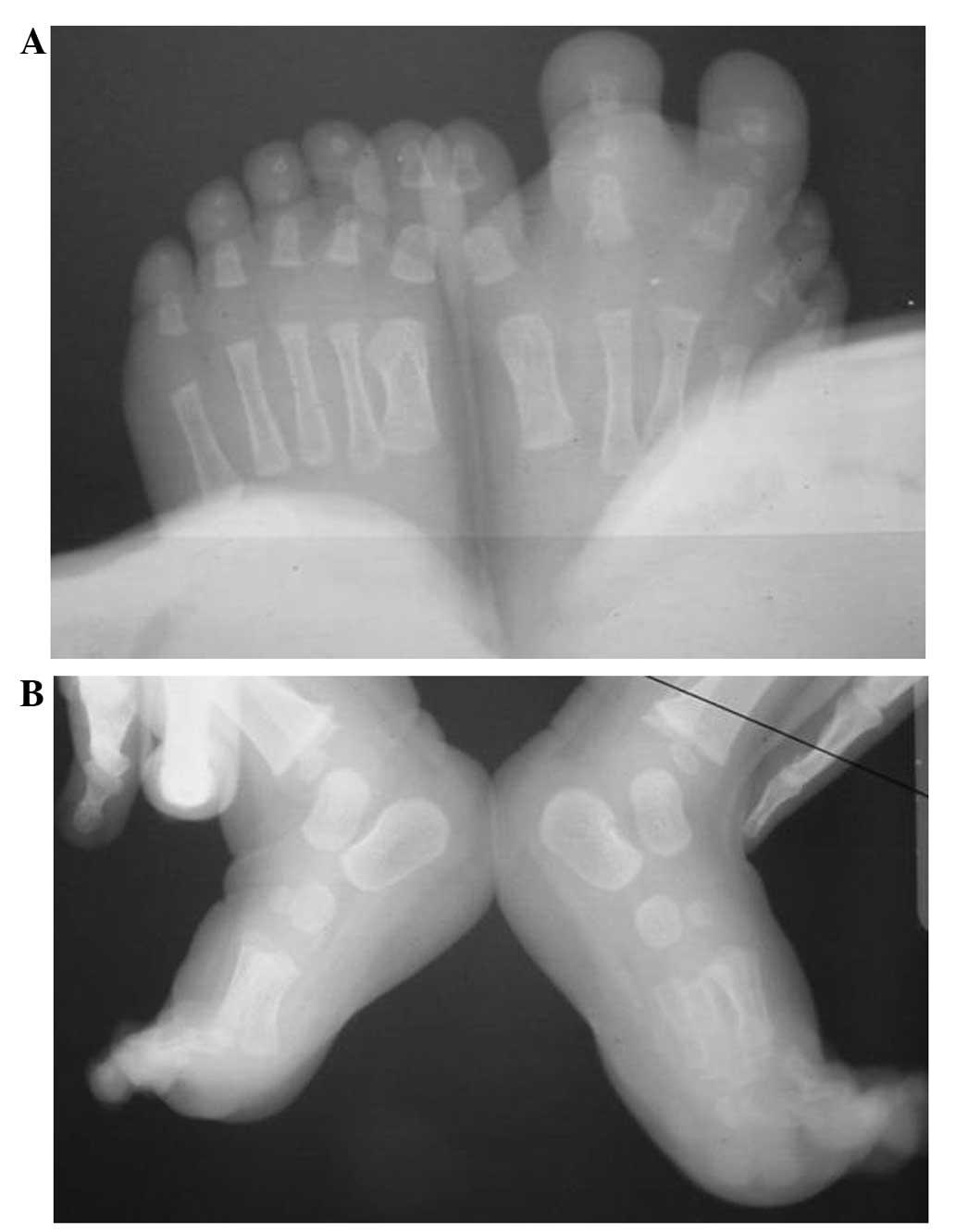
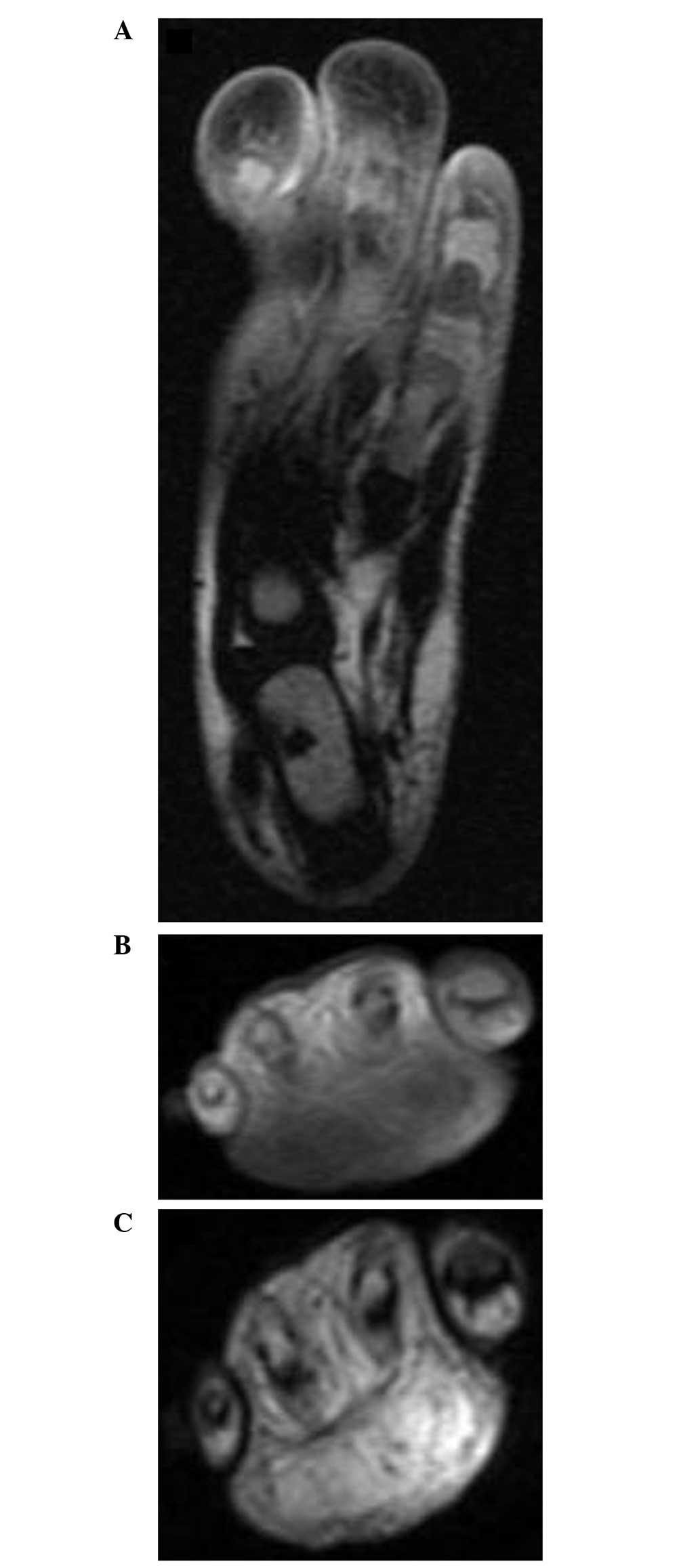
X-rays of the right foot reflected the macrodactyly of the second and third digits by revealing disproportionately increased length and width of the phalanxes and metatarses, and an increase in the surrounding soft tissue (Fig. 1). MRI scans identified a nonenhancing aberrant soft-tissue mass, which was hyperintense on T1- and T2-weighted images, with faint hypointense streaks on the T1 series. The mass surrounded the metatarses and phalanxes, causing the asymmetry of the foot (Fig. 2). Based on these findings, the patient was diagnosed with macrodystrophia lipomatosa and was referred for reconstructive consideration. Subsequently, the excision of excess skin and adipose tissue was performed, and the patient underwent successful bone reconstruction of the second and third digits. No complications were observed after surgery, and the patient required no further treatment. This rare case of macrodystrophia lipomatosa highlights the importance of differential diagnosis and conservative surgical treatment.

Figure 1.

(A) Anterior-posterior and (B) lateral radiographic images revealing macrodactyly of the second and third digits with disproportionately increased length and width of the phalanxes and metatarses accompanied by an increase in the surrounding soft-tissue density.

Figure 2.

(A) Axial T2WI, (B) coronal T2WI and (C) coronal post-contrast T1WI revealing a nonenhancing aberrant soft-tissue mass, hyperintense on T1WI and T2WI with faint hypointense streaks on the T1 series. WI, weighted image.

Discussion

Macrodystrophia lipomatosa is a sporadic, nonhereditary developmental anomaly and a rare form of congenital localized gigantism (1–4). This disease is characterized by the proliferation of all the mesenchymal elements of a digit or digits and a disproportionate increase of fibroadipose tissue, involving the nerve sheath, muscle, periosteum and bone marrow (6).

Macrodactyly is divided into two types, including the static and progressive forms (7). In the static form, the growth rate of affected tissues is normal. By contrast, in the progressive form, which includes macrodystrophia lipomatosa, the growth rate of mesenchymal tissues is faster when compared with normal tissues and ceases its abnormal growth at puberty (4–6). Although the involvement of a single digit is common, adjacent digits are also often affected (8,9). However, bilateral involvement is rare. Secondary osteoarthritic changes, including reduced joint space, subchondral cysts and large osteophytes frequently present in adolescence or early adulthood (9). Mechanical and functional problems may develop as a result of these degenerative changes (6,10,11). An association between macrodactyly and median, plantar nerve abnormalities has also been established. Although the disease affects the nerves, it does not present with symptoms of pain (9).

Conventional radiographs have previously revealed that macrodactyly is associated with hypertrophy of the soft tissue and osseous structures. Soft-tissue overgrowth is typically observed at the distal end of the affected digits and its plantar aspect (1,2). The soft-tissue lucency detected on radiographs has been found to result from hypertrophic adipose tissue, while the phalanges are typically elongated, widened and spread out at the distal ends (3).

MRI scans of macrodystrophia lipomatosa patients have previously revealed the presence of abundant adipose tissue, which exhibits the same signal intensity as normal subcutaneous fat in the areas affected by the disease. Furthermore, linear fibrous strands of low signal intensity within the hyperintense muscle on Tl-weighted imaging, as well as bony hypertrophy and cortical thickening, can also be detected on MRI scans of patients (4).

Based on the MRI findings, the differential diagnosis of macrodystrophia lipomatosa includes the proteus syndrome, neurofibromatosis, fibrolipomatous hamartoma, hemangiomatosis, lymphangiomatosis and the Klippel-Trénaunay-Weber syndrome (1,2,12). In the Klipel-Trenaunay-Weber syndrome, a classic triad of port-wine stains, an overgrowth of the distal digits or entire extremity involving the soft tissue, and varicose veins on the lateral aspect of the affected limb are typical signs. The disease is usually observed in children and affects a lower extremity 15 times more often compared with an upper extremity. In lymphangiomatosis, significant clinical findings include diffuse swelling and pitting edema (3). By contrast, in the proteus syndrome, hemihypertrophy is usually present, which is accompanied by lung cysts, skull abnormalities, pigmented neuvi and intraabdominal lipomas (3,8,9).

Neurofibromatosis may be challenging to distinguish from macrodystrophia lipomatosa; however, only plantar and median nerve trace affections are characteristic in macrodystrophia lipomatosa. Neurofibromatosis can present with neurofibromas, freckling in the axilla, cafe-au-lait spots and lisch nodules. Upon physical examination, hemangiomatosis may be associated with bruits, and on T2-weighted spin-echo imaging, evidence of worm-like areas of high signal intensity is common. Furthermore, fibrolipomatous hamartoma of the nerves is occasionally observed in association with macrodactyly (8).

The treatment of this disease relies on conservative surgery, which requires specific microsurgical techniques, and primarily consists of debulking and partial amputation of the affected limb. Recurrent interventions may be required for complete treatment. However, the effect of amputation on the patient's quality of life should be considered prior to surgery. Reconstructive approaches, which achieve a more aesthetic and functional result should be a preferred strategy (5).

Macrodystrophia lipomatosa is the progressive enlargement of soft and bony tissue, which leads to cosmetic and mechanical problems. The treatment of this disease depends on surgical procedures. Different imaging modalities, including radiography, ultrasonography and MRI are important for the diagnosis of this rare entity. Thus, awareness with regard to the characteristic symptoms, imaging features and differential diagnosis of the disease is important for the diagnosis and treatment of this rare entity.

References

1 

Sudesh P, Raj N, Kumar R and Parakash S: Macrodystrophia lipomatosa. Foot (Edinb). 22:172–174. 2012. View Article : Google Scholar : PubMed/NCBI

2 

Gaur AK, Mhambre AS, Popalwar H and Sharma R: Macrodystrophia lipomatosa of foot involving great toe. Foot (Edinb). 24:86–88. 2014. View Article : Google Scholar : PubMed/NCBI

3 

Singla V, Virmani V, Tuli P, et al: Case Report: Macrodystrophia lipomatosa-Illustration of two cases. Indian J Radiol Imaging. 18:298–301. 2008. View Article : Google Scholar : PubMed/NCBI

4 

Selcen O, Baykara M, Öztürk M and Özyazgan İ: Macrodactyly: Radiologic findings of a rare anomaly. Erciyes Medical Journal. 26:44–47. 2004.

5 

Watt AJ and Chung KC: Macrodystrophia lipomatosa: a reconstructive approach to gigantism of the foot. J Foot Ankle Surg. 43:51–55. 2004. View Article : Google Scholar : PubMed/NCBI

6 

Wang YC, Jeng CM, Marcantonio DR and Resnick D: Macrodystrophia lipomatosa. MR imaging in three patients. Clin Imaging. 21:323–327. 1997. View Article : Google Scholar : PubMed/NCBI

7 

Barsky AJ: Macrodactyly. J Bone Joint Surg Am. 49:1255–1266. 1967.PubMed/NCBI

8 

Goldman AB: Heritable diseases of connective tissue, epiphysealphyseal dysplasias and related conditions. Diagnosis of Bone and Joint Disorders. Resnick D: 3rd. W.B. Saunders Company; Philadelphia, PA: pp. 4095–4162. 1995

9 

Silverman TA and Enzinger FM: Fibrolipomatous hamartoma of nerve. A clinicopathologic analysis of 26 cases. Am J Surg Pathol. 9:7–14. 1985. View Article : Google Scholar : PubMed/NCBI

10 

Curry NS, Schabel SI and Keuper JT: Computed tomography diagnosis of macrodystrophia lipomatosa. J Comput Tomogr. 12:295–297. 1988. View Article : Google Scholar : PubMed/NCBI

11 

Dahnert W: Radiology Review Manual. 6th. Lippincott Williams &Wilkins; Philadelphia, PA: pp. 1152007

12 

Colonna MR, Guarneri C, do Stagno d'Alcontres F, Risitano G, Cavallari V and Ribuffo D: Invasive macrodystrophia of the hand. Eur Rev Med Pharmacol Sci. 18:2621–2623. 2014.PubMed/NCBI

Related Articles

  • Abstract
  • View
  • Download
  • Twitter
Copy and paste a formatted citation
Spandidos Publications style
Çelebi F, Karagulle K and Oner AY: Macrodystrophia lipomatosa of the foot: A case report. Oncol Lett 10: 951-953, 2015.
APA
Çelebi, F., Karagulle, K., & Oner, A.Y. (2015). Macrodystrophia lipomatosa of the foot: A case report. Oncology Letters, 10, 951-953. https://doi.org/10.3892/ol.2015.3300
MLA
Çelebi, F., Karagulle, K., Oner, A. Y."Macrodystrophia lipomatosa of the foot: A case report". Oncology Letters 10.2 (2015): 951-953.
Chicago
Çelebi, F., Karagulle, K., Oner, A. Y."Macrodystrophia lipomatosa of the foot: A case report". Oncology Letters 10, no. 2 (2015): 951-953. https://doi.org/10.3892/ol.2015.3300
Copy and paste a formatted citation
x
Spandidos Publications style
Çelebi F, Karagulle K and Oner AY: Macrodystrophia lipomatosa of the foot: A case report. Oncol Lett 10: 951-953, 2015.
APA
Çelebi, F., Karagulle, K., & Oner, A.Y. (2015). Macrodystrophia lipomatosa of the foot: A case report. Oncology Letters, 10, 951-953. https://doi.org/10.3892/ol.2015.3300
MLA
Çelebi, F., Karagulle, K., Oner, A. Y."Macrodystrophia lipomatosa of the foot: A case report". Oncology Letters 10.2 (2015): 951-953.
Chicago
Çelebi, F., Karagulle, K., Oner, A. Y."Macrodystrophia lipomatosa of the foot: A case report". Oncology Letters 10, no. 2 (2015): 951-953. https://doi.org/10.3892/ol.2015.3300
Follow us
  • Twitter
  • LinkedIn
  • Facebook
About
  • Spandidos Publications
  • Careers
  • Cookie Policy
  • Privacy Policy
How can we help?
  • Help
  • Live Chat
  • Contact
  • Email to our Support Team