Spandidos Publications Logo
  • About
    • About Spandidos
    • Aims and Scopes
    • Abstracting and Indexing
    • Editorial Policies
    • Reprints and Permissions
    • Job Opportunities
    • Terms and Conditions
    • Contact
  • Journals
    • All Journals
    • Oncology Letters
      • Oncology Letters
      • Information for Authors
      • Editorial Policies
      • Editorial Board
      • Aims and Scope
      • Abstracting and Indexing
      • Bibliographic Information
      • Archive
    • International Journal of Oncology
      • International Journal of Oncology
      • Information for Authors
      • Editorial Policies
      • Editorial Board
      • Aims and Scope
      • Abstracting and Indexing
      • Bibliographic Information
      • Archive
    • Molecular and Clinical Oncology
      • Molecular and Clinical Oncology
      • Information for Authors
      • Editorial Policies
      • Editorial Board
      • Aims and Scope
      • Abstracting and Indexing
      • Bibliographic Information
      • Archive
    • Experimental and Therapeutic Medicine
      • Experimental and Therapeutic Medicine
      • Information for Authors
      • Editorial Policies
      • Editorial Board
      • Aims and Scope
      • Abstracting and Indexing
      • Bibliographic Information
      • Archive
    • International Journal of Molecular Medicine
      • International Journal of Molecular Medicine
      • Information for Authors
      • Editorial Policies
      • Editorial Board
      • Aims and Scope
      • Abstracting and Indexing
      • Bibliographic Information
      • Archive
    • Biomedical Reports
      • Biomedical Reports
      • Information for Authors
      • Editorial Policies
      • Editorial Board
      • Aims and Scope
      • Abstracting and Indexing
      • Bibliographic Information
      • Archive
    • Oncology Reports
      • Oncology Reports
      • Information for Authors
      • Editorial Policies
      • Editorial Board
      • Aims and Scope
      • Abstracting and Indexing
      • Bibliographic Information
      • Archive
    • Molecular Medicine Reports
      • Molecular Medicine Reports
      • Information for Authors
      • Editorial Policies
      • Editorial Board
      • Aims and Scope
      • Abstracting and Indexing
      • Bibliographic Information
      • Archive
    • World Academy of Sciences Journal
      • World Academy of Sciences Journal
      • Information for Authors
      • Editorial Policies
      • Editorial Board
      • Aims and Scope
      • Abstracting and Indexing
      • Bibliographic Information
      • Archive
    • International Journal of Functional Nutrition
      • International Journal of Functional Nutrition
      • Information for Authors
      • Editorial Policies
      • Editorial Board
      • Aims and Scope
      • Abstracting and Indexing
      • Bibliographic Information
      • Archive
    • International Journal of Epigenetics
      • International Journal of Epigenetics
      • Information for Authors
      • Editorial Policies
      • Editorial Board
      • Aims and Scope
      • Abstracting and Indexing
      • Bibliographic Information
      • Archive
    • Medicine International
      • Medicine International
      • Information for Authors
      • Editorial Policies
      • Editorial Board
      • Aims and Scope
      • Abstracting and Indexing
      • Bibliographic Information
      • Archive
  • Articles
  • Information
    • Information for Authors
    • Information for Reviewers
    • Information for Librarians
    • Information for Advertisers
    • Conferences
  • Language Editing
Spandidos Publications Logo
  • About
    • About Spandidos
    • Aims and Scopes
    • Abstracting and Indexing
    • Editorial Policies
    • Reprints and Permissions
    • Job Opportunities
    • Terms and Conditions
    • Contact
  • Journals
    • All Journals
    • Biomedical Reports
      • Information for Authors
      • Editorial Policies
      • Editorial Board
      • Aims and Scope
      • Abstracting and Indexing
      • Bibliographic Information
      • Archive
    • Experimental and Therapeutic Medicine
      • Information for Authors
      • Editorial Policies
      • Editorial Board
      • Aims and Scope
      • Abstracting and Indexing
      • Bibliographic Information
      • Archive
    • International Journal of Epigenetics
      • Information for Authors
      • Editorial Policies
      • Editorial Board
      • Aims and Scope
      • Abstracting and Indexing
      • Bibliographic Information
      • Archive
    • International Journal of Functional Nutrition
      • Information for Authors
      • Editorial Policies
      • Editorial Board
      • Aims and Scope
      • Abstracting and Indexing
      • Bibliographic Information
      • Archive
    • International Journal of Molecular Medicine
      • Information for Authors
      • Editorial Policies
      • Editorial Board
      • Aims and Scope
      • Abstracting and Indexing
      • Bibliographic Information
      • Archive
    • International Journal of Oncology
      • Information for Authors
      • Editorial Policies
      • Editorial Board
      • Aims and Scope
      • Abstracting and Indexing
      • Bibliographic Information
      • Archive
    • Medicine International
      • Information for Authors
      • Editorial Policies
      • Editorial Board
      • Aims and Scope
      • Abstracting and Indexing
      • Bibliographic Information
      • Archive
    • Molecular and Clinical Oncology
      • Information for Authors
      • Editorial Policies
      • Editorial Board
      • Aims and Scope
      • Abstracting and Indexing
      • Bibliographic Information
      • Archive
    • Molecular Medicine Reports
      • Information for Authors
      • Editorial Policies
      • Editorial Board
      • Aims and Scope
      • Abstracting and Indexing
      • Bibliographic Information
      • Archive
    • Oncology Letters
      • Information for Authors
      • Editorial Policies
      • Editorial Board
      • Aims and Scope
      • Abstracting and Indexing
      • Bibliographic Information
      • Archive
    • Oncology Reports
      • Information for Authors
      • Editorial Policies
      • Editorial Board
      • Aims and Scope
      • Abstracting and Indexing
      • Bibliographic Information
      • Archive
    • World Academy of Sciences Journal
      • Information for Authors
      • Editorial Policies
      • Editorial Board
      • Aims and Scope
      • Abstracting and Indexing
      • Bibliographic Information
      • Archive
  • Articles
  • Information
    • For Authors
    • For Reviewers
    • For Librarians
    • For Advertisers
    • Conferences
  • Language Editing
Login Register Submit
  • This site uses cookies
  • You can change your cookie settings at any time by following the instructions in our Cookie Policy. To find out more, you may read our Privacy Policy.

    I agree
Search articles by DOI, keyword, author or affiliation
Search
Advanced Search
presentation
Oncology Letters
Join Editorial Board Propose a Special Issue
Print ISSN: 1792-1074 Online ISSN: 1792-1082
Journal Cover
August-2015 Volume 10 Issue 2

Full Size Image

Sign up for eToc alerts
Recommend to Library

Journals

International Journal of Molecular Medicine

International Journal of Molecular Medicine

International Journal of Molecular Medicine is an international journal devoted to molecular mechanisms of human disease.

International Journal of Oncology

International Journal of Oncology

International Journal of Oncology is an international journal devoted to oncology research and cancer treatment.

Molecular Medicine Reports

Molecular Medicine Reports

Covers molecular medicine topics such as pharmacology, pathology, genetics, neuroscience, infectious diseases, molecular cardiology, and molecular surgery.

Oncology Reports

Oncology Reports

Oncology Reports is an international journal devoted to fundamental and applied research in Oncology.

Experimental and Therapeutic Medicine

Experimental and Therapeutic Medicine

Experimental and Therapeutic Medicine is an international journal devoted to laboratory and clinical medicine.

Oncology Letters

Oncology Letters

Oncology Letters is an international journal devoted to Experimental and Clinical Oncology.

Biomedical Reports

Biomedical Reports

Explores a wide range of biological and medical fields, including pharmacology, genetics, microbiology, neuroscience, and molecular cardiology.

Molecular and Clinical Oncology

Molecular and Clinical Oncology

International journal addressing all aspects of oncology research, from tumorigenesis and oncogenes to chemotherapy and metastasis.

World Academy of Sciences Journal

World Academy of Sciences Journal

Multidisciplinary open-access journal spanning biochemistry, genetics, neuroscience, environmental health, and synthetic biology.

International Journal of Functional Nutrition

International Journal of Functional Nutrition

Open-access journal combining biochemistry, pharmacology, immunology, and genetics to advance health through functional nutrition.

International Journal of Epigenetics

International Journal of Epigenetics

Publishes open-access research on using epigenetics to advance understanding and treatment of human disease.

Medicine International

Medicine International

An International Open Access Journal Devoted to General Medicine.

Journal Cover
August-2015 Volume 10 Issue 2

Full Size Image

Sign up for eToc alerts
Recommend to Library

  • Article
  • Citations
    • Cite This Article
    • Download Citation
    • Create Citation Alert
    • Remove Citation Alert
    • Cited By
  • Similar Articles
    • Related Articles (in Spandidos Publications)
    • Similar Articles (Google Scholar)
    • Similar Articles (PubMed)
  • Download PDF
  • Download XML
  • View XML
Case Report

Primary malignant hepatic paraganglioma mimicking liver tumor: A case report

  • Authors:
    • Zhen You
    • Yilei Deng
    • Anuj Shrestha
    • Fuyu Li
    • Nansheng Cheng
  • View Affiliations / Copyright

    Affiliations: Department of Biliary Surgery, West China Hospital, Sichuan University, Chengdu, Sichuan 610041, P.R. China
  • Pages: 1176-1178
    |
    Published online on: June 4, 2015
       https://doi.org/10.3892/ol.2015.3318
  • Expand metrics +
Metrics: Total Views: 0 (Spandidos Publications: | PMC Statistics: )
Metrics: Total PDF Downloads: 0 (Spandidos Publications: | PMC Statistics: )
Cited By (CrossRef): 0 citations Loading Articles...

This article is mentioned in:


Abstract

An extra-adrenal pheochromocytoma is also known as a paraganglioma. The present study reported the case of a 47-year-old female patient with an extremely rare primary nonfunctioning hepatic paraganglioma without any clinical signs and symptoms. A computed tomography scan of the entire abdomen region revealed a hyper‑enhanced, well‑marginated round mass located in segment 3 of the liver. A preoperative diagnosis of hepatocellular carcinoma was established and a left lateral hepatic lobectomy was performed. During the removal of the mass, the patient experienced extreme fluctuations in blood pressure. Analysis of hepatic and peripheral venous blood test results confirmed the increase of noradrenaline secretion. Postoperatively, the patient's blood pressure and catecholamine level returned to the normal range. However, three years after surgery, a plasma catecholamine examination revealed a high noradrenaline level. Abdominal magnetic resonance imaging scans revealed two metastases, located in the spleen and below the right posterior lobe of the liver, which were identified as malignant paragangliomas. Therefore, the patient was diagnosed with primary malignant hepatic paraganglioma recurrence three years after hepatic resection.

Introduction

Paragangliomas, also known as extra-adrenal pheochromocytomas, are rare neuroendocrine tumors (1,2). Patients may present with signs and symptoms of catecholamine excess, including paroxysmal hypertension, headache, palpitation and sweating, or may be completely asymptomatic (2–4). Although paragangliomas are usually benign tumors, arising from the paraganglionic tissue and distributed in areas between the neck and the pelvis, they have also been reported in other less common sites, including the gallbladder, lungs and cardiac area (2,5–7). In general, complete surgical excisions are the conventional treatment for these tumors. However, for malignant paragangliomas, surgical debulking is rarely curative and is only considered as a palliative therapy (2,3). In the present study, the case of an extremely rare primary nonfunctioning hepatic paraganglioma, mimicking a primary liver tumor, was described. The patient underwent partial hepatectomy. Although extremely rare cases of primary hepatic paranglioma have been described previously (7–11), knowledge of the present case is valuable in order to help avoid the possibility of confusing hepatic paraganglioma with other liver tumors.

Case report

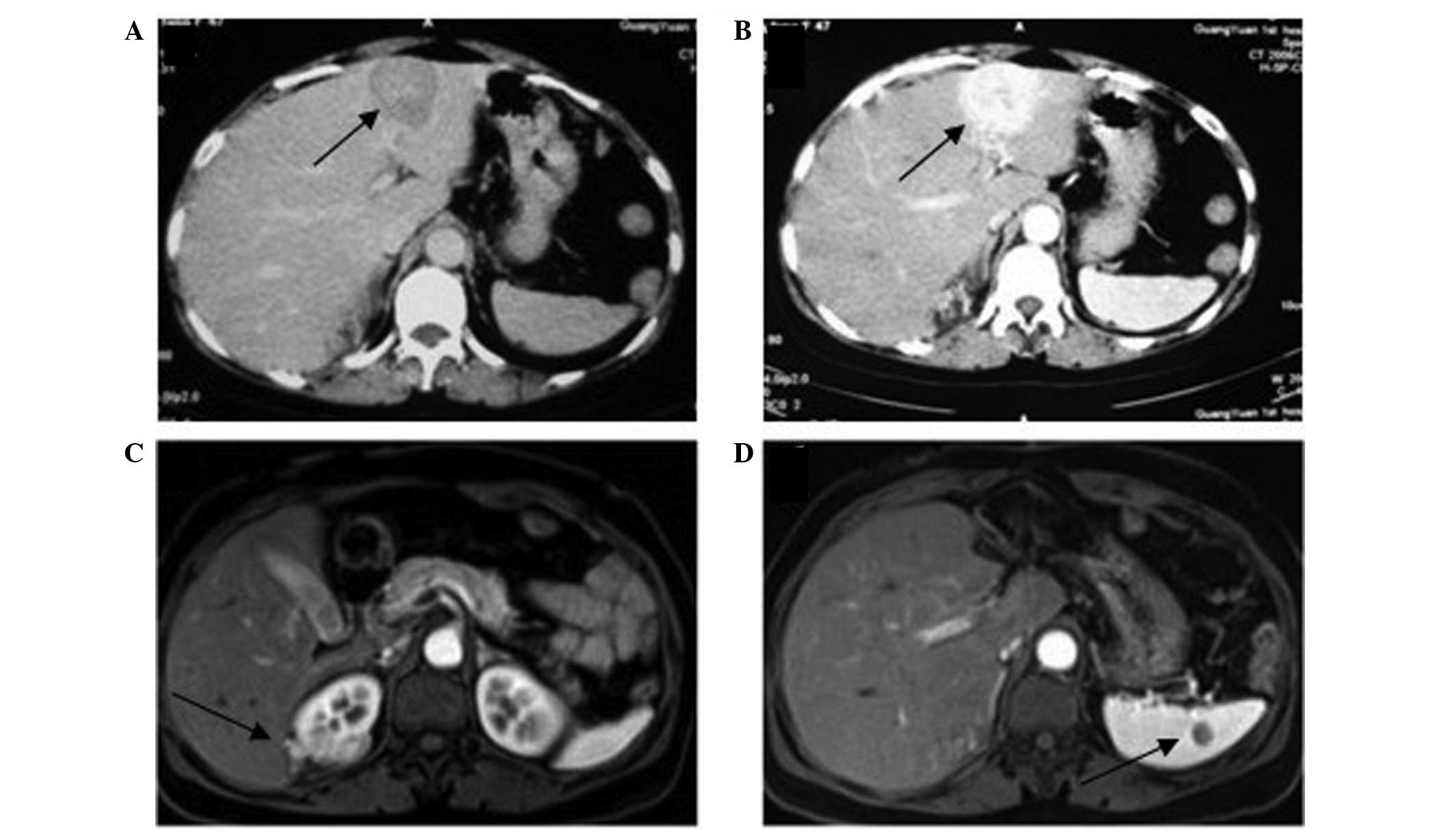
The study was approved by the Ethics Committee of West China Hospital, and written informed consent was obtained from the patient. In September 2010, an asymptomatic 47-year-old female patient was admitted to the West China Hospital (Chengdu, China) with an abdominal ultrasound (US) diagnosis of a solitary left hepatic lesion. The patient had no history of drug or alcohol abuse, previous malignancies or weight loss. Physical examination revealed no abnormal findings, with the exception of mild hypertension (150/100 mmHg). The patient's blood pressure was reduced to ~140/90 mmHg by administration of felodipine (10 mg/day). Laboratory values, including serum bilirubin and transaminases (aspartate transaminase, alanine transaminase), blood urea, nitrogen and serum creatinine were all within the normal range, indicating normal liver and renal function; hepatitis serology and α-fetoprotein levels were also within the normal range. A contrast-enhanced helical computed tomography (CT) scan of the entire abdomen revealed a hypodense, well-marginated round mass that measured 3.6×3.4 cm and was located in segment 3 of the liver in a subcapsular location. The mass was highly vascular and markedly enhanced following intravenous injection of iodine (Fig. 1A and B), and a preoperative diagnosis of hepatocellular carcinoma was established. No abnormalities were noted in the kidneys and adrenal glands. Subsequently, a left lateral hepatic lobectomy was performed. Intraoperatively, a dark red, multinodular solid mass that measured ~4.0 cm in diameter was observed. A thorough exploration of the abdominal cavity did not reveal any other abnormalities. During the removal of the mass, the patient experienced extreme fluctuations in blood pressure in the range of 90/70–310/200 mmHg. Therefore, the endocrine activity of the mass was suspected. Analysis of hepatic and peripheral venous blood samples confirmed the increase of noradrenaline secretion [1627 ng/l and 1312 ng/l, respectively; normal range, 174–357 ng/l (12)]. Postoperatively, the patient's blood pressure gradually stabilized to 130/76 mmHg without administration of any antihypertensive drugs, and the concentration of catecholamine in the peripheral blood was reduced to the normal range 5 days after surgery. Immunohistochemical analysis of the resected tissue revealed that the mass was positive for chromogranin A and neuron-specific enolase. Sustentacular cells that were positive for S100 protein were also identified. However, the tissues were negative for synaptophysin, cytokeratin-8, epithelial membrane antigen, HMB45, MART1 and Hep Par 1 values. The overall immunohistochemical findings supported the diagnosis of paraganglioma.

Figure 1.

Preoperative CT scans of the primary malignant hepatic paraganglioma: (A) Non-enhanced CT, and (B) Enhanced CT scanning, revealed a hypodense, well-marginated round mass, measuring 3.6×3.4 cm. The mass was located in segment 3 of the liver in a subcapsular location and was markedly enhanced following intravenous injection of iodine (arrow). Abdominal MRI scans three years after the left lateral hepatic lobectomy for hepatic paraganglioma revealed two metastases: (C) One lesion with unclear boundaries below the liver right-posterior lobe, which demonstrated a high-intensity signal on T1-weighted image (arrow); and (D) a second mass located in the spleen with slight high-intensity signal on the T1-weighted image (arrow). CT, computed tomography; MRI, magnetic resonance imaging.

Within the initial two years of follow-up, the blood pressure of the patient and the results of repeated plasma catecholamine tests were found to be within the normal range. Abdominal US was performed every three months and demonstrated no evidence of recurrence or metastasis. Thereafter, regular telephone follow-ups also revealed that the patient was in the good general condition. On April 2014, the patient attended an outpatient follow-up visit, during which the plasma catecholamine examination revealed a high noradrenaline level of 2286 ng/ml. However, the patient was asymptomatic and the blood pressure was stable at 140/78 mmHg. Subsequently, abdominal magnetic resonance imaging (MRI) scans were performed, which revealed two metastases (Fig. 1C and D). One lesion with unclear boundaries was identified below the right posterior lobe of the liver and exhibited a high-intensity signal on T1- and T2- weighted images. The other lesion was located in the spleen, exhibiting a slight high-intensity signal on the T1-weighted image and equal signal intensity to the spleen on the T2-weighted image. The metastases were established to be malignant paragangliomas (3). Therefore, the patient was diagnosed with primary malignant hepatic paraganglioma recurrence three years after hepatic resection. Subsequently, appropriate radiotherapy were recommended for this patient, but she refused further treatment and also refused additional follow-up without definite cause.

Discussion

Primary hepatic paraganglioma is an extremely rare tumor. The majority of hepatic paragangliomas are metastatic, since the liver is the second most frequent site of metastasis from malignant pheochromocytoma (13). In the present study, the patient was diagnosed with hepatic paraganglioma, based on the following three main arguments: i) Absence of any other tumor in the chest, and abdominal or pelvic cavities; ii) increase of noradrenaline secretion in the hepatic and peripheral venous blood, followed by reduction to the normal levels at least two years after the primary tumor resection; and iii) a follow-up period without any evidence of recurrence, with tumor recurrence detected three years after surgery. A radiologic diagnosis of hepatic pheochromocytoma based on CT or MRI scans is not normally possible, due to the nonspecific radiologic features of this tumor (7). Metaiodobenzylguanidine (MIBG) scanning has been previously demonstrated to have a high specificity and sensitivity for detecting pheochromocytoma (14). However, in the present case, hepatic paraganglioma was not suspected preoperatively, since the radiologic features (in CT scans) of this tumor were nonspecific and the patient did not present any characteristic symptoms of catecholamine excess, including marked hypertension, headache or palpitation (2–4). In patients with liver masses, particularly those with unexplained hypertension, MIBG is a valuable test with high specificity for detecting a paraganglioma, when this tumor is suspected (14).

The majority of abdominal paragangliomas are benign; however, at least 15–35% of cases are malignant (15,16). The clinical, biochemical and radiological features are not adequate to predict malignancy or distinguish benign from malignant lesions (2,17). However, the presence of distant metastases, such as in the liver, lungs and/or bones, indicates malignancy. Metastases may be identified at the time of the initial diagnosis and surgery, or may only become evident following surgical removal of the primary tumor, typically within five years (17). In the current case, the metastases were not present until three years after surgery. Therefore, the follow-up period should be long in order to detect such metastases. At present, there is no universally effective therapeutic strategy for malignant paragangliomas. Surgical resection of a primary mass or metastases is rarely curative, but it may be effective in obtaining rapid palliation of the symptoms. Furthermore, surgical debulking may be used prior to radio- or chemotherapy; however, whether this strategy increases survival requires further clinical assessment in randomized prospective trials (2,17).

The current case study reported an extremely rare case of primary malignant hepatic paraganglioma without typical signs and symptoms of catecholamine excess that are normally expected when blood levels of catecholamine are elevated. The paraganglioma was successfully resected, and the levels of circulating catecholamine were reduced to within the normal range and the blood pressure was stable following surgery, but recurred 3 years following the resection. The present case indicates that despite the rarity, hepatic paraganglioma should be considered in the differential diagnosis of liver tumor, particularly when the blood levels of catecholamine and/or the blood pressure is elevated. Surgery for malignant hepatic pheochromocytoma is rarely curative; however, it may quickly reduce the levels of circulating catecholamine and offer palliation of symptoms.

Acknowledgements

The authors would like to acknowledge the support from the Department of Pathology at the West China Hospital. This work was supported by the Science & Technology Support Project of Sichuan Province (No. 2011FZ2009).

References

1 

Whalen RK, Althausen AF and Daniels GH: Extra-adrenal pheochromocytoma. J Urol. 147:1–10. 1992.PubMed/NCBI

2 

Young WF Jr: Paragangliomas: Clinical overview. Ann N Y Acad Sci. 1073:21–29. 2006. View Article : Google Scholar : PubMed/NCBI

3 

Chrisoulidou A, Kaltsas G, Ilias I and Grossman AB: The diagnosis and management of malignant phaeochromocytoma and paraganglioma. Endocr Relat Cancer. 14:569–585. 2007. View Article : Google Scholar : PubMed/NCBI

4 

Ahmad S1, Cathy D, Sheikh M and Sweeney P: Retroperitoneal extra-adrenal paraganglioma: a rare but important diagnosis. Ir J Med Sci. 178:211–214. 2009. View Article : Google Scholar : PubMed/NCBI

5 

Freschi MI and Sassi I: Paraganglioma of the gallbladder. Pathologica. 82:459–463. 1990.(Article in Italian). PubMed/NCBI

6 

Jurascheck F, Egloff H, Buemi A and Laedlein-Greilsammer D: Paraganglioma of urinary bladder. Urology. 22:659–663. 1983. View Article : Google Scholar : PubMed/NCBI

7 

Roman SA and Sosa JA: Functional paragangliomas presenting as primary liver tumors. South Med J. 100:195–196. 2007. View Article : Google Scholar : PubMed/NCBI

8 

Chang H, Xu L and Mu Q: Primary functioning hepatic paraganglioma: A case report. Adv Ther. 23:817–820. 2006. View Article : Google Scholar : PubMed/NCBI

9 

Corti B, D'Errico A, Pierangeli F, Fiorentino M, Altimari A and Grigioni WF: Primary paraganglioma strictly confined to the liver and mimicking hepatocellular carcinoma: an immunohistochemical and in situ hybridization study. Am J Surg Pathol. 26:945–949. 2002. View Article : Google Scholar : PubMed/NCBI

10 

Reif MC1, Hanto DW, Moulton JS, Alspaugh JP and Bejarano P: Primary hepatic pheochromocytoma? Am J Hypertens. 9:1040–1043. 1996. View Article : Google Scholar : PubMed/NCBI

11 

Kang YS, Kuhlman JE, Fishman EK and Zerhouni EA: Nonfunctional paraganglioma of the liver. Clin Imaging. 15:216–219. 1991. View Article : Google Scholar : PubMed/NCBI

12 

Eisenhofer G1, Goldstein DS, Kopin IJ and Crout JR: Pheochromocytoma: rediscovery as a catecholamine-metabolizing tumor. Endocr Pathol. 14:193–212. 2003. View Article : Google Scholar : PubMed/NCBI

13 

Schlumberger M, Gicquel C, Lumbroso J, et al: Malignant pheochromocytoma: Clinical, biological, histologic and therapeutic data in a series of 20 patients with distant metastases. J Endocrinol Invest. 15:631–642. 1992. View Article : Google Scholar : PubMed/NCBI

14 

Ilias I and Pacak K: Anatomical and functional imaging of metastatic pheochromocytoma. Ann N Y Acad Sci. 1018:495–504. 2004. View Article : Google Scholar : PubMed/NCBI

15 

O'Riordain DS1, Young WF Jr, Grant CS, Carney JA and van Heerden JA: Clinical spectrum and outcome of functional extraadrenal paraganglioma. World J Surg. 20:916–922. 1996. View Article : Google Scholar : PubMed/NCBI

16 

Chrisoulidou A1, Kaltsas G, Ilias I and Grossman AB: The diagnosis and management of malignant phaeochromocytoma and paraganglioma. Endocr Relat Cancer. 14:569–585. 2007. View Article : Google Scholar : PubMed/NCBI

17 

Eisenhofer G, Bornstein SR, Brouwers FM, et al: Malignant pheochromocytoma: Current status and initiatives for future progress. Endocr Relat Cancer. 11:423–436. 2004. View Article : Google Scholar : PubMed/NCBI

Related Articles

  • Abstract
  • View
  • Download
  • Twitter
Copy and paste a formatted citation
Spandidos Publications style
You Z, Deng Y, Shrestha A, Li F and Cheng N: Primary malignant hepatic paraganglioma mimicking liver tumor: A case report. Oncol Lett 10: 1176-1178, 2015.
APA
You, Z., Deng, Y., Shrestha, A., Li, F., & Cheng, N. (2015). Primary malignant hepatic paraganglioma mimicking liver tumor: A case report. Oncology Letters, 10, 1176-1178. https://doi.org/10.3892/ol.2015.3318
MLA
You, Z., Deng, Y., Shrestha, A., Li, F., Cheng, N."Primary malignant hepatic paraganglioma mimicking liver tumor: A case report". Oncology Letters 10.2 (2015): 1176-1178.
Chicago
You, Z., Deng, Y., Shrestha, A., Li, F., Cheng, N."Primary malignant hepatic paraganglioma mimicking liver tumor: A case report". Oncology Letters 10, no. 2 (2015): 1176-1178. https://doi.org/10.3892/ol.2015.3318
Copy and paste a formatted citation
x
Spandidos Publications style
You Z, Deng Y, Shrestha A, Li F and Cheng N: Primary malignant hepatic paraganglioma mimicking liver tumor: A case report. Oncol Lett 10: 1176-1178, 2015.
APA
You, Z., Deng, Y., Shrestha, A., Li, F., & Cheng, N. (2015). Primary malignant hepatic paraganglioma mimicking liver tumor: A case report. Oncology Letters, 10, 1176-1178. https://doi.org/10.3892/ol.2015.3318
MLA
You, Z., Deng, Y., Shrestha, A., Li, F., Cheng, N."Primary malignant hepatic paraganglioma mimicking liver tumor: A case report". Oncology Letters 10.2 (2015): 1176-1178.
Chicago
You, Z., Deng, Y., Shrestha, A., Li, F., Cheng, N."Primary malignant hepatic paraganglioma mimicking liver tumor: A case report". Oncology Letters 10, no. 2 (2015): 1176-1178. https://doi.org/10.3892/ol.2015.3318
Follow us
  • Twitter
  • LinkedIn
  • Facebook
About
  • Spandidos Publications
  • Careers
  • Cookie Policy
  • Privacy Policy
How can we help?
  • Help
  • Live Chat
  • Contact
  • Email to our Support Team