Spandidos Publications Logo
  • About
    • About Spandidos
    • Aims and Scopes
    • Abstracting and Indexing
    • Editorial Policies
    • Reprints and Permissions
    • Job Opportunities
    • Terms and Conditions
    • Contact
  • Journals
    • All Journals
    • Oncology Letters
      • Oncology Letters
      • Information for Authors
      • Editorial Policies
      • Editorial Board
      • Aims and Scope
      • Abstracting and Indexing
      • Bibliographic Information
      • Archive
    • International Journal of Oncology
      • International Journal of Oncology
      • Information for Authors
      • Editorial Policies
      • Editorial Board
      • Aims and Scope
      • Abstracting and Indexing
      • Bibliographic Information
      • Archive
    • Molecular and Clinical Oncology
      • Molecular and Clinical Oncology
      • Information for Authors
      • Editorial Policies
      • Editorial Board
      • Aims and Scope
      • Abstracting and Indexing
      • Bibliographic Information
      • Archive
    • Experimental and Therapeutic Medicine
      • Experimental and Therapeutic Medicine
      • Information for Authors
      • Editorial Policies
      • Editorial Board
      • Aims and Scope
      • Abstracting and Indexing
      • Bibliographic Information
      • Archive
    • International Journal of Molecular Medicine
      • International Journal of Molecular Medicine
      • Information for Authors
      • Editorial Policies
      • Editorial Board
      • Aims and Scope
      • Abstracting and Indexing
      • Bibliographic Information
      • Archive
    • Biomedical Reports
      • Biomedical Reports
      • Information for Authors
      • Editorial Policies
      • Editorial Board
      • Aims and Scope
      • Abstracting and Indexing
      • Bibliographic Information
      • Archive
    • Oncology Reports
      • Oncology Reports
      • Information for Authors
      • Editorial Policies
      • Editorial Board
      • Aims and Scope
      • Abstracting and Indexing
      • Bibliographic Information
      • Archive
    • Molecular Medicine Reports
      • Molecular Medicine Reports
      • Information for Authors
      • Editorial Policies
      • Editorial Board
      • Aims and Scope
      • Abstracting and Indexing
      • Bibliographic Information
      • Archive
    • World Academy of Sciences Journal
      • World Academy of Sciences Journal
      • Information for Authors
      • Editorial Policies
      • Editorial Board
      • Aims and Scope
      • Abstracting and Indexing
      • Bibliographic Information
      • Archive
    • International Journal of Functional Nutrition
      • International Journal of Functional Nutrition
      • Information for Authors
      • Editorial Policies
      • Editorial Board
      • Aims and Scope
      • Abstracting and Indexing
      • Bibliographic Information
      • Archive
    • International Journal of Epigenetics
      • International Journal of Epigenetics
      • Information for Authors
      • Editorial Policies
      • Editorial Board
      • Aims and Scope
      • Abstracting and Indexing
      • Bibliographic Information
      • Archive
    • Medicine International
      • Medicine International
      • Information for Authors
      • Editorial Policies
      • Editorial Board
      • Aims and Scope
      • Abstracting and Indexing
      • Bibliographic Information
      • Archive
  • Articles
  • Information
    • Information for Authors
    • Information for Reviewers
    • Information for Librarians
    • Information for Advertisers
    • Conferences
  • Language Editing
Spandidos Publications Logo
  • About
    • About Spandidos
    • Aims and Scopes
    • Abstracting and Indexing
    • Editorial Policies
    • Reprints and Permissions
    • Job Opportunities
    • Terms and Conditions
    • Contact
  • Journals
    • All Journals
    • Biomedical Reports
      • Information for Authors
      • Editorial Policies
      • Editorial Board
      • Aims and Scope
      • Abstracting and Indexing
      • Bibliographic Information
      • Archive
    • Experimental and Therapeutic Medicine
      • Information for Authors
      • Editorial Policies
      • Editorial Board
      • Aims and Scope
      • Abstracting and Indexing
      • Bibliographic Information
      • Archive
    • International Journal of Epigenetics
      • Information for Authors
      • Editorial Policies
      • Editorial Board
      • Aims and Scope
      • Abstracting and Indexing
      • Bibliographic Information
      • Archive
    • International Journal of Functional Nutrition
      • Information for Authors
      • Editorial Policies
      • Editorial Board
      • Aims and Scope
      • Abstracting and Indexing
      • Bibliographic Information
      • Archive
    • International Journal of Molecular Medicine
      • Information for Authors
      • Editorial Policies
      • Editorial Board
      • Aims and Scope
      • Abstracting and Indexing
      • Bibliographic Information
      • Archive
    • International Journal of Oncology
      • Information for Authors
      • Editorial Policies
      • Editorial Board
      • Aims and Scope
      • Abstracting and Indexing
      • Bibliographic Information
      • Archive
    • Medicine International
      • Information for Authors
      • Editorial Policies
      • Editorial Board
      • Aims and Scope
      • Abstracting and Indexing
      • Bibliographic Information
      • Archive
    • Molecular and Clinical Oncology
      • Information for Authors
      • Editorial Policies
      • Editorial Board
      • Aims and Scope
      • Abstracting and Indexing
      • Bibliographic Information
      • Archive
    • Molecular Medicine Reports
      • Information for Authors
      • Editorial Policies
      • Editorial Board
      • Aims and Scope
      • Abstracting and Indexing
      • Bibliographic Information
      • Archive
    • Oncology Letters
      • Information for Authors
      • Editorial Policies
      • Editorial Board
      • Aims and Scope
      • Abstracting and Indexing
      • Bibliographic Information
      • Archive
    • Oncology Reports
      • Information for Authors
      • Editorial Policies
      • Editorial Board
      • Aims and Scope
      • Abstracting and Indexing
      • Bibliographic Information
      • Archive
    • World Academy of Sciences Journal
      • Information for Authors
      • Editorial Policies
      • Editorial Board
      • Aims and Scope
      • Abstracting and Indexing
      • Bibliographic Information
      • Archive
  • Articles
  • Information
    • For Authors
    • For Reviewers
    • For Librarians
    • For Advertisers
    • Conferences
  • Language Editing
Login Register Submit
  • This site uses cookies
  • You can change your cookie settings at any time by following the instructions in our Cookie Policy. To find out more, you may read our Privacy Policy.

    I agree
Search articles by DOI, keyword, author or affiliation
Search
Advanced Search
presentation
Oncology Letters
Join Editorial Board Propose a Special Issue
Print ISSN: 1792-1074 Online ISSN: 1792-1082
Journal Cover
September-2015 Volume 10 Issue 3

Full Size Image

Sign up for eToc alerts
Recommend to Library

Journals

International Journal of Molecular Medicine

International Journal of Molecular Medicine

International Journal of Molecular Medicine is an international journal devoted to molecular mechanisms of human disease.

International Journal of Oncology

International Journal of Oncology

International Journal of Oncology is an international journal devoted to oncology research and cancer treatment.

Molecular Medicine Reports

Molecular Medicine Reports

Covers molecular medicine topics such as pharmacology, pathology, genetics, neuroscience, infectious diseases, molecular cardiology, and molecular surgery.

Oncology Reports

Oncology Reports

Oncology Reports is an international journal devoted to fundamental and applied research in Oncology.

Experimental and Therapeutic Medicine

Experimental and Therapeutic Medicine

Experimental and Therapeutic Medicine is an international journal devoted to laboratory and clinical medicine.

Oncology Letters

Oncology Letters

Oncology Letters is an international journal devoted to Experimental and Clinical Oncology.

Biomedical Reports

Biomedical Reports

Explores a wide range of biological and medical fields, including pharmacology, genetics, microbiology, neuroscience, and molecular cardiology.

Molecular and Clinical Oncology

Molecular and Clinical Oncology

International journal addressing all aspects of oncology research, from tumorigenesis and oncogenes to chemotherapy and metastasis.

World Academy of Sciences Journal

World Academy of Sciences Journal

Multidisciplinary open-access journal spanning biochemistry, genetics, neuroscience, environmental health, and synthetic biology.

International Journal of Functional Nutrition

International Journal of Functional Nutrition

Open-access journal combining biochemistry, pharmacology, immunology, and genetics to advance health through functional nutrition.

International Journal of Epigenetics

International Journal of Epigenetics

Publishes open-access research on using epigenetics to advance understanding and treatment of human disease.

Medicine International

Medicine International

An International Open Access Journal Devoted to General Medicine.

Journal Cover
September-2015 Volume 10 Issue 3

Full Size Image

Sign up for eToc alerts
Recommend to Library

  • Article
  • Citations
    • Cite This Article
    • Download Citation
    • Create Citation Alert
    • Remove Citation Alert
    • Cited By
  • Similar Articles
    • Related Articles (in Spandidos Publications)
    • Similar Articles (Google Scholar)
    • Similar Articles (PubMed)
  • Download PDF
  • Download XML
  • View XML
Case Report Open Access

Management of nasopharyngeal angiofibroma in a 72-year-old male through a sublabial and buccolabial incision approach: A case report and literature review

  • Authors:
    • Huan‑Kang Zhang
    • Jing‑Jing Wang
    • Zhuo‑Fu Liu
    • De‑Hui Wang
  • View Affiliations / Copyright

    Affiliations: Department of Otolaryngology, Fudan University Affiliated Eye, Ear, Nose and Throat Hospital, Shanghai 200031, P.R. China
    Copyright: © Zhang et al. This is an open access article distributed under the terms of Creative Commons Attribution License.
  • Pages: 1267-1270
    |
    Published online on: June 22, 2015
       https://doi.org/10.3892/ol.2015.3410
  • Expand metrics +
Metrics: Total Views: 0 (Spandidos Publications: | PMC Statistics: )
Metrics: Total PDF Downloads: 0 (Spandidos Publications: | PMC Statistics: )
Cited By (CrossRef): 0 citations Loading Articles...

This article is mentioned in:


Abstract

Nasopharyngeal angiofibroma (NA) primarily affects adolescent males. The incidence of NA in the elderly, however, is extremely low. The present study describes a 72-year-old male with NA that presented with typical symptoms and radiological findings. The location and extension of the tumor was too lateral and inferior to be effectively resected by an endoscopic approach. Therefore, a combination of endoscopic and open approaches was considered. The tumor was completely resected using an image‑guided endoscopic‑assisted sublabial and buccolabial incision approach. The post‑operative histopathological and immunohistochemical analysis confirmed the diagnosis of NA. The present study demonstrated the occurrence of NA in the elderly, and highlighted the potential of an image‑guided endoscopic‑assisted sublabial and buccolabial incision approach for the treatment of NA in the elderly.

Introduction

Nasopharyngeal angiofibroma (NA) is a rare, non-encapsulated and highly-vascularized benign tumor that primarily affects adolescent males (1,2). Extremely few studies have described NA in elderly individuals; in our previous report of 162 cases from 1995 to 2012, all patients were male subjects ranging in age from 8–41 years (mean, 17.5 years) (3). Although NA is a benign neoplasm histopathologically, it has a propensity for locally destructive growth with bone erosion, which can lead to life threatening complications, such as fatal epistaxis, and other complications, including facial swelling, proptosis, cranial neuropathy, and intraoperative massive hemorrhage (1,4). In the majority of cases, patients present with symptoms of a painless, unilateral nasal obstruction and epistaxis (4). Currently, surgery is the standard treatment for NA (5).

The present study reports the case of a 72-year-old male with NA that underwent a successful resection via an endoscopic-assisted sublabial and buccolabial incision approach (6). This case confirms the occurrence of NA in the elderly, and also highlights the potential of an endoscopic-assisted sublabial and buccolabial incision approach for the treatment of NA in elderly patients.

Case report

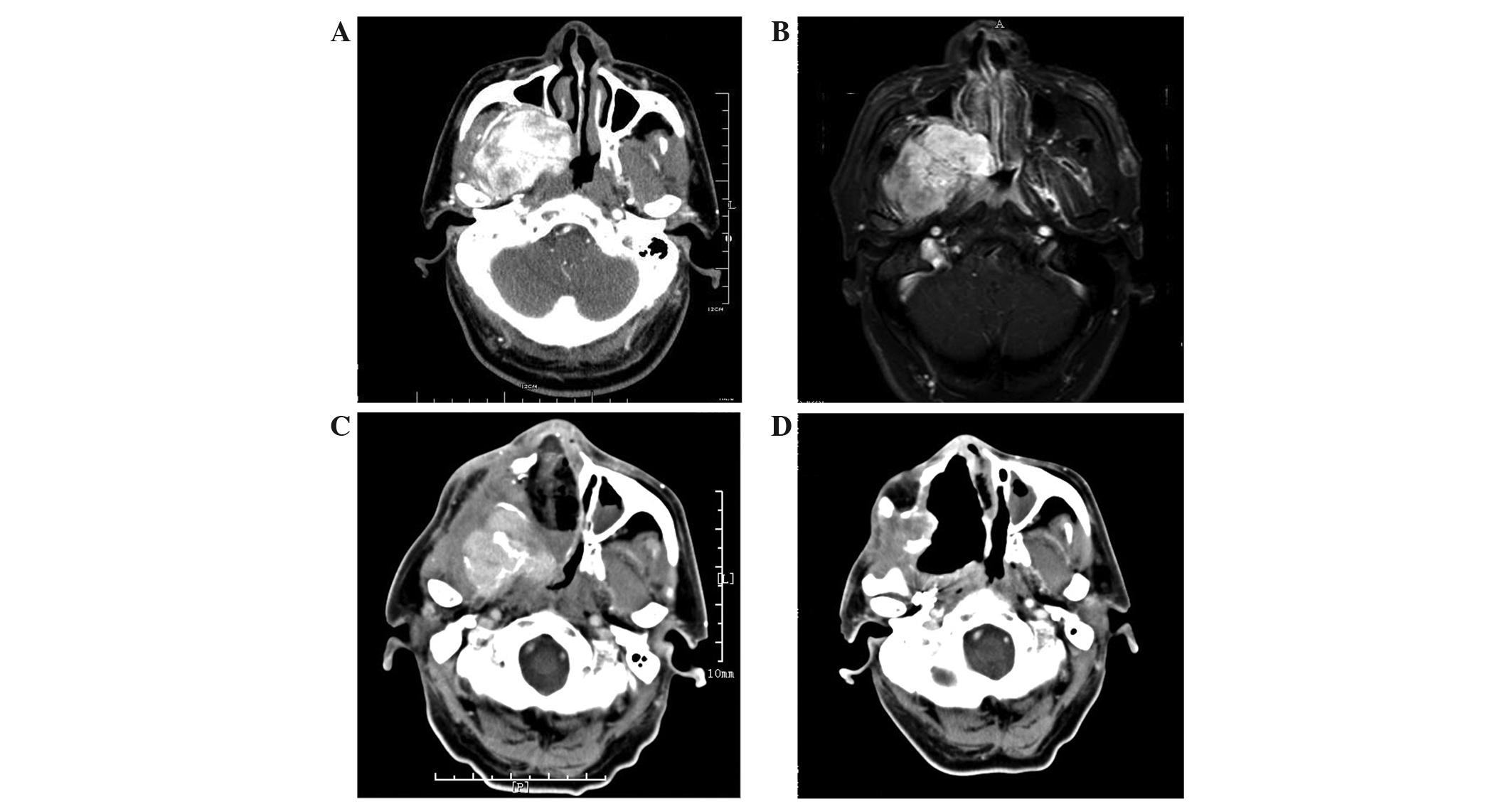
A 72-year-old male presented with continuous headaches, right nasal epistaxis, right nasal obstruction and a decreased sense of smell for three months. The patient was admitted to the First Affiliated Hospital of Medical School of Zhejiang University (Hangzhou, China) on March 29, 2013, three months after the initial onset of these symptoms. The contrast-enhanced computed tomography (CT) and magnetic resonance imaging (MRI) revealed a highly vascular nasopharyngeal mass, and the sphenomaxillary fossa was enlarged (Fig. 1A and B). Surgical resection was performed using a lateral rhinotomy approach. However, due to massive hemorrhage, the tumor was not completely removed. Histopathological examination of the excised lesion revealed the presence of angiofibroma. Five months after surgery, the patient presented with recurrent right spontaneous epistaxis and right nasal obstruction and was subsequently referred to the Fudan University Affiliated Eye, Ear, Nose and Throat Hospital (Shanghai, China) to receive additional treatment.

Figure 1.

Radiological findings. (A) Pre-operative CT scan revealing a strongly enhancing, expanding mass originating in the nasopharynx and invading the right maxillary sinus, anterior and posterior ethmoid sinus, parapharyngeal space and infratemporal fossa. (B) Pre-operative T1-weighted axial magnetic resonance imaging revealing a strongly enhancing tumor following the administration of a contrast medium. (C) CT scan revealing the recurrence of the tumor five months after the lateral rhinotomy was performed. The large soft-tissue nasal-nasopharyngeal mass had extended into the right parapharyngeal space and infratemporal fossa. (D) CT scan revealing the complete removal of the tumor two weeks after a repeat endoscopic-assisted sublabial and buccolabial incision approach was performed. CT, computed tomography.

A physical examination at our hospital revealed a red mass in the right nasal cavity. Contrast-enhanced CT confirmed the presence of a large soft-tissue nasal and nasopharyngeal mass that extended into the right maxillary antrum and up towards the orbital floor, with destruction of the medial and lateral walls of the antrum, into the sphenoid sinus on the right side and continued dorsally to the right parapharyngeal space and infratemporal fossa (Fig. 1C).

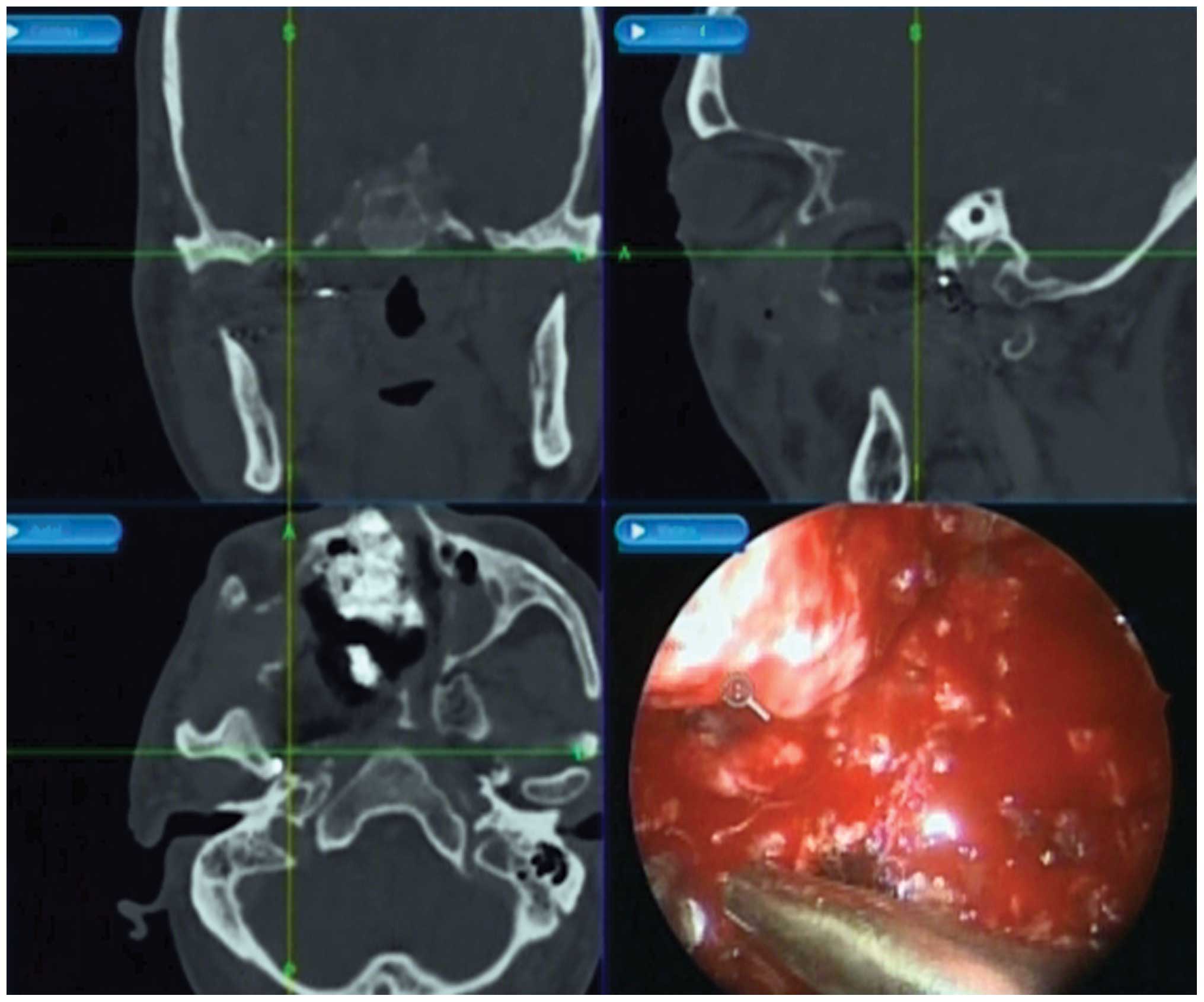
An endoscopic-assisted sublabial and buccolabial incision approach was used to remove the tumor following pre-operative embolization. Using clamp forceps, the nasal component of the tumor was pushed down into the nasopharynx and drawn out through the oral cavity. In order to remove the infratemporal fossa extension of the NA, a sublabial and buccolabial incision, which extended from the first molar teeth to the maxillary tuberosity at the gingivobuccal sulcus, was made on the involved side. Due to the complex anatomy and high vascularity of the region, a blood loss of ~2,800 ml occurred during the surgery. The patient therefore received a blood transfusion of 400 ml fresh frozen plasma and 4 units of packed red blood cells. The extensive hemorrhage also led to a poor surgical field. In order to prevent accidental injury, the surgery was terminated without further investigation. A contrast-enhanced CT scan was performed the next day to determine whether the tumor had been completely removed. The results revealed the presence of residual tumor in the right parapharyngeal space and infratemporal fossa. A day later, a repeat endoscopic-assisted sublabial and buccolabial incision approach was performed to remove the residual tumor. An image-guided navigation system (Medtronic, Louisville, KY, USA) was used for the localization of the residual tumor in the right parapharyngeal space and infratemporal fossa (Fig. 2). A contrast-enhanced CT scan performed 2 weeks subsequent to the procedure confirmed the complete removal of the tumor (Fig. 1D). The patient was followed up for 6 months, without exhibiting evidence of recurrence.

Figure 2.

Revision surgery. A repeat endoscopic-assisted sublabial and buccolabial incision approach was performed in order to remove the residual tumor. An image-guided navigation system was used for the localization of the residual tumor in the right parapharyngeal space and infratemporal fossa.

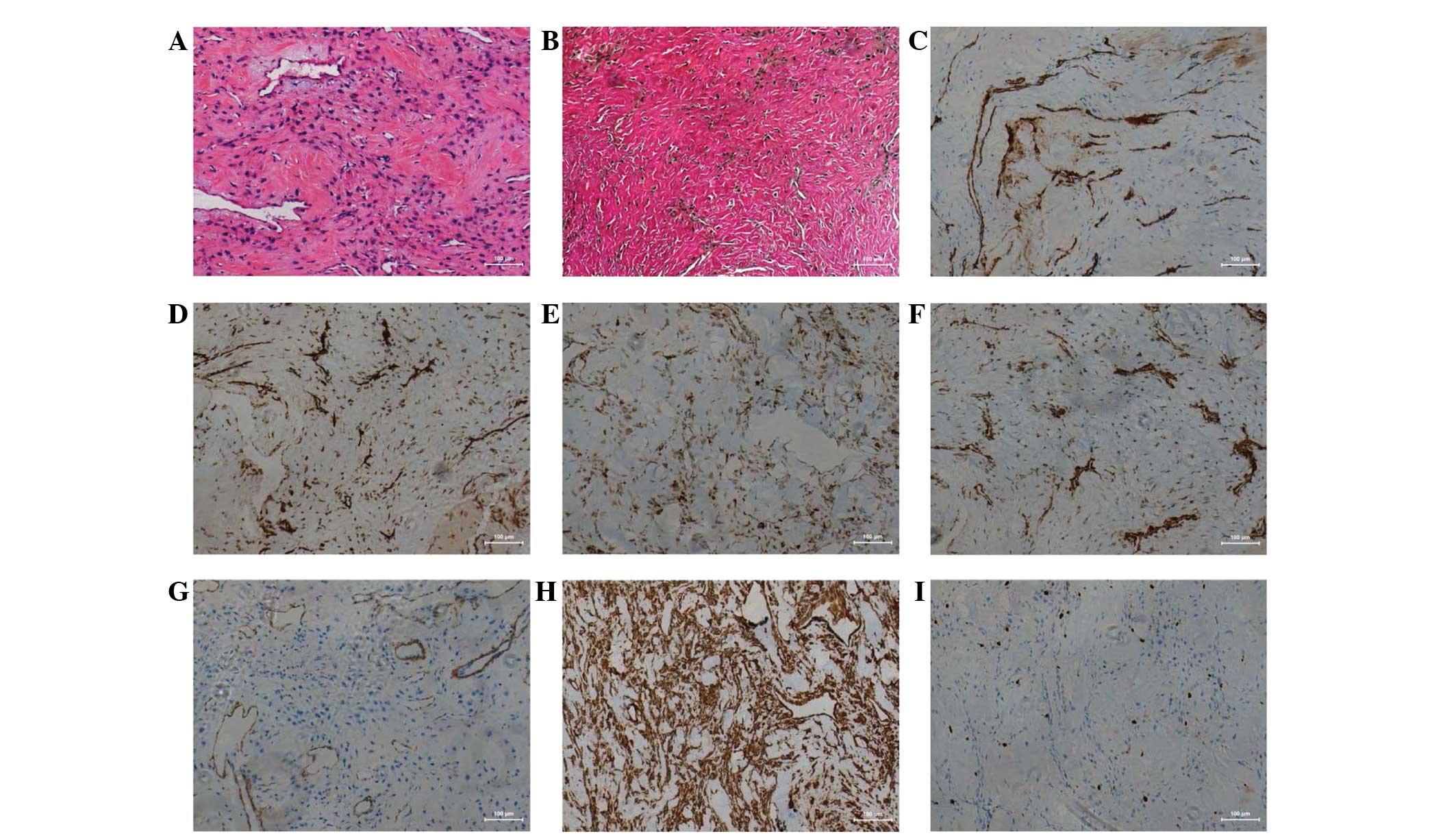
A hematoxylin and eosin-stained section revealed that the tumor was composed of a characteristic fibrous stroma in which the vascular channels were lined by flat endothelial cells (Fig. 3A). A Van-Gieson-stained section established that the tumor was mainly composed of collagen fibers, while elastic fibers were scarcely discernible (Fig. 3B). Immunohistochemically, the tumor was positive for the expression of cluster of differentiation (CD)31 (Fig. 3C), CD34 (Fig. 3D), CD68 (Fig. 3E), HHF35 (Fig. 3F), smooth muscle actin (Fig. 3G), and vimentin (Fig. 3H). The percentage of Ki-67-positive cells was 4% (Fig. 3I). According to these findings, a diagnosis of angiofibroma was established.

Figure 3.

Results of the histopathological and immunohistochemical studies established a diagnosis of angiofibroma. (A) Hematoxylin and eosin-stained section revealing that the tumor was composed of microvascular embedded in fibrous tissue. (B) Van-Gieson-stained section revealing that the tumor was mainly composed of collagen fibers, while muscle fibres were scarcely discernible. Immunohistochemically, the tumor was positive for (C) CD31, (D) CD34, (E) CD68, (F) HHF35, (G) smooth muscle actin and (H) vimentin. (I) The percentage of Ki-67-positive cells was 4%. Scale bar, 100µm. CD, cluster of differentiation.

This study was approved by the Ethics Committee of Fudan University Affiliated Eye, Ear, Nose and Throat Hospital, and written informed consent was obtained from the patient and the patient's family.

Discussion

In general, NA primarily affects adolescent males, and is therefore considered to be a juvenile disease. However, NA has been observed in at least three patients over the age of 70 (Table I), consisting of a 79-year-old male (7), a 71-year-old female (8) and a 70-year-old male (9). These patients were treated by traditional open surgical approaches and the diagnoses were lacking in immunohistochemical evidence. According to Patrocinio et al (10), immunohistochemical analyses are required for the diagnosis of atypical NA cases, particularly those with atypical clinical manifestations. The immune profile is extremely useful during the process of pathological differential diagnosis.

Table I.

Three patients over the age of 70 diagnosed with nasopharyngeal angiofibroma.

Table I.

Three patients over the age of 70 diagnosed with nasopharyngeal angiofibroma.

First author (ref.)GenderAge, yearsSurgical approach
Conley et al (7)Male79Transpalatine or lateral rhinotomy approach
Ewing and Shively (8)Female71Right lateral rhinotomy and antrotomy
Shaheen (9)Male70Moure's lateral rhinotomy incision

The present study reported a rare case of NA in a 72-year-old male, which was confirmed by histopathological and immunohistochemical analysis. With the exception of age, the patient demonstrated typical presentation, clinical examination and radiological findings (Fig. 1). Histologically and immunohistochemically, the tumor was composed of proliferating vasculature in a fibrous stroma. The presence of red-colored regions following Van-Gieson staining and a strong positivity to vimentin indicated that the majority of the stromal cells were fibrocytes (11). Positive immunohistochemical staining for the endothelial markers CD31 and CD34 supported true endothelial differentiation (Fig. 3) (12). This typical presentation was of significant value for the diagnosis of NA.

The etiology and pathogenesis of NA remains unclear. It has been reported that no abnormalities in the serum levels of dihydrotestosterone, testosterone and estradiol-17 B are detected in NA patients (13). To a certain extent, the occurrence of NA in the elderly may support the hypothesis that serum androgen levels do not affect the development of NA, since low serum androgen levels are present in older men (14,15).

Large NAs continue to present a considerable surgical challenge (1,6). The optimal treatment for these tumors is gross total resection. However, open approaches require external and internal incisions, which results in extensive soft-tissue dissection and multiple osteotomies (3). Improvements in pre-operative assessment and preparation, in addition to operative techniques and instrumentation, may enable the endoscopic removal of the majority of juvenile NAs (16). If the location or extension of the tumor is too lateral or inferior to be effectively resected by an endoscopic approach, a combination of endoscopic and open approaches may be considered (17,18). It has previously been reported that an endoscopic-assisted sublabial and buccolabial incision is an optional approach for the removal of an NA with extensive infratemporal fossa extension in youths (6). The present case confirmed that this modified surgery is well tolerated by the elderly. Due to a firm connection with surrounding structures, the tumor may break during surgery, leaving remnants in the surgical cavity, which poses a challenge for effective treatment. As a result of tumor extension and massive intraoperative hemorrhage, complete resection of the tumor was unsuccessful following the first endoscopic-assisted sublabial and buccolabial incision approach in the current case. Therefore, a revision surgery was considered. Image-guided navigation systems are useful for the localization of deep located tumors (19). In the present study, radiographical analysis revealed that the tumor had been completely resected following image-guided surgery. This counter example illustrated the value of the image-guided navigation system.

The present study confirmed the occurrence of NA in the elderly and highlighted the potential of an image-guided endoscopic-assisted sublabial and buccolabial incision approach for the treatment of NA in the elderly. In addition, the present study established that image-guided navigation systems are useful for the localization of deep NA lesions.

Acknowledgements

The authors would like to thank the patient for his contribution to this work. This work was supported by the National Natural Science Foundation of China (grant no. 81371077) and by Shanghai Municipal Hospitals' Rising and Leading Technology Program (grant no. SHDC12013121).

References

1 

Sun XC, Wang DH, Yu HP, et al: Analysis of risk factors associated with recurrence of nasopharyngeal angiofibroma. J Otolaryngol Head Neck Surg. 39:56–61. 2010.PubMed/NCBI

2 

Boghani Z, Husain Q, Kanumuri VV, et al: Juvenile nasopharyngeal angiofibroma: A systematic review and comparison of endoscopic, endoscopic-assisted and open resection in 1047 cases. Laryngoscope. 123:859–869. 2013. View Article : Google Scholar : PubMed/NCBI

3 

Huang Y, Liu Z, Wang J, et al: Surgical management of juvenile nasopharyngeal angiofibroma: Analysis of 162 cases from 1995 to 2012. Laryngoscope. 124:1942–1946. 2014. View Article : Google Scholar : PubMed/NCBI

4 

Tang IP, Shashinder S, Gopala Krishnan G and Narayanan P: Juvenile nasopharyngeal angiofibroma in a tertiary centre: Ten-year experience. Singapore Med J. 50:261–264. 2009.PubMed/NCBI

5 

Paris J, Guelfucci B, Moulin G, et al: Diagnosis and treatment of juvenile nasopharyngeal angiofibroma. Eur Arch Otorhinolaryngol. 258:120–124. 2001. View Article : Google Scholar : PubMed/NCBI

6 

Sun XC, Li H, Liu ZF, et al: Endoscopic-assisted sublabial and buccolabial incision approach for juvenile nasopharyngeal angiofibroma with extensive infratemporal fossa extension. Int J Pediatr Otorhinolaryngol. 76:1501–1506. 2012. View Article : Google Scholar : PubMed/NCBI

7 

Conley J, Healey WV, Blaugrund SM and Erzin KH: Nasopharyngeal angiofibroma in the juvenile. Surg Gynecol Obstet. 126:825–837. 1968.PubMed/NCBI

8 

Ewing JA and Shively EH: Angiofibroma: a rare case in an elderly female. Otolaryngol Head Neck Surg. 89:602–603. 1981.PubMed/NCBI

9 

Shaheen HB: Nasopharyngeal fibroma. J Laryngol Otol. 45:259–264. 1930. View Article : Google Scholar

10 

Patrocínio JA, Patrocínio LG, Borba BH, et al: Nasopharyngeal angiofibroma in an elderly woman. Am J Otolaryngol. 26:198–200. 2005. View Article : Google Scholar : PubMed/NCBI

11 

Bornemann A and Schmalbruch H: Anti-vimentin staining in muscle pathology. Neuropathol Appl Neurobiol. 19:414–419. 2009. View Article : Google Scholar

12 

Pusztaszeri MP, Seelentag W and Bosman FT: Immunohistochemical expression of endothelial markers CD31, CD34, von Willebrand factor, and Fli-1 in normal human tissues. J Histochem Cytochem. 54:385–395. 2006. View Article : Google Scholar : PubMed/NCBI

13 

Farag MM, Ghanimah SE, Ragaie A and Saleem TH: Hormonal receptors in juvenile nasopharyngeal angiofibroma. Laryngoscope. 97:208–211. 1987. View Article : Google Scholar : PubMed/NCBI

14 

Ferrini RL and Barrett-Connor E: Sex hormones and age: a cross-sectional study of testosterone and estradiol and their bioavailable fractions in community-dwelling men. Am J Epidemiol. 147:750–754. 1998. View Article : Google Scholar : PubMed/NCBI

15 

Laughlin GA, Barrett-Connor E and Bergstrom J: Low serum testosterone and mortality in older men. J Clin Endocrinol Metab. 93:68–75. 2008. View Article : Google Scholar : PubMed/NCBI

16 

Douglas R and Wormald PJ: Endoscopic surgery for juvenile nasopharyngeal angiofibroma: Where are the limits? Curr Opin Otolaryngol Head Neck Surg. 14:1–5. 2006. View Article : Google Scholar : PubMed/NCBI

17 

Khalifa MA and Ragab SM: Endoscopic assisted antral window approach for type III nasopharyngeal angiofibroma with infratemporal fossa extension. Int J Pediatr Otorhinolaryngol. 72:1855–1860. 2008. View Article : Google Scholar : PubMed/NCBI

18 

Gallia GL, Ramanathan M Jr, Blitz AM and Reh DD: Expanded endonasal endoscopic approach for resection of a juvenile nasopharyngeal angiofibroma with skull base involvement. J Clin Neurosci. 17:1423–1427. 2010. View Article : Google Scholar : PubMed/NCBI

19 

Farhadi M, Jalessi M, Sharifi G, et al: Use of image guidance in endoscopic endonasal surgeries: A 5-year experience. B-ENT. 7:277–282. 2011.PubMed/NCBI

Related Articles

  • Abstract
  • View
  • Download
  • Twitter
Copy and paste a formatted citation
Spandidos Publications style
Zhang HK, Wang JJ, Liu ZF and Wang DH: Management of nasopharyngeal angiofibroma in a 72-year-old male through a sublabial and buccolabial incision approach: A case report and literature review. Oncol Lett 10: 1267-1270, 2015.
APA
Zhang, H., Wang, J., Liu, Z., & Wang, D. (2015). Management of nasopharyngeal angiofibroma in a 72-year-old male through a sublabial and buccolabial incision approach: A case report and literature review. Oncology Letters, 10, 1267-1270. https://doi.org/10.3892/ol.2015.3410
MLA
Zhang, H., Wang, J., Liu, Z., Wang, D."Management of nasopharyngeal angiofibroma in a 72-year-old male through a sublabial and buccolabial incision approach: A case report and literature review". Oncology Letters 10.3 (2015): 1267-1270.
Chicago
Zhang, H., Wang, J., Liu, Z., Wang, D."Management of nasopharyngeal angiofibroma in a 72-year-old male through a sublabial and buccolabial incision approach: A case report and literature review". Oncology Letters 10, no. 3 (2015): 1267-1270. https://doi.org/10.3892/ol.2015.3410
Copy and paste a formatted citation
x
Spandidos Publications style
Zhang HK, Wang JJ, Liu ZF and Wang DH: Management of nasopharyngeal angiofibroma in a 72-year-old male through a sublabial and buccolabial incision approach: A case report and literature review. Oncol Lett 10: 1267-1270, 2015.
APA
Zhang, H., Wang, J., Liu, Z., & Wang, D. (2015). Management of nasopharyngeal angiofibroma in a 72-year-old male through a sublabial and buccolabial incision approach: A case report and literature review. Oncology Letters, 10, 1267-1270. https://doi.org/10.3892/ol.2015.3410
MLA
Zhang, H., Wang, J., Liu, Z., Wang, D."Management of nasopharyngeal angiofibroma in a 72-year-old male through a sublabial and buccolabial incision approach: A case report and literature review". Oncology Letters 10.3 (2015): 1267-1270.
Chicago
Zhang, H., Wang, J., Liu, Z., Wang, D."Management of nasopharyngeal angiofibroma in a 72-year-old male through a sublabial and buccolabial incision approach: A case report and literature review". Oncology Letters 10, no. 3 (2015): 1267-1270. https://doi.org/10.3892/ol.2015.3410
Follow us
  • Twitter
  • LinkedIn
  • Facebook
About
  • Spandidos Publications
  • Careers
  • Cookie Policy
  • Privacy Policy
How can we help?
  • Help
  • Live Chat
  • Contact
  • Email to our Support Team