Spandidos Publications Logo
  • About
    • About Spandidos
    • Aims and Scopes
    • Abstracting and Indexing
    • Editorial Policies
    • Reprints and Permissions
    • Job Opportunities
    • Terms and Conditions
    • Contact
  • Journals
    • All Journals
    • Oncology Letters
      • Oncology Letters
      • Information for Authors
      • Editorial Policies
      • Editorial Board
      • Aims and Scope
      • Abstracting and Indexing
      • Bibliographic Information
      • Archive
    • International Journal of Oncology
      • International Journal of Oncology
      • Information for Authors
      • Editorial Policies
      • Editorial Board
      • Aims and Scope
      • Abstracting and Indexing
      • Bibliographic Information
      • Archive
    • Molecular and Clinical Oncology
      • Molecular and Clinical Oncology
      • Information for Authors
      • Editorial Policies
      • Editorial Board
      • Aims and Scope
      • Abstracting and Indexing
      • Bibliographic Information
      • Archive
    • Experimental and Therapeutic Medicine
      • Experimental and Therapeutic Medicine
      • Information for Authors
      • Editorial Policies
      • Editorial Board
      • Aims and Scope
      • Abstracting and Indexing
      • Bibliographic Information
      • Archive
    • International Journal of Molecular Medicine
      • International Journal of Molecular Medicine
      • Information for Authors
      • Editorial Policies
      • Editorial Board
      • Aims and Scope
      • Abstracting and Indexing
      • Bibliographic Information
      • Archive
    • Biomedical Reports
      • Biomedical Reports
      • Information for Authors
      • Editorial Policies
      • Editorial Board
      • Aims and Scope
      • Abstracting and Indexing
      • Bibliographic Information
      • Archive
    • Oncology Reports
      • Oncology Reports
      • Information for Authors
      • Editorial Policies
      • Editorial Board
      • Aims and Scope
      • Abstracting and Indexing
      • Bibliographic Information
      • Archive
    • Molecular Medicine Reports
      • Molecular Medicine Reports
      • Information for Authors
      • Editorial Policies
      • Editorial Board
      • Aims and Scope
      • Abstracting and Indexing
      • Bibliographic Information
      • Archive
    • World Academy of Sciences Journal
      • World Academy of Sciences Journal
      • Information for Authors
      • Editorial Policies
      • Editorial Board
      • Aims and Scope
      • Abstracting and Indexing
      • Bibliographic Information
      • Archive
    • International Journal of Functional Nutrition
      • International Journal of Functional Nutrition
      • Information for Authors
      • Editorial Policies
      • Editorial Board
      • Aims and Scope
      • Abstracting and Indexing
      • Bibliographic Information
      • Archive
    • International Journal of Epigenetics
      • International Journal of Epigenetics
      • Information for Authors
      • Editorial Policies
      • Editorial Board
      • Aims and Scope
      • Abstracting and Indexing
      • Bibliographic Information
      • Archive
    • Medicine International
      • Medicine International
      • Information for Authors
      • Editorial Policies
      • Editorial Board
      • Aims and Scope
      • Abstracting and Indexing
      • Bibliographic Information
      • Archive
  • Articles
  • Information
    • Information for Authors
    • Information for Reviewers
    • Information for Librarians
    • Information for Advertisers
    • Conferences
  • Language Editing
Spandidos Publications Logo
  • About
    • About Spandidos
    • Aims and Scopes
    • Abstracting and Indexing
    • Editorial Policies
    • Reprints and Permissions
    • Job Opportunities
    • Terms and Conditions
    • Contact
  • Journals
    • All Journals
    • Biomedical Reports
      • Information for Authors
      • Editorial Policies
      • Editorial Board
      • Aims and Scope
      • Abstracting and Indexing
      • Bibliographic Information
      • Archive
    • Experimental and Therapeutic Medicine
      • Information for Authors
      • Editorial Policies
      • Editorial Board
      • Aims and Scope
      • Abstracting and Indexing
      • Bibliographic Information
      • Archive
    • International Journal of Epigenetics
      • Information for Authors
      • Editorial Policies
      • Editorial Board
      • Aims and Scope
      • Abstracting and Indexing
      • Bibliographic Information
      • Archive
    • International Journal of Functional Nutrition
      • Information for Authors
      • Editorial Policies
      • Editorial Board
      • Aims and Scope
      • Abstracting and Indexing
      • Bibliographic Information
      • Archive
    • International Journal of Molecular Medicine
      • Information for Authors
      • Editorial Policies
      • Editorial Board
      • Aims and Scope
      • Abstracting and Indexing
      • Bibliographic Information
      • Archive
    • International Journal of Oncology
      • Information for Authors
      • Editorial Policies
      • Editorial Board
      • Aims and Scope
      • Abstracting and Indexing
      • Bibliographic Information
      • Archive
    • Medicine International
      • Information for Authors
      • Editorial Policies
      • Editorial Board
      • Aims and Scope
      • Abstracting and Indexing
      • Bibliographic Information
      • Archive
    • Molecular and Clinical Oncology
      • Information for Authors
      • Editorial Policies
      • Editorial Board
      • Aims and Scope
      • Abstracting and Indexing
      • Bibliographic Information
      • Archive
    • Molecular Medicine Reports
      • Information for Authors
      • Editorial Policies
      • Editorial Board
      • Aims and Scope
      • Abstracting and Indexing
      • Bibliographic Information
      • Archive
    • Oncology Letters
      • Information for Authors
      • Editorial Policies
      • Editorial Board
      • Aims and Scope
      • Abstracting and Indexing
      • Bibliographic Information
      • Archive
    • Oncology Reports
      • Information for Authors
      • Editorial Policies
      • Editorial Board
      • Aims and Scope
      • Abstracting and Indexing
      • Bibliographic Information
      • Archive
    • World Academy of Sciences Journal
      • Information for Authors
      • Editorial Policies
      • Editorial Board
      • Aims and Scope
      • Abstracting and Indexing
      • Bibliographic Information
      • Archive
  • Articles
  • Information
    • For Authors
    • For Reviewers
    • For Librarians
    • For Advertisers
    • Conferences
  • Language Editing
Login Register Submit
  • This site uses cookies
  • You can change your cookie settings at any time by following the instructions in our Cookie Policy. To find out more, you may read our Privacy Policy.

    I agree
Search articles by DOI, keyword, author or affiliation
Search
Advanced Search
presentation
Oncology Letters
Join Editorial Board Propose a Special Issue
Print ISSN: 1792-1074 Online ISSN: 1792-1082
Journal Cover
August-2016 Volume 12 Issue 2

Full Size Image

Sign up for eToc alerts
Recommend to Library

Journals

International Journal of Molecular Medicine

International Journal of Molecular Medicine

International Journal of Molecular Medicine is an international journal devoted to molecular mechanisms of human disease.

International Journal of Oncology

International Journal of Oncology

International Journal of Oncology is an international journal devoted to oncology research and cancer treatment.

Molecular Medicine Reports

Molecular Medicine Reports

Covers molecular medicine topics such as pharmacology, pathology, genetics, neuroscience, infectious diseases, molecular cardiology, and molecular surgery.

Oncology Reports

Oncology Reports

Oncology Reports is an international journal devoted to fundamental and applied research in Oncology.

Experimental and Therapeutic Medicine

Experimental and Therapeutic Medicine

Experimental and Therapeutic Medicine is an international journal devoted to laboratory and clinical medicine.

Oncology Letters

Oncology Letters

Oncology Letters is an international journal devoted to Experimental and Clinical Oncology.

Biomedical Reports

Biomedical Reports

Explores a wide range of biological and medical fields, including pharmacology, genetics, microbiology, neuroscience, and molecular cardiology.

Molecular and Clinical Oncology

Molecular and Clinical Oncology

International journal addressing all aspects of oncology research, from tumorigenesis and oncogenes to chemotherapy and metastasis.

World Academy of Sciences Journal

World Academy of Sciences Journal

Multidisciplinary open-access journal spanning biochemistry, genetics, neuroscience, environmental health, and synthetic biology.

International Journal of Functional Nutrition

International Journal of Functional Nutrition

Open-access journal combining biochemistry, pharmacology, immunology, and genetics to advance health through functional nutrition.

International Journal of Epigenetics

International Journal of Epigenetics

Publishes open-access research on using epigenetics to advance understanding and treatment of human disease.

Medicine International

Medicine International

An International Open Access Journal Devoted to General Medicine.

Journal Cover
August-2016 Volume 12 Issue 2

Full Size Image

Sign up for eToc alerts
Recommend to Library

  • Article
  • Citations
    • Cite This Article
    • Download Citation
    • Create Citation Alert
    • Remove Citation Alert
    • Cited By
  • Similar Articles
    • Related Articles (in Spandidos Publications)
    • Similar Articles (Google Scholar)
    • Similar Articles (PubMed)
  • Download PDF
  • Download XML
  • View XML
Article Open Access

Fluorescence in situ hybridization analysis of the ALK gene in 2,045 non-small cell lung cancer patients from North-Western Spain (Galicia)

  • Authors:
    • María Sánchez‑Ares
    • José M. Cameselle‑Teijeiro
    • Sergio Vázquez‑Estévez
    • Martín Lázaro‑Quintela
    • Ángel Vázquez‑Boquete
    • Francisco J. Afonso‑Afonso
    • Joaquín Casal‑Rubio
    • Ana L. González‑Piñeiro
    • Yolanda Rico‑Rodríguez
    • José L. Fírvida‑Pérez
    • Juan Ruíz‑Bañobre
    • Elena Couso
    • Lucía Santomé
    • Raquel Pérez‑Becerra
    • Rosario García‑Campelo
    • Margarita Amenedo
    • Cristina Azpitarte‑Raposeiras
    • José Antúnez
    • Ihab Abdulkader
  • View Affiliations / Copyright

    Affiliations: Department of Anatomic Pathology, Clinical University Hospital, Galician Healthcare Service (SERGAS), 15706 Santiago de Compostela, Spain, Department of Medical Oncology, Lucus Augusti University Hospital, SERGAS, 27003 Lugo, Spain, Department of Medical Oncology, University Hospital Complex, SERGAS, 36312 Vigo, Spain, Department of Medical Oncology, University Hospital Complex Arquitecto Marcide‑Novoa Santos, SERGAS, 15405 Ferrol, Spain, Department of Anatomic Pathology, University Hospital Complex, SERGAS, 36312 Vigo, Spain, Department of Medical Oncology, Clinical University Hospital, SERGAS, 32005 Ourense, Spain, Department of Medical Oncology, Clinical University Hospital, SERGAS, 15706 Santiago de Compostela, Spain, Department of Medical Oncology, Povisa Hospital, 36211 Vigo, Spain, Department of Medical Oncology, Clinical University Hospital, SERGAS, 15006 A Coruña, Spain, Department of Medical Oncology, Centro Oncológico de Galicia, 15009 A Coruña, Spain, Department of Medical Oncology, Clinical University Hospital, SERGAS, 36164 Pontevedra, Spain
    Copyright: © Sánchez‑Ares et al. This is an open access article distributed under the terms of Creative Commons Attribution License.
  • Pages: 1403-1407
    |
    Published online on: June 28, 2016
       https://doi.org/10.3892/ol.2016.4788
  • Expand metrics +
Metrics: Total Views: 0 (Spandidos Publications: | PMC Statistics: )
Metrics: Total PDF Downloads: 0 (Spandidos Publications: | PMC Statistics: )
Cited By (CrossRef): 0 citations Loading Articles...

This article is mentioned in:


Abstract

Identification of anaplastic lymphoma receptor tyrosine kinase (ALK) gene rearrangements is a standard diagnostic test in patients with advanced non-small cell lung cancer (NSCLC). The current study describes the experience of ALK rearrangement detection of a referral center in the public health care system of Galicia in North‑Western Spain. The fluorescence in situ hybridization (FISH) patterns of the ALK gene and the clinical and pathological features of these patients are reported. This study is also of interest for comparative purposes due to the relative geographical isolation of the area, which could have contributed to particular genetic features. A total of 2,045 tissue samples from NSCLC patients were collected between October 2010 and July 2015 and tested for ALK rearrangements by FISH. Examination of 1,686 paraffin‑embedded tissue specimens and 395 cytological samples (306 cell block preparations and 53 cytological smears) was conducted, and any associations between the FISH results and clinicopathological features were assessed. The rate of successful evaluation was marginally higher in tissue samples than in cytological samples (92.9% vs. 84.1%); this difference was not significant. ALK rearrangements were identified in 82 patients(4%): 65 (79.3%) in tissue specimens, 15 (18.3%) in cell block samples and 2 (2.4%) in cytological smears. This genetic translocation appeared to be associated with a non‑smoking history, younger age, female gender, stage IV and adenocarcinoma histological type. The findings demonstrate that ALK evaluation by FISH is feasible in tissue and cytological samples. The clinical and pathological features of the ALK‑positive series of patients are similar to those previously reported in the literature.

Introduction

Recent advances in the biology of non-small cell lung cancer (NSCLC) have identified driver mutations that can predict response to the therapy. This molecularly targeted therapy has dramatically improved results for patients whose tumors harbor somatically activated oncogenes, such as epidermal growth factor receptor (EGFR), anaplastic lymphoma receptor tyrosine kinase (ALK), ret proto-oncogene (RET) or ROS proto-oncogene 1 (ROS1) (1–3). Although EGFR mutations and ALK, RET and ROS1 translocations are predominantly detected in lung adenocarcinomas from never-smokers and light smokers, these associations are not absolute; thus, clinical profile must not be used to exclude patients from molecular testing for specific alterations (4).

Activating rearrangements of ALK gene are detectable in 1.9–6.8% of NSCLC cases (5–9). In these tumors, a fusion gene involving echinoderm microtubule associated protein-like 4 (EML4) and ALK (EML4-ALK) encodes a chimeric protein with constitutive tyrosine kinase activity that confers transformation potential and responsiveness to specific targeted inhibitors (5). Whereas the fused ALK gene region remains constant (exon 20), different EML4 exons can be affected, generating several variants; other ALK fusion partners have also been reported (10,11). In patients with ALK-positive NSCLC, the use of crizotinib, an oral ATP-competitive selective inhibitor of the ALK tyrosine kinase, along with a new generation of ALK tyrosine kinase inhibitors (alectinib and ceritinib), has demonstrated superiority over standard chemotherapy (3,4).

Fluorescence in situ hybridization (FISH), bright-field dual-color chromogenic in situ hybridization (12), immunohistochemistry (IHC) (7,12) and reverse transcriptase-polymerase chain reaction (13) are available methods for the detection of ALK rearrangements. ALK FISH has been recognized as the most sensitive method (9). Recently, the FDA has approved the Ventana ALK (D5F3) CDx Assay (Roche, Tucson, AZ, USA) to identify patients for crizotinib therapy. Ultrasensitive IHC assays may obviate FISH confirmation in positive IHC cases; however, the likelihood of false negative IHC results demands FISH testing, at least in some situations (7,8,12). Currently, the only approved FISH assay for the detection of ALK positivity, as a companion diagnostic tool for crizotinib-based treatment eligibility, is the Vysis ALK Break Apart FISH Probe Kit (Abbott Molecular, Des Plaines, IL, USA).

In the current study, we describe our experience of FISH ALK rearrangement detection in 2,045 routine diagnostic samples in the public health care system of Galicia (Spain). This report is of particular interest for comparative purposes due to Galicia's isolation in North-Western Spain and its specific cultural characteristics, which may contribute to the emergence of genetic diversity (14).

Materials and methods

Patients and samples

A total of 2,045 unselected samples of NSCLC from patients in 9 hospitals of the Galician public health care system (Spain), collected between October 2010 and July 2015, were investigated. Samples were received as buffered formalin-fixed, paraffin-embedded tissue biopsies, cell blocks and cytological smears. In the referral center (Clinical University Hospital, Santiago de Compostela, Spain), pathologists verified the adequacy of the samples and reviewed the diagnosis according to the World Health Organization criteria (1). For all patients, medical records were reviewed, and written informed consent obtained. The Independent Ethics Committee of Galicia (Galician Healthcare Service; SERGAS) approved the study protocol, which was conducted in accordance with the Declaration of Helsinki and applicable Spanish laws.

ALK FISH analysis

The ALK genetic status of each patient was evaluated by FISH in representative tumor areas, with an LSI ALK dual-color, break-apart rearrangement probe (Vysis ALK Break Apart FISH Probe Kit, Abbott Molecular Inc.), following the manufacturer's protocol. In each case, 50 non-overlapping nuclei were examined by fluorescence microscope (BX51; Olympus Corporation, Barcelona, Spain). The kit included red (3′) and green (5′) break-apart probes. ALK was determined to be not rearranged when the two signals were adjacent or fused (appearing yellow under an Orange/Green V2 filter) or when there was a single green signal. ALK was considered positive (rearranged) when ≥1 set of red and green signals were ≥2 signal diameters apart, or when a single red signal was present. A sample was considered negative for ALK if <5 cells out of 50 (<10%), and positive when >25 cells out of 50 (>50%), exhibited split ALK 5′ and 3′ probe signals or isolated 3′ signals. With borderline results, when the number of positive cells was 5–25 (10–50%), a second reader evaluated the slide: First and second cell count readings were added together and a percentage out of 100 cells was calculated. If the positive cell percentage was ≥15%, the sample was considered positive.

Statistical analysis

Statistical analysis was conducted with SPSS version 19.0 (IBM SPSS, Armonk, NY, USA). The association between ALK mutation status and clinicopathological features was calculated using Pearson's χ2 test or Fisher's exact test. P<0.05 was considered to indicated a statistically significant difference.

Results

ALK assessment

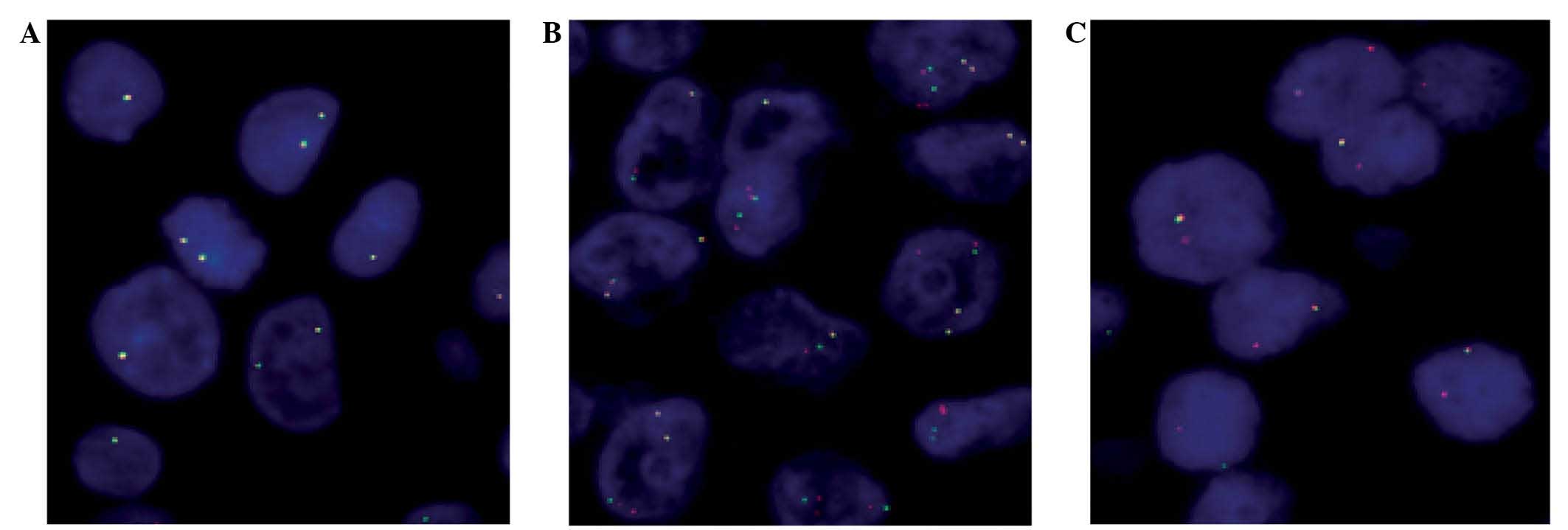
The 2,045 samples of NSCLC included 1,686 (82.4%) tissue biopsies, 306 (15%) cell block samples and 53 (2.6%) cytological smears. Among the total samples examined, 1,866 (91.2%) could be tested by FISH (Fig. 1). Specifically, 1,566 (92.9%) tissue biopsies, 256 (83.7%) cell blocks and 46 (86.8%) cytological smears could be assessed. In the remaining 179 (8.8%) samples, the FISH result was not obtained owing to insufficient/non-representative tumor material (n=143; 79.9%) or to assay failure (n=36; 20.1%) due to pre-analytical factors (poor fixation, decalcification treatment, etc.). The rate of successful evaluation was not significantly higher in histological samples compared with cytological samples (92.9% vs. 84.1%). Additionally, no differences were found between cell blocks and cytological smears (83.7% vs. 86.8%).

Figure 1.

ALK break-apart FISH signals in non-small cell lung cancer. (A) ALK FISH-negative specimen. (B) ALK FISH-positive specimen showing split red and green signals. (C) ALK FISH-positive specimen showing isolated single red signals. ALK, anaplastic lymphoma receptor tyrosine kinase; FISH, fluorescence in situ hybridization.

ALK rearrangement

ALK rearrangements were identified in 82 (4%) out of 2,045 tumor samples: 65 (79.3%) tissue biopsies, 15 (18.3%) cell blocks and 2 (2.4%) cytological smears (Table I). The mean percentage of ALK-positive cells was 52% (range, 15–92%). A typical translocation pattern was observed in 62 (75.6%) cases, and the remaining cases (24.4%) exhibited a split pattern (Fig. 1).

Table I.

Clinical and pathological features of patients positive and negative for ALK rearrangement.

Table I.

Clinical and pathological features of patients positive and negative for ALK rearrangement.

VariableAll casesALK-negative casesALK-positive casesP-value
Total, n (%a)2,0451,784 (87.2)82 (4.0)
Age, years <0.001
  Range25–9431–9425–83
  Median64.064.458.0
Gender, n (%b) <0.001
  Male1,420 (69.4)1,262 (70.7)  31 (37.8)
  Female  605 (29.6)  507 (28.4)  49 (59.8)
  Unknown  20 (1.0)  15 (0.8)  2 (2.4)
Histology, n (%b) 0.017
  Adenocarcinoma1,559 (76.2)1,352 (75.8)  72 (87.8)
  Squamous cell carcinoma  263 (12.9)  239 (13.4)  1 (1.2)
  Large cell neuroendocrine carcinoma  21 (1.0)  18 (1.0)  2 (2.4)
  Adenosquamous carcinoma  17 (0.8)  16 (0.9)  0 (0.0)
  Not otherwise specified  185 (9.0)  159 (8.9)  7 (8.5)
Smoking history, n (%b) <0.001
  Ex-smoker  783 (38.3)  688 (38.6)  20 (24.4)
  Smoker  761 (37.2)  661 (37.0)  23 (28.0)
  Non-smoker  372 (18.2)  312 (17.5)  34 (41.5)
  Unknown  129 (6.3)  123 (6.9)  5 (6.1)
Stage, n (%b) <0.001
  T1 (T1a+T1b)  36 (1.8)  34 (1.9)  1 (1.2)
  T2  39 (1.9)  38 (2.1)  1 (1.2)
  T3  126 (6.2)  117 (6.6)  3 (3.7)
  T4  883 (43.2)  780 (43.7)  47 (57.3)
  Unknown  961 (47.0)  815 (45.7)  30 (36.6)

a Percentage of total patients

b percentage by ALK rearrangement group. ALK, anaplastic lymphoma receptor tyrosine kinase.

Clinicopathological findings

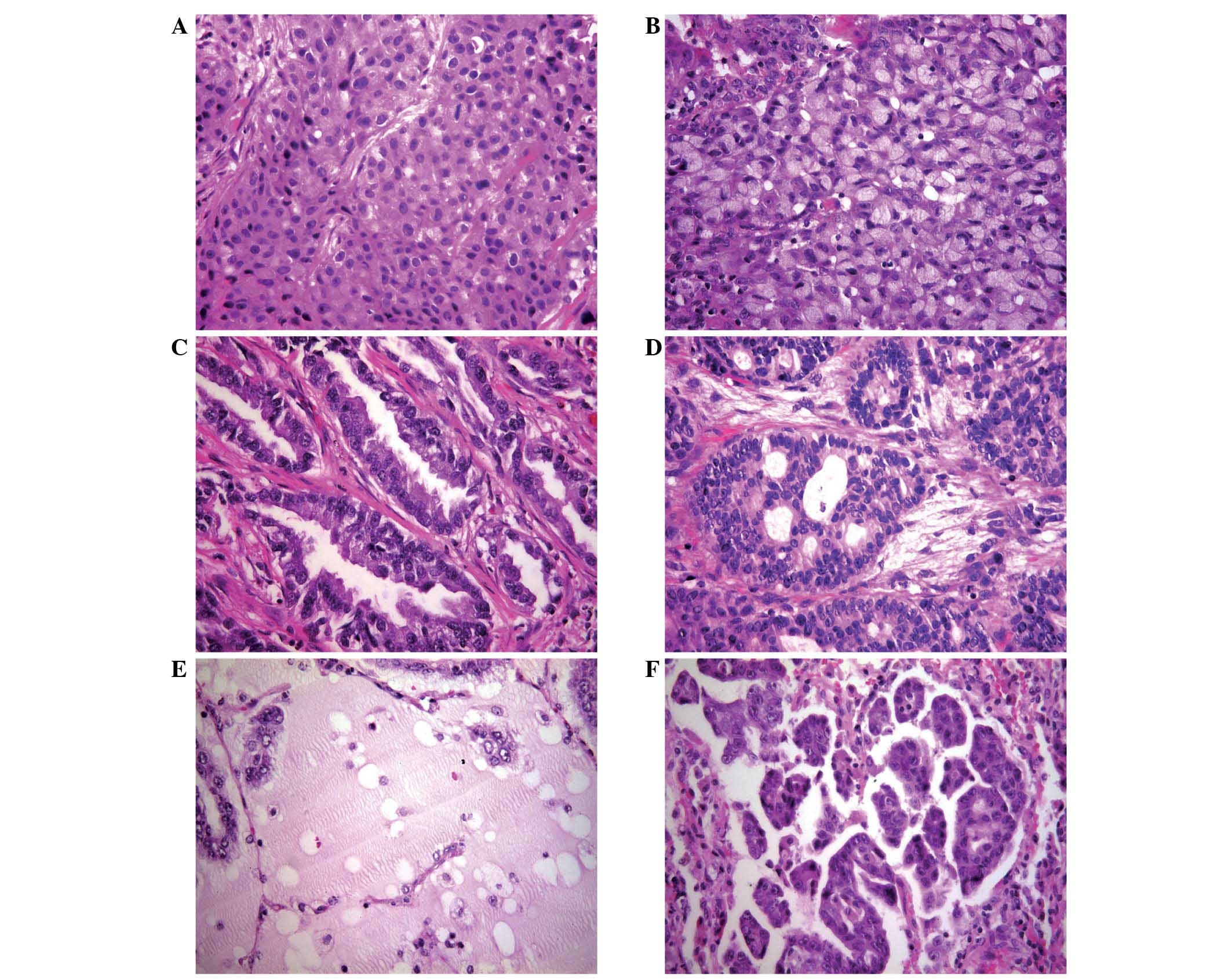
The clinicopathological features of the 2,045 NSCLC patients are summarized in Table I. The majority were male (69.4%) and ex-smokers (38.3%) or current smokers (37.2%). At diagnosis, the vast majority were in advanced stage (43.2% at stage IV). The predominant histological type was adenocarcinoma (76.2%). Significant associations between ALK rearrangement and younger age (P<0.001; Mann-Whitney U test), female gender (P<0.001; Pearson's χ2 test), non-smoking history (P<0.001; likelihood ratio test), stage IV at diagnosis (P<0.001; likelihood ratio test) and the adenocarcinoma histological type (P=0.046; likelihood ratio test) were found. Other ALK-positive tumor types were large cell neuroendocrine carcinomas (n=2), squamous carcinoma (n=1) and not otherwise specified carcinomas (n=7). ALK-positive adenocarcinomas (n=72) exhibited a predominantly solid pattern of growth in 45.8% of cases, with cellular features of signet ring cell carcinoma in 36.4% (n=12) of these (Table II and Fig. 2). No simultaneous EGFR mutations were detected in any cases.

Figure 2.

Representative histological patterns of adenocarcinoma tissues. (A) Solid growth pattern, (B) solid pattern with a signet ring cell component, (C) acinar pattern, (D) cribriform pattern, (E) mucinous pattern, and (F) micropapillary pattern. Hematoxylin-eosin staining; original magnification, ×400.

Table II.

Adenocarcinoma growth patterns of ALK gene rearrangement-positive patients (n=72).

Table II.

Adenocarcinoma growth patterns of ALK gene rearrangement-positive patients (n=72).

Pattern of growthCases, n
Solid adenocarcinoma NOS19
Solid with signet ring cells12
Acinar adenocarcinoma NOS13
Cribriform adenocarcinoma  2
Colloid adenocarcinoma  4
Mixed adenocarcinomaa  5
Adenocarcinoma NOS  8
Unknown  9

a Including solid-papillary patterns (1 case), solid-cribriform patterns (1 case), acinar-cribriform patterns (1 case), acinar-solid patterns (1 case), and acinar-micropapillary patterns (1 case). NOS, not otherwise specified; ALK, anaplastic lymphoma receptor tyrosine kinase.

Discussion

To the best of our knowledge, this is the largest study on ALK rearrangements in unselected NSCLC patients in a Spanish Caucasian population. It is also the first study in Galicia, North-Western Spain, and is particularly interesting as the adequacy and histology of all samples were reviewed in a single institution by the same pathologists using the same criteria. Although Galicia is relatively isolated, the current results confirm the low frequency of ALK rearrangements (4%) in unselected Caucasian NSCLC patients, which is marginally higher than values from other areas of Spain (3%) (6), and within the range of 1.9–6.8% reported in the literature (5,7–9).

The current study utilized the Food and Drug Administration (FDA)-approved ALK break-apart FISH method, with excellent results. The successful evaluation rate difference between tissue samples and cytological samples was not significant (92.9% vs. 84.1%); very similar results were obtained using cell blocks and cytological smears (83.7% vs. 86.8%). Although technical limitations have been reported in cytological specimens (6), the success rate in the present study was in line with the literature, which reports the feasibility of ALK FISH analysis of cytological samples as ranging from 79–97% (15). Cytological smears may be preferable for FISH assays as they avoid formalin fixation problems and permit the evaluation of whole nuclei, eliminating overlapping nuclei and nuclear truncation (16). According to FDA guidelines (12), this FISH analysis is applicable on histological samples, however, cytological smears could also be appropriate.

The present study revealed an apparent association of ALK rearrangement with non-smoking, female gender, younger age, stage IV and adenocarcinoma. The significant proportion of ALK-positive non-smokers is consistent with previous reports (9), but 55.9% of the current cases were previous or current smokers, which confirms that smoking is not a reliable criterion on which to predict or exclude ALK rearrangement. ALK positivity was determined to be strongly associated with female gender (P<0.001); however, controversial results have been reported (6,8). A marginally, non-significantly higher rate of ALK positivity in females has been described in a recent meta-analysis of 6,950 patients (9). The results of the present study and that of Proietti et al (16) found a younger age to be associated with ALK rearrangement. We also found ALK positivity to be associated with stage IV disease; however, analysis of a greater number of patients in other stages would be desirable to reach reliable conclusions. Consistently with previous reports (6,8,9), the current results found ALK rearrangements to be largely, but not completely, restricted to adenocarcinomas, specifically solid or acinar variants or with signet ring cell features. ALK positivity was also identified in one squamous cell carcinoma and two large cell neuroendocrine carcinomas.

In conclusion, the present findings indicated that ALK evaluation by FISH is feasible in tissue and cytological samples. It was also found that ALK translocation is associated with a non-smoking history, a younger age, the female gender, stage IV and the adenocarcinoma histological type. Due to the fact that ALK rearrangement was detected in various histological tumor types, the ALK study should not be restricted to adenocarcinomas.

References

1 

Travis WD, Brambilla E, Burke AP, Marx A and Nicholson AG: Tumours of the lung. Who Classification Of Tumours Of Lung, Pleura, Thymus And Heart (4th). IARC Press. (Lyon, France). 9–151. 2015.

2 

Kwak EL, Bang YJ, Camidge DR, Shaw AT, Solomon B, Maki RG, Ou SH, Dezube BJ, Jänne PA, Costa DB, et al: Anaplastic lymphoma kinase inhibition in non-small-cell lung cancer. N Engl J Med. 363:1693–1703. 2010. View Article : Google Scholar : PubMed/NCBI

3 

Patel JN, Ersek JL and Kim ES: Lung cancer biomarkers, targeted therapies and clinical assays. Transl Lung Cancer Res. 4:503–514. 2015.PubMed/NCBI

4 

Lindeman NI, Cagle PT, Beasley MB, Chitale DA, Dacic S, Giaccone G, Jenkins RB, Kwiatkowski DJ, Saldivar JS, Squire J, et al: Molecular testing guideline for selection of lung cancer patients for EGFR and ALK tyrosine kinase inhibitors: Guideline from the College of American pathologists, international association for the study of lung cancer, and association for molecular pathology. J Thorac Oncol. 8:823–859. 2013. View Article : Google Scholar : PubMed/NCBI

5 

Soda M, Choi YL, Enomoto M, Takada S, Yamashita Y, Ishikawa S, Fujiwara S, Watanabe H, Kurashina K, Hatanaka H, et al: Identification of the transforming EML4-ALK fusion gene in non-small-cell lung cancer. Nature. 448:561–566. 2007. View Article : Google Scholar : PubMed/NCBI

6 

Vidal J, Clavé S, de Muga S, González I, Pijuan L, Gimeno J, Remón J, Reguart N, Viñolas N, Gironés R, et al: Assessment of ALK status by FISH on 1,000 Spanish non-small cell lung cancer patients. J Thorac Oncol. 9:1816–1820. 2014. View Article : Google Scholar : PubMed/NCBI

7 

Alì G, Proietti A, Pelliccioni S, Niccoli C, Lupi C, Sensi E, Giannini R, Borrelli N, Menghi M, Chella A, et al: ALK rearrangement in a large series of consecutive non-small cell lung cancers: Comparison between a new immunohistochemical approach and fluorescence in situ hybridization for the screening of patients eligible for crizotinib treatment. Arch Pathol Lab Med. 138:1449–1458. 2014. View Article : Google Scholar : PubMed/NCBI

8 

Cabillic F, Gros A, Dugay F, Begueret H, Mesturoux L, Chiforeanu DC, Dufrenot L, Jauffret V, Dachary D, Corre R, et al: Parallel FISH and immunohistochemical studies of ALK status in 3,244 non-small-cell lung cancers reveal major discordances. J Thorac Oncol. 9:295–306. 2014. View Article : Google Scholar : PubMed/NCBI

9 

Zhao F, Xu M, Lei H, Zhou Z, Wang L, Li P, Zhao J and Hu P: Clinicopathological characteristics of patients with non-small-cell lung cancer who harbor EML4-ALK fusion gene: A meta-analysis. PLoS One. 10:e01173332015. View Article : Google Scholar : PubMed/NCBI

10 

Ou SH, Klempner SJ, Greenbowe JR, Azada M, Schrock AB, Ali SM, Ross JS, Stephens PJ and Miller VA: Identification of a novel HIP1-ALK fusion variant in non-small-cell lung cancer (NSCLC) and discovery of ALK I1171 (I1171N/S) mutations in two ALK-rearranged NSCLC patients with resistance to Alectinib. J Thorac Oncol. 9:1821–1825. 2014. View Article : Google Scholar : PubMed/NCBI

11 

Iyevleva AG, Raskin GA, Tiurin VI, Sokolenko AP, Mitiushkina NV, Aleksakhina SN, Garifullina AR, Strelkova TN, Merkulov VO, Ivantsov AO, et al: Novel ALK fusion partners in lung cancer. Cancer Lett. 362:116–121. 2015. View Article : Google Scholar : PubMed/NCBI

12 

Conde E, Suárez-Gauthier A, Benito A, Garrido P, García-Campelo R, Biscuola M, Paz-Ares L, Hardisson D, de Castro J, Camacho MC, et al: Accurate identification of ALK positive lung carcinoma patients: Novel FDA-cleared automated fluorescence in situ hybridization scanning system and ultrasensitive immunohistochemistry. PLoS One. 9:e1072002014. View Article : Google Scholar : PubMed/NCBI

13 

Wang Q, Yang X, He Y, Ma Q, Lin L, Fu P and Xiao H: Droplet digital PCR for absolute quantification of EML4-ALK gene rearrangement in lung adenocarcinoma. J Mol Diagn. 17:515–520. 2015. View Article : Google Scholar : PubMed/NCBI

14 

Mancikova V, Cruz R, Inglada-Pérez L, Fernández-Rozadilla C, Landa I, Cameselle-Teijeiro J, Celeiro C, Pastor S, Velázquez A, Marcos R, et al: Thyroid cancer GWAS identifies 10q26.12 and 6q14.1 as novel susceptibility loci and reveals genetic heterogeneity among populations. Int J Cancer. 137:1870–1878. 2015. View Article : Google Scholar : PubMed/NCBI

15 

Bozzetti C, Nizzoli R, Tiseo M, Squadrilli A, Lagrasta C, Buti S, Gasparro D, Zanoni D, Majori M, De Filippo M, et al: ALK and ROS1 rearrangements tested by fluorescence in situ hybridization in cytological smears from advanced non-small cell lung cancer patients. Diagn Cytopathol. 43:941–946. 2015. View Article : Google Scholar : PubMed/NCBI

16 

Proietti A, Alì G, Pelliccioni S, Lupi C, Sensi E, Boldrini L, Servadio A, Chella A, Ribechini A, Cappuzzo F, et al: Anaplastic lymphoma kinase gene rearrangements in cytological samples of non-small cell lung cancer: Comparison with histological assessment. Cancer Cytopathol. 122:445–1453. 2014. View Article : Google Scholar : PubMed/NCBI

Related Articles

  • Abstract
  • View
  • Download
  • Twitter
Copy and paste a formatted citation
Spandidos Publications style
Sánchez‑Ares M, Cameselle‑Teijeiro JM, Vázquez‑Estévez S, Lázaro‑Quintela M, Vázquez‑Boquete Á, Afonso‑Afonso FJ, Casal‑Rubio J, González‑Piñeiro AL, Rico‑Rodríguez Y, Fírvida‑Pérez JL, Fírvida‑Pérez JL, et al: Fluorescence in situ hybridization analysis of the ALK gene in 2,045 non-small cell lung cancer patients from North-Western Spain (Galicia). Oncol Lett 12: 1403-1407, 2016.
APA
Sánchez‑Ares, M., Cameselle‑Teijeiro, J.M., Vázquez‑Estévez, S., Lázaro‑Quintela, M., Vázquez‑Boquete, Á., Afonso‑Afonso, F.J. ... Abdulkader, I. (2016). Fluorescence in situ hybridization analysis of the ALK gene in 2,045 non-small cell lung cancer patients from North-Western Spain (Galicia). Oncology Letters, 12, 1403-1407. https://doi.org/10.3892/ol.2016.4788
MLA
Sánchez‑Ares, M., Cameselle‑Teijeiro, J. M., Vázquez‑Estévez, S., Lázaro‑Quintela, M., Vázquez‑Boquete, Á., Afonso‑Afonso, F. J., Casal‑Rubio, J., González‑Piñeiro, A. L., Rico‑Rodríguez, Y., Fírvida‑Pérez, J. L., Ruíz‑Bañobre, J., Couso, E., Santomé, L., Pérez‑Becerra, R., García‑Campelo, R., Amenedo, M., Azpitarte‑Raposeiras, C., Antúnez, J., Abdulkader, I."Fluorescence in situ hybridization analysis of the ALK gene in 2,045 non-small cell lung cancer patients from North-Western Spain (Galicia)". Oncology Letters 12.2 (2016): 1403-1407.
Chicago
Sánchez‑Ares, M., Cameselle‑Teijeiro, J. M., Vázquez‑Estévez, S., Lázaro‑Quintela, M., Vázquez‑Boquete, Á., Afonso‑Afonso, F. J., Casal‑Rubio, J., González‑Piñeiro, A. L., Rico‑Rodríguez, Y., Fírvida‑Pérez, J. L., Ruíz‑Bañobre, J., Couso, E., Santomé, L., Pérez‑Becerra, R., García‑Campelo, R., Amenedo, M., Azpitarte‑Raposeiras, C., Antúnez, J., Abdulkader, I."Fluorescence in situ hybridization analysis of the ALK gene in 2,045 non-small cell lung cancer patients from North-Western Spain (Galicia)". Oncology Letters 12, no. 2 (2016): 1403-1407. https://doi.org/10.3892/ol.2016.4788
Copy and paste a formatted citation
x
Spandidos Publications style
Sánchez‑Ares M, Cameselle‑Teijeiro JM, Vázquez‑Estévez S, Lázaro‑Quintela M, Vázquez‑Boquete Á, Afonso‑Afonso FJ, Casal‑Rubio J, González‑Piñeiro AL, Rico‑Rodríguez Y, Fírvida‑Pérez JL, Fírvida‑Pérez JL, et al: Fluorescence in situ hybridization analysis of the ALK gene in 2,045 non-small cell lung cancer patients from North-Western Spain (Galicia). Oncol Lett 12: 1403-1407, 2016.
APA
Sánchez‑Ares, M., Cameselle‑Teijeiro, J.M., Vázquez‑Estévez, S., Lázaro‑Quintela, M., Vázquez‑Boquete, Á., Afonso‑Afonso, F.J. ... Abdulkader, I. (2016). Fluorescence in situ hybridization analysis of the ALK gene in 2,045 non-small cell lung cancer patients from North-Western Spain (Galicia). Oncology Letters, 12, 1403-1407. https://doi.org/10.3892/ol.2016.4788
MLA
Sánchez‑Ares, M., Cameselle‑Teijeiro, J. M., Vázquez‑Estévez, S., Lázaro‑Quintela, M., Vázquez‑Boquete, Á., Afonso‑Afonso, F. J., Casal‑Rubio, J., González‑Piñeiro, A. L., Rico‑Rodríguez, Y., Fírvida‑Pérez, J. L., Ruíz‑Bañobre, J., Couso, E., Santomé, L., Pérez‑Becerra, R., García‑Campelo, R., Amenedo, M., Azpitarte‑Raposeiras, C., Antúnez, J., Abdulkader, I."Fluorescence in situ hybridization analysis of the ALK gene in 2,045 non-small cell lung cancer patients from North-Western Spain (Galicia)". Oncology Letters 12.2 (2016): 1403-1407.
Chicago
Sánchez‑Ares, M., Cameselle‑Teijeiro, J. M., Vázquez‑Estévez, S., Lázaro‑Quintela, M., Vázquez‑Boquete, Á., Afonso‑Afonso, F. J., Casal‑Rubio, J., González‑Piñeiro, A. L., Rico‑Rodríguez, Y., Fírvida‑Pérez, J. L., Ruíz‑Bañobre, J., Couso, E., Santomé, L., Pérez‑Becerra, R., García‑Campelo, R., Amenedo, M., Azpitarte‑Raposeiras, C., Antúnez, J., Abdulkader, I."Fluorescence in situ hybridization analysis of the ALK gene in 2,045 non-small cell lung cancer patients from North-Western Spain (Galicia)". Oncology Letters 12, no. 2 (2016): 1403-1407. https://doi.org/10.3892/ol.2016.4788
Follow us
  • Twitter
  • LinkedIn
  • Facebook
About
  • Spandidos Publications
  • Careers
  • Cookie Policy
  • Privacy Policy
How can we help?
  • Help
  • Live Chat
  • Contact
  • Email to our Support Team