Introduction
Colorectal cancer is one of the most common types of
cancer and is one of the leading causes of cancer-associated
mortality worldwide (1). Numerous
therapeutic approaches, including chemotherapy, radiotherapy and
targeted therapy, have been used in the treatment of colorectal
cancer (2). As one of the most common
drugs used to treat colorectal cancer, 5-fluorouracil (5-Fu) has
the ability to induce apoptosis in normal and tumor cells (3). However, clinical data has indicated that
drug resistance to 5-Fu is ubiquitous, even when 5-Fu is used in
combination with other chemotherapeutic agents (4,5). YN968D1
is a tyrosine kinase inhibitor that selectively inhibits vascular
endothelial growth factor (VEGF) receptor 2 (6). YN968D1 is thought to function by
inhibiting VEGF-mediated endothelial cell migration and
proliferation (7). As YN968D1
inhibits angiogenesis in cancer cells, it may be a novel treatment
option for advanced types of cancer, including colorectal
cancer.
Dickkopf-related protein 4 (DKK4) is a member of the
dickkopf family of genes, which have been implicated in
tumorigenesis. DKK4 is a target of the β-catenin/transcription
factor 4 complex and binds to the Wnt co-receptors, low-density
lipoprotein receptor-related protein 5 and 6 (8). DKK4 is overexpressed in the colonic
mucosa of patients with colitis (9),
while the expression of DKK4 is downregulated in colorectal cancer
cells (10). Previous research has
shown that DKK4 may be involved in resistance to chemotherapy in
colorectal cancer (9). To further
understand the role of DKK4 in chemotherapy resistance, the present
study induced its overexpression in several colorectal cancer cell
lines, which were subsequently analyzed for cell viability,
migration and apoptosis following treatment with 5-Fu, YN968D1 or
both. The results of the present study suggest that DKK4 may
enhance the resistance of colorectal cancer cells to 5-Fu and
YN968D1 treatment, when used alone or in combination.
Materials and methods
Cell culture and treatment
A total of 6 human colorectal cell lines were used:
HCT116, HT29, LoVo, SW480, Caco2 and Colo205. All cell lines were
purchased from the Cell Bank of Type Culture Collection of Chinese
Academy of Sciences, Shanghai Institute of Cell Biology (Shanghai,
China). All cells were cultured in Dulbecco's modified Eagle's
medium (Gibco; Thermo Fisher Scientific, Inc., Waltham, MA, USA)
supplemented with 10% calf serum (PAA Laboratories; GE Healthcare
Life Sciences, Chalfont, UK) and treated with 5-Fu (Sigma-Aldrich;
Merck Millipore, Darmstadt, Germany), YN968D1 (Jiangsu Hengrui
Medicine Co., Ltd., Lianyungang, China), or a combination of the
two. The cells were cultured in a humidified atmosphere (60%
relative humidity) containing 5% CO2 at 37°C.
Lentiviral construction and generation
of the active virus
DKK4 cDNA sequence was obtained from the National
Center for Biotechnology Information (NCBI) database (http://www.ncbi.nlm.nih.gov/) and synthesized using
the phosphoramidite method (11). The
fragment was subsequently cloned into the Lv5 plasmid (Suzhou
GenePharma Co., Ltd., Suzhou, China) to generate the expression
construct. Expression construct and the Vira Power Lentiviral
Packaging Mix (Thermo Fisher Scientific, Inc., Waltham, MA, USA)
were co-transfected into the 293 FT cell line (Thermo Fisher
Scientific, Inc.) to produce lentivirus. Lentiviral supernatants
were subsequently harvested and used to infect colorectal cancer
cell lines. Virus collection and propagation was performed
according to the manufacturer's protocol.
Reverse transcription-quantitative
polymerase chain reaction (RT-qPCR) and western blot analysis
Lentiviral DNA, free-from or containing DKK4, was
transduced into 6 colorectal cancer cell lines. Cells were
harvested and total RNA was extracted using the PureLink RNA Mini
kit (Thermo Fisher Scientific, Inc.). RNA was reverse transcribed
using the Super Script™ III First-Strand Synthesis Super Mix for
RT-qPCR (Thermo Fisher Scientific, Inc.). qPCR was performed using
the SYBR® GreenER™ qPCR Super Mix Universal (Thermo
Fisher Scientific, Inc.), and DKK4 mRNA expression was normalized
tothe internal control glyceraldehyde-3-phosphate dehydrogenase
(GAPDH). The following primer sequences were used: GAPDH forward,
5′-ACAACTTTGGTATCGTGGAAGG-3′ and reverse,
5′-GCCATCACGCCACAGTTTC-3′; DKK4 forward,
5′-ACGGACTGCAATACCAGAAAG-3′ and reverse,
5′-CGTTCACACAGAGTGTCCCAG-3′. The data was normalized using the
2−Δ∆Cq method (12).
The 12 colorectal cancer cell lines (6
overexpressing DKK4 and 6 controls) were washed with PBS
(Invitrogen; Thermo Fisher Scientific, Inc.) and mixed with lysis
buffer (Sigma-Aldrich; Merck Millipore). The mixtures were vortexed
for 1 min and placed on ice for 30 min. Following centrifugation
(10,000 × g for 10 min, 4°C), the dye-binding Bradford
method (Bio-Rad Laboratories, Inc., Hercules, CA, USA) was used to
quantify the protein. Equal amounts of protein (40 µg protein/lane)
were separated on a 10–12% sodium dodecyl sulfate (SDS) gel via
polyacrylamide gel electrophoresis (PAGE) and transferred onto
polyvinylidene difluoride (PVDF) membranes. The membranes were
incubated with the primary anti-DKK4 rabbit monoclonal IgG antibody
(ab172613; 1:1,000 dilution; Abcam, Cambridge, UK) and anti-GAPDH
rabbit monoclonal IgG antibody (ab9483; 1:1,000 dilution; Abcam)
separately, overnight at 4°C. The secondary antibody was a
horseradish peroxidase-labeled goat anti-rabbit IgG antibody (H+L)
(A0208, 1:5,000 dilution; Beyotime Institute of Biotechnology,
Haimen, China). The samples were incubated with the secondary
antibody for 1 h at 37°C. The signals were analyzed following
treatment with 3,3′, 5,5′-tetramethylbenzidine (TMB) substrate
(P0211; Beyotime Institute of Biotechnology). The bands were
visualized by the ChemiDocä Touch Imaging system (Bio-Rad
Laboratories, Inc.).
Measurement of cell viability
Colorectal cancer cell lines were cultured in a
96-well microplate at a density of 5×10³ cells/well for
24 h in a humidified atmosphere (60% relative humidity) containing
5% CO2 at 37°C. The cells were subsequently divided into
several groups and treated with 5-Fu, YN968D1 or both. The
following drug concentrations were used: 0, 0.0128, 0.064, 0.32,
1.6, 8, 40 and 200 µg/ml. Cell viability was assessed using the
Cell Counting Kit-8 assay at 3 days post-treatment according to the
manufacturer's protocol. The absorbance at 450 nm was read using a
96-well plate reader in order to determine the cell viability.
Migration assay
Migration assays were performed in a 24-well
Transwell® chamber (Corning Incorporated, Corning, NY,
USA). A total of 40 µg/ml 5-Fu, YN968D1 or both were used and the
Transwell chamber assays were performed according to the
manufacturer's protocol.
Flow cytometric analysis of apoptotic
cells
Fluorescence-activated cell sorting (FACS) was
performed using the Annexin-V-fluorescein isothiocyanate (FITC)
conjugate and binding buffer as standard reagents (Beyotime
Institute of Biotechnology). The cells were exposed to the drugs
(20 µg/ml 5-Fu and 40 µg/ml YN968D1) for 24 h and were subsequently
collected for analysis. Flow cytometry was performed at 488 nm on a
FACScanto flow cytometer (BD Biosciences, Franklin Lakes, NJ, USA).
Fluorescent emission of FITC was measured at 515–545 nm and that of
DNA-propidium iodide complexes at 564–606 nm. Cell debris was
excluded from analysis by an appropriate forward light scatter
threshold setting. Compensation was used wherever necessary.
Western blot analysis
Following drug treatment, cells were washed with PBS
and mixed with lysis buffer. The mixtures were vortexed for 1 min
and placed on ice for 30 min. Following centrifugation (10,000 ×
g for 10 min, 4°C), the dye-binding Bradford method (Bio-Rad
Laboratories, Inc.) was used to quantify the proteins. Equal
amounts of protein (40 µg protein/lane) were separated on a 10–12%
SDS gel via PAGE and transferred onto PVDF membranes. The membranes
were separately incubated with the primary anti-DKK4 rabbit
monoclonal IgG antibody, anti-transcription factor AP-2 epsilon
(TFAP2E) rabbit monoclonal IgG antibody (AV40023-100UG, 1:1,000
dilution; Sigma-Aldrich; Merck Millipore), anti-hypoxia-inducible
factor-2α (HIF2α) rabbit polyclonal IgG antibody (ab109616, 1:1,000
dilution; Abcam) and anti-GAPDH rabbit monoclonal IgG antibody
(ab9483, 1:1,000 dilution; Abcam), overnight at 4°C. The secondary
antibody was a horseradish peroxidase-labeled goat anti-rabbit IgG
antibody (H+L). The samples were incubated with the secondary
antibody for 1 h at 37°C. The signals were analyzed following
treatment with TMB substrate and visualized by the ChemiDocä Touch
Imaging system.
Statistical analysis
Differences between experimental groups were
analyzed using the unpaired Student's t-test on Microsoft Office
Excel 2010 (Microsoft Corporation, Redmond, WA, USA). P<0.05 was
considered to indicate a statistically significant difference.
Results
Overexpression of DKK4 in colorectal
cancer cell lines
The DKK4 cDNA sequence was obtained from the NCBI
database and the fragment synthesized using the chemical synthesis
method. It was cloned into the Lv5 plasmid and co-transfected with
packaging mix into 293FT cells to produce lentivirus. Lentiviral
supernatant was harvested and used to infect 6 colorectal cancer
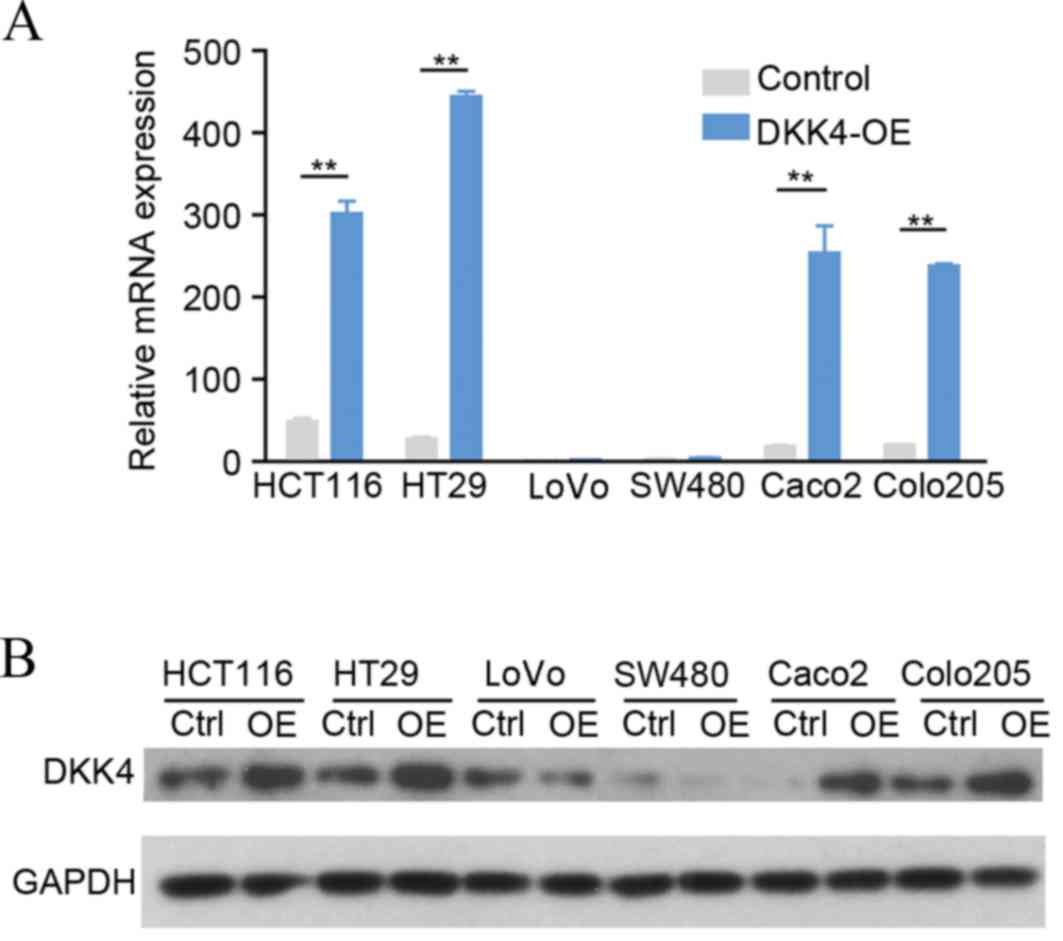
cell lines, in order to induce DKK4 overexpression. RT-qPCR and
western blot analyses were performed to measure the DKK4 expression
in the various cell lines. The present RT-qPCR results demonstrated
that DKK4 was upregulated in 4 cell lines: HCT116 (314.45-fold
increase compared with the control; P=0.00027), HT29 (456.14-fold
increase compared with the control; P=0.00052), Caco2 (253.38-fold
increase compared withthecontrol; P=0.00032) and Colo205
(204.89-fold increase compared with the control; P=0.00001)
(Fig. 1A). Similar results were
observed following western blot analysis (Fig. 1B). The mRNA and protein expression
levels observed indicated that DKK4 was being overexpressed in
those 4 cell lines. Therefore subsequent research made use of only
those 4 cell lines to investigate the role of DKK4 in the
development of resistance to chemotherapy in colorectal cancer
cells.
Effect of DKK4 on cell viability
As 5-Fu is one of the most widely used drugs in
colorectal cancer treatment and YN968D1 is a tyrosine kinase
inhibitor used in metastatic cancer, they were selected to
investigate the role of DKK4 in resistance to chemotherapy.
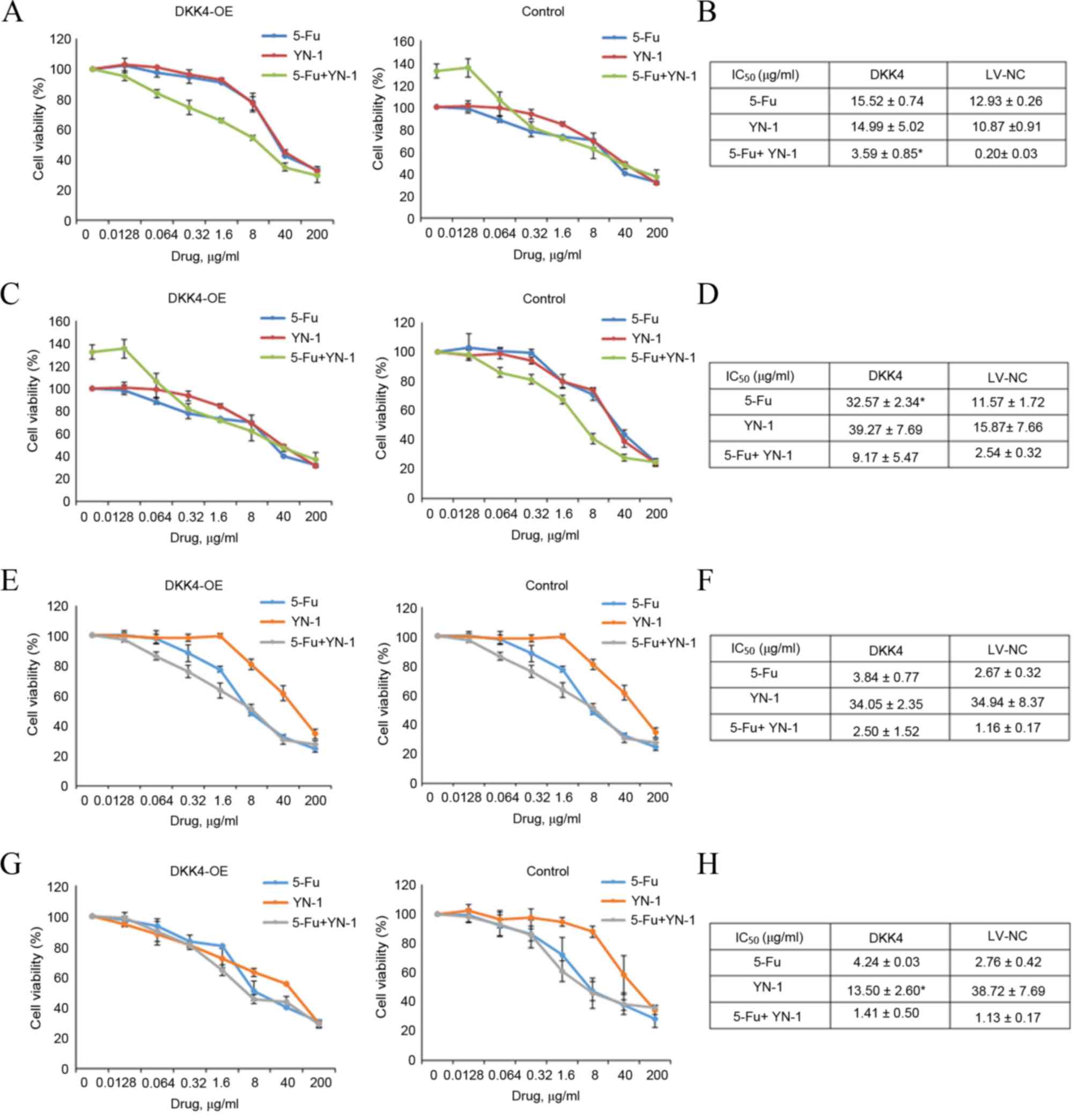
Cell lines were treated with varying doses of 5-Fu,
YN968D1 or both to assess cell viability. The present results
demonstrated that in the 4 selected cell lines, cell viability
decreased in a dose-dependent manner in the control and
DKK4-overexpressing cells (Fig. 2).
Furthermore, the half maximal inhibitory concentration
(IC50) data for the HCT116 and HT29 cell lines was
significantly increased (P=0.00032 for combined drug treatment
inHCT116 cells; P=0.01426 for 5-Fu treatment in HT29 cells) in the
DKK4 over-expressing cells compared with the control cells
following drug treatment, which suggest that DKK4 enhances
colorectal cancer cell resistance tochemotherapy (Fig. 2). The present results demonstrated
that treatment with 5-Fu, YN968D1 or both decreases the viability
of cancer cells, however DKK4 over-expressing cells demonstrated
higher drug resistance.
Effect of DKK4 on cell migration
A Transwell chamber assay was performed to assess
the effect of DKK4 expression on cell migration in colorectal
cancer cell lines. The results are presented in Table I. The migration percentage in HCT116
cells of the DKK4 over-expressing cells was 88.7±1.5, 81.0±1.0 and
71.7±2.1 following treatment with 5-Fu, YN968D1 or both,
respectively, while the control migration percentages were
61.7±1.5, 57.3±1.5 and 32.0±1.0, respectively. However, in the HT29
cell line the migration percentages in the DKK4 over-expressing
cells were reduced compared with the control. In the remaining cell
lines, the differences in migration percentages between DKK4
over-expressing cells and control cells were negligible. The
present data suggests that DKK4 may have an effect on cell
migration in cancer cells following drug treatment.
 | Table I.Effect of DKK4 on cell migration. |
Table I.
Effect of DKK4 on cell migration.
|
| Migration (%) |
|---|
|
|
|
|---|
|
| HCT116 | HT29 | Caco2 | Colo205 |
|---|
|
|
|
|
|
|
|---|
| Group | Control | DKK4-OE | Control | DKK4-OE | Control | DKK4-OE | Control | DKK4-OE |
|---|
| 5-Fu | 61.7±1.5 | 88.7±1.5 | 72.3±2.1 | 54.0±2.6 | 79.0±3.0 | 135.0±8.9 | 109.7±3.8 | 105.3±1.7 |
| YN-1 | 57.3±1.5 | 81.0±1.0 | 88.7±0.6 | 78.3±3.2 | 206.7±7.6 | 130.3±9.0 | 109.3±0.6 | 100.7±0.6 |
| 5-Fu+YN-1 | 32.0±1.0 | 71.7±2.1 | 63.7±1.5 | 39.6±2.9 | 132.7±7.5 | 67.0±4.4 | 104.8±1.9 | 104.7±3.9 |
Effect of DKK4 on cell death
The aforementioned data demonstrated that DKK4 had
an effect on cell viability and migration, therefore the effect of
DKK4 expression on cell death was subsequently analyzed. Due to
data obtained from the cell viability and migration assays, the
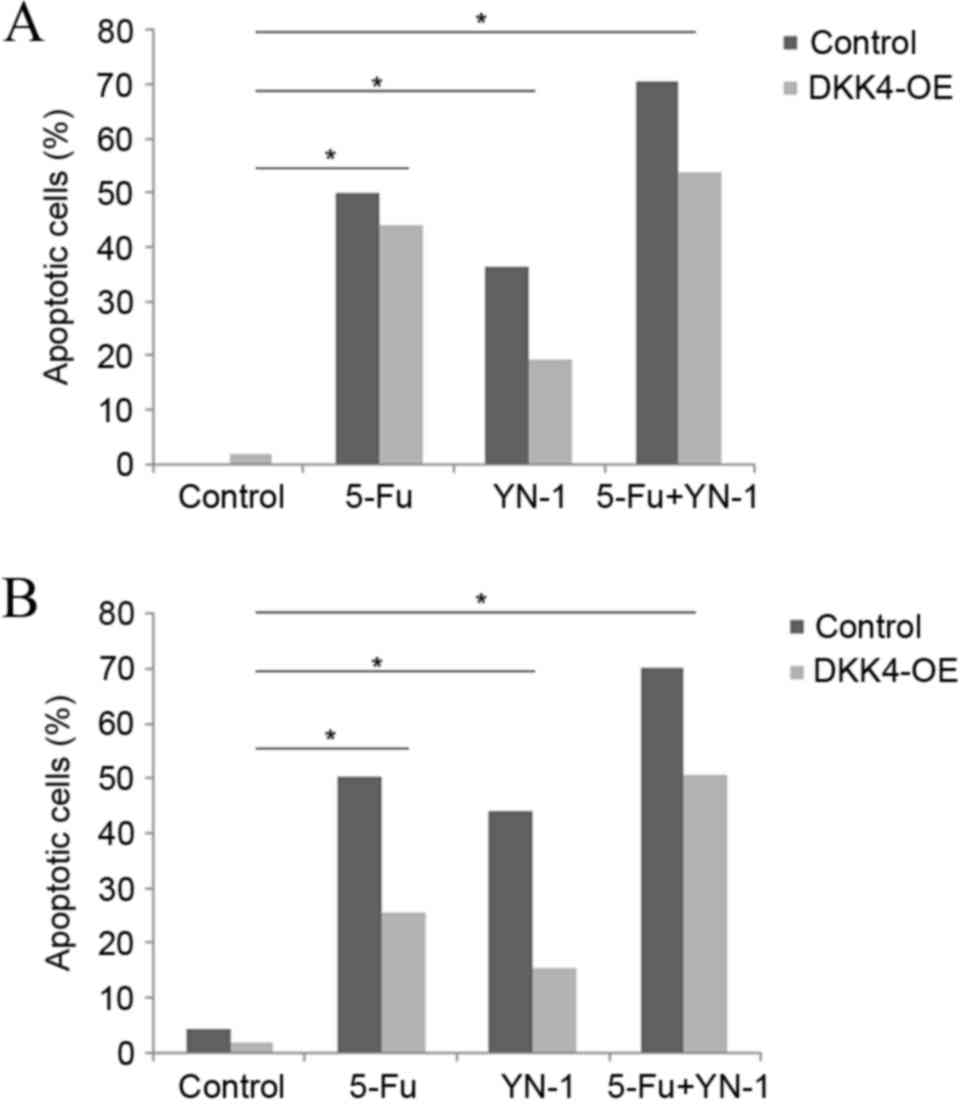
HCT116 and HT29 cell lines were selected for subsequent study. FACS
analysis was used to evaluate the apoptotic status of cells
(Fig. 3). The percentage of apoptotic
cells in the HCT116 cell line following 5-Fu treatment was 44.32%
in the DKK4-overexpressing cells and 50.08% in the control cells
(P=0.0011). Following YN968D1 treatment the percentage of apoptotic
cells was 19.49% in the DKK4 over-expressing cells and 36.38% in
the control cells (P=0.0052). Following combined treatment with the
two drugs, the percentage of apoptotic cells was 53.83% in the DKK4
over-expressing cells and 70.74% in the control cells. The results
indicated that the HCT116 DKK4 over-expressing cells demonstrated
increased resistance to drugs compared with the control cells
(P=0.0006; Fig. 3A). The percentage
of apoptotic cells in the HT29 cell line following 5-Fu treatment
was 25.91% in the DKK4 over-expressing cells and 50.42% in the
control cells (P=0.0027). Following YN968D1 treatment the
percentage of apoptotic cells was 15.7% in the DKK4 over-expressing
cells and 44.09% in the control cells (P=0.0094). Following
combined treatment with the two drugs, the percentage of apoptotic
cells was 50.77% in the DKK4 over-expressing cells and 70.09% in
the control cells (P=0.0012). The results were almost identical in
the HT29 cell line, except there was less cell death in the HT29
DKK4 over-expressing cells following drug treatment (Fig. 3B). The present data indicate that DKK4
may decrease the number of apoptotic colorectal cancer cells
following treatment with chemotherapy drugs.
Effect of DKK4 on other
cancer-associated genes
TFAP2E is a member of the AP-2 transcription factor
family and has an important role in cancer biology. A previous
report demonstrated that TFAP2E hypermethylation is associated with
resistance to chemotherapy in colorectal cancer and that
TFAP2E-dependent resistance to chemotherapy is mediated by DKK4
(9). In order to determine whether
the expression pattern of this gene was altered, western blotting
was performed in the present study. Compared with the control, the
TFAP2E expression level was increased in the DKK4 over-expressing
cells of both untreated cell lines when compared with the control
cells (Fig. 4). Following any form of
drug treatment, TFA2E expression was increased in both cell lines
compared to the untreated cell lines. This increase was more marked
in the DKK4 over-expressing cells compared with the control cells
(Fig. 4).
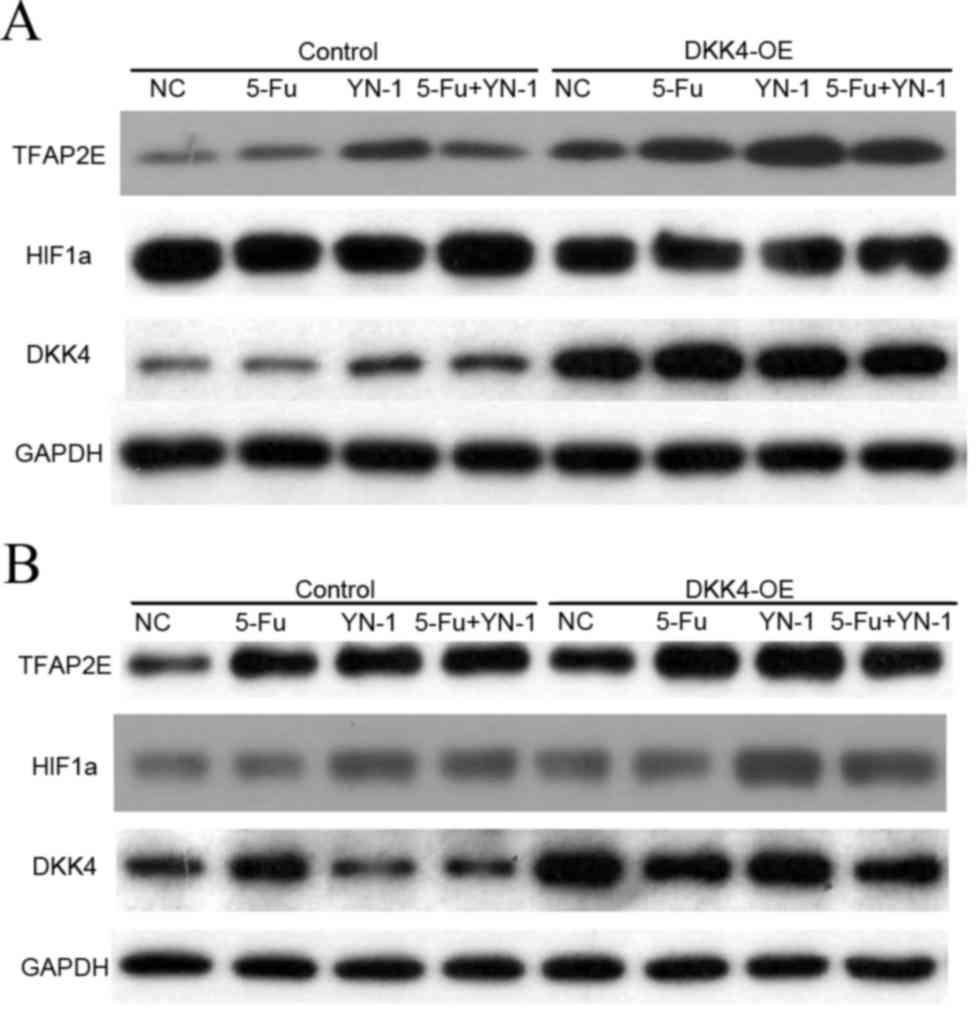 | Figure 4.Western blot analysis of DKK4, TFAP2E
and HIF2a in DKK4-overexpressing and control cells following
drugtreatment. Proteins were detected by western blot in (A) HCT116
cell lines and (B) HT29 cell lines following treatment with 5-Fu,
YN-1 or both. GAPDH was used as the internal control. DKK4,
dickkopf-related protein 4; TFAP2E, transcription factor AP-2
epsilon; HIF2a, hypoxia-inducible factor-2alpha; GAPDH,
glyceraldehyde 3-phosphate dehydrogenase; NC, negative control; OE,
overexpressing; 5-Fu, 5-fluorouracil; YN-1, YN968D1. |
Another gene investigated in the present study was
HIF2α. HIF2α belongs to the basic helix-loop-helix/Per-ARNT-Sim
domain transcription factor family and has clinical value in
predicting cancers (13,14). For example, Koukourakis et al
(14) observed that HIF proteins may
have value in predicting early esophageal cancer and the clinical
responses to photodynamic therapy (PDT). It was reported that the
HIF proteins were expressed in the normal epithelium around the
early-stage esophageal tumor, but not in the normal esophagus
(14). Furthermore, it was revealed
that following treatment with PDT and radiotherapy, the expression
levels of HIF proteins were highly upregulated, which indicated
that the HIF proteins may enhance the resistance of tumors to PDT
(14). The present results
demonstrated that drug treatment had a negligible effect on HIF2α
expression in the HCT116 cell line compared with untreated HCT116
cells (Fig. 4A). Drug treatment
upregulated HIF2α expression in the HT29 cell line compared with
the untreated HT29 cells (Fig.
4B).
The present results indicate that the expression
patterns of certain cancer-associated genes is altered between DKK4
over-expressing cells and control cells, but whether this
alteration is dependent on DKK4 remains to be elucidated.
Discussion
Colorectal cancer has one of the highest mortality
rates and is often not diagnosed until it has reached an advanced
stage (1). Chemotherapy is commonly
utilized in cancer treatment and 5-Fu is widely used (3). The drug 5-Fu induces apoptosis in cancer
and normal cells (3). YN968D1 is a
tyrosine kinase inhibitor that is thought to inhibit angiogenesis
in cancer cells (6).
Previous studies have shown that in human colon
cancer, DKK4 has a role in cancer development. The expression of
DKK4 is induced in colorectal cancer, and this promotes tumor cells
invasion and angiogenesis (15).
Baehs et al (10) reported
that DKK4 was able to inhibit the growth of colorectal cancer cells
and cell cycle progression. In chemoresistance research, studies
have revealed that overexpression of DKK4 enhances resistance to
5-Fu, and this resistance may function in TFAP2E-dependent
resistance in colorectal cancer cells (9). The present study aimed to investigate
the role of DKK4 in cancer chemoresistance not only to 5-Fu, but
also to another drug or a combination of the 2. In the present
study, DKK4 was over expressed in several colorectal cancer cell
lines and its expression level was analyzed by RT-qPCR and western
blotting. Of the original 6, 4 cell lines exhibited high expression
of DKK4.
Cell proliferation assays demonstrated that cell
viability decreased in a dose-dependent manner following drug
treatment and that the IC50 of drugs was increased in
DKK4 over-expressing cells compared with control cells in both the
HCT116 and HT29 cell lines. The present results suggest that DKK4
enhances the resistance of tumor cells to chemotherapy drugs. The
results of the present study are similar to those of Ebert et
al (9), who observed that
overexpression of DKK4 was able to enhance resistance to 5-Fu.
Analysis of Transwell chamber assays indicated that DKK4 had an
effect on the migration of colorectal cancer cells following
treatment with chemotherapy drugs. Furthermore, FACS demonstrated
that DKK4 decreased the percentage of apoptotic cells following
treatment with chemotherapy drugs. The present results suggest that
DKK4 may enhance resistance to chemotherapy in colorectal cancer
cells. In addition to this, western blotting was performed to
analyze TFAP2E and HIF2α expression in DKK4-overexpressing cells
and control cells following drug treatment. The present results
indicated that treatment with a single drug/drug combination alters
the expression pattern of TFAP2E and HIF2α; however, whether this
alteration is dependent on DKK4 remains to be elucidated.
In conclusion, the present study indicates that DKK4
may have a role in the development of resistance to chemotherapy
drugs, including 5-Fu and YN968D1, in colorectal cancer cells.
Acknowledgements
This study was supported by the Shangshai Minhang
District Health and Family Planning Commission (Shanghai, China;
grant no. 2015MW22) and the Program for Shanghai Minhang District
Outstanding Academic Leader (Shanghai, China; grant no.
201511).
References
|
1
|
Tsukihara H, Nakagawa F, Sakamoto K,
Ishida K, Tanaka N, Okabe H, Uchida J, Matsuo K and Takechi T:
Efficacy of combination chemotherapy using a novel oral
chemotherapeutic agent, TAS-102, together with bevacizumab,
cetuximab, or panitumumab on human colorectal cancer xenografts.
Oncol Rep. 33:2135–2142. 2015.PubMed/NCBI
|
|
2
|
Wang H, Zhang L, Yang X, Jin Y, Pei S,
Zhang D, Zhang H, Zhou B, Zhang Y and Lin D: PUMA mediates the
combinational therapy of 5-FU and NVP-BEZ235 in colon cancer.
Oncotarget. 6:14385–14398. 2015. View Article : Google Scholar : PubMed/NCBI
|
|
3
|
Longley DB, Harkin DP and Johnston PG:
5-fluorouracil: Mechanisms of action and clinical strategies. Nat
Rev Cancer. 3:330–338. 2003. View
Article : Google Scholar : PubMed/NCBI
|
|
4
|
Zhang N, Yin Y, Xu SJ and Chen WS:
5-Fluorouracil: Mechanisms of resistance and reversal strategies.
Molecules. 13:1551–1569. 2008. View Article : Google Scholar : PubMed/NCBI
|
|
5
|
Xi Y, Formentini A, Nakajima G, Kornmann M
and Ju J: Validation of biomarkers associated with 5-fluorouracil
and thymidylate synthase in colorectal cancer. Oncol Rep.
19:257–262. 2008.PubMed/NCBI
|
|
6
|
Tian S, Quan H, Xie C, Guo H, Lü F, Xu Y,
Li J and Lou L: YN968D1 is a novel and selective inhibitor of
vascular endothelial growth factor receptor-2 tyrosine kinase with
potent activity in vitro and in vivo. Cancer Sci. 102:1374–1380.
2011. View Article : Google Scholar : PubMed/NCBI
|
|
7
|
Li J, Zhao X, Chen L, Guo H, Lv F, Jia K,
Yv K, Wang F, Li C, Qian J, et al: Safety and pharmacokinetics of
novel selective vascular endothelial growth factor receptor-2
inhibitor YN968D1 in patients with advanced malignancies. BMC
Cancer. 10:5292010. View Article : Google Scholar : PubMed/NCBI
|
|
8
|
Maehata T, Taniguchi H, Yamamoto H, Nosho
K, Adachi Y, Miyamoto N, Miyamoto C, Akutsu N, Yamaoka S and Itoh
F: Transcriptional silencing of Dickkopf gene family by CpG island
hypermethylation in human gastrointestinal cancer. World J
Gastroenterol. 14:2702–2714. 2008. View Article : Google Scholar : PubMed/NCBI
|
|
9
|
Ebert MP, Tänzer M, Balluff B,
Burgermeister E, Kretzschmar AK, Hughes DJ, Tetzner R, Lofton-Day
C, Rosenberg R, Reinacher-Schick AC, et al: TFAP2E-DKK4 and
chemoresistance in colorectal cancer. N Engl J Med. 366:44–53.
2012. View Article : Google Scholar : PubMed/NCBI
|
|
10
|
Baehs S, Herbst A, Thieme SE, Perschl C,
Behrens A, Scheel S, Jung A, Brabletz T, Göke B, Blum H and Kolligs
FT: Dickkopf-4 is frequently down-regulated and inhibits growth of
colorectal cancer cells. Cancer Lett. 276:152–159. 2009. View Article : Google Scholar : PubMed/NCBI
|
|
11
|
Mandecki W, Mollison KW, Bolling TJ,
Powell BS, Carter GW and Fox JL: Chemical synthesis of a gene
encoding the human complement fragment C5a and its expression in
Escherichia coli. Proc Natl Acad Sci USA. 82:3543–3547. 1985.
View Article : Google Scholar : PubMed/NCBI
|
|
12
|
Livak KJ and Schmittgen TD: Analysis of
relative gene expression data using real-time quantitative PCR and
the 2(−Delta Delta C(T)) method. Methods. 25:402–408. 2001.
View Article : Google Scholar : PubMed/NCBI
|
|
13
|
Swartz JE, Pothen AJ, Stegeman I, Willems
SM and Grolman W: Clinical implications of hypoxia biomarker
expression in head and neck squamous cell carcinoma: A systematic
review. Cancer Med. 4:1101–1016. 2015. View
Article : Google Scholar : PubMed/NCBI
|
|
14
|
Koukourakis MI, Giatromanolaki A,
Skarlatos J, Corti L, Blandamura S, Piazza M, Gatter KC and Harris
AL: Hypoxia inducible factor (HIF-1a and HIF-2a) expression in
early esophageal cancer and response to photodynamic therapy and
radiotherapy. Cancer Res. 61:1830–1832. 2001.PubMed/NCBI
|
|
15
|
Pendás-Franco N, García JM, Peña C, Valle
N, Pálmer HG, Heinäniemi M, Carlberg C, Jiménez B, Bonilla F, Muñoz
A and González-Sancho JM: DICKKOPF-4 is induced by TCF/beta-catenin
and upregulated in human colon cancer, promotes tumour cell
invasion and angiogenesis and is repressed by 1alpha,
25-dihydroxyvitamin D3. Oncogene. 27:4467–4477. 2008. View Article : Google Scholar : PubMed/NCBI
|