Introduction
Laryngeal carcinoma is the second most prevalent
malignancy of the upper aerodigestive tract, accounting for 3,620
mortalities per year in the United States. The estimated incidence
in 2016 was 13,430 new cases in the US (1). Smoking and alcohol ingestion are known
risk factors with a synergistic effect (2). A dose-dependent effect of cigarette
smoking has been observed, and the risk for cancer remains elevated
even several years after smoking cessation (3).
Less than 10% of patients with laryngeal cancer are
younger than 40 years of age. The association of classic risk
factors for squamous cell carcinoma (SCC) of the larynx in young
patients is less prominent compared with older patients (4,5). This may
imply a different disease than classic larynx cancer with a unique
pathophysiology. Other risk factors, including human papilloma
virus and laryngopharyngeal reflux, remain under investigation and
their link to laryngeal cancer is controversial (6–9).
Up until the 1990′s, the primary treatment for
laryngeal SCC was surgery, which included various types, such as
total or partial laryngectomy. The Veterans Affairs laryngeal
cancer study (VA) changed this paradigm and the pendulum shifted
towards treatments that preserve the larynx, including radiotherapy
(10). However, the optimal treatment
of laryngeal SCC in young patients remains unclear.
The aim of the present study was to assess the
distinct characteristics of laryngeal SCC in patients less than 40
years of age and the effect of the organ preservation era on
survival.
Materials and methods
Design and setting
The present study was a retrospective chart review
based in the Rabin Medical Center, a tertiary university-affiliated
center in Petah Tikva, Israel.
Participants
All patients were <40 years of age, and had been
treated for SCC of the larynx between January 1960 and December
2013. Patients who were treated prior to the VA were compared with
those treated after. The VA was selected arbitrarily as a reference
point that initiated the organ preservation era (OPE). Parameters
included patient age and gender, presenting symptoms, histological
diagnosis, treatment modalities, recurrence and survival time. The
study was approved by the Rabin Medica Center Institutional Ethics
Committee.
Statistical analysis
Data were analyzed using SPSS v22.0 (IBM SPSS,
Armonk, NY, USA). Survival time was calculated using the
Kaplan-Meier product limit estimate method. Variables were compared
between groups using T-scores and the χ2 test. P<0.05
was considered to indicate a statistically significant
difference.
Results
Patient demographics and clinical
data
Patient demographic and clinical data are presented
in Table I. A total of 29 patients
(male:female ratio, 2.6:1) were identified and the mean age at
diagnosis was 35±5 years. In total, 17 patients were smokers and 1
reported alcohol abuse. The mean number of packs per year was
32±14.4 (range, 10–60) and was identified to have no significant
effect on survival (P=0.326). Hoarseness was the most common
presenting symptom and only a minority of patients reported
dysphagia, odynophagia or dyspnea. The glottis was the most common
site of disease (69%), while supraglottic tumors were noted in 21%
of patients. The site of origin could not be determined in 10% of
patients. A total of 5 patients (17%) presented with stage IV
disease and 8 (28%) presented with stage III. The rest of the
patients presented at an early stage. Surgery was performed in 11
patients, with 7 undergoing an upfront total laryngectomy and 2
undergoing supraglottic laryngectomy and hemilaryngectomy. A total
of 21 patients were treated with radiotherapy and 5 patients with
chemotherapy; 2 patients were given induction chemotherapy. Tumor
grade was reported in 14 patients, 50% had G2 histology. The rest
of the patients presented with well- or poorly-differentiated
tumors.
 | Table I.Demographic and clinical
characteristics of 29 patients with laryngeal squamous cell
carcinoma. |
Table I.
Demographic and clinical
characteristics of 29 patients with laryngeal squamous cell
carcinoma.
| Characteristic | Overall cohort
(n=29) | Pre-VA (n=15) | Post-VA (n=14) |
|---|
| Male: female
ratio | 2.6:1 | 12:3 | 9:5 |
| Age, mean ± SD | 35±5 | 34.7±6 | 35.1±3.9 |
| Smoking (pack/year),
n (%) | 17 (59) | 12 (80) | 5 (36) |
| Tumor site, n
(%) |
|
|
|
|
Glottis | 20 (69) | 13 (86) | 7 (50) |
|
Supraglottis | 6 (21) | 1 (7) | 5 (36) |
|
Unknown | 3 (10) | 1 (7) | 2 (14) |
| Stage, n (%) |
|
|
|
| I | 12 (41) | 8 (53) | 3 (21) |
| II | 4 (14) | 4 (27) | 1 (7) |
| III | 8 (28) | 3 (20) | 5 (36) |
| IV | 5 (17) | 0 (0) | 5 (36) |
| Treatment, n (%) |
|
|
|
|
Surgery | 11 (38) | 7 (47) | 4 (29) |
|
Radiation | 21 (72) | 10 (67) | 11 (79) |
|
Chemotherapy | 5 (17) | 0 (0) | 5 (36) |
| Recurrence, n
(%) | 12 (41) | 6 (40) | 6 (43) |
| Mortality, n (%) | 15 (51) | 11 (73) | 4 (29) |
Patient outcome and survival
The mean duration of follow-up was 18.7±18.8 years
(range, 1–57 years). Overall survival (OS) time for the entire
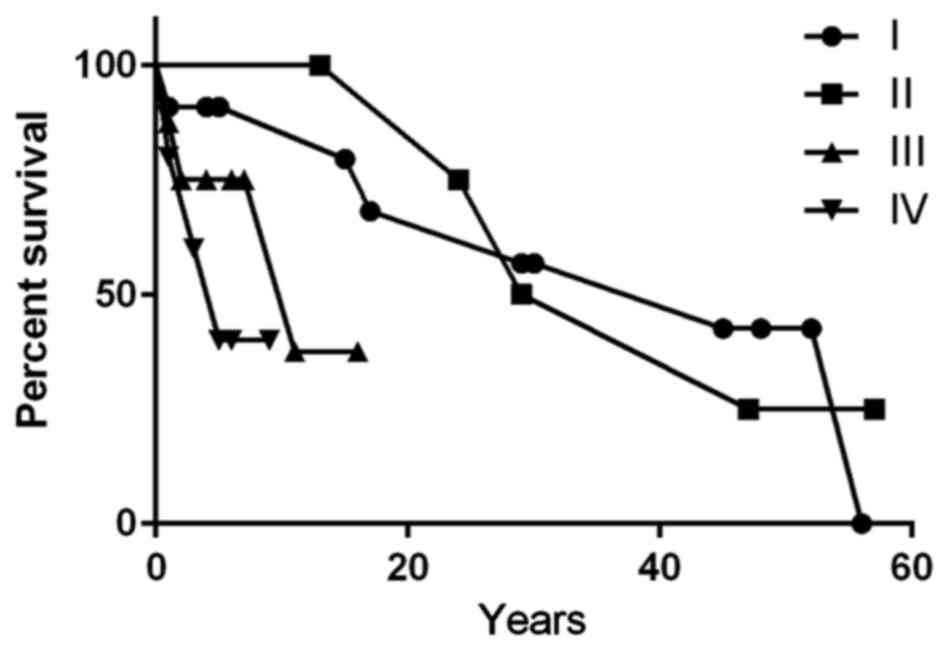
cohort was 30.8±4.6 years. Stage IV and III patients had an OS time
of 5.4±1.4 and 10.5±2.2 years, respectively, with a significantly
poorer outcome than patients with earlier stages (P=0.043)
(Fig. 1). The 2- and 5-year survival
rates for the entire cohort were 86 and 79% respectively. Disease
site or smoking history was not observed to affect survival. A
total of 15 patients succumbed during follow-up. Of the 12 patients
in whom disease recurred, local recurrence was most common.
Effect of organ preservation treatment
on patients with laryngeal SCC
To assess the effect of organ preservation treatment
in young patients, patients who were treated prior to the VA were
compared with those who were treated after. A total of 14 patients
were identified who were treated following publication of the VA.
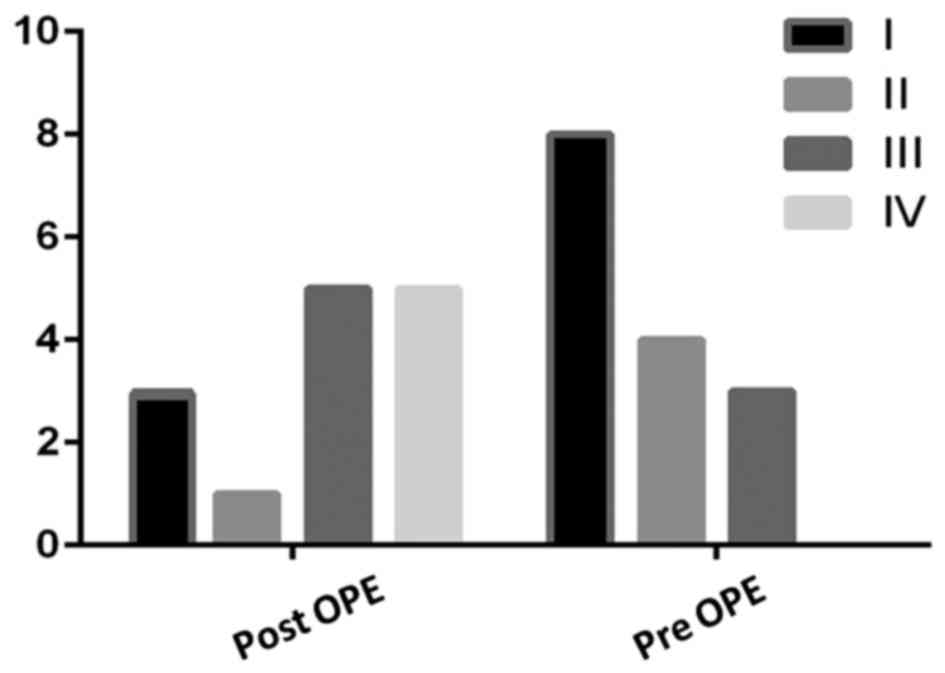
Differences in stage are presented in Fig. 2. No stage IV patients were identified
in the pre-VA group. The mean follow-up period for patients who
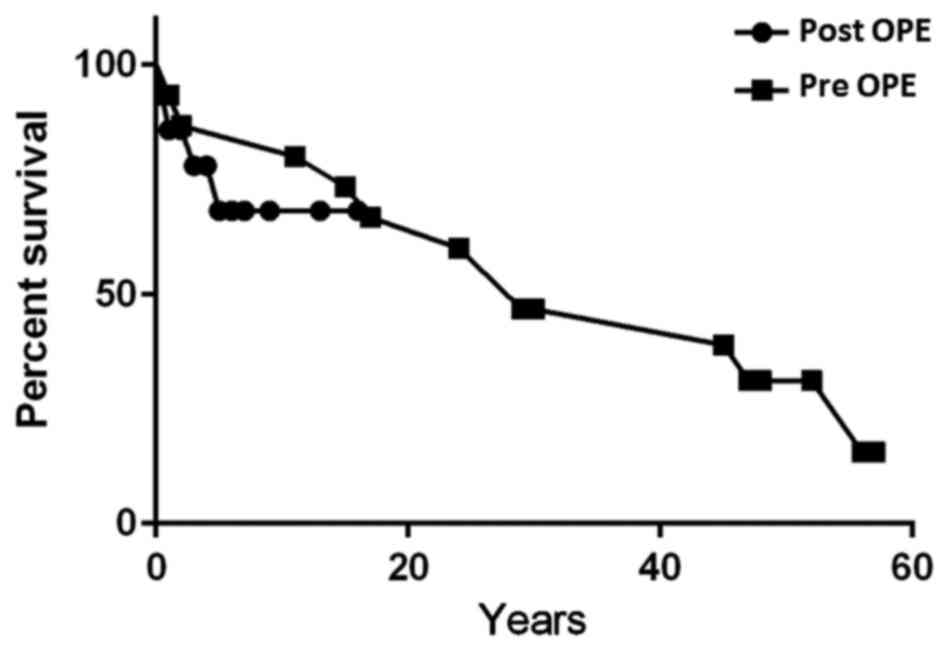
were given radiotherapy was 16.8±18 years (range, 1–57). OS time
was 33.2±5.2 and 11.7±1.7 years for the pre- and post-VA patients,
respectively (P=0.413) (Fig. 3). In
total, 6 patients within each group experienced recurrence. The
2-year disease-free survival rate was 93% for patients who were
treated prior to the VA and 71% for patients who were treated
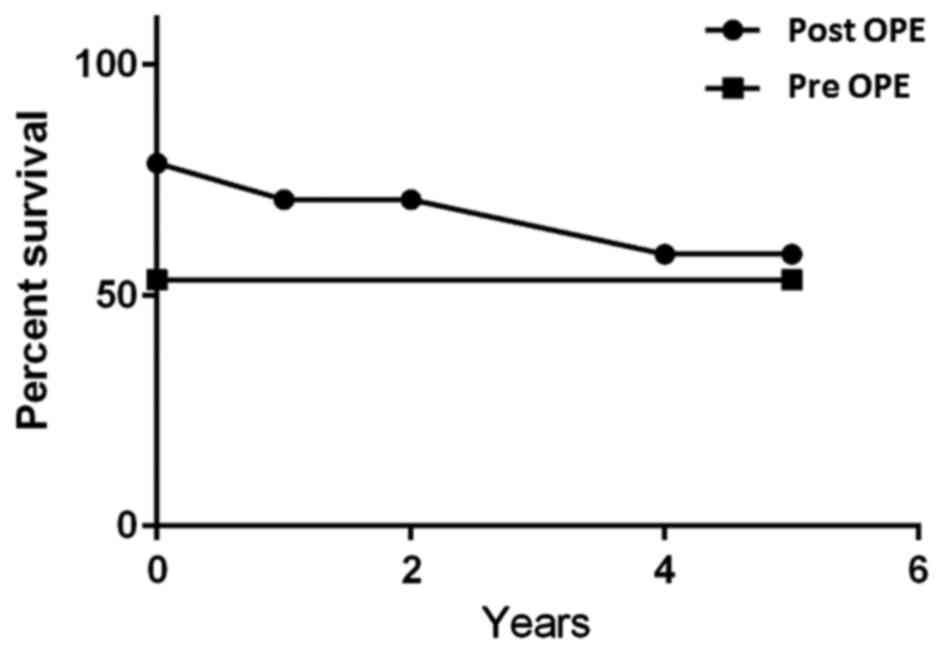
following the study (P=0.001). The 2-year laryngectomy-free
survival rate was 53% for pre-VA patients and 78% for post-VA
patients (P=0.299) (Fig. 4).
Effect of radiotherapy on patients
with laryngeal SCC
The mean duration of follow-up in patients treated
with radiotherapy was 16.8±18.5 years (range, 1–57). In order to
examine the effect of radiation on secondary malignant neoplasms
(SMNs) in these patients, patients who were treated with
radiotherapy and developed a second primary malignancy were
compared with patients who did not. Overall, 6 patients developed
SMNs, 4 (19%) received radiotherapy, while the other two (25%) had
no radiotherapy. The OS time was 26.3 years [95% confidence
interval (CI), 9.9–42.6] for patients with SMNs compared with 34.2
(95% CI, 23.3–45.1) for other irradiated patients (P=0.241). When
assessing the impact of radiotherapy on patients with SMNs, no
difference was observed in OS time between those who had a history
of radiotherapy and those who did not (P=0.441).
Discussion
The present study describes the patient and tumor
characteristics, disease history, and treatment outcome of patients
<40 years of age with laryngeal cancer. The results demonstrated
non-significantly higher rates of laryngectomy-free survival in
patients who were treated post-VA, with no difference in OS time
compared with patients who were treated pre-VA, suggesting that the
organ preservation concept should be applied.
Laryngeal cancer in patients younger than 40 years
of age is rare. Classical risk factors, including smoking and
alcohol, are not as prevalent among young patients as in older ones
(4,5).
This has led to the assumption that the carcinogenic effect of
tobacco is not the primary cause of cancer in young patients and
that this disease has a different etiology. Human papillomavirus
(HPV) for example, is common in youngsters and is linked to
oropharyngeal SCC (11). However, a
link between laryngeal cancer and HPV infection remains
controversial (6–8). Another possible etiology is diet. Levi
et al (12) reported a higher
overall recurrence rate of laryngeal cancer in young patients who
ate processed meat, although processed meat may represent a more
general indicator of an unfavorable diet for laryngeal cancer risk.
The present cohort demonstrated lower smoking rates than older
patients, but other possible etiologies for the disease could not
be investigated due to the retrospective nature of the work.
A number of previous studies compared younger and
older patients with laryngeal SCC and did not observe any
differences in tumor location or disease stage (4,13). The
tumor locations reported in the current study were similar to those
previously reported in the literature, with the glottis being the
most prevalent location followed by the supraglottis (14). In a longitudinal study of patients
with laryngeal cancer, Hoffman et al (15) was unable to define tumor location in
14% of patients, similar to the 10% in the present study. In
another study, no difference was reported in histological grade
among young patients, and the most common grade was
well-to-moderately-differentiated SCC, which is consistent with the
current study (16). Several previous
studies have addressed survival difference in young patients. A
number of these report that youngsters have a poorer prognosis than
older patients (16), while others
report the survival is the same (17,18) or
even better (4,19–21).
However, confounders, including poorer baseline medical status and
other comorbidities, most likely serve a role in these
observations. Reizenstein et al (18) reviewed 945 patients with laryngeal
cancer. Patients <40 years of age were treated in a similar
manner as older patients, and 77% were given curative radiotherapy.
Similar OS, disease-specific survival and relapse-free survival
rates were reported except in patients >80 years of age, who did
worse in all these parameters (18).
Overall, SCC in young patients appears to behave in a manner
similar to the disease in its traditional population.
The VA and the RTOG-91 (22) changed the treatment dogma towards
organ preservation treatment, including chemotherapy and
radiotherapy. Today the larynx-preservation approach is a standard,
appropriate treatment option even in advanced disease stage
(23). There are compelling studies
regarding the effect of this shift on survival in laryngeal cancer.
For example, Hoffman et al (15) reported of decreased survival in
patients with laryngeal cancer, which was attributed to the shift
in treatment towards chemoradiotherapy. Despite this, organ
preservation treatment is still recommended in advanced stage
laryngeal cancer (23,24). A recommendation for laryngectomy in
young patients is not given easily. Lee-Preston et al
(25) reported a poorer quality of
life in young patients treated with laryngectomy and radiotherapy
compared with radiotherapy alone, and concluded that younger
patients are more likely to require intensive support throughout
the treatment period, which should be taken into consideration when
discussing treatment options with younger patients. The results of
the current study demonstrated a non-significantly higher rate of
laryngectomy-free survival and a higher recurrence rate in patients
treated following publication of the VA. However, no change in OS
time was observed between the two groups despite patients in the
post-VA group having more advanced disease stage. Similar OS time
and laryngectomy-free survival were demonstrated between the groups
even without excluding stage IV patients.
In the past, radiotherapy was avoided in young
patients due to the fear of SMNs. Development of SMNs has a
negative impact on survival in cases of laryngeal cancer (26,27). The
present study demonstrated a trend towards decreased survival in
these patients, however, the majority of irradiated patients did
not develop SMNs and radiotherapy improved survival in these
patients. Furthermore, the results of the current study did not
demonstrate a difference in OS time between patients who had SMNs
and prior radiotherapy treatment and patients who did not. Albright
et al (28) reviewed the
Surveillance, Epidemiolosgy and End Results database and identified
that patients <40 years of age with invasive SCC of the larynx
were significantly less likely to develop a second malignancy than
older patients. Thus, it may be reasonable to consider radiotherapy
in the treatment of young patients.
The present study has certain limitations. Firstly,
the small cohort makes it difficult to reach statistical
significance. However, one of the aims of the study was to evaluate
trends in survival of young patients with SCC of the larynx,
similar to Hoffman et al (15), who reported of decreased survival in
the organ preservation era. Secondly, the long follow-up time of
the study, which spreads over 53 years, may lead to certain
imprecision. Nevertheless, treatment modality, date of diagnosis
and mortality should not be affected by this possibility.
In conclusion, SCC of the larynx in young adults has
the same characteristics and behavior as in older patients. Higher
rates of laryngectomy-free survival were noted in patients treated
following publication of the VA with no significant difference in
survival compared with patients who were treated prior to the VA,
suggesting that the organ preservation era did not affect
survival.
References
|
1
|
Siegel RL, Miller KD and Jemal A: Cancer
statistics, 2016. CA Cancer J Clin. 66:7–30. 2016. View Article : Google Scholar : PubMed/NCBI
|
|
2
|
Muscat JE and Wynder EL: Tobacco, alcohol,
asbestos, and occupational risk factors for laryngeal cancer.
Cancer. 69:2244–2251. 1992. View Article : Google Scholar : PubMed/NCBI
|
|
3
|
Menvielle G, Luce D, Goldberg P, Bugel I
and Leclerc A: Smoking, alcohol drinking and cancer risk for
various sites of the larynx and hypopharynx. A case-control study
in France. Eur J Cancer Prev. 13:165–172. 2004. View Article : Google Scholar : PubMed/NCBI
|
|
4
|
Singh B, Alfonso A, Sabin S, Poluri A,
Shaha AR, Sundaram K and Lucente FE: Outcome differences in younger
and older patients with laryngeal cancer: A retrospective
case-control study. Am J Otolaryngol. 21:92–97. 2000. View Article : Google Scholar : PubMed/NCBI
|
|
5
|
Shvero J, Hadar T, Segal K, Abraham A and
Sidi J: Laryngeal carcinoma in patients 40 years of age and
younger. Cancer. 60:3092–3095. 1987. View Article : Google Scholar : PubMed/NCBI
|
|
6
|
Li X, Gao L, Li H, Gao J, Yang Y, Zhou F,
Gao C, Li M and Jin Q: Human papillomavirus infection and laryngeal
cancer risk: A systematic review and meta-analysis. J Infect Dis.
207:479–488. 2013. View Article : Google Scholar : PubMed/NCBI
|
|
7
|
Koskinen WJ, Brøndbo K, Dahlstrand H
Mellin, Luostarinen T, Hakulinen T, Leivo I, Molijn A, Quint WG,
Røysland T, Munck-Wikland E, et al: Alcohol, smoking and human
papillomavirus in laryngeal carcinoma: A Nordic prospective
multicenter study. J Cancer Res Clin Oncol. 133:673–678. 2007.
View Article : Google Scholar : PubMed/NCBI
|
|
8
|
Baumann JL, Cohen S, Evjen AN, Law JH,
Vadivelu S, Attia A, Schindler JS, Chung CH, Wirth PS, Meijer CJ,
et al: Human papillomavirus in early laryngeal carcinoma.
Laryngoscope. 119:1531–1537. 2009. View Article : Google Scholar : PubMed/NCBI
|
|
9
|
Coca-Pelaz A, Rodrigo JP, Takes RP, Silver
CE, Paccagnella D, Rinaldo A, Hinni ML and Ferlito A: Relationship
between reflux and laryngeal cancer. Head Neck. 35:1814–1818. 2013.
View Article : Google Scholar : PubMed/NCBI
|
|
10
|
No authors listed, . Induction
chemotherapy plus radiation compared with surgery plus radiation in
patients with advanced laryngeal cancer. The department of veterans
affairs laryngeal cancer study group. N Engl J Med. 324:1685–1690.
1991. View Article : Google Scholar : PubMed/NCBI
|
|
11
|
Herrero R, Castellsagué X, Pawlita M,
Lissowska J, Kee F, Balaram P, Rajkumar T, Sridhar H, Rose B,
Pintos J, et al: Human papillomavirus and oral cancer: The
International Agency for Research on Cancer multicenter study. J
Natl Cancer Inst. 95:1772–1783. 2003. View Article : Google Scholar : PubMed/NCBI
|
|
12
|
Levi F, Pasche C, Lucchini F, Bosetti C
and La Vecchia C: Processed meat and the risk of selected digestive
tract and laryngeal neoplasms in Switzerland. Ann Oncol.
15:346–349. 2004. View Article : Google Scholar : PubMed/NCBI
|
|
13
|
Luna-Ortiz K, VillavicencioValencia V,
Pasche P, LavinLozano A and Herrera-Gómeza Á: Laryngeal cancer in
patients younger vs older than 40 years old: A matched-paired
analysis. Acta Otorrinolaringologica Esp. 62:113–118. 2011.(In
Spanish). View Article : Google Scholar
|
|
14
|
van Dijk BA, KarimKos HE, Coebergh JW,
Marres HA and de Vries E: Progress against laryngeal cancer in The
Netherlands between 1989 and 2010. Int J Cancer. 134:674–681. 2014.
View Article : Google Scholar : PubMed/NCBI
|
|
15
|
Hoffman HT, Porter K, Karnell LH, Cooper
JS, Weber RS, Langer CJ, Ang KK, Gay G, Stewart A and Robinson RA:
Laryngeal cancer in the United States: Changes in demographics,
patterns of care and survival. Laryngoscope. 116:(9 Pt 2 Suppl
111). 1–13. 2006. View Article : Google Scholar : PubMed/NCBI
|
|
16
|
Lipkin A, Miller RH and Woodson GE:
Squamous cell carcinoma of the oral cavity, pharynx, and larynx in
young adults. Laryngoscope. 95:790–793. 1985. View Article : Google Scholar : PubMed/NCBI
|
|
17
|
Verschuur HP, Irish JC, O'Sullivan B, Goh
C, Gullane PJ and Pintilie M: A matched control study of treatment
outcome in young patients with squamous cell carcinoma of the head
and neck. Laryngoscope. 109:249–258. 1999. View Article : Google Scholar : PubMed/NCBI
|
|
18
|
Reizenstein JA, Bergström SN, Holmberg L,
Linder A, Ekman S, Blomquist E, Lödén B, Holmqvist M, Hellström K,
Nilsson CO, et al: Impact of age at diagnosis on prognosis and
treatment in laryngeal cancer. Head Neck;. 32:1062–1068. 2010.
View Article : Google Scholar : PubMed/NCBI
|
|
19
|
Rutt AL, Hawkshaw MJ and Sataloff RT:
Laryngeal cancer in patients younger than 30 years: A review of 99
cases. Ear Nose Throat J. 89:189–192. 2010.PubMed/NCBI
|
|
20
|
Petrović Z, Stojcić G and Jesić S:
Laryngeal carcinoma in younger patients. J Laryngol Otol.
110:934–936. 1996. View Article : Google Scholar : PubMed/NCBI
|
|
21
|
Misono S, Marmor S, Yueh B and Virnig BA:
Treatment and survival in 10,429 patients with localized laryngeal
cancer: A population-based analysis. Cancer. 120:1810–1817. 2014.
View Article : Google Scholar : PubMed/NCBI
|
|
22
|
Forastiere AA, Goepfert H, Maor M, Pajak
TF, Weber R, Morrison W, Glisson B, Trotti A, Ridge JA, Chao C, et
al: Concurrent chemotherapy and radiotherapy for organ preservation
in advanced laryngeal cancer. N Engl J Med. 349:2091–2097. 2003.
View Article : Google Scholar : PubMed/NCBI
|
|
23
|
American Society of Clinical Oncology, .
Pfister DG, Laurie SA, Weinstein GS, Mendenhall WM, Adelstein DJ,
Ang KK, Clayman GL, Fisher SG, Forastiere AA, et al: American
Society of Clinical Oncology clinical practice guideline for the
use of larynx-preservation strategies in the treatment of laryngeal
cancer. J Clin Oncol. 24:3693–3704. 2006. View Article : Google Scholar : PubMed/NCBI
|
|
24
|
Forastiere AA: Larynx preservation and
survival trends: Should there be concern? Head Neck. 32:14–17.
2010.PubMed/NCBI
|
|
25
|
Lee-Preston V, Steen IN, Dear A, Kelly CG,
Welch AR, Meikle D, Stafford FW and Wilson JA: Optimizing the
assessment of quality of life after laryngeal cancer treatment. J
Laryngol Otol. 118:432–438. 2004. View Article : Google Scholar : PubMed/NCBI
|
|
26
|
Fujita M, Rudoltz M, Canady DJ, Patel P,
Machtay M, Pittard MQ, Mohiuddin M and Regine WF: Second malignant
neoplasia in patients with T1 glottic cancer treated with
radiation. Laryngoscope. 108:1853–1855. 1998. View Article : Google Scholar : PubMed/NCBI
|
|
27
|
Holland JM, Arsanjani A, Liem BJ, Hoffelt
SC, Cohen JI and Stevens KR Jr: Second malignancies in early stage
laryngeal carcinoma patients treated with radiotherapy. J Laryngol
Otol. 116:190–193. 2002. View Article : Google Scholar : PubMed/NCBI
|
|
28
|
Albright JT, Karpati R, Topham AK, Spiegel
JR and Sataloff RT: Second malignant neoplasms in patients under 40
years of age with laryngeal cancer. Laryngoscope. 111:563–567.
2001. View Article : Google Scholar : PubMed/NCBI
|