Spandidos Publications Logo
  • About
    • About Spandidos
    • Aims and Scopes
    • Abstracting and Indexing
    • Editorial Policies
    • Reprints and Permissions
    • Job Opportunities
    • Terms and Conditions
    • Contact
  • Journals
    • All Journals
    • Oncology Letters
      • Oncology Letters
      • Information for Authors
      • Editorial Policies
      • Editorial Board
      • Aims and Scope
      • Abstracting and Indexing
      • Bibliographic Information
      • Archive
    • International Journal of Oncology
      • International Journal of Oncology
      • Information for Authors
      • Editorial Policies
      • Editorial Board
      • Aims and Scope
      • Abstracting and Indexing
      • Bibliographic Information
      • Archive
    • Molecular and Clinical Oncology
      • Molecular and Clinical Oncology
      • Information for Authors
      • Editorial Policies
      • Editorial Board
      • Aims and Scope
      • Abstracting and Indexing
      • Bibliographic Information
      • Archive
    • Experimental and Therapeutic Medicine
      • Experimental and Therapeutic Medicine
      • Information for Authors
      • Editorial Policies
      • Editorial Board
      • Aims and Scope
      • Abstracting and Indexing
      • Bibliographic Information
      • Archive
    • International Journal of Molecular Medicine
      • International Journal of Molecular Medicine
      • Information for Authors
      • Editorial Policies
      • Editorial Board
      • Aims and Scope
      • Abstracting and Indexing
      • Bibliographic Information
      • Archive
    • Biomedical Reports
      • Biomedical Reports
      • Information for Authors
      • Editorial Policies
      • Editorial Board
      • Aims and Scope
      • Abstracting and Indexing
      • Bibliographic Information
      • Archive
    • Oncology Reports
      • Oncology Reports
      • Information for Authors
      • Editorial Policies
      • Editorial Board
      • Aims and Scope
      • Abstracting and Indexing
      • Bibliographic Information
      • Archive
    • Molecular Medicine Reports
      • Molecular Medicine Reports
      • Information for Authors
      • Editorial Policies
      • Editorial Board
      • Aims and Scope
      • Abstracting and Indexing
      • Bibliographic Information
      • Archive
    • World Academy of Sciences Journal
      • World Academy of Sciences Journal
      • Information for Authors
      • Editorial Policies
      • Editorial Board
      • Aims and Scope
      • Abstracting and Indexing
      • Bibliographic Information
      • Archive
    • International Journal of Functional Nutrition
      • International Journal of Functional Nutrition
      • Information for Authors
      • Editorial Policies
      • Editorial Board
      • Aims and Scope
      • Abstracting and Indexing
      • Bibliographic Information
      • Archive
    • International Journal of Epigenetics
      • International Journal of Epigenetics
      • Information for Authors
      • Editorial Policies
      • Editorial Board
      • Aims and Scope
      • Abstracting and Indexing
      • Bibliographic Information
      • Archive
    • Medicine International
      • Medicine International
      • Information for Authors
      • Editorial Policies
      • Editorial Board
      • Aims and Scope
      • Abstracting and Indexing
      • Bibliographic Information
      • Archive
  • Articles
  • Information
    • Information for Authors
    • Information for Reviewers
    • Information for Librarians
    • Information for Advertisers
    • Conferences
  • Language Editing
Spandidos Publications Logo
  • About
    • About Spandidos
    • Aims and Scopes
    • Abstracting and Indexing
    • Editorial Policies
    • Reprints and Permissions
    • Job Opportunities
    • Terms and Conditions
    • Contact
  • Journals
    • All Journals
    • Biomedical Reports
      • Information for Authors
      • Editorial Policies
      • Editorial Board
      • Aims and Scope
      • Abstracting and Indexing
      • Bibliographic Information
      • Archive
    • Experimental and Therapeutic Medicine
      • Information for Authors
      • Editorial Policies
      • Editorial Board
      • Aims and Scope
      • Abstracting and Indexing
      • Bibliographic Information
      • Archive
    • International Journal of Epigenetics
      • Information for Authors
      • Editorial Policies
      • Editorial Board
      • Aims and Scope
      • Abstracting and Indexing
      • Bibliographic Information
      • Archive
    • International Journal of Functional Nutrition
      • Information for Authors
      • Editorial Policies
      • Editorial Board
      • Aims and Scope
      • Abstracting and Indexing
      • Bibliographic Information
      • Archive
    • International Journal of Molecular Medicine
      • Information for Authors
      • Editorial Policies
      • Editorial Board
      • Aims and Scope
      • Abstracting and Indexing
      • Bibliographic Information
      • Archive
    • International Journal of Oncology
      • Information for Authors
      • Editorial Policies
      • Editorial Board
      • Aims and Scope
      • Abstracting and Indexing
      • Bibliographic Information
      • Archive
    • Medicine International
      • Information for Authors
      • Editorial Policies
      • Editorial Board
      • Aims and Scope
      • Abstracting and Indexing
      • Bibliographic Information
      • Archive
    • Molecular and Clinical Oncology
      • Information for Authors
      • Editorial Policies
      • Editorial Board
      • Aims and Scope
      • Abstracting and Indexing
      • Bibliographic Information
      • Archive
    • Molecular Medicine Reports
      • Information for Authors
      • Editorial Policies
      • Editorial Board
      • Aims and Scope
      • Abstracting and Indexing
      • Bibliographic Information
      • Archive
    • Oncology Letters
      • Information for Authors
      • Editorial Policies
      • Editorial Board
      • Aims and Scope
      • Abstracting and Indexing
      • Bibliographic Information
      • Archive
    • Oncology Reports
      • Information for Authors
      • Editorial Policies
      • Editorial Board
      • Aims and Scope
      • Abstracting and Indexing
      • Bibliographic Information
      • Archive
    • World Academy of Sciences Journal
      • Information for Authors
      • Editorial Policies
      • Editorial Board
      • Aims and Scope
      • Abstracting and Indexing
      • Bibliographic Information
      • Archive
  • Articles
  • Information
    • For Authors
    • For Reviewers
    • For Librarians
    • For Advertisers
    • Conferences
  • Language Editing
Login Register Submit
  • This site uses cookies
  • You can change your cookie settings at any time by following the instructions in our Cookie Policy. To find out more, you may read our Privacy Policy.

    I agree
Search articles by DOI, keyword, author or affiliation
Search
Advanced Search
presentation
Oncology Letters
Join Editorial Board Propose a Special Issue
Print ISSN: 1792-1074 Online ISSN: 1792-1082
Journal Cover
May-2017 Volume 13 Issue 5

Full Size Image

Sign up for eToc alerts
Recommend to Library

Journals

International Journal of Molecular Medicine

International Journal of Molecular Medicine

International Journal of Molecular Medicine is an international journal devoted to molecular mechanisms of human disease.

International Journal of Oncology

International Journal of Oncology

International Journal of Oncology is an international journal devoted to oncology research and cancer treatment.

Molecular Medicine Reports

Molecular Medicine Reports

Covers molecular medicine topics such as pharmacology, pathology, genetics, neuroscience, infectious diseases, molecular cardiology, and molecular surgery.

Oncology Reports

Oncology Reports

Oncology Reports is an international journal devoted to fundamental and applied research in Oncology.

Experimental and Therapeutic Medicine

Experimental and Therapeutic Medicine

Experimental and Therapeutic Medicine is an international journal devoted to laboratory and clinical medicine.

Oncology Letters

Oncology Letters

Oncology Letters is an international journal devoted to Experimental and Clinical Oncology.

Biomedical Reports

Biomedical Reports

Explores a wide range of biological and medical fields, including pharmacology, genetics, microbiology, neuroscience, and molecular cardiology.

Molecular and Clinical Oncology

Molecular and Clinical Oncology

International journal addressing all aspects of oncology research, from tumorigenesis and oncogenes to chemotherapy and metastasis.

World Academy of Sciences Journal

World Academy of Sciences Journal

Multidisciplinary open-access journal spanning biochemistry, genetics, neuroscience, environmental health, and synthetic biology.

International Journal of Functional Nutrition

International Journal of Functional Nutrition

Open-access journal combining biochemistry, pharmacology, immunology, and genetics to advance health through functional nutrition.

International Journal of Epigenetics

International Journal of Epigenetics

Publishes open-access research on using epigenetics to advance understanding and treatment of human disease.

Medicine International

Medicine International

An International Open Access Journal Devoted to General Medicine.

Journal Cover
May-2017 Volume 13 Issue 5

Full Size Image

Sign up for eToc alerts
Recommend to Library

  • Article
  • Citations
    • Cite This Article
    • Download Citation
    • Create Citation Alert
    • Remove Citation Alert
    • Cited By
  • Similar Articles
    • Related Articles (in Spandidos Publications)
    • Similar Articles (Google Scholar)
    • Similar Articles (PubMed)
  • Download PDF
  • Download XML
  • View XML
Article Open Access

Tumor necrosis factor-related apoptosis-inducing ligand inhibits proliferation and induces apoptosis of prostate and bladder cancer cells

Retraction in: /10.3892/ol.2025.15354
  • Authors:
    • Lin Hao
    • Yan Zhao
    • Zhi-Gang Li
    • Hou-Guang He
    • Qing Liang
    • Zhi-Guo Zhang
    • Zhen-Duo Shi
    • Pei-Ying Zhang
    • Cong-Hui Han
  • View Affiliations / Copyright

    Affiliations: Department of Urology, Xuzhou Central Hospital, Xuzhou, Jiangsu 221009, P.R. China
    Copyright: © Hao et al. This is an open access article distributed under the terms of Creative Commons Attribution License.
  • Pages: 3638-3640
    |
    Published online on: March 27, 2017
       https://doi.org/10.3892/ol.2017.5922
  • Expand metrics +
Metrics: Total Views: 0 (Spandidos Publications: | PMC Statistics: )
Metrics: Total PDF Downloads: 0 (Spandidos Publications: | PMC Statistics: )
Cited By (CrossRef): 0 citations Loading Articles...

This article is mentioned in:


Abstract

The effect of recombinant and purified tumor necrosis factor-related apoptosis-inducing ligand (TRAIL) on the proliferation and apoptosis of PC-3 prostate cancer cells and the 5637 bladder cancer cells were investigated. We used a cell proliferation assay and flow cytometry to measure the proliferation and apoptosis of cancer cells after 24-h incubation of PC-3 and 5637 cells with different concentrations of TRAIL. PC-3 cell proliferation rate significantly decreased when TRAIL was used at concentrations of 20, 40, 80 and 160 ng/ml compared with the untreated group. In the 5637 cells, the proliferation rate significantly decreased when TRAIL was used at concentrations of 5, 10, 20 and 40 ng/ml compared with the untreated group. The flow cytometry results also confirmed that the apoptosis rate of both cancer cell lines increased with TRAIL protein concentration. In conclusion, recombinant and purified TRAIL has anticancer activity by inhibiting proliferation and promoting apoptosis of prostate and bladder cancer cells.

Introduction

Bladder and prostate cancer are the most common malignant tumors of the male urogenital system, with high morbidity and mortality (1–3). Currently, the main treatment for these cancers are surgery, combined with chemotherapy, immunotherapy, radiotherapy and other combined treatment regimens. However, these treatments have limitations that cannot be ignored. Current biological treatments show great potential in animal experiments and clinical tests and represents a new potential way to inhibit tumor development.

Tumor necrosis factor-related apoptosis-inducing ligand (TRAIL) is the only known protein that can specifically induce apoptosis of tumor cells without affecting normal cells. Therefore, it has great potential for use in tumor treatment (4,5). In the present study, we observed the effects of TRAIL on proliferation and apoptosis of prostate and bladder cancer cells, thereby providing an experimental basis for cancer treatment with TRAIL.

Materials and methods

Cells and reagents

The human prostate cancer cell line, PC-3 and human bladder carcinoma cell line 5637 were purchased from the Institute of Biochemistry and Cell Biology of the Chinese Academy of Sciences (Shanghai, China). Recombinant human TRAIL containing amino acids 114–281 of the extracellular domain and purified GST-rTRAIL protein were obtained as previously described (6,7). The cell incubator was from Thermo Forna (Marietta, OH, USA). SW-CJ-IF type super-clean bench was purchased from Suzhou Purification Equipment Factory (Suzhou, China). Flat-bottom 6-well plates and 96-well plates were purchased from Coster (Cambridge, MA, USA). ELISA plate reader was purchased from BioTek (Winooski, VT, USA). Cell Counting Kit-8 (CCK-8) was purchased from Dojindo Laboratories (Kumamoto, Japan). Annexin V kit was purchased from the Laboratories Company. Flow cytometer was purchased from Beckman Coulter, Inc. (Brea, CA, USA). Fetal calf serum (FCS) and RPMI-1640 were purchased from Gibco (Grand Island, NY, USA).

Cell culture

PC-3 human bladder cancer cells and the 5637 prostate cancer cells were cultured in RPMI-1640 medium containing 10% FCS, 100 U/ml penicillin and 100 mg/l streptomycin at 37°C, 5% CO2 and saturated humidity conditions. Half of the medium was changed twice each week.

Measurement of tumor cell proliferation by CCK-8

PC-3 and 5637 cells in the logarithmic growth phase were seeded in 96-well plates at a density of 8×10³ cells/ml. After 12 h of incubation, TRAIL was added to each well corresponding to cells of the experimental group for 24 h. TRAIL concentrations used in the 5637 cells were 1, 5, 10, 20 and 40 ng/ml, and TRAIL concentrations used in PC-3 cells were 10, 20, 40, 80 and 160 ng/ml. Ten microliters of CCK-8 reagent was added to each well and incubated for 2 h at 37°C and the optical density (OD) value was measured by the microplate reader at 450 nm. The cells without TRAIL were taken as the untreated group. The medium was used as the blank control and each group was examined in triplicate. Cell proliferation rate (%) = (experimental group OD value - blank control group OD value)/(untreated group OD value - control group OD value) × 100%.

Measurement of tumor cell apoptosis by flow cytometry

PC-3 and 5637 cells were seeded in 6-well plates at a density of 4×10⁵ cells/ml. After 12-h incubation, the 5637 cells in the experimental group were treated with 5 or 10 ng/ml TRAIL, while the PC-3 cells in the experimental group were treated with 20 or 40 ng/ml TRAIL, and the cells were collected after 24-h incubation. Cells were washed twice in PBS. After being combined with the re-suspended cells in the buffer solution, 5 µl Annexin V-FITC and PI were added, respectively, and mixed evenly. Finally, samples were left to stand shielded from light at room temperature for 15 min and then analyzed for apoptosis by low cytometry. The above experiments were repeated three times.

Statistical analysis

SPSS statistical software version 12.0 (IBM, Armonk, NY, USA) was used for data processing. Data are expressed as mean ± SD. Groups were compared with the t-test, P<0.05 was considered to indicate a statistically significant difference.

Results

The effect of different concentrations of TRAIL on PC-3 and 5637 cell proliferation

TRAIL inhibited the proliferation rate of PC-3 and 5637 cells, and proliferation rate decreased with increasing concentration of TRAIL. PC-3 cell proliferation decreased significantly when treated by TRAIL at all concentrations except 10 ng/ml (P<0.05). In 5637 cells, TRAIL at all concentrations except 1 ng/ml significantly decreased the cell proliferation rate (P<0.05) (Table I).

Table I.

Proliferation rate of PC-3 and 5637 cells as a function of TRAIL protein concentration.

Table I.

Proliferation rate of PC-3 and 5637 cells as a function of TRAIL protein concentration.

Proliferation rate (%) with different concentrations of TRAIL (ng/ml)

Cell type1510204080160
PC-3 94.56±1.32 53.71±0.61a 30.0±0.58a 17.22±0.45a 12.22±0.67a
563792.35±1.35 52.31±0.91a 26.22±0.65a 10.83±0.63a 4.35±0.35a

a Compared with the non-treated TRAIL protein group, P<0.05. TRAIL, tumor necrosis factor-related apoptosis-inducing ligand.

The effect of TRAIL on apoptosis of 5637 bladder cancer cells

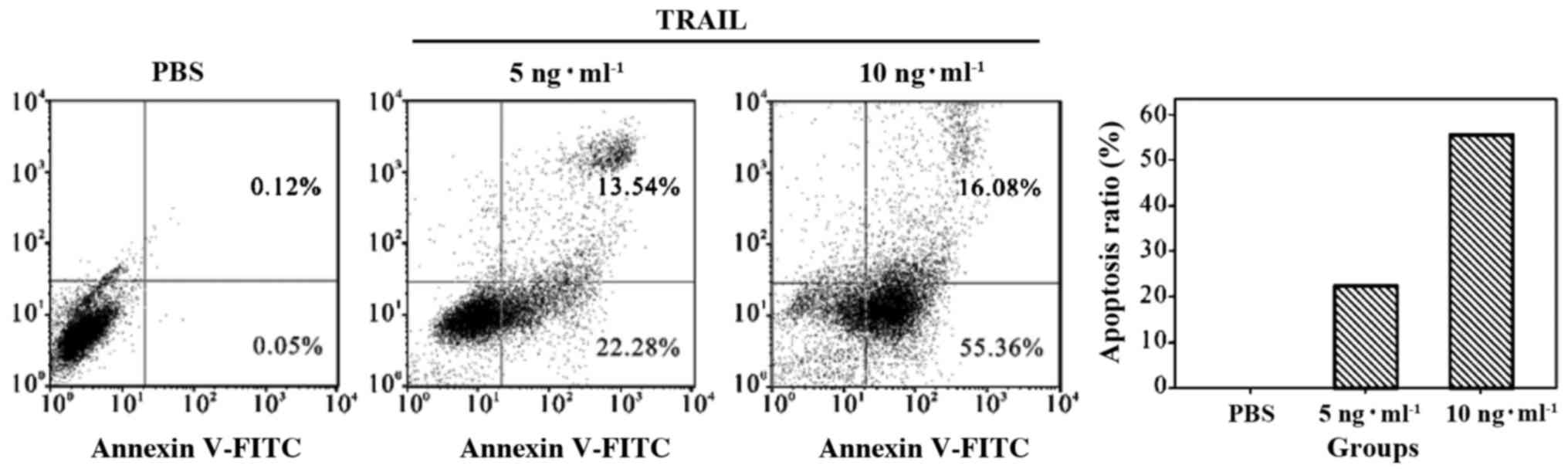
Flow cytometry showed that TRAIL significantly increased the rate of apoptosis of 5637 cells. Tumor cell apoptosis increased with the dose of TRAIL (Fig. 1).

Figure 1.

Detection of 5637 cell apoptosis by flow cytometry. Apoptosis increased with the concentration of TRAIL. TRAIL, tumor necrosis factor-related apoptosis-inducing ligand.

The effect of TRAIL on apoptosis on PC-3 prostate cancer cells

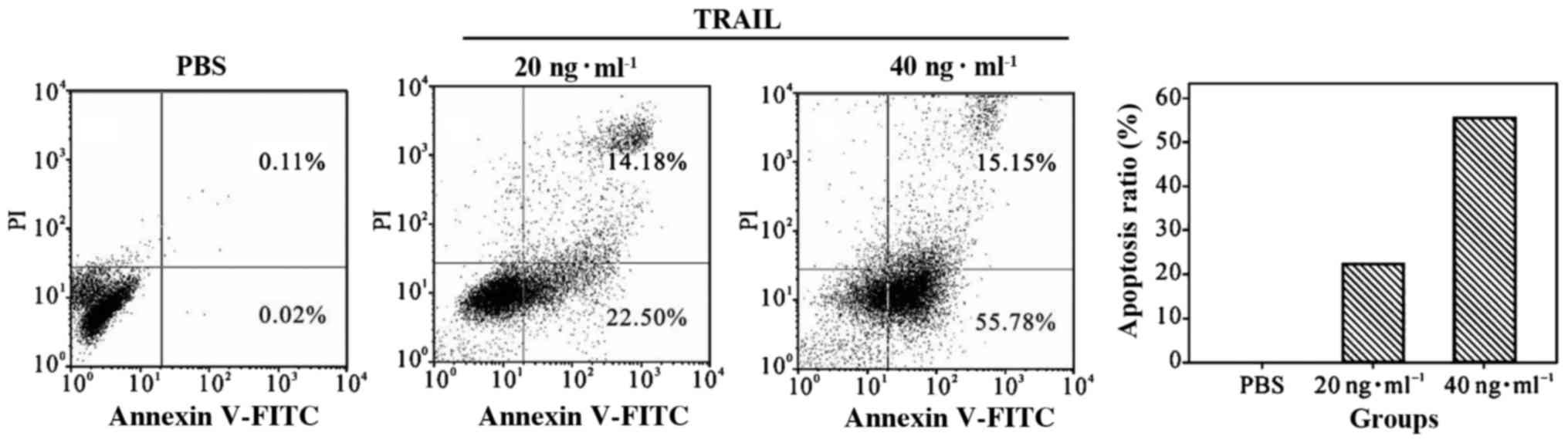
Flow cytometry showed that TRAIL significantly increased the rate of apoptosis of PC-3 cells. Tumor cell apoptosis increased with the dose of TRAIL (Fig. 2).

Figure 2.

Detection of PC-3 cell apoptosis by flow cytometry. Apoptosis increased with the concentration of TRAIL. TRAIL, tumor necrosis factor-related apoptosis-inducing ligand.

Discussion

TRAIL is a member of the TNF superfamily, which activates apoptotic pathways by binding to corresponding death receptors, TRAIL2R1 (DR4) and TRAIL2R2 (DR5), thereby selectively inducing apoptosis in cancer cells without effecting normal cells. The results of this study show that the recombinant and purified TRAIL protein mainly plays an inhibitory role in PC-3 prostate cancer cells and 5637 bladder cancer cells by inducing apoptosis. The inhibitory effect of TRAIL is dose-dependent and tumor cells from different sources have different sensitivities to TRAIL-induced apoptosis. Low-dose TRAIL did not induce significant apoptosis in either cell line. These results are consistent with the observations of the cell proliferation assay. Apoptosis of tumor cells was significantly increased with higher doses of TRAIL.

Despite these observations on apoptosis and proliferation, the long-term inhibitory effects of our TRAIL protein construct on tumor cell proliferation are unclear. Previous studies have shown that due to tumor drug resistance, TRAIL monotherapy was ineffective. In recent years, many studies reported on the combined use of TRAIL and chemotherapy drugs for the treatment of tumors (8,9). Their combined use can effectively enhance the overall antitumor effect, reduce the required dose of chemotherapy drugs in clinical application and reduce cytotoxicity. Shin et al showed that when prostate cells were treated in combination with tanshinone and TRAIL, miR135a-3p expression was upregulated and DR5 activity was induced, thereby increasing TRAIL-induced apoptosis of prostate cancer cells (10). Ismail et al showed that the combination of the anticancer drug, RG003 and TRAIL could enhance TRAIL-induced apoptosis of prostate cancer cells (11). Others have reported that metformin and evodiamine could enhance the effect of TRAIL on the apoptosis of human bladder cancer cells through downregulation of c-FLIP and Mcl-1 expression (12,13) via the mTOR/S6K1 signaling pathway. Therefore, whether the combined application of our recombinant, purified TRAIL construct with chemotherapy drugs can effectively induce long-term effects on the apoptosis of tumor cells and the specific mechanisms thereof, remain to be further studied.

Acknowledgements

The present study was funded by the Funding Project of National Natural Science Foundation of China (8127257), the Funding Project of Sino-US International Cooperation Foundation (2014DFA31480), the Xuzhou Municipal Science and Technology Program Project (XM13B079), the Jiangsu Maternal and Child Health Scientific Research Project (F201561), and the Funding Project of Xuzhou Central Hospital Doctor (Master) Innovation Team Science and Technology Foundation (XZS2013004).

References

1 

Siegel R, Naishadham D and Jemal A: Cancer statistics, 2012. CA Cancer J Clin. 62:10–29. 2012. View Article : Google Scholar : PubMed/NCBI

2 

Babjuk M, Burger M, Zigeuner R, Shariat SF, van Rhijn BW, Compérat E, Sylvester RJ, Kaasinen E, Böhle A, Palou Redorta J, et al: European Association of Urology: EAU guidelines on non-muscle-invasive urothelial carcinoma of the bladder: update 2013. Eur Urol. 64:639–653. 2013. View Article : Google Scholar : PubMed/NCBI

3 

Seiler R, Thalmann GN, Fleischmann A, Shariat SF, van Rhijn BW, Comperat E, Sylvester RJ, Kaasinen E, Bohle A, Palou RJ, et al: MMP-2 and MMP-9 in lymph-node-positive bladder cancer. J Clin Pathol. 64:1078–1082. 2011. View Article : Google Scholar : PubMed/NCBI

4 

Herbst RS, Eckhardt SG, Kurzrock R, Ebbinghaus S, O'Dwyer PJ, Gordon MS, Novotny W, Goldwasser MA, Tohnya TM, Lum BL, et al: Phase I dose-escalation study of recombinant human Apo2L/TRAIL, a dual proapoptotic receptor agonist, in patients with advanced cancer. J Clin Oncol. 28:2839–2846. 2010. View Article : Google Scholar : PubMed/NCBI

5 

Galligan L, Longley DB, McEwan M, Wilson TR, McLaughlin K and Johnston PG: Chemotherapy and TRAIL-mediated colon cancer cell death: the roles of p53, TRAIL receptors, and c-FLIP. Mol Cancer Ther. 4:2026–2036. 2005. View Article : Google Scholar : PubMed/NCBI

6 

Yin S, Rishi AK and Reddy KB: Anti-estrogen-resistant breast cancer cells are sensitive to cisplatin plus TRAIL treatment. Oncol Rep. 33:1475–1480. 2015.PubMed/NCBI

7 

Wang D and Shi L: High-level expression, purification, and in vitro refolding of soluble tumor necrosis factor-related apoptosis-inducing ligand (TRAIL). Appl Biochem Biotechnol. 157:1–9. 2009. View Article : Google Scholar : PubMed/NCBI

8 

Ismail B, Ghezali L, Gueye R, Limami Y, Pouget C, Leger DY, Martin F, Beneytout JL, Duroux JL, Diab-Assaf M, et al: Novel methylsulfonyl chalcones as potential antiproliferative drugs for human prostate cancer: Involvement of the intrinsic pathway of apoptosis. Int J Oncol. 43:1160–1168. 2013.PubMed/NCBI

9 

Kauntz H, Bousserouel S, Gossé F and Raul F: The flavonolignan silibinin potentiates TRAIL-induced apoptosis in human colon adenocarcinoma and in derived TRAIL-resistant metastatic cells. Apoptosis. 17:797–809. 2012. View Article : Google Scholar : PubMed/NCBI

10 

Shin EA, Sohn EJ, Won G, Choi JU, Jeong M, Kim B, Kim MJ and Kim SH: Upregulation of microRNA135a-3p and death receptor 5 plays a critical role in Tanshinone I sensitized prostate cancer cells to TRAIL induced apoptosis. Oncotarget. 5:5624–5636. 2014. View Article : Google Scholar : PubMed/NCBI

11 

Ismail B, Fagnere C, Limami Y, Ghezali L, Pouget C, Fidanzi C, Ouk C, Gueye R, Beneytout JL, Duroux JL, et al: 2′-Hydroxy-4-methylsulfonylchalcone enhances TRAIL-induced apoptosis in prostate cancer cells. Anticancer Drugs. 26:74–84. 2015. View Article : Google Scholar : PubMed/NCBI

12 

Zhang T, Qu S, Shi Q, He D and Jin X: Evodiamine induces apoptosis and enhances TRAIL-induced apoptosis in human bladder cancer cells through mTOR/S6K1-mediated downregulation of Mcl-1. Int J Mol Sci. 15:3154–3171. 2014. View Article : Google Scholar : PubMed/NCBI

13 

Zhang T, Wang X, He D, Jin X and Guo P: Metformin sensitizes human bladder cancer cells to TRAIL-induced apoptosis through mTOR/S6K1-mediated downregulation of c-FLIP. Anticancer Drugs. 25:887–897. 2014. View Article : Google Scholar : PubMed/NCBI

Related Articles

  • Abstract
  • View
  • Download
  • Twitter
Copy and paste a formatted citation
Spandidos Publications style
Hao L, Zhao Y, Li Z, He H, Liang Q, Zhang Z, Shi Z, Zhang P and Han C: Tumor necrosis factor-related apoptosis-inducing ligand inhibits proliferation and induces apoptosis of prostate and bladder cancer cells Retraction in /10.3892/ol.2025.15354. Oncol Lett 13: 3638-3640, 2017.
APA
Hao, L., Zhao, Y., Li, Z., He, H., Liang, Q., Zhang, Z. ... Han, C. (2017). Tumor necrosis factor-related apoptosis-inducing ligand inhibits proliferation and induces apoptosis of prostate and bladder cancer cells Retraction in /10.3892/ol.2025.15354. Oncology Letters, 13, 3638-3640. https://doi.org/10.3892/ol.2017.5922
MLA
Hao, L., Zhao, Y., Li, Z., He, H., Liang, Q., Zhang, Z., Shi, Z., Zhang, P., Han, C."Tumor necrosis factor-related apoptosis-inducing ligand inhibits proliferation and induces apoptosis of prostate and bladder cancer cells Retraction in /10.3892/ol.2025.15354". Oncology Letters 13.5 (2017): 3638-3640.
Chicago
Hao, L., Zhao, Y., Li, Z., He, H., Liang, Q., Zhang, Z., Shi, Z., Zhang, P., Han, C."Tumor necrosis factor-related apoptosis-inducing ligand inhibits proliferation and induces apoptosis of prostate and bladder cancer cells Retraction in /10.3892/ol.2025.15354". Oncology Letters 13, no. 5 (2017): 3638-3640. https://doi.org/10.3892/ol.2017.5922
Copy and paste a formatted citation
x
Spandidos Publications style
Hao L, Zhao Y, Li Z, He H, Liang Q, Zhang Z, Shi Z, Zhang P and Han C: Tumor necrosis factor-related apoptosis-inducing ligand inhibits proliferation and induces apoptosis of prostate and bladder cancer cells Retraction in /10.3892/ol.2025.15354. Oncol Lett 13: 3638-3640, 2017.
APA
Hao, L., Zhao, Y., Li, Z., He, H., Liang, Q., Zhang, Z. ... Han, C. (2017). Tumor necrosis factor-related apoptosis-inducing ligand inhibits proliferation and induces apoptosis of prostate and bladder cancer cells Retraction in /10.3892/ol.2025.15354. Oncology Letters, 13, 3638-3640. https://doi.org/10.3892/ol.2017.5922
MLA
Hao, L., Zhao, Y., Li, Z., He, H., Liang, Q., Zhang, Z., Shi, Z., Zhang, P., Han, C."Tumor necrosis factor-related apoptosis-inducing ligand inhibits proliferation and induces apoptosis of prostate and bladder cancer cells Retraction in /10.3892/ol.2025.15354". Oncology Letters 13.5 (2017): 3638-3640.
Chicago
Hao, L., Zhao, Y., Li, Z., He, H., Liang, Q., Zhang, Z., Shi, Z., Zhang, P., Han, C."Tumor necrosis factor-related apoptosis-inducing ligand inhibits proliferation and induces apoptosis of prostate and bladder cancer cells Retraction in /10.3892/ol.2025.15354". Oncology Letters 13, no. 5 (2017): 3638-3640. https://doi.org/10.3892/ol.2017.5922
Follow us
  • Twitter
  • LinkedIn
  • Facebook
About
  • Spandidos Publications
  • Careers
  • Cookie Policy
  • Privacy Policy
How can we help?
  • Help
  • Live Chat
  • Contact
  • Email to our Support Team