Introduction
Colorectal carcinoma is the third most common cancer
in males and the second most common in females (1). Metastasis is the primary cause of
treatment failure in patients with colorectal cancer and usually
occurs in the liver, lungs and other organs due to the malignant
characteristics of the disease (2,3). Current
treatments of metastatic colorectal cancer include surgery,
chemotherapy and targeted therapy, which uses small molecule-based
drugs or monoclonal antibodies against abnormally expressed
proteins that are essential for cancer cell growth, including
anti-EGFR agents, e.g., cetuximab and panitumumab, in addition to
anti-VEGF agents, e.g., bevacizumab and aflibercept (4). Due to unresectable metastatic lesions,
only a small proportion of patients with metastatic colorectal
cancer are eligible to undergo surgery (5,6).
Furthermore, chemotherapy induces toxic side effects and targeted
therapy is very expensive, meaning that few patients with
metastatic colorectal cancer receive suitable treatment. Currently,
the 5-year survival rate of patients with metastatic colorectal
cancer is <15% (7,8). Therefore, it is necessary to develop a
novel approach to treat and prevent metastasis in colorectal
cancer.
Traditional Chinese medicine (TCM) may be used as a
method of treating colorectal cancer. Syndrome
differentiation-based treatment with TCM decoctions can alleviate
symptoms, improve quality of life and immune function, produce
synergistic effects alongside anti-cancer chemotherapy, prevent
cancer recurrence and metastasis and prolong the survival time of
patients with colorectal cancer (9,10). Based
on the principles and practice of TCM, the formula,
Teng-Long-Bu-Zhong-Tang (TLBZT) has been produced that may
potentially be used to treat patients with colorectal cancer.
Previous studies have suggested that TLBZT inhibits proliferation
and induces apoptosis and senescence in colon cancer cells
(11–13).
Some of the herbs present in TLBZT have been
studied. Actinidia chinensis and Duchesnea indica can
inhibit cell proliferation in suspension, induce active oxygen
production, activate caspase-3 and induce anoikis in colorectal
cancer cells (14,15). Anoikis is a form of programmed cell
death elicited when cells detach from the extracellular matrix
(ECM) and is closely associated with the survival of tumor cells in
a liquid environment, including the blood and lymph circulation.
Therefore, inhibiting the growth of tumor cells in suspension and
inducing anoikis may suppress cancer metastasis. Furthermore,
Solanum nigrum, one of the herbs present in TLBZT, inhibits
the proliferation, adhesion, migration and invasion of colorectal
cancer cells (16). These
observations suggest that TLBZT may inhibit the metastasis of
colorectal cancer cells.
The present study evaluated the effect of TLBZT on
colorectal cancer metastasis in vivo. The effects of TLBZT
on the expression of the metastasis-associated genes, including
lysyl oxidase (LOX), hypoxia-inducible factor 1α (HIF-1α),
integrins αv and β3 and the phosphorylation of focal adhesion
kinase (p-FAK), were also determined. The results demonstrated that
TLBZT inhibits the metastasis of human RKO colon carcinoma cells to
the lungs, downregulates the expression of LOX, HIF-1α, integrin αV
and β3, and inhibits FAK phosphorylation.
Materials and methods
Reagents
Dulbecco's Modified Eagle's medium (DMEM) and fetal
bovine serum were obtained from Hyclone; GE Healthcare Life
Sciences (Logan, UT, USA). The antibody against LOX was purchased
from Novus Biologicals (Littleton, CO, USA) (cat. no. NB100-2527).
The antibody against HIF-1α was purchased from Santa Cruz
Biotechnology, Inc. (Dallas, TX, USA) (cat. no. sc-53546).
Antibodies against integrins αV (cat. no. BS3513) and β3 (cat. no.
BS1187), phosphorylated (p)-FAK (cat. no. BS4617), horseradish
peroxidase (HRP)-conjugated-anti-rabbit IgG (cat. no. BS13278) and
anti-Mouse IgG-HRP (cat. no. BS12478) were procured from Bioworld
Technology, Inc. (St. Louis Park, MN, USA).
TLBZT extraction
The major herbs in the TLBZT formula (Chinese patent
ZL200910197565.2) are: The roots of A. chinensis (30 g),
S. nigrum (15 g), D. indica (15 g), Atractylodes
macrocephala (9 g), Coix seed (30 g) and Viscum
coloratum (15 g). All the aforementioned herbs were obtained
from Longhua Hospital (Shanghai, China) in accordance with the
amounts required for the TLBZT formula and decocted twice with
8-fold distilled water at 100°C for 1 h. The decoctions were
merged, filtered and made up to a concentration of 1.5 g crude herb
materials/ml water and stored at 4°C.
RKO cell culture
Human colon carcinoma RKO cells were obtained from
the Cell Bank of Type Culture Collection of Chinese Academy of
Sciences (Beijing, China). RKO cells were cultured in DMEM with 10%
fetal bovine serum, penicillin (100 U/ml) and streptomycin (100
µg/ml) and maintained at 37°C with 5% CO2 in a
humidified atmosphere for 2-3 days until cells reached 80%
confluence. Cells were subsequently passaged to new plates.
Animal model
A total of 30 male 6–7-week old BALB/c nude mice
were purchased from the Shanghai SLAC Laboratory Animal Co., Ltd.
(Shanghai, China). Mice were acclimatized for 1 week in
pathogen-free conditions at the animal laboratory of Longhua
Hospital with a 12 h light/dark cycle, regulated temperature of
24±2°C and humidity of 50±10%, with ad libitum access to
water and animal chow.
Mice were injected with 2×10⁶ RKO cells
in 0.1 ml PBS through the tail vein. Subsequently, mice were
randomly divided into 3 groups (n=10 mice/group), and
intragastrically administrated with either 11.25 g/kg/0.3 ml TLBZT,
22.5 g/kg/0.3 ml TLBZT or same volume of distilled water, once a
day. Following 2 months treatment, mice were sacrificed by cervical
dislocation, mouse lungs were removed and weighed, and metastatic
nodules on the lung surface were counted. The Longhua Hospital
Animal Care and Use Committee approved all studies involving
mice.
Histochemistry
Lung tissues were fixed in 4% paraformaldehyde in
PBS at 4°C overnight, embedded in paraffin and cut into 4 µm thick
sections. Sections were then deparaffinized with xylene two times
for 10 min, re-hydrated with 100, 95 and 70% alcohol for 2 min, and
stained with hematoxylin and eosin for 4 min and 1 min
respectively, and mounted with xylene based mounting medium. Slides
were visualized using an Olympus light microscope (Olympus
Corporation, Tokyo, Japan).
Immunohistochemistry (IHC)
Lung tissues were fixed, embedded and cut as
described above. For IHC, sections were blocked with 3% hydrogen
peroxide for 15 min at room temperature, blocked with 5% normal
goat serum (Cell Signaling Technology, Inc., Danvers, MA, USA) for
30 min at 37°C, and subsequently incubated with primary antibodies
against LOX (1:100), integrin αV (1:100), integrin β3 (1:100),
p-FAK (1:100) and HIF-1α (1:200) at 4°C overnight. Sections were
then incubated with the appropriate HRP-conjugated anti-rabbit/anti
mouse IgG secondary antibody (1:4,000) at 37°C for 30 min and
visualized using 3,3-diaminobenzidine at room temperature for 3–5
min. Sections were then counterstained with hematoxylin for 45 sec
at room temperature and mounted with glass coverslips. Slides were
observed using an Olympus light microscope (Olympus Corporation).
Five fields at ×200 magnification were randomly selected from each
slide and analyzed using Image-Pro Plus 6.0 software (Media
Cybernetics, Rockville, MD, USA).
Statistical analyses
Data are expressed as the mean ± standard deviation.
Differences among groups were analyzed using one-way analysis of
variance followed by a least significant difference (LSD) test.
P≤0.05 was considered to indicate a statistically significant
difference.
Results
TLBZT inhibits the lung metastasis of
colorectal cancer cells
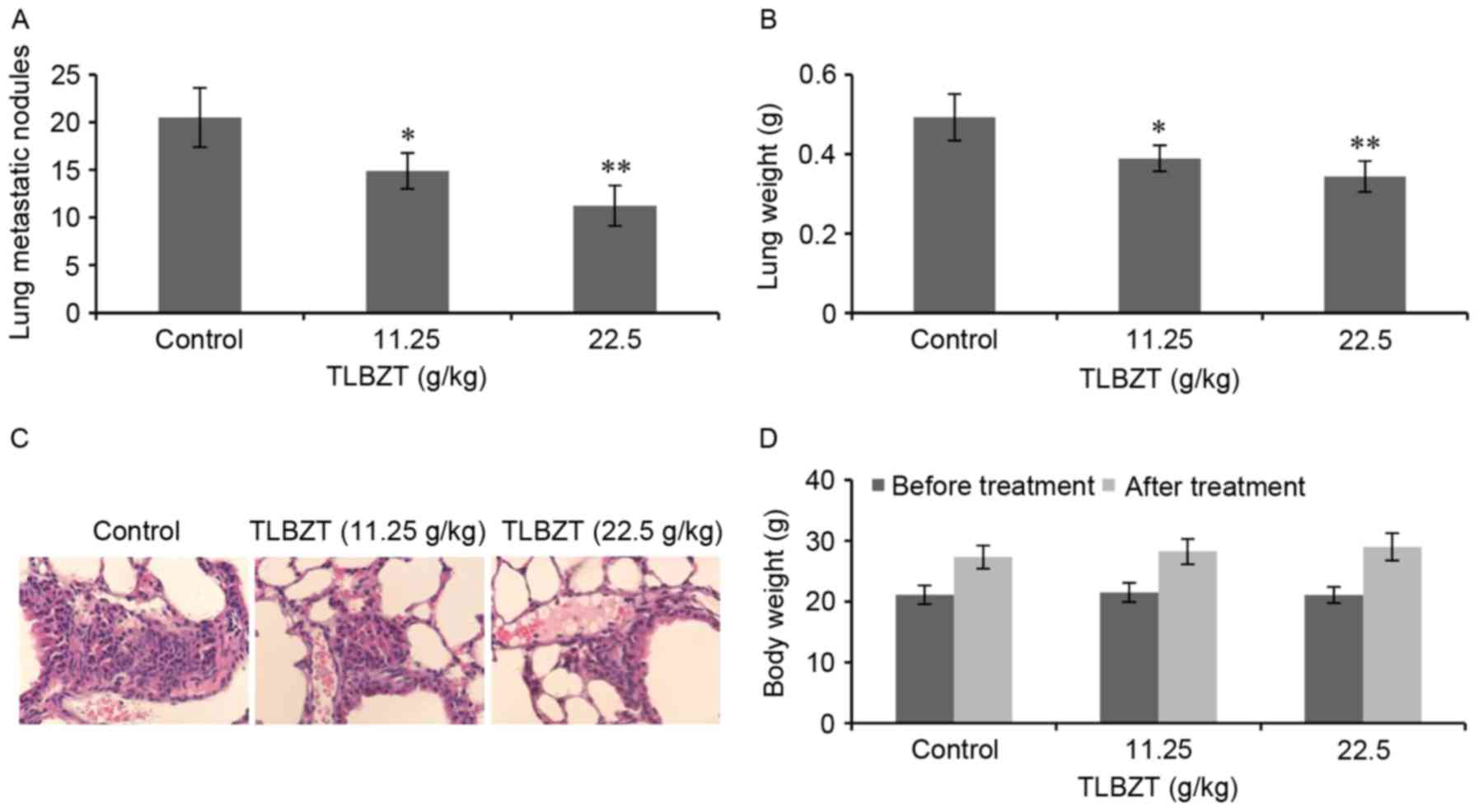
Following treatment with TLBZT, lungs from nude mice
were removed and weighed, and the number of metastatic nodules on
the lung surface was counted. The results demonstrated that the
number of metastatic nodules on the lung surface decreased
following treatment with TLBZT in a dose-dependent manner (Fig. 1A; P<0.05). Furthermore, lung weight
was significantly reduced in a dose-dependent manner following
treatment with TLBZT (Fig. 1B;
P<0.05). Pathology indicates that TLBZT markedly inhibited the
growth of metastatic nodules in the lung (Fig. 1C). Following treatment with TLBZT, no
significant adverse consequences were observed, including weight
loss (Fig. 1D), ruffling of fur,
changes in behavior and feeding (data not shown). These results
suggest that TLBZT inhibits the metastasis of colorectal carcinoma
without inducing toxicity.
TLBZT inhibits the expression of
LOX
LOX is associated with the remodeling of the ECM,
which serves an important role in tumor metastasis and may be a
target for regulating cancer metastasis (17,18). The
present study demonstrated that LOX was overexpressed in lung
metastases from RKO colorectal cancer and that treatment with TLBZT
significantly inhibited its expression (Fig. 2; P<0.01).
TLBZT inhibits the expression of
HIF-1α
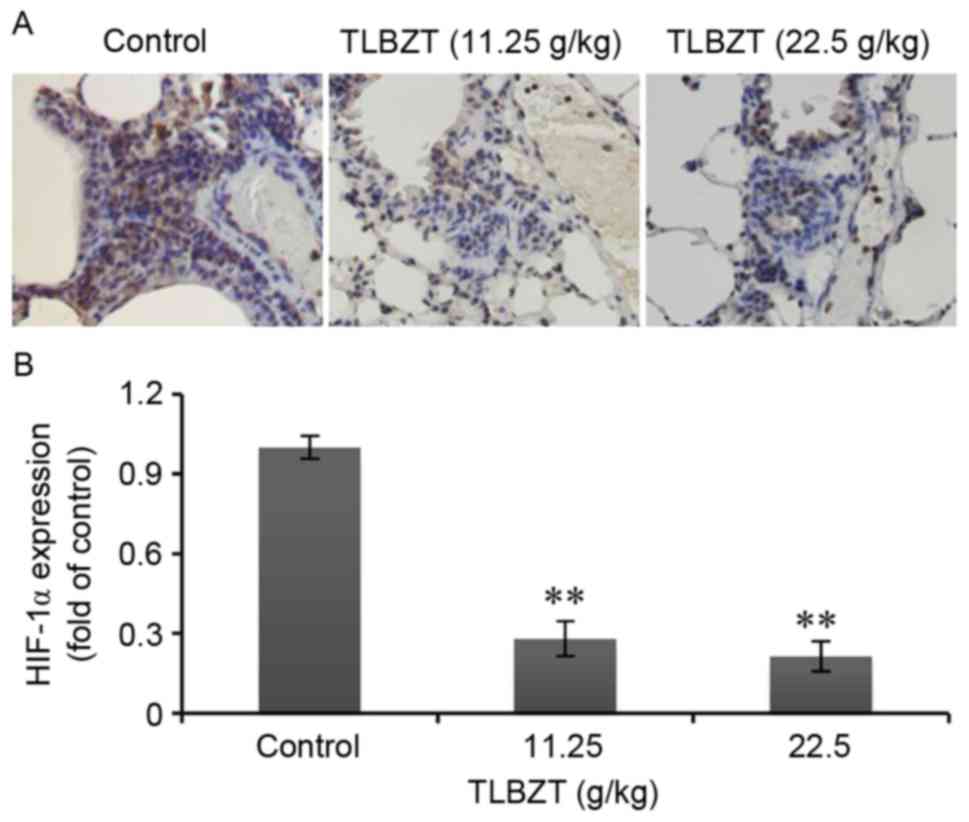
It has been demonstrated that the expression of LOX
is regulated by HIF-1α (19);
therefore, the current study determined the effect of TLBZT
treatment on HIF-1α expression. The results demonstrated that
HIF-1α was highly expressed in lung metastases from RKO colorectal
carcinoma, but that TLBZT significantly inhibited its expression
(Fig. 3; P<0.01).
TLBZT inhibits the expression of
integrins αV and β3
Integrins serve an important role in cell-cell and
cell-ECM interactions and participate in the process of tumor
metastasis; thus, their inhibition may suppress cancer metastasis
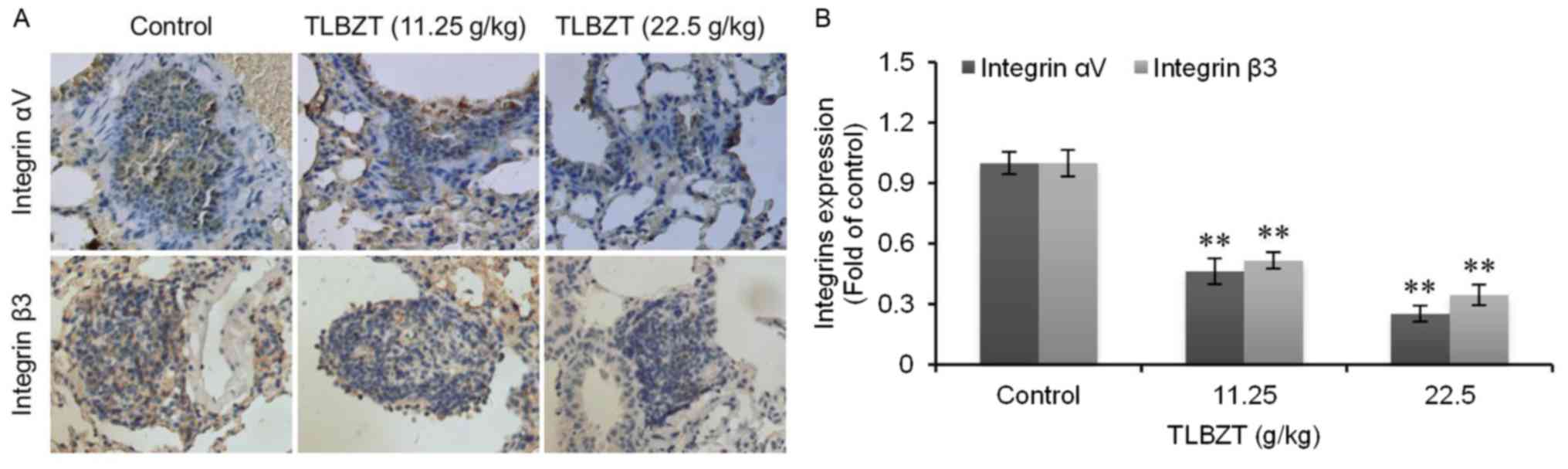
(20–22). Therefore, the effects of TLBZT
treatment on integrin expression were assessed. Integrins αV and β3
were overexpressed in lung metastases from RKO colorectal cancer;
however, treatment with TLBZT significantly inhibited their
expression (Fig. 4; all
P<0.01).
TLBZT inhibits FAK
phosphorylation
The transduction of the downstream signals of
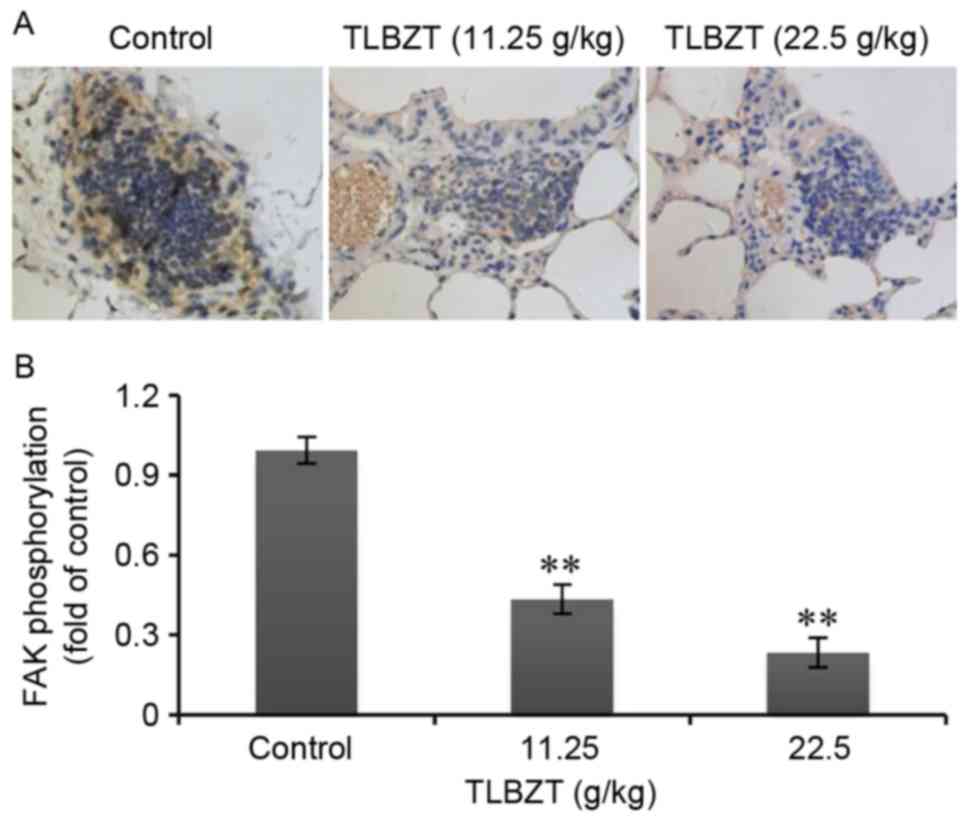
integrins are associated with the phosphorylation of FAK (23), therefore the effects of TLBZT on FAK
phosphorylation were assessed using immunohistochemistry. FAK was
highly phosphorylated in lung metastases from RKO colorectal
cancer. However, treatment with TLBZT significantly inhibited the
phosphorylation of FAK (Fig. 5;
P<0.01).
Discussion
According to TCM, the basic pathogenesis of
colorectal cancer is associated with toxicity, dampness and
spleen-deficiency, and the therapeutic principles of TLBZT are
considered to be detoxification, overcoming dampness and tonifying
the spleen (9,10). Furthermore, all the herbs contained in
the TLBZT formula exhibit anti-cancer effects and are commonly used
in clinical oncology. A. chinensis inhibits colorectal
cancer cell proliferation and induces apoptosis via mitochondrial
pathways (24). S. nigrum
inhibits cell proliferation, induces autophagy and enhances the
cytotoxic effect of chemotherapeutic drugs in colorectal cancer
cells (25). D. indica
inhibits cell proliferation, promotes cell apoptosis and arrests
the cell cycle in the S-phase in cervical cancer (26).
Atractylenolide I, a component of A.
macrocephala, is able to inhibit cell survival and induce
apoptosis by upregulating the expression of caspase-2, caspase-9
and Bax, and downregulating the expression of Bcl-2 and Bcl-XL
(27). Kanglaite, a Chinese herb
product extracted from the Coix seed, induces apoptosis in
cancer cells and is widely used to treat different types of cancer,
including lung, liver and gastric cancer (28–30). V.
coloratum inhibits cell proliferation and promotes the
apoptosis of colorectal cancer cells via inhibition of nuclear
factor-κB (31). These results
suggest that TLBZT is a herbal formula that exhibits anti-cancerous
effects according to TCM theories and clinical practice.
LOX, a type of ECM-modifying enzyme, is involved in
the remodeling of ECM. It is highly expressed in colorectal cancer
and is considered to promote tumor metastasis (17,18,32,33).
Inhibiting LOX expression impairs tumor cell metastasis, therefore
LOX has become a target for cancer treatment (34,35). The
expression of LOX is regulated by HIF-1α, which is degraded by
ubiquitination in normoxic conditions. However, HIF-1α degradation
is inhibited in hypoxic conditions and it forms heterodimers with
HIF-1β, which activates the expression of downstream genes,
including vascular endothelial growth factor and LOX, which are
involved in angiogenesis and metastasis (36). The results of the present study
demonstrated that LOX and HIF-1α are overexpressed in metastatic
lesions in the lung that arise from colorectal cancer cells.
Treatment with TLBZT significantly inhibited LOX and HIF-1α
expression, suggesting that inhibition of LOX and HIF-1α
contributes to the TLBZT-mediated prevention of colorectal cancer
metastasis.
Integrins, consisting of α and β subtypes, are
transmembrane proteins that mediate cell-cell and cell-ECM
interactions (37,38). The extracellular domains of integrins
α and β form a ligand binding domain for binding ligands, including
fibrinogen, fibronectin and intercellular adhesion molecules
(37,38). The downstream signal transduction of
integrins is associated with the FAK signaling pathway and they are
able to mediate the biological behavior of cells, including cell
migration, invasion and metastasis (23,39).
Integrin αVβ3 is a heterodimer formed by the non-covalent linking
of the integrin αV and β3 subunits. It is widely expressed in tumor
tissues and is closely associated with tumor metastasis (39,40).
Antagonizing integrin αVβ3 or inhibiting its ligand, osteopontin
may effectively inhibit colorectal cancer metastasis (22,41). The
results of the present study indicate that integrin αVβ3 is
overexpressed and that FAK is highly phosphorylated in metastatic
cells of RKO colorectal carcinoma. TLBZT may inhibit the expression
of integrin αVβ3 and the phosphorylation of FAK. These results
suggest that inhibiting integrin αVβ3-FAK signal transduction may
induce the anti-metastatic effects observed following treatment
with TLBZT in colorectal cancer.
To conclude, the present study demonstrated that
TLBZT inhibits the metastasis of RKO colorectal cancer cells and
that this may be associated with the inhibition of HIF1α-LOX and
integrin αVβ3-FAK signal transduction. These results provide a
novel insight for the treatment and prevention of colorectal cancer
metastasis with TLBZT.
Acknowledgements
The present study was supported by National Natural
Science Foundation of China (grant nos. 81273726 and 81473625), the
Program from Science and Technology Commission of Shanghai
Municipality (grant no. 16401902500), the Three-year Action Program
of Shanghai Municipality for Traditional Chinese Medicine (grant
no. ZY3-CCCX-3-3025) and the Opening Research Fund of Shanghai Key
Laboratory of Tissue Engineering (grant no. TE1401).
Glossary
Abbreviations
Abbreviations:
|
TLBZT
|
Teng-Long-Bu-Zhong-Tang
|
|
TCM
|
traditional Chinese medicine
|
|
LOX
|
lysyl oxidase
|
|
HIF-1α
|
hypoxia-inducible factor 1α
|
|
DMEM
|
Dulbecco's modified Eagle's medium
|
|
FAK
|
focal adhesion kinase
|
|
ECM
|
extracellular matrix
|
References
|
1
|
Torre LA, Bray F, Siegel RL, Ferlay J,
Lortet-Tieulent J and Jemal A: Global cancer statistics, 2012. CA
Cancer J Clin. 65:87–108. 2015. View Article : Google Scholar : PubMed/NCBI
|
|
2
|
Bognár G, Ledniczky G, István G and
Ondrejka P: Molecular mechanisms in development of colorectal
cancer metastasis. Magy Seb. 59:342–349. 2006.(In Hungarian).
PubMed/NCBI
|
|
3
|
Geiger TR and Peeper DS: Metastasis
mechanisms. Biochim Biophys Acta. 1796:293–308. 2009.PubMed/NCBI
|
|
4
|
Ohhara Y, Fukuda N, Takeuchi S, Honma R,
Shimizu Y, Kinoshita I and Dosaka-Akita H: Role of targeted therapy
in metastatic colorectal cancer. World J Gastrointest Oncol.
8:642–655. 2016. View Article : Google Scholar : PubMed/NCBI
|
|
5
|
Moorcraft SY, Ladas G, Bowcock A and Chau
I: Management of resectable colorectal lung metastases. Clin Exp
Metastasis. 33:285–296. 2016. View Article : Google Scholar : PubMed/NCBI
|
|
6
|
Smith JJ and D'Angelica MI: Surgical
management of hepatic metastases of colorectal cancer. Hematol
Oncol Clin North Am. 29:61–84. 2015. View Article : Google Scholar : PubMed/NCBI
|
|
7
|
Davies JM and Goldberg RM: Treatment of
metastatic colorectal cancer. Semin Oncol. 38:552–560. 2011.
View Article : Google Scholar : PubMed/NCBI
|
|
8
|
Siegel RL, Miller KD and Jemal A: Cancer
statistics, 2016. CA Cancer J Clin. 66:7–30. 2016. View Article : Google Scholar : PubMed/NCBI
|
|
9
|
Deng S, Hu B and An HM: Traditional
Chinese medicinal syndromes and treatment in colorectal cancer. J
Cancer Ther. 3:888–897. 2012. View Article : Google Scholar
|
|
10
|
Deng S, Hu B and Shen KP: Pathogenesis and
treatment of colorectal cancer in traditional Chinese medicine.
World Sci Technol Mod Trad Chinese Med Mater Med. 14:1858–1862.
2012.(In Chinese).
|
|
11
|
Hu B, An HM, Shen KP and DU Q: Effects of
Tenglong Buzhong Decoction on proliferation and apoptosis of human
colon carcinoma cell line LS174T. Zhong Xi Yi Jie He Xue Bao.
8:575–580. 2010.(In Chinese). View Article : Google Scholar : PubMed/NCBI
|
|
12
|
Hu B, An HM, Shen KP and Du Q:
Senescence-inducing effects of Chinese herbal medicine Tenglong
Buzhong Decoction on human colon carcinoma LS-174-T cells and the
mechanism. Zhong Xi Yi Jie He Xue Bao. 8:1048–1052. 2010.(In
Chinese). View Article : Google Scholar : PubMed/NCBI
|
|
13
|
Deng S, Hu B, An HM, Du Q, Xu L, Shen KP,
Shi XF, Wei MM and Wu Y: Teng-Long-Bu-Zhong-Tang, a Chinese herbal
formula, enhances anticancer effects of 5-fluorouracil in CT26
colon carcinoma. BMC Complement Altern Med. 13:1282013. View Article : Google Scholar : PubMed/NCBI
|
|
14
|
Hu B, Shen KP, Shi XF, Deng S and Wei MM:
Root of Actinidia chinensis induces anoikis in colon
carcinoma RKO cells. Chin J Exp Tradit Med Formul. 19:242–245.
2013.(In Chinese).
|
|
15
|
Hu B, Shen KP, Shi XF, Deng S and Wei MM:
Experimental research of RKO cell anoikis induced by Duchesnea
indica in human colon cancer. World J Integr Trad West Med.
8:69–72. 2013.(In Chinese).
|
|
16
|
Hu B, An HM, Shen KP, Shi XF, Deng S and
Wei MM: Effect of Solanum nigrum on human colon carcinoma
RKO cells. Zhong Yao Cai. 36:958–961. 2013.(In Chinese). PubMed/NCBI
|
|
17
|
Xiao Q and Ge G: Lysyl oxidase,
extracellular matrix remodeling and cancer metastasis. Cancer
Microenviron. 5:261–273. 2012. View Article : Google Scholar : PubMed/NCBI
|
|
18
|
Cox TR, Gartland A and Erler JT: Lysyl
oxidase, a targetable secreted molecule involved in cancer
metastasis. Cancer Res. 76:188–192. 2016. View Article : Google Scholar : PubMed/NCBI
|
|
19
|
Ji F, Wang Y, Qiu L, Li S, Zhu J, Liang Z,
Wan Y and Di W: Hypoxia inducible factor 1α-mediated LOX expression
correlates with migration and invasion in epithelial ovarian
cancer. Int J Oncol. 42:1578–1588. 2013. View Article : Google Scholar : PubMed/NCBI
|
|
20
|
Felding-Habermann B: Integrin adhesion
receptors in tumor metastasis. Clin Exp Metastasis. 20:203–213.
2003. View Article : Google Scholar : PubMed/NCBI
|
|
21
|
Zhang Y, Yang M, Ji Q, Fan D, Peng H, Yang
C, Xiong D and Zhou Y: Anoikis induction and metastasis suppression
by a new integrin αvβ3 inhibitor in human melanoma cell line M21.
Invest New Drugs. 29:666–673. 2011. View Article : Google Scholar : PubMed/NCBI
|
|
22
|
Reinmuth N, Liu W, Ahmad SA, Fan F,
Stoeltzing O, Parikh AA, Bucana CD, Gallick GE, Nickols MA, Westlin
WF and Ellis LM: Alphavbeta3 integrin antagonist S247 decreases
colon cancer metastasis and angiogenesis and improves survival in
mice. Cancer Res. 63:2079–2087. 2003.PubMed/NCBI
|
|
23
|
Mitra SK and Schlaepfer DD:
Integrin-regulated FAK-Src signaling in normal and cancer cells.
Curr Opin Cell Biol. 18:516–523. 2006. View Article : Google Scholar : PubMed/NCBI
|
|
24
|
Chen YJ and Shi RJ: Ethanol extract from
radix of Actinidia chinensis inhibits cell proliferation and
indeuces apoptosis in human colon carcinoma cell line LoVo. World
Chin J Digest. 20:pp. 1657–1661. 2012, (In Chinese).
|
|
25
|
Tai CJ, Wang CK, Tai CJ, Lin YF, Lin CS,
Jian JY, Chang YJ and Chang CC: Aqueous extract of Solanum
nigrum leaves induces autophagy and enhances cytotoxicity of
cisplatin, doxorubicin, docetaxel, and 5-fluorouracil in human
colorectal carcinoma cells. Evid Based Complement Alternat Med.
2013:5147192013. View Article : Google Scholar : PubMed/NCBI
|
|
26
|
Peng B, Hu Q, Liu X, Wang L, Chang Q, Li
J, Tang J, Wang N and Wang Y: Duchesnea phenolic fraction
inhibits in vitro and in vivo growth of cervical cancer through
induction of apoptosis and cell cycle arrest. Exp Biol Med
(Maywood). 234:74–83. 2009. View Article : Google Scholar : PubMed/NCBI
|
|
27
|
Liu H, Zhu Y, Zhang T, Zhao Z, Zhao Y,
Cheng P, Li H, Gao H and Su X: Anti-tumor effects of
atractylenolide I isolated from Atractylodes macrocephala in
human lung carcinoma cell lines. Molecules. 18:13357–13368. 2013.
View Article : Google Scholar : PubMed/NCBI
|
|
28
|
Liu X, Yang Q, Xi Y, Yu K, Wang W, Zhao X
and Kou X: Kanglaite injection combined with chemotherapy versus
chemotherapy alone in the treatment of advanced non-small cell lung
carcinoma. J Cancer Res Ther. 10 Suppl 1:S46–S51. 2014. View Article : Google Scholar
|
|
29
|
Fu F, Wan Y, Mulati and Wu T: Kanglaite
injection combined with hepatic arterial intervention for
unresectable hepatocellular carcinoma: A meta-analysis. J Cancer
Res Ther. 10 Suppl 1:S38–S41. 2014. View Article : Google Scholar
|
|
30
|
Zhan YP, Huang XE, Cao J, Lu YY, Wu XY,
Liu J, Xu X, Xiang J and Ye LH: Clinical safety and efficacy of
Kanglaite® (Coix seed oil) injection combined
with chemotherapy in treating patients with gastric cancer. Asian
Pac J Cancer Prev. 13:5319–5321. 2012. View Article : Google Scholar : PubMed/NCBI
|
|
31
|
Lin L, Ye M, Wang SM, Ni SM and Wu X:
Mistletoe induces apoptosis by down-regulating the constitutive
activation of nuclear factor-kB in HCT116 cells. Chin J Clin Pharm
Ther. 13:730–734. 2008.(In Chinese).
|
|
32
|
Kim Y, Roh S, Park JY, Kim Y, Cho DH and
Kim JC: Differential expression of the LOX family genes in human
colorectal adenocarcinomas. Oncol Rep. 22:799–804. 2009. View Article : Google Scholar : PubMed/NCBI
|
|
33
|
Ward ST, Weston CJ, Hepburn E, Damery S,
Hejmadi RK, Morton DG, Middleton G, Ismail T and Adams DH:
Evaluation of serum lysyl oxidase as a blood test for colorectal
cancer. Eur J Surg Oncol. 40:731–738. 2014. View Article : Google Scholar : PubMed/NCBI
|
|
34
|
Cox TR and Erler JT: Lysyl oxidase in
colorectal cancer. Am J Physiol Gastrointest Liver Physiol.
305:G659–G666. 2013. View Article : Google Scholar : PubMed/NCBI
|
|
35
|
Bondareva A, Downey CM, Ayres F, Liu W,
Boyd SK, Hallgrimsson B and Jirik FR: The lysyl oxidase inhibitor,
beta-aminopropionitrile, diminishes the metastatic colonization
potential of circulating breast cancer cells. PLoS One.
4:e56202009. View Article : Google Scholar : PubMed/NCBI
|
|
36
|
Finger EC and Giaccia AJ: Hypoxia,
inflammation, and the tumor microenvironment in metastatic disease.
Cancer Metastasis Rev. 29:285–293. 2010. View Article : Google Scholar : PubMed/NCBI
|
|
37
|
Ley K, Rivera-Nieves J, Sandborn WJ and
Shattil S: Integrin-based therapeutics: Biological basis, clinical
use and new drugs. Nat Rev Drug Discov. 15:173–183. 2016.
View Article : Google Scholar : PubMed/NCBI
|
|
38
|
Iwamoto DV and Calderwood DA: Regulation
of integrin-mediated adhesions. Curr Opin Cell Biol. 36:41–47.
2015. View Article : Google Scholar : PubMed/NCBI
|
|
39
|
Ramsay AG, Marshall JF and Hart IR:
Integrin trafficking and its role in cancer metastasis. Cancer
Metastasis Rev. 26:567–578. 2007. View Article : Google Scholar : PubMed/NCBI
|
|
40
|
Hsu AR, Veeravagu A, Cai W, Hou LC, Tse V
and Chen X: Integrin alpha v beta 3 antagonists for anti-angiogenic
cancer treatment. Recent Pat Anticancer Drug Discov. 2:143–158.
2007. View Article : Google Scholar : PubMed/NCBI
|
|
41
|
Wai PY, Mi Z, Guo H, Sarraf-Yazdi S, Gao
C, Wei J, Marroquin CE, Clary B and Kuo PC: Osteopontin silencing
by small interfering RNA suppresses in vitro and in vivo CT26
murine colon adenocarcinoma metastasis. Carcinogenesis. 26:741–751.
2005. View Article : Google Scholar : PubMed/NCBI
|