Spandidos Publications Logo
  • About
    • About Spandidos
    • Aims and Scopes
    • Abstracting and Indexing
    • Editorial Policies
    • Reprints and Permissions
    • Job Opportunities
    • Terms and Conditions
    • Contact
  • Journals
    • All Journals
    • Oncology Letters
      • Oncology Letters
      • Information for Authors
      • Editorial Policies
      • Editorial Board
      • Aims and Scope
      • Abstracting and Indexing
      • Bibliographic Information
      • Archive
    • International Journal of Oncology
      • International Journal of Oncology
      • Information for Authors
      • Editorial Policies
      • Editorial Board
      • Aims and Scope
      • Abstracting and Indexing
      • Bibliographic Information
      • Archive
    • Molecular and Clinical Oncology
      • Molecular and Clinical Oncology
      • Information for Authors
      • Editorial Policies
      • Editorial Board
      • Aims and Scope
      • Abstracting and Indexing
      • Bibliographic Information
      • Archive
    • Experimental and Therapeutic Medicine
      • Experimental and Therapeutic Medicine
      • Information for Authors
      • Editorial Policies
      • Editorial Board
      • Aims and Scope
      • Abstracting and Indexing
      • Bibliographic Information
      • Archive
    • International Journal of Molecular Medicine
      • International Journal of Molecular Medicine
      • Information for Authors
      • Editorial Policies
      • Editorial Board
      • Aims and Scope
      • Abstracting and Indexing
      • Bibliographic Information
      • Archive
    • Biomedical Reports
      • Biomedical Reports
      • Information for Authors
      • Editorial Policies
      • Editorial Board
      • Aims and Scope
      • Abstracting and Indexing
      • Bibliographic Information
      • Archive
    • Oncology Reports
      • Oncology Reports
      • Information for Authors
      • Editorial Policies
      • Editorial Board
      • Aims and Scope
      • Abstracting and Indexing
      • Bibliographic Information
      • Archive
    • Molecular Medicine Reports
      • Molecular Medicine Reports
      • Information for Authors
      • Editorial Policies
      • Editorial Board
      • Aims and Scope
      • Abstracting and Indexing
      • Bibliographic Information
      • Archive
    • World Academy of Sciences Journal
      • World Academy of Sciences Journal
      • Information for Authors
      • Editorial Policies
      • Editorial Board
      • Aims and Scope
      • Abstracting and Indexing
      • Bibliographic Information
      • Archive
    • International Journal of Functional Nutrition
      • International Journal of Functional Nutrition
      • Information for Authors
      • Editorial Policies
      • Editorial Board
      • Aims and Scope
      • Abstracting and Indexing
      • Bibliographic Information
      • Archive
    • International Journal of Epigenetics
      • International Journal of Epigenetics
      • Information for Authors
      • Editorial Policies
      • Editorial Board
      • Aims and Scope
      • Abstracting and Indexing
      • Bibliographic Information
      • Archive
    • Medicine International
      • Medicine International
      • Information for Authors
      • Editorial Policies
      • Editorial Board
      • Aims and Scope
      • Abstracting and Indexing
      • Bibliographic Information
      • Archive
  • Articles
  • Information
    • Information for Authors
    • Information for Reviewers
    • Information for Librarians
    • Information for Advertisers
    • Conferences
  • Language Editing
Spandidos Publications Logo
  • About
    • About Spandidos
    • Aims and Scopes
    • Abstracting and Indexing
    • Editorial Policies
    • Reprints and Permissions
    • Job Opportunities
    • Terms and Conditions
    • Contact
  • Journals
    • All Journals
    • Biomedical Reports
      • Information for Authors
      • Editorial Policies
      • Editorial Board
      • Aims and Scope
      • Abstracting and Indexing
      • Bibliographic Information
      • Archive
    • Experimental and Therapeutic Medicine
      • Information for Authors
      • Editorial Policies
      • Editorial Board
      • Aims and Scope
      • Abstracting and Indexing
      • Bibliographic Information
      • Archive
    • International Journal of Epigenetics
      • Information for Authors
      • Editorial Policies
      • Editorial Board
      • Aims and Scope
      • Abstracting and Indexing
      • Bibliographic Information
      • Archive
    • International Journal of Functional Nutrition
      • Information for Authors
      • Editorial Policies
      • Editorial Board
      • Aims and Scope
      • Abstracting and Indexing
      • Bibliographic Information
      • Archive
    • International Journal of Molecular Medicine
      • Information for Authors
      • Editorial Policies
      • Editorial Board
      • Aims and Scope
      • Abstracting and Indexing
      • Bibliographic Information
      • Archive
    • International Journal of Oncology
      • Information for Authors
      • Editorial Policies
      • Editorial Board
      • Aims and Scope
      • Abstracting and Indexing
      • Bibliographic Information
      • Archive
    • Medicine International
      • Information for Authors
      • Editorial Policies
      • Editorial Board
      • Aims and Scope
      • Abstracting and Indexing
      • Bibliographic Information
      • Archive
    • Molecular and Clinical Oncology
      • Information for Authors
      • Editorial Policies
      • Editorial Board
      • Aims and Scope
      • Abstracting and Indexing
      • Bibliographic Information
      • Archive
    • Molecular Medicine Reports
      • Information for Authors
      • Editorial Policies
      • Editorial Board
      • Aims and Scope
      • Abstracting and Indexing
      • Bibliographic Information
      • Archive
    • Oncology Letters
      • Information for Authors
      • Editorial Policies
      • Editorial Board
      • Aims and Scope
      • Abstracting and Indexing
      • Bibliographic Information
      • Archive
    • Oncology Reports
      • Information for Authors
      • Editorial Policies
      • Editorial Board
      • Aims and Scope
      • Abstracting and Indexing
      • Bibliographic Information
      • Archive
    • World Academy of Sciences Journal
      • Information for Authors
      • Editorial Policies
      • Editorial Board
      • Aims and Scope
      • Abstracting and Indexing
      • Bibliographic Information
      • Archive
  • Articles
  • Information
    • For Authors
    • For Reviewers
    • For Librarians
    • For Advertisers
    • Conferences
  • Language Editing
Login Register Submit
  • This site uses cookies
  • You can change your cookie settings at any time by following the instructions in our Cookie Policy. To find out more, you may read our Privacy Policy.

    I agree
Search articles by DOI, keyword, author or affiliation
Search
Advanced Search
presentation
Oncology Letters
Join Editorial Board Propose a Special Issue
Print ISSN: 1792-1074 Online ISSN: 1792-1082
Journal Cover
March-2018 Volume 15 Issue 3

Full Size Image

Sign up for eToc alerts
Recommend to Library

Journals

International Journal of Molecular Medicine

International Journal of Molecular Medicine

International Journal of Molecular Medicine is an international journal devoted to molecular mechanisms of human disease.

International Journal of Oncology

International Journal of Oncology

International Journal of Oncology is an international journal devoted to oncology research and cancer treatment.

Molecular Medicine Reports

Molecular Medicine Reports

Covers molecular medicine topics such as pharmacology, pathology, genetics, neuroscience, infectious diseases, molecular cardiology, and molecular surgery.

Oncology Reports

Oncology Reports

Oncology Reports is an international journal devoted to fundamental and applied research in Oncology.

Experimental and Therapeutic Medicine

Experimental and Therapeutic Medicine

Experimental and Therapeutic Medicine is an international journal devoted to laboratory and clinical medicine.

Oncology Letters

Oncology Letters

Oncology Letters is an international journal devoted to Experimental and Clinical Oncology.

Biomedical Reports

Biomedical Reports

Explores a wide range of biological and medical fields, including pharmacology, genetics, microbiology, neuroscience, and molecular cardiology.

Molecular and Clinical Oncology

Molecular and Clinical Oncology

International journal addressing all aspects of oncology research, from tumorigenesis and oncogenes to chemotherapy and metastasis.

World Academy of Sciences Journal

World Academy of Sciences Journal

Multidisciplinary open-access journal spanning biochemistry, genetics, neuroscience, environmental health, and synthetic biology.

International Journal of Functional Nutrition

International Journal of Functional Nutrition

Open-access journal combining biochemistry, pharmacology, immunology, and genetics to advance health through functional nutrition.

International Journal of Epigenetics

International Journal of Epigenetics

Publishes open-access research on using epigenetics to advance understanding and treatment of human disease.

Medicine International

Medicine International

An International Open Access Journal Devoted to General Medicine.

Journal Cover
March-2018 Volume 15 Issue 3

Full Size Image

Sign up for eToc alerts
Recommend to Library

  • Article
  • Citations
    • Cite This Article
    • Download Citation
    • Create Citation Alert
    • Remove Citation Alert
    • Cited By
  • Similar Articles
    • Related Articles (in Spandidos Publications)
    • Similar Articles (Google Scholar)
    • Similar Articles (PubMed)
  • Download PDF
  • Download XML
  • View XML
Article

Prognostic significance of c-Met, β-catenin and FAK in patients with hepatocellular carcinoma following surgery

  • Authors:
    • Xue‑Yi Gong
    • Ning Ma
    • Hong‑Xu Xu
    • Fan Chen
    • Xiao‑Hui Huang
    • Qian Wang
  • View Affiliations / Copyright

    Affiliations: Department of Hepatobiliary Surgery, The First Affiliated Hospital, Sun Yat‑Sen University, Guangzhou, Guangdong 510080, P.R. China, Department of General Surgical Laboratory, The First Affiliated Hospital, Sun Yat‑Sen University, Guangzhou, Guangdong 510080, P.R. China, Laboratory of Medicine, The First Affiliated Hospital, Sun Yat‑Sen University, Guangzhou, Guangdong 510080, P.R. China
  • Pages: 3796-3805
    |
    Published online on: January 5, 2018
       https://doi.org/10.3892/ol.2018.7733
  • Expand metrics +
Metrics: Total Views: 0 (Spandidos Publications: | PMC Statistics: )
Metrics: Total PDF Downloads: 0 (Spandidos Publications: | PMC Statistics: )
Cited By (CrossRef): 0 citations Loading Articles...

This article is mentioned in:


Abstract

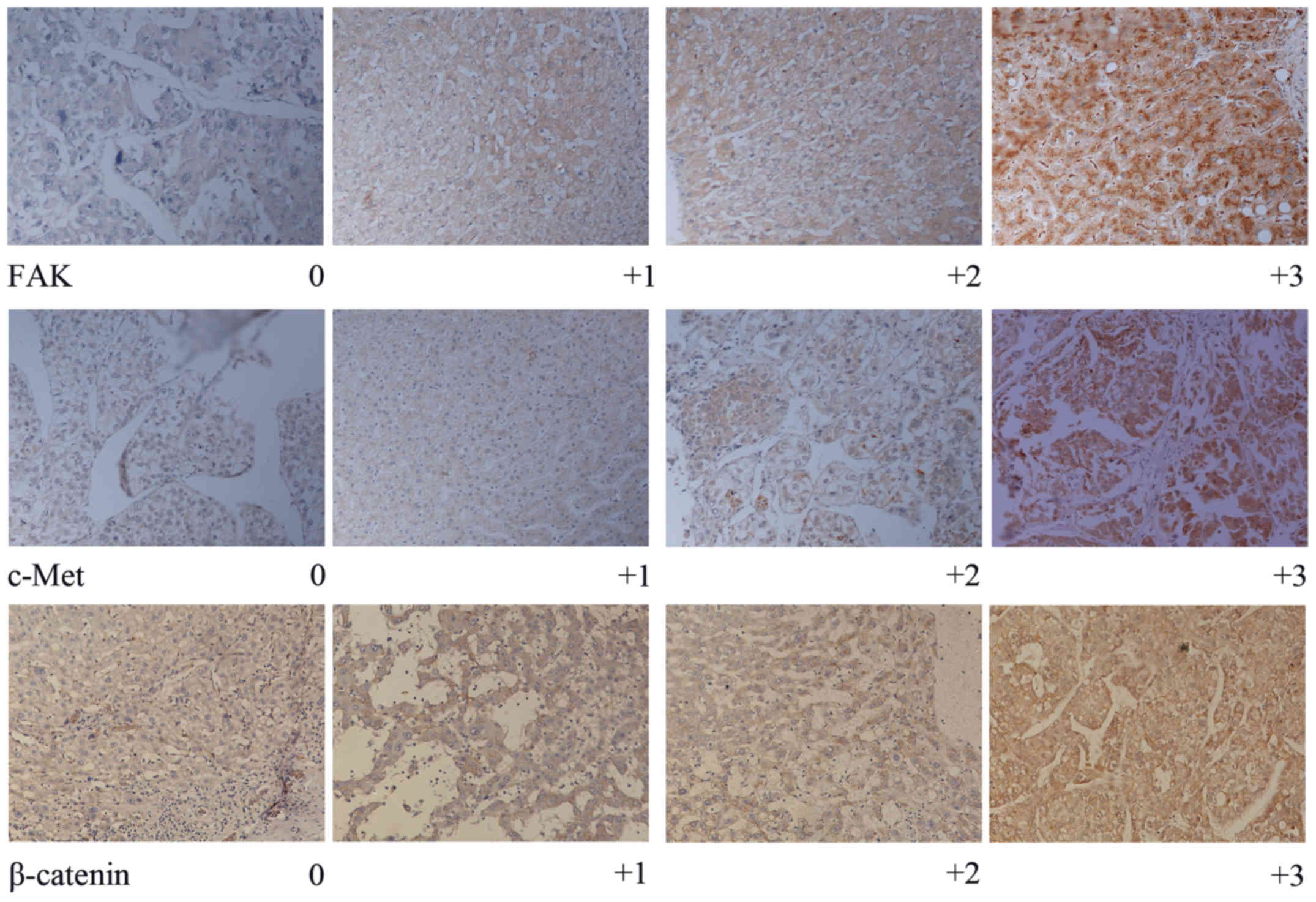
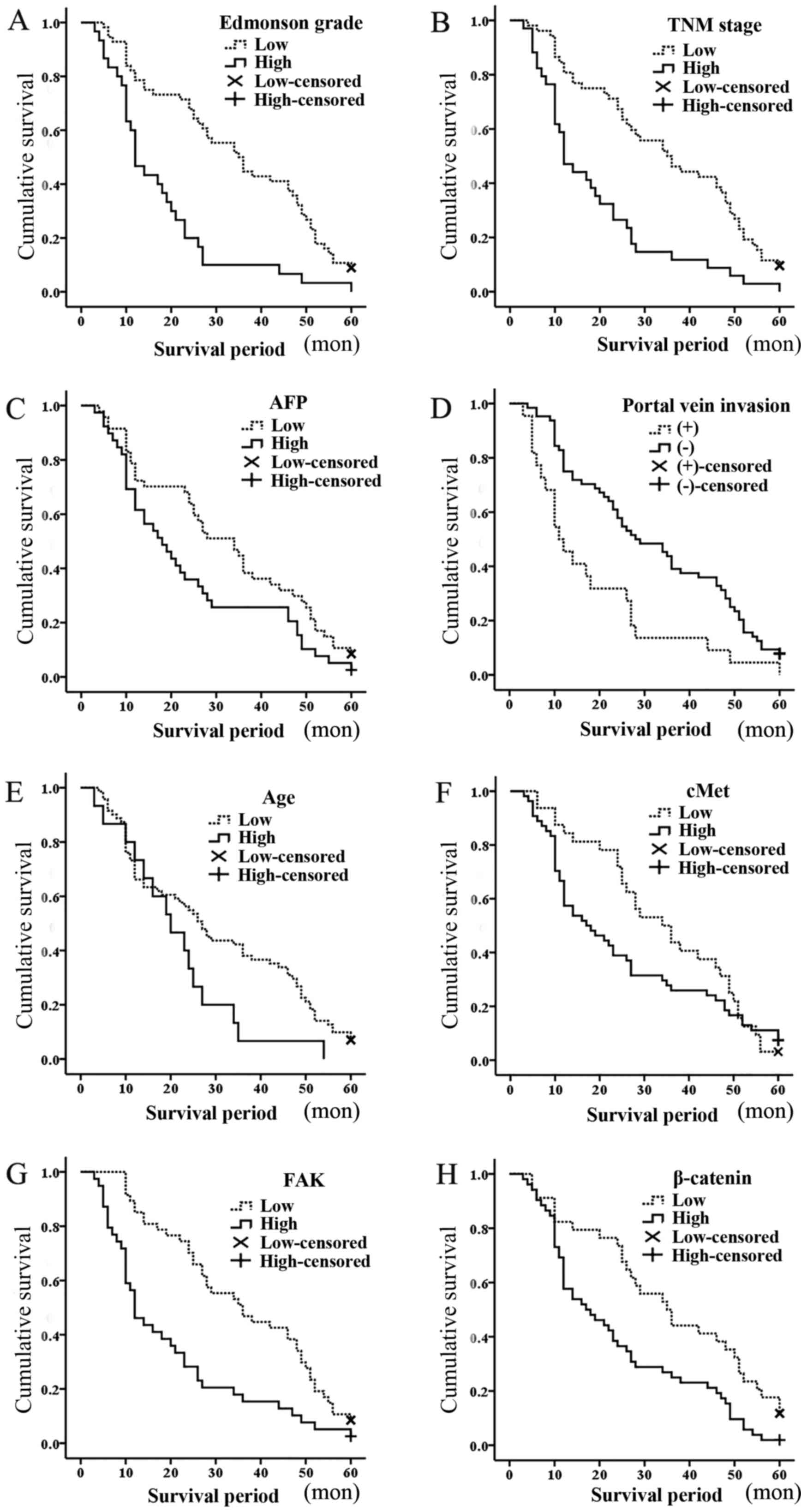
The present study aimed to investigate the prognostic value of specific molecular markers in patients with hepatocellular carcinoma (HCC) who had received surgery. Immunohistochemical analysis was used to measure the expression of hepatocyte growth factor receptor (c‑Met), β‑catenin and focal adhesion kinase (FAK) in patients with HCC. c‑Met expression was identified to be high in patients with larger tumors, higher α‑fetoprotein (AFP) levels, higher Edmondson grades, portal vein invasion and higher tumor‑node‑metastasis (TNM) stages. FAK expression was high in patients with portal vein invasion, higher Edmondson grades and higher TNM stages. β‑catenin expression was high in patients with larger tumors, hepatitis B virus (HBV) infection, portal vein invasion, higher Edmondson grades and higher TNM stages. Following multivariate analysis, FAK (P=0.002) and β‑catenin (P=0.006) expression levels were demonstrated to be significantly associated with Edmondson grade. Additionally, the tumor size (P=0.009) and HBV infection status (P=0.002) were revealed to be associated with β‑catenin expression. Kaplan‑Meier survival curve analysis demonstrated that patients with HCC with higher FAK expression, higher β‑catenin expression, portal vein invasion, higher Edmondson grades, higher TNM stages, younger ages and higher AFP levels had significantly poorer prognoses. Cox's regression analysis revealed that the survival period was correlated with the Edmondson grade, age, AFP level, and FAK and β‑catenin expression. Univariate analysis of c‑Met, β‑catenin and FAK identified a significant correlation between FAK and β‑catenin (P=0.015). Correlation analysis revealed no significant correlation between the three molecular markers, but β‑catenin and c‑Met were markedly correlated (P=0.052). No significant correlation between FAK, c‑Met or β‑catenin expression was identified. FAK and β‑catenin expression demonstrated a correlation with a range of clinicopathological factors, and high FAK and β‑catenin expression levels were identified to be correlated with a poor survival rate of patients with HCC. Thus, patients with higher FAK and β‑catenin expression may require more aggressive therapy. The results of the present study suggest that FAK and β‑catenin expression possess more prognostic value than c‑Met expression in patients with HCC.
View Figures

Figure 1

Figure 2

View References

1 

Torre LA, Bray F, Siegel RL, Ferlay J, Lortet-Tieulent J and Jemal A: Global cancer statistics, 2012. CA Cancer J Clin. 65:87–108. 2015. View Article : Google Scholar : PubMed/NCBI

2 

Kim KH and Choi YK: Long-term survival after resection of hepatocellular carcinoma. Korean J Hepatobiliary Pancreat Surg. 16:98–104. 2012. View Article : Google Scholar : PubMed/NCBI

3 

Shang N, Arteaga M, Zaidi A, Stauffer J, Cotler SJ, Zeleznik-Le NJ, Zhang J and Qiu W: FAK is required for c-Met/β-catenin-driven hepatocarcinogenesis. Hepatology. 61:214–226. 2015. View Article : Google Scholar : PubMed/NCBI

4 

Bruix J and Sherman M: Practice Guidelines Committee, American Association for the Study of Liver Diseases: Management of hepatocellular carcinoma. Hepatology. 42:1208–1236. 2005. View Article : Google Scholar : PubMed/NCBI

5 

Clevers H: Wnt/beta-catenin signaling in development and disease. Cell. 127:469–480. 2006. View Article : Google Scholar : PubMed/NCBI

6 

Zhao X and Guan JL: Focal adhesion kinase and its signaling pathways in cell migration and angiogenesis. Adv Drug Deliv Rev. 63:610–615. 2011. View Article : Google Scholar : PubMed/NCBI

7 

Llovet JM, Ricci S, Mazzaferro V, Hilgard P, Gane E, Blanc JF, de Oliveira AC, Santoro A, Raoul JL, Forner A, et al: Sorafenib in advanced hepatocellular carcinoma. N Engl J Med. 359:378–390. 2008. View Article : Google Scholar : PubMed/NCBI

8 

Mitra SK, Hanson DA and Schlaepfer DD: Focal adhesion kinase: In command and control of cell motility. Nat Rev Mol Cell Biol. 6:56–68. 2005. View Article : Google Scholar : PubMed/NCBI

9 

Schaller MD: Cellular functions of FAK kinases: Insight into molecular mechanisms and novel functions. J Cell Sci. 123:1007–1013. 2010. View Article : Google Scholar : PubMed/NCBI

10 

Zhao J and Guan JL: Signal transduction by focal adhesion kinase in cancer. Cancer Metastasis Rev. 28:35–49. 2009. View Article : Google Scholar : PubMed/NCBI

11 

Parsons JT: Focal adhesion kinase: The first ten years. J Cell Sci. 116:1409–1416. 2003. View Article : Google Scholar : PubMed/NCBI

12 

Patil MA, Lee SA, Macias E, Lam ET, Xu C, Jones KD, Ho C, Rodriguez-Puebla M and Chen X: Role of cyclin D1 as a mediator of c-Met and beta-catenin induced hepatocarcinogenesis. Cancer Res. 69:253–261. 2009. View Article : Google Scholar : PubMed/NCBI

13 

Tward AD, Jones KD, Yant S, Cheung ST, Fan ST, Chen X, Kay MA, Wang R and Bishop JM: Distinct pathways of genomic progression to benign and malignant tumors of the liver. Proc Natl Acad Sci USA. 104:pp. 14771–14776. 2007; View Article : Google Scholar : PubMed/NCBI

14 

Schlaepfer DD, Hauck CR and Sieg DJ: Signaling through focal adhesion kinase. Prog Biophys Mol Biol. 71:435–478. 1999. View Article : Google Scholar : PubMed/NCBI

15 

Pylayeva Y, Gillen KM, Gerald W, Beggs HE, Reichardt LF and Giancotti FG: Ras- and PI3K-dependent breast tumorigenesis in mice and humans requires focal adhesion kinase signaling. J Clin Invest. 119:252–266. 2009.PubMed/NCBI

16 

Ashton GH, Morton JP, Myant K, Phesse TJ, Ridgway RA, Marsh V, Wilkins JA, Athineos D, Muncan V, Kemp R, et al: Focal adhesion kinase is required for intestinal regeneration and tumorigenesis downstream of Wnt/c-Myc signaling. Dev Cell. 19:259–269. 2010. View Article : Google Scholar : PubMed/NCBI

17 

Lee J, Borboa AK, Chun HB, Baird A and Eliceiri BP: Conditional deletion of the focal adhesion kinase FAK alters remodeling of the blood-brain barrier in glioma. Cancer Res. 70:10131–10140. 2010. View Article : Google Scholar : PubMed/NCBI

18 

Itoh S, Maeda T, Shimada M, Aishima S, Shirabe K, Tanaka S and Maehara Y: Role of expression of focal adhesion kinase in progression of hepatocellular carcinoma. Clin Cancer Res. 10:2812–2817. 2004. View Article : Google Scholar : PubMed/NCBI

19 

Fujii T, Koshikawa K, Nomoto S, Okochi O, Kaneko T, Inoue S, Yatabe Y, Takeda S and Nakao A: Focal adhesion kinase is overexpressed in hepatocellular carcinoma and can be served as an independent prognostic factor. J Hepatol. 41:104–111. 2004. View Article : Google Scholar : PubMed/NCBI

20 

Kaposi-Novak P, Lee JS, Gòmez-Quiroz L, Coulouarn C, Factor VM and Thorgeirsson SS: Met-regulated expression signature defines a subset of human hepatocellular carcinomas with poor prognosis and aggressive phenotype. J Clin Invest. 116:1582–1595. 2006. View Article : Google Scholar : PubMed/NCBI

21 

Cieply B, Zeng G, Proverbs-Singh T, Geller DA and Monga SP: Unique phenotype of hepatocellular cancers with exon-3 mutations in beta-catenin gene. Hepatology. 49:821–831. 2009. View Article : Google Scholar : PubMed/NCBI

22 

Stauffer JK, Scarzello AJ, Andersen JB, De Kluyver RL, Back TC, Weiss JM, Thorgeirsson SS and Wiltrout RH: Coactivation of AKT and β-catenin in mice rapidly induces formation of lipogenic liver tumors. Cancer Res. 71:2718–2727. 2011. View Article : Google Scholar : PubMed/NCBI

23 

Edmondson HA and Steiner PE: Primary carcinoma of the liver: A study of 100 cases among 48,900 necropsies. Cancer. 7:462–503. 1954. View Article : Google Scholar : PubMed/NCBI

24 

Calabrese CT, Adam YG and Volk H: Geriatric colon cancer. Am J Surg. 125:181–184. 1973. View Article : Google Scholar : PubMed/NCBI

25 

Ershler WB, Socinski MA and Greene CJ: Bronchogenic cancer, metastases and aging. J Am Geriatr Soc. 31:673–676. 1983. View Article : Google Scholar : PubMed/NCBI

26 

Ershler WB: Why tumors grow more slowly in old people. J Natl Cancer Inst. 77:837–839. 1986.PubMed/NCBI

27 

Breuhahn K, Longerich T and Schirmacher P: Dysregulation of growth factor signaling in human hepatocellular carcinoma. Oncogene. 25:3787–3800. 2006. View Article : Google Scholar : PubMed/NCBI

28 

Farazi PA and DePinho RA: Hepatocellular carcinoma pathogenesis: From genes to environment. Nat Rev Cancer. 6:674–687. 2006. View Article : Google Scholar : PubMed/NCBI

29 

Tabor E: Tumor suppressor genes, growth factor genes, and oncogenes in hepatitis B virus-associated hepatocellular carcinoma. J Med Virol. 42:357–365. 1994. View Article : Google Scholar : PubMed/NCBI

30 

Rogler CE and Chisari FV: Cellular and molecular mechanisms of hepatocarcinogenesis. Semin Liver Dis. 12:265–278. 1992. View Article : Google Scholar : PubMed/NCBI

31 

Sung CO, Yoo BC, Koh KC, Cho JW and Park CK: Prognostic significance of p53 overexpression after hepatic resection of hepatocellular carcinoma. Korean J Gastroenterol. 45:425–430. 2005.PubMed/NCBI

32 

Pang RW and Poon RT: From molecular biology to targeted therapies for hepatocellular carcinoma: The future is now. Oncology. 72 Suppl 1:S30–S44. 2007. View Article : Google Scholar

33 

Llovet JM and Bruix J: Molecular targeted therapies in hepatocellular carcinoma. Hepatology. 48:1312–1327. 2008. View Article : Google Scholar : PubMed/NCBI

34 

André E and Becker-André M: Expression of an N-terminally truncated form of human focal adhesion kinase in brain. Biochem Biophys Res Commun. 190:140–147. 1993. View Article : Google Scholar : PubMed/NCBI

35 

Fausto N, Campbell JS and Riehle KJ: Liver regeneration. Hepatology. 43(2 Suppl 1): S45–S53. 2006. View Article : Google Scholar : PubMed/NCBI

36 

Schmidt L, Duh FM, Chen F, Kishida T, Glenn G, Choyke P, Scherer SW, Zhuang Z, Lubensky I, Dean M, et al: Germline and somatic mutations in the tyrosine kinase domain of the MET proto-oncogene in papillary renal carcinomas. Nat Genet. 16:68–73. 1997. View Article : Google Scholar : PubMed/NCBI

37 

Schmidt L, Junker K, Weirich G, Glenn G, Choyke P, Lubensky I, Zhuang Z, Jeffers M, Vande Woude G, Neumann H, et al: Two North American families with hereditary papillary renal carcinoma and identical novel mutations in the MET proto-oncogene. Cancer Res. 58:1719–1722. 1998.PubMed/NCBI

38 

Park WS, Dong SM, Kim SY, Na EY, Shin MS, Pi JH, Kim BJ, Bae JH, Hong YK, Lee KS, et al: Somatic mutations in the kinase domain of the Met/hepatocyte growth factor receptor gene in childhood hepatocellular carcinomas. Cancer Res. 59:307–310. 1999.PubMed/NCBI

39 

Ma PC, Kijima T, Maulik G, et al: c-MET mutational analysis in small cell lung cancer: Novel juxtamembrane domain mutations regulating cytoskeletal functions. Cancer Res. 63:6272–6281. 2003.PubMed/NCBI

40 

Ma PC, Jagdeesh S, Jagadeeswaran R, Fox EA, Christensen J, Maulik G, Naoki K, Schaefer E, Lader A, Richards W, et al: c-MET expression/activation, functions and mutations in non-small cell lung cancer. Proc Am Assoc Cancer Res. 44:pp. 18752004;

41 

Lee JH, Han SU, Cho H, Jennings B, Gerrard B, Dean M, Schmidt L, Zbar B and Vande Woude GF: A novel germ line juxtamembrane Met mutation in human gastric cancer. Oncogene. 19:4947–4953. 2000. View Article : Google Scholar : PubMed/NCBI

42 

Christensen JG, Burrows J and Salgia R: c-Met as a target for human cancer and characterization of inhibitors for therapeutic intervention. Cancer Lett. 225:1–26. 2005. View Article : Google Scholar : PubMed/NCBI

43 

Chen Z, He X, Jia M, Liu Y, Qu D, Wu D, Wu P, Ni C, Zhang Z, Ye J, et al: β-catenin overexpression in the nucleus predicts progress disease and unfavourable survival in colorectal cancer: A meta-analysis. PLoS One. 8:e638542013. View Article : Google Scholar : PubMed/NCBI

44 

Gough NR: Focus issue: Wnt and beta-catenin signaling in development and disease. Sci Signal. 5:eg22012.PubMed/NCBI

45 

Inagawa S, Itabashi M, Adachi S, Kawamoto T, Hori M, Shimazaki J, Yoshimi F and Fukao K: Expression and prognostic roles of beta-catenin in hepatocellular carcinoma: Correlation with tumor progression and postoperative survival. Clin Cancer Res. 8:450–456. 2002.PubMed/NCBI

46 

Liu L, Zhu XD, Wang WQ, Shen Y, Qin Y, Ren ZG, Sun HC and Tang ZY: Activation of beta-catenin by hypoxia in hepatocellular carcinoma contributes to enhanced metastatic potential and poor prognosis. Clin Cancer Res. 16:2740–2750. 2010. View Article : Google Scholar : PubMed/NCBI

47 

Lee JM, Yang J, Newell P, Singh S, Parwani A, Friedman SL, Nejak-Bowen KN and Monga SP: β-Catenin signaling in hepatocellular cancer: Implications in inflammation, fibrosis, and proliferation. Cancer Lett. 343:90–97. 2014. View Article : Google Scholar : PubMed/NCBI

48 

Jin J, Jung HY, Wang Y, Xie J, Yeom YI, Jang JJ and Lee KB: Nuclear expression of phosphorylated TRAF2- and NCK-interacting kinase in hepatocellular carcinoma is associated with poor prognosis. Path Res Pract. 210:621–627. 2014. View Article : Google Scholar : PubMed/NCBI

49 

Zulehner G, Mikula M, Schneller D, van Zijl F, Huber H, Sieghart W, Grasl-Kraupp B, Waldhör T, Peck-Radosavljevic M, Beug H and Mikulits W: Nuclear beta-catenin induces an early liver progenitor phenotype in hepatocellular carcinoma and promotes tumor recurrence. Am J Pathol. 176:472–481. 2010. View Article : Google Scholar : PubMed/NCBI

50 

Liver cancer study group of Japan, . The general rules for the clinical and pathological study of primary liver cancer. 3rd. Kanehara Shuppan; Tokyo: 1992

51 

Sumie S, Kuromatsu R, Okuda K, Ando E, Takata A, Fukushima N, Watanabe Y, Kojiro M and Sata M: Microvascular invasion in patients with hepatocellular carcinoma and its predictable clinicopathological factors. Ann Surg Oncol. 15:1375–1382. 2008. View Article : Google Scholar : PubMed/NCBI

52 

Minagawa M, Ikai I, Matsuyama Y, Yamaoka Y and Makuuchi M: Staging of hepatocellular carcinoma: Assessment of the Japanese TNM and AJCC/UICC TNM systems in a cohort of 13,772 patients in Japan. Ann Surg. 245:909–922. 2007. View Article : Google Scholar : PubMed/NCBI

53 

Henderson J, Sherman M, Tavill A, Abecassis M, Chejfec G and Gramlich T: AHPBA/AJCC consensus conference on staging of hepatocellular carcinoma: Consensus statement. HPB(Oxford). 5:243–250. 2003.PubMed/NCBI

54 

Leung TW, Tang AM, Zee B, Lau WY, Lai PB, Leung KL, Lau JT, Yu SC and Johnson PJ: Construction of the Chinese University Prognostic Index for hepatocellular carcinoma and comparison with the TNM staging system, the Okuda staging system, and the Cancer of the Liver Italian Program staging system: A study based on 926 patients. Cancer. 94:1760–1769. 2002. View Article : Google Scholar : PubMed/NCBI

Related Articles

  • Abstract
  • View
  • Download
  • Twitter
Copy and paste a formatted citation
Spandidos Publications style
Gong XY, Ma N, Xu HX, Chen F, Huang XH and Wang Q: Prognostic significance of c-Met, β-catenin and FAK in patients with hepatocellular carcinoma following surgery. Oncol Lett 15: 3796-3805, 2018.
APA
Gong, X., Ma, N., Xu, H., Chen, F., Huang, X., & Wang, Q. (2018). Prognostic significance of c-Met, β-catenin and FAK in patients with hepatocellular carcinoma following surgery. Oncology Letters, 15, 3796-3805. https://doi.org/10.3892/ol.2018.7733
MLA
Gong, X., Ma, N., Xu, H., Chen, F., Huang, X., Wang, Q."Prognostic significance of c-Met, β-catenin and FAK in patients with hepatocellular carcinoma following surgery". Oncology Letters 15.3 (2018): 3796-3805.
Chicago
Gong, X., Ma, N., Xu, H., Chen, F., Huang, X., Wang, Q."Prognostic significance of c-Met, β-catenin and FAK in patients with hepatocellular carcinoma following surgery". Oncology Letters 15, no. 3 (2018): 3796-3805. https://doi.org/10.3892/ol.2018.7733
Copy and paste a formatted citation
x
Spandidos Publications style
Gong XY, Ma N, Xu HX, Chen F, Huang XH and Wang Q: Prognostic significance of c-Met, β-catenin and FAK in patients with hepatocellular carcinoma following surgery. Oncol Lett 15: 3796-3805, 2018.
APA
Gong, X., Ma, N., Xu, H., Chen, F., Huang, X., & Wang, Q. (2018). Prognostic significance of c-Met, β-catenin and FAK in patients with hepatocellular carcinoma following surgery. Oncology Letters, 15, 3796-3805. https://doi.org/10.3892/ol.2018.7733
MLA
Gong, X., Ma, N., Xu, H., Chen, F., Huang, X., Wang, Q."Prognostic significance of c-Met, β-catenin and FAK in patients with hepatocellular carcinoma following surgery". Oncology Letters 15.3 (2018): 3796-3805.
Chicago
Gong, X., Ma, N., Xu, H., Chen, F., Huang, X., Wang, Q."Prognostic significance of c-Met, β-catenin and FAK in patients with hepatocellular carcinoma following surgery". Oncology Letters 15, no. 3 (2018): 3796-3805. https://doi.org/10.3892/ol.2018.7733
Follow us
  • Twitter
  • LinkedIn
  • Facebook
About
  • Spandidos Publications
  • Careers
  • Cookie Policy
  • Privacy Policy
How can we help?
  • Help
  • Live Chat
  • Contact
  • Email to our Support Team