Spandidos Publications Logo
  • About
    • About Spandidos
    • Aims and Scopes
    • Abstracting and Indexing
    • Editorial Policies
    • Reprints and Permissions
    • Job Opportunities
    • Terms and Conditions
    • Contact
  • Journals
    • All Journals
    • Oncology Letters
      • Oncology Letters
      • Information for Authors
      • Editorial Policies
      • Editorial Board
      • Aims and Scope
      • Abstracting and Indexing
      • Bibliographic Information
      • Archive
    • International Journal of Oncology
      • International Journal of Oncology
      • Information for Authors
      • Editorial Policies
      • Editorial Board
      • Aims and Scope
      • Abstracting and Indexing
      • Bibliographic Information
      • Archive
    • Molecular and Clinical Oncology
      • Molecular and Clinical Oncology
      • Information for Authors
      • Editorial Policies
      • Editorial Board
      • Aims and Scope
      • Abstracting and Indexing
      • Bibliographic Information
      • Archive
    • Experimental and Therapeutic Medicine
      • Experimental and Therapeutic Medicine
      • Information for Authors
      • Editorial Policies
      • Editorial Board
      • Aims and Scope
      • Abstracting and Indexing
      • Bibliographic Information
      • Archive
    • International Journal of Molecular Medicine
      • International Journal of Molecular Medicine
      • Information for Authors
      • Editorial Policies
      • Editorial Board
      • Aims and Scope
      • Abstracting and Indexing
      • Bibliographic Information
      • Archive
    • Biomedical Reports
      • Biomedical Reports
      • Information for Authors
      • Editorial Policies
      • Editorial Board
      • Aims and Scope
      • Abstracting and Indexing
      • Bibliographic Information
      • Archive
    • Oncology Reports
      • Oncology Reports
      • Information for Authors
      • Editorial Policies
      • Editorial Board
      • Aims and Scope
      • Abstracting and Indexing
      • Bibliographic Information
      • Archive
    • Molecular Medicine Reports
      • Molecular Medicine Reports
      • Information for Authors
      • Editorial Policies
      • Editorial Board
      • Aims and Scope
      • Abstracting and Indexing
      • Bibliographic Information
      • Archive
    • World Academy of Sciences Journal
      • World Academy of Sciences Journal
      • Information for Authors
      • Editorial Policies
      • Editorial Board
      • Aims and Scope
      • Abstracting and Indexing
      • Bibliographic Information
      • Archive
    • International Journal of Functional Nutrition
      • International Journal of Functional Nutrition
      • Information for Authors
      • Editorial Policies
      • Editorial Board
      • Aims and Scope
      • Abstracting and Indexing
      • Bibliographic Information
      • Archive
    • International Journal of Epigenetics
      • International Journal of Epigenetics
      • Information for Authors
      • Editorial Policies
      • Editorial Board
      • Aims and Scope
      • Abstracting and Indexing
      • Bibliographic Information
      • Archive
    • Medicine International
      • Medicine International
      • Information for Authors
      • Editorial Policies
      • Editorial Board
      • Aims and Scope
      • Abstracting and Indexing
      • Bibliographic Information
      • Archive
  • Articles
  • Information
    • Information for Authors
    • Information for Reviewers
    • Information for Librarians
    • Information for Advertisers
    • Conferences
  • Language Editing
Spandidos Publications Logo
  • About
    • About Spandidos
    • Aims and Scopes
    • Abstracting and Indexing
    • Editorial Policies
    • Reprints and Permissions
    • Job Opportunities
    • Terms and Conditions
    • Contact
  • Journals
    • All Journals
    • Biomedical Reports
      • Information for Authors
      • Editorial Policies
      • Editorial Board
      • Aims and Scope
      • Abstracting and Indexing
      • Bibliographic Information
      • Archive
    • Experimental and Therapeutic Medicine
      • Information for Authors
      • Editorial Policies
      • Editorial Board
      • Aims and Scope
      • Abstracting and Indexing
      • Bibliographic Information
      • Archive
    • International Journal of Epigenetics
      • Information for Authors
      • Editorial Policies
      • Editorial Board
      • Aims and Scope
      • Abstracting and Indexing
      • Bibliographic Information
      • Archive
    • International Journal of Functional Nutrition
      • Information for Authors
      • Editorial Policies
      • Editorial Board
      • Aims and Scope
      • Abstracting and Indexing
      • Bibliographic Information
      • Archive
    • International Journal of Molecular Medicine
      • Information for Authors
      • Editorial Policies
      • Editorial Board
      • Aims and Scope
      • Abstracting and Indexing
      • Bibliographic Information
      • Archive
    • International Journal of Oncology
      • Information for Authors
      • Editorial Policies
      • Editorial Board
      • Aims and Scope
      • Abstracting and Indexing
      • Bibliographic Information
      • Archive
    • Medicine International
      • Information for Authors
      • Editorial Policies
      • Editorial Board
      • Aims and Scope
      • Abstracting and Indexing
      • Bibliographic Information
      • Archive
    • Molecular and Clinical Oncology
      • Information for Authors
      • Editorial Policies
      • Editorial Board
      • Aims and Scope
      • Abstracting and Indexing
      • Bibliographic Information
      • Archive
    • Molecular Medicine Reports
      • Information for Authors
      • Editorial Policies
      • Editorial Board
      • Aims and Scope
      • Abstracting and Indexing
      • Bibliographic Information
      • Archive
    • Oncology Letters
      • Information for Authors
      • Editorial Policies
      • Editorial Board
      • Aims and Scope
      • Abstracting and Indexing
      • Bibliographic Information
      • Archive
    • Oncology Reports
      • Information for Authors
      • Editorial Policies
      • Editorial Board
      • Aims and Scope
      • Abstracting and Indexing
      • Bibliographic Information
      • Archive
    • World Academy of Sciences Journal
      • Information for Authors
      • Editorial Policies
      • Editorial Board
      • Aims and Scope
      • Abstracting and Indexing
      • Bibliographic Information
      • Archive
  • Articles
  • Information
    • For Authors
    • For Reviewers
    • For Librarians
    • For Advertisers
    • Conferences
  • Language Editing
Login Register Submit
  • This site uses cookies
  • You can change your cookie settings at any time by following the instructions in our Cookie Policy. To find out more, you may read our Privacy Policy.

    I agree
Search articles by DOI, keyword, author or affiliation
Search
Advanced Search
presentation
Oncology Letters
Join Editorial Board Propose a Special Issue
Print ISSN: 1792-1074 Online ISSN: 1792-1082
Journal Cover
April-2018 Volume 15 Issue 4

Full Size Image

Sign up for eToc alerts
Recommend to Library

Journals

International Journal of Molecular Medicine

International Journal of Molecular Medicine

International Journal of Molecular Medicine is an international journal devoted to molecular mechanisms of human disease.

International Journal of Oncology

International Journal of Oncology

International Journal of Oncology is an international journal devoted to oncology research and cancer treatment.

Molecular Medicine Reports

Molecular Medicine Reports

Covers molecular medicine topics such as pharmacology, pathology, genetics, neuroscience, infectious diseases, molecular cardiology, and molecular surgery.

Oncology Reports

Oncology Reports

Oncology Reports is an international journal devoted to fundamental and applied research in Oncology.

Experimental and Therapeutic Medicine

Experimental and Therapeutic Medicine

Experimental and Therapeutic Medicine is an international journal devoted to laboratory and clinical medicine.

Oncology Letters

Oncology Letters

Oncology Letters is an international journal devoted to Experimental and Clinical Oncology.

Biomedical Reports

Biomedical Reports

Explores a wide range of biological and medical fields, including pharmacology, genetics, microbiology, neuroscience, and molecular cardiology.

Molecular and Clinical Oncology

Molecular and Clinical Oncology

International journal addressing all aspects of oncology research, from tumorigenesis and oncogenes to chemotherapy and metastasis.

World Academy of Sciences Journal

World Academy of Sciences Journal

Multidisciplinary open-access journal spanning biochemistry, genetics, neuroscience, environmental health, and synthetic biology.

International Journal of Functional Nutrition

International Journal of Functional Nutrition

Open-access journal combining biochemistry, pharmacology, immunology, and genetics to advance health through functional nutrition.

International Journal of Epigenetics

International Journal of Epigenetics

Publishes open-access research on using epigenetics to advance understanding and treatment of human disease.

Medicine International

Medicine International

An International Open Access Journal Devoted to General Medicine.

Journal Cover
April-2018 Volume 15 Issue 4

Full Size Image

Sign up for eToc alerts
Recommend to Library

  • Article
  • Citations
    • Cite This Article
    • Download Citation
    • Create Citation Alert
    • Remove Citation Alert
    • Cited By
  • Similar Articles
    • Related Articles (in Spandidos Publications)
    • Similar Articles (Google Scholar)
    • Similar Articles (PubMed)
  • Download PDF
  • Download XML
  • View XML
Article Open Access

A role for the clock period circadian regulator 2 gene in regulating the clock gene network in human oral squamous cell carcinoma cells

  • Authors:
    • Yiran Ao
    • Qin Zhao
    • Kai Yang
    • Gang Zheng
    • Xiaoqing Lv
    • Xiaoli Su
  • View Affiliations / Copyright

    Affiliations: Department of Oral and Maxillofacial Surgery, The First Affiliated Hospital of Chongqing Medical University, Chongqing 400016, P.R. China, Anorectal Department, Chongqing Traditional Chinese Medicine Hospital, Chongqing 400021, P.R. China
    Copyright: © Ao et al. This is an open access article distributed under the terms of Creative Commons Attribution License.
  • Pages: 4185-4192
    |
    Published online on: January 19, 2018
       https://doi.org/10.3892/ol.2018.7825
  • Expand metrics +
Metrics: Total Views: 0 (Spandidos Publications: | PMC Statistics: )
Metrics: Total PDF Downloads: 0 (Spandidos Publications: | PMC Statistics: )
Cited By (CrossRef): 0 citations Loading Articles...

This article is mentioned in:


Abstract

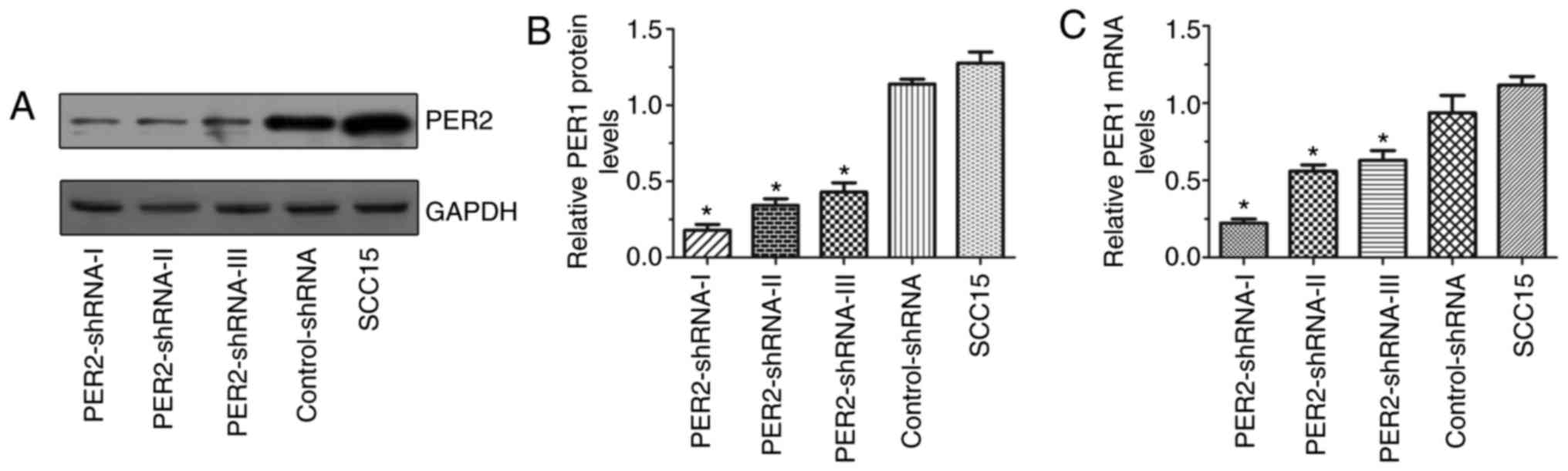
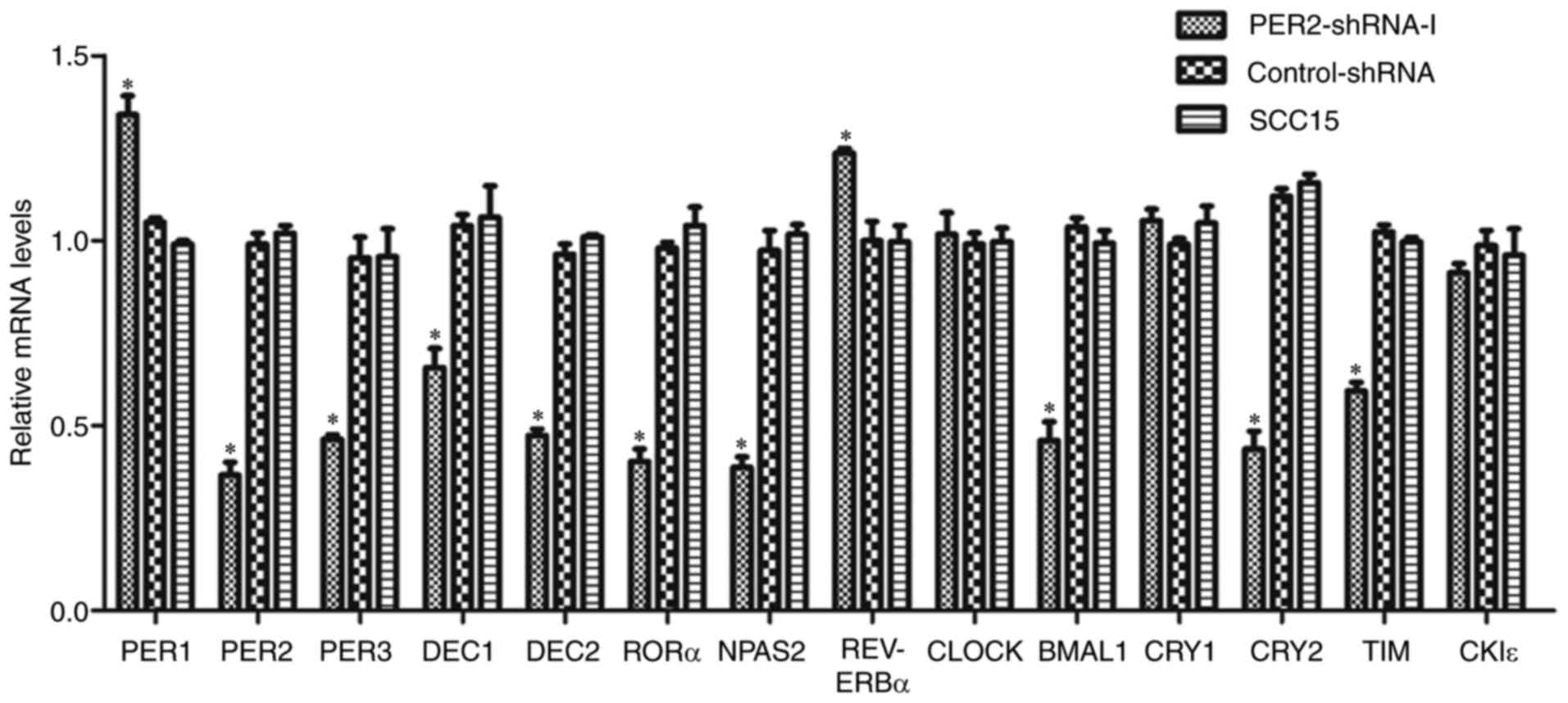
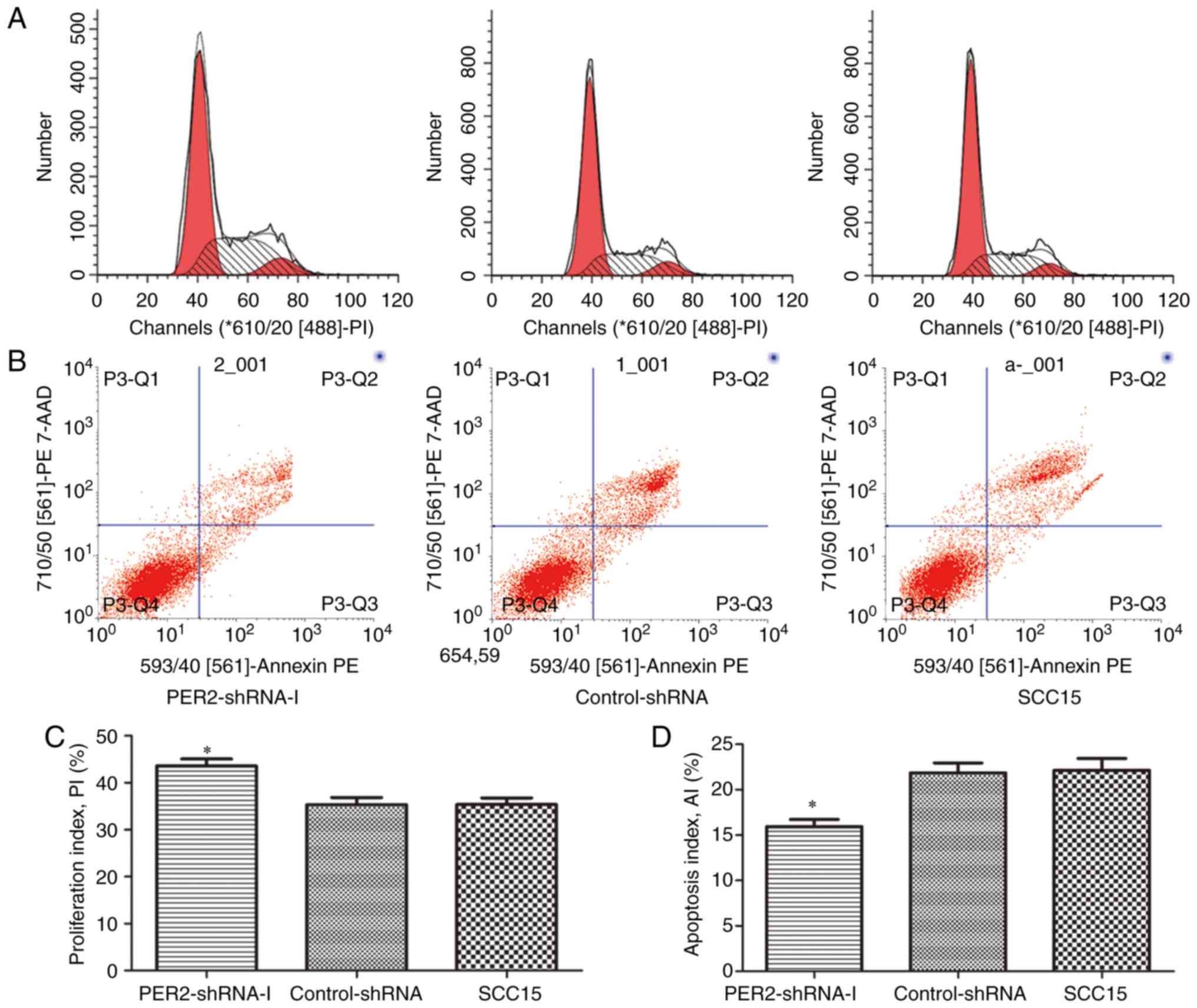
Clock genes are the core of the circadian rhythms in the human body and are important in regulating normal physiological functions. To date, research has indicated that the clock gene, period circadian clock 2 (PER2), is downregulated in numerous types of cancer, and that it is associated with cancer occurrence and progression via the regulation of various downstream cell cycle genes. However, it remains unclear whether the decreased expression of PER2 influences the expression of other clock genes in cancer cells. In the present study, short hairpin RNA interference was used to knockdown PER2 effectively in human oral squamous cell carcinoma SCC15 cells. Quantitative polymerase chain reaction was used to assess the mRNA expression levels of various clock genes and revealed that, following the knockdown of PER2 in SCC15 cells, the mRNA expression levels of PER3, brain and muscle ARNT‑like 1, deleted in esophageal cancer (DEC)1, DEC2, cryptochrome circadian clock (CRY)2, timeless circadian clock, retinoic acid receptor‑related orphan receptor‑alpha and neuronal PAS domain protein 2 were significantly downregulated, while the mRNA expression levels of PER1 and nuclear receptor subfamily 1 group D member 1 were significantly upregulated. In addition, flow cytometric analysis demonstrated that proliferation was enhanced and apoptosis was reduced following PER2 knockdown in SCC15 cells (P<0.05). To the best of our knowledge, the present study is the first to report that PER2 is important for the regulation of other clock genes of the clock gene network in cancer cells. This is of great significance in elucidating the molecular function and tumor suppression mechanism of PER2.
View Figures

Figure 1

Figure 2

Figure 3

View References

1 

Fu L and Lee CC: The circadian clock: Pacemaker and tumour suppressor. Nature Rev Cancer. 3:350–361. 2003. View Article : Google Scholar

2 

Ye H, Yang K, Tan XM, Fu XJ and Li HX: Daily rhythm variations of the clock gene PER1 and cancer-related genes during various stages of carcinogenesis in a golden hamster model of buccal mucosa carcinoma. Onco Targets Ther. 8:1419–1426. 2015.PubMed/NCBI

3 

Shearman LP, Sriram S, Weaver DR, Maywood ES, Chaves I, Zheng B, Kume K, Lee CC, van der Horst GT, Hastings MH and Reppert SM: Interacting molecular loops in the mammalian circadian clock. Science. 288:1013–1019. 2000. View Article : Google Scholar : PubMed/NCBI

4 

Preitner N, Damiola F, Lopez-Molina L, Zakany J, Duboule D, Albrecht U and Schibler U: The orphan nuclear receptor REV-ERBalpha controls circadian transcription within the positive limb of the mammalian circadian oscillator. Cell. 110:251–260. 2002. View Article : Google Scholar : PubMed/NCBI

5 

Zhao N, Yang K, Yang G, Chen D, Tang H, Zhao D and Zhao C: Aberrant expression of clock gene period1 and its correlations with the growth, proliferation and metastasis of buccal squamous cell carcinoma. PLoS One. 8:e558942013. View Article : Google Scholar : PubMed/NCBI

6 

Lowrey PL and Takahashi JS: Genetics of the mammalian circadian system: Photic entrainment, circadian pacemaker mechanisms, and posttranslational regulation. Annu Rev Genet. 34:533–562. 2000. View Article : Google Scholar : PubMed/NCBI

7 

Rana S and Mahmood S: Circadian rhythm and its role in malignancy. J Circadian Rhythms. 8:32010. View Article : Google Scholar : PubMed/NCBI

8 

Bozek K, Relogio A, Kielbasa SM, Heine M, Dame C, Kramer A and Herzel H: Regulation of clock-controlled genes in mammals. PLoS One. 4:e48822009. View Article : Google Scholar : PubMed/NCBI

9 

Chu G, Yoshida K, Narahara S, Uchikawa M, Kawamura M, Yamauchi N, Xi Y, Shigeyoshi Y, Hashimoto S and Hattori MA: Alterations of circadian clockworks during differentiation and apoptosis of rat ovarian cells. Chronobiol Int. 28:477–487. 2011. View Article : Google Scholar : PubMed/NCBI

10 

Filipski E, King VM, Li X, Granda TG, Mormont MC, Liu X, Claustrat B, Hastings MH and Lévi F: Host circadian clock as a control point in tumor progression. J Natl Cancer Inst. 94:690–697. 2002. View Article : Google Scholar : PubMed/NCBI

11 

Hayashida S, Kuramoto Y, Koyanagi S, Oishi K, Fujiki J, Matsunaga N, Ikeda E, Ohdo S, Shimeno H and Soeda S: Proxisome proliferator-activated receptor-α mediates high-fat, diet-enhanced daily oscillation of plasminogen activator inhibitor-1 activity in mice. Chronobiol Int. 27:1735–1753. 2010. View Article : Google Scholar : PubMed/NCBI

12 

Panda S, Antoch MP, Miller BH, Su AI, Schook AB, Straume M, Schultz PG, Kay SA, Takahashi JS and Hogenesch JB: Coordinated transcription of key pathways in the mouse by the circadian clock. Cell. 109:307–320. 2002. View Article : Google Scholar : PubMed/NCBI

13 

Miyazaki K, Wakabayashi M, Hara Y and Ishida N: Tumor growth suppression in vivo by overexpression of the circadian component, PER2. Genes Cells. 15:351–358. 2010. View Article : Google Scholar : PubMed/NCBI

14 

Yang X, Wood PA, Ansell C and Hrushesky WJ: Circadian time-dependent tumor suppressor function of period genes. Integr Cancer Ther. 8:309–316. 2009. View Article : Google Scholar : PubMed/NCBI

15 

Chen ST, Choo KB, Hou MF, Yeh KT, Kuo SJ and Chang JG: Deregulated expression of the PER1, PER2 and PER3 genes in breast cancers. Carcinogenesis. 26:1241–1246. 2005. View Article : Google Scholar : PubMed/NCBI

16 

Zhao H, Zeng ZL, Yang J, Jin Y, Qiu MZ, Hu XY, Han J, Liu KY, Liao JW, Xu RH and Zou QF: Prognostic relevance of Period1 (Per1) and Period2 (Per2) expression in human gastric cancer. Int J Clin Exp Pathol. 7:619–630. 2014.PubMed/NCBI

17 

Hsu CM, Lin SF, Lu CT, Lin PM and Yang MY: Altered expression of circadian clock genes in head and neck squamous cell carcinoma. Tumour Biol. 33:149–155. 2012. View Article : Google Scholar : PubMed/NCBI

18 

Wang Q, Ao Y, Yang K, Tang H and Chen D: Circadian clock gene Per2 plays an important role in cell proliferation, apoptosis and cell cycle progression in human oral squamous cell carcinoma. Oncol Rep. 35:3387–3394. 2016. View Article : Google Scholar : PubMed/NCBI

19 

Tan XM, Ye H, Yang K, Chen D, Wang QQ, Tang H and Zhao NB: Circadian variations of clock gene Per2 and cell cycle genes in different stages of carcinogenesis in golden hamster buccal mucosa. Sci Rep. 5:99972015. View Article : Google Scholar : PubMed/NCBI

20 

O'Driscoll A, Belogrudov V, Carroll J, Kropp K, Walsh P, Ghazal P and Sleator RD: HBLAST: Parallelised sequence similarity-A Hadoop MapReducable basic local alignment search tool. J Biomed Inform. 54:58–64. 2015. View Article : Google Scholar : PubMed/NCBI

21 

Chernolovskaya EL and Zenkova MA: Design of nuclease-resistant fork-like small interfering RNA (fsiRNA). Methods Mol Biol. 942:153–168. 2013. View Article : Google Scholar : PubMed/NCBI

22 

Livak KJ and Schmittgen TD: Analysis of relative gene expression data using real-time quantitative PCR and the 2(-Delta Delta C(T)) method. Methods. 25:402–408. 2001. View Article : Google Scholar : PubMed/NCBI

23 

Militi S, Maywood ES, Sandate CR, Chesham JE, Barnard AR, Parsons MJ, Vibert JL, Joynson GM, Partch CL, Hastings MH and Nolan PM: Early doors (Edo) mutant mouse reveals the importance of period 2 (PER2) PAS domain structure for circadian pacemaking. Proc Natl Acad Sci USA. 113:pp. 2756–2761. 2016; View Article : Google Scholar : PubMed/NCBI

24 

Gekakis N, Staknis D, Nguyen HB, Davis FC, Wilsbacher LD, King DP, Takahashi JS and Weitz CJ: Role of the CLOCK protein in the mammalian circadian mechanism. Science. 280:1564–1569. 1998. View Article : Google Scholar : PubMed/NCBI

25 

Borgs L, Beukelaers P, Vandenbosch R, Belachew S, Nguyen L and Malgrange B: Cell ‘circadian’ cycle: New role for mammalian core clock genes. Cell Cycle. 8:832–837. 2009. View Article : Google Scholar : PubMed/NCBI

26 

Nakashima A, Kawamoto T, Honda KK, Ueshima T, Noshiro M, Iwata T, Fujimoto K, Kubo H, Honma S, Yorioka N, et al: DEC1 modulates the circadian phase of clock gene expression. Mol Cell Biol. 28:4080–4092. 2008. View Article : Google Scholar : PubMed/NCBI

27 

Lee C, Etchegaray JP, Cagampang FR, Loudon AS and Reppert SM: Posttranslational mechanisms regulate the mammalian circadian clock. Cell. 107:855–867. 2001. View Article : Google Scholar : PubMed/NCBI

Related Articles

  • Abstract
  • View
  • Download
  • Twitter
Copy and paste a formatted citation
Spandidos Publications style
Ao Y, Zhao Q, Yang K, Zheng G, Lv X and Su X: A role for the clock period circadian regulator 2 gene in regulating the clock gene network in human oral squamous cell carcinoma cells. Oncol Lett 15: 4185-4192, 2018.
APA
Ao, Y., Zhao, Q., Yang, K., Zheng, G., Lv, X., & Su, X. (2018). A role for the clock period circadian regulator 2 gene in regulating the clock gene network in human oral squamous cell carcinoma cells. Oncology Letters, 15, 4185-4192. https://doi.org/10.3892/ol.2018.7825
MLA
Ao, Y., Zhao, Q., Yang, K., Zheng, G., Lv, X., Su, X."A role for the clock period circadian regulator 2 gene in regulating the clock gene network in human oral squamous cell carcinoma cells". Oncology Letters 15.4 (2018): 4185-4192.
Chicago
Ao, Y., Zhao, Q., Yang, K., Zheng, G., Lv, X., Su, X."A role for the clock period circadian regulator 2 gene in regulating the clock gene network in human oral squamous cell carcinoma cells". Oncology Letters 15, no. 4 (2018): 4185-4192. https://doi.org/10.3892/ol.2018.7825
Copy and paste a formatted citation
x
Spandidos Publications style
Ao Y, Zhao Q, Yang K, Zheng G, Lv X and Su X: A role for the clock period circadian regulator 2 gene in regulating the clock gene network in human oral squamous cell carcinoma cells. Oncol Lett 15: 4185-4192, 2018.
APA
Ao, Y., Zhao, Q., Yang, K., Zheng, G., Lv, X., & Su, X. (2018). A role for the clock period circadian regulator 2 gene in regulating the clock gene network in human oral squamous cell carcinoma cells. Oncology Letters, 15, 4185-4192. https://doi.org/10.3892/ol.2018.7825
MLA
Ao, Y., Zhao, Q., Yang, K., Zheng, G., Lv, X., Su, X."A role for the clock period circadian regulator 2 gene in regulating the clock gene network in human oral squamous cell carcinoma cells". Oncology Letters 15.4 (2018): 4185-4192.
Chicago
Ao, Y., Zhao, Q., Yang, K., Zheng, G., Lv, X., Su, X."A role for the clock period circadian regulator 2 gene in regulating the clock gene network in human oral squamous cell carcinoma cells". Oncology Letters 15, no. 4 (2018): 4185-4192. https://doi.org/10.3892/ol.2018.7825
Follow us
  • Twitter
  • LinkedIn
  • Facebook
About
  • Spandidos Publications
  • Careers
  • Cookie Policy
  • Privacy Policy
How can we help?
  • Help
  • Live Chat
  • Contact
  • Email to our Support Team