Spandidos Publications Logo
  • About
    • About Spandidos
    • Aims and Scopes
    • Abstracting and Indexing
    • Editorial Policies
    • Reprints and Permissions
    • Job Opportunities
    • Terms and Conditions
    • Contact
  • Journals
    • All Journals
    • Oncology Letters
      • Oncology Letters
      • Information for Authors
      • Editorial Policies
      • Editorial Board
      • Aims and Scope
      • Abstracting and Indexing
      • Bibliographic Information
      • Archive
    • International Journal of Oncology
      • International Journal of Oncology
      • Information for Authors
      • Editorial Policies
      • Editorial Board
      • Aims and Scope
      • Abstracting and Indexing
      • Bibliographic Information
      • Archive
    • Molecular and Clinical Oncology
      • Molecular and Clinical Oncology
      • Information for Authors
      • Editorial Policies
      • Editorial Board
      • Aims and Scope
      • Abstracting and Indexing
      • Bibliographic Information
      • Archive
    • Experimental and Therapeutic Medicine
      • Experimental and Therapeutic Medicine
      • Information for Authors
      • Editorial Policies
      • Editorial Board
      • Aims and Scope
      • Abstracting and Indexing
      • Bibliographic Information
      • Archive
    • International Journal of Molecular Medicine
      • International Journal of Molecular Medicine
      • Information for Authors
      • Editorial Policies
      • Editorial Board
      • Aims and Scope
      • Abstracting and Indexing
      • Bibliographic Information
      • Archive
    • Biomedical Reports
      • Biomedical Reports
      • Information for Authors
      • Editorial Policies
      • Editorial Board
      • Aims and Scope
      • Abstracting and Indexing
      • Bibliographic Information
      • Archive
    • Oncology Reports
      • Oncology Reports
      • Information for Authors
      • Editorial Policies
      • Editorial Board
      • Aims and Scope
      • Abstracting and Indexing
      • Bibliographic Information
      • Archive
    • Molecular Medicine Reports
      • Molecular Medicine Reports
      • Information for Authors
      • Editorial Policies
      • Editorial Board
      • Aims and Scope
      • Abstracting and Indexing
      • Bibliographic Information
      • Archive
    • World Academy of Sciences Journal
      • World Academy of Sciences Journal
      • Information for Authors
      • Editorial Policies
      • Editorial Board
      • Aims and Scope
      • Abstracting and Indexing
      • Bibliographic Information
      • Archive
    • International Journal of Functional Nutrition
      • International Journal of Functional Nutrition
      • Information for Authors
      • Editorial Policies
      • Editorial Board
      • Aims and Scope
      • Abstracting and Indexing
      • Bibliographic Information
      • Archive
    • International Journal of Epigenetics
      • International Journal of Epigenetics
      • Information for Authors
      • Editorial Policies
      • Editorial Board
      • Aims and Scope
      • Abstracting and Indexing
      • Bibliographic Information
      • Archive
    • Medicine International
      • Medicine International
      • Information for Authors
      • Editorial Policies
      • Editorial Board
      • Aims and Scope
      • Abstracting and Indexing
      • Bibliographic Information
      • Archive
  • Articles
  • Information
    • Information for Authors
    • Information for Reviewers
    • Information for Librarians
    • Information for Advertisers
    • Conferences
  • Language Editing
Spandidos Publications Logo
  • About
    • About Spandidos
    • Aims and Scopes
    • Abstracting and Indexing
    • Editorial Policies
    • Reprints and Permissions
    • Job Opportunities
    • Terms and Conditions
    • Contact
  • Journals
    • All Journals
    • Biomedical Reports
      • Information for Authors
      • Editorial Policies
      • Editorial Board
      • Aims and Scope
      • Abstracting and Indexing
      • Bibliographic Information
      • Archive
    • Experimental and Therapeutic Medicine
      • Information for Authors
      • Editorial Policies
      • Editorial Board
      • Aims and Scope
      • Abstracting and Indexing
      • Bibliographic Information
      • Archive
    • International Journal of Epigenetics
      • Information for Authors
      • Editorial Policies
      • Editorial Board
      • Aims and Scope
      • Abstracting and Indexing
      • Bibliographic Information
      • Archive
    • International Journal of Functional Nutrition
      • Information for Authors
      • Editorial Policies
      • Editorial Board
      • Aims and Scope
      • Abstracting and Indexing
      • Bibliographic Information
      • Archive
    • International Journal of Molecular Medicine
      • Information for Authors
      • Editorial Policies
      • Editorial Board
      • Aims and Scope
      • Abstracting and Indexing
      • Bibliographic Information
      • Archive
    • International Journal of Oncology
      • Information for Authors
      • Editorial Policies
      • Editorial Board
      • Aims and Scope
      • Abstracting and Indexing
      • Bibliographic Information
      • Archive
    • Medicine International
      • Information for Authors
      • Editorial Policies
      • Editorial Board
      • Aims and Scope
      • Abstracting and Indexing
      • Bibliographic Information
      • Archive
    • Molecular and Clinical Oncology
      • Information for Authors
      • Editorial Policies
      • Editorial Board
      • Aims and Scope
      • Abstracting and Indexing
      • Bibliographic Information
      • Archive
    • Molecular Medicine Reports
      • Information for Authors
      • Editorial Policies
      • Editorial Board
      • Aims and Scope
      • Abstracting and Indexing
      • Bibliographic Information
      • Archive
    • Oncology Letters
      • Information for Authors
      • Editorial Policies
      • Editorial Board
      • Aims and Scope
      • Abstracting and Indexing
      • Bibliographic Information
      • Archive
    • Oncology Reports
      • Information for Authors
      • Editorial Policies
      • Editorial Board
      • Aims and Scope
      • Abstracting and Indexing
      • Bibliographic Information
      • Archive
    • World Academy of Sciences Journal
      • Information for Authors
      • Editorial Policies
      • Editorial Board
      • Aims and Scope
      • Abstracting and Indexing
      • Bibliographic Information
      • Archive
  • Articles
  • Information
    • For Authors
    • For Reviewers
    • For Librarians
    • For Advertisers
    • Conferences
  • Language Editing
Login Register Submit
  • This site uses cookies
  • You can change your cookie settings at any time by following the instructions in our Cookie Policy. To find out more, you may read our Privacy Policy.

    I agree
Search articles by DOI, keyword, author or affiliation
Search
Advanced Search
presentation
Oncology Letters
Join Editorial Board Propose a Special Issue
Print ISSN: 1792-1074 Online ISSN: 1792-1082
Journal Cover
April-2018 Volume 15 Issue 4

Full Size Image

Sign up for eToc alerts
Recommend to Library

Journals

International Journal of Molecular Medicine

International Journal of Molecular Medicine

International Journal of Molecular Medicine is an international journal devoted to molecular mechanisms of human disease.

International Journal of Oncology

International Journal of Oncology

International Journal of Oncology is an international journal devoted to oncology research and cancer treatment.

Molecular Medicine Reports

Molecular Medicine Reports

Covers molecular medicine topics such as pharmacology, pathology, genetics, neuroscience, infectious diseases, molecular cardiology, and molecular surgery.

Oncology Reports

Oncology Reports

Oncology Reports is an international journal devoted to fundamental and applied research in Oncology.

Experimental and Therapeutic Medicine

Experimental and Therapeutic Medicine

Experimental and Therapeutic Medicine is an international journal devoted to laboratory and clinical medicine.

Oncology Letters

Oncology Letters

Oncology Letters is an international journal devoted to Experimental and Clinical Oncology.

Biomedical Reports

Biomedical Reports

Explores a wide range of biological and medical fields, including pharmacology, genetics, microbiology, neuroscience, and molecular cardiology.

Molecular and Clinical Oncology

Molecular and Clinical Oncology

International journal addressing all aspects of oncology research, from tumorigenesis and oncogenes to chemotherapy and metastasis.

World Academy of Sciences Journal

World Academy of Sciences Journal

Multidisciplinary open-access journal spanning biochemistry, genetics, neuroscience, environmental health, and synthetic biology.

International Journal of Functional Nutrition

International Journal of Functional Nutrition

Open-access journal combining biochemistry, pharmacology, immunology, and genetics to advance health through functional nutrition.

International Journal of Epigenetics

International Journal of Epigenetics

Publishes open-access research on using epigenetics to advance understanding and treatment of human disease.

Medicine International

Medicine International

An International Open Access Journal Devoted to General Medicine.

Journal Cover
April-2018 Volume 15 Issue 4

Full Size Image

Sign up for eToc alerts
Recommend to Library

  • Article
  • Citations
    • Cite This Article
    • Download Citation
    • Create Citation Alert
    • Remove Citation Alert
    • Cited By
  • Similar Articles
    • Related Articles (in Spandidos Publications)
    • Similar Articles (Google Scholar)
    • Similar Articles (PubMed)
  • Download PDF
  • Download XML
  • View XML
Article Open Access

MicroRNA-374b inhibits liver cancer progression via down regulating programmed cell death-1 expression on cytokine-induced killer cells

  • Authors:
    • Fen Huang
    • Bo Wang
    • Jiangzheng Zeng
    • Shenggang Sang
    • Junhua Lei
    • Yanda Lu
  • View Affiliations / Copyright

    Affiliations: Department of Medical Oncology, The First Affiliated Hospital of Hainan Medical University, Haikou, Hainan 570102, P.R. China, Department of Emergency, Hainan General Hospital, Haikou, Hainan 570311, P.R. China, Department of Clinical Laboratory, The First Affiliated Hospital of Hainan Medical University, Haikou, Hainan 570102, P.R. China
    Copyright: © Huang et al. This is an open access article distributed under the terms of Creative Commons Attribution License.
  • Pages: 4797-4804
    |
    Published online on: February 5, 2018
       https://doi.org/10.3892/ol.2018.7951
  • Expand metrics +
Metrics: Total Views: 0 (Spandidos Publications: | PMC Statistics: )
Metrics: Total PDF Downloads: 0 (Spandidos Publications: | PMC Statistics: )
Cited By (CrossRef): 0 citations Loading Articles...

This article is mentioned in:


Abstract

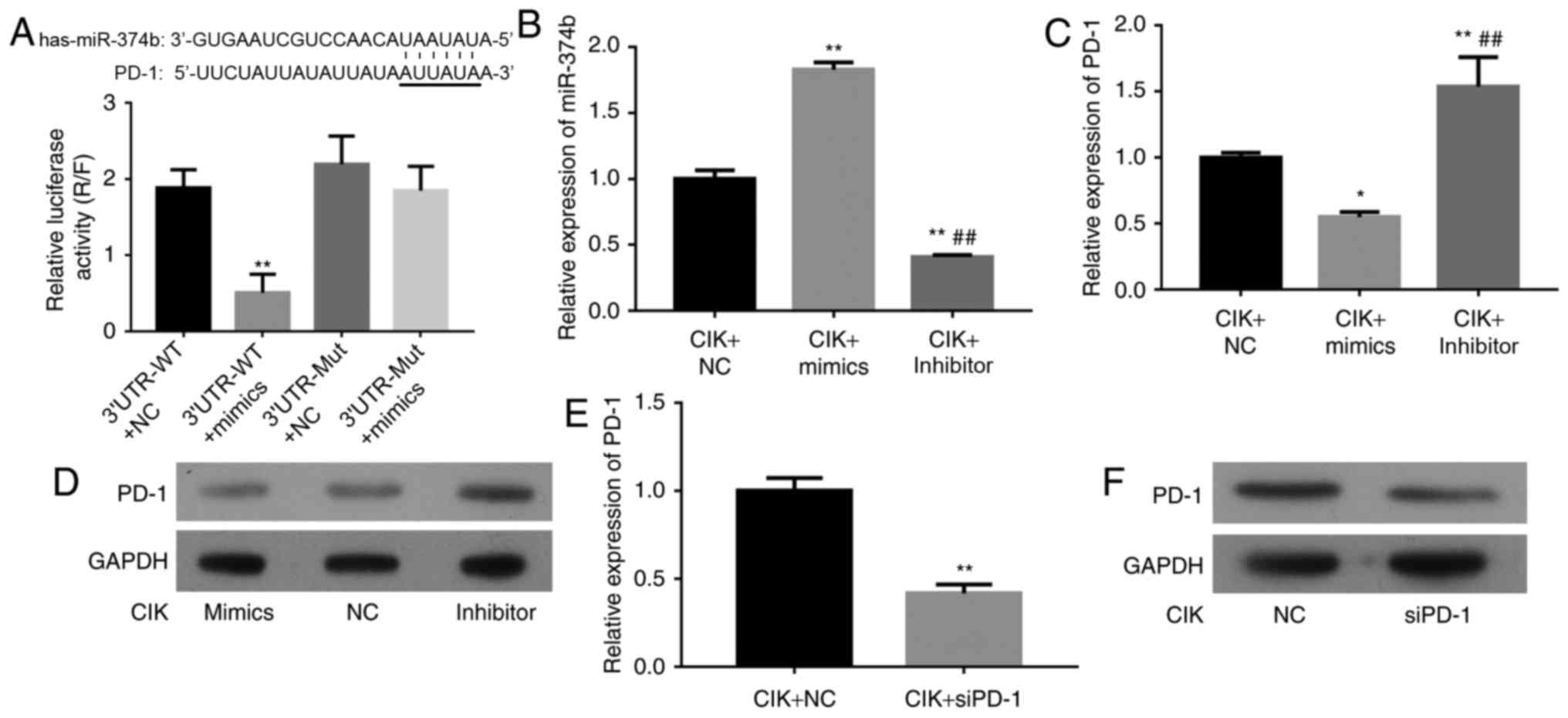
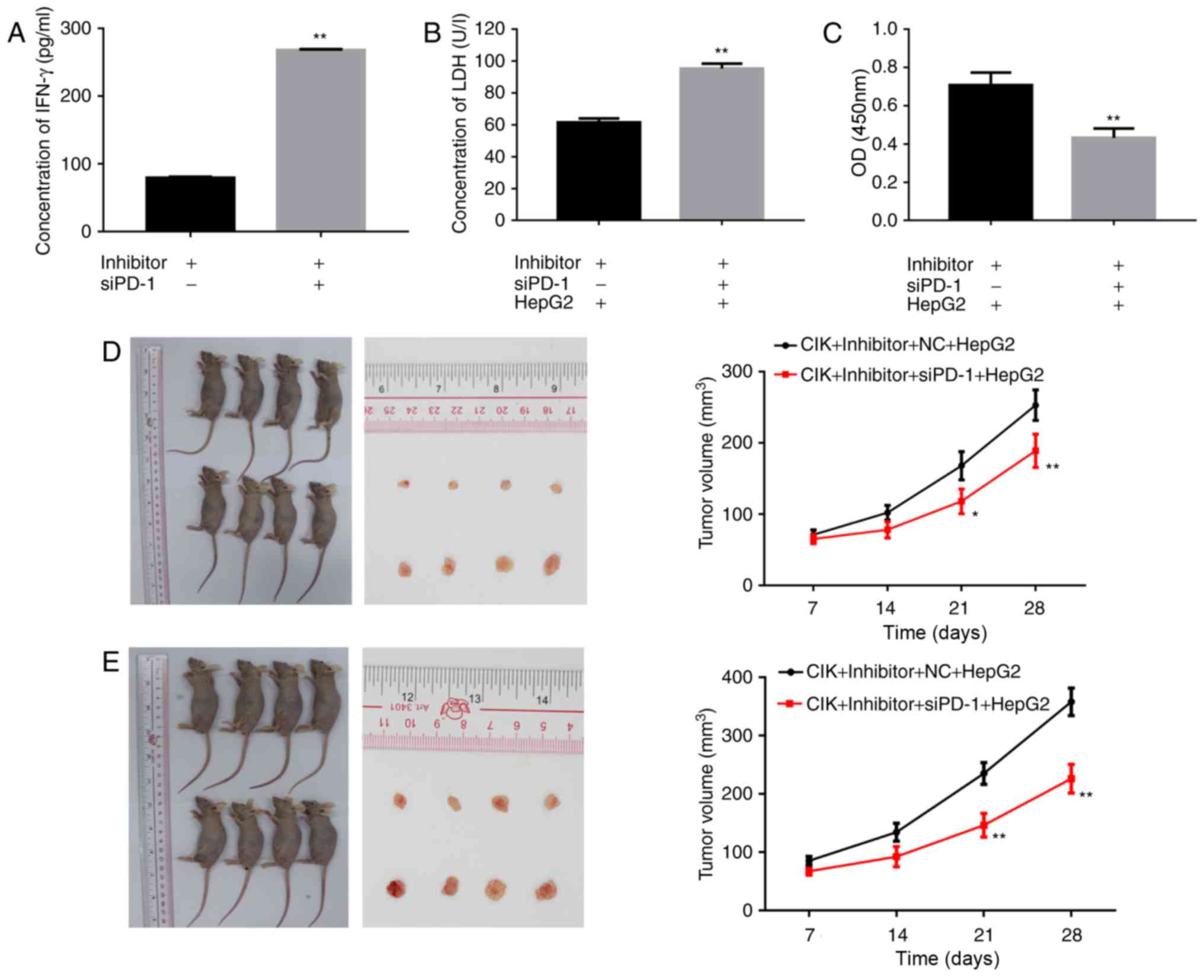
Programmed cell death‑1 (PD‑1) is an oncogene associated with suppressing proliferation and cytokine production of T cells in the progression of liver cancer. microRNAs (miRs) regulate gene expression via specific binding to the target 3'untranslated region of mRNA. In the present study, miR‑374b was indicated to interact with PD‑1 and affect the tumor‑targeting capacity of cytokine‑induced killer (CIK) cells. miR‑374b inhibitor significantly increased PD‑1 expression in CIK cells. A synthetic small interfering (si)RNA targeting PD‑1 was employed to silence the expression level of PD‑1 in CIK cells. Then, the antitumor effect of siPD‑1 in CIK cells was investigated. In vitro study demonstrated that IFN‑γ secretion and the concentration of lactate dehydrogenase were significantly increased in the PD‑1 knockdown group; however, the viability of HepG2 cells in the PD‑1 knockdown group had significantly decreased, compared with the HepG2 cells in the negative control group. In vivo study indicated that mice inoculated with HepG2 cells and CIK cells with PD‑1 knocked down had a significantly smaller tumor volume, compared with the control group. To conclude, human CIK cells transfected with siPD‑1 can target liver cancer cells and enhance immunotherapy efficacy, and therefore they have potential in the immunotherapy of liver cancer.
View Figures

Figure 1

Figure 2

Figure 3

Figure 4

View References

1 

El-Serag HB: Epidemiology of viral hepatitis and hepatocellular carcinoma. Gastroenterology. 142:1264–1273.e1261. 2012. View Article : Google Scholar : PubMed/NCBI

2 

Sawyers CL, Abate-Shen C, Anderson KC, Barker A, Baselga J, Berger NA, Foti M, Jemal A, Lawrence TS, Li CI, et al: AACR Cancer progress report 2013. Clin Cancer Res. 19:S4–98. 2013. View Article : Google Scholar : PubMed/NCBI

3 

Wang FS, Liu MX, Zhang B, Shi M, Lei ZY, Sun WB, Du QY and Chen JM: Antitumor activities of human autologous cytokine-induced killer (CIK) cells against hepatocellular carcinoma cells in vitro and in vivo. World J Gastroenterol. 8:464–468. 2002. View Article : Google Scholar : PubMed/NCBI

4 

Li XD, Xu B, Wu J, Ji M, Xu BH, Jiang JT and Wu CP: Review of Chinese clinical trials on CIK cell treatment for malignancies. Clin Transl Oncol:. 14:102–108. 2012. View Article : Google Scholar : PubMed/NCBI

5 

Schmidt-Wolf IG, Negrin RS, Kiem HP, Blume KG and Weissman IL: Use of a SCID mouse/human lymphoma model to evaluate cytokine-induced killer cells with potent antitumor cell activity. J Exp Med. 174:139–149. 1991. View Article : Google Scholar : PubMed/NCBI

6 

Chen L: Co-inhibitory molecules of the B7-CD28 family in the control of T-cell immunity. Nat Rev Immunol. 4:336–347. 2004. View Article : Google Scholar : PubMed/NCBI

7 

Freeman GJ, Long AJ, Iwai Y, Bourque K, Chernova T, Nishimura H, Fitz LJ, Malenkovich N, Okazaki T and Byrne MC: Engagement of the PD-1 immunoinhibitory receptor by a novel B7 family member leads to negative regulation of lymphocyte activation. J Exp Med. 192:1027–1034. 2000. View Article : Google Scholar : PubMed/NCBI

8 

Bengsch B, Martin B and Thimme R: Restoration of HBV-specific CD8+ T cell function by PD-1 blockade in inactive carrier patients is linked to T cell differentiation. J Hepatol. 61:1212–1219. 2014. View Article : Google Scholar : PubMed/NCBI

9 

Boni C, Fisicaro P, Valdatta C, Amadei B, Di Vincenzo P, Giuberti T, Laccabue D, Zerbini A, Cavalli A, Missale G, et al: Characterization of hepatitis B virus (HBV)-specific T-cell dysfunction in chronic HBV infection. J Virol. 81:4215–4225. 2007. View Article : Google Scholar : PubMed/NCBI

10 

Fisicaro P, Valdatta C, Massari M, Loggi E, Biasini E, Sacchelli L, Cavallo MC, Silini EM, Andreone P, Missale G and Ferrari C: Antiviral intrahepatic T-cell responses can be restored by blocking programmed death-1 pathway in chronic hepatitis B. Gastroenterology. 138:682–693, 693.e1-4. 2010. View Article : Google Scholar : PubMed/NCBI

11 

Mühlbauer M, Fleck M, Schütz C, Weiss T, Froh M, Blank C, Schölmerich J and Hellerbrand C: PD-L1 is induced in hepatocytes by viral infection and by interferon-alpha and -gamma and mediates T cell apoptosis. J Hepatol. 45:520–528. 2006. View Article : Google Scholar : PubMed/NCBI

12 

Peng G, Li S, Wu W, Tan X, Chen Y and Chen Z: PD-1 upregulation is associated with HBV-specific T cell dysfunction in chronic hepatitis B patients. Mol Immunol. 45:963–970. 2008. View Article : Google Scholar : PubMed/NCBI

13 

Tzeng HT, Tsai HF, Liao HJ, Lin YJ, Chen L, Chen PJ and Hsu PN: PD-1 blockage reverses immune dysfunction and hepatitis B viral persistence in a mouse animal model. PloS One. 7:e391792012. View Article : Google Scholar : PubMed/NCBI

14 

Ye P, Weng ZH, Zhang SL, Zhang JA, Zhao L, Dong JH, Jie SH, Pang R and Wei RH: Programmed death-1 expression is associated with the disease status in hepatitis B virus infection. World J Gastroenterol. 14:4551–4557. 2008. View Article : Google Scholar : PubMed/NCBI

15 

Hamid O, Robert C, Daud A, Hodi FS, Hwu WJ, Kefford R, Wolchok JD, Hersey P, Joseph RW, Weber JS, et al: Safety and tumor responses with lambrolizumab (anti-PD-1) in melanoma. N Engl J Med. 369:134–144. 2013. View Article : Google Scholar : PubMed/NCBI

16 

Topalian SL, Hodi FS, Brahmer JR, Gettinger SN, Smith DC, McDermott DF, Powderly JD, Carvajal RD, Sosman JA, Atkins MB, et al: Safety, activity, and immune correlates of anti-PD-1 antibody in cancer. N Engl J Med. 366:2443–2454. 2012. View Article : Google Scholar : PubMed/NCBI

17 

Topalian SL, Sznol M, McDermott DF, Kluger HM, Carvajal RD, Sharfman WH, Brahmer JR, Lawrence DP, Atkins MB, Powderly JD, et al: Survival, durable tumor remission, and long-term safety in patients with advanced melanoma receiving nivolumab. J Clin Oncol. 32:1020–1030. 2014. View Article : Google Scholar : PubMed/NCBI

18 

Duraiswamy J, Freeman GJ and Coukos G: Therapeutic PD-1 pathway blockade augments with other modalities of immunotherapy T-cell function to prevent immune decline in ovarian cancer. Cancer Res. 73:6900–6912. 2013. View Article : Google Scholar : PubMed/NCBI

19 

Topalian SL, Drake CG and Pardoll DM: Targeting the PD-1/B7-H1(PD-L1) pathway to activate anti-tumor immunity. Curr Opin Immunol. 24:207–212. 2012. View Article : Google Scholar : PubMed/NCBI

20 

Gozuacik D, Akkoc Y, Ozturk DG and Kocak M: Autophagy-Regulating microRNAs and Cancer. Front Oncol. 7:652017. View Article : Google Scholar : PubMed/NCBI

21 

Lewis BP, Burge CB and Bartel DP: Conserved seed pairing, often flanked by adenosines, indicates that thousands of human genes are microRNA targets. Cell. 120:15–20. 2005. View Article : Google Scholar : PubMed/NCBI

22 

Jasinski-Bergner S, Mandelboim O and Seliger B: The role of microRNAs in the control of innate immune response in cancer. J Natl Cancer Inst. 106(pii): dju2572014.PubMed/NCBI

23 

Atarod S and Dickinson AM: MicroRNAs: The Missing Link in the Biology of Graft-Versus-Host Disease? Front Immunol. 4:4202013. View Article : Google Scholar : PubMed/NCBI

24 

Xu XM and Zhang HJ: miRNAs as new molecular insights into inflammatory bowel disease: Crucial regulators in autoimmunity and inflammation. World J Gastroenterol. 22:2206–2218. 2016. View Article : Google Scholar : PubMed/NCBI

25 

Gong H, Cao Y, Han G, Zhang Y, You Q, Wang Y and Pan Y.: p53/microRNA-374b/AKT1 regulates colorectal cancer cell apoptosis in response to DNA damage. Int J Oncol. 50:1785–1791. 2017. View Article : Google Scholar : PubMed/NCBI

26 

Wu X, Li S, Xu X, Wu S, Chen R, Jiang Q, Li Y and Xu Y: The potential value of miR-1 and miR-374b as biomarkers for colorectal cancer. Int J Clin Exp Pathol. 8:2840–2851. 2015.PubMed/NCBI

27 

Hu S, Bao H, Xu X, Zhou X, Qin W, Zeng C and Liu Z: Increased miR-374b promotes cell proliferation and the production of aberrant glycosylated IgA1 in B cells of IgA nephropathy. FEBS Lett. 589:4019–4025. 2015. View Article : Google Scholar : PubMed/NCBI

28 

Liao YY, Tsai HC, Chou PY, Wang SW, Chen HT, Lin YM, Chiang IP, Chang TM, Hsu SK, Chou MC, et al: CCL3 promotes angiogenesis by dysregulation of miR-374b/VEGF-A axis in human osteosarcoma cells. Oncotarget. 7:4310–4325. 2016. View Article : Google Scholar : PubMed/NCBI

29 

Ma Z, Sun X, Xu D, Xiong Y and Zuo B: MicroRNA, miR-374b, directly targets Myf6 and negatively regulates C2C12 myoblasts differentiation. Biochem Biophys Res Commun. 467:670–675. 2015. View Article : Google Scholar : PubMed/NCBI

30 

Qian D, Chen K, Deng H, Rao H, Huang H, Liao Y, Sun X, Lu S, Yuan Z, Xie D and Cai Q: MicroRNA-374b suppresses proliferation and promotes apoptosis in T-cell lymphoblastic lymphoma by repressing AKT1 and Wnt-16. Clin Cancer Res. 21:4881–4891. 2015. View Article : Google Scholar : PubMed/NCBI

31 

Schreiber R, Mezencev R, Matyunina LV and McDonald JF: Evidence for the role of microRNA 374b in acquired cisplatin resistance in pancreatic cancer cells. Cancer Gene Ther. 23:241–245. 2016. View Article : Google Scholar : PubMed/NCBI

32 

Xie J, Tan ZH, Tang X, Mo MS, Liu YP, Gan RL, Li Y, Zhang L and Li GQ: MiR-374b-5p suppresses RECK expression and promotes gastric cancer cell invasion and metastasis. World J Gastroenterol. 20:17439–17447. 2014. View Article : Google Scholar : PubMed/NCBI

33 

Livak KJ and Schmittgen TD: Analysis of relative gene expression data using real-time quantitative PCR and the 2(-Delta Delta C (T)) method. Methods. 25:402–408. 2001. View Article : Google Scholar : PubMed/NCBI

34 

Crispe IN: Hepatic T cells and liver tolerance. Nat Rev Immunol. 3:51–62. 2003. View Article : Google Scholar : PubMed/NCBI

35 

Protzer U, Maini MK and Knolle PA: Living in the liver: Hepatic infections. Nat Rev Immunol. 12:201–213. 2012. View Article : Google Scholar : PubMed/NCBI

36 

McDermott DF and Atkins MB: PD-1 as a potential target in cancer therapy. Cancer Med. 2:662–673. 2013.PubMed/NCBI

37 

Thomson AW and Knolle PA: Antigen-presenting cell function in the tolerogenic liver environment. Nat Rev Immunol. 10:753–766. 2010. View Article : Google Scholar : PubMed/NCBI

38 

Odorizzi PM, Pauken KE, Paley MA, Sharpe A and Wherry EJ: Genetic absence of PD-1 promotes accumulation of terminally differentiated exhausted CD8+ T cells. J Exp Med. 212:1125–1137. 2015. View Article : Google Scholar : PubMed/NCBI

39 

Spranger S, Koblish HK, Horton B, Scherle PA, Newton R and Gajewski TF: Mechanism of tumor rejection with doublets of CTLA-4, PD-1/PD-L1, or IDO blockade involves restored IL-2 production and proliferation of CD8(+) T cells directly within the tumor microenvironment. J Immunother Cancer. 2:32014. View Article : Google Scholar : PubMed/NCBI

40 

Linedale R, Schmidt C, King BT, Ganko AG, Simpson F, Panizza BJ and Leggatt GR: Elevated frequencies of CD8 T cells expressing PD-1, CTLA-4 and Tim-3 within tumour from perineural squamous cell carcinoma patients. PloS One. 12:e01757552017. View Article : Google Scholar : PubMed/NCBI

41 

Liu H, Wang Y, Zeng Q, Zeng YQ, Liang CL, Qiu F, Nie H and Dai Z: Suppression of allograft rejection by CD8+CD122+PD-1+ Tregs is dictated by their Fas ligand-initiated killing of effector T cells versus Fas-mediated own apoptosis. Oncotarget. 8:24187–24195. 2017.PubMed/NCBI

42 

Schmittnaegel M, Rigamonti N, Kadioglu E, Cassará A, Wyser Rmili C, Kiialainen A, Kienast Y, Mueller HJ, Ooi CH, Laoui D and De Palma M: Dual angiopoietin-2 and VEGFA inhibition elicits antitumor immunity that is enhanced by PD-1 checkpoint blockade. Sci Transl Med. 9(pii): eaak96702017. View Article : Google Scholar : PubMed/NCBI

43 

Daskivich TJ and Belldegrun A: Words of wisdom. Re: Safety, activity, and immune correlates of anti-PD-1 antibody in cancer. Eur Urol. 67:816–817. 2015. View Article : Google Scholar : PubMed/NCBI

44 

Hato T, Goyal L, Greten TF, Duda DG and Zhu AX: Immune checkpoint blockade in hepatocellular carcinoma: current progress and future directions. Hepatology. 60:1776–1782. 2014. View Article : Google Scholar : PubMed/NCBI

45 

Croce CM: Causes and consequences of microRNA dysregulation in cancer. Nat Rev Genet. 10:704–714. 2009. View Article : Google Scholar : PubMed/NCBI

46 

Yongchun Z, Linwei T, Xicai W, Lianhua Y, Guangqiang Z, Ming Y, Guanjian L, Yujie L and Yunchao H: MicroRNA-195 inhibits non-small cell lung cancer cell proliferation, migration and invasion by targeting MYB. Cancer Lett. 347:65–74. 2014. View Article : Google Scholar : PubMed/NCBI

47 

Aleckovic M and Kang Y: Regulation of cancer metastasis by cell-free miRNAs. Biochim Biophys Acta. 1855:24–42. 2015.PubMed/NCBI

48 

Di Leva G, Garofalo M and Croce CM: MicroRNAs in cancer. Annu Rev Pathol. 9:287–314. 2014. View Article : Google Scholar : PubMed/NCBI

49 

Zhang Y, Yang P and Wang XF: Microenvironmental regulation of cancer metastasis by miRNAs. Trends Cell Biol. 24:153–160. 2014. View Article : Google Scholar : PubMed/NCBI

50 

Mao B and Wang G: MicroRNAs involved with hepatocellular carcinoma (Review). Oncol Rep. 34:2811–2820. 2015. View Article : Google Scholar : PubMed/NCBI

51 

Giordano S and Columbano A: MicroRNAs: New tools for diagnosis, prognosis, and therapy in hepatocellular carcinoma? Hepatology. 57:840–847. 2013. View Article : Google Scholar : PubMed/NCBI

52 

Zhang G, Li N, Li Z, Zhu Q, Li F, Yang C, Han Q, Lv Y, Zhou Z and Liu Z: microRNA-4717 differentially interacts with its polymorphic target in the PD1 3′ untranslated region: A mechanism for regulating PD-1 expression and function in HBV-associated liver diseases. Oncotarget. 6:18933–18944. 2015.PubMed/NCBI

Related Articles

  • Abstract
  • View
  • Download
  • Twitter
Copy and paste a formatted citation
Spandidos Publications style
Huang F, Wang B, Zeng J, Sang S, Lei J and Lu Y: MicroRNA-374b inhibits liver cancer progression via down regulating programmed cell death-1 expression on cytokine-induced killer cells. Oncol Lett 15: 4797-4804, 2018.
APA
Huang, F., Wang, B., Zeng, J., Sang, S., Lei, J., & Lu, Y. (2018). MicroRNA-374b inhibits liver cancer progression via down regulating programmed cell death-1 expression on cytokine-induced killer cells. Oncology Letters, 15, 4797-4804. https://doi.org/10.3892/ol.2018.7951
MLA
Huang, F., Wang, B., Zeng, J., Sang, S., Lei, J., Lu, Y."MicroRNA-374b inhibits liver cancer progression via down regulating programmed cell death-1 expression on cytokine-induced killer cells". Oncology Letters 15.4 (2018): 4797-4804.
Chicago
Huang, F., Wang, B., Zeng, J., Sang, S., Lei, J., Lu, Y."MicroRNA-374b inhibits liver cancer progression via down regulating programmed cell death-1 expression on cytokine-induced killer cells". Oncology Letters 15, no. 4 (2018): 4797-4804. https://doi.org/10.3892/ol.2018.7951
Copy and paste a formatted citation
x
Spandidos Publications style
Huang F, Wang B, Zeng J, Sang S, Lei J and Lu Y: MicroRNA-374b inhibits liver cancer progression via down regulating programmed cell death-1 expression on cytokine-induced killer cells. Oncol Lett 15: 4797-4804, 2018.
APA
Huang, F., Wang, B., Zeng, J., Sang, S., Lei, J., & Lu, Y. (2018). MicroRNA-374b inhibits liver cancer progression via down regulating programmed cell death-1 expression on cytokine-induced killer cells. Oncology Letters, 15, 4797-4804. https://doi.org/10.3892/ol.2018.7951
MLA
Huang, F., Wang, B., Zeng, J., Sang, S., Lei, J., Lu, Y."MicroRNA-374b inhibits liver cancer progression via down regulating programmed cell death-1 expression on cytokine-induced killer cells". Oncology Letters 15.4 (2018): 4797-4804.
Chicago
Huang, F., Wang, B., Zeng, J., Sang, S., Lei, J., Lu, Y."MicroRNA-374b inhibits liver cancer progression via down regulating programmed cell death-1 expression on cytokine-induced killer cells". Oncology Letters 15, no. 4 (2018): 4797-4804. https://doi.org/10.3892/ol.2018.7951
Follow us
  • Twitter
  • LinkedIn
  • Facebook
About
  • Spandidos Publications
  • Careers
  • Cookie Policy
  • Privacy Policy
How can we help?
  • Help
  • Live Chat
  • Contact
  • Email to our Support Team