Spandidos Publications Logo
  • About
    • About Spandidos
    • Aims and Scopes
    • Abstracting and Indexing
    • Editorial Policies
    • Reprints and Permissions
    • Job Opportunities
    • Terms and Conditions
    • Contact
  • Journals
    • All Journals
    • Oncology Letters
      • Oncology Letters
      • Information for Authors
      • Editorial Policies
      • Editorial Board
      • Aims and Scope
      • Abstracting and Indexing
      • Bibliographic Information
      • Archive
    • International Journal of Oncology
      • International Journal of Oncology
      • Information for Authors
      • Editorial Policies
      • Editorial Board
      • Aims and Scope
      • Abstracting and Indexing
      • Bibliographic Information
      • Archive
    • Molecular and Clinical Oncology
      • Molecular and Clinical Oncology
      • Information for Authors
      • Editorial Policies
      • Editorial Board
      • Aims and Scope
      • Abstracting and Indexing
      • Bibliographic Information
      • Archive
    • Experimental and Therapeutic Medicine
      • Experimental and Therapeutic Medicine
      • Information for Authors
      • Editorial Policies
      • Editorial Board
      • Aims and Scope
      • Abstracting and Indexing
      • Bibliographic Information
      • Archive
    • International Journal of Molecular Medicine
      • International Journal of Molecular Medicine
      • Information for Authors
      • Editorial Policies
      • Editorial Board
      • Aims and Scope
      • Abstracting and Indexing
      • Bibliographic Information
      • Archive
    • Biomedical Reports
      • Biomedical Reports
      • Information for Authors
      • Editorial Policies
      • Editorial Board
      • Aims and Scope
      • Abstracting and Indexing
      • Bibliographic Information
      • Archive
    • Oncology Reports
      • Oncology Reports
      • Information for Authors
      • Editorial Policies
      • Editorial Board
      • Aims and Scope
      • Abstracting and Indexing
      • Bibliographic Information
      • Archive
    • Molecular Medicine Reports
      • Molecular Medicine Reports
      • Information for Authors
      • Editorial Policies
      • Editorial Board
      • Aims and Scope
      • Abstracting and Indexing
      • Bibliographic Information
      • Archive
    • World Academy of Sciences Journal
      • World Academy of Sciences Journal
      • Information for Authors
      • Editorial Policies
      • Editorial Board
      • Aims and Scope
      • Abstracting and Indexing
      • Bibliographic Information
      • Archive
    • International Journal of Functional Nutrition
      • International Journal of Functional Nutrition
      • Information for Authors
      • Editorial Policies
      • Editorial Board
      • Aims and Scope
      • Abstracting and Indexing
      • Bibliographic Information
      • Archive
    • International Journal of Epigenetics
      • International Journal of Epigenetics
      • Information for Authors
      • Editorial Policies
      • Editorial Board
      • Aims and Scope
      • Abstracting and Indexing
      • Bibliographic Information
      • Archive
    • Medicine International
      • Medicine International
      • Information for Authors
      • Editorial Policies
      • Editorial Board
      • Aims and Scope
      • Abstracting and Indexing
      • Bibliographic Information
      • Archive
  • Articles
  • Information
    • Information for Authors
    • Information for Reviewers
    • Information for Librarians
    • Information for Advertisers
    • Conferences
  • Language Editing
Spandidos Publications Logo
  • About
    • About Spandidos
    • Aims and Scopes
    • Abstracting and Indexing
    • Editorial Policies
    • Reprints and Permissions
    • Job Opportunities
    • Terms and Conditions
    • Contact
  • Journals
    • All Journals
    • Biomedical Reports
      • Information for Authors
      • Editorial Policies
      • Editorial Board
      • Aims and Scope
      • Abstracting and Indexing
      • Bibliographic Information
      • Archive
    • Experimental and Therapeutic Medicine
      • Information for Authors
      • Editorial Policies
      • Editorial Board
      • Aims and Scope
      • Abstracting and Indexing
      • Bibliographic Information
      • Archive
    • International Journal of Epigenetics
      • Information for Authors
      • Editorial Policies
      • Editorial Board
      • Aims and Scope
      • Abstracting and Indexing
      • Bibliographic Information
      • Archive
    • International Journal of Functional Nutrition
      • Information for Authors
      • Editorial Policies
      • Editorial Board
      • Aims and Scope
      • Abstracting and Indexing
      • Bibliographic Information
      • Archive
    • International Journal of Molecular Medicine
      • Information for Authors
      • Editorial Policies
      • Editorial Board
      • Aims and Scope
      • Abstracting and Indexing
      • Bibliographic Information
      • Archive
    • International Journal of Oncology
      • Information for Authors
      • Editorial Policies
      • Editorial Board
      • Aims and Scope
      • Abstracting and Indexing
      • Bibliographic Information
      • Archive
    • Medicine International
      • Information for Authors
      • Editorial Policies
      • Editorial Board
      • Aims and Scope
      • Abstracting and Indexing
      • Bibliographic Information
      • Archive
    • Molecular and Clinical Oncology
      • Information for Authors
      • Editorial Policies
      • Editorial Board
      • Aims and Scope
      • Abstracting and Indexing
      • Bibliographic Information
      • Archive
    • Molecular Medicine Reports
      • Information for Authors
      • Editorial Policies
      • Editorial Board
      • Aims and Scope
      • Abstracting and Indexing
      • Bibliographic Information
      • Archive
    • Oncology Letters
      • Information for Authors
      • Editorial Policies
      • Editorial Board
      • Aims and Scope
      • Abstracting and Indexing
      • Bibliographic Information
      • Archive
    • Oncology Reports
      • Information for Authors
      • Editorial Policies
      • Editorial Board
      • Aims and Scope
      • Abstracting and Indexing
      • Bibliographic Information
      • Archive
    • World Academy of Sciences Journal
      • Information for Authors
      • Editorial Policies
      • Editorial Board
      • Aims and Scope
      • Abstracting and Indexing
      • Bibliographic Information
      • Archive
  • Articles
  • Information
    • For Authors
    • For Reviewers
    • For Librarians
    • For Advertisers
    • Conferences
  • Language Editing
Login Register Submit
  • This site uses cookies
  • You can change your cookie settings at any time by following the instructions in our Cookie Policy. To find out more, you may read our Privacy Policy.

    I agree
Search articles by DOI, keyword, author or affiliation
Search
Advanced Search
presentation
Oncology Letters
Join Editorial Board Propose a Special Issue
Print ISSN: 1792-1074 Online ISSN: 1792-1082
Journal Cover
January-2019 Volume 17 Issue 1

Full Size Image

Sign up for eToc alerts
Recommend to Library

Journals

International Journal of Molecular Medicine

International Journal of Molecular Medicine

International Journal of Molecular Medicine is an international journal devoted to molecular mechanisms of human disease.

International Journal of Oncology

International Journal of Oncology

International Journal of Oncology is an international journal devoted to oncology research and cancer treatment.

Molecular Medicine Reports

Molecular Medicine Reports

Covers molecular medicine topics such as pharmacology, pathology, genetics, neuroscience, infectious diseases, molecular cardiology, and molecular surgery.

Oncology Reports

Oncology Reports

Oncology Reports is an international journal devoted to fundamental and applied research in Oncology.

Experimental and Therapeutic Medicine

Experimental and Therapeutic Medicine

Experimental and Therapeutic Medicine is an international journal devoted to laboratory and clinical medicine.

Oncology Letters

Oncology Letters

Oncology Letters is an international journal devoted to Experimental and Clinical Oncology.

Biomedical Reports

Biomedical Reports

Explores a wide range of biological and medical fields, including pharmacology, genetics, microbiology, neuroscience, and molecular cardiology.

Molecular and Clinical Oncology

Molecular and Clinical Oncology

International journal addressing all aspects of oncology research, from tumorigenesis and oncogenes to chemotherapy and metastasis.

World Academy of Sciences Journal

World Academy of Sciences Journal

Multidisciplinary open-access journal spanning biochemistry, genetics, neuroscience, environmental health, and synthetic biology.

International Journal of Functional Nutrition

International Journal of Functional Nutrition

Open-access journal combining biochemistry, pharmacology, immunology, and genetics to advance health through functional nutrition.

International Journal of Epigenetics

International Journal of Epigenetics

Publishes open-access research on using epigenetics to advance understanding and treatment of human disease.

Medicine International

Medicine International

An International Open Access Journal Devoted to General Medicine.

Journal Cover
January-2019 Volume 17 Issue 1

Full Size Image

Sign up for eToc alerts
Recommend to Library

  • Article
  • Citations
    • Cite This Article
    • Download Citation
    • Create Citation Alert
    • Remove Citation Alert
    • Cited By
  • Similar Articles
    • Related Articles (in Spandidos Publications)
    • Similar Articles (Google Scholar)
    • Similar Articles (PubMed)
  • Download PDF
  • Download XML
  • View XML
Article Open Access

Correlation between tumor microenvironment‑associated factors and the efficacy and prognosis of neoadjuvant therapy for rectal cancer

  • Authors:
    • Siyu Zhang
    • Wenqi Bai
    • Xunan Tong
    • Peng Bu
    • Jing Xu
    • Yanfeng Xi
  • View Affiliations / Copyright

    Affiliations: Department of Pathology, Shanxi Medical University, Taiyuan, Shanxi 030001, P.R. China, Department of Colorectal Surgery, Shanxi Provincial Cancer Hospital, Taiyuan, Shanxi 030013, P.R. China, Departent of Surgery, Shanxi Medical University, Taiyuan, Shanxi 030001, P.R. China, Department of Pathology, Shanxi Provincial Cancer Hospital, Taiyuan, Shanxi 030013, P.R. China
    Copyright: © Zhang et al. This is an open access article distributed under the terms of Creative Commons Attribution License.
  • Pages: 1062-1070
    |
    Published online on: November 9, 2018
       https://doi.org/10.3892/ol.2018.9682
  • Expand metrics +
Metrics: Total Views: 0 (Spandidos Publications: | PMC Statistics: )
Metrics: Total PDF Downloads: 0 (Spandidos Publications: | PMC Statistics: )
Cited By (CrossRef): 0 citations Loading Articles...

This article is mentioned in:


Abstract

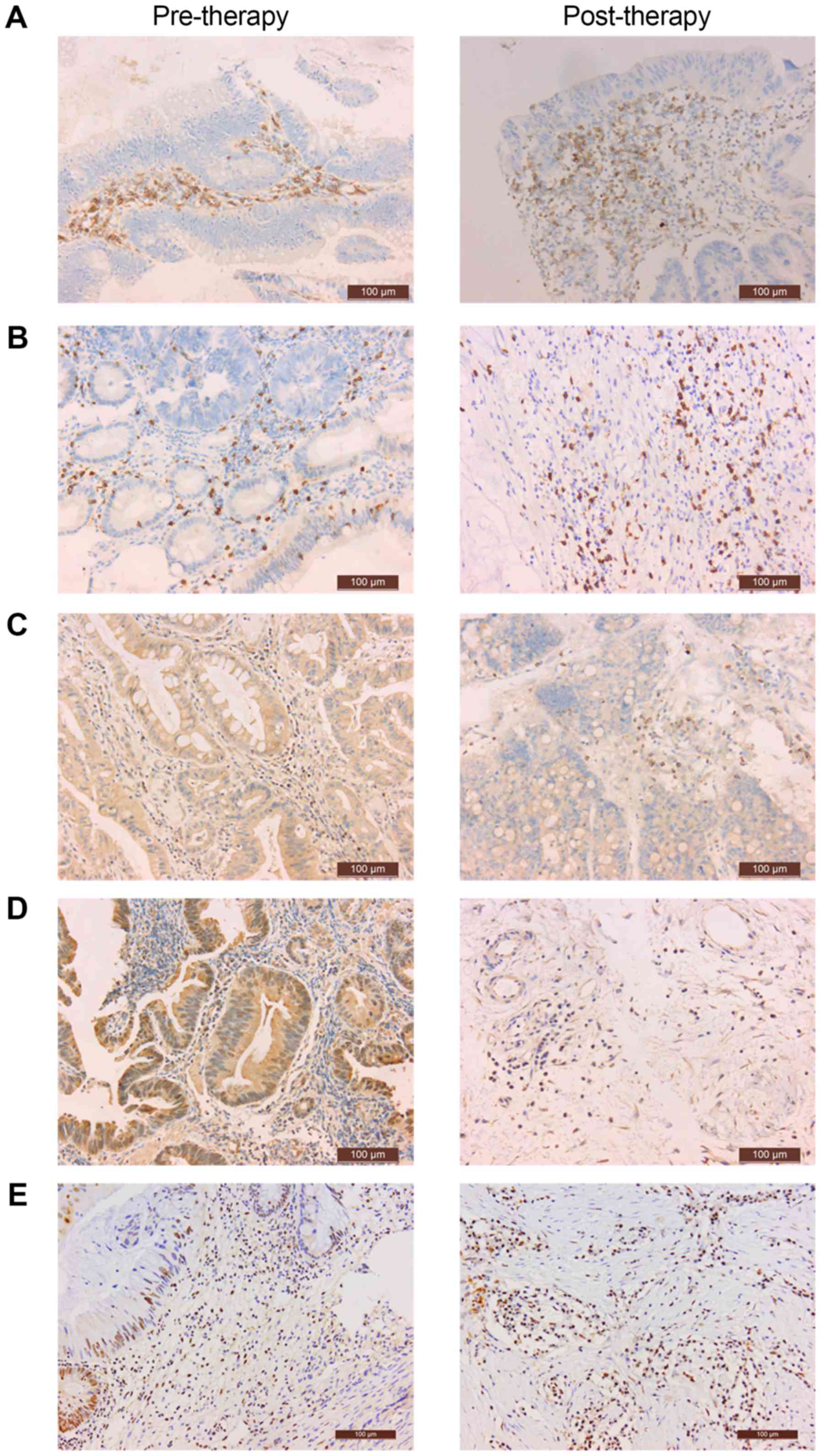
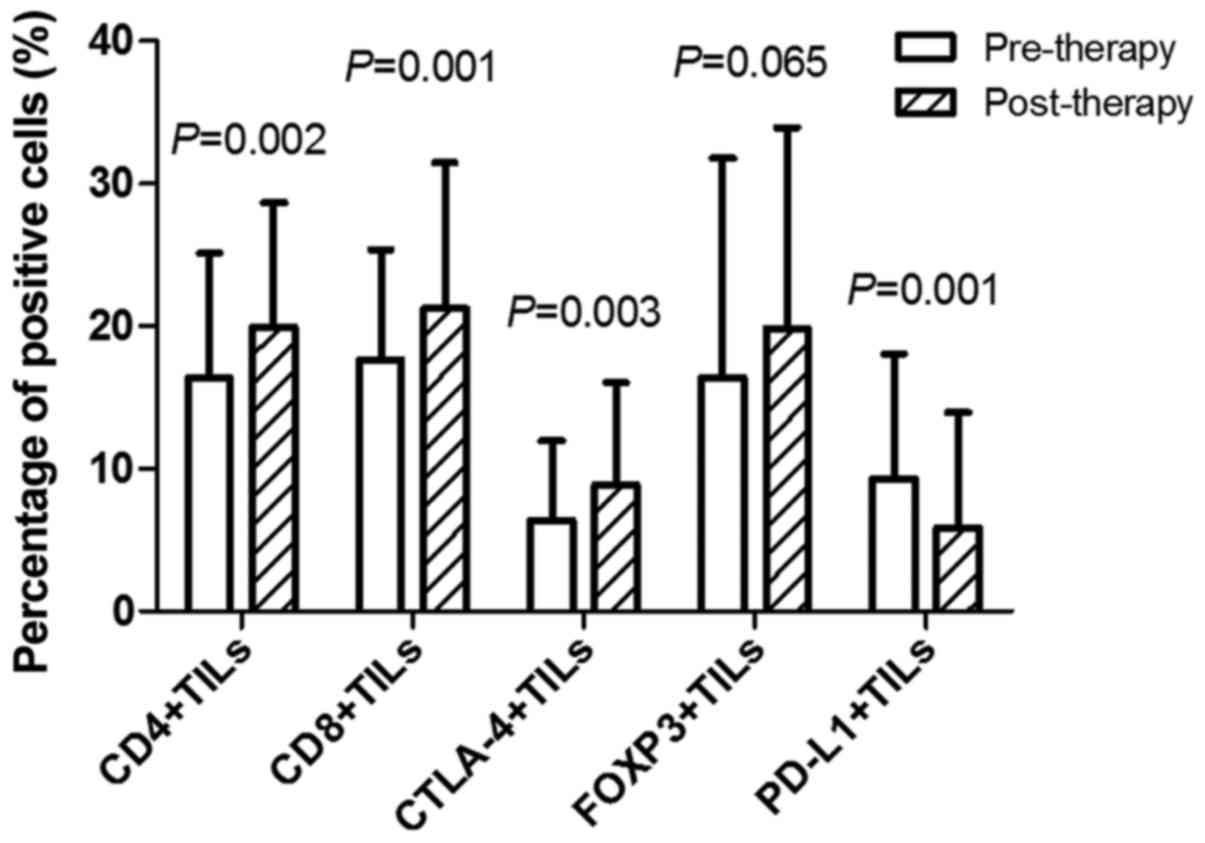
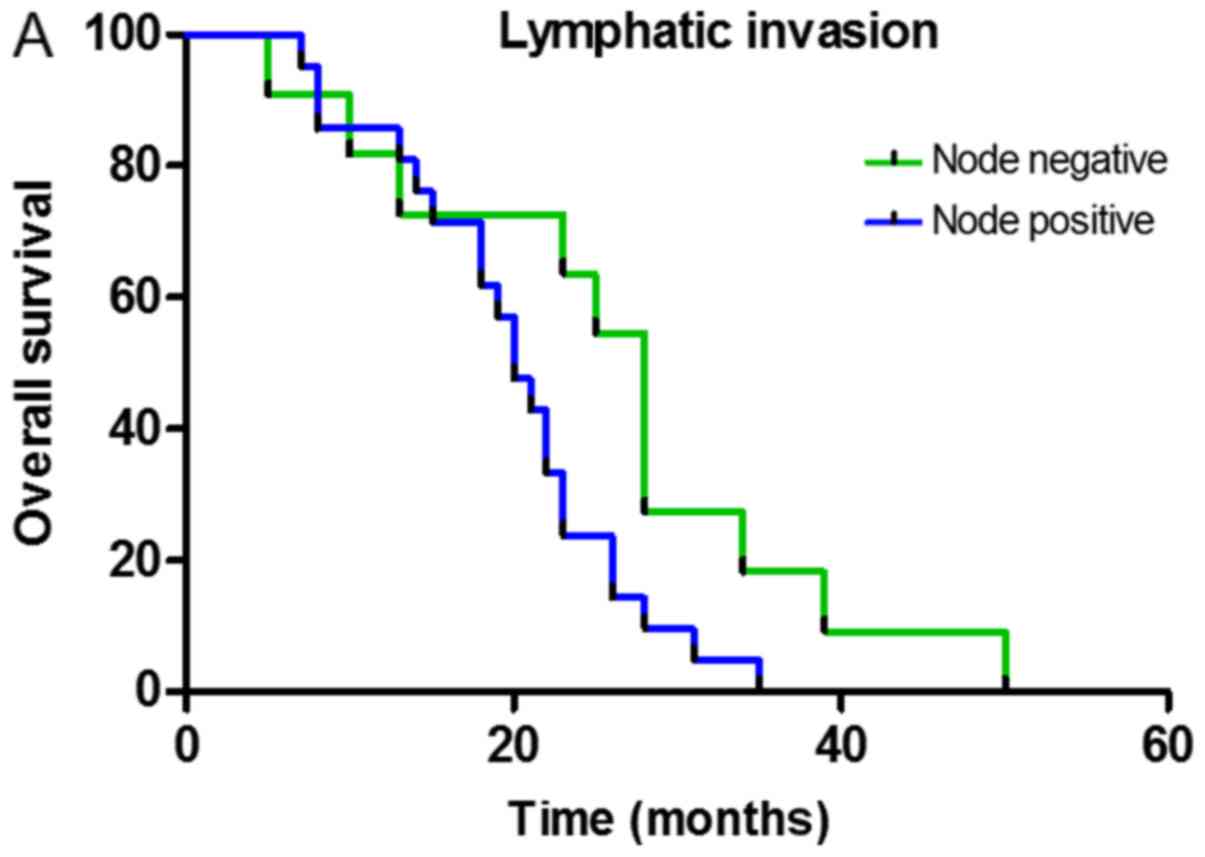
The tumor microenvironment contributes to the survival and development of tumor cells and is therefore a key target for cancer therapy. The tumor microenvironment has unique physical and chemical properties and is associated with inflammation and immunity. To examine the correlation between tumor microenvironment‑associated factors and the efficacy and prognosis of neoadjuvant therapy for rectal cancer, and to compare the differences between two treatments [neoadjuvant chemotherapy (NAC) vs. neoadjuvant chemoradiotherapy (NACR)], an immunohistochemical method was used to measure the expression levels of CD4+ tumor‑infiltrating lymphocytes (TILs), cluster of differentiation (CD)8+TILs, forkhead box P3 (FOXP3)+TILs, cytotoxic T lymphocyte‑associated antigen‑4+TILs and programmed death ligand‑1 (PD‑L1)+TILs in 109 patients with rectal cancer, pre‑ and post‑neoadjuvant therapy. The significance of these protein expression patterns was also analyzed using tissue microarrays, and the prognostic significance of these findings evaluated. The results indicated that high levels of CD4+TILs, CD8+TILs and PD‑L1+TILs may be associated with favorable responses to neoadjuvant therapy, whereas high levels of FOXP3+TILs were associated with poor therapeutic responses. Expression levels of CD8+TILs and FOXP3+TILs following neoadjuvant therapy were independent prognostic factors and affected the total survival of patients subjected to neoadjuvant therapy for the treatment of rectal cancer. Moreover, the effects of NAC and NACR on the tumor microenvironment may be different.
View Figures

Figure 1

Figure 2

Figure 3

Figure 4

View References

1 

Torre LA, Bray F, Siegel RL, Ferlay J, Lortet-Tieulent J and Jemal A: Global cancer statistics, 2012. CA Cancer J Clin. 65:87–108. 2015. View Article : Google Scholar : PubMed/NCBI

2 

Paget S: The distribution of secondary growths in cancer of the breast. 1889. Cancer Metastasis Rev. 8:98–101. 1989.PubMed/NCBI

3 

Albini A, Magnani E and Noonan DM: The tumor microenvironment: Biology of a complex cellular and tissue society. Q J Nucl Med Mol Imaging. 54:244–248. 2010.PubMed/NCBI

4 

Kumamoto Y, Mattei LM, Sellers S, Payne GW and Iwasaki A: CD4+ T cells support cytotoxic T lymphocyte priming by controlling lymph node input. Proc Natl Acad Sci USA. 108:8749–8754. 2011. View Article : Google Scholar : PubMed/NCBI

5 

Hori S, Nomura T and Sakaguchi S: Control of regulatory T cell development by the transcription factor Foxp3. Science. 299:1057–1061. 2003. View Article : Google Scholar : PubMed/NCBI

6 

Grossman WJ, Verbsky JW, Barchet W, Colonna M, Atkinson JP and Ley TJ: Human T regulatory cells can use the perforin pathway to cause autologous target cell death. Immunity. 21:589–601. 2004. View Article : Google Scholar : PubMed/NCBI

7 

Paust S, Lu L, McCarty N and Cantor H: Engagement of B7 on effector T cells by regulatory T cells prevents autoimmune disease. Proc Natl Acad Sci USA. 101:10398–10403. 2004. View Article : Google Scholar : PubMed/NCBI

8 

von Boehmer H: Mechanisms of suppression by suppressor T cells. Nat Immunol. 6:338–344. 2005. View Article : Google Scholar : PubMed/NCBI

9 

Chaudhary B, Khaled YS, Ammori BJ and Elkord E: Neuropilin 1: Function and therapeutic potential in cancer. Cancer Immunol Immunother. 63:81–99. 2014. View Article : Google Scholar : PubMed/NCBI

10 

Bloch O, Crane CA, Kaur R, Safaee M, Rutkowski MJ and Parsa AT: Gliomas promote immunosuppression through induction of B7-H1 expression in tumor-associated macrophages. Clin Cancer Res. 19:3165–3175. 2013. View Article : Google Scholar : PubMed/NCBI

11 

Lu B, Chen L, Liu L, Zhu Y, Wu C, Jiang J and Zhang X: T-cell-mediated tumor immune surveillance and expression of B7 co-inhibitory molecules in cancers of the upper gastrointestinal tract. Immunol Res. 50:269–275. 2011. View Article : Google Scholar : PubMed/NCBI

12 

Brunner MC, Chambers CA, Chan FK, Hanke J, Winoto A and Allison JP: CTLA-4-Mediated inhibition of early events of T cell proliferation. J Immunol. 162:5813–5820. 1999.PubMed/NCBI

13 

Salvi S, Fontana V, Boccardo S, Merlo DF, Margallo E, Laurent S, Morabito A, Rijavec E, Dal Bello MG, Mora M, et al: Evaluation of CTLA-4 expression and relevance as a novel prognostic factor in patients with non-small cell lung cancer. Cancer Immunol Immunother. 61:1463–1472. 2012. View Article : Google Scholar : PubMed/NCBI

14 

Karabon L, Markiewicz M, Kosmaczewska A, Partyka A, Pawlak-Adamska E, Tomkiewicz A, Ciszak L, Jagoda K, Dzierzak-Mietla M, Kyrcz-Krzemien S and Frydecka I: Pretransplant donor and recipient CTLA-4 mRNA and protein levels as a prognostic marker for aGvHD in allogeneic hematopoietic stem cell transplantation. Immunol Lett. 165:52–59. 2015. View Article : Google Scholar : PubMed/NCBI

15 

Zou W and Chen L: Inhibitory B7-family molecules in the tumour microenvironment. Nat Rev Immunol. 8:467–477. 2008. View Article : Google Scholar : PubMed/NCBI

16 

Keir ME, Butte MJ, Freeman GJ and Sharpe AH: PD-1 and its ligands in tolerance and immunity. Annu Rev Immunol. 26:677–704. 2008. View Article : Google Scholar : PubMed/NCBI

17 

Dong H, Strome SE, Salomao DR, Tamura H, Hirano F, Flies DB, Roche PC, Lu J, Zhu G, Tamada K, et al: Tumor-associated B7-H1 promotes T-cell apoptosis: A potential mechanism of immune evasion. Nat Med. 8:793–800. 2002. View Article : Google Scholar : PubMed/NCBI

18 

Sabatier R, Finetti P, Mamessier E, Adelaide J, Chaffanet M, Ali HR, Viens P, Caldas C, Birnbaum D and Bertucci F: Prognostic and predictive value of PDL1 expression in breast cancer. Oncotarget. 6:5449–5464. 2015. View Article : Google Scholar : PubMed/NCBI

19 

Shen JK, Cote GM, Choy E, Yang P, Harmon D, Schwab J, Nielsen GP, Chebib I, Ferrone S, Wang X, et al: Programmed cell death ligand 1 expression in osteosarcoma. Cancer Immunol Res. 2:690–698. 2014. View Article : Google Scholar : PubMed/NCBI

20 

Curiel TJ, Wei S, Dong H, Alvarez X, Cheng P, Mottram P, Krzysiek R, Knutson KL, Daniel B, Zimmermann MC, et al: Blockade of B7-H1 improves myeloid dendritic cell-mediated antitumor immunity. Nat Med. 9:562–567. 2003. View Article : Google Scholar : PubMed/NCBI

21 

Zhang L, Gajewski TF and Kline J: PD-1/PD-L1 interactions inhibit antitumor immune responses in a murine acute myeloid leukemia model. Blood. 114:1545–1552. 2009. View Article : Google Scholar : PubMed/NCBI

22 

Dworak O, Keilholz L and Hoffmann A: Pathological features of rectal cancer after preoperative radiochemotherapy. Int J Colorectal Dis. 12:19–23. 1997. View Article : Google Scholar : PubMed/NCBI

23 

Kalbasi A, June CH, Haas N and Vapiwala N: Radiation and immunotherapy: A synergistic combination. J Clin Invest. 123:2756–2763. 2013. View Article : Google Scholar : PubMed/NCBI

24 

Yasuda K, Nirei T, Sunami E, Nagawa H and Kitayama J: Density of CD4(+) and CD8(+) T lymphocytes in biopsy samples can be a predictor of pathological response to chemoradiotherapy (CRT) for rectal cancer. Radiat Oncol. 6:492011. View Article : Google Scholar : PubMed/NCBI

25 

Garcia-Martinez E, Gil GL, Benito AC, González-Billalabeitia E, Conesa MA, García García T, García-Garre E, Vicente V and de la Peña Ayala F: Tumor-infiltrating immune cell profiles and their change after neoadjuvant chemotherapy predict response and prognosis of breast cancer. Breast Cancer Res. 16:4882014. View Article : Google Scholar : PubMed/NCBI

26 

Zhang J and Guo Z: Immune escape of tumor. Chin J Cancer Biother. 4:315–317. 2006.(In Chinese).

27 

Rettig L, Seidenberg S, Parvanova I, Samaras P, Curioni A, Knuth A and Pascolo S: Gemcitabine depletes regulatory T-cells in human and mice and enhances triggering of vaccine-specific cytotoxic T-cells. Int J Cancer. 129:832–838. 2011. View Article : Google Scholar : PubMed/NCBI

28 

Maeda K, Hazama S, Tokuno K, Kan S, Maeda Y, Watanabe Y, Kamei R, Shindo Y, Maeda N, Yoshimura K, et al: Impact of chemotherapy for colorectal cancer on regulatory T-cells and tumor immunity. Anticancer Res. 31:4569–4574. 2011.PubMed/NCBI

29 

Van der Most RG, Currie AJ, Mahendran S, Prosser A, Darabi A, Robinson BW, Nowak AK and Lake RA: Tumor eradication after cyclophosphamide depends on concurrent depletion of regulatory T cells: A role for cycling TNFR2-expressing effector-suppressor T cells in limiting effective chemotherapy. Cancer Immunol Immunother. 58:1219–1228. 2009. View Article : Google Scholar : PubMed/NCBI

30 

Frey DM, Droeser RA, Viehl CT, Zlobec I, Lugli A, Zingg U, Oertli D, Kettelhack C, Terracciano L and Tornillo L: High frequency of tumor-infiltrating FOXP3(+) regulatory T cells predicts improved survival in mismatch repair-proficient colorectal cancer patients. Int J Cancer. 126:2635–2643. 2010.PubMed/NCBI

31 

Lin YC, Mahalingam J, Chiang JM, Su PJ, Chu YY, Lai HY, Fang JH, Huang CT, Chiu CT and Lin CY: Activated but not resting regulatory T cells accumulated in tumor microenvironment and correlated with tumor progression in patients with colorectal cancer. Int J Cancer. 132:1341–1350. 2013. View Article : Google Scholar : PubMed/NCBI

32 

Llosa NJ, Cruise M, Tam A, Wicks EC, Hechenbleikner EM, Taube JM, Blosser RL, Fan H, Wang H, Luber BS, et al: The vigorous immune microenvironment of microsatellite instable colon cancer is balanced by multiple counter-inhibitory checkpoints. Cancer Discov. 5:43–51. 2015. View Article : Google Scholar : PubMed/NCBI

33 

Saigusa S, Toiyama Y, Tanaka K, Inoue Y, Mori K, Ide S, Imaoka H, Kawamura M, Mohri Y and Kusunoki M: Implication of programmed cell death ligand 1 expression in tumor recurrence and prognosis in rectal cancer with neoadjuvant chemoradiotherapy. Int J Clin Oncol. 21:946–952. 2016. View Article : Google Scholar : PubMed/NCBI

34 

Butte MJ, Keir ME, Phamduy TB, Sharpe AH and Freeman GJ: Programmed death-1 ligand 1 interacts specifically with the B7-1 costimulatory molecule to inhibit T cell responses. Immunity. 27:111–122. 2007. View Article : Google Scholar : PubMed/NCBI

35 

Tamura H, Dong H, Zhu G, Sica GL, Flies DB, Tamada K and Chen L: B7-H1 costimulation preferentially enhances CD28-independent T-helper cell function. Blood. 97:1809–1816. 2001. View Article : Google Scholar : PubMed/NCBI

36 

Parsa AT, Waldron JS, Panner A, Crane CA, Parney IF, Barry JJ, Cachola KE, Murray JC, Tihan T, Jensen MC, et al: Loss of tumor suppressor PTEN function increases B7-H1 expression and immunoresistance in glioma. Nat Med. 13:84–88. 2007. View Article : Google Scholar : PubMed/NCBI

37 

Walker LS: Treg and CTLA-4: Two intertwining pathways to immune tolerance. J Autoimmun. 45:49–57. 2013. View Article : Google Scholar : PubMed/NCBI

38 

Birebent B, Lorho R, Lechartier H, de Guibert S, Alizadeh M, Vu N, Beauplet A, Robillard N and Semana G: Suppressive properties of human CD4+CD25+ regulatory T cells are dependent on CTLA-4 expression. Eur J Immunol. 34:3485–3496. 2004. View Article : Google Scholar : PubMed/NCBI

39 

Xu C, Li W and Yao Y: Regulating mechanism of regulatory T cells in immunoregulatory responses. Int J Pathol Clin Med. 28:199–204. 2008.

40 

Postow MA, Callahan MK, Barker CA, Yamada Y, Yuan J, Kitano S, Mu Z, Rasalan T, Adamow M, Ritter E, et al: Immunologic correlates of the abscopal effect in a patient with melanoma. N Engl J Med. 366:925–931. 2012. View Article : Google Scholar : PubMed/NCBI

41 

Qu Y, Zhang B, Liu S, Zhang A, Wu T and Zhao Y: 2-Gy whole-body irradiation significantly alters the balance of CD4+ CD25- T effector cells and CD4+ CD25+ Foxp3+ T regulatory cells in mice. Cell Mol Immunol. 7:419–427. 2010. View Article : Google Scholar : PubMed/NCBI

42 

Billiard F, Buard V, Benderitter M and Linard C: Abdominal γ-radiation induces an accumulation of function-impaired regulatory T cells in the small intestine. Int J Radiat Oncol Biol Phys. 80:869–876. 2011. View Article : Google Scholar : PubMed/NCBI

43 

Mizukami Y, Kono K, Kawaguchi Y, Akaike H, Kamimura K, Sugai H and Fujii H: Localisation pattern of Foxp3+ regulatory T cells is associated with clinical behaviour in gastric cancer. Br J Cancer. 98:148–153. 2008. View Article : Google Scholar : PubMed/NCBI

44 

Matsutani S, Shibutani M, Maeda K, Nagahara H, Fukuoka T, Nakao S, Hirakawa K and Ohira M: Significance of tumor-infiltrating lymphocytes before and after neoadjuvant therapy for rectal cancer. Cancer Sci. 109:966–979. 2018. View Article : Google Scholar : PubMed/NCBI

Related Articles

  • Abstract
  • View
  • Download
  • Twitter
Copy and paste a formatted citation
Spandidos Publications style
Zhang S, Bai W, Tong X, Bu P, Xu J and Xi Y: Correlation between tumor microenvironment‑associated factors and the efficacy and prognosis of neoadjuvant therapy for rectal cancer. Oncol Lett 17: 1062-1070, 2019.
APA
Zhang, S., Bai, W., Tong, X., Bu, P., Xu, J., & Xi, Y. (2019). Correlation between tumor microenvironment‑associated factors and the efficacy and prognosis of neoadjuvant therapy for rectal cancer. Oncology Letters, 17, 1062-1070. https://doi.org/10.3892/ol.2018.9682
MLA
Zhang, S., Bai, W., Tong, X., Bu, P., Xu, J., Xi, Y."Correlation between tumor microenvironment‑associated factors and the efficacy and prognosis of neoadjuvant therapy for rectal cancer". Oncology Letters 17.1 (2019): 1062-1070.
Chicago
Zhang, S., Bai, W., Tong, X., Bu, P., Xu, J., Xi, Y."Correlation between tumor microenvironment‑associated factors and the efficacy and prognosis of neoadjuvant therapy for rectal cancer". Oncology Letters 17, no. 1 (2019): 1062-1070. https://doi.org/10.3892/ol.2018.9682
Copy and paste a formatted citation
x
Spandidos Publications style
Zhang S, Bai W, Tong X, Bu P, Xu J and Xi Y: Correlation between tumor microenvironment‑associated factors and the efficacy and prognosis of neoadjuvant therapy for rectal cancer. Oncol Lett 17: 1062-1070, 2019.
APA
Zhang, S., Bai, W., Tong, X., Bu, P., Xu, J., & Xi, Y. (2019). Correlation between tumor microenvironment‑associated factors and the efficacy and prognosis of neoadjuvant therapy for rectal cancer. Oncology Letters, 17, 1062-1070. https://doi.org/10.3892/ol.2018.9682
MLA
Zhang, S., Bai, W., Tong, X., Bu, P., Xu, J., Xi, Y."Correlation between tumor microenvironment‑associated factors and the efficacy and prognosis of neoadjuvant therapy for rectal cancer". Oncology Letters 17.1 (2019): 1062-1070.
Chicago
Zhang, S., Bai, W., Tong, X., Bu, P., Xu, J., Xi, Y."Correlation between tumor microenvironment‑associated factors and the efficacy and prognosis of neoadjuvant therapy for rectal cancer". Oncology Letters 17, no. 1 (2019): 1062-1070. https://doi.org/10.3892/ol.2018.9682
Follow us
  • Twitter
  • LinkedIn
  • Facebook
About
  • Spandidos Publications
  • Careers
  • Cookie Policy
  • Privacy Policy
How can we help?
  • Help
  • Live Chat
  • Contact
  • Email to our Support Team