Introduction
Pancreatic cancer is the fourth-leading cause of
cancer deaths in the US and has a very poor prognosis with a
mortality approaching 100% (1–4). Only
15–20% of pancreatic cancer cases are diagnosed early due to
nonspecific symptoms and approximately 50% of patients have
metastasis at diagnosis (5,6). As precision and personalized medicine
emerged, research on the genomics of patients with various cancers
to identify novel biomarkers is actively being pursued (7,8).
γ-Secretase is an intramembrane-cleaving protease
composed of an essential protein complex including γ-secretase
complex-presenilin (PSEN), nicastrin (NCSTN), presenilin enhancer
protein 2 (PSENEN), and anterior pharynx-defective 1 (APH1-)
(9,10). Either PSEN1 or PSEN2 contains NCSTN,
the catalytic site, and the PSENEN and APH1 (APH1A or APH1B)
substrate binding site (10,11). Notch signaling is one of the most
evolutionarily conserved pathways involved in cell fate control
during development and postnatal tissue differentiation (10,12).
Aberrations in this signaling pathway have been identified in
several diseases, including Alzheimer's disease, and malignancies
(10,12–15).
γ-Secretase is not only able to cleave type I transmembrane
proteins, but also the amyloid precursor protein and NOTCH
receptors (12). Because abnormal
activation of the Notch pathway plays a role in tumorigenesis,
γ-secretase, which mediates Notch signals, is a promising
therapeutic target (12,16).
Several Notch signal inhibitors have been developed,
including γ-secretase inhibitors (GSIs), siRNA, and monoclonal
antibodies (17,18). In in vitro studies, the
administration of the GSI MRK-003 with gemcitabine decreased
pancreatic adenocarcinoma cancer cell growth and suppressed cancer
stem cells (18–20). In this context, γ-secretase is
thought to play a significant role in tumorigenesis and survival in
pancreatic cancer.
The present study retrospectively examined the
prognostic significance of γ-secretase genes in patients with
pancreatic cancer in independent cohorts. Among these genes, high
expression of APH1A was significantly associated with a
worse prognosis in patients with pancreatic cancer.
Materials and methods
Patients
The patients' data were downloaded from The Cancer
Genome Atlas (TCGA) (21,22) and the Gene Expression Omnibus (GEO,
GSE21501, GSE28735, GSE15471, GSE16515) in October 2017 (23–26). We
included only cohorts (TCGA, GSE21501) containing more than 100
patients with pancreatic cancer in which survival information was
available. In TCGA and GSE21501, the cancer staging system follows
The American Joint Committee on Cancer (AJCC) (27). These processes were performed using R
software version 3.5.0 (The R Foundation for Statistical Computing,
2018), using the ‘cgdsr’ and ‘GEOquery’ packages.
Survival and statistical analysis
Survival analyses were performed to predict the
overall survival (OS). We used following three methods: i)
Kaplan-Meier survival curves with log-rank test to evaluate the
accuracy of the discrimination, ii) Uno's C-index in the
time-dependent area under the curve (AUC) analysis, and iii) AUC
values in receiver operating characteristics (ROC) at three years
as we used previously (28–31). These values were calculated using the
R packages ‘survival’ and ‘survAUC’. C-indices and
AUC values of 0.6 or greater were considered acceptable for
survival predictions. In the Kaplan-Meier analyses, we determined
the optimal cutoff value with the maximal Uno's C-index by
five-fold cross-validation as we performed before (30,32). We
used univariate Cox regression to identify the effect of the genes
on prognosis. To compare the γ-secretases expression value between
tumor and non-tumor tissues, we used Wilcoxon signed rank test or t
test according to their expression distribution in GSE28735,
GSE15471 and GSE16515. All statistical analyses were performed
using R.
Results
Patient distribution
In total, 172 patients (TCGA) and 102 patients
(GSE21501) were included in this study. Their information is
described in Table I and the
characteristics of each cohort were quite different. The patients
in TCGA were almost all at low stages (AJCC staging system, Stage
I, 21; Stage II, 145; Stage III 3; Stage IV, 5), while the patients
in GSE21501 were almost all at high stages (T1, 2; T2, 16; T3, 79;
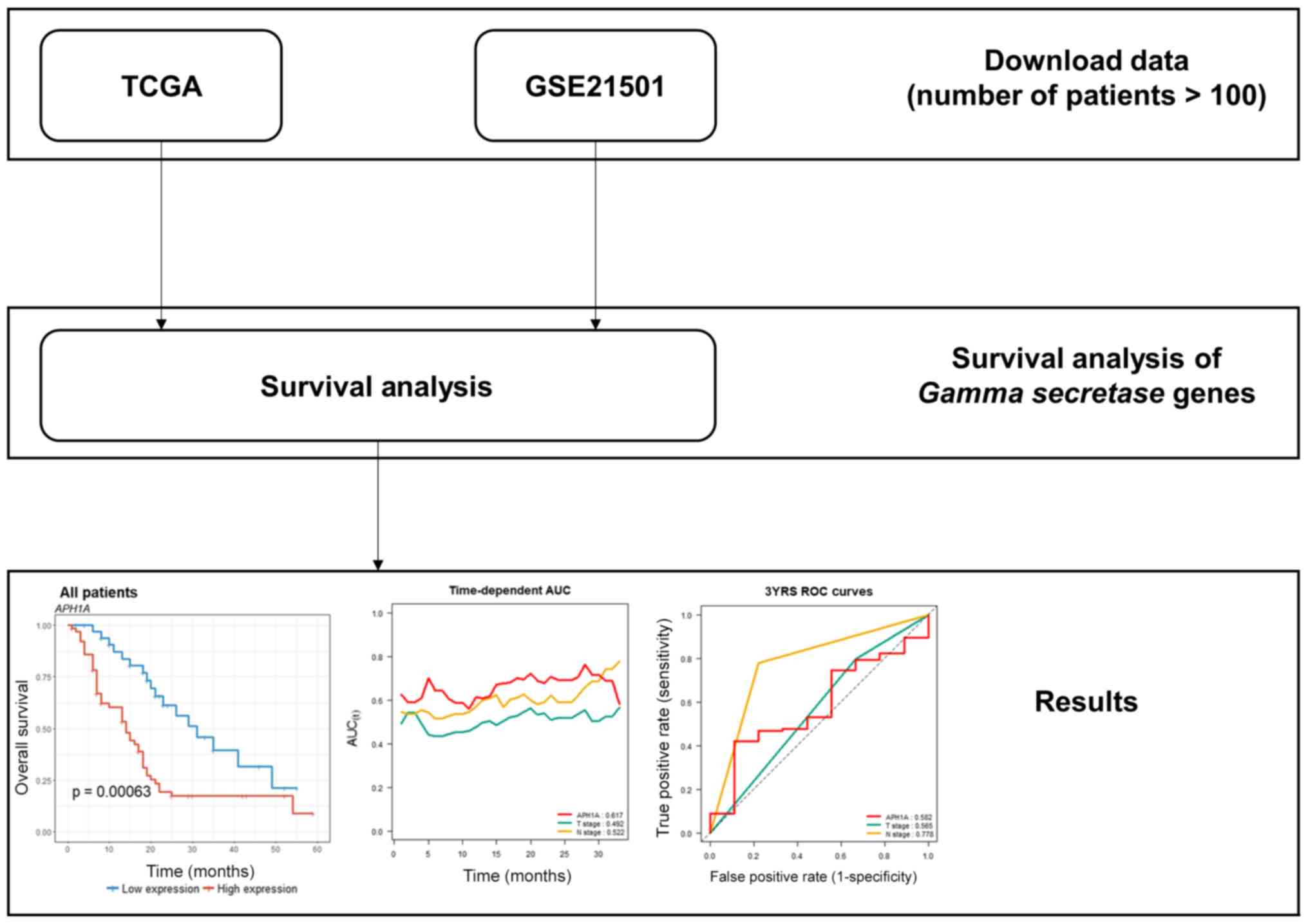
T4, 1; N0, 28; N1, 73). A flowchart of the present study is
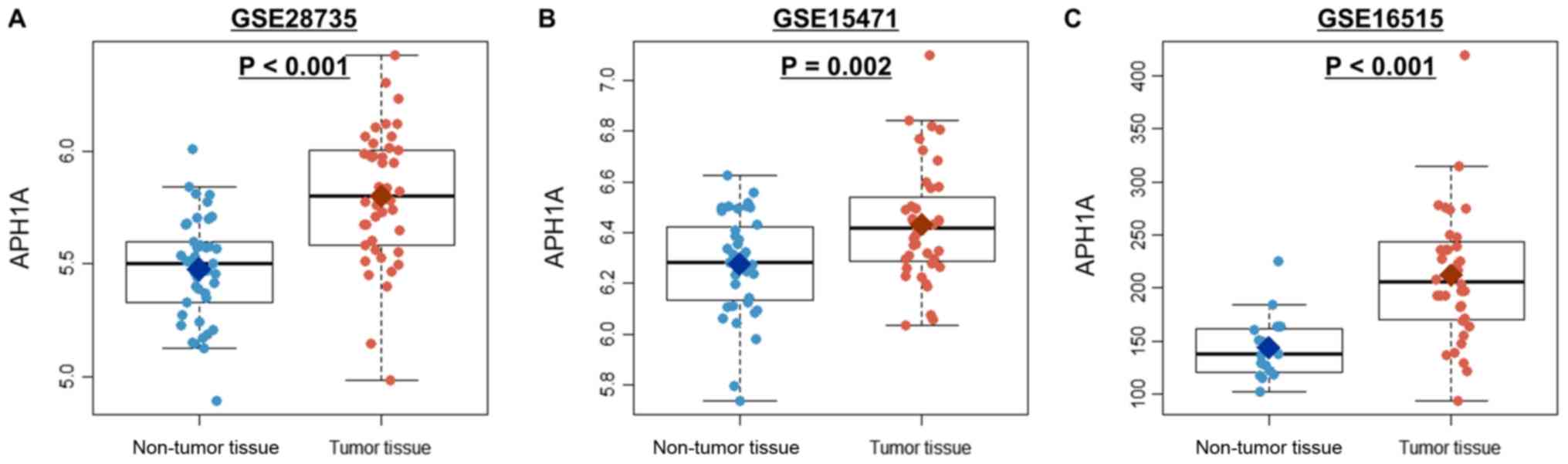
described in Fig. 1. There are 45,
36 pairs of pancreatic tumor and adjacent non-tumor tissues in
GSE28735, GSE15471. GSE16515 dataset consists of 36 tumors and 16
normal samples.
 | Table I.Patients' information used in current
research in the TCGA and GSE21501 cohorts. |
Table I.
Patients' information used in current
research in the TCGA and GSE21501 cohorts.
| Group | Description | TCGA | GSE21501 |
|---|
| Male | – | 94 | − |
| Female | – | 78 | − |
| Stage I | – | 21 | − |
| Stage II | – | 145 | − |
| Stage III | – |
3 | − |
| Stage IV | – |
5 | − |
| T1 | Confined to the
pancreas, ≤2 cm in diameter | − | 2 |
| T2 | Confined to the
pancreas, 2 cm < diameter ≤4 cm | − | 16 |
| T3 | Confined to the
pancreas, >4 cm in diameter | − | 79 |
| T4 | Extends outside the
pancreas and into nearby major blood vessels | − | 1 |
| N0 | No spread to nearby
lymph nodes | − | 28 |
| N1 | Spreads to no more
than 3 nearby lymph nodes | − | 73 |
Survival curve of γ-secretases
To identify the discriminatory power of γ-secretase
genes as a categorical variable, we analyzed Kaplan-Meier curves
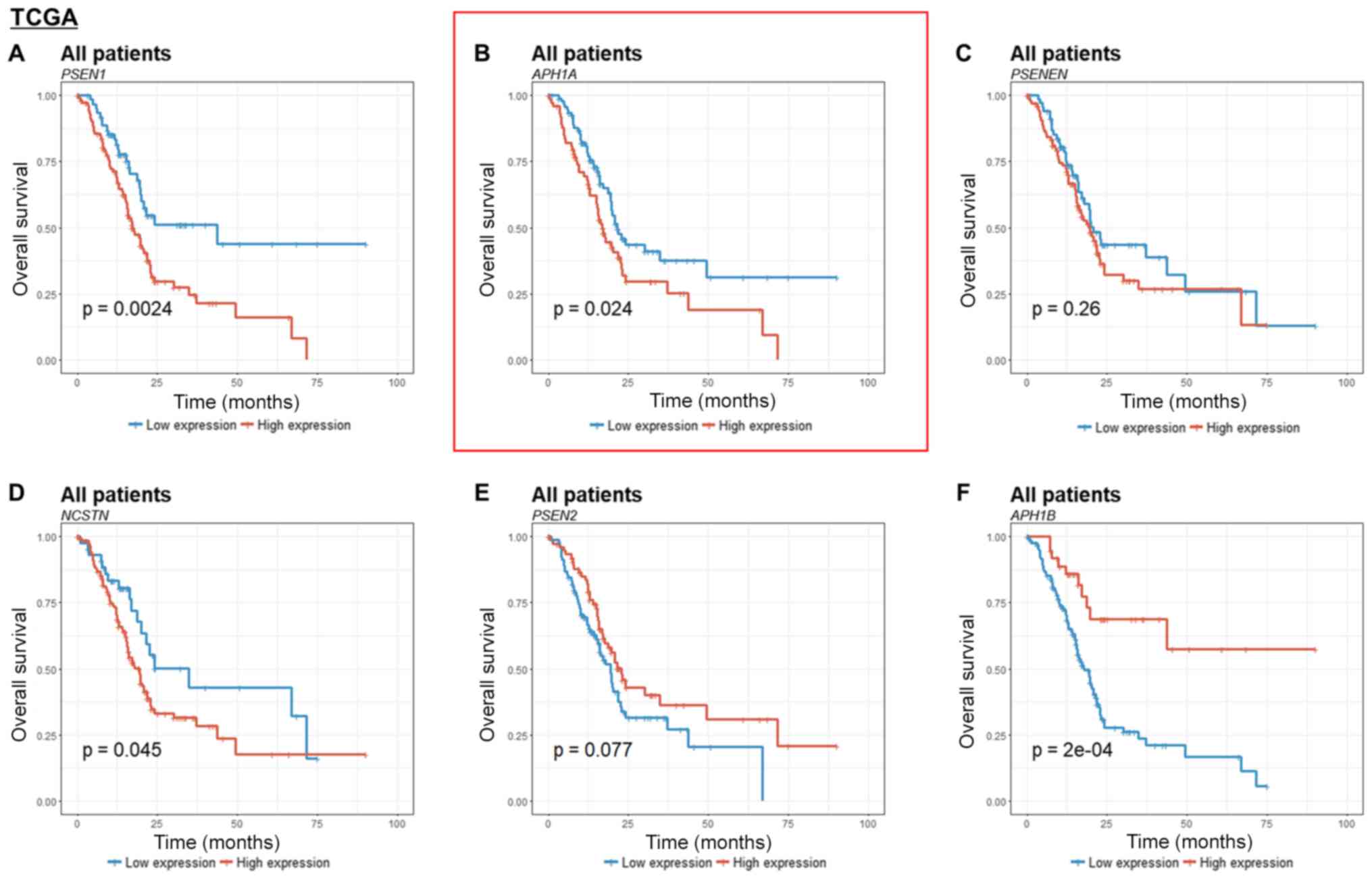
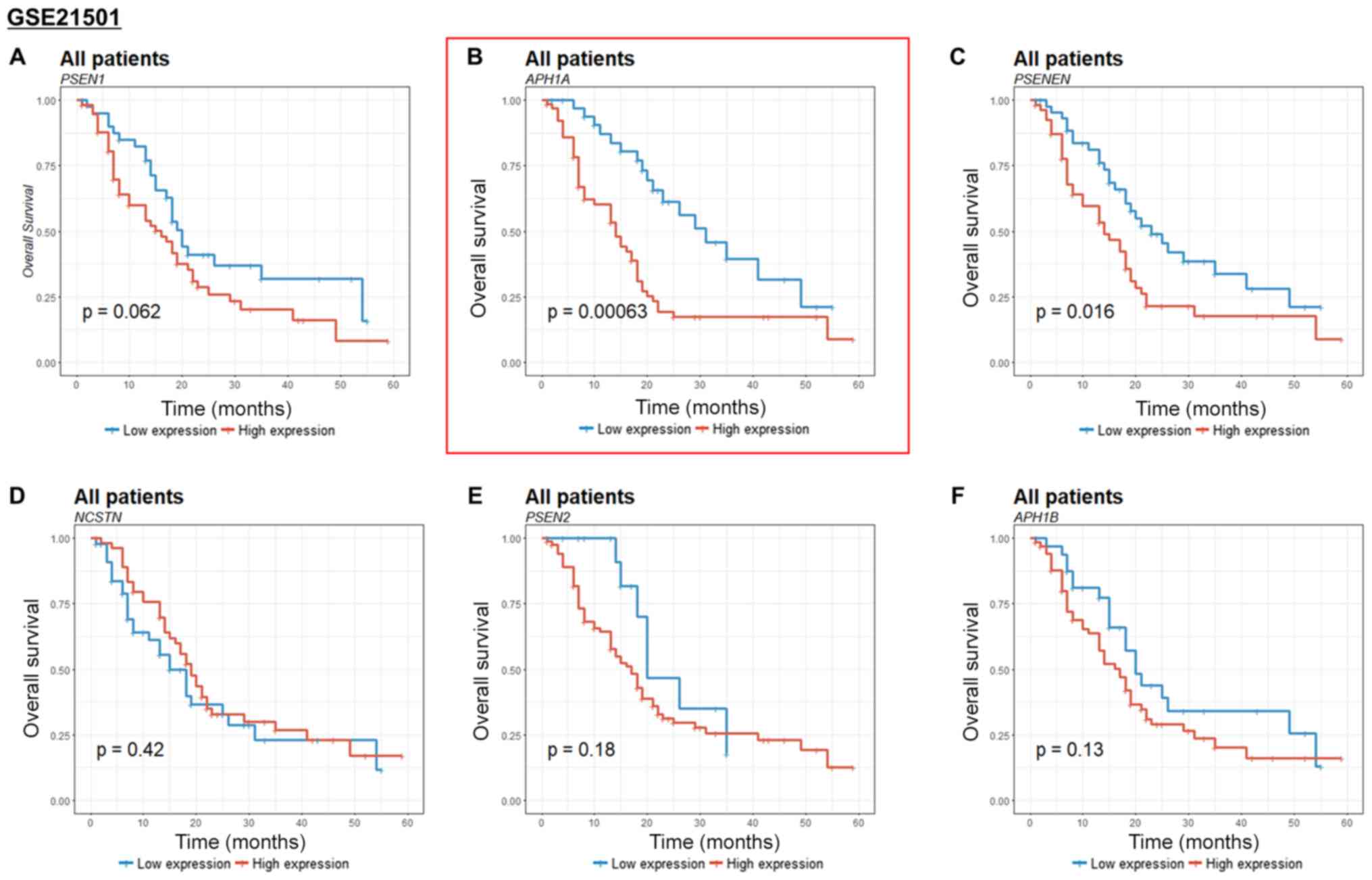
with log-rank test for gene expression and survival. Among the
γ-secretase genes, only APH1A was significantly associated
with survival in both cohorts (Figs.
2B and 3B). High expression of
PSEN1 and PSENEN showed a poor prognosis as the
expression levels increased in both cohorts and were statistically
significant in GSE21501 and TCGA respectively (Figs. 2A and C, and 3A and C). The other genes were not
statistically significant or showed opposite trends in each cohort
(Figs. 2 and 3). The number of patients and deaths in the
high- and low-risk groups divided by each gene are listed in
Table II. The prognostic values
were further confirmed using univariate Cox regression analysis
(Table III).
| Table II.Number of patients (event) divided by
each gene cutoff value. |
Table II.
Number of patients (event) divided by
each gene cutoff value.
| Gene | Group | TCGA | GSE21501 |
|---|
| Total values
(n) | All patients | 172 | 102 |
| PSEN1 | High expression
(event) | 107 (68) | 61 (42) |
|
| Low expression
(event) | 65 (24) | 41 (24) |
| APH1A | High expression
(event) | 75 (49) | 68 (49) |
|
| Low expression
(event) | 97 (43) | 34 (17) |
| PSENEN | High expression
(event) | 101 (57) | 56 (40) |
|
| Low expression
(event) | 71 (35) | 46 (26) |
| NCSTN | High expression
(event) | 127 (74) | 57 (38) |
|
| Low expression
(event) | 45 (18) | 45 (28) |
| PSEN2 | High expression
(event) | 79 (39) | 86 (59) |
|
| Low expression
(event) | 93 (53) | 16 (7) |
| APH1B | High expression
(event) | 37 (10) | 69 (47) |
|
| Low expression
(event) | 135 (82) | 33 (19) |
| Table III.Univariate cox regression results of
each gene in TCGA and GSE21501 cohorts. |
Table III.
Univariate cox regression results of
each gene in TCGA and GSE21501 cohorts.
| A, TCGA |
|---|
|
|---|
| Genes | P-value | Hazard ratio | 95% confidence
interval |
|---|
| PSEN1 |
0.00291b | 2.0355 | 1.275 | 3.25 |
| APH1A | 0.025a | 1.598 | 1.061 | 2.408 |
| PSENEN | 0.26 | 1.275 | 0.8353 | 1.946 |
| NCSTN | 0.0469a | 1.7011 | 1.007 | 2.873 |
| PSEN2 | 0.0782 | 1.4574 | 0.9583 | 2.216 |
| APH1B |
<0.0001c | 3.2734 | 1.691 | 6.335 |
|
| B,
GSE21501 |
|
| Genes | P-value | Hazard
ratio | 95% confidence
interval |
|
| PSEN1 | 0.0835 | 1.5772 | 0.9414 | 2.642 |
| APH1A |
<0.0001c | 2.724 | 1.517 | 4.892 |
| PSENEN | 0.0248a | 1.7894 | 1.076 | 2.975 |
| NCSTN | 0.371 | 1.257 | 0.7623 | 2.071 |
| PSEN2 | 0.195 | 1.747 | 0.7517 | 4.06 |
| APH1B | 0.153 | 1.4939 | 0.861 | 2.592 |
C-index and AUC values of γ-secretase
genes
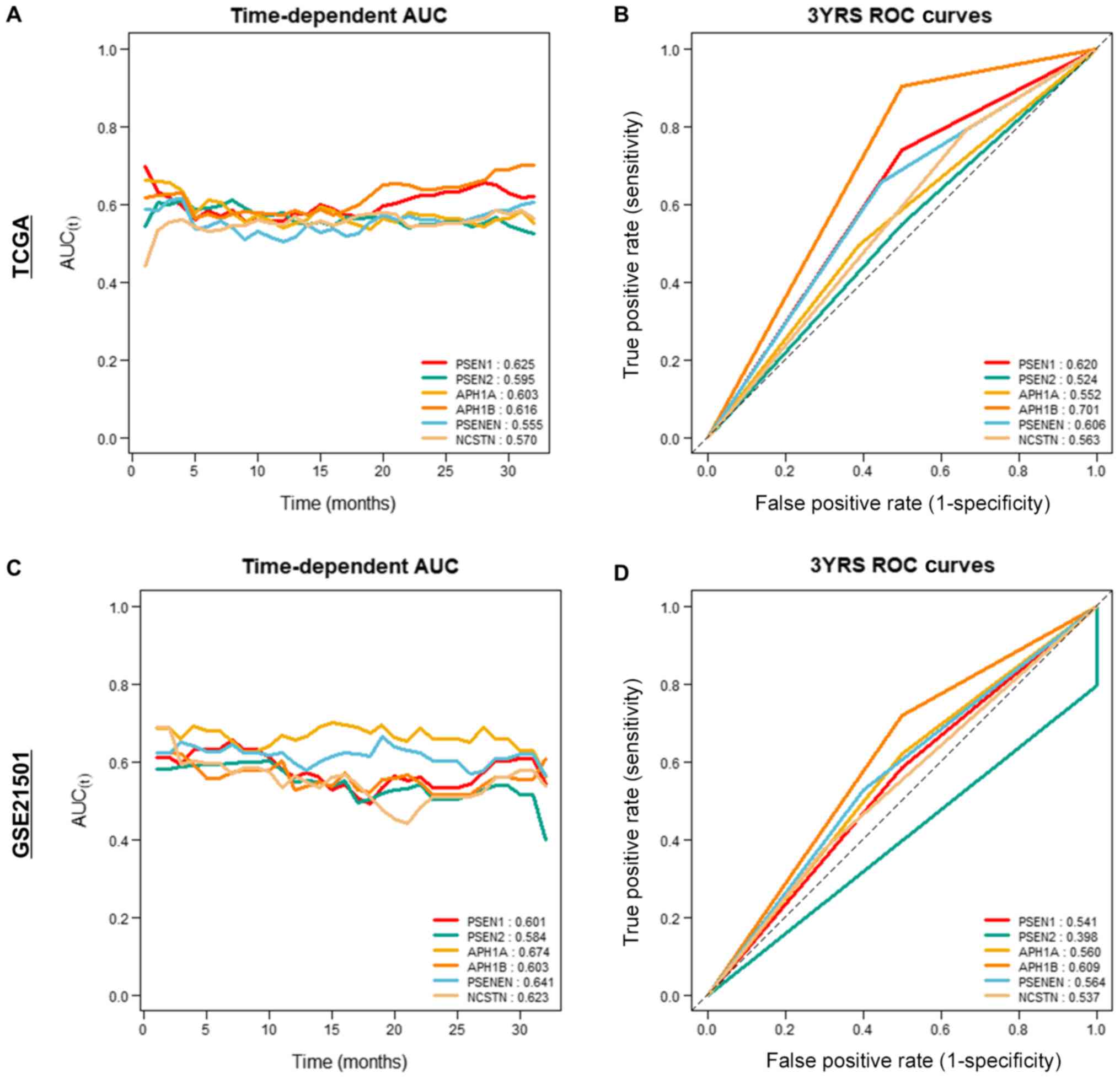
We compared γ-secretase genes in both cohorts to
evaluate their prognostic value. We analyzed the gene expression
values as continuous variables using Uno's C-indices and AUC values
at three years. APH1A had high C-index values in the two
independent cohorts compared to those of the other genes (Fig. 4). The three-year AUC value was also
significantly higher than that of the other factors across the two
cohorts (Fig. 4).
The differences of expression values
between normal and tumor tissues
By using Wilcoxon rank sum test, we compared the
expression of γ-secretase genes in three independent cohorts. As
shown in Table IV, the expression
patterns of the γ-secretase genes except APH1B and
NCSTN were statistically significant in agreement with the
three independent cohorts. APH1A, the only statistically
significant gene in survival curves, was found to be more expressed
in cancer tissues compared to normal tissues in the three cohorts
(Fig. 5 and Table IV).
| Table IV.Differences in gene expression
between cancerous and normal tissues. |
Table IV.
Differences in gene expression
between cancerous and normal tissues.
|
| GSE28735 | GSE15471 | GSE16515 |
|---|
|
|
|
|
|
|---|
| Genes | P-value | Cancer (mean) | Normal (mean) | P-value | Cancer (mean) | Normal (mean) | P-value | Cancer (mean) | Normal (mean) |
|---|
| PSEN1 | <0.001 | 6.462 | 5.932 | <0.001 | 5.677 | 5.503 | <0.001 | 85.603 | 50.961 |
| APH1A | <0.001 | 5.799 | 5.476 | 0.002 | 6.416 | 6.282 | <0.001 | 211.812 | 144.006 |
| PSENEN | <0.001 | 6.347 | 6.038 | 0.006 | 7.726 | 7.456 | <0.001 | 168.60 | 107.950 |
| NCSTN | 0.016 | 6.162 | 6.024 | <0.001 | 6.635 | 6.732 | 0.0501 | 154.240 | 134.207 |
| PSEN2 | <0.001 | 5.251 | 5.689 | <0.001 | 6.045 | 6.625 | 0.032 | 38.227 | 58.335 |
| APH1B | 0.41 | 5.123 | 5.035 | <0.001 | 6.952 | 6.688 | 0.504 | 57.535 | 60.265 |
Discussion
The present study investigated the prognostic
significance of γ-secretase genes in pancreatic cancer using two
independent cohorts each containing more than 100 patients.
Although the characteristics of the two cohorts were quite
different, high expression levels of PSEN1, APH1A, and
PSENEN were associated with a poor prognosis in both
cohorts. Especially, APH1A is the only statistically
significant gene in all analyses.
Owing to the poor survival rate of pancreatic
cancer, it is necessary to identify prognostic markers for patients
to determine the precise treatment strategy. Although certain
studies have attempted to predict the survival of patients with
pancreatic cancer based on clinical variables and/or expression
profiles, carbohydrate antigen 19-9 (CA-19-9) is the only biomarker
approved by the US Food and Drug Administration (FDA) (33,34). As
the development of genetics and the importance of data sharing have
been emphasized, relatively rare pancreatic cancer data have been
collected and released. For the implementation of precision
medicine, a number of cohorts and biomarkers verified in data from
many patients are needed. Hence, we included and analyzed cohorts
with more than 100 patients (21–23).
Notch signaling promotes the tumorigenesis of lung
cancer in the hypoxic state (12,35). In
breast cancer, this signaling has been implicated in tumorigenesis
(36–38). In this context, GSIs have been tested
for their therapeutic activity in cancer cell lines (breast and
lung) and several clinical trials (12,37,39).
Moreover, the activation of Notch signals has been implicated in
the progression of pancreatic cancer and MRK-003, a potent
pan-NOTCH inhibitor has been shown to be an effective treatment for
pancreatic adenocarcinoma (19). In
our study, as the expression of some Notch substrates (PSEN1,
APH1A, and PSENEN) increases, the prognosis of the
patient worsens. Also, their expression levels of cancer are
significantly higher than normal tissues. Thus, higher expression
of them may play a significant role in tumor progression in
pancreatic cancer. Our findings suggest that MRK-003 is in line
with findings that is effective in the suppression of pancreatic
cancer.
Some studies have reported that the different
composition of six γ-secretase subunits have various enzymatic
functions and cause varying physiological outcome. For instance,
some researchers suggested that complexes in which the PSEN1
and/or APH1A subunits were the major constituents could
cause Alzheimer's disease if PSEN2 and/or APH1B were
changed to a major member (40,41). In
the current study, APH1A, PSEN1, and PSENEN increased
in cancer tissues compared to normal tissues, while PSEN2
decreased and APH1B and NCSTN did not change. These
results suggested that they may play a role in the progression of
pancreatic cancer. Especially, APH1A is closely related to
survival, so APH1A is considered to play the most important
role in changed γ-secretase subunits. Therefore, in future studies
of pancreatic cancer, it will be necessary to study the role and
function of APH1A as a major component of γ-secretase.
In conclusion, we found that the survival rate of
patients with pancreatic cancer with high PSEN1, APH1A, and
PSENEN expression was low. Although further studies are
needed to assess the role of γ-secretase in tumorigenesis, our
findings suggest that some γ-secretase substrates, especially
APH1A, may have a critical role on the development and
progression of pancreatic cancer. We believe that these findings
will contribute to the prognostic prediction of pancreatic
cancer.
Acknowledgements
Not applicable.
Funding
This work was supported by Pusan National University
Research Grant, 2018 and the Basic Science Research Program through
a National Research Foundation of Korea (NRF) grant funded by the
Korean government (MOE; grant no. NRF-2016R1A2B4014593). It was
also supported by the Medical Research Center Program through the
National Research Foundation of Korea grant funded by the Korea
government (MSIP; grant no. NRF-2015R1A5A2009656).
Availability of data and materials
The datasets used and/or analyzed during the current
study are available from the corresponding author on reasonable
request.
Authors' contributions
YHJ and MH analyzed data and wrote the manuscript.
SWK, MJK and MEH collected the data. MH performed the statistical
analysis. MEH contributed to the conception of the study. CSL and
CKO performed the statistical analysis. SOO and YHK conceived and
designed the study, supervised the project and gave final approval
of the version to be published. All authors read and approved the
final manuscript.
Ethics approval and consent to
participate
Not applicable.
Patient consent for publication
Not applicable.
Competing interest
The authors declare that they have no conflict of
interest.
References
|
1
|
Kleeff J, Michalski C, Friess H and
Büchler MW: Pancreatic cancer: From bench to 5-year survival.
Pancreas. 33:111–118. 2006. View Article : Google Scholar : PubMed/NCBI
|
|
2
|
Kwon HJ and Kim SG: Surgical treatment for
advanced pancreatic cancer. Korean J Hepatobiliary Pancreat Surg.
16:89–92. 2012. View Article : Google Scholar : PubMed/NCBI
|
|
3
|
Lowenfels AB and Maisonneuve P:
Epidemiology and risk factors for pancreatic cancer. Best Pract Res
Clin Gastroenterol. 20:197–209. 2006. View Article : Google Scholar : PubMed/NCBI
|
|
4
|
Yeo CJ, Cameron JL, Lillemoe KD, Sitzmann
JV, Hruban RH, Goodman SN, Dooley WC, Coleman J and Pitt HA:
Pancreaticoduodenectomy for cancer of the head of the pancreas. 201
patients. Ann Surg. 221:721–733. 1995. View Article : Google Scholar : PubMed/NCBI
|
|
5
|
Eto S, Ishikawa M, Asanoma M, Tashiro Y,
Matsuyama K and Oshio T: A long-term survival case of advanced
biliary cancer with repeated resection due to recurrence in the
pancreaticogastrostomy site after pancreaticoduodenectomy. Ann
Hepatobiliary Pancreat Surg. 22:173–177. 2018. View Article : Google Scholar : PubMed/NCBI
|
|
6
|
Kim HS, Jang JY, Han Y, Lee KB, Joo I, Lee
DH, Kim JR, Kim H, Kwon W and Kim SW: Survival outcome and
prognostic factors of neoadjuvant treatment followed by resection
for borderline resectable pancreatic cancer. Ann Surg Treat Res.
93:186–194. 2017. View Article : Google Scholar : PubMed/NCBI
|
|
7
|
Arnedos M, Vicier C, Loi S, Lefebvre C,
Michiels S, Bonnefoi H and Andre F: Precision medicine for
metastatic breast cancer-limitations and solutions. Nat Rev Clin
Oncol. 12:693–704. 2015. View Article : Google Scholar : PubMed/NCBI
|
|
8
|
Friedman AA, Letai A, Fisher DE and
Flaherty KT: Precision medicine for cancer with next-generation
functional diagnostics. Nat Rev Cancer. 15:747–756. 2015.
View Article : Google Scholar : PubMed/NCBI
|
|
9
|
Selkoe D and Kopan R: Notch and
presenilin: Regulated intramembrane proteolysis links development
and degeneration. Annu Rev Neurosci. 26:565–597. 2003. View Article : Google Scholar : PubMed/NCBI
|
|
10
|
Zhao G, Liu Z, Ilagan MX and Kopan R:
Gamma-secretase composed of PS1/Pen2/Aph1a can cleave notch and
amyloid precursor protein in the absence of nicastrin. J Neurosci.
30:1648–1656. 2010. View Article : Google Scholar : PubMed/NCBI
|
|
11
|
De Strooper B: Aph-1, Pen-2, and Nicastrin
with Presenilin generate an active gamma-Secretase complex. Neuron.
38:9–12. 2003. View Article : Google Scholar : PubMed/NCBI
|
|
12
|
Ran Y, Hossain F, Pannuti A, Lessard CB,
Ladd GZ, Jung JI, Minter LM, Osborne BA, Miele L and Golde TE:
γ-Secretase inhibitors in cancer clinical trials are
pharmacologically and functionally distinct. EMBO Mol Med.
9:950–966. 2017. View Article : Google Scholar : PubMed/NCBI
|
|
13
|
Halawany AME, Sayed NSE, Abdallah HM and
Dine RSE: Protective effects of gingerol on streptozotocin-induced
sporadic Alzheimer's disease: Emphasis on inhibition of β-amyloid,
COX-2, alpha-, beta-secretases and APH1a. Sci Rep. 7:29022017.
View Article : Google Scholar : PubMed/NCBI
|
|
14
|
Penton AL, Leonard LD and Spinner NB:
Notch signaling in human development and disease. Semin Cell Dev
Biol. 23:450–457. 2012. View Article : Google Scholar : PubMed/NCBI
|
|
15
|
International Cancer Genome Consortium, ;
Hudson TJ, Anderson W, Artez A, Barker AD, Bell C, Bernabé RR, Bhan
MK, Calvo F, Eerola I, et al: International network of cancer
genome projects. Nature. 464:993–998. 2010. View Article : Google Scholar : PubMed/NCBI
|
|
16
|
Shih IeM and Wang TL: Notch signaling,
gamma-secretase inhibitors, and cancer therapy. Cancer Res.
67:1879–1882. 2007. View Article : Google Scholar : PubMed/NCBI
|
|
17
|
Takebe N, Nguyen D and Yang SX: Targeting
notch signaling pathway in cancer: Clinical development advances
and challenges. Pharmacol Ther. 141:140–149. 2014. View Article : Google Scholar : PubMed/NCBI
|
|
18
|
Yuan X, Wu H, Xu H, Xiong H, Chu Q, Yu S,
Wu GS and Wu K: Notch signaling: An emerging therapeutic target for
cancer treatment. Cancer Lett. 369:20–27. 2015. View Article : Google Scholar : PubMed/NCBI
|
|
19
|
Mizuma M, Rasheed ZA, Yabuuchi S, Omura N,
Campbell NR, de Wilde RF, De Oliveira E, Zhang Q, Puig O, Matsui W,
et al: The gamma secretase inhibitor MRK-003 attenuates pancreatic
cancer growth in preclinical models. Mol Cancer Ther. 11:1999–2009.
2012. View Article : Google Scholar : PubMed/NCBI
|
|
20
|
So JY, Wahler J, Das Gupta S, Salerno DM,
Maehr H, Uskokovic M and Suh N: HES1-mediated inhibition of Notch1
signaling by a Gemini vitamin D analog leads to decreased
CD44(+)/CD24(−/low) tumor-initiating subpopulation in basal-like
breast cancer. J Steroid Biochem Mol Biol. 148:111–121. 2015.
View Article : Google Scholar : PubMed/NCBI
|
|
21
|
Cancer Genome Atlas Research Network, ;
Weinstein JN, Collisson EA, Mills GB, Shaw KR, Ozenberger BA,
Ellrott K, Shmulevich I, Sander C and Stuart JM: The cancer genome
atlas pan-cancer analysis project. Nat Genet. 45:1113–1120. 2013.
View Article : Google Scholar : PubMed/NCBI
|
|
22
|
Cerami E, Gao J, Dogrusoz U, Gross BE,
Sumer SO, Aksoy BA, Jacobsen A, Byrne CJ, Heuer ML, Larsson E, et
al: The cBio cancer genomics portal: An open platform for exploring
multidimensional cancer genomics data. Cancer Discov. 2:401–404.
2012. View Article : Google Scholar : PubMed/NCBI
|
|
23
|
Stratford JK, Bentrem DJ, Anderson JM, Fan
C, Volmar KA, Marron JS, Routh ED, Caskey LS, Samuel JC, Der CJ, et
al: A six-gene signature predicts survival of patients with
localized pancreatic ductal adenocarcinoma. PLoS Med.
7:e10003072010. View Article : Google Scholar : PubMed/NCBI
|
|
24
|
Badea L, Herlea V, Dima SO, Dumitrascu T
and Popescu I: Combined gene expression analysis of whole-tissue
and microdissected pancreatic ductal adenocarcinoma identifies
genes specifically overexpressed in tumor epithelia.
Hepatogastroenterology. 55:2016–2027. 2008.PubMed/NCBI
|
|
25
|
Pei H, Li L, Fridley BL, Jenkins GD,
Kalari KR, Lingle W, Petersen G, Lou Z and Wang L: FKBP51 affects
cancer cell response to chemotherapy by negatively regulating Akt.
Cancer Cell. 16:259–266. 2009. View Article : Google Scholar : PubMed/NCBI
|
|
26
|
Zhang G, He P, Tan H, Budhu A, Gaedcke J,
Ghadimi BM, Ried T, Yfantis HG, Lee DH, Maitra A, et al:
Integration of metabolomics and transcriptomics revealed a fatty
acid network exerting growth inhibitory effects in human pancreatic
cancer. Clin Cancer Res. 19:4983–4993. 2013. View Article : Google Scholar : PubMed/NCBI
|
|
27
|
Amin MB, Greene FL, Edge SB, Compton CC,
Gershenwald JE, Brookland RK, Meyer L, Gress DM, Byrd DR and
Winchester DP: The Eighth Edition AJCC Cancer Staging Manual:
Continuing to build a bridge from a population-based to a more
‘personalized’ approach to cancer staging. CA Cancer J Clin.
67:93–99. 2017. View Article : Google Scholar : PubMed/NCBI
|
|
28
|
Cho SH, Pak K, Jeong DC, Han ME, Oh SO and
Kim YH: The AP2M1 gene expression is a promising biomarker for
predicting survival of patients with hepatocellular carcinoma. J
Cell Biochem. 120:4140–4146. 2019. View Article : Google Scholar : PubMed/NCBI
|
|
29
|
Ha M, Kim JY, Han ME, Kim GH, Park SY,
Jeong DC, Oh SO and Kim YH: TMEM18: A novel prognostic marker in
acute myeloid leukemia. Acta Haematol. 140:71–76. 2018. View Article : Google Scholar : PubMed/NCBI
|
|
30
|
Han ME, Kim JY, Kim GH, Park SY, Kim YH
and Oh SO: SAC3D1: A novel prognostic marker in hepatocellular
carcinoma. Sci Rep. 8:156082018. View Article : Google Scholar : PubMed/NCBI
|
|
31
|
Goh TS, Lee JS, Il Kim J, Park YG, Pak K,
Jeong DC, Oh SO and Kim YH: Prognostic scoring system for
osteosarcoma using network-regularized high-dimensional
Cox-regression analysis and potential therapeutic targets. J Cell
Physiol. Jan 3–2019.(Epub ahead of print). View Article : Google Scholar : PubMed/NCBI
|
|
32
|
Ha M, Han ME, Kim JY, Jeong DC, Oh SO and
Kim YH: Prognostic role of TPD52 in acute myeloid leukemia: A
retrospective multicohort analysis. J Cell Biochem. 120:3672–3678.
2019. View Article : Google Scholar : PubMed/NCBI
|
|
33
|
Fong ZV and Winter JM: Biomarkers in
pancreatic cancer: Diagnostic, prognostic, and predictive. Cancer
J. 18:530–538. 2012. View Article : Google Scholar : PubMed/NCBI
|
|
34
|
Winter JM, Yeo CJ and Brody JR:
Diagnostic, prognostic, and predictive biomarkers in pancreatic
cancer. J Surg Oncol. 107:15–22. 2013. View Article : Google Scholar : PubMed/NCBI
|
|
35
|
Chen Y, De Marco MA, Graziani I, Gazdar
AF, Strack PR, Miele L and Bocchetta M: Oxygen concentration
determines the biological effects of NOTCH-1 signaling in
adenocarcinoma of the lung. Cancer Res. 67:7954–7959. 2007.
View Article : Google Scholar : PubMed/NCBI
|
|
36
|
Al-Hussaini H, Subramanyam D, Reedijk M
and Sridhar SS: Notch signaling pathway as a therapeutic target in
breast cancer. Mol Cancer Ther. 10:9–15. 2011. View Article : Google Scholar : PubMed/NCBI
|
|
37
|
Han J and Shen Q: Targeting γ-secretase in
breast cancer. Breast Cancer (Dove Med Press). 4:83–90.
2012.PubMed/NCBI
|
|
38
|
Harrison H, Farnie G, Brennan KR and
Clarke RB: Breast cancer stem cells: Something out of notching?
Cancer Res. 70:8973–8976. 2010. View Article : Google Scholar : PubMed/NCBI
|
|
39
|
Kondratyev M, Kreso A, Hallett RM,
Girgis-Gabardo A, Barcelon ME, Ilieva D, Ware C, Majumder PK and
Hassell JA: Gamma-secretase inhibitors target tumor-initiating
cells in a mouse model of ERBB2 breast cancer. Oncogene. 31:93–103.
2012. View Article : Google Scholar : PubMed/NCBI
|
|
40
|
Peltonen HM, Haapasalo A, Hiltunen M,
Kataja V, Kosma VM and Mannermaa A: Γ-secretase components as
predictors of breast cancer outcome. PLoS One. 8:e792492013.
View Article : Google Scholar : PubMed/NCBI
|
|
41
|
Placanica L, Tarassishin L, Yang G,
Peethumnongsin E, Kim SH, Zheng H, Sisodia SS and Li YM: Pen2 and
presenilin-1 modulate the dynamic equilibrium of presenilin-1 and
presenilin-2 gamma-secretase complexes. J Biol Chem. 284:2967–2977.
2009. View Article : Google Scholar : PubMed/NCBI
|