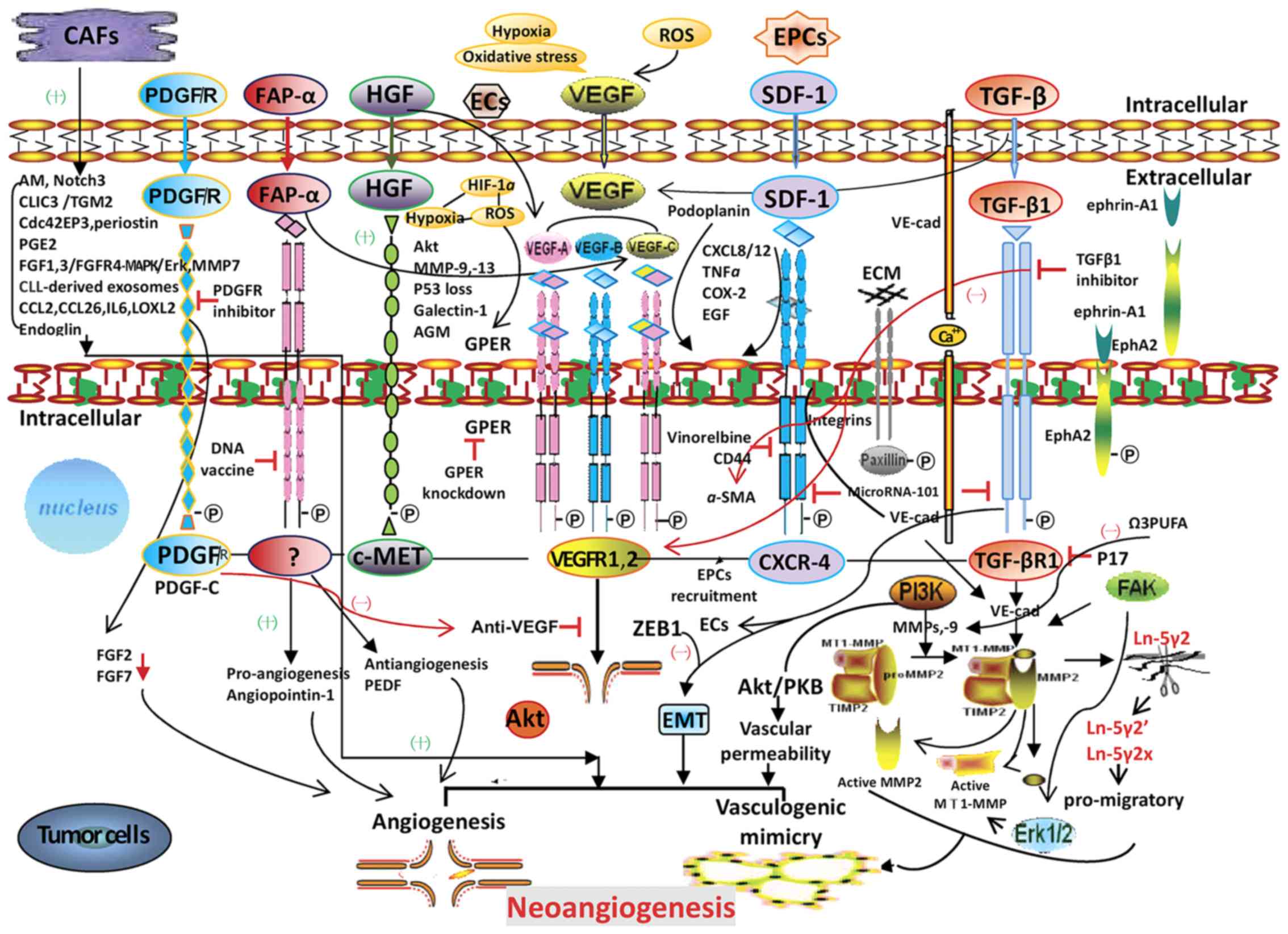
|
1
|
Folkman J: Anti-angiogenesis: New concept
for therapy of solid tumors. Ann Surg. 175:409–416. 1972.
View Article : Google Scholar : PubMed/NCBI
|
|
2
|
Huang G and Chen L: Tumor vasculature and
microenvironment normalization: A possible mechanism of
antiangiogenesis therapy. Cancer Biother Radiopharm. 23:661–667.
2008. View Article : Google Scholar : PubMed/NCBI
|
|
3
|
Maniotis AJ, Folberg R, Hess A, Seftor EA,
Gardner LM, Pe'er J, Trent JM, Meltzer PS and Hendrix MJ: Vascular
channel formation by human melanoma cells in vivo and in vitro:
Vasculogenic mimicry. Am J Pathol. 155:739–752. 1999. View Article : Google Scholar : PubMed/NCBI
|
|
4
|
Folberg R, Hendrix M and Maniotis A:
Vasculogenic mimicry and tumor angiogenesis. Am J Pathol.
156:361–381. 2000. View Article : Google Scholar : PubMed/NCBI
|
|
5
|
Senger D and Davis G: Angiogenesis. Cold
Spring Harb Perspect Biol. 3:a0050902011. View Article : Google Scholar : PubMed/NCBI
|
|
6
|
Rhee J and Hoff P: Angiogenesis inhibitors
in the treatment of cancer. Expert Opin Pharmacother. 6:1701–1711.
2005. View Article : Google Scholar : PubMed/NCBI
|
|
7
|
Fan YZ and Sun W: Molecular regulation of
vasculogenic mimicry in tumors and potential tumor-target therapy.
World J Gastrointest Surg. 2:117–127. 2010. View Article : Google Scholar : PubMed/NCBI
|
|
8
|
Chen HX and Cleck JN: Adverse effects of
anticancer agents that target the VEGF pathway. Nat Rev Clin Oncol.
6:465–477. 2009. View Article : Google Scholar : PubMed/NCBI
|
|
9
|
Higa GM and Abraham J: Biological
mechanisms of bevacizumab-associated adverse events. Expert Rev
Anticancer Ther. 9:999–1007. 2009. View Article : Google Scholar : PubMed/NCBI
|
|
10
|
Liotta LA and Kohn EC: The
microenvironment of the tumour-host interface. Nature. 411:375–379.
2001. View Article : Google Scholar : PubMed/NCBI
|
|
11
|
Reisfeld RA: The tumor microenvironment: A
target for combination therapy of breast cancer. Crit Rev Oncog.
18:115–133. 2013. View Article : Google Scholar : PubMed/NCBI
|
|
12
|
Micke P and Ostman A: Tumour-stroma
interaction: Cancer-associated fibroblasts as novel targets in
anti-cancer therapy? Lung Cancer. 45:(Suppl 2). S163–S175. 2004.
View Article : Google Scholar : PubMed/NCBI
|
|
13
|
Franco OE, Shaw AK, Strand DW and Hayward
SW: Cancer associated fibroblasts in cancer pathogenesis. Semin
Cell Dev Biol. 21:33–39. 2010. View Article : Google Scholar : PubMed/NCBI
|
|
14
|
O'Reilly MS: Antiangiogenesis and vascular
endothelial growth factor/vascular endothelial growth factor
receptor targeting as part of a combined-modality approach to the
treatment of cancer. Int J Radiat Oncol Biol Phys. 69:S64–S66.
2007. View Article : Google Scholar : PubMed/NCBI
|
|
15
|
Hajitou A, Sounni NE, Devy L,
Grignet-Debrus C, Lewalle JM, Li H, Deroanne C, Lu H, Colige A,
Nusgens BV, et al: Down-regulation of vascular endothelial growth
factor by tissue inhibitor of metalloproteinase-2: Effect on in
vivo mammary tumor growth and angiogenesis. Cancer Res.
61:3450–3457. 2001.PubMed/NCBI
|
|
16
|
Sato M, Arap W and Pasqualini R: Molecular
targets on blood vessels for cancer therapies in clinical trials.
Oncology (Williston Park). 21:1346–1355, 1367, 1370 passim.
2007.PubMed/NCBI
|
|
17
|
Zhang JT, Fan YZ, Chen CQ, Zhao ZM and Sun
W: Norcantharidin: A potential antiangiogenic agent for gallbladder
cancers in vitro and in vivo. Int J Oncol. 40:1501–1514.
2012.PubMed/NCBI
|
|
18
|
Ma J and Waxman DJ: Combination of
antiangiogenesis with chemotherapy for more effective cancer
treatment. Mol Cancer Ther. 7:3670–3684. 2008. View Article : Google Scholar : PubMed/NCBI
|
|
19
|
Kamrava M, Bernstein MB, Camphausen K and
Hodge J: Combining radiation, immunotherapy, and antiangiogenesis
agents in the management of cancer: The Three Musketeers or just
another quixotic combination? Mol Biosyst. 5:1262–1270. 2009.
View Article : Google Scholar : PubMed/NCBI
|
|
20
|
Frenkel S, Barzel I, Levy J, Lin AY,
Bartsch DJ, Majumdar D, Folberg R and Pe'er J: Demonstrating
circulation in vasculogenic mimicry patterns of uveal melanoma by
confocal indocyanine green angiography. Eye (Lond). 22:948–952.
2008. View Article : Google Scholar : PubMed/NCBI
|
|
21
|
Xu Y, Li Q, Li XY, Yang QY, Xu WW and Liu
GL: Short-term anti-vascular endothelial growth factor treatment
elicits vasculogenic mimicry formation of tumors to accelerate
metastasis. J Exp Clin Cancer Res. 31:162012. View Article : Google Scholar : PubMed/NCBI
|
|
22
|
Sun W, Fan YZ, Zhang WZ and Ge CY: A pilot
histomorphology and hemodynamic of vasculogenic mimicry in
gallbladder carcinomas in vivo and in vitro. J Exp Clin Cancer Res.
30:462011. View Article : Google Scholar : PubMed/NCBI
|
|
23
|
Lu XS, Sun W, Ge CY, Zhang WZ and Fan YZ:
Contribution of the PI3K/MMPs/Ln-5γ2 and EphA2/FAK/Paxillin
signaling pathways to tumor growth and vasculogenic mimicry of
gallbladder carcinomas. Int J Oncol. 42:2103–2115. 2013. View Article : Google Scholar : PubMed/NCBI
|
|
24
|
Zhang JT, Sun W, Zhang WZ, Ge CY, Liu ZY,
Zhao ZM, Lu XS and Fan YZ: Norcantharidin inhibits tumor growth and
vasculogenic mimicry of human gallbladder carcinomas by suppression
of the PI3-K/MMPs/Ln-5γ2 signaling pathway. BMC Cancer. 14:1932014.
View Article : Google Scholar : PubMed/NCBI
|
|
25
|
Wang H, Sun W, Zhang WZ, Ge CY, Zhang JT,
Liu ZY and Fan YZ: Inhibition of tumor vasculogenic mimicry and
prolongation of host survival in highly aggressive gallbladder
cancers by norcantharidin via blocking the ephrin type a receptor
2/focal adhesion kinase/paxillin signaling pathway. PLoS One.
9:e969822014. View Article : Google Scholar : PubMed/NCBI
|
|
26
|
Zhu W, Sun W, Zhang JT, Liu ZY, Li XP and
Fan YZ: Norcantharidin enhances TIMP-2 anti-vasculogenic mimicry
activity for human gallbladder cancers through downregulating MMP-2
and MT1-MMP. Int J Oncol. 46:627–640. 2015. View Article : Google Scholar : PubMed/NCBI
|
|
27
|
Han H, Du L, Cao Z, Zhang B and Zhou Q:
Triptonide potently suppresses pancreatic cancer cell-mediated
vasculogenic mimicry by inhibiting expression of VE-cadherin and
chemokine ligand 2 genes. Eur J Pharmacol. 818:593–603. 2018.
View Article : Google Scholar : PubMed/NCBI
|
|
28
|
Chen J, Zhao M, Zhisheng Z, Lin C, Yayun
Q, Xuanyi W, Feng J, Haibo W, Youyang S, Tadashi H, et al: COE
inhibits vasculogenic mimicry in hepatocellular carcinoma via
suppressing Notch1 signaling. J Ethnopharmacol. 208:165–173. 2017.
View Article : Google Scholar : PubMed/NCBI
|
|
29
|
Zhang F, Zhang CM, Li S, Wang KK, Guo BB,
Fu Y, Liu LY, Zhang Y, Jiang HY and Wu CJ: Low dosage of arsenic
trioxide inhibits vasculogenic mimicry in hepatoblastoma without
cell apoptosis. Mol Med Rep. 17:1573–1582. 2018.PubMed/NCBI
|
|
30
|
Li S, Zhang Q, Zhou L, Guan Y, Chen S,
Zhang Y and Han X: Inhibitory effects of compound DMBT on
hypoxia-induced vasculogenic mimicry in human breast cancer. Biomed
Pharmacother. 96:982–992. 2017. View Article : Google Scholar : PubMed/NCBI
|
|
31
|
Angara K, Rashid MH, Shankar A, Ara R,
Iskander A, Borin TF, Jain M, Achyut BR and Arbab AS: Vascular
mimicry in glioblastoma following anti-angiogenic and anti-20-HETE
therapies. Histol Histopathol. 32:917–928. 2017.PubMed/NCBI
|
|
32
|
Xue W, Du XS, Wu H, Liu H, Xie T, Tong HP,
Chen X, Guo Y and Zhang WG: Aberrant glioblastoma
neovascularization patterns and their correlation with
DCE-MRI-derived parameters following temozolomide and bevacizumab
treatment. Sci Rep. 7:138942017. View Article : Google Scholar : PubMed/NCBI
|
|
33
|
Zang M, Hu L, Zhang B, Zhu Z, Li J, Zhu Z,
Yan M and Liu B: Luteolin suppresses angiogenesis and vasculogenic
mimicry formation through inhibiting Notchl-VEGF signaling in
gastric cancer. Biochem Biophys Res Commun. 490:913–919. 2017.
View Article : Google Scholar : PubMed/NCBI
|
|
34
|
Liu W, Lv C, Zhang B, Zhou Q and Cao Z:
MicroRNA-27b functions as a new inhibitor of ovarian
cancer-mediated vasculogenic mimicry through suppression of
VE-cadherin expression. RNA. 23:1019–1027. 2017. View Article : Google Scholar : PubMed/NCBI
|
|
35
|
Orimo A, Gupta P, Sgroi D,
Arenzana-Seisdedos F, Delaunay T, Naeem R, Carey V, Richardson A
and Weinberg R: Stromal fibroblasts present in invasive human
breast carcinomas promote tumor growth and angiogenesis through
elevated SDF-1/CXCL12 secretion. Cell. 121:335–348. 2005.
View Article : Google Scholar : PubMed/NCBI
|
|
36
|
Sugimoto H, Mundel T, Kieran M and Kalluri
R: Identification of fibroblast heterogeneity in the tumor
microenvironment. Cancer Biol Ther. 5:1640–1646. 2006. View Article : Google Scholar : PubMed/NCBI
|
|
37
|
Johansson A, Ansell A, Jerhammar F, Lindh
M, Grénman R, Munck-Wikland E, Östman A and Roberg K:
Cancer-associated fibroblasts induce matrix
metalloproteinase-mediated cetuximab resistance in head and neck
squamous cell carcinoma cells. Mol Cancer Res. 10:1158–1168. 2012.
View Article : Google Scholar : PubMed/NCBI
|
|
38
|
Affolter A, Schmidtmann I, Mann WJ and
Brieger J: Cancer-associated fibroblasts do not respond to combined
irradiation and kinase inhibitor treatment. Oncol Rep. 29:785–790.
2013. View Article : Google Scholar : PubMed/NCBI
|
|
39
|
Al-Ansari MM, Hendrayani SF, Tulbah A,
Al-Tweigeri T, Shehata AL and Aboussekhra A: p16INK4A represses
breast stromal fibroblasts migration/invasion and their
VEGF-A-dependent promotion of angiogenesis through Akt inhibition.
Neoplasia. 14:1269–1277. 2012. View Article : Google Scholar : PubMed/NCBI
|
|
40
|
Gao Q, Wang XY, Qiu SJ, Zhou J, Shi YH,
Zhang BH and Fan J: Tumor stroma reaction-related gene signature
predicts clinical outcome in human hepatocellular carcinoma. Cancer
Sci. 102:1522–1531. 2011. View Article : Google Scholar : PubMed/NCBI
|
|
41
|
Herrera M, Herrera A, Domínguez G, Silva
J, García V, García J, Gómez I, Soldevilla B, Muñoz C, Provencio M,
et al: Cancer-associated fibroblast and M2 macrophage markers
together predict outcome in colorectal cancer patients. Cancer Sci.
104:437–444. 2013. View Article : Google Scholar : PubMed/NCBI
|
|
42
|
Madar S, Goldstein I and Rotter V: ‘Cancer
associated fibroblasts’ -more than meets the eye. Trends Mol Med.
19:447–453. 2013. View Article : Google Scholar : PubMed/NCBI
|
|
43
|
Gonda TA, Varro A, Wang TC and Tycko B:
Molecular biology of cancer-associated fibroblasts: Can these cells
be targeted in anti-cancer therapy? Semin Cell Dev Biol. 21:2–10.
2010. View Article : Google Scholar : PubMed/NCBI
|
|
44
|
Mertens J, Fingas CD, Christensen JD,
Smoot RL, Bronk SF, Werneburg NW, Gustafson MP, Dietz AB, Roberts
LR, Sirica AE and Gores GJ: Therapeutic effects of deleting
cancer-associated fibroblasts in cholangiocarcinoma. Cancer Res.
73:897–907. 2013. View Article : Google Scholar : PubMed/NCBI
|
|
45
|
Olive KP, Jacobetz MA, Davidson CJ,
Gopinathan A, McIntyre D, Honess D, Madhu B, Goldgraben MA,
Caldwell ME, Allard D, et al: Inhibition of Hedgehog signaling
enhances delivery of chemotherapy in a mouse model of pancreatic
cancer. Science. 324:1457–1461. 2009. View Article : Google Scholar : PubMed/NCBI
|
|
46
|
Fukumura D, Xavier R, Sugiura T, Chen Y,
Park EC, Lu N, Selig M, Nielsen G, Taksir T, Jain RK and Seed B:
Tumor induction of VEGF promoter activity in stromal cells. Cell.
94:715–725. 1998. View Article : Google Scholar : PubMed/NCBI
|
|
47
|
Okabe H, Beppu T, Hayashi H, Ishiko T,
Masuda T, Otao R, Horlad H, Jono H, Ueda M, Shinriki S, et al:
Hepatic stellate cells accelerate the malignant behavior of
cholangiocarcinoma cells. Ann Surg Oncol. 18:1175–1184. 2011.
View Article : Google Scholar : PubMed/NCBI
|
|
48
|
Guo X, Oshima H, Kitmura T, Taketo M and
Oshima M: Stromal fibroblasts activated by tumor cells promote
angiogenesis in mouse gastric cancer. J Biol Chem. 283:19864–19871.
2008. View Article : Google Scholar : PubMed/NCBI
|
|
49
|
Vartanian AA, Burova OS, Stepanova EV,
Baryshnikov AY and Lichinitser MR: Melanoma vasculogenic mimicry is
strongly related to reactive oxygen species level. Melanoma Res.
17:370–379. 2007. View Article : Google Scholar : PubMed/NCBI
|
|
50
|
Liu Z, Sun B, Qi L, Li H, Gao J and Leng
X: Zinc finger E-box binding homeobox 1 promotes vasculogenic
mimicry in colorectal cancer through induction of
epithelial-to-mesenchymal transition. Cancer Sci. 103:813–820.
2012. View Article : Google Scholar : PubMed/NCBI
|
|
51
|
Carmeliet P and Jain R: Molecular
mechanisms and clinical applications of angiogenesis. Nature.
473:298–307. 2011. View Article : Google Scholar : PubMed/NCBI
|
|
52
|
Noma K, Smalley KS, Lioni M, Naomoto Y,
Tanaka N, El-Deiry W, King AJ, Nakagawa H and Herlyn M: The
essential role of fibroblasts in esophageal squamous cell
carcinoma-induced angiogenesis. Gastroenterology. 134:1981–1993.
2008. View Article : Google Scholar : PubMed/NCBI
|
|
53
|
Suzuki H, Onimaru M, Yonemitsu Y, Maehara
Y, Nakamura S and Sueishi K: Podoplanin in cancer cells is
experimentally able to attenuate prolymphangiogenic and
lymphogenous metastatic potentials of lung squamoid cancer cells.
Mol Cancer. 9:2872010. View Article : Google Scholar : PubMed/NCBI
|
|
54
|
Schoppmann SF, Jesch B, Riegler MF,
Maroske F, Schwameis K, Jomrich G and Birner P: Podoplanin
expressing cancer associated fibroblasts are associated with
unfavourable prognosis in adenocarcinoma of the esophagus. Clin Exp
Metastasis. 30:441–446. 2013. View Article : Google Scholar : PubMed/NCBI
|
|
55
|
Pula B, Jethon A, Piotrowska A,
Gomulkiewicz A, Owczarek T, Calik J, Wojnar A, Witkiewicz W, Rys J,
Ugorski M, et al: Podoplanin expression by cancer-associated
fibroblasts predicts poor outcome in invasive ductal breast
carcinoma. Histopathology. 59:1249–1260. 2011. View Article : Google Scholar : PubMed/NCBI
|
|
56
|
Pula B, Wojnar A, Witkiewicz W, Dziegiel P
and Podhorska-Okolow M: Podoplanin expression in cancer-associated
fibroblasts correlates with VEGF-C expression in cancer cells of
invasive ductal breast carcinoma. Neoplasma. 60:516–524. 2013.
View Article : Google Scholar : PubMed/NCBI
|
|
57
|
Tang D, Yuan Z, Xue X, Lu Z, Zhang Y, Wang
H, Chen M, An Y, Wei J, Zhu Y, et al: High expression of Galectin-1
in pancreatic stellate cells plays a role in the development and
maintenance of an immunosuppressive microenvironment in pancreatic
cancer. Int J Cancer. 130:2337–2348. 2012. View Article : Google Scholar : PubMed/NCBI
|
|
58
|
Wu MH, Hong TM, Cheng HW, Pan SH, Liang
YR, Hong HC, Chiang WF, Wong TY, Shieh DB, Shiau AL, et al:
Galectin-1-mediated tumor invasion and metastasis, up-regulated
matrix metalloproteinase expression, and reorganized actin
cytoskeletons. Mol Cancer Res. 7:311–318. 2009. View Article : Google Scholar : PubMed/NCBI
|
|
59
|
Thijssen VL, Postel R, Brandwijk RJ, Dings
RP, Nesmelova I, Satijn S, Verhofstad N, Nakabeppu Y, Baum L,
Bakkers J, et al: Galectin-1 is essential in tumor angiogenesis and
is a target for antiangiogenesis therapy. Proc Natl Acad Sci USA.
103:15975–15980. 2006. View Article : Google Scholar : PubMed/NCBI
|
|
60
|
Bektas S, Bahadir B, Ucan BH and Ozdamar
SO: CD24 and galectin-1 expressions in gastric adenocarcinoma and
clinicopathologic significance. Pathol Oncol Res. 16:569–577. 2010.
View Article : Google Scholar : PubMed/NCBI
|
|
61
|
Tang D, Gao J, Wang S, Ye N, Chong Y,
Huang Y, Wang J, Li B, Yin W and Wang D: Cancer-associated
fibroblasts promote angiogenesis in gastric cancer through
galectin-1 expression. Tumour Biol. 37:1889–1899. 2016. View Article : Google Scholar : PubMed/NCBI
|
|
62
|
Hooper AT, Shmelkov SV, Gupta S, Milde T,
Bambino K, Gillen K, Goetz M, Chavala S, Baljevic M, Murphy A, et
al: Angiomodulin is a specific marker of vasculature and regulates
vascular endothelial growth factor-A-dependent neoangiogenesis.
Circ Res. 105:201–208. 2009. View Article : Google Scholar : PubMed/NCBI
|
|
63
|
Komiya E, Furuya M, Watanabe N, Miyagi Y,
Higashi S and Miyazaki K: Elevated expression of angiomodulin
(AGM/IGFBP-rP1) in tumor stroma and its roles in fibroblast
activation. Cancer Sci. 103:691–699. 2012. View Article : Google Scholar : PubMed/NCBI
|
|
64
|
Komiya E, Sato H, Watanabe N, Ise M,
Higashi S, Miyagi Y and Miyazaki K: Angiomodulin, a marker of
cancer vasculature, is upregulated by vascular endothelial growth
factor and increases vascular permeability as a ligand of integrin
αvβ3. Cancer Med. 3:537–549. 2014. View Article : Google Scholar : PubMed/NCBI
|
|
65
|
Ren J, Guo H, Wu H, Tian T, Dong D, Zhang
Y, Sui Y, Zhang Y, Zhao D, Wang S, et al: GPER in CAFs regulates
hypoxia-driven breast cancer invasion in a CTGF-dependent manner.
Oncol Rep. 33:1929–1937. 2015. View Article : Google Scholar : PubMed/NCBI
|
|
66
|
De Francesco E, Lappano R, Santolla M,
Marsico S, Caruso A and Maggiolini M: HIF-1α/GPER signaling
mediates the expression of VEGF induced by hypoxia in breast cancer
associated fibroblasts (CAFs). Breast Cancer Res. 15:R642013.
View Article : Google Scholar : PubMed/NCBI
|
|
67
|
Hayashi Y, Tsujii M, Kodama T, Akasaka T,
Kondo J, Hikita H, Inoue T, Tsujii Y, Maekawa A, Yoshii S, et al:
p53 functional deficiency in human colon cancer cells promotes
fibroblast-mediated angiogenesis and tumor growth. Carcinogenesis.
37:972–984. 2016. View Article : Google Scholar : PubMed/NCBI
|
|
68
|
Jo M, Nishikawa T, Nakajima T, Okada Y,
Yamaguchi K, Mitsuyoshi H, Yasui K, Minami M, Iwai M, Kagawa K, et
al: Oxidative stress is closely associated with tumor angiogenesis
of hepatocellular carcinoma. J Gastroenterol. 46:809–821. 2011.
View Article : Google Scholar : PubMed/NCBI
|
|
69
|
Wang S, Ma N, Kawanishi S, Hiraku Y,
Oikawa S, Xie Y, Zhang Z, Huang G and Murata M: Relationships of
alpha-SMA-positive fibroblasts and SDF-1-positive tumor cells with
neoangiogenesis in nasopharyngeal carcinoma. Biomed Res Int 2014.
5073532014.
|
|
70
|
Orimo A and Weinberg R: Stromal
fibroblasts in cancer: A novel tumor-promoting cell type. Cell
Cycle. 5:1597–1601. 2006. View Article : Google Scholar : PubMed/NCBI
|
|
71
|
Matsuo Y, Ochi N, Sawai H, Yasuda A,
Takahashi H, Funahashi H, Takeyama H, Tong Z and Guha S: CXCL8/IL-8
and CXCL12/SDF-1 alpha co-operatively promote invasiveness and
angiogenesis in pancreatic cancer. Int J Cancer. 124:853–861. 2009.
View Article : Google Scholar : PubMed/NCBI
|
|
72
|
Yang J, Lu Y, Lin YY, Zheng ZY, Fang JH,
He S and Zhuang SM: Vascular mimicry formation is promoted by
paracrine TGF-β and SDF1 of cancer-associated fibroblasts and
inhibited by miR-101 in hepatocellular carcinoma. Cancer Lett.
383:18–27. 2016. View Article : Google Scholar : PubMed/NCBI
|
|
73
|
Fang D, Sun L, Lin S, Zhou L, Su N, Yuan S
and Yu B: Vinorelbine inhibits angiogenesis and 95D migration via
reducing hypoxic fibroblast stromal cell-derived factor 1
secretion. Exp Biol Med (Maywood). 237:1045–1055. 2012. View Article : Google Scholar : PubMed/NCBI
|
|
74
|
Zhou B, Zhuang XM, Wang YY, Lin ZY, Zhang
DM, Fan S, Li JS and Chen WL: Tumor necrosis factor α induces
myofibroblast differentiation in human tongue cancer and promotes
invasiveness and angiogenesis via secretion of stromal cell-derived
factor-1. Oral Oncol. 51:1095–1102. 2015. View Article : Google Scholar : PubMed/NCBI
|
|
75
|
Katoh H, Hosono K, Ito Y, Suzuki T, Ogawa
Y, Kubo H, Kamata H, Mishima T, Tamaki H, Sakagami H, et al: COX-2
and prostaglandin EP3/EP4 signaling regulate the tumor stromal
proangiogenic microenvironment via CXCL12-CXCR4 chemokine systems.
Am J Pathol. 176:1469–1483. 2010. View Article : Google Scholar : PubMed/NCBI
|
|
76
|
Massagué J: TGFβ signalling in context.
Nat Rev Mol Cell Biol. 13:616–630. 2012. View Article : Google Scholar : PubMed/NCBI
|
|
77
|
Meulmeester E and Ten Dijke P: The dynamic
roles of TGF-β in cancer. J Pathol. 223:205–218. 2011. View Article : Google Scholar : PubMed/NCBI
|
|
78
|
Sánchez-Elsner T, Botella L, Velasco B,
Corbí A, Attisano L and Bernabéu C: Synergistic cooperation between
hypoxia and transforming growth factor-beta pathways on human
vascular endothelial growth factor gene expression. J Biol Chem.
276:38527–38535. 2001. View Article : Google Scholar : PubMed/NCBI
|
|
79
|
Schnegg C, Yang MH, Ghosh SK and Hsu MY:
Induction of vasculogenic mimicry overrides VEGF-A silencing and
enriches stem-like cancer cells in melanoma. Cancer Res.
75:1682–1690. 2015. View Article : Google Scholar : PubMed/NCBI
|
|
80
|
Seftor RE, Hess AR, Seftor EA, Kirschmann
DA, Hardy KM, Margaryan NV and Hendrix MJ: Tumor cell vasculogenic
mimicry: From controversy to therapeutic promise. Am J Pathol.
181:1115–1125. 2012. View Article : Google Scholar : PubMed/NCBI
|
|
81
|
Kirschmann DA, Seftor EA, Hardy KM, Seftor
RE and Hendrix MJ: Molecular pathways: Vasculogenic mimicry in
tumor cells: Diagnostic and therapeutic implications. Clin Cancer
Res. 18:2726–2732. 2012. View Article : Google Scholar : PubMed/NCBI
|
|
82
|
Barcellos-de-Souza P, Comito G,
Pons-Segura C, Taddei ML, Gori V, Becherucci V, Bambi F, Margheri
F, Laurenzana A, Del Rosso M, et al: Mesenchymal stem cells are
recruited and activated into carcinoma-associated fibroblasts by
prostate cancer microenvironment-derived TGF-β1. Stem Cells.
34:2536–2547. 2016. View Article : Google Scholar : PubMed/NCBI
|
|
83
|
Gonzalez-Zubeldia I, Dotor J, Redrado M,
Bleau A, Manrique I, de Aberasturi A, Villalba M and Calvo A:
Co-migration of colon cancer cells and CAFs induced by TGFβ1
enhances liver metastasis. Cell Tissue Res. 359:829–839. 2015.
View Article : Google Scholar : PubMed/NCBI
|
|
84
|
Xu Z, Wang S, Wu M, Zeng W, Wang X and
Dong Z: TGFβ1 and HGF protein secretion by esophageal squamous
epithelial cells and stromal fibroblasts in oesophageal
carcinogenesis. Oncol Lett. 6:401–406. 2013. View Article : Google Scholar : PubMed/NCBI
|
|
85
|
Saito H, Tsujitani S, Oka S, Kondo A,
Ikeguchi M, Maeta M and Kaibara N: The expression of transforming
growth factor-beta1 is significantly correlated with the expression
of vascular endothelial growth factor and poor prognosis of
patients with advanced gastric carcinoma. Cancer. 86:1455–1462.
1999. View Article : Google Scholar : PubMed/NCBI
|
|
86
|
Xu LN, Xu BN, Cai J, Yang JB and Lin N:
Tumor-associated fibroblast-conditioned medium promotes tumor cell
proliferation and angiogenesis. Genet Mol Res. 12:5863–5871. 2013.
View Article : Google Scholar : PubMed/NCBI
|
|
87
|
Guido C, Whitaker-Menezes D, Capparelli C,
Balliet R, Lin Z, Pestell R, Howell A, Aquila S, Andò S,
Martinez-Outschoorn U, et al: Metabolic reprogramming of
cancer-associated fibroblasts by TGF-β drives tumor growth:
Connecting TGF-β signaling with ‘Warburg-like’ cancer metabolism
and L-lactate production. Cell Cycle. 11:3019–3035. 2012.
View Article : Google Scholar : PubMed/NCBI
|
|
88
|
Ding S, Merkulova-Rainon T, Han ZC and
Tobelem G: HGF receptor up-regulation contributes to the angiogenic
phenotype of human endothelial cells and promotes angiogenesis in
vitro. Blood. 101:4816–4822. 2003. View Article : Google Scholar : PubMed/NCBI
|
|
89
|
Sulpice E, Ding S, Muscatelli-Groux B,
Bergé M, Han Z, Plouet J, Tobelem G and Merkulova-Rainon T:
Cross-talk between the VEGF-A and HGF signalling pathways in
endothelial cells. Biol Cell. 101:525–539. 2009. View Article : Google Scholar : PubMed/NCBI
|
|
90
|
Spina A, De Pasquale V, Cerulo G,
Cocchiaro P, Della Morte R, Avallone L and Pavone L: HGF/c-MET axis
in tumor microenvironment and metastasis formation. Biomedicines.
3:71–88. 2015. View Article : Google Scholar : PubMed/NCBI
|
|
91
|
Grugan KD, Miller CG, Yao Y, Michaylira
CZ, Ohashi S, Klein-Szanto AJ, Diehl A, Herlyn M, Han M, Nakagawa H
and Rustgi AK: Fibroblast-secreted hepatocyte growth factor plays a
functional role in esophageal squamous cell carcinoma invasion.
Proc Natl Acad Sci USA. 107:11026–11031. 2010. View Article : Google Scholar : PubMed/NCBI
|
|
92
|
Wu X, Chen X, Zhou Q, Li P, Yu B, Li J, Qu
Y, Yan J, Yu Y, Yan M, et al: Hepatocyte growth factor activates
tumor stromal fibroblasts to promote tumorigenesis in gastric
cancer. Cancer Lett. 335:128–135. 2013. View Article : Google Scholar : PubMed/NCBI
|
|
93
|
Jia C, Wang T, Liu W, Fu B, Hua X, Wang G,
Li T, Li X, Wu X, Tai Y, et al: Cancer-associated fibroblasts from
hepatocellular carcinoma promote malignant cell proliferation by
HGF secretion. PLoS One. 8:e632432013. View Article : Google Scholar : PubMed/NCBI
|
|
94
|
Tyan SW, Kuo WH, Huang CK, Pan CC, Shew
JY, Chang KJ, Lee EY and Lee WH: Breast cancer cells induce
cancer-associated fibroblasts to secrete hepatocyte growth factor
to enhance breast tumorigenesis. PLoS One. 6:e153132011. View Article : Google Scholar : PubMed/NCBI
|
|
95
|
Ren Y, Cao B, Law S, Xie Y, Lee PY, Cheung
L, Chen Y, Huang X, Chan HM, Zhao P, et al: Hepatocyte growth
factor promotes cancer cell migration and angiogenic factors
expression: A prognostic marker of human esophageal squamous cell
carcinomas. Clin Cancer Res. 11:6190–6197. 2005. View Article : Google Scholar : PubMed/NCBI
|
|
96
|
Oshima Y, Yajima S, Yamazaki K, Matsushita
K, Tagawa M and Shimada H: Angiogenesis-related factors are
molecular targets for diagnosis and treatment of patients with
esophageal carcinoma. Ann Thorac Cardiovasc Surg. 16:389–393.
2010.PubMed/NCBI
|
|
97
|
Bergsten E, Uutela M, Li X, Pietras K,
Ostman A, Heldin C, Alitalo K and Eriksson U: PDGF-D is a specific,
protease-activated ligand for the PDGF beta-receptor. Nat Cell
Biol. 3:512–516. 2001. View Article : Google Scholar : PubMed/NCBI
|
|
98
|
Kitadai Y, Sasaki T, Kuwai T, Nakamura T,
Bucana C and Fidler I: Targeting the expression of platelet-derived
growth factor receptor by reactive stroma inhibits growth and
metastasis of human colon carcinoma. Am J Pathol. 169:2054–2065.
2006. View Article : Google Scholar : PubMed/NCBI
|
|
99
|
Crawford Y, Kasman I, Yu L, Zhong C, Wu X,
Modrusan Z, Kaminker J and Ferrara N: PDGF-C mediates the
angiogenic and tumorigenic properties of fibroblasts associated
with tumors refractory to anti-VEGF treatment. Cancer Cell.
15:21–34. 2009. View Article : Google Scholar : PubMed/NCBI
|
|
100
|
Ostman A: PDGF receptors-mediators of
autocrine tumor growth and regulators of tumor vasculature and
stroma. Cytokine Growth Factor Rev. 15:275–286. 2004. View Article : Google Scholar : PubMed/NCBI
|
|
101
|
Pietras K, Rubin K, Sjöblom T, Buchdunger
E, Sjöquist M, Heldin C and Ostman A: Inhibition of PDGF receptor
signaling in tumor stroma enhances antitumor effect of
chemotherapy. Cancer Res. 62:5476–5484. 2002.PubMed/NCBI
|
|
102
|
Pietras K, Gustafson AM, Sjoblom T,
Buchdunger E, McSheehy P, Sjoquist M, Wartmann M, Reed R, Heldin
CH, Rubin K, et al: PDGF receptor inhibition in tumor stroma, with
STI571 or PDGF B-chain aptamers, enhances the effects of
chemotherapy in experimental solid tumors by increasing tumor drug
uptake. Eur J Cancer. 38:S91. 2002. View Article : Google Scholar
|
|
103
|
Pietras K, Pahler J, Bergers G and Hanahan
D: Functions of paracrine PDGF signaling in the proangiogenic tumor
stroma revealed by pharmacological targeting. PLoS Med. 5:e192008.
View Article : Google Scholar : PubMed/NCBI
|
|
104
|
Zi F, He J, He D, Li Y, Yang L and Cai Z:
Fibroblast activation protein α in tumor microenvironment: Recent
progression and implications (review). Mol Med Rep. 11:3203–3211.
2015. View Article : Google Scholar : PubMed/NCBI
|
|
105
|
Santos AM, Jung J, Aziz N, Kissil JL and
Puré E: Targeting fibroblast activation protein inhibits tumor
stromagenesis and growth in mice. J Clin Invest. 119:3613–3625.
2009. View Article : Google Scholar : PubMed/NCBI
|
|
106
|
Patsouras D, Papaxoinis K, Kostakis A,
Safioleas MC, Lazaris AC and Nicolopoulou-Stamati P: Fibroblast
activation protein and its prognostic significance in correlation
with vascular endothelial growth factor in pancreatic
adenocarcinoma. Mol Med Rep. 11:4585–4590. 2015. View Article : Google Scholar : PubMed/NCBI
|
|
107
|
Koczorowska MM, Tholen S, Bucher F, Lutz
L, Kizhakkedathu JN, De Wever O, Wellner U, Biniossek ML, Stahl A,
Lassmann S and Schilling O: Fibroblast activation protein-α, a
stromal cell surface protease, shapes key features of cancer
associated fibroblasts through proteome and degradome alterations.
Mol Oncol. 10:40–58. 2016. View Article : Google Scholar : PubMed/NCBI
|
|
108
|
LeBeau AM, Brennen WN, Aggarwal S and
Denmeade SR: Targeting the cancer stroma with a fibroblast
activation protein-activated promelittin protoxin. Mol Cancer Ther.
8:1378–1386. 2009. View Article : Google Scholar : PubMed/NCBI
|
|
109
|
Liao D, Luo Y, Markowitz D, Xiang R and
Reisfeld RA: Cancer associated fibroblasts promote tumor growth and
metastasis by modulating the tumor immune microenvironment in a 4T1
murine breast cancer model. PLoS One. 4:e79652009. View Article : Google Scholar : PubMed/NCBI
|
|
110
|
Chang HY, Chi JT, Dudoit S, Bondre C, van
de Rijn M, Botstein D and Brown PO: Diversity, topographic
differentiation, and positional memory in human fibroblasts. Proc
Natl Acad Sci USA. 99:12877–12882. 2002. View Article : Google Scholar : PubMed/NCBI
|
|
111
|
Simian M, Hirai Y, Navre M, Werb Z,
Lochter A and Bissell MJ: The interplay of matrix
metalloproteinases, morphogens and growth factors is necessary for
branching of mammary epithelial cells. Development. 128:3117–3131.
2001.PubMed/NCBI
|
|
112
|
Vosseler S, Lederle W, Airola K,
Obermueller E, Fusenig NE and Mueller MM: Distinct
progression-associated expression of tumor and stromal MMPs in
HaCaT skin SCCs correlates with onset of invasion. Int J Cancer.
125:2296–2306. 2009. View Article : Google Scholar : PubMed/NCBI
|
|
113
|
Lederle W, Hartenstein B, Meides A,
Kunzelmann H, Werb Z, Angel P and Mueller M: MMP13 as a stromal
mediator in controlling persistent angiogenesis in skin carcinoma.
Carcinogenesis. 31:1175–1184. 2010. View Article : Google Scholar : PubMed/NCBI
|
|
114
|
Zigrino P, Kuhn I, Bäuerle T, Zamek J, Fox
JW, Neumann S, Licht A, Schorpp-Kistner M, Angel P and Mauch C:
Stromal expression of MMP-13 is required for melanoma invasion and
metastasis. J Invest Dermatol. 129:2686–2693. 2009. View Article : Google Scholar : PubMed/NCBI
|
|
115
|
Benyahia Z, Dussault N, Cayol M, Sigaud R,
Berenguer-Daizé C, Delfino C, Tounsi A, Garcia S, Martin P, Mabrouk
K and Ouafik L: Stromal fibroblasts present in breast carcinomas
promote tumor growth and angiogenesis through adrenomedullin
secretion. Oncotarget. 8:15744–15762. 2017. View Article : Google Scholar : PubMed/NCBI
|
|
116
|
Kayamori K, Katsube K, Sakamoto K, Ohyama
Y, Hirai H, Yukimori A, Ohata Y, Akashi T, Saitoh M, Harada K, et
al: NOTCH3 is induced in cancer-associated fibroblasts and promotes
angiogenesis in oral squamous cell carcinoma. PLoS One.
11:e01541122016. View Article : Google Scholar : PubMed/NCBI
|
|
117
|
Tasiopoulou V, Magouliotis D, Solenov EI,
Vavougios G, Molyvdas PA, Gourgoulianis KI, Hatzoglou C and
Zarogiannis SG: Transcriptional over-expression of chloride
intracellular channels 3 and 4 in malignant pleural mesothelioma.
Comput Biol Chem. 59:Pt A. 111–116. 2015. View Article : Google Scholar : PubMed/NCBI
|
|
118
|
Macpherson IR, Rainero E, Mitchell LE, van
den Berghe PV, Speirs C, Dozynkiewicz MA, Chaudhary S, Kalna G,
Edwards J, Timpson P and Norman JC: CLIC3 controls recycling of
late endosomal MT1-MMP and dictates invasion and metastasis in
breast cancer. J Cell Sci. 127:3893–3901. 2014. View Article : Google Scholar : PubMed/NCBI
|
|
119
|
Dozynkiewicz MA, Jamieson NB, Macpherson
I, Grindlay J, van den Berghe P, von Thun A, Morton JP, Gourley C,
Timpson P, Nixon C, et al: Rab25 and CLIC3 collaborate to promote
integrin recycling from late endosomes/lysosomes and drive cancer
progression. Dev Cell. 22:131–145. 2012. View Article : Google Scholar : PubMed/NCBI
|
|
120
|
Hernandez-Fernaud JR, Ruengeler E, Casazza
A, Neilson LJ, Pulleine E, Santi A, Ismail S, Lilla S, Dhayade S,
MacPherson IR, et al: Secreted CLIC3 drives cancer progression
through its glutathione-dependent oxidoreductase activity. Nat
Commun. 8:142062017. View Article : Google Scholar : PubMed/NCBI
|
|
121
|
Calvo F, Ranftl R, Hooper S, Farrugia AJ,
Moeendarbary E, Bruckbauer A, Batista F, Charras G and Sahai E:
Cdc42EP3/BORG2 and septin network enables mechano-transduction and
the emergence of cancer-associated fibroblasts. Cell Rep.
13:2699–2714. 2015. View Article : Google Scholar : PubMed/NCBI
|
|
122
|
Paggetti J, Haderk F, Seiffert M, Janji B,
Distler U, Ammerlaan W, Kim YJ, Adam J, Lichter P, Solary E, et al:
Exosomes released by chronic lymphocytic leukemia cells induce the
transition of stromal cells into cancer-associated fibroblasts.
Blood. 126:1106–1117. 2015. View Article : Google Scholar : PubMed/NCBI
|
|
123
|
Bai YP, Shang K, Chen H, Ding F, Wang Z,
Liang C, Xu Y, Sun MH and Li YY: FGF-1/-3/FGFR4 signaling in
cancer-associated fibroblasts promotes tumor progression in colon
cancer through Erk and MMP-7. Cancer Sci. 106:1278–1287. 2015.
View Article : Google Scholar : PubMed/NCBI
|
|
124
|
Núñez-Gómez E, Pericacho M, Ollauri-Ibáñez
C, Bernabéu C and López-Novoa J: The role of endoglin in
post-ischemic revascularization. Angiogenesis. 20:1–24. 2017.
View Article : Google Scholar : PubMed/NCBI
|
|
125
|
Romero D, O'Neill C, Terzic A, Contois L,
Young K, Conley BA, Bergan RC, Brooks PC and Vary CP: Endoglin
regulates cancer-stromal cell interactions in prostate tumors.
Cancer Res. 71:3482–3493. 2011. View Article : Google Scholar : PubMed/NCBI
|
|
126
|
Mendel DB, Laird AD, Smolich BD, Blake RA,
Liang C, Hannah AL, Shaheen RM, Ellis LM, Weitman S, Shawver LK and
Cherrington JM: Development of SU5416, a selective small molecule
inhibitor of VEGF receptor tyrosine kinase activity, as an
anti-angiogenesis agent. Anticancer Drug Des. 15:29–41.
2000.PubMed/NCBI
|
|
127
|
Wang LL, Li JJ, Zheng ZB, Liu HY, Du GJ
and Li S: Antitumor activities of a novel indolin-2-ketone
compound, Z24: More potent inhibition on bFGF-induced angiogenesis
and bcl-2 over-expressing cancer cells. Eur J Pharmacol. 502:1–10.
2004. View Article : Google Scholar : PubMed/NCBI
|
|
128
|
Brennen WN, Isaacs JT and Denmeade SR:
Rationale behind targeting fibroblast activation protein-expressing
carcinoma-associated fibroblasts as a novel chemotherapeutic
strategy. Mol Cancer Ther. 11:257–266. 2012. View Article : Google Scholar : PubMed/NCBI
|
|
129
|
Yamamoto Y, Matsui J, Matsushima T,
Obaishi H, Miyazaki K, Nakamura K, Tohyama O, Semba T, Yamaguchi A,
Hoshi SS, et al: Lenvatinib, an angiogenesis inhibitor targeting
VEGFR/FGFR, shows broad antitumor activity in human tumor xenograft
models associated with microvessel density and pericyte coverage.
Vasc Cell. 6:182014. View Article : Google Scholar : PubMed/NCBI
|
|
130
|
Taguchi A, Kawana K, Tomio K, Yamashita A,
Isobe Y, Nagasaka K, Koga K, Inoue T, Nishida H, Kojima S, et al:
Matrix metalloproteinase (MMP)-9 in cancer-associated fibroblasts
(CAFs) is suppressed by omega-3 polyunsaturated fatty acids in
vitro and in vivo. PLoS One. 9:e896052014. View Article : Google Scholar : PubMed/NCBI
|
|
131
|
Wang X, Shen Y, Li S, Lv M, Zhang X and
Yang J, Wang F and Yang J: Importance of the interaction between
immune cells and tumor vasculature mediated by thalidomide in
cancer treatment (Review). Int J Mol Med. 38:1021–1029. 2016.
View Article : Google Scholar : PubMed/NCBI
|
|
132
|
Hu-Lowe DD, Chen E, Zhang L, Watson KD,
Mancuso P, Lappin P, Wickman G, Chen JH, Wang J, Jiang X, et al:
Targeting activin receptor-like kinase 1 inhibits angiogenesis and
tumorigenesis through a mechanism of action complementary to
anti-VEGF therapies. Cancer Res. 71:1362–1373. 2011. View Article : Google Scholar : PubMed/NCBI
|
|
133
|
Huijbers EJ, van Beijnum JR, Thijssen VL,
Sabrkhany S, Nowak-Sliwinska P and Griffioen A: Role of the tumor
stroma in resistance to anti-angiogenic therapy. Drug Resist Updat.
25:26–37. 2016. View Article : Google Scholar : PubMed/NCBI
|
|
134
|
di Tomaso E, London N, Fuja D, Logie J,
Tyrrell JA, Kamoun W, Munn LL and Jain RK: PDGF-C induces
maturation of blood vessels in a model of glioblastoma and
attenuates the response to anti-VEGF treatment. PLoS One.
4:e51232009. View Article : Google Scholar : PubMed/NCBI
|
|
135
|
Hainsworth JD, Spigel DR, Sosman JA,
Burris HA III, Farley C, Cucullu H, Yost K, Hart LL, Sylvester L,
Waterhouse DM and Greco FA: Treatment of advanced renal cell
carcinoma with the combination bevacizumab/erlotinib/imatinib: A
phase I/II trial. Clin Genitourin Cancer. 5:427–432. 2007.
View Article : Google Scholar : PubMed/NCBI
|
|
136
|
Li M, Li M, Yin T, Shi H, Wen Y, Zhang B,
Chen M, Xu G, Ren K and Wei Y: Targeting of cancer-associated
fibroblasts enhances the efficacy of cancer chemotherapy by
regulating the tumor microenvironment. Mol Med Rep. 13:2476–2484.
2016. View Article : Google Scholar : PubMed/NCBI
|
|
137
|
Kinugasa Y, Matsui T and Takakura N: CD44
expressed on cancer-associated fibroblasts is a functional molecule
supporting the stemness and drug resistance of malignant cancer
cells in the tumor microenvironment. Stem Cells. 32:145–156. 2014.
View Article : Google Scholar : PubMed/NCBI
|
|
138
|
Wang W, Ma JL, Jia WD and Xu GL:
Periostin: A putative mediator involved in tumour resistance to
anti-angiogenic therapy? Cell Biol Int. 35:1085–1088. 2011.
View Article : Google Scholar : PubMed/NCBI
|