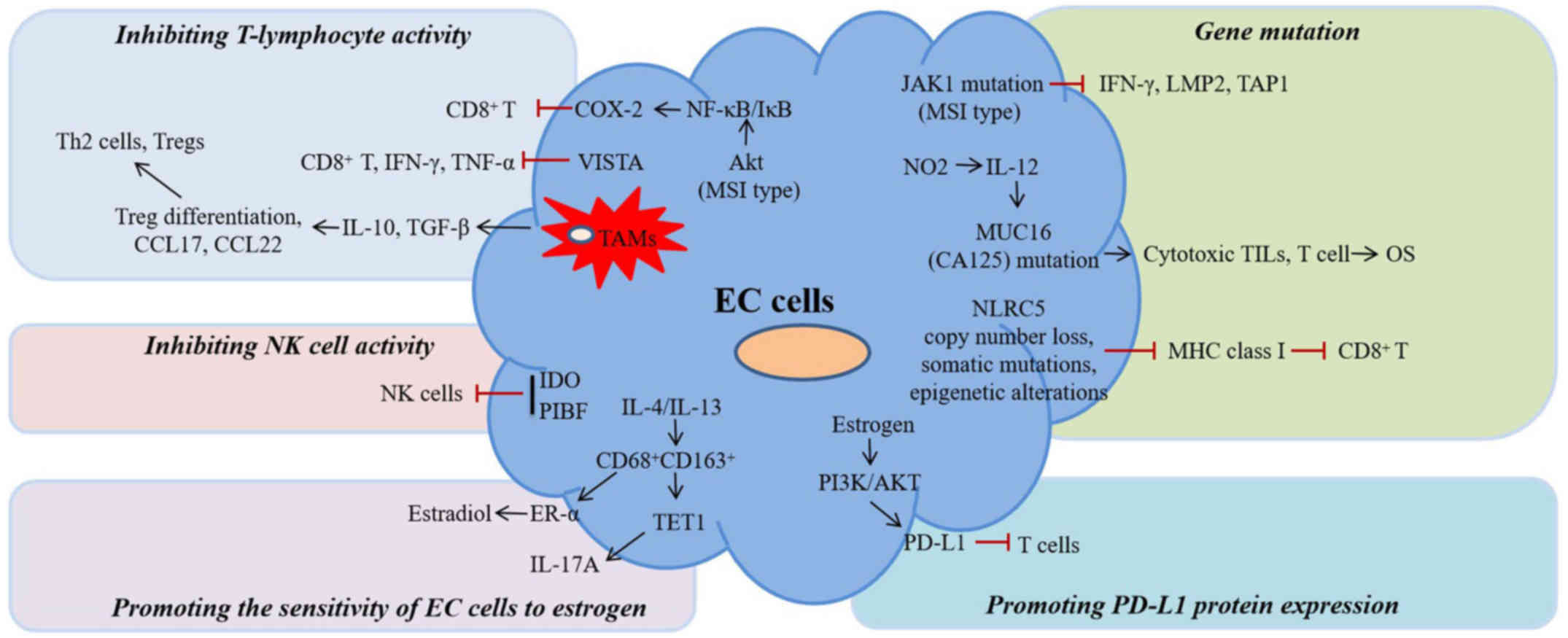
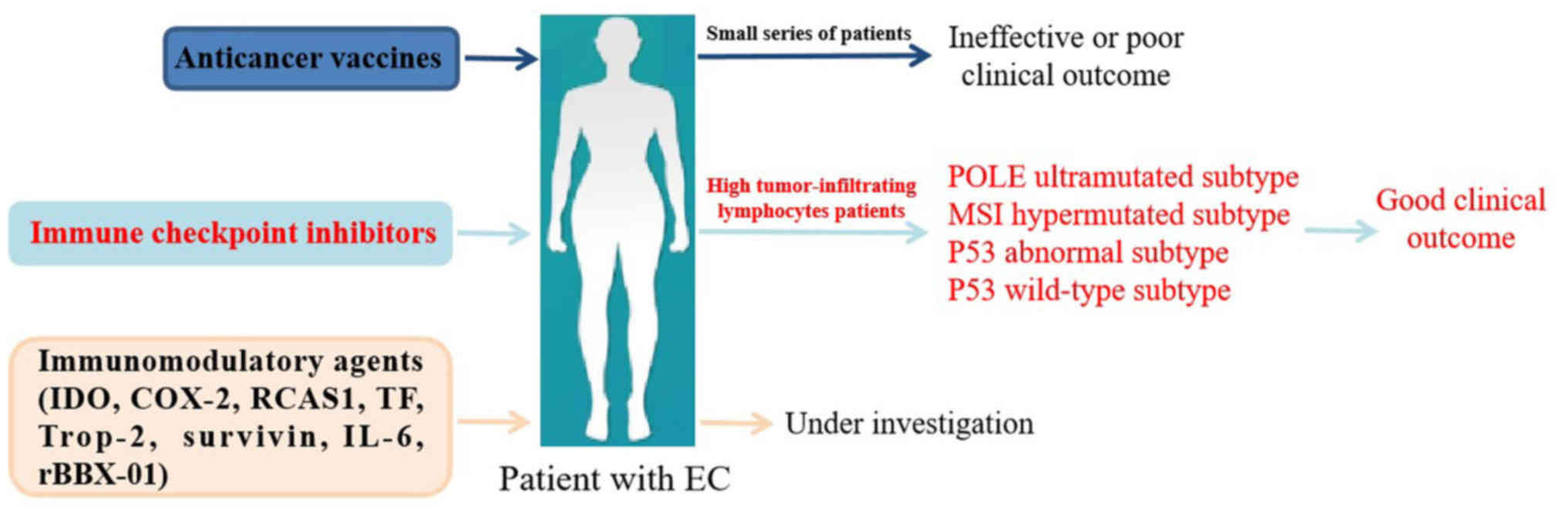
|
1
|
Siegel RL, Miller KD and Jemal A: Cancer
statistics, 2019. CA Cancer J Clin. 69:7–34. 2019. View Article : Google Scholar : PubMed/NCBI
|
|
2
|
Van Arsdale A, Miller DT, Kuo DY, Isani S,
Sanchez L and Nevadunsky NS: Association of obesity with survival
in patients with endometrial cancer. Gynecol Oncol. 154:156–162.
2019. View Article : Google Scholar : PubMed/NCBI
|
|
3
|
Yang X and Wang J: The Role of Metabolic
Syndrome in Endometrial Cancer: A Review. Front Oncol. 9:7442019.
View Article : Google Scholar : PubMed/NCBI
|
|
4
|
Lynch HT, Snyder CL, Shaw TG, Heinen CD
and Hitchins MP: Milestones of Lynch syndrome: 1895–2015. Nat Rev
Cancer. 15:181–194. 2015. View Article : Google Scholar : PubMed/NCBI
|
|
5
|
Boretto M, Maenhoudt N, Luo X, Hennes A,
Boeckx B, Bui B, Heremans R, Perneel L, Kobayashi H, Van Zundert I,
et al: Patient-derived organoids from endometrial disease capture
clinical heterogeneity and are amenable to drug screening. Nat Cell
Biol. 21:1041–1051. 2019. View Article : Google Scholar : PubMed/NCBI
|
|
6
|
Bokhman JV: Two pathogenetic types of
endometrial carcinoma. Gynecol Oncol. 15:10–17. 1983. View Article : Google Scholar : PubMed/NCBI
|
|
7
|
Morice P, Leary A, Creutzberg C,
Abu-Rustum N and Darai E: Endometrial cancer. Lancet.
387:1094–1108. 2016. View Article : Google Scholar : PubMed/NCBI
|
|
8
|
Brooks RA, Fleming GF, Lastra RR, Lee NK,
Moroney JW, Son CH, Tatebe K and Veneris JL: Current
recommendations and recent progress in endometrial cancer. CA
Cancer J Clin. 69:258–279. 2019.PubMed/NCBI
|
|
9
|
Han G, Sidhu D, Duggan MA, Arseneau J,
Cesari M, Clement PB, Ewanowich CA, Kalloger SE and Köbel M:
Reproducibility of histological cell type in high-grade endometrial
carcinoma. Mod Pathol. 26:1594–1604. 2013. View Article : Google Scholar : PubMed/NCBI
|
|
10
|
Zannoni GF, Vellone VG, Arena V, Prisco
MG, Scambia G, Carbone A and Gallo D: Does high-grade endometrioid
carcinoma (grade 3 FIGO) belong to type I or type II endometrial
cancer? A clinical-pathological and immunohistochemical study.
Virchows Arch. 457:27–34. 2010. View Article : Google Scholar : PubMed/NCBI
|
|
11
|
Kandoth C, Schultz N, Cherniack AD, Akbani
R, Liu Y, Shen H, Robertson AG, Pashtan I, Shen R, Benz CC, et al
Cancer Genome Atlas Research Network, : Integrated genomic
characterization of endometrial carcinoma. Nature. 497:67–73. 2013.
View Article : Google Scholar : PubMed/NCBI
|
|
12
|
Talhouk A, McConechy MK, Leung S, Yang W,
Lum A, Senz J, Boyd N, Pike J, Anglesio M, Kwon JS, et al:
Confirmation of ProMisE: A simple, genomics-based clinical
classifier for endometrial cancer. Cancer. 123:802–813. 2017.
View Article : Google Scholar : PubMed/NCBI
|
|
13
|
Talhouk A, McConechy MK, Leung S, Li-Chang
HH, Kwon JS, Melnyk N, Yang W, Senz J, Boyd N, Karnezis AN, et al:
A clinically applicable molecular-based classification for
endometrial cancers. Br J Cancer. 113:299–310. 2015. View Article : Google Scholar : PubMed/NCBI
|
|
14
|
Kommoss S, McConechy MK, Kommoss F, Leung
S, Bunz A, Magrill J, Britton H, Kommoss F, Grevenkamp F, Karnezis
A, et al: Final validation of the ProMisE molecular classifier for
endometrial carcinoma in a large population-based case series. Ann
Oncol. 29:1180–1188. 2018. View Article : Google Scholar : PubMed/NCBI
|
|
15
|
Kim M, Suh DH, Lee KH, Eom KY, Toftdahl
NG, Mirza MR and Kim JW: Major clinical research advances in
gynecologic cancer in 2018. J Gynecol Oncol. 30:e182019. View Article : Google Scholar : PubMed/NCBI
|
|
16
|
Melero I, Berman DM, Aznar MA, Korman AJ,
Pérez Gracia JL and Haanen J: Evolving synergistic combinations of
targeted immunotherapies to combat cancer. Nat Rev Cancer.
15:457–472. 2015. View Article : Google Scholar : PubMed/NCBI
|
|
17
|
Dracopoli NC and Boguski MS: The evolution
of oncology companion diagnostics from signal transduction to
immuno-oncology. Trends Pharmacol Sci. 38:41–54. 2017. View Article : Google Scholar : PubMed/NCBI
|
|
18
|
Kowanetz M, Zou W, Gettinger SN, Koeppen
H, Kockx M, Schmid P, Kadel EE III, Wistuba I, Chaft J, Rizvi NA,
et al: Differential regulation of PD-L1 expression by immune and
tumor cells in NSCLC and the response to treatment with
atezolizumab (anti-PD-L1). Proc Natl Acad Sci USA.
115:E10119–E10126. 2018. View Article : Google Scholar : PubMed/NCBI
|
|
19
|
Tawbi HA, Forsyth PA, Algazi A, Hamid O,
Hodi FS, Moschos SJ, Khushalani NI, Lewis K, Lao CD, Postow MA, et
al: Combined nivolumab and ipilimumab in melanoma metastatic to the
brain. N Engl J Med. 379:722–730. 2018. View Article : Google Scholar : PubMed/NCBI
|
|
20
|
Vanderstraeten A, Tuyaerts S and Amant F:
The immune system in the normal endometrium and implications for
endometrial cancer development. J Reprod Immunol. 109:7–16. 2015.
View Article : Google Scholar : PubMed/NCBI
|
|
21
|
Deligdisch L: Morphologic correlates of
host response in endometrial carcinoma. Am J Reprod Immunol.
2:54–57. 1982. View Article : Google Scholar : PubMed/NCBI
|
|
22
|
Silverberg SG, Sasano N and Yajima A:
Endometrial carcinoma in Miyagi Prefecture, Japan: Histopathologic
analysis of a cancer registry-based series and comparison with
cases in American women. Cancer. 49:1504–1510. 1982. View Article : Google Scholar : PubMed/NCBI
|
|
23
|
Wira CR, Fahey JV, Ghosh M, Patel MV,
Hickey DK and Ochiel DO: Sex hormone regulation of innate immunity
in the female reproductive tract: The role of epithelial cells in
balancing reproductive potential with protection against sexually
transmitted pathogens. Am J Reprod Immunol. 63:544–565. 2010.
View Article : Google Scholar : PubMed/NCBI
|
|
24
|
Pascual-García M, Bértolo C, Nieto JC,
Serrat N, Espinosa Í, D'Angelo E, Muñoz R, Rovira R, Vidal S and
Prat J: CD8 down-regulation on cytotoxic T lymphocytes of patients
with endometrioid endometrial carcinomas. Hum Pathol. 56:180–188.
2016. View Article : Google Scholar : PubMed/NCBI
|
|
25
|
Kondratiev S, Sabo E, Yakirevich E, Lavie
O and Resnick MB: Intratumoral CD8+ T lymphocytes as a
prognostic factor of survival in endometrial carcinoma. Clin Cancer
Res. 10:4450–4456. 2004. View Article : Google Scholar : PubMed/NCBI
|
|
26
|
Chang WC, Li CH, Huang SC, Chang DY, Chou
LY and Sheu BC: Clinical significance of regulatory T cells and
CD8+ effector populations in patients with human
endometrial carcinoma. Cancer. 116:5777–5788. 2010. View Article : Google Scholar : PubMed/NCBI
|
|
27
|
Yamagami W, Susumu N, Tanaka H, Hirasawa
A, Banno K, Suzuki N, Tsuda H, Tsukazaki K and Aoki D:
Immunofluorescence-detected infiltration of
CD4+FOXP3+ regulatory T cells is relevant to
the prognosis of patients with endometrial cancer. Int J Gynecol
Cancer. 21:1628–1634. 2011. View Article : Google Scholar : PubMed/NCBI
|
|
28
|
Sica A and Mantovani A: Macrophage
plasticity and polarization: In vivo veritas. J Clin Invest.
122:787–795. 2012. View Article : Google Scholar : PubMed/NCBI
|
|
29
|
Xue J, Schmidt SV, Sander J, Draffehn A,
Krebs W, Quester I, De Nardo D, Gohel TD, Emde M, Schmidleithner L,
et al: Transcriptome-based network analysis reveals a spectrum
model of human macrophage activation. Immunity. 40:274–288. 2014.
View Article : Google Scholar : PubMed/NCBI
|
|
30
|
Zeng Q and Jewell CM: Directing toll-like
receptor signaling in macrophages to enhance tumor immunotherapy.
Curr Opin Biotechnol. 60:138–145. 2019. View Article : Google Scholar : PubMed/NCBI
|
|
31
|
Dun EC, Hanley K, Wieser F, Bohman S, Yu J
and Taylor RN: Infiltration of tumor-associated macrophages is
increased in the epithelial and stromal compartments of endometrial
carcinomas. Int J Gynecol Pathol. 32:576–584. 2013. View Article : Google Scholar : PubMed/NCBI
|
|
32
|
Soeda S, Nakamura N, Ozeki T, Nishiyama H,
Hojo H, Yamada H, Abe M and Sato A: Tumor-associated macrophages
correlate with vascular space invasion and myometrial invasion in
endometrial carcinoma. Gynecol Oncol. 109:122–128. 2008. View Article : Google Scholar : PubMed/NCBI
|
|
33
|
Weber SK, Sauerwald A, Pölcher M, Braun M,
Debald M, Serce NB, Kuhn W, Brunagel-Walgenbach G and Rudlowski C:
Detection of lymphovascular invasion by D2-40 (podoplanin)
immunoexpression in endometrial cancer. Int J Gynecol Cancer.
22:1442–1448. 2012. View Article : Google Scholar : PubMed/NCBI
|
|
34
|
Kübler K, Ayub TH, Weber SK, Zivanovic O,
Abramian A, Keyver-Paik MD, Mallmann MR, Kaiser C, Serçe NB, Kuhn
W, et al: Prognostic significance of tumor-associated macrophages
in endometrial adenocarcinoma. Gynecol Oncol. 135:176–183. 2014.
View Article : Google Scholar : PubMed/NCBI
|
|
35
|
Garzetti GG, Ciavattini A, Muzzioli M,
Goteri G, Fabris N, Valensise H and Romanini C: The relationship of
clinical-pathologic status and adjuvant treatment with natural
killer cell activity in stage I and II endometrial carcinoma. Acta
Obstet Gynecol Scand. 73:652–657. 1994. View Article : Google Scholar : PubMed/NCBI
|
|
36
|
Garzetti GG, Ciavattini A, Goteri G,
Tranquilli AL, Muzzioli M, Fabris N, De Nictolis M and Romanini C:
Natural killer cell activity in stage I endometrial carcinoma:
Correlation with nuclear grading, myometrial invasion, and
immunoreactivity of proliferating cell nuclear antigen. Gynecol
Oncol. 55:111–114. 1994. View Article : Google Scholar : PubMed/NCBI
|
|
37
|
Versluis MA, Marchal S, Plat A, de Bock
GH, van Hall T, de Bruyn M, Hollema H and Nijman HW: The prognostic
benefit of tumour-infiltrating Natural Killer cells in endometrial
cancer is dependent on concurrent overexpression of Human Leucocyte
Antigen-E in the tumour microenvironment. Eur J Cancer. 86:285–295.
2017. View Article : Google Scholar : PubMed/NCBI
|
|
38
|
Chen C, Zhu YB, Qu QX, Ge Y, Huang JA,
Wang Y and Zhang XG: CD40-activated apoptotic tumor cell-pulsed
dendritic cell could potentially elicit antitumor immune response:
Involvement of up-regulation of B7-H3 expression. J Immunother.
32:29–35. 2009. View Article : Google Scholar : PubMed/NCBI
|
|
39
|
Lijun Z, Xin Z, Danhua S, Xiaoping L,
Jianliu W, Huilan W and Lihui W: Tumor-infiltrating dendritic cells
may be used as clinicopathologic prognostic factors in endometrial
carcinoma. Int J Gynecol Cancer. 22:836–841. 2012. View Article : Google Scholar : PubMed/NCBI
|
|
40
|
Jia J, Wang Z, Li X, Wang Z and Wang X:
Morphological characteristics and co-stimulatory molecule (CD80,
CD86, CD40) expression in tumor infiltrating dendritic cells in
human endometrioid adenocarcinoma. Eur J Obstet Gynecol Reprod
Biol. 160:223–227. 2012. View Article : Google Scholar : PubMed/NCBI
|
|
41
|
Zinovkin D and Pranjol MZ:
Tumor-infiltrated lymphocytes, macrophages, and dendritic cells in
endometrioid adenocarcinoma of corpus uteri as potential prognostic
factors: An immunohistochemical study. Int J Gynecol Cancer.
26:1207–1212. 2016. View Article : Google Scholar : PubMed/NCBI
|
|
42
|
Inoue T, Adachi K, Kawana K, Taguchi A,
Nagamatsu T, Fujimoto A, Tomio K, Yamashita A, Eguchi S, Nishida H,
et al: Cancer-associated fibroblast suppresses killing activity of
natural killer cells through downregulation of poliovirus receptor
(PVR/CD155), a ligand of activating NK receptor. Int J Oncol.
49:1297–1304. 2016. View Article : Google Scholar : PubMed/NCBI
|
|
43
|
Kerr J, Anderson C and Lippman SM:
Physical activity, sedentary behaviour, diet, and cancer: An update
and emerging new evidence. Lancet Oncol. 18:e457–e471. 2017.
View Article : Google Scholar : PubMed/NCBI
|
|
44
|
Ni L and Dong C: New checkpoints in cancer
immunotherapy. Immunol Rev. 276:52–65. 2017. View Article : Google Scholar : PubMed/NCBI
|
|
45
|
Ishida Y, Agata Y, Shibahara K and Honjo
T: Induced expression of PD-1, a novel member of the immunoglobulin
gene superfamily, upon programmed cell death. EMBO J. 11:3887–3895.
1992. View Article : Google Scholar : PubMed/NCBI
|
|
46
|
Curran CS, Gupta S, Sanz I and Sharon E:
PD-1 immunobiology in systemic lupus erythematosus. J Autoimmun.
97:1–9. 2019. View Article : Google Scholar : PubMed/NCBI
|
|
47
|
Jin H-T, Ahmed R and Okazaki T: Role of
PD-1 in regulating T-cell immunity. 350:17–37. 2010.
|
|
48
|
Vanderstraeten A, Luyten C, Verbist G,
Tuyaerts S and Amant F: Mapping the immunosuppressive environment
in uterine tumors: Implications for immunotherapy. Cancer Immunol
Immunother. 63:545–557. 2014. View Article : Google Scholar : PubMed/NCBI
|
|
49
|
Mo Z, Liu J, Zhang Q, Chen Z, Mei J, Liu
L, Yang S, Li H, Zhou L and You Z: Expression of PD-1, PD-L1 and
PD-L2 is associated with differentiation status and histological
type of endometrial cancer. Oncol Lett. 12:944–950. 2016.
View Article : Google Scholar : PubMed/NCBI
|
|
50
|
Kim J, Kim S, Lee HS, Yang W, Cho H, Chay
DB, Cho SJ, Hong S and Kim JH: Prognostic implication of programmed
cell death 1 protein and its ligand expressions in endometrial
cancer. Gynecol Oncol. 149:381–387. 2018. View Article : Google Scholar : PubMed/NCBI
|
|
51
|
Janakiram M, Shah UA, Liu W, Zhao A,
Schoenberg MP and Zang X: The third group of the B7-CD28 immune
checkpoint family: HHLA2, TMIGD2, B7×, and B7-H3. Immunol Rev.
276:26–39. 2017. View Article : Google Scholar : PubMed/NCBI
|
|
52
|
Brunner A, Hinterholzer S, Riss P, Heinze
G and Brustmann H: Immunoexpression of B7-H3 in endometrial cancer:
Relation to tumor T-cell infiltration and prognosis. Gynecol Oncol.
124:105–111. 2012. View Article : Google Scholar : PubMed/NCBI
|
|
53
|
Miyatake T, Tringler B, Liu W, Liu SH,
Papkoff J, Enomoto T, Torkko KC, Dehn DL, Swisher A and Shroyer KR:
B7-H4 (DD-O110) is overexpressed in high risk uterine endometrioid
adenocarcinomas and inversely correlated with tumor T-cell
infiltration. Gynecol Oncol. 106:119–127. 2007. View Article : Google Scholar : PubMed/NCBI
|
|
54
|
Bregar A, Deshpande A, Grange C, Zi T,
Stall J, Hirsch H, Reeves J, Sathyanarayanan S, Growdon WB and
Rueda BR: Characterization of immune regulatory molecules B7-H4 and
PD-L1 in low and high grade endometrial tumors. Gynecol Oncol.
145:446–452. 2017. View Article : Google Scholar : PubMed/NCBI
|
|
55
|
Ricciuti B, Leonardi GC, Puccetti P,
Fallarino F, Bianconi V, Sahebkar A, Baglivo S, Chiari R and Pirro
M: Targeting indoleamine-2,3-dioxygenase in cancer: Scientific
rationale and clinical evidence. Pharmacol Ther. 196:105–116. 2019.
View Article : Google Scholar : PubMed/NCBI
|
|
56
|
Ino K, Yoshida N, Kajiyama H, Shibata K,
Yamamoto E, Kidokoro K, Takahashi N, Terauchi M, Nawa A, Nomura S,
et al: Indoleamine 2,3-dioxygenase is a novel prognostic indicator
for endometrial cancer. Br J Cancer. 95:1555–1561. 2006. View Article : Google Scholar : PubMed/NCBI
|
|
57
|
de Jong RA, Kema IP, Boerma A, Boezen HM,
van der Want JJ, Gooden MJ, Hollema H and Nijman HW: Prognostic
role of indoleamine 2,3-dioxygenase in endometrial carcinoma.
Gynecol Oncol. 126:474–480. 2012. View Article : Google Scholar : PubMed/NCBI
|
|
58
|
Ino K, Yamamoto E, Shibata K, Kajiyama H,
Yoshida N, Terauchi M, Nawa A, Nagasaka T, Takikawa O and Kikkawa
F: Inverse correlation between tumoral indoleamine 2,3-dioxygenase
expression and tumor-infiltrating lymphocytes in endometrial
cancer: Its association with disease progression and survival. Clin
Cancer Res. 14:2310–2317. 2008. View Article : Google Scholar : PubMed/NCBI
|
|
59
|
Mills A, Zadeh S, Sloan E, Chinn Z,
Modesitt SC and Ring KL: Indoleamine 2,3-dioxygenase in endometrial
cancer: A targetable mechanism of immune resistance in mismatch
repair-deficient and intact endometrial carcinomas. Mod Pathol.
31:1282–1290. 2018. View Article : Google Scholar : PubMed/NCBI
|
|
60
|
Calviño-Sampedro C, Gomez-Tourino I,
Cordero OJ, Reche PA, Gómez-Perosanz M, Sánchez-Trincado JL,
Rodríguez MÁ, Sueiro AM, Viñuela JE and Calviño RV: Naturally
presented HLA class I-restricted epitopes from the neurotrophic
factor S100-β are targets of the autoimmune response in type 1
diabetes. FASEB J. 33:6390–6401. 2019. View Article : Google Scholar : PubMed/NCBI
|
|
61
|
Liepe J, Marino F, Sidney J, Jeko A,
Bunting DE, Sette A, Kloetzel PM, Stumpf MP, Heck AJ and Mishto M:
A large fraction of HLA class I ligands are proteasome-generated
spliced peptides. Science. 354:354–358. 2016. View Article : Google Scholar : PubMed/NCBI
|
|
62
|
Chowell D, Morris LGT, Grigg CM, Weber JK,
Samstein RM, Makarov V, Kuo F, Kendall SM, Requena D, Riaz N, et
al: Patient HLA class I genotype influences cancer response to
checkpoint blockade immunotherapy. Science. 359:582–587. 2018.
View Article : Google Scholar : PubMed/NCBI
|
|
63
|
de Jong RA, Boerma A, Boezen HM, Mourits
MJE, Hollema H and Nijman HW: Loss of HLA class I and mismatch
repair protein expression in sporadic endometrioid endometrial
carcinomas. Int J Cancer. 131:1828–1836. 2012. View Article : Google Scholar : PubMed/NCBI
|
|
64
|
Barrier BF, Kendall BS, Sharpe-Timms KL
and Kost ER: Characterization of human leukocyte antigen-G (HLA-G)
expression in endometrial adenocarcinoma. Gynecol Oncol. 103:25–30.
2006. View Article : Google Scholar : PubMed/NCBI
|
|
65
|
Bijen CB, Bantema-Joppe EJ, de Jong RA,
Leffers N, Mourits MJ, Eggink HF, van der Zee AG, Hollema H, de
Bock GH and Nijman HW: The prognostic role of classical and
nonclassical MHC class I expression in endometrial cancer. Int J
Cancer. 126:1417–1427. 2010.PubMed/NCBI
|
|
66
|
Lin A and Yan WH: Heterogeneity of HLA-G
expression in cancers: Facing the challenges. Front Immunol.
9:21642018. View Article : Google Scholar : PubMed/NCBI
|
|
67
|
Ben Yahia H, Babay W, Bortolotti D,
Boujelbene N, Laaribi AB, Zidi N, Kehila M, Chelbi H, Boudabous A,
Mrad K, et al: Increased plasmatic soluble HLA-G levels in
endometrial cancer. Mol Immunol. 99:82–86. 2018. View Article : Google Scholar : PubMed/NCBI
|
|
68
|
Sonoda K, Miyamoto S, Hirakawa T, Yagi H,
Yotsumoto F, Nakashima M, Watanabe T and Nakano H: Association
between RCAS1 expression and microenvironmental immune cell death
in uterine cervical cancer. Gynecol Oncol. 97:772–779. 2005.
View Article : Google Scholar : PubMed/NCBI
|
|
69
|
Nakashima M, Sonoda K and Watanabe T:
Inhibition of cell growth and induction of apoptotic cell death by
the human tumor-associated antigen RCAS1. Nat Med. 5:938–942. 1999.
View Article : Google Scholar : PubMed/NCBI
|
|
70
|
Giaginis C, Giagini A and Theocharis S:
Receptor-binding cancer antigen expressed on SiSo cells (RCAS1): A
novel biomarker in the diagnosis and prognosis of human neoplasia.
Histol Histopathol. 24:761–776. 2009.PubMed/NCBI
|
|
71
|
Sonoda K, Kaku T, Hirakawa T, Kobayashi H,
Amada S, Sakai K, Nakashima M, Watanabe T and Nakano H: The
clinical significance of tumor-associated antigen RCAS1 expression
in the normal, hyperplastic, and malignant uterine endometrium.
Gynecol Oncol. 79:424–429. 2000. View Article : Google Scholar : PubMed/NCBI
|
|
72
|
Sonoda K, Miyamoto S, Hirakawa T, Kaku T,
Nakashima M, Watanabe T, Akazawa K, Fujita T and Nakano H:
Association between RCAS1 expression and clinical outcome in
uterine endometrial cancer. Br J Cancer. 89:546–551. 2003.
View Article : Google Scholar : PubMed/NCBI
|
|
73
|
Szubert S, Koper K, Dutsch-Wicherek MM and
Kojs Z: The potential predictive value of serum srCaS1 levels for
overall survival in endometrial cancer. Ginekol Pol. 90:134–140.
2019. View Article : Google Scholar : PubMed/NCBI
|
|
74
|
Rand AA, Barnych B, Morisseau C, Cajka T,
Lee KS, Panigrahy D and Hammock BD: Cyclooxygenase-derived
proangiogenic metabolites of epoxyeicosatrienoic acids. Proc Natl
Acad Sci USA. 114:4370–4375. 2017. View Article : Google Scholar : PubMed/NCBI
|
|
75
|
Elling R, Robinson EK, Shapleigh B, Liapis
SC, Covarrubias S, Katzman S, Groff AF, Jiang Z, Agarwal S, Motwani
M, et al: Genetic models reveal cis and trans immune-regulatory
activities for lincRNA-Cox2. Cell Reports. 25:1511–1524.e1516.
2018. View Article : Google Scholar : PubMed/NCBI
|
|
76
|
Tang H, Liu Y, Wang C, Zheng H, Chen Y,
Liu W, Chen X, Zhang J, Chen H, Yang Y, et al: Inhibition of COX-2
and EGFR by melafolone improves anti-PD-1 therapy through vascular
normalization and PD-L1 downregulation in lung cancer. J Pharmacol
Exp Ther. 368:401–413. 2019. View Article : Google Scholar : PubMed/NCBI
|
|
77
|
Ohno Y, Ohno S, Suzuki N, Kamei T, Inagawa
H, Soma G and Inoue M: Role of cyclooxygenase-2 in immunomodulation
and prognosis of endometrial carcinoma. Int J Cancer. 114:696–701.
2005. View Article : Google Scholar : PubMed/NCBI
|
|
78
|
Suemori T, Susumu N, Iwata T, Banno K,
Yamagami W, Hirasawa A, Sugano K, Matsumoto E and Aoki D:
Intratumoral CD8+ lymphocyte infiltration as a
prognostic factor and its relationship with cyclooxygenase 2
expression and microsatellite instability in endometrial cancer.
Int J Gynecol Cancer. 25:1165–1172. 2015. View Article : Google Scholar : PubMed/NCBI
|
|
79
|
Ols ML, Cullen JL, Turqueti-Neves A, Giles
J and Shlomchik MJ: Dendritic cells regulate extrafollicular
autoreactive B cells via T cells expressing Fas and Fas ligand.
Immunity. 45:1052–1065. 2016. View Article : Google Scholar : PubMed/NCBI
|
|
80
|
Das H, Koizumi T, Sugimoto T, Chakraborty
S, Ichimura T, Hasegawa K and Nishimura R: Quantitation of Fas and
Fas ligand gene expression in human ovarian, cervical and
endometrial carcinomas using real-time quantitative RT-PCR. Br J
Cancer. 82:1682–1688. 2000.PubMed/NCBI
|
|
81
|
Jia JJ, Wang ZN, Liu GX and Wang ZX:
Apoptosis and expression of Fas/FasL in tumor infiltrating
dendritic cells in human endometrioid adenocarcinoma. Nan Fang Yi
Ke Da Xue Xue Bao. 31:1693–1696. 2011.(In Chinese). PubMed/NCBI
|
|
82
|
Rapoport AP, Aqui NA, Stadtmauer EA, Vogl
DT, Fang HB, Cai L, Janofsky S, Chew A, Storek J, Akpek G, et al:
Combination immunotherapy using adoptive T-cell transfer and tumor
antigen vaccination on the basis of hTERT and survivin after ASCT
for myeloma. Blood. 117:788–797. 2011. View Article : Google Scholar : PubMed/NCBI
|
|
83
|
Végran F, Mary R, Gibeaud A, Mirjolet C,
Collin B, Oudot A, Charon-Barra C, Arnould L, Lizard-Nacol S and
Boidot R: Survivin-3B potentiates immune escape in cancer but also
inhibits the toxicity of cancer chemotherapy. Cancer Res.
73:5391–5401. 2013. View Article : Google Scholar : PubMed/NCBI
|
|
84
|
Wang Z, Liu Y and Liu M: Platelet-rich
plasma injection is not more effective than hyaluronic acid to
treat knee osteoarthritis when using a random-effects model. Br J
Sports Med. 50:953–954. 2016. View Article : Google Scholar : PubMed/NCBI
|
|
85
|
Chuwa AH, Sone K, Oda K, Ikeda Y, Fukuda
T, Wada-Hiraike O, Inaba K, Makii C, Takeuchi M, Oki S, et al:
Significance of survivin as a prognostic factor and a therapeutic
target in endometrial cancer. Gynecol Oncol. 141:564–569. 2016.
View Article : Google Scholar : PubMed/NCBI
|
|
86
|
Kumar A, Sirohi VK, Anum F, Singh PK,
Gupta K, Gupta D, Saraf SA, Dwivedi A and Chourasia MK: Enhanced
apoptosis, survivin down-regulation and assisted immunochemotherapy
by curcumin loaded amphiphilic mixed micelles for subjugating
endometrial cancer. Nanomedicine (Lond). 13:1953–1963. 2017.
View Article : Google Scholar
|
|
87
|
Kang S, Tanaka T, Narazaki M and Kishimoto
T: Targeting Interleukin-6 Signaling in Clinic. Immunity.
50:1007–1023. 2019. View Article : Google Scholar : PubMed/NCBI
|
|
88
|
Bellone S, Watts K, Cane' S, Palmieri M,
Cannon MJ, Burnett A, Roman JJ, Pecorelli S and Santin AD: High
serum levels of interleukin-6 in endometrial carcinoma are
associated with uterine serous papillary histology, a highly
aggressive and chemotherapy-resistant variant of endometrial
cancer. Gynecol Oncol. 98:92–98. 2005. View Article : Google Scholar : PubMed/NCBI
|
|
89
|
Ren Y, Zhang Y, Liu RZ, Fenstermacher DA,
Wright KL, Teer JK and Wu J: JAK1 truncating mutations in
gynecologic cancer define new role of cancer-associated protein
tyrosine kinase aberrations. Sci Rep. 3:30422013. View Article : Google Scholar : PubMed/NCBI
|
|
90
|
Albacker LA, Wu J, Smith P, Warmuth M,
Stephens PJ, Zhu P, Yu L and Chmielecki J: Loss of function JAK1
mutations occur at high frequency in cancers with microsatellite
instability and are suggestive of immune evasion. PLoS One.
12:e01761812017. View Article : Google Scholar : PubMed/NCBI
|
|
91
|
Chao A, Tang YH, Lai CH, Chang CJ, Chang
SC, Wu TI, Hsueh S, Wang CJ, Chou HH and Chang TC: Potential of an
age-stratified CA125 cut-off value to improve the prognostic
classification of patients with endometrial cancer. Gynecol Oncol.
129:500–504. 2013. View Article : Google Scholar : PubMed/NCBI
|
|
92
|
Hu J and Sun J: MUC16 mutations improve
patients' prognosis by enhancing the infiltration and antitumor
immunity of cytotoxic T lymphocytes in the endometrial cancer
microenvironment. OncoImmunology. 7:e14879142018. View Article : Google Scholar : PubMed/NCBI
|
|
93
|
Grotzke JE, Sengupta D, Lu Q and Cresswell
P: The ongoing saga of the mechanism(s) of MHC class I-restricted
cross-presentation. Curr Opin Immunol. 46:89–96. 2017. View Article : Google Scholar : PubMed/NCBI
|
|
94
|
Chen Y, Li H, Xiao C, Zeng X, Xiao X, Zhou
Q and Xiao P: NLRC5: Potential novel non-invasive biomarker for
predicting and reflecting the progression of IgA nephritis. J
Transl Med. 16:3172018. View Article : Google Scholar : PubMed/NCBI
|
|
95
|
Yoshihama S, Roszik J, Downs I, Meissner
TB, Vijayan S, Chapuy B, Sidiq T, Shipp MA, Lizee GA and Kobayashi
KS: NLRC5/MHC class I transactivator is a target for immune evasion
in cancer. Proc Natl Acad Sci USA. 113:5999–6004. 2016. View Article : Google Scholar : PubMed/NCBI
|
|
96
|
Mao Y, Poschke I, Wennerberg E, Pico de
Coaña Y, Egyhazi Brage S, Schultz I, Hansson J, Masucci G,
Lundqvist A and Kiessling R: Melanoma-educated CD14+
cells acquire a myeloid-derived suppressor cell phenotype through
COX-2-dependent mechanisms. Cancer Res. 73:3877–3887. 2013.
View Article : Google Scholar : PubMed/NCBI
|
|
97
|
Sharma S, Yang SC, Zhu L, Reckamp K,
Gardner B, Baratelli F, Huang M, Batra RK and Dubinett SM: Tumor
cyclooxygenase-2/prostaglandin E2-dependent promotion of FOXP3
expression and CD4+ CD25+ T regulatory cell
activities in lung cancer. Cancer Res. 65:5211–5220. 2005.
View Article : Google Scholar : PubMed/NCBI
|
|
98
|
St-Germain ME, Gagnon V, Parent S and
Asselin E: Regulation of COX-2 protein expression by Akt in
endometrial cancer cells is mediated through NF-kappaB/IkappaB
pathway. Mol Cancer. 3:72004. View Article : Google Scholar : PubMed/NCBI
|
|
99
|
Mulati K, Hamanishi J, Matsumura N,
Chamoto K, Mise N, Abiko K, Baba T, Yamaguchi K, Horikawa N,
Murakami R, et al: VISTA expressed in tumour cells regulates T cell
function. Br J Cancer. 120:115–127. 2019. View Article : Google Scholar : PubMed/NCBI
|
|
100
|
Zsiros E and Odunsi K: Tumor-associated
macrophages: Co-conspirators and orchestrators of immune
suppression in endometrial adenocarcinoma. Gynecol Oncol.
135:173–175. 2014. View Article : Google Scholar : PubMed/NCBI
|
|
101
|
Mantovani A, Sica A, Sozzani S, Allavena
P, Vecchi A and Locati M: The chemokine system in diverse forms of
macrophage activation and polarization. Trends Immunol. 25:677–686.
2004. View Article : Google Scholar : PubMed/NCBI
|
|
102
|
Yoshida N, Ino K, Ishida Y, Kajiyama H,
Yamamoto E, Shibata K, Terauchi M, Nawa A, Akimoto H, Takikawa O,
et al: Overexpression of indoleamine 2,3-dioxygenase in human
endometrial carcinoma cells induces rapid tumor growth in a mouse
xenograft model. Clin Cancer Res. 14:7251–7259. 2008. View Article : Google Scholar : PubMed/NCBI
|
|
103
|
Check JH and Cohen R: The role of
progesterone and the progesterone receptor in human reproduction
and cancer. Expert Rev Endocrinol Metab. 8:469–484. 2013.
View Article : Google Scholar : PubMed/NCBI
|
|
104
|
Yang L, Huang F, Mei J, Wang X, Zhang Q,
Wang H, Xi M and You Z: Posttranscriptional control of PD-L1
expression by 17β-estradiol via PI3K/Akt signaling pathway in
ERα-positive cancer cell lines. Int J Gynecol Cancer. 27:196–205.
2017. View Article : Google Scholar : PubMed/NCBI
|
|
105
|
Ning C, Xie B, Zhang L, Li C, Shan W, Yang
B, Luo X, Gu C, He Q, Jin H, et al: Infiltrating macrophages induce
ERα expression through an IL17A-mediated epigenetic mechanism to
sensitize endometrial cancer cells to estrogen. Cancer Res.
76:1354–1366. 2016. View Article : Google Scholar : PubMed/NCBI
|
|
106
|
Kaumaya PT, Foy KC, Garrett J, Rawale SV,
Vicari D, Thurmond JM, Lamb T, Mani A, Kane Y, Balint CR, et al:
Phase I active immunotherapy with combination of two chimeric,
human epidermal growth factor receptor 2, B-cell epitopes fused to
a promiscuous T-cell epitope in patients with metastatic and/or
recurrent solid tumors. J Clin Oncol. 27:5270–5277. 2009.
View Article : Google Scholar : PubMed/NCBI
|
|
107
|
Ohno S, Kyo S, Myojo S, Dohi S, Ishizaki
J, Miyamoto K, Morita S, Sakamoto J, Enomoto T, Kimura T, et al:
Wilms' tumor 1 (WT1) peptide immunotherapy for gynecological
malignancy. Anticancer Res. 29:4779–4784. 2009.PubMed/NCBI
|
|
108
|
Jäger E, Karbach J, Gnjatic S, Neumann A,
Bender A, Valmori D, Ayyoub M, Ritter E, Ritter G, Jäger D, et al:
Recombinant vaccinia/fowlpox NY-ESO-1 vaccines induce both humoral
and cellular NY-ESO-1-specific immune responses in cancer patients.
Proc Natl Acad Sci USA. 103:14453–14458. 2006. View Article : Google Scholar : PubMed/NCBI
|
|
109
|
Howitt BE, Shukla SA, Sholl LM,
Ritterhouse LL, Watkins JC, Rodig S, Stover E, Strickland KC,
D'Andrea AD, Wu CJ, et al: Association of Polymerase e-Mutated and
Microsatellite-Instable Endometrial Cancers With Neoantigen Load,
Number of Tumor-Infiltrating Lymphocytes, and Expression of PD-1
and PD-L1. JAMA Oncol. 1:1319–1323. 2015. View Article : Google Scholar : PubMed/NCBI
|
|
110
|
Mehnert JM, Panda A, Zhong H, Hirshfield
K, Damare S, Lane K, Sokol L, Stein MN, Rodriguez-Rodriquez L,
Kaufman HL, et al: Immune activation and response to pembrolizumab
in POLE-mutant endometrial cancer. J Clin Invest. 126:2334–2340.
2016. View Article : Google Scholar : PubMed/NCBI
|
|
111
|
Ott PA, Bang YJ, Berton-Rigaud D, Elez E,
Pishvaian MJ, Rugo HS, Puzanov I, Mehnert JM, Aung KL, Lopez J, et
al: Safety and antitumor activity of pembrolizumab in advanced
programmed death ligand 1-positive endometrial cancer: Results from
the KEYNOTE-028 study. J Clin Oncol. 35:2535–2541. 2017. View Article : Google Scholar : PubMed/NCBI
|
|
112
|
Osterman C, McCarthy MBR, Cote MP, Beitzel
K, Bradley J, Polkowski G and Mazzocca AD: Platelet-rich plasma
increases anti-inflammatory markers in a human coculture model for
osteoarthritis. Am J Sports Med. 43:1474–1484. 2015. View Article : Google Scholar : PubMed/NCBI
|
|
113
|
Makker V, Rasco D, Vogelzang NJ, Brose MS,
Cohn AL, Mier J, Di Simone C, Hyman DM, Stepan DE, Dutcus CE, et
al: Lenvatinib plus pembrolizumab in patients with advanced
endometrial cancer: An interim analysis of a multicentre,
open-label, single-arm, phase 2 trial. Lancet Oncol. 20:711–718.
2019. View Article : Google Scholar : PubMed/NCBI
|
|
114
|
Tran E, Turcotte S, Gros A, Robbins PF, Lu
YC, Dudley ME, Wunderlich JR, Somerville RP, Hogan K, Hinrichs CS,
et al: Cancer immunotherapy based on mutation-specific
CD4+ T cells in a patient with epithelial cancer.
Science. 344:641–645. 2014. View Article : Google Scholar : PubMed/NCBI
|
|
115
|
de Bono JS, Concin N, Hong DS,
Thistlethwaite FC, Machiels JP, Arkenau HT, Plummer R, Jones RH,
Nielsen D, Windfeld K, et al: Tisotumab vedotin in patients with
advanced or metastatic solid tumours (InnovaTV 201): A
first-in-human, multicentre, phase 1–2 trial. Lancet Oncol.
20:383–393. 2019. View Article : Google Scholar : PubMed/NCBI
|
|
116
|
Tuyaerts S, Van Nuffel AMT, Naert E, Van
Dam PA, Vuylsteke P, De Caluwé A, Aspeslagh S, Dirix P, Lippens L,
De Jaeghere E, et al: PRIMMO study protocol: A phase II study
combining PD-1 blockade, radiation and immunomodulation to tackle
cervical and uterine cancer. BMC Cancer. 19:5062019. View Article : Google Scholar : PubMed/NCBI
|
|
117
|
Pakish JB, Zhang Q, Chen Z, Liang H,
Chisholm GB, Yuan Y, Mok SC, Broaddus RR, Lu KH and Yates MS:
Immune microenvironment in microsatellite-instable endometrial
cancers: Hereditary or sporadic origin matters. Clin Cancer Res.
23:4473–4481. 2017. View Article : Google Scholar : PubMed/NCBI
|
|
118
|
Temko D, Van Gool IC, Rayner E, Glaire M,
Makino S, Brown M, Chegwidden L, Palles C, Depreeuw J, Beggs A, et
al: Somatic POLE exonuclease domain mutations are early events in
sporadic endometrial and colorectal carcinogenesis, determining
driver mutational landscape, clonal neoantigen burden and immune
response. J Pathol. 245:283–296. 2018. View Article : Google Scholar : PubMed/NCBI
|
|
119
|
Eggink FA, Van Gool IC, Leary A, Pollock
PM, Crosbie EJ, Mileshkin L, Jordanova ES, Adam J, Freeman-Mills L,
Church DN, et al: Immunological profiling of molecularly classified
high-risk endometrial cancers identifies POLE-mutant and
microsatellite unstable carcinomas as candidates for checkpoint
inhibition. OncoImmunology. 6:e12645652016. View Article : Google Scholar : PubMed/NCBI
|
|
120
|
Talhouk A, Derocher H, Schmidt P, Leung S,
Milne K, Gilks CB, Anglesio MS, Nelson BH and McAlpine JN:
Molecular subtype not immune response drives outcomes in
endometrial carcinoma. Clin Cancer Res. 25:2537–2548. 2019.
View Article : Google Scholar : PubMed/NCBI
|
|
121
|
Mullen MM and Mutch DG: Endometrial tumor
immune response: Predictive biomarker of response to immunotherapy.
Clin Cancer Res. 25:2366–2368. 2019. View Article : Google Scholar : PubMed/NCBI
|
|
122
|
DeLong P, Tanaka T, Kruklitis R, Henry AC,
Kapoor V, Kaiser LR, Sterman DH and Albelda SM: Use of
cyclooxygenase-2 inhibition to enhance the efficacy of
immunotherapy. Cancer Res. 63:7845–7852. 2003.PubMed/NCBI
|
|
123
|
Han Y, Qin W and Huang G: Knockdown of
RCAS1 expression by RNA interference recovers T cell growth and
proliferation. Cancer Lett. 257:182–190. 2007. View Article : Google Scholar : PubMed/NCBI
|
|
124
|
Cocco E, Hu Z, Richter CE, Bellone S,
Casagrande F, Bellone M, Todeschini P, Krikun G, Silasi DA, Azodi
M, et al: hI-con1, a factor VII–IgGFc chimeric protein targeting
tissue factor for immunotherapy of uterine serous papillary
carcinoma. Br J Cancer. 103:812–819. 2010. View Article : Google Scholar : PubMed/NCBI
|
|
125
|
Varughese J, Cocco E, Bellone S, de Leon
M, Bellone M, Todeschini P, Schwartz PE, Rutherford TJ, Pecorelli S
and Santin AD: Uterine serous papillary carcinomas overexpress
human trophoblast-cell-surface marker (Trop-2) and are highly
sensitive to immunotherapy with hRS7, a humanized anti-Trop-2
monoclonal antibody. Cancer. 117:3163–3172. 2011. View Article : Google Scholar : PubMed/NCBI
|
|
126
|
Vanderstraeten A, Everaert T, Van Bree R,
Verbist G, Luyten C, Amant F and Tuyaerts S: In vitro validation of
survivin as target tumor-associated antigen for immunotherapy in
uterine cancer. J Immunother. 38:239–249. 2015. View Article : Google Scholar : PubMed/NCBI
|
|
127
|
Dijkgraaf EM, Santegoets SJ, Reyners AK,
Goedemans R, Wouters MC, Kenter GG, van Erkel AR, van Poelgeest MI,
Nijman HW, van der Hoeven JJ, et al: A phase I trial combining
carboplatin/doxorubicin with tocilizumab, an anti-IL-6R monoclonal
antibody, and interferon-α2b in patients with recurrent epithelial
ovarian cancer. Ann Oncol. 26:2141–2149. 2015. View Article : Google Scholar : PubMed/NCBI
|
|
128
|
Rader JS, Aylsworth CF, Juckett DA, Mutch
DG, Powell MA, Lippmann L and Dimitrov NV: Phase I study and
preliminary pharmacology of the novel innate immune modulator
rBBX-01 in gynecologic cancers. Clin Cancer Res. 14:3089–3097.
2008. View Article : Google Scholar : PubMed/NCBI
|