Oncol Lett 9: [Related article:] 2623-2628, 2015; DOI:
10.3892/ol.2015.3122
Subsequently to the publication of the above paper,
an interested reader drew to the authors’ attention that the data
shown in Fig. 4I and J on p. 2625
for the CD5 and CD3 experiments appeared to be overlapping if one
of the panels were rotated through 180°.
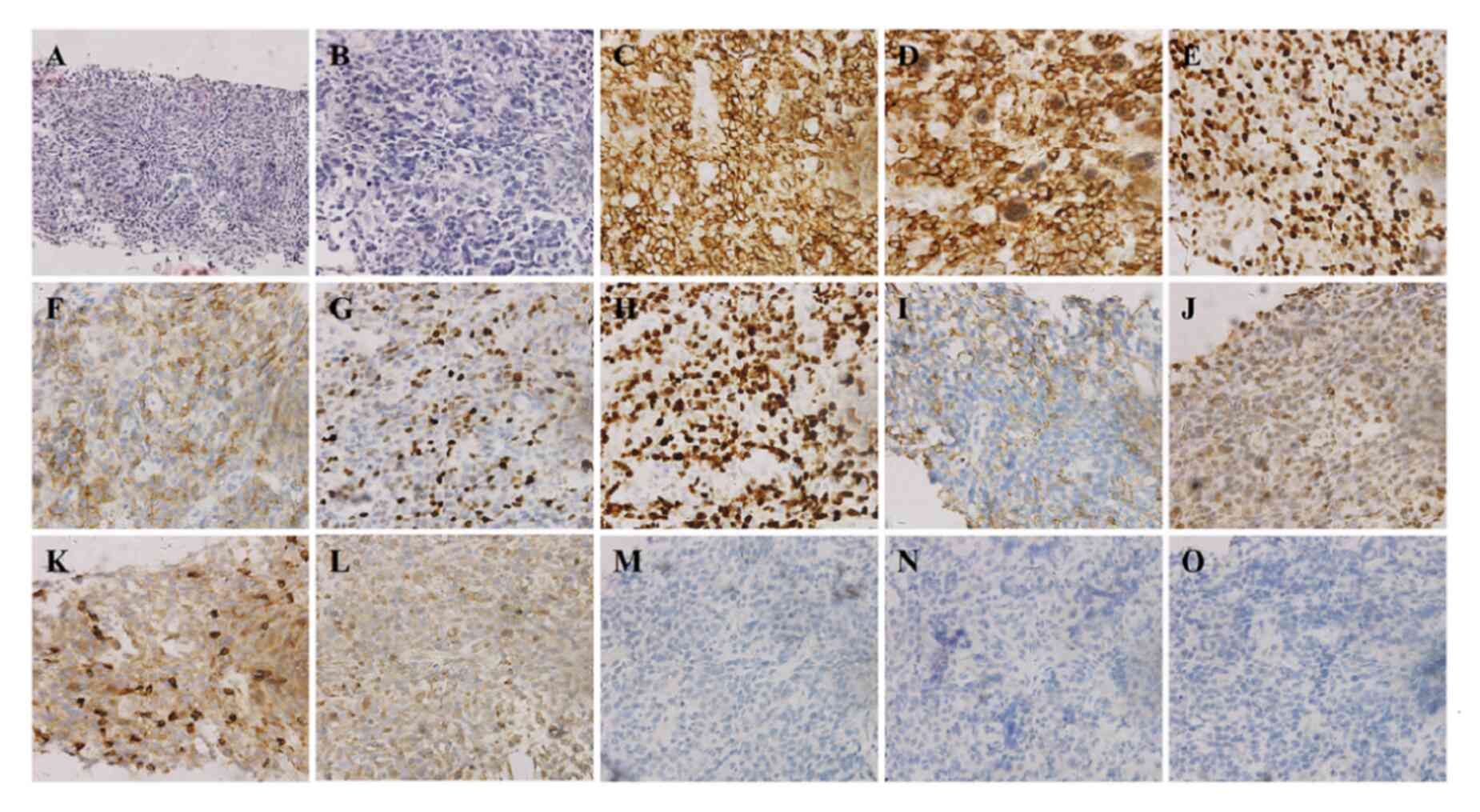 | Figure 4.Diffuse infiltration of large B-cells.
(A and B) Hematoxylin and eosin-stained cells (A, ×200; B, ×400).
Immunohistochemical analysis revealed that the neoplastic cells
were positive for (C) CD20, (D) CD79a, (E) BCL-6, (F) CD10, (G)
MUM-1 and (H) Ki-67, partially positive for (I) EMA, weakly
positive for (J) CD5, (K) CD3 and (L) BCL-2, and negative for (M)
AE1/AE3, (N) CD30 and (O) ALK (×400). MUM-1, multiple myeloma
oncogene 1; EMA, epithelial membrane antigen; BCL, B-cell lymphoma;
AE, anion exchanger; ALK, anaplastic lymphoma kinase. |
The authors have re-examined their data, and
realized that the same data panel was inadvertently incorporated
into Fig. 4 twice, albeit in the
different positions shown. To rectify this situation, and to better
illustrate their findings, the authors have requested that they
show all their markers in a revised version of Fig. 4, and this is presented on the next
page. Furthermore, the legend for Fig.
4 has been revised to the following: “Figure 4. Diffuse infiltration of large
B-cells. (A and B) Hematoxylin and eosin-stained cells (A, ×200; B,
×400). Immunohistochemical analysis revealed that the neoplastic
cells were positive for (C) CD20, (D) CD79a, (E) BCL-6, (F) CD10,
(G) MUM-1 and (H) Ki-67, partially positive for (I) EMA, weakly
positive for (J) CD5, (K) CD3 and (L) BCL-2, and negative for (M)
AE1/AE3, (N) CD30 and (O) ALK (×400). MUM-1, multiple myeloma
oncogene 1; EMA, epithelial membrane antigen; BCL, B-cell lymphoma;
AE, anion exchanger; ALK, anaplastic lymphoma kinase.”. Finally,
the text in the Results section on p. 2624, line 2, should have
read as follows (changes highlighted in bold): “However, the
specimen was weakly positive for CD5, CD3 and BCL-2,
and negative for anaplastic lymphoma kinase, CD30 and anion
exchanger (AE)1/AE3.”.
The authors regret the error that was made in the
preparation of the published figure, and confirm that this error,
together with the revisions now made to the text, did not affect
the diagnosis of this case. The authors are grateful to the editor
of Oncology Letters for allowing them the opportunity to
publish a Corrigendum, and all the authors agree to this
Corrigendum. Furthermore, they apologize to the readership for any
inconvenience caused.

















