Oncol Lett 14: [Related article:] 639-646, 2017; DOI:
10.3892/ol.2017.6258
Subsequently to the publication of the above paper,
after having re-examined their raw data the authors have realized
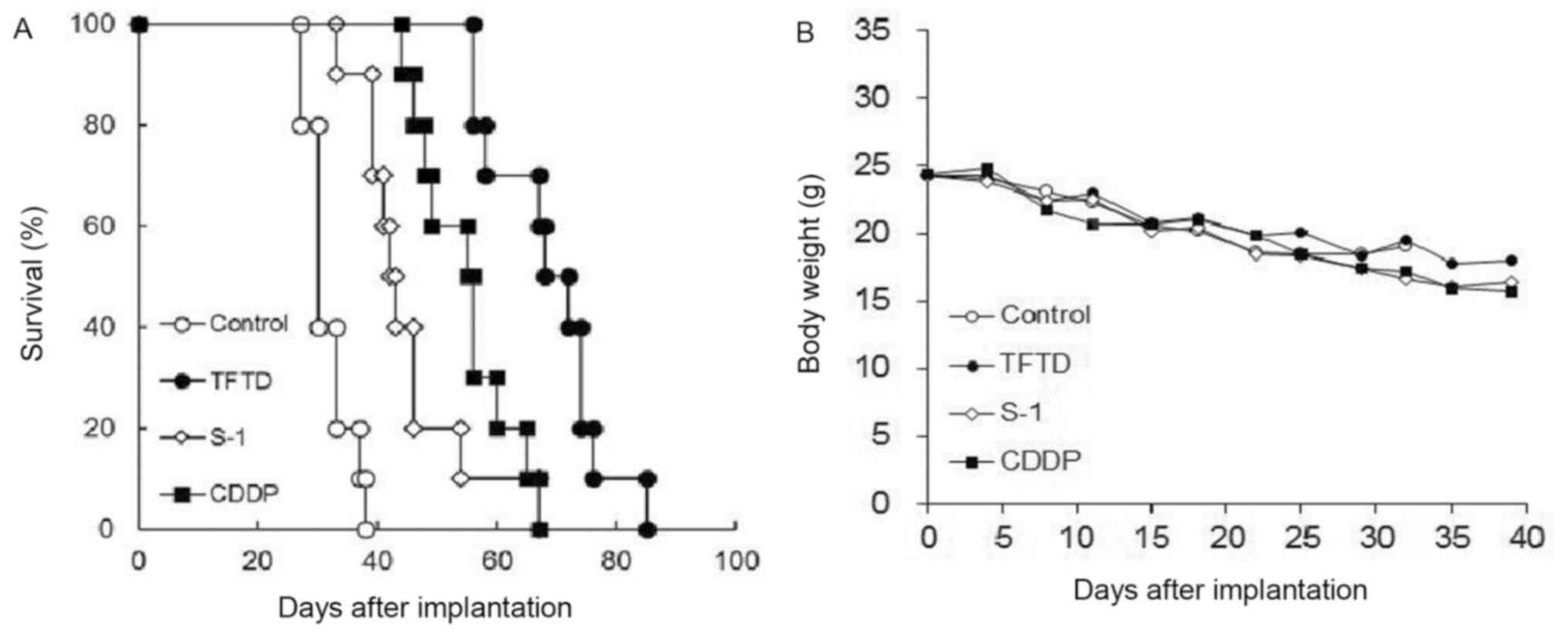
that Fig. 6 and Table II contained miscalculations. This
figure and table appeared to show the results of one designated
experiment, although they actually were intended to represent the
results of the integration of two independent experiments.
Specifically, one of the experiments evaluated the
trifluridine/tipiracil (TFTD), tegafur, gimeracil and potassium
oxonate (S-1) and cisplatin (CDDP) groups, whereas the other
experiment evaluated the 5-fluorouracil (5FU) group alone. In
addition, the description of the CDDP dosing schedule was also
inaccurate: The CDDP dosing schedule on p. 640 of the Materials and
methods section, right-hand column, “In vivo antitumor
activity” subsection, should have been written as follows:
“CDDP (7 mg/kg) was injected intravenously, once every 4
weeks, into the tail vein of mice (days 4 and 32) for
evaluating the effect on the gastric cancer MKN45 cell line”
(essentially, the information reported for the weeks and days in
this sentence was incorrect). Finally, the third sentence in the
“Antitumor activity of TFTD in the human gastric MKN45
intraperitoneal xenograft model” subsection of the Results,
towards the end of p. 642, should have read as follows (without the
reference to 5FU): “TFTD exhibited a significant antitumor effect
compared with S-1 and CDDP in the MKN45 intraperitoneal xenograft
model (P<0.01; Table II).”
 | Table II.Antitumor activity of TFTD in the
human gastric MKN45 intraperitoneal xenograft model. |
Table II.
Antitumor activity of TFTD in the
human gastric MKN45 intraperitoneal xenograft model.
|
| Survival day, median
(ILS, %) |
|---|
|
|
|
|---|
| Cell line | Control | TFTH | S-1 | CDDP |
|---|
| MKN45 | 30 (−) | 70a–c
(133) | 43a (42) | 56a (85) |
The revised versions of Fig. 6 and Table
II, showing the corrected data without the 5FU group, are
included on the next page. Note that the above errors did not
affect the results or conclusions reported in this paper, and all
the authors agree with this corrigendum. The authors thank the
editor of Oncology Letters for presenting them with the
opportunity to publish this Corrigendum and apologize to the editor
and to the readership of the journal for any inconvenience
caused.