Spandidos Publications Logo
  • About
    • About Spandidos
    • Aims and Scopes
    • Abstracting and Indexing
    • Editorial Policies
    • Reprints and Permissions
    • Job Opportunities
    • Terms and Conditions
    • Contact
  • Journals
    • All Journals
    • Oncology Letters
      • Oncology Letters
      • Information for Authors
      • Editorial Policies
      • Editorial Board
      • Aims and Scope
      • Abstracting and Indexing
      • Bibliographic Information
      • Archive
    • International Journal of Oncology
      • International Journal of Oncology
      • Information for Authors
      • Editorial Policies
      • Editorial Board
      • Aims and Scope
      • Abstracting and Indexing
      • Bibliographic Information
      • Archive
    • Molecular and Clinical Oncology
      • Molecular and Clinical Oncology
      • Information for Authors
      • Editorial Policies
      • Editorial Board
      • Aims and Scope
      • Abstracting and Indexing
      • Bibliographic Information
      • Archive
    • Experimental and Therapeutic Medicine
      • Experimental and Therapeutic Medicine
      • Information for Authors
      • Editorial Policies
      • Editorial Board
      • Aims and Scope
      • Abstracting and Indexing
      • Bibliographic Information
      • Archive
    • International Journal of Molecular Medicine
      • International Journal of Molecular Medicine
      • Information for Authors
      • Editorial Policies
      • Editorial Board
      • Aims and Scope
      • Abstracting and Indexing
      • Bibliographic Information
      • Archive
    • Biomedical Reports
      • Biomedical Reports
      • Information for Authors
      • Editorial Policies
      • Editorial Board
      • Aims and Scope
      • Abstracting and Indexing
      • Bibliographic Information
      • Archive
    • Oncology Reports
      • Oncology Reports
      • Information for Authors
      • Editorial Policies
      • Editorial Board
      • Aims and Scope
      • Abstracting and Indexing
      • Bibliographic Information
      • Archive
    • Molecular Medicine Reports
      • Molecular Medicine Reports
      • Information for Authors
      • Editorial Policies
      • Editorial Board
      • Aims and Scope
      • Abstracting and Indexing
      • Bibliographic Information
      • Archive
    • World Academy of Sciences Journal
      • World Academy of Sciences Journal
      • Information for Authors
      • Editorial Policies
      • Editorial Board
      • Aims and Scope
      • Abstracting and Indexing
      • Bibliographic Information
      • Archive
    • International Journal of Functional Nutrition
      • International Journal of Functional Nutrition
      • Information for Authors
      • Editorial Policies
      • Editorial Board
      • Aims and Scope
      • Abstracting and Indexing
      • Bibliographic Information
      • Archive
    • International Journal of Epigenetics
      • International Journal of Epigenetics
      • Information for Authors
      • Editorial Policies
      • Editorial Board
      • Aims and Scope
      • Abstracting and Indexing
      • Bibliographic Information
      • Archive
    • Medicine International
      • Medicine International
      • Information for Authors
      • Editorial Policies
      • Editorial Board
      • Aims and Scope
      • Abstracting and Indexing
      • Bibliographic Information
      • Archive
  • Articles
  • Information
    • Information for Authors
    • Information for Reviewers
    • Information for Librarians
    • Information for Advertisers
    • Conferences
  • Language Editing
Spandidos Publications Logo
  • About
    • About Spandidos
    • Aims and Scopes
    • Abstracting and Indexing
    • Editorial Policies
    • Reprints and Permissions
    • Job Opportunities
    • Terms and Conditions
    • Contact
  • Journals
    • All Journals
    • Biomedical Reports
      • Information for Authors
      • Editorial Policies
      • Editorial Board
      • Aims and Scope
      • Abstracting and Indexing
      • Bibliographic Information
      • Archive
    • Experimental and Therapeutic Medicine
      • Information for Authors
      • Editorial Policies
      • Editorial Board
      • Aims and Scope
      • Abstracting and Indexing
      • Bibliographic Information
      • Archive
    • International Journal of Epigenetics
      • Information for Authors
      • Editorial Policies
      • Editorial Board
      • Aims and Scope
      • Abstracting and Indexing
      • Bibliographic Information
      • Archive
    • International Journal of Functional Nutrition
      • Information for Authors
      • Editorial Policies
      • Editorial Board
      • Aims and Scope
      • Abstracting and Indexing
      • Bibliographic Information
      • Archive
    • International Journal of Molecular Medicine
      • Information for Authors
      • Editorial Policies
      • Editorial Board
      • Aims and Scope
      • Abstracting and Indexing
      • Bibliographic Information
      • Archive
    • International Journal of Oncology
      • Information for Authors
      • Editorial Policies
      • Editorial Board
      • Aims and Scope
      • Abstracting and Indexing
      • Bibliographic Information
      • Archive
    • Medicine International
      • Information for Authors
      • Editorial Policies
      • Editorial Board
      • Aims and Scope
      • Abstracting and Indexing
      • Bibliographic Information
      • Archive
    • Molecular and Clinical Oncology
      • Information for Authors
      • Editorial Policies
      • Editorial Board
      • Aims and Scope
      • Abstracting and Indexing
      • Bibliographic Information
      • Archive
    • Molecular Medicine Reports
      • Information for Authors
      • Editorial Policies
      • Editorial Board
      • Aims and Scope
      • Abstracting and Indexing
      • Bibliographic Information
      • Archive
    • Oncology Letters
      • Information for Authors
      • Editorial Policies
      • Editorial Board
      • Aims and Scope
      • Abstracting and Indexing
      • Bibliographic Information
      • Archive
    • Oncology Reports
      • Information for Authors
      • Editorial Policies
      • Editorial Board
      • Aims and Scope
      • Abstracting and Indexing
      • Bibliographic Information
      • Archive
    • World Academy of Sciences Journal
      • Information for Authors
      • Editorial Policies
      • Editorial Board
      • Aims and Scope
      • Abstracting and Indexing
      • Bibliographic Information
      • Archive
  • Articles
  • Information
    • For Authors
    • For Reviewers
    • For Librarians
    • For Advertisers
    • Conferences
  • Language Editing
Login Register Submit
  • This site uses cookies
  • You can change your cookie settings at any time by following the instructions in our Cookie Policy. To find out more, you may read our Privacy Policy.

    I agree
Search articles by DOI, keyword, author or affiliation
Search
Advanced Search
presentation
Oncology Letters
Join Editorial Board Propose a Special Issue
Print ISSN: 1792-1074 Online ISSN: 1792-1082
Journal Cover
February-2026 Volume 31 Issue 2

Full Size Image

Sign up for eToc alerts
Recommend to Library

Journals

International Journal of Molecular Medicine

International Journal of Molecular Medicine

International Journal of Molecular Medicine is an international journal devoted to molecular mechanisms of human disease.

International Journal of Oncology

International Journal of Oncology

International Journal of Oncology is an international journal devoted to oncology research and cancer treatment.

Molecular Medicine Reports

Molecular Medicine Reports

Covers molecular medicine topics such as pharmacology, pathology, genetics, neuroscience, infectious diseases, molecular cardiology, and molecular surgery.

Oncology Reports

Oncology Reports

Oncology Reports is an international journal devoted to fundamental and applied research in Oncology.

Experimental and Therapeutic Medicine

Experimental and Therapeutic Medicine

Experimental and Therapeutic Medicine is an international journal devoted to laboratory and clinical medicine.

Oncology Letters

Oncology Letters

Oncology Letters is an international journal devoted to Experimental and Clinical Oncology.

Biomedical Reports

Biomedical Reports

Explores a wide range of biological and medical fields, including pharmacology, genetics, microbiology, neuroscience, and molecular cardiology.

Molecular and Clinical Oncology

Molecular and Clinical Oncology

International journal addressing all aspects of oncology research, from tumorigenesis and oncogenes to chemotherapy and metastasis.

World Academy of Sciences Journal

World Academy of Sciences Journal

Multidisciplinary open-access journal spanning biochemistry, genetics, neuroscience, environmental health, and synthetic biology.

International Journal of Functional Nutrition

International Journal of Functional Nutrition

Open-access journal combining biochemistry, pharmacology, immunology, and genetics to advance health through functional nutrition.

International Journal of Epigenetics

International Journal of Epigenetics

Publishes open-access research on using epigenetics to advance understanding and treatment of human disease.

Medicine International

Medicine International

An International Open Access Journal Devoted to General Medicine.

Journal Cover
February-2026 Volume 31 Issue 2

Full Size Image

Sign up for eToc alerts
Recommend to Library

  • Article
  • Citations
    • Cite This Article
    • Download Citation
    • Create Citation Alert
    • Remove Citation Alert
    • Cited By
  • Similar Articles
    • Related Articles (in Spandidos Publications)
    • Similar Articles (Google Scholar)
    • Similar Articles (PubMed)
  • Download PDF
  • Download XML
  • View XML

  • Supplementary Files
    • Supplementary_Data1.pdf
    • Supplementary_Data2.pdf
Article Open Access

SENP5 acts as a downstream target of androgen receptor and contributes to prostate cancer growth

  • Authors:
    • Ximin Chen
    • Xubo Gong
    • Jingcheng Zhang
    • Weiwei Liu
  • View Affiliations / Copyright

    Affiliations: Department of Medical Genetics and Prenatal Diagnosis, Sichuan Provincial Women's and Children's Hospital, The Affiliated Women's and Children's Hospital of Chengdu Medical College, Chengdu, Sichuan 610041, P.R. China, Department of Laboratory Medicine, Zhejiang University School of Medicine Second Affiliated Hospital, Hangzhou, Zhejiang 310009, P.R. China, Department of Hematology, Affiliated Jinhua Hospital, Zhejiang University School of Medicine, Jinhua, Zhejiang 321000, P.R. China
    Copyright: © Chen et al. This is an open access article distributed under the terms of Creative Commons Attribution License.
  • Article Number: 51
    |
    Published online on: November 26, 2025
       https://doi.org/10.3892/ol.2025.15404
  • Expand metrics +
Metrics: Total Views: 0 (Spandidos Publications: | PMC Statistics: )
Metrics: Total PDF Downloads: 0 (Spandidos Publications: | PMC Statistics: )
Cited By (CrossRef): 0 citations Loading Articles...

This article is mentioned in:


Abstract

The androgen receptor (AR) signaling pathway plays an important role in prostate cancer (PCa) progression. In the present study, a significant co‑expression was found between SENPs and AR. In addition, SENP5 was obviously negatively correlated with overall survival and disease‑free survival in patients with PCa. Moreover, SENP5 silencing markedly inhibited the proliferation of PCa cells. Chromatin immunoprecipitation quantitative PCR assays further confirmed that AR could transcriptionally activate SENP5 expression. In summary, the present results suggested that SENP5 acts as a downstream target of AR and contributes to PCa growth, the underlying molecular mechanism of which needs further investigation.

Introduction

The incidence rate and mortality of prostate cancer (PCa) pose a huge threat to global health (1). The androgen receptor (AR) signaling pathway, as the most important growth signaling axis, plays an important role in PCa progression (2,3). This is mainly closely related to the numerous downstream target genes regulated by AR, which are widely involved in multiple tumor characteristics of PCa (2). Therefore, identification of novel AR downstream target genes and clarification of their functions are expected to bring new insights into PCa diagnosis and treatment. In the present study, it was found that SENP5 acts as a downstream target of AR and contributions to PCa growth.

SUMO-specific proteases (SENPs) mainly consist of 7 genes, namely SENP1, SENP2, SENP3, SENP5, SENP6, SENP7 and SENP8, and their abnormal expression are closely related to the development of multiple tumors (4). Currently, the main research hotspots are SENP1 and SENP2 of this family, and a large number of studies have shown that SENP1/2 can act as oncogenes involving PCa progression (4,5). Further research reveals that SENP1 and SENP2 are downstream target genes of AR (6). However, the roles of other genes in this family have not yet been clarified in PCa.

Materials and methods

Ethics

The present study and all related procedures were approved (approval no. 2021-1142) by the Ethics Committee of Zhejiang University School of Medicine Second Affiliated Hospital (Hangzhou, China). Prior to conducting the study, informed consent forms were obtained from all patients with PCa participating in the study.

Bioinformatics

JASPARA database (https://jaspar.elixir.no/) was used to predicted sequences of transcription factor AR binding to the promoter of SENPs genes.

Survival analysis

The survival analysis of SENPs was obtained from the GEPIA 2.0 database (http://gepia.cancer-pku.cn/), including overall survival (OS) and disease-free survival (DFS) in patients with cancer. Patients were divided into two groups according to the tumor types and the levels of SENPs from The Cancer Genome Atlas (TCGA) database (https://www.cancer.gov/ccg/research/genome-sequencing/tcga), either lower or higher than the mean level. P<0.05 was considered to indicate a significantly significant difference. The 95% confidence interval (CI) is presented as dotted line, hazards ratio (HR).

Cell lines and cell culture

LNCaP cells (cat. no. CRL-1740) were purchased from the American Type Culture Collection, cells were cultured in RPMI-1640 media (cat. no. PYG0006; Wuhan Boster Biological Technology, Ltd.) supplemented with 10% fetal bovine serum (FBS) in 37°C and 5% CO2 atmosphere. To mimic patients undergoing ADT treatment, androgen-independent cell lines, had already been generated: LNCaP-AI cells derived from androgen-sensitive LNCaP cells cultured under androgen-depleted conditions (7). LNCaP-AI cells were cultured in RPMI-1640 medium with 10% dextran-charcoal stripped FBS (CS-FBS; Gibco; Thermo Fisher Scientific, Inc.).

Reagents and antibodies

Enzalutamide (cat. no. MDV3100) was purchased from Selleck Chemicals and dihydrotestosterone (DHT; cat. no. A8380) from MilliporeSigma. Antibody against GAPDH (cat. no. 5174) was obtained from Cell Signaling Technology, Inc. Anti-human SENP5 (cat no. 19529-1-AP) antibody was purchased from Proteintech Group, Inc. Secondary antibodies [HRP-conjugated sheep anti-rabbit antibodies (cat. no. AP510P) or HRP-conjugated sheep anti-mouse antibodies (cat. no. AC111P)] for western blotting were obtained from MilliporeSigma. DyLight 488 AffiniPure Goat Anti-Rabbit IgG (H+L) for immunofluorescence were obtained from Abbkine Scientific Co., Ltd.

Immunofluorescence staining of tissues

Immunofluorescence staining with SENP5 was performed as previously described (8).

Transfection

LNCaP and LNCaP-AI cells were seeded in six-well plates (5×10⁵/well) and transfected with the siRNAs (100 nM) using Lipofectamine 2000® according to the manufacturer's instructions (Thermo Fisher Scientific, Inc.). The siRNAs used in the study were as follows: siSENP5 #1: 5′-CCAACACTTGTGCATTCTGAA-3′; siSENP5 #2: 5′-CCTTACCAGAACATCGTTCTA-3′; siAR: 5′-GGAACTCGATCGTATCATTGC-3′; negative control: 5′-UUCUCCGAACGUGUCACGUTT-3′. Cell transfection was performed for 6 h at 37°C, after which the medium was replaced. After 48 h, the cells were collected for subsequent experiments.

Western blot analysis

Total protein of cells was extracted with RIPA buffer (Beyotime Institute of Biotechnology), and western blot analysis was performed as previously described (9).

Cell Counting Kit-8 assay

LNCaP and LNCaP-AI cells were transfected with siScr or siSENP5 for 48 h. Cell proliferation assay was performed as previously described (9).

Reverse transcription-quantitative PCR

RNA isolation and qPCR were performed as previously described (8). Primers used were as follows: SENP5 forward, 5′-CTTTAGGTCAGGCCAATGGTC-3′ and reverse, 5′-CAGCAGCCGTAACAAAAGCC-3; and GAPDH forward, 5′-AACAGCCTCAAGATCATCAGCA-3′ and reverse, 5′-CATGAGTCCTTCCACGATACCA-3′.

Chromatin immunoprecipitation-quantitative PCR assays (ChIP-qPCR)

ChIP-qPCR was performed as previously described (10). Cells (5×10⁷) were collected, followed by ChIP assays with anti-AR (Cell Signaling Technology, Inc.; cat. no. 5153) or IgG (Proteintech Group, Inc.; cat no. 30000-0-AP). qPCR analysis was carried out on ChIPed and input DNA. Data are presented as percent of input DNA, and error bars represent S.D. for technical duplicates of the qPCR analysis. Primer sequences to detect the AR binding site along the SENP5 promoter were as follows: SENP5-ChIP-F1: TGGGGCGGGTAAGACATAGA; SENP5-ChIP-R1: CCATTCCAGCTCTGGACGTT.

Statistical analysis

Data were analyzed with GraphPad Prism 8 (Dotmatics). The values were shown as the mean ± S.D. for triplicate experiments and the statistical differences were calculated by one-way ANOVA analysis of variance with Dunnett's test or Newman-Keuls test and Student's two-tailed t-test. P<0.05 was considered to indicate a statistically significant difference.

Results

SENPs are potential downstream target genes of transcription factor AR

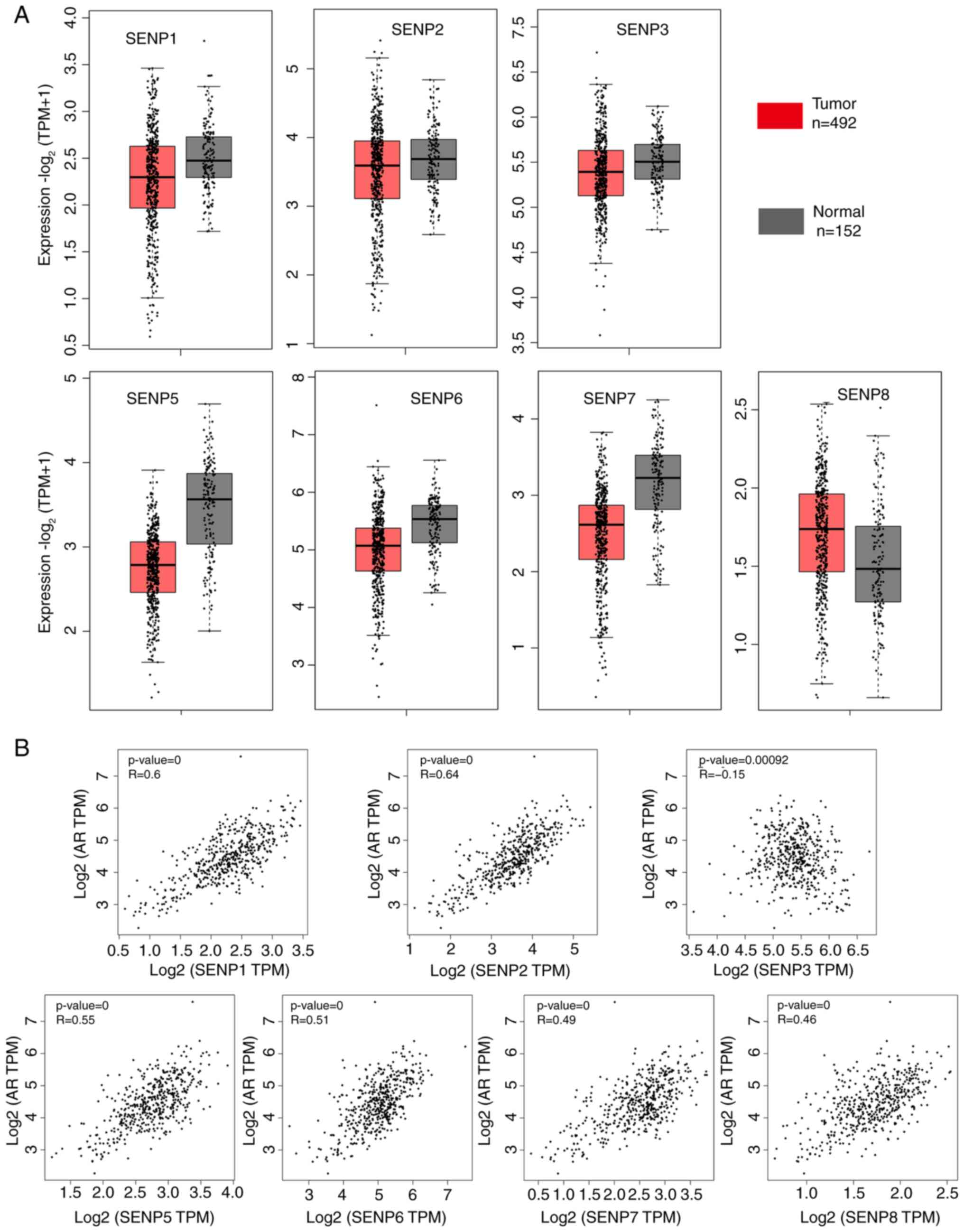
In order to clarify the expression and potential clinical values of SENPs in PCa, firstly, the mRNA expression level of SENPs were analyzed in PCa and normal tissues using the TCGA database. As revealed in Fig. 1A, the expression level of SENPs were almost no difference between PCa and normal tissues. However, interestingly, significant co-expression between SENPs and AR was found (Fig. 1B), except for SENP3, strongly indicating a potential regulatory relationship between SENPs and AR. It has been previously reported that AR can transcriptionally regulate SENP1 and SENP2 (6). Therefore, it was hypothesized that AR may also be able to transcriptionally regulate other genes in the SENP family. Using the public online tool JASPARA, an interaction was found between the promoter regions of SENPs genes and the transcription factor AR (Table SI, Table SII, Table SIII, Table SIV, Table SV, Table SVI, Table SVII). These data indicated that SENPs are potential downstream target genes of transcription factor AR.

mRNA expression level of SENPs in
prostate cancer and adjacent normal tissues varies only slightly,
but there is significant co-expression with AR. (A) Gene expression
analysis of SENPs in normal and tumoral prostate tissues according
to the PRAD TCGA dataset. Results were obtained from the GEPIA
website. (B) Pearson's correlation analysis of SENPs with AR using
the PRAD TCGA dataset. Results were obtained from the GEPIA website
http://gepia2.cancer-pku.cn/. AR,
androgen receptor; PRAD, prostate adenocarcinoma; TCGA, The Cancer
Genome Atlas.

Figure 1.

mRNA expression level of SENPs in prostate cancer and adjacent normal tissues varies only slightly, but there is significant co-expression with AR. (A) Gene expression analysis of SENPs in normal and tumoral prostate tissues according to the PRAD TCGA dataset. Results were obtained from the GEPIA website. (B) Pearson's correlation analysis of SENPs with AR using the PRAD TCGA dataset. Results were obtained from the GEPIA website http://gepia2.cancer-pku.cn/. AR, androgen receptor; PRAD, prostate adenocarcinoma; TCGA, The Cancer Genome Atlas.

SENP5 acts as a downstream target of AR and contributes to PCa growth

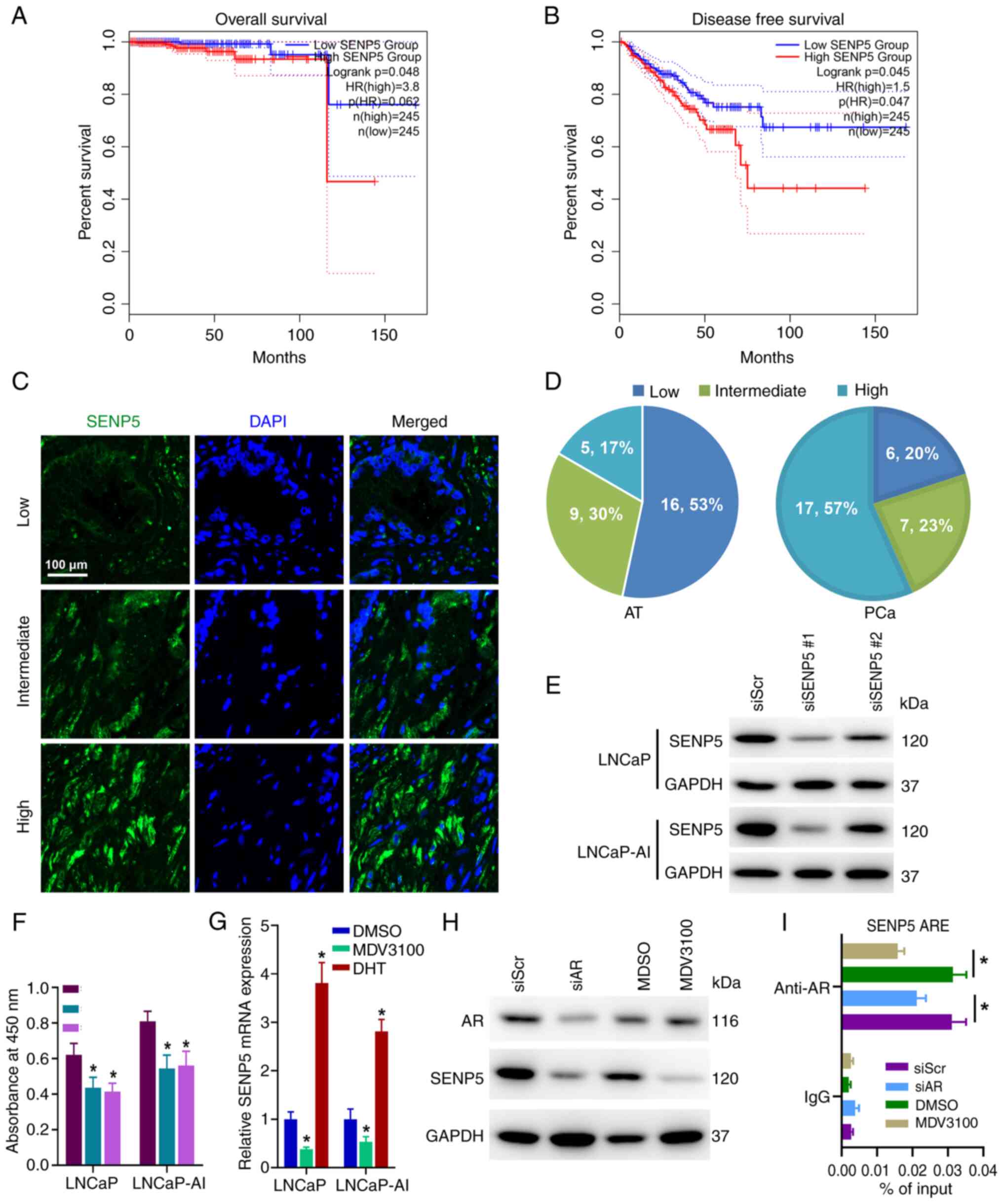
Despite there was almost no difference in the expression level of SENPs between PCa and normal tissues, it was attempted to further clarify whether the expression of SENPs is related to the prognosis of PCa. Using the TCGA database, it was found that the mRNA expression of SENP5 was significantly negatively associated with OS (Fig. 2A) and DFS (Fig. 2B) in PCa, while other genes in the SENP family were not markedly associated with OS and DFS (Fig. S1), indicating that high expression of SENP5 is associated with poor prognosis in PCa. Furthermore, it was found that the protein level of SENP5 was markedly higher in PCa tissues compared with normal adjacent tissues through immunofluorescence analysis (Fig. 2C and D). In addition, SENP5 silencing significantly inhibited the proliferation activity of LNCaP and LNCaP AI cells (Fig. 2E and F). These results suggested that SENP5 may act as an oncogene in PCa.

SENP5 acts as a downstream target of
AR and contributes to PCa growth. (A and B) Survival analysis of
patients with PCa stratified according high and low SENP5
expression using the prostate adenocarcinoma dataset from The
Cancer Genome Atlas. (A) Overall survival; (B) Disease-free
survival. (C and D) Immunofluorescence analysis of the expression
of SENP5 in PCa tissues. (C) Representative images (including low,
intermediate and high expression) from the immunofluorescence
analysis for SENP5 in primary PCa tissues and corresponding
adjacent normal prostate tissues. (D) Quantification of the
staining observed in 30 PCa cases. (E) LNCaP and LNCaP-AI cells
were transfected with siScr or siSENP5 for 48 h; western blots were
probed for levels of SENP5 and GAPDH was used as a loading control.
(F) Cell viability was determined using a Cell Counting Kit-8
assay. (G) LNCaP and LNCaP-AI cells were treated with MDV3100 (25
µM), DHT (10 nM) or vehicle alone for 48 h. The mRNA expression
level of SENP5 was measured using quantitative PCR. (H) LNCaP cells
were transfected with siAR or treated with MDV3100 (25 µM) for 48
h; then total protein cell lysates were prepared and immunoblot
analysis was performed using anti-SENP5 and anti- GAPDH antibodies.
(I) Chromatin immunoprecipitation-quantitative PCR showing the
occupancy of AR on the human SENP5 ARE region in LNCaP cells with
indicated treatment. All results are representative of three
experiments and expressed as the mean ± S.D. *P<0.05. AR,
androgen receptor; PCa, prostate cancer; si-, small interfering;
DHT, dihydrotestosterone.

Figure 2.

SENP5 acts as a downstream target of AR and contributes to PCa growth. (A and B) Survival analysis of patients with PCa stratified according high and low SENP5 expression using the prostate adenocarcinoma dataset from The Cancer Genome Atlas. (A) Overall survival; (B) Disease-free survival. (C and D) Immunofluorescence analysis of the expression of SENP5 in PCa tissues. (C) Representative images (including low, intermediate and high expression) from the immunofluorescence analysis for SENP5 in primary PCa tissues and corresponding adjacent normal prostate tissues. (D) Quantification of the staining observed in 30 PCa cases. (E) LNCaP and LNCaP-AI cells were transfected with siScr or siSENP5 for 48 h; western blots were probed for levels of SENP5 and GAPDH was used as a loading control. (F) Cell viability was determined using a Cell Counting Kit-8 assay. (G) LNCaP and LNCaP-AI cells were treated with MDV3100 (25 µM), DHT (10 nM) or vehicle alone for 48 h. The mRNA expression level of SENP5 was measured using quantitative PCR. (H) LNCaP cells were transfected with siAR or treated with MDV3100 (25 µM) for 48 h; then total protein cell lysates were prepared and immunoblot analysis was performed using anti-SENP5 and anti- GAPDH antibodies. (I) Chromatin immunoprecipitation-quantitative PCR showing the occupancy of AR on the human SENP5 ARE region in LNCaP cells with indicated treatment. All results are representative of three experiments and expressed as the mean ± S.D. *P<0.05. AR, androgen receptor; PCa, prostate cancer; si-, small interfering; DHT, dihydrotestosterone.

To further illuminate the regulatory mechanism between AR and SENP5, PCa cell lines (LNCaP and LNCaP-AI) were treated with MDV3100 and DHT respectively. DHT, the most potent androgen, is usually synthesized in the prostate from testosterone secreted by the testis, which acts as the activating ligand of AR (11). Furthermore, MDV3100 is an antagonist of AR that is widely used in the treatment of patients with PCa (12). Compared with the control group, qPCR results showed that the mRNA level of SENP5 was significantly reduced after MDV3100 treatment (Fig. 2G). On the contrary, the mRNA level of SENP5 significantly increased after DHT treatment (Fig. 2G). Consistent with the mRNA results, similar results were also obtained at the protein level (Fig. 2H). In addition, it was further confirmed that AR could transcriptionally activate SENP5 expression using CHIP-qPCR (Fig. 2I). These results further confirmed that SENP5 is indeed a direct downstream target gene of AR.

Discussion

SUMO-mediated signaling is a proteome regulatory pathway that plays a key role in maintaining cellular physiological functions (13,14). Aberrant SENPs expression promotes the development and progression of multiple cancers, including colon cancer (15), ovarian cancer (16), and breast cancer (17). In the present study, it was demonstrated that SENP5 protein level was markedly elevated in PCa tissues compared to normal adjacent tissues. Moreover, knocking down SENP5 significantly inhibited the growth activity of PCa cells, indicating that SENP5 may act as an oncogene in PCa. High-level expression of SENP5 is significantly associated with poor prognosis, further suggests that SENP5 is an oncogene in PCa (Fig. 2B). Our finding is consistent with its role in promoting drug resistance in colon cancer (18).

Furthermore, it was confirmed that SENP5 is a direct downstream target gene of AR. Firstly, TCGA dataset showed significant co-expression between SENP5 and AR (Fig. 1B). Using JASPARA database, we further found an interaction between the promoter regions of SENP5 and AR, strongly indicating that SENP5 is a potential downstream target gene of AR. Thus, we further verified the result using CHIP-qPCR, as expected, SENP5 is indeed a direct downstream target gene of AR (Fig. 2I). Our finding further expands the types of SENPs targeted by AR, in addition to SENP1 and SENP2 (6), but also SENP5. To some extent, this also implies that inhibition of SENP5 may induce the expression of SENP1 and SENP2 as a negative feedback mechanism to maintain the growth of PCa cells, and the combined blockade of AR and SENP5 may be an improved therapeutic strategy.

Taken together, our results suggest that SENP5 is a novel downstream target gene of AR, and its mRNA level is significantly associated with poor prognosis in PCa, indicating that SENP5 can participate in the occurrence and development of PCa as an oncogene, the underlying molecular mechanism of which needs further investigation. Thus, SENP5 has great potential to become a new target for the diagnosis and treatment of PCa.

Supplementary Material

Supporting Data
Supporting Data

Acknowledgements

The authors would like to thank the Clinical Research Center, Zhejiang University School of Medicine Second Affiliated Hospital for essential technical support and the use of the laboratory to perform experiments.

Funding

The present study was supported by the National Natural Science Foundation of China Youth Science Foundation Project (grant no. 81802571) and Zhejiang Medical and Health Science and Technology Project (grant no. 2019RC039).

Availability of data and materials

The data generated in the present study are included in the figures and/or tables of this article.

Authors' contributions

WL and JZ designed the study. XC, XG and WL performed the experiments. XC, XG and WL supervised specific experiments and revised the manuscript. WL wrote the manuscript. All authors have read and approved the final version of the manuscript. WL and JZ confirm the authenticity of all the raw data.

Ethics approval and consent to participate

All samples were collected from patients with informed consent, and all related procedures were performed with the approval of the internal review and ethics boards of Zhejiang University School of Medicine Second Affiliated Hospital (approval no. 2021-1142; Hangzhou, China).

Patient consent for publication

Not applicable.

Competing interests

The authors declare that they have no competing interests.

References

1 

Siegel RL, Giaquinto AN and Jemal A: Cancer statistics, 2024. CA Cancer J Clin. 74:12–49. 2024.

2 

Mills IG: Maintaining and reprogramming genomic androgen receptor activity in prostate cancer. Nat Rev Cancer. 14:187–198. 2014. View Article : Google Scholar

3 

Dai C, Dehm SM and Sharifi N: Targeting the androgen signaling axis in prostate cancer. J Clin Oncol. 41:4267–4278. 2023. View Article : Google Scholar

4 

Claessens LA and Vertegaal ACO: SUMO proteases: From cellular functions to disease. Trends Cell Biol. 34:901–912. 2024. View Article : Google Scholar

5 

Chang HM and Yeh ETH: SUMO: From bench to bedside. Physiol Rev. 100:1599–1619. 2020. View Article : Google Scholar

6 

Kaikkonen S, Jääskeläinen T, Karvonen U, Rytinki MM, Makkonen H, Gioeli D, Paschal BM and Palvimo JJ: SUMO-specific protease 1 (SENP1) reverses the hormone-augmented SUMOylation of androgen receptor and modulates gene responses in prostate cancer cells. Mol Endocrinol. 23:292–307. 2009. View Article : Google Scholar

7 

Xu G, Wu J, Zhou L, Chen B, Sun Z, Zhao F and Tao Z: Characterization of the small RNA transcriptomes of androgen dependent and independent prostate cancer cell line by deep sequencing. PLoS One. 5:e155192010. View Article : Google Scholar

8 

Liu W, Wang X, Wang Y, Dai Y, Xie Y, Ping Y, Yin B, Yu P, Liu Z, Duan X, et al: SGK1 inhibition-induced autophagy impairs prostate cancer metastasis by reversing EMT. J Exp Clin Cancer Res. 37:732018. View Article : Google Scholar

9 

Liu W, Wang X, Wang Y, Dai Y, Xie Y, Ping Y, Yin B, Yu P, Liu Z, Duan X, et al: SGK1 inhibition induces autophagy-dependent apoptosis via the mTOR-Foxo3a pathway. Br J Cancer. 117:1139–1153. 2017. View Article : Google Scholar

10 

Liang D, Feng Y, Zandkarimi F, Wang H, Zhang Z, Kim J, Cai Y, Gu W, Stockwell BR and Jiang X: Ferroptosis surveillance independent of GPX4 and differentially regulated by sex hormones. Cell. 186:2748–2764.e2722. 2023. View Article : Google Scholar

11 

Chang KH, Li R, Kuri B, Lotan Y, Roehrborn CG, Liu J, Vessella R, Nelson PS, Kapur P, Guo X, et al: A gain-of-function mutation in DHT synthesis in castration-resistant prostate cancer. Cell. 154:1074–1084. 2013. View Article : Google Scholar

12 

Higano CS, Beer TM, Taplin ME, Efstathiou E, Hirmand M, Forer D and Scher HI: Long-term safety and antitumor activity in the phase 1–2 study of enzalutamide in pre- and post-docetaxel castration-resistant prostate cancer. Eur Urol. 68:795–801. 2015. View Article : Google Scholar

13 

Claessens LA, Verlaan-de Vries M, de Graaf IJ and Vertegaal ACO: SENP6 regulates localization and nuclear condensation of DNA damage response proteins by group deSUMOylation. Nat Commun. 14:58932023. View Article : Google Scholar

14 

Lin H, Suzuki K, Smith N, Li X, Nalbach L, Fuentes S, Spigelman AF, Dai XQ, Bautista A, Ferdaoussi M, et al: A role and mechanism for redox sensing by SENP1 in β-cell responses to high fat feeding. Nat Commun. 15:3342024. View Article : Google Scholar

15 

Wei M, Huang X, Liao L, Tian Y and Zheng X: SENP1 decreases RNF168 phase separation to promote DNA damage repair and drug resistance in colon cancer. Cancer Res. 83:2908–2923. 2023. View Article : Google Scholar

16 

Zhang Y, Wei H, Zhou Y, Li Z, Gou W, Meng Y, Zheng W, Li J, Li Y and Zhu W: Identification of potent SENP1 inhibitors that inactivate SENP1/JAK2/STAT signaling pathway and overcome platinum drug resistance in ovarian cancer. Clin Transl Med. 11:e6492021. View Article : Google Scholar

17 

Xiao M, Bian Q, Lao Y, Yi J, Sun X, Sun X and Yang J: SENP3 loss promotes M2 macrophage polarization and breast cancer progression. Mol Oncol. 16:1026–1044. 2021. View Article : Google Scholar

18 

Liu T, Wang H, Chen Y, Wan Z, Du Z, Shen H, Yu Y, Ma S, Xu Y, Li Z, et al: SENP5 promotes homologous recombination-mediated DNA damage repair in colorectal cancer cells through H2AZ deSUMOylation. J Exp Clin Cancer Res. 42:2342023. View Article : Google Scholar

Related Articles

  • Abstract
  • View
  • Download
  • Twitter
Copy and paste a formatted citation
Spandidos Publications style
Chen X, Gong X, Zhang J and Liu W: SENP5 acts as a downstream target of androgen receptor and contributes to prostate cancer growth. Oncol Lett 31: 51, 2026.
APA
Chen, X., Gong, X., Zhang, J., & Liu, W. (2026). SENP5 acts as a downstream target of androgen receptor and contributes to prostate cancer growth. Oncology Letters, 31, 51. https://doi.org/10.3892/ol.2025.15404
MLA
Chen, X., Gong, X., Zhang, J., Liu, W."SENP5 acts as a downstream target of androgen receptor and contributes to prostate cancer growth". Oncology Letters 31.2 (2026): 51.
Chicago
Chen, X., Gong, X., Zhang, J., Liu, W."SENP5 acts as a downstream target of androgen receptor and contributes to prostate cancer growth". Oncology Letters 31, no. 2 (2026): 51. https://doi.org/10.3892/ol.2025.15404
Copy and paste a formatted citation
x
Spandidos Publications style
Chen X, Gong X, Zhang J and Liu W: SENP5 acts as a downstream target of androgen receptor and contributes to prostate cancer growth. Oncol Lett 31: 51, 2026.
APA
Chen, X., Gong, X., Zhang, J., & Liu, W. (2026). SENP5 acts as a downstream target of androgen receptor and contributes to prostate cancer growth. Oncology Letters, 31, 51. https://doi.org/10.3892/ol.2025.15404
MLA
Chen, X., Gong, X., Zhang, J., Liu, W."SENP5 acts as a downstream target of androgen receptor and contributes to prostate cancer growth". Oncology Letters 31.2 (2026): 51.
Chicago
Chen, X., Gong, X., Zhang, J., Liu, W."SENP5 acts as a downstream target of androgen receptor and contributes to prostate cancer growth". Oncology Letters 31, no. 2 (2026): 51. https://doi.org/10.3892/ol.2025.15404
Follow us
  • Twitter
  • LinkedIn
  • Facebook
About
  • Spandidos Publications
  • Careers
  • Cookie Policy
  • Privacy Policy
How can we help?
  • Help
  • Live Chat
  • Contact
  • Email to our Support Team