Spandidos Publications Logo
  • About
    • About Spandidos
    • Aims and Scopes
    • Abstracting and Indexing
    • Editorial Policies
    • Reprints and Permissions
    • Job Opportunities
    • Terms and Conditions
    • Contact
  • Journals
    • All Journals
    • Oncology Letters
      • Oncology Letters
      • Information for Authors
      • Editorial Policies
      • Editorial Board
      • Aims and Scope
      • Abstracting and Indexing
      • Bibliographic Information
      • Archive
    • International Journal of Oncology
      • International Journal of Oncology
      • Information for Authors
      • Editorial Policies
      • Editorial Board
      • Aims and Scope
      • Abstracting and Indexing
      • Bibliographic Information
      • Archive
    • Molecular and Clinical Oncology
      • Molecular and Clinical Oncology
      • Information for Authors
      • Editorial Policies
      • Editorial Board
      • Aims and Scope
      • Abstracting and Indexing
      • Bibliographic Information
      • Archive
    • Experimental and Therapeutic Medicine
      • Experimental and Therapeutic Medicine
      • Information for Authors
      • Editorial Policies
      • Editorial Board
      • Aims and Scope
      • Abstracting and Indexing
      • Bibliographic Information
      • Archive
    • International Journal of Molecular Medicine
      • International Journal of Molecular Medicine
      • Information for Authors
      • Editorial Policies
      • Editorial Board
      • Aims and Scope
      • Abstracting and Indexing
      • Bibliographic Information
      • Archive
    • Biomedical Reports
      • Biomedical Reports
      • Information for Authors
      • Editorial Policies
      • Editorial Board
      • Aims and Scope
      • Abstracting and Indexing
      • Bibliographic Information
      • Archive
    • Oncology Reports
      • Oncology Reports
      • Information for Authors
      • Editorial Policies
      • Editorial Board
      • Aims and Scope
      • Abstracting and Indexing
      • Bibliographic Information
      • Archive
    • Molecular Medicine Reports
      • Molecular Medicine Reports
      • Information for Authors
      • Editorial Policies
      • Editorial Board
      • Aims and Scope
      • Abstracting and Indexing
      • Bibliographic Information
      • Archive
    • World Academy of Sciences Journal
      • World Academy of Sciences Journal
      • Information for Authors
      • Editorial Policies
      • Editorial Board
      • Aims and Scope
      • Abstracting and Indexing
      • Bibliographic Information
      • Archive
    • International Journal of Functional Nutrition
      • International Journal of Functional Nutrition
      • Information for Authors
      • Editorial Policies
      • Editorial Board
      • Aims and Scope
      • Abstracting and Indexing
      • Bibliographic Information
      • Archive
    • International Journal of Epigenetics
      • International Journal of Epigenetics
      • Information for Authors
      • Editorial Policies
      • Editorial Board
      • Aims and Scope
      • Abstracting and Indexing
      • Bibliographic Information
      • Archive
    • Medicine International
      • Medicine International
      • Information for Authors
      • Editorial Policies
      • Editorial Board
      • Aims and Scope
      • Abstracting and Indexing
      • Bibliographic Information
      • Archive
  • Articles
  • Information
    • Information for Authors
    • Information for Reviewers
    • Information for Librarians
    • Information for Advertisers
    • Conferences
  • Language Editing
Spandidos Publications Logo
  • About
    • About Spandidos
    • Aims and Scopes
    • Abstracting and Indexing
    • Editorial Policies
    • Reprints and Permissions
    • Job Opportunities
    • Terms and Conditions
    • Contact
  • Journals
    • All Journals
    • Biomedical Reports
      • Information for Authors
      • Editorial Policies
      • Editorial Board
      • Aims and Scope
      • Abstracting and Indexing
      • Bibliographic Information
      • Archive
    • Experimental and Therapeutic Medicine
      • Information for Authors
      • Editorial Policies
      • Editorial Board
      • Aims and Scope
      • Abstracting and Indexing
      • Bibliographic Information
      • Archive
    • International Journal of Epigenetics
      • Information for Authors
      • Editorial Policies
      • Editorial Board
      • Aims and Scope
      • Abstracting and Indexing
      • Bibliographic Information
      • Archive
    • International Journal of Functional Nutrition
      • Information for Authors
      • Editorial Policies
      • Editorial Board
      • Aims and Scope
      • Abstracting and Indexing
      • Bibliographic Information
      • Archive
    • International Journal of Molecular Medicine
      • Information for Authors
      • Editorial Policies
      • Editorial Board
      • Aims and Scope
      • Abstracting and Indexing
      • Bibliographic Information
      • Archive
    • International Journal of Oncology
      • Information for Authors
      • Editorial Policies
      • Editorial Board
      • Aims and Scope
      • Abstracting and Indexing
      • Bibliographic Information
      • Archive
    • Medicine International
      • Information for Authors
      • Editorial Policies
      • Editorial Board
      • Aims and Scope
      • Abstracting and Indexing
      • Bibliographic Information
      • Archive
    • Molecular and Clinical Oncology
      • Information for Authors
      • Editorial Policies
      • Editorial Board
      • Aims and Scope
      • Abstracting and Indexing
      • Bibliographic Information
      • Archive
    • Molecular Medicine Reports
      • Information for Authors
      • Editorial Policies
      • Editorial Board
      • Aims and Scope
      • Abstracting and Indexing
      • Bibliographic Information
      • Archive
    • Oncology Letters
      • Information for Authors
      • Editorial Policies
      • Editorial Board
      • Aims and Scope
      • Abstracting and Indexing
      • Bibliographic Information
      • Archive
    • Oncology Reports
      • Information for Authors
      • Editorial Policies
      • Editorial Board
      • Aims and Scope
      • Abstracting and Indexing
      • Bibliographic Information
      • Archive
    • World Academy of Sciences Journal
      • Information for Authors
      • Editorial Policies
      • Editorial Board
      • Aims and Scope
      • Abstracting and Indexing
      • Bibliographic Information
      • Archive
  • Articles
  • Information
    • For Authors
    • For Reviewers
    • For Librarians
    • For Advertisers
    • Conferences
  • Language Editing
Login Register Submit
  • This site uses cookies
  • You can change your cookie settings at any time by following the instructions in our Cookie Policy. To find out more, you may read our Privacy Policy.

    I agree
Search articles by DOI, keyword, author or affiliation
Search
Advanced Search
presentation
Oncology Letters
Join Editorial Board Propose a Special Issue
Print ISSN: 1792-1074 Online ISSN: 1792-1082
Journal Cover
February-2026 Volume 31 Issue 2

Full Size Image

Sign up for eToc alerts
Recommend to Library

Journals

International Journal of Molecular Medicine

International Journal of Molecular Medicine

International Journal of Molecular Medicine is an international journal devoted to molecular mechanisms of human disease.

International Journal of Oncology

International Journal of Oncology

International Journal of Oncology is an international journal devoted to oncology research and cancer treatment.

Molecular Medicine Reports

Molecular Medicine Reports

Covers molecular medicine topics such as pharmacology, pathology, genetics, neuroscience, infectious diseases, molecular cardiology, and molecular surgery.

Oncology Reports

Oncology Reports

Oncology Reports is an international journal devoted to fundamental and applied research in Oncology.

Experimental and Therapeutic Medicine

Experimental and Therapeutic Medicine

Experimental and Therapeutic Medicine is an international journal devoted to laboratory and clinical medicine.

Oncology Letters

Oncology Letters

Oncology Letters is an international journal devoted to Experimental and Clinical Oncology.

Biomedical Reports

Biomedical Reports

Explores a wide range of biological and medical fields, including pharmacology, genetics, microbiology, neuroscience, and molecular cardiology.

Molecular and Clinical Oncology

Molecular and Clinical Oncology

International journal addressing all aspects of oncology research, from tumorigenesis and oncogenes to chemotherapy and metastasis.

World Academy of Sciences Journal

World Academy of Sciences Journal

Multidisciplinary open-access journal spanning biochemistry, genetics, neuroscience, environmental health, and synthetic biology.

International Journal of Functional Nutrition

International Journal of Functional Nutrition

Open-access journal combining biochemistry, pharmacology, immunology, and genetics to advance health through functional nutrition.

International Journal of Epigenetics

International Journal of Epigenetics

Publishes open-access research on using epigenetics to advance understanding and treatment of human disease.

Medicine International

Medicine International

An International Open Access Journal Devoted to General Medicine.

Journal Cover
February-2026 Volume 31 Issue 2

Full Size Image

Sign up for eToc alerts
Recommend to Library

  • Article
  • Citations
    • Cite This Article
    • Download Citation
    • Create Citation Alert
    • Remove Citation Alert
    • Cited By
  • Similar Articles
    • Related Articles (in Spandidos Publications)
    • Similar Articles (Google Scholar)
    • Similar Articles (PubMed)
  • Download PDF
  • Download XML
  • View XML

  • Supplementary Files
    • Supplementary_Data.pdf
Article Open Access

Analysis of the TCRβ repertoire characteristics when combining radiotherapy and immunotherapy in cancer

  • Authors:
    • Xueli Yang
    • Wujun Wei
    • Zhihui Feng
    • Biao Zhang
    • Yi Liu
    • Fei Yang
    • Chong Zhang
    • Minglin Ou
    • Songbai Liao
    • Xianliang Hou
  • View Affiliations / Copyright

    Affiliations: Scientific Research Department, The Second Affiliated Hospital of Guilin Medical University, Guilin, Guangxi Zhuang Autonomous Region 541199, P.R. China, Center for Clinical Laboratory Diagnosis and Research, Affiliated Hospital of Youjiang Medical University for Nationalities, Baise, Guangxi Zhuang Autonomous Region 533000, P.R. China, Guangxi Key Laboratory of Metabolic Reprogramming and Intelligent Medical Engineering for Chronic Diseases, The Second Affiliated Hospital of Guilin Medical University, Guilin, Guangxi Zhuang Autonomous Region 541199, P.R. China, Department of Neurology, The Second Affiliated Hospital of Guilin Medical University, Guilin, Guangxi Zhuang Autonomous Region 541199, P.R. China, Department of Urology, The Nanxishan Hospital of Guangxi Zhuang Autonomous Region, Guilin, Guangxi Zhuang Autonomous Region 541002, P.R. China
    Copyright: © Yang et al. This is an open access article distributed under the terms of Creative Commons Attribution License.
  • Article Number: 67
    |
    Published online on: December 3, 2025
       https://doi.org/10.3892/ol.2025.15420
  • Expand metrics +
Metrics: Total Views: 0 (Spandidos Publications: | PMC Statistics: )
Metrics: Total PDF Downloads: 0 (Spandidos Publications: | PMC Statistics: )
Cited By (CrossRef): 0 citations Loading Articles...

This article is mentioned in:


Abstract

Cancer is a global public health concern. Radio­therapy (RT) and immunotherapy are increasingly used in cancer treatment, but the specific immune mechanisms underlying their effects remain to be elucidated. The present study analyzed publicly available datasets, in which the T‑cell receptor β chain (TCRβ) repertoire in tumor‑bearing mice treated with RT and immunotherapy, as well as the TCR repertoire of T cells derived from hematopoietic stem cells (HSCs) of mice exposed to radiation doses of 0, 10 and 100 mGy were comprehensively evaluated. The results of the present study indicated that the diversity of the TCRβ complementarity‑determining region 3 (CDR3) in tumor‑bearing mice decreased after RT, anti‑cytotoxic T‑lymphocyte‑associated protein‑4 (CTLA‑4) and anti‑programmed cell death protein‑1 (PD‑1) treatment, especially in the RT and RT + anti‑CTLA‑4 or anti‑PD‑1 treatment groups. Furthermore, the CDR3 length markedly decreased in the RT group and markedly increased in the anti‑CTLA‑4 and anti‑PD‑1 groups. Next, the TCR profile of T cells differentiated from HSCs exposed to different radiation doses was examined. As the radiation dose increased, the TCRβ diversity in mice gradually decreased and the degree of clonal expansion markedly increased, the percentage of private sequences (unique sequences detected in only a single mouse) was markedly increased and the degree of overlap was markedly decreased. Furthermore, there was a notable difference in the usage frequency of TCRβ chain variable/joining gene segments among the different radiation dose groups. The present study demonstrated that RT and immunotherapy may alter the TCR repertoire owing to their effects on HSCs.
View Figures

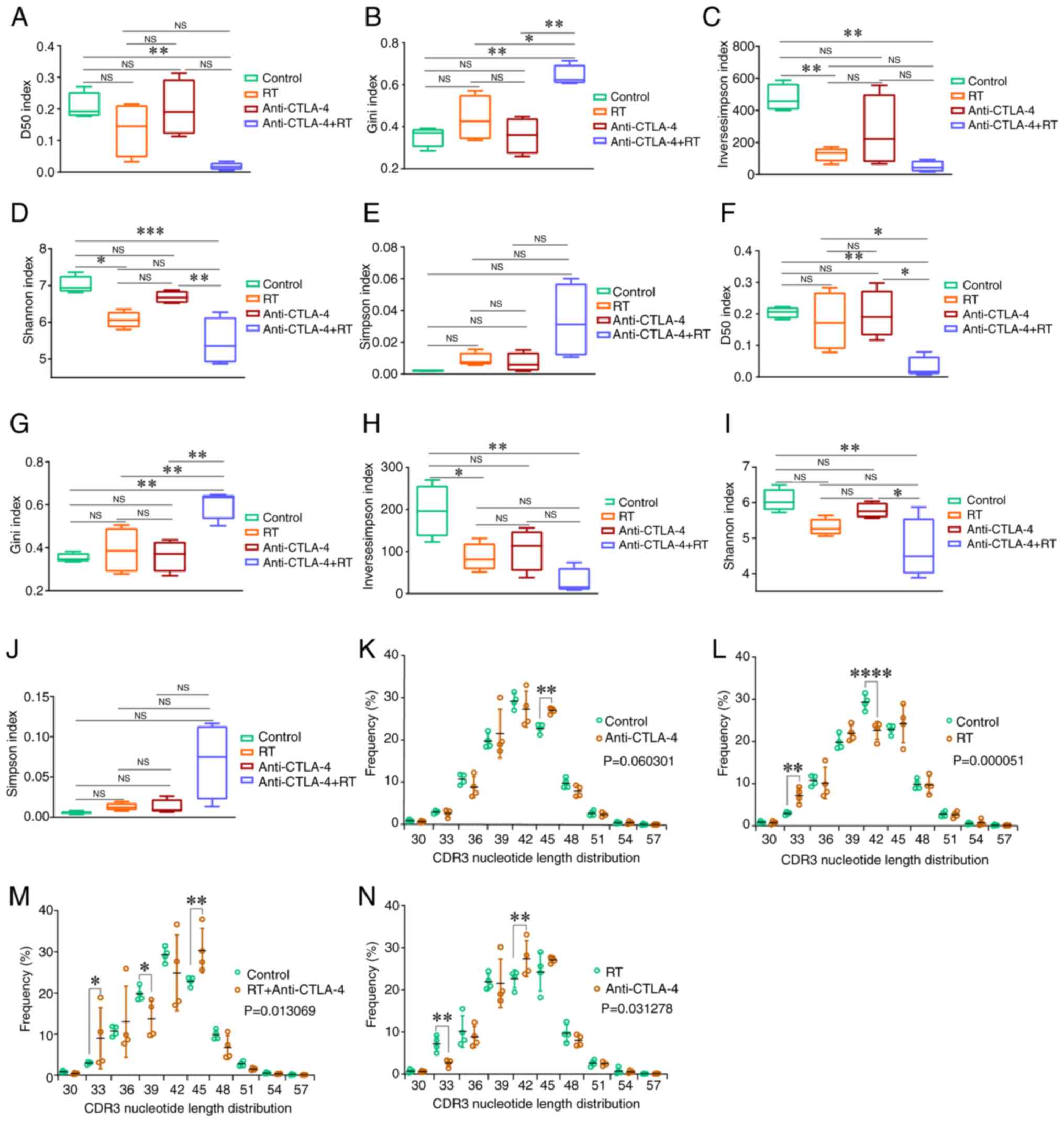
Figure 1

CDR3 nucleotide length distribution
and diversity analysis of the TCRβ repertoire in mice with RT and
anti-CTLA-4 therapy, and the control group. The TCRβ CDR3 diversity
in the post-selection repertoire (in-frame sequences) was estimated
by (A) the D50 index, (B) Gini index, (C) Inverse Simpson index,
(D) Shannon index and (E) Simpson index. (F-J) The TCRβ CDR3
diversity in the pre-selection repertoire (out-of-frame sequences)
was estimated by the aforementioned five diversity indices. Data
are presented as the mean ± SD; comparisons were made using one-way
ANOVA or Kruskal-Wallis test and corrected for multiple comparisons
using Bonferroni. *P<0.05, **P<0.01 and ***P<0.001. (K-N)
The comparison of CDR3 length between the different groups. All of
the CDR3 lengths that differed significantly (P<0.05) between
treatment group mice and controls are presented. Data are presented
as the mean ± SD; the overall differences of the CDR3 length
distribution (ten length categories) between groups were compared
using two-way ANOVA, and Tukey's test was performed after the
two-way ANOVA to compare the differences in each CDR3 length
between groups. *P<0.05, **P<0.01, ***P<0.001 and
****P<0.0001. CDR3, complementarity-determining region 3; TCRβ,
T-cell receptor β-chain; CTLA-4, cytotoxic T lymphocyte-associated
antigen-4; RT, radiotherapy; NS, not significant.

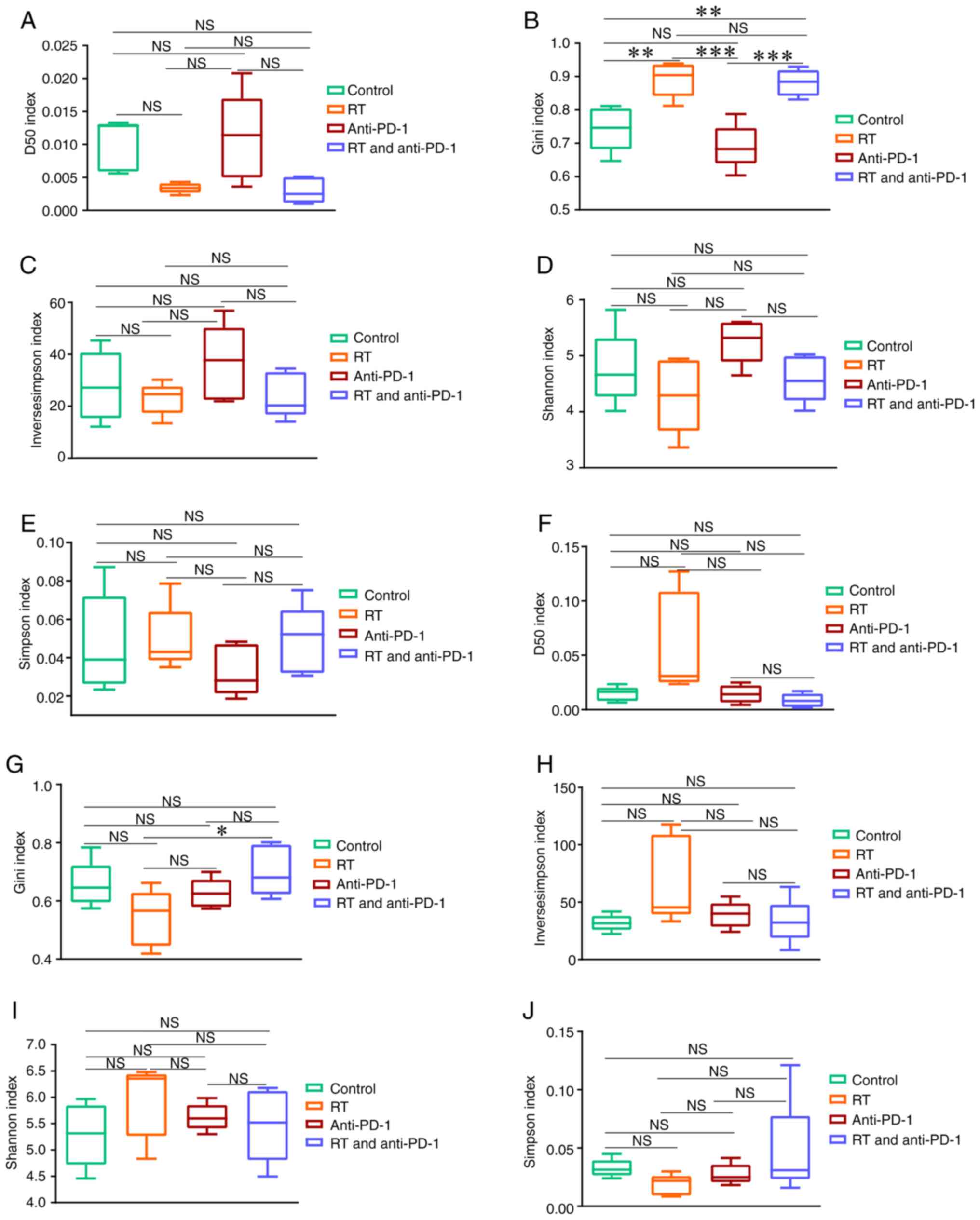
Figure 2

Diversity indexes of the
post-selection repertoire in mice with RT and anti-PD-1 therapy,
and the control group. The diversity of the treatment area was
measured by (A) the D50 index, (B) Gini index, (C) Inverse Simpson
index, (D) Shannon index and (E) Simpson index. (F) The D50 index,
(G) Gini index, (H) Inverse Simpson index, (I) Shannon index and
(J) Simpson index were all used to evaluate the diversity of the
outside the RT field. Data are presented as the mean ± SD;
comparisons were made using one-way ANOVA corrected for multiple
comparisons using Bonferroni. *P<0.05, **P<0.01 and
***P<0.001 (two-tailed). PD-1, programmed cell death-1; NS, not
significant; RT, radiotherapy.

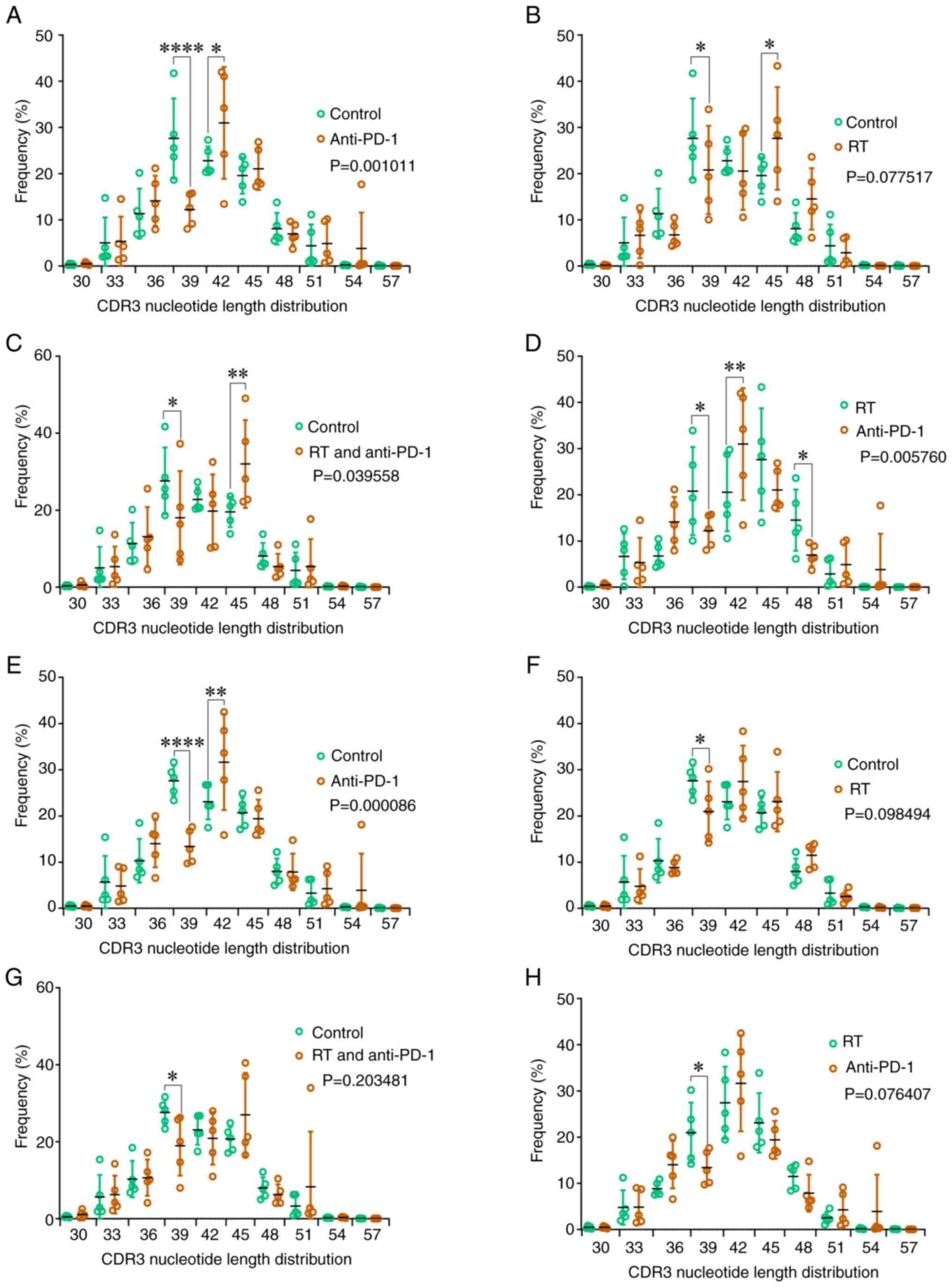
Figure 3

Distribution of TCRβ repertoire CDR3
length within and outside the treatment area in mice receiving RT
and anti-PD-1 therapy, as well as in the control group. (A) The
CDR3 length distribution map compared between the control and
anti-PD-1 groups. (B) The CDR3 length distribution map compared
between the control and RT groups. (C) The CDR3 length distribution
map compared between the control and RT + anti-PD-1 groups. (D) The
CDR3 length distribution map compared between the RT and the
anti-PD-1 groups. (E) The CDR3 length distribution map compared
between the control and anti-PD-1 groups. (F) The CDR3 length
distribution map compared between the control and RT groups. (G)
The CDR3 length distribution map compared between the control and
RT + anti-PD-1 groups. (H) The CDR3 length distribution map
compared between the RT and the anti-PD-1 groups. Data are
presented as the mean ± SD; the overall differences of the CDR3
length distribution (ten length categories) between groups were
compared using two-way ANOVA, and Tukey's test was performed after
the two-way ANOVA to compare the differences in each CDR3 length
between groups. *P<0.05, **P<0.01 and ****P<0.0001. TCRβ,
T-cell receptor β-chain; CDR3, complementarity-determining region
3; PD-1, programmed cell death-1; RT, radiotherapy.

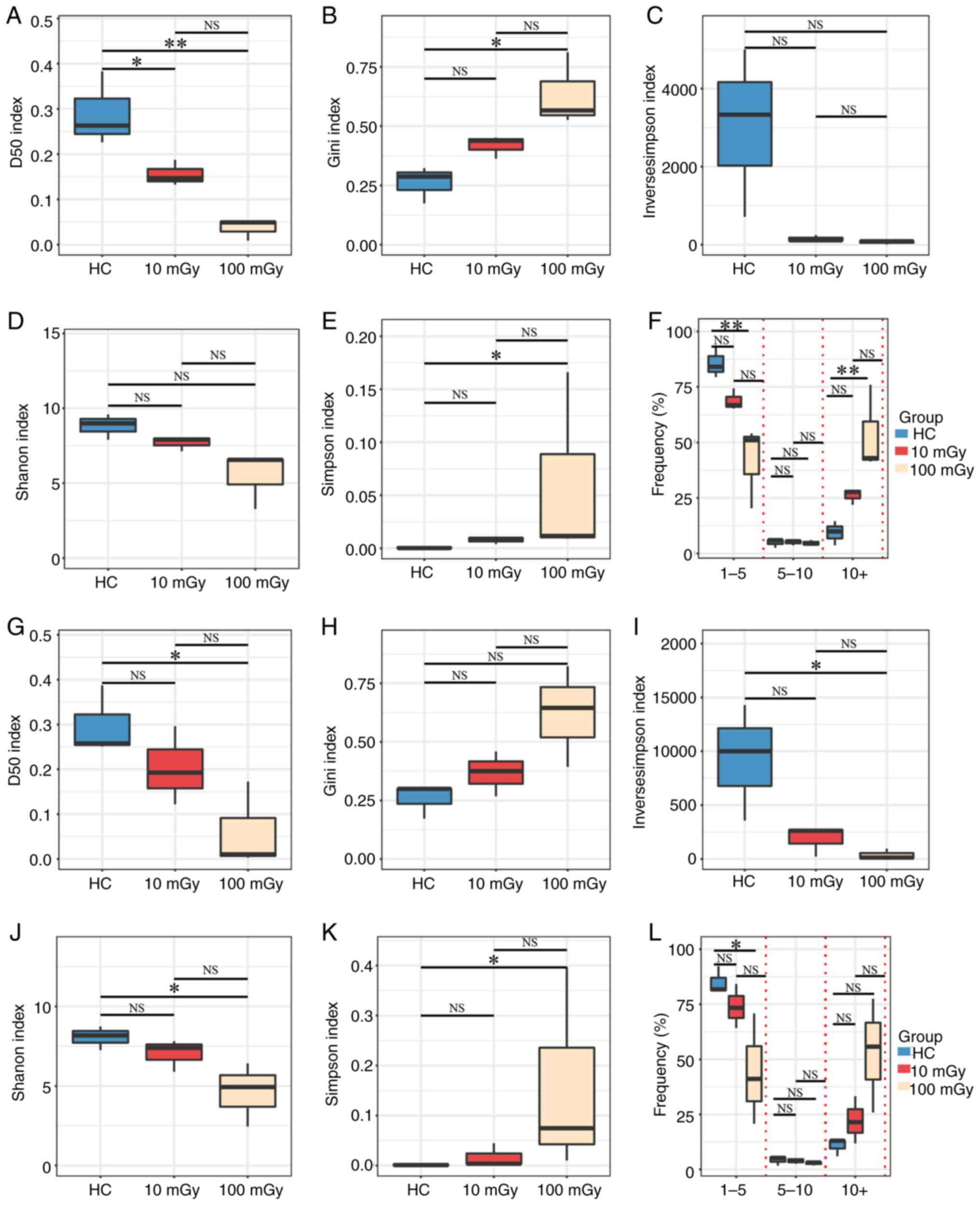
Figure 4

Degree of expansion and diversity
indices of the TCRβ repertoire in the HC and RT groups. The
diversity of the post-selection repertoire was measured by (A) the
D50 index, (B) Gini index, (C) Inverse Simpson index, (D) Shannon
index and (E) Simpson index. (F) Distribution in the clonal
abundance of the post-selection repertoire. Five diversity indices
were used to assess the diversity of pre-selection repertoire: (G)
D50 index, (H) Gini index, (I) Inverse Simpson index, (J) Shannon
index and (K) Simpson index. (L) Distribution in the clonal
abundance of the pre-selection repertoire. Data are presented as
the mean ± SD; comparisons were made using the one-way ANOVA or
Kruskal-Wallis test and corrected for multiple comparisons using
Bonferroni. *P<0.05 and **P<0.01. TCRβ, T-cell receptor
β-chain; HC, healthy control; ns, not significant.

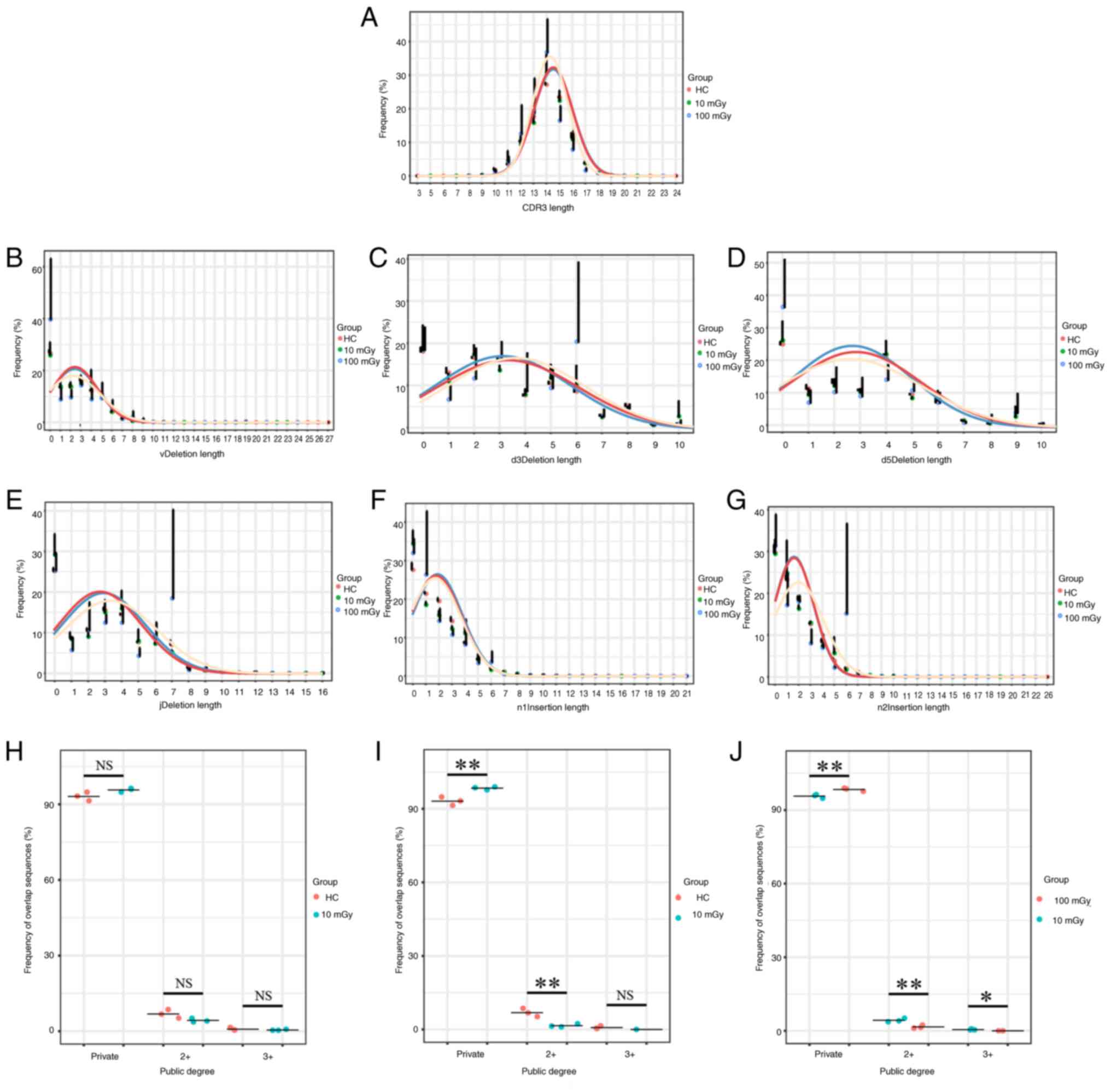
Figure 5

Altered CDR3 length distribution,
InDel patterns and public degree in the RT group. (A) The changes
in the CDR3 length in the radiation group mice from the 10 and 100
mGy groups were compared with those of the HC group. (B-G) TCRβ
CDR3 sequences from the radiotherapy and HC groups in the
post-selection repertoire were analyzed for the frequency of
clonotypes with a specific number of InDels at each of the six
rearrangement sites: (B) vDdel, (C) d3Del, (D) d5Del, (E) jDel, (F)
n1Ins and (G) n2Ins. (H-J) Overlap indices were calculated from 9
HC, 9 mice with 10 mGy and 9 mice with 100 mGy, where (H) is the
comparison between HC group mice and mice receiving 10 mGy
radiation, (I) is the comparison between HC group mice and mice
receiving 100 mGy radiation and (J) is the comparison between mice
receiving 10 mGy radiation and mice receiving 100 mGy radiation.
Data are presented as the mean ± SD and the means between the two
groups were compared using the unpaired t-test or the Mann-Whitney
U test. One-way ANOVA or Kruskal-Wallis test was used to compare
group means across three or more groups and corrected for multiple
comparisons using Bonferroni. *P<0.05 and **P<0.01. TCRβ,
T-cell receptor β-chain; CDR3, complementarity-determining region
3; InDel, insertions and deletions; NS, not significant; HC,
healthy control.

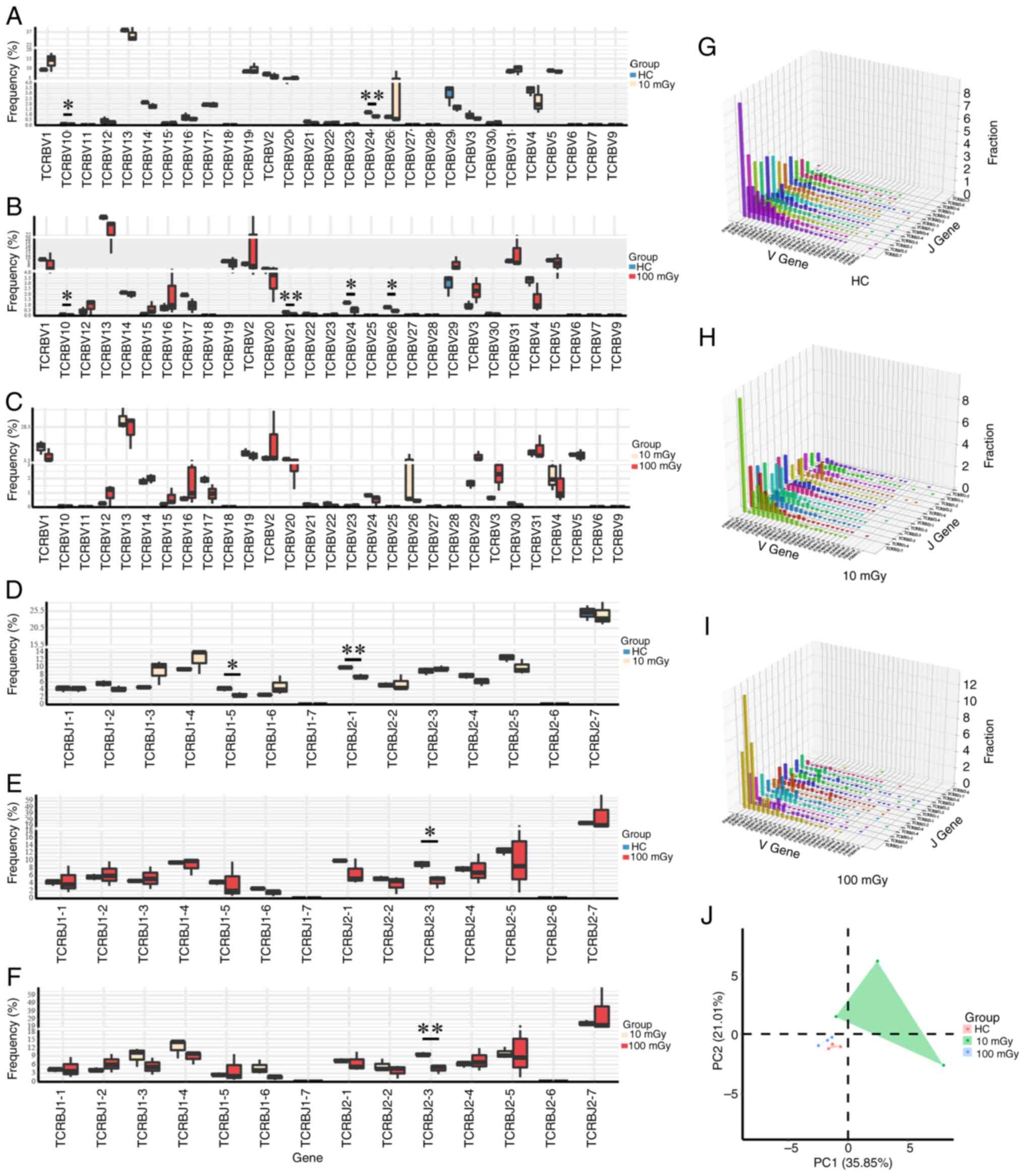
Figure 6

Usage frequency of TRBV/J segments is
different following three different radiation doses in the
post-selection repertoire. Significant differences in TRBV segment
usage in the (A) 10 mGy and (B) 100 mGy groups, compared with the
HC group. Differential usage of the TRBJ gene segment in the (D) 10
mGy and (E) 100 mGy groups, compared with the HC group. Use of TRBV
(C) and TRBJ (F) gene fragments in the 100 mGy group compared with
the 10 mGy group. Significant differences were analyzed by unpaired
t-test and false discovery rate correction. All of the TRBVs and
TRBJs that were found to differ significantly (P<0.05) between
radiation group mice and HC are presented. Data are presented as
the mean ± SD. Three-dimensional landscapes depicting the mean
utilization frequency of specific Vβ-Jβ gene segment combinations
in the in-frame TCRβ chains expressed in the (G) HC group and mice
with radiation from the (H) 10 mGy and (I) 100 mGy groups. (J) PCA
based on the TRBV segment out-of-frame usage demonstrated notable
differences between the radiation and HC groups. *P<0.05,
**P<0.01. TCRβ, T-cell receptor β-chain; TRBV, TCR β chain
variable gene; TRBJ, TCR β chain joining gene; PCA, principal
coordinate analysis; HC, healthy control.
View References

1 

Chen Z, Ma Y, Hua J, Wang Y and Guo H: Impacts from economic development and environmental factors on life expectancy: A comparative study based on data from both developed and developing countries from 2004 to 2016. Int J Environ Res Public Health. 18:85592021. View Article : Google Scholar : PubMed/NCBI

2 

Tchkonia T, Palmer AK and Kirkland JL: New horizons: Novel approaches to enhance healthspan through targeting cellular senescence and related aging mechanisms. J Clin Endocrinol Metab. 106:e1481–e1487. 2021. View Article : Google Scholar : PubMed/NCBI

3 

Cao W, Qin K, Li F and Chen W: Socioeconomic inequalities in cancer incidence and mortality: An analysis of GLOBOCAN 2022. Chin Med J (Engl). 137:1407–1413. 2024. View Article : Google Scholar : PubMed/NCBI

4 

Torre LA, Siegel RL, Ward EM and Jemal A: Global cancer incidence and mortality rates and trends-an update. Cancer Epidemiol Biomarkers Prev. 25:16–27. 2016. View Article : Google Scholar : PubMed/NCBI

5 

Zheng R, Zhang S, Zeng H, Wang S, Sun K, Chen R, Li L, Wei W and He J: Cancer incidence and mortality in China, 2016. J Natl Cancer Cent. 2:1–9. 2022.PubMed/NCBI

6 

Cao W, Chen HD, Yu YW, Li N and Chen WQ: Changing profiles of cancer burden worldwide and in China: A secondary analysis of the global cancer statistics 2020. Chin Med J (Engl). 134:783–791. 2021. View Article : Google Scholar : PubMed/NCBI

7 

Bhattacharya S and Asaithamby A: Repurposing DNA repair factors to eradicate tumor cells upon radiotherapy. Transl Cancer Res. 6 (Suppl 5):S822–S839. 2017. View Article : Google Scholar : PubMed/NCBI

8 

Mortezaee K and Najafi M: Immune system in cancer radiotherapy: Resistance mechanisms and therapy perspectives. Crit Rev Oncol Hematol. 157:1031802021. View Article : Google Scholar : PubMed/NCBI

9 

Watanabe T, Sato GE, Yoshimura M, Suzuki M and Mizowaki T: The mutual relationship between the host immune system and radiotherapy: Stimulating the action of immune cells by irradiation. Int J Clin Oncol. 28:201–208. 2023. View Article : Google Scholar : PubMed/NCBI

10 

Hoffman RM: Back to the future: Are tumor-targeting bacteria the next-generation cancer therapy? Methods Mol Biol. 1317:239–260. 2015. View Article : Google Scholar : PubMed/NCBI

11 

Zhang Y and Zhang Z: The history and advances in cancer immunotherapy: Understanding the characteristics of tumor-infiltrating immune cells and their therapeutic implications. Cell Mol Immunol. 17:807–821. 2020. View Article : Google Scholar : PubMed/NCBI

12 

Dewan MZ, Galloway AE, Kawashima N, Dewyngaert JK, Babb JS, Formenti SC and Demaria S: Fractionated but not single-dose radiotherapy induces an immune-mediated abscopal effect when combined with anti-CTLA-4 antibody. Clin Cancer Res. 15:5379–5388. 2009. View Article : Google Scholar : PubMed/NCBI

13 

Verbrugge I, Hagekyriakou J, Sharp LL, Galli M, West A, McLaughlin NM, Duret H, Yagita H, Johnstone RW, Smyth MJ and Haynes NM: Radiotherapy increases the permissiveness of established mammary tumors to rejection by immunomodulatory antibodies. Cancer Res. 72:3163–3174. 2012. View Article : Google Scholar : PubMed/NCBI

14 

Hou X, Yang Y, Chen J, Jia H, Zeng P, Lv L, Lu Y, Liu X and Diao H: TCRβ repertoire of memory T cell reveals potential role for Escherichia coli in the pathogenesis of primary biliary cholangitis. Liver Int. 39:956–966. 2019. View Article : Google Scholar : PubMed/NCBI

15 

Hou XL, Wang L, Ding YL, Xie Q and Diao HY: Current status and recent advances of next generation sequencing techniques in immunological repertoire. Genes Immun. 17:153–164. 2016. View Article : Google Scholar : PubMed/NCBI

16 

Hou X, Lu C, Chen S, Xie Q, Cui G, Chen J, Chen Z, Wu Z, Ding Y, Ye P, et al: High throughput sequencing of T cell antigen receptors reveals a conserved TCR repertoire. Medicine (Baltimore). 95:e28392016. View Article : Google Scholar : PubMed/NCBI

17 

Hou X, Wang M, Lu C, Xie Q, Cui G, Chen J, Du Y, Dai Y and Diao H: Analysis of the repertoire features of TCR beta chain CDR3 in human by high-throughput sequencing. Cell Physiol Biochem. 39:651–667. 2016. View Article : Google Scholar : PubMed/NCBI

18 

Zvyagin IV, Pogorelyy MV, Ivanova ME, Komech EA, Shugay M, Bolotin DA, Shelenkov AA, Kurnosov AA, Staroverov DB, Chudakov DM, et al: Distinctive properties of identical twins' TCR repertoires revealed by high-throughput sequencing. Proc Natl Acad Sci USA. 111:5980–5985. 2014. View Article : Google Scholar : PubMed/NCBI

19 

Larimore K, McCormick MW, Robins HS and Greenberg PD: Shaping of human germline IgH repertoires revealed by deep sequencing. J Immunol. 189:3221–3230. 2012. View Article : Google Scholar : PubMed/NCBI

20 

Robins HS, Campregher PV, Srivastava SK, Wacher A, Turtle CJ, Kahsai O, Riddell SR, Warren EH and Carlson CS: Comprehensive assessment of T-cell receptor beta-chain diversity in alphabeta T cells. Blood. 114:4099–4107. 2009. View Article : Google Scholar : PubMed/NCBI

21 

Robins HS, Srivastava SK, Campregher PV, Turtle CJ, Andriesen J, Riddell SR, Carlson CS and Warren EH: Overlap and effective size of the human CD8+ T cell receptor repertoire. Sci Transl Med. 2:47ra642010. View Article : Google Scholar : PubMed/NCBI

22 

Zhang J, Ji Z and Smith KN: Analysis of TCR β CDR3 sequencing data for tracking anti-tumor immunity. Methods Enzymol. 629:443–464. 2019. View Article : Google Scholar : PubMed/NCBI

23 

Li S, Sun J, Allesøe R, Datta K, Bao Y, Oliveira G, Forman J, Jin R, Olsen LR, Keskin DB, et al: RNase H-dependent PCR-enabled T-cell receptor sequencing for highly specific and efficient targeted sequencing of T-cell receptor mRNA for single-cell and repertoire analysis. Nat Protoc. 14:2571–2594. 2019. View Article : Google Scholar : PubMed/NCBI

24 

Baumeister SH, Freeman GJ, Dranoff G and Sharpe AH: Coinhibitory pathways in immunotherapy for cancer. Annu Rev Immunol. 34:539–573. 2016. View Article : Google Scholar : PubMed/NCBI

25 

Candéias SM, Mika J, Finnon P, Verbiest T, Finnon R, Brown N, Bouffler S, Polanska J and Badie C: Low-dose radiation accelerates aging of the T-cell receptor repertoire in CBA/Ca mice. Cell Mol Life Sci. 74:4339–4351. 2017. View Article : Google Scholar : PubMed/NCBI

26 

Rudqvist NP, Pilones KA, Lhuillier C, Wennerberg E, Sidhom JW, Emerson RO, Robins HS, Schneck J, Formenti SC and Demaria S: Radiotherapy and CTLA-4 blockade shape the TCR repertoire of tumor-infiltrating T cells. Cancer Immunol Res. 6:139–150. 2018. View Article : Google Scholar : PubMed/NCBI

27 

Dovedi SJ, Cheadle EJ, Popple AL, Poon E, Morrow M, Stewart R, Yusko EC, Sanders CM, Vignali M, Emerson RO, et al: Fractionated radiation therapy stimulates antitumor immunity mediated by both resident and infiltrating polyclonal T-cell populations when combined with PD-1 blockade. Clin Cancer Res. 23:5514–5526. 2017. View Article : Google Scholar : PubMed/NCBI

28 

Robins H, Desmarais C, Matthis J, Livingston R, Andriesen J, Reijonen H, Carlson C, Nepom G, Yee C and Cerosaletti K: Ultra-sensitive detection of rare T cell clones. J Immunol Methods. 375:14–19. 2012. View Article : Google Scholar : PubMed/NCBI

29 

Carlson CS, Emerson RO, Sherwood AM, Desmarais C, Chung MW, Parsons JM, Steen MS, LaMadrid-Herrmannsfeldt MA, Williamson DW, Livingston RJ, et al: Using synthetic templates to design an unbiased multiplex PCR assay. Nat Commun. 4:26802013. View Article : Google Scholar : PubMed/NCBI

30 

Bolotin DA, Shugay M, Mamedov IZ, Putintseva EV, Turchaninova MA, Zvyagin IV, Britanova OV and Chudakov DM: MiTCR: Software for T-cell receptor sequencing data analysis. Nat Methods. 10:813–814. 2013. View Article : Google Scholar : PubMed/NCBI

31 

Elhanati Y, Sethna Z, Callan CG Jr, Mora T and Walczak AM: Predicting the spectrum of TCR repertoire sharing with a data-driven model of recombination. Immunol Rev. 284:167–179. 2018. View Article : Google Scholar : PubMed/NCBI

32 

Pogorelyy MV, Minervina AA, Chudakov DM, Mamedov IZ, Lebedev YB, Mora T and Walczak AM: Method for identification of condition-associated public antigen receptor sequences. Elife. 7:e330502018. View Article : Google Scholar : PubMed/NCBI

33 

Murugan A, Mora T, Walczak AM and Callan CG Jr: Statistical inference of the generation probability of T-cell receptors from sequence repertoires. Proc Natl Acad Sci USA. 109:16161–16166. 2012. View Article : Google Scholar : PubMed/NCBI

34 

Gomez-Tourino I, Kamra Y, Baptista R, Lorenc A and Peakman M: T cell receptor β-chains display abnormal shortening and repertoire sharing in type 1 diabetes. Nat Commun. 8:17922017. View Article : Google Scholar : PubMed/NCBI

35 

Hou X, Zeng P, Chen J and Diao H: No difference in TCRβ repertoire of CD4+ naive T cell between patients with primary biliary cholangitis and healthy control subjects. Mol Immunol. 116:167–173. 2019. View Article : Google Scholar : PubMed/NCBI

36 

Hou X, Zeng P, Zhang X, Chen J, Liang Y, Yang J, Yang Y, Liu X and Diao H: Shorter TCR β-chains are highly enriched during thymic selection and antigen-driven selection. Front Immunol. 10:2992019. View Article : Google Scholar : PubMed/NCBI

37 

Huang C, Li X, Wu J, Zhang W, Sun S, Lin L, Wang X, Li H, Wu X, Zhang P, et al: The landscape and diagnostic potential of T and B cell repertoire in immunoglobulin A nephropathy. J Autoimmun. 97:100–107. 2019. View Article : Google Scholar : PubMed/NCBI

38 

Liu Y, Zhu H, Zhang Q and Zhao Y: Clonal analysis of peripheral blood T cells in patients with hashimoto's thyroiditis at different stages using TCR sequencing. Immunobiology. 230:1528902025. View Article : Google Scholar : PubMed/NCBI

39 

Venturi V, Kedzierska K, Turner SJ, Doherty PC and Davenport MP: Methods for comparing the diversity of samples of the T cell receptor repertoire. J Immunol Methods. 321:182–195. 2007. View Article : Google Scholar : PubMed/NCBI

40 

Wang Z, Tang Y, Tan Y, Wei Q and Yu W: Cancer-associated fibroblasts in radiotherapy: Challenges and new opportunities. Cell Commun Signal. 17:472019. View Article : Google Scholar : PubMed/NCBI

41 

Van Allen EM, Miao D, Schilling B, Shukla SA, Blank C, Zimmer L, Sucker A, Hillen U, Foppen MHG, Goldinger SM, et al: Genomic correlates of response to CTLA-4 blockade in metastatic melanoma. Science. 9:207–211. 2015. View Article : Google Scholar

42 

Chan TA, Wolchok JD and Snyder A: Genetic basis for clinical response to CTLA-4 blockade in melanoma. N Engl J Med. 12:19842015. View Article : Google Scholar

43 

Rizvi NA, Hellmann MD, Snyder A, Kvistborg P, Makarov V, Havel JJ, Lee W, Yuan J, Wong P, Ho TS, et al: Cancer immunology. Mutational landscape determines sensitivity to PD-1 blockade in non-small cell lung cancer. Science. 3:124–128. 2015. View Article : Google Scholar

44 

Ruocco MG, Pilones KA, Kawashima N, Cammer M, Huang J, Babb JS, Liu M, Formenti SC, Dustin ML and Demaria S: Suppressing T cell motility induced by anti-CTLA-4 monotherapy improves antitumor effects. J Clin Invest. 122:3718–3730. 2012. View Article : Google Scholar : PubMed/NCBI

45 

Krishna C, Chowell D, Gönen M, Elhanati Y and Chan TA: Genetic and environmental determinants of human TCR repertoire diversity. Immun Ageing. 17:262020. View Article : Google Scholar : PubMed/NCBI

46 

Riaz N, Havel JJ, Makarov V, Desrichard A, Urba WJ, Sims JS, Hodi FS, Martín-Algarra S, Mandal R, Sharfman WH, et al: Tumor and microenvironment evolution during immunotherapy with nivolumab. Cell. 171:934–949.e916. 2017. View Article : Google Scholar : PubMed/NCBI

47 

Hebeisen M, Allard M, Gannon PO, Schmidt J, Speiser DE and Rufer N: Identifying individual T cell receptors of optimal avidity for tumor antigens. Front Immunol. 6:5822015. View Article : Google Scholar : PubMed/NCBI

48 

Yan C, Ma X, Guo Z, Wei X, Han D, Zhang T, Chen X, Cao F, Dong J, Zhao G, et al: Time-spatial analysis of T cell receptor repertoire in esophageal squamous cell carcinoma patients treated with combined radiotherapy and PD-1 blockade. Oncoimmunology. 11:20256682022. View Article : Google Scholar : PubMed/NCBI

49 

Pickman Y, Dunn-Walters D and Mehr R: BCR CDR3 length distributions differ between blood and spleen and between old and young patients, and TCR distributions can be used to detect myelodysplastic syndrome. Phys Biol. 10:0560012013. View Article : Google Scholar : PubMed/NCBI

50 

Liu S, Hou XL, Sui WG, Lu QJ, Hu YL and Dai Y: Direct measurement of B-cell receptor repertoire's composition and variation in systemic lupus erythematosus. Genes Immun. 18:22–27. 2017. View Article : Google Scholar : PubMed/NCBI

51 

Weng NP: Numbers and odds: TCR repertoire size and its age changes impacting on T cell functions. Semin Immunol. 69:1018102023. View Article : Google Scholar : PubMed/NCBI

52 

Hollingsworth BA, Aldrich JT, Case CM Jr, DiCarlo AL, Hoffman CM, Jakubowski AA, Liu Q, Loelius SG, PrabhuDas M, Winters TA and Cassatt DR: Immune dysfunction from radiation exposure. Radiat Res. 200:396–416. 2023. View Article : Google Scholar : PubMed/NCBI

53 

Price DA, Asher TE, Wilson NA, Nason MC, Brenchley JM, Metzler IS, Venturi V, Gostick E, Chattopadhyay PK, Roederer M, et al: Public clonotype usage identifies protective Gag-specific CD8+ T cell responses in SIV infection. J Exp Med. 206:923–936. 2009. View Article : Google Scholar : PubMed/NCBI

54 

Venturi V, Quigley MF, Greenaway HY, Ng PC, Ende ZS, McIntosh T, Asher TE, Almeida JR, Levy S, Price DA, et al: A mechanism for TCR sharing between T cell subsets and individuals revealed by pyrosequencing. J Immunol. 186:4285–4294. 2011. View Article : Google Scholar : PubMed/NCBI

55 

Zhao Y, Nguyen P, Ma J, Wu T, Jones LL, Pei D, Cheng C and Geiger TL: Preferential use of public TCR during autoimmune encephalomyelitis. J Immunol. 196:4905–4914. 2016. View Article : Google Scholar : PubMed/NCBI

56 

Hou X, Wang G, Fan W, Chen X, Mo C, Wang Y, Gong W, Wen X, Chen H, He D, et al: T-cell receptor repertoires as potential diagnostic markers for patients with COVID-19. Int J Infect Dis. 113:308–317. 2021. View Article : Google Scholar : PubMed/NCBI

57 

Forrester HB and Radford IR: Ionizing radiation-induced chromosomal rearrangements occur in transcriptionally active regions of the genome. Int J Radiat Biol. 80:757–767. 2004. View Article : Google Scholar : PubMed/NCBI

58 

Sui W, Hou X, Zou G, Che W, Yang M, Zheng C, Liu F, Chen P, Wei X, Lai L and Dai Y: Composition and variation analysis of the TCR β-chain CDR3 repertoire in systemic lupus erythematosus using high-throughput sequencing. Mol Immunol. 67:455–464. 2015. View Article : Google Scholar : PubMed/NCBI

59 

Kuehm LM, Wolf K, Zahour J, DiPaolo RJ and Teague RM: Checkpoint blockade immunotherapy enhances the frequency and effector function of murine tumor-infiltrating T cells but does not alter TCRβ diversity. Cancer Immunol Immunother. 68:1095–1106. 2019. View Article : Google Scholar : PubMed/NCBI

60 

Valença-Pereira F, Sheridan RM, Riemondy KA, Thornton T, Fang Q, Barret B, Paludo G, Thompson C, Collins P, Santiago M, et al: Inactivation of GSK3β by Ser(389) phosphorylation prevents thymocyte necroptosis and impacts Tcr repertoire diversity. Cell Death Differ. 32:880–898. 2025. View Article : Google Scholar : PubMed/NCBI

61 

Kershaw MH, Devaud C, John LB, Westwood JA and Darcy PK: Enhancing immunotherapy using chemotherapy and radiation to modify the tumor microenvironment. Oncoimmunology. 2:e259622013. View Article : Google Scholar : PubMed/NCBI

62 

Huang J and Li JJ: Multiple dynamics in tumor microenvironment under radiotherapy. Adv Exp Med Biol. 1263:175–202. 2020. View Article : Google Scholar : PubMed/NCBI

63 

D'Alonzo RA, Keam S, Gill S, Rowshanfarzad P, Nowak AK, Ebert MA and Cook AM: Fractionated low-dose radiotherapy primes the tumor microenvironment for immunotherapy in a murine mesothelioma model. Cancer Immunol Immunother. 74:442025. View Article : Google Scholar : PubMed/NCBI

64 

Pituch KC, Miska J, Krenciute G, Li G, Panek WK, Gottschalk S and Balyasnikova IV: P06.01 Functional analysis of IL13Rα2-specific chimeric antigen receptor T cells in immunocompetent mouse of glioblastoma. Neuro Oncol. 19:iii48–iii49. 2017. View Article : Google Scholar

65 

Hsieh J, Ng S, Bosinger S, Wu JH, Tharp GK, Garcia A, Hossain MS, Yuan S, Waller EK and Galipeau J: A GMCSF and IL7 fusion cytokine leads to functional thymic-dependent T-cell regeneration in age-associated immune deficiency. Clin Transl Immunology. 4:e372015. View Article : Google Scholar : PubMed/NCBI

66 

Savino W, Mendes-da-Cruz DA, Lepletier A and Dardenne M: Hormonal control of T-cell development in health and disease. Nat Rev Endocrinol. 12:77–89. 2016. View Article : Google Scholar : PubMed/NCBI

67 

Besman M, Zambrowicz A and Matwiejczyk M: Review of thymic peptides and hormones: From their properties to clinical application. International Journal of Peptide Research and Therapeutics. 31:102024. View Article : Google Scholar

68 

Kim KS: Regulation of T cell repertoires by commensal microbiota. Front Cell Infect Microbiol. 12:10043392022. View Article : Google Scholar : PubMed/NCBI

69 

Bessell CA, Isser A, Havel JJ, Lee S, Bell DR, Hickey JW, Chaisawangwong W, Glick Bieler J, Srivastava R, Kuo F, et al: Commensal bacteria stimulate antitumor responses via T cell cross-reactivity. JCI Insight. 5:e1355972020. View Article : Google Scholar : PubMed/NCBI

70 

Fang M, Miao Y, Zhu L, Mei Y, Zeng H, Luo L, Ding Y, Zhou L, Quan X, Zhao Q, et al: Age-related dynamics and spectral characteristics of the tcrβ repertoire in healthy children: Implications for immune aging. Aging Cell. 24:e144602025. View Article : Google Scholar : PubMed/NCBI

71 

Chen M, Su Z and Xue J: Targeting T-cell aging to remodel the aging immune system and revitalize geriatric immunotherapy. Aging Dis. 15:10.14336/AD.2025.0061. 2025.

72 

Han J, Duan J, Bai H, Wang Y, Wan R, Wang X, Chen S, Tian Y, Wang D, Fei K, et al: TCR repertoire diversity of peripheral PD-1(+)CD8(+) T cells predicts clinical outcomes after immunotherapy in patients with non-small cell lung cancer. Cancer Immunol Res. 8:146–154. 2020. View Article : Google Scholar : PubMed/NCBI

73 

Wang J, Bie Z, Zhang Y, Li L, Zhu Y, Zhang Y, Nie X, Zhang P, Cheng G, Di X, et al: Prognostic value of the baseline circulating T cell receptor β chain diversity in advanced lung cancer. Oncoimmunology. 10:18996092021. View Article : Google Scholar : PubMed/NCBI

Related Articles

  • Abstract
  • View
  • Download
  • Twitter
Copy and paste a formatted citation
Spandidos Publications style
Yang X, Wei W, Feng Z, Zhang B, Liu Y, Yang F, Zhang C, Ou M, Liao S, Hou X, Hou X, et al: Analysis of the TCR&beta; repertoire characteristics when combining radiotherapy and immunotherapy in cancer. Oncol Lett 31: 67, 2026.
APA
Yang, X., Wei, W., Feng, Z., Zhang, B., Liu, Y., Yang, F. ... Hou, X. (2026). Analysis of the TCR&beta; repertoire characteristics when combining radiotherapy and immunotherapy in cancer. Oncology Letters, 31, 67. https://doi.org/10.3892/ol.2025.15420
MLA
Yang, X., Wei, W., Feng, Z., Zhang, B., Liu, Y., Yang, F., Zhang, C., Ou, M., Liao, S., Hou, X."Analysis of the TCR&beta; repertoire characteristics when combining radiotherapy and immunotherapy in cancer". Oncology Letters 31.2 (2026): 67.
Chicago
Yang, X., Wei, W., Feng, Z., Zhang, B., Liu, Y., Yang, F., Zhang, C., Ou, M., Liao, S., Hou, X."Analysis of the TCR&beta; repertoire characteristics when combining radiotherapy and immunotherapy in cancer". Oncology Letters 31, no. 2 (2026): 67. https://doi.org/10.3892/ol.2025.15420
Copy and paste a formatted citation
x
Spandidos Publications style
Yang X, Wei W, Feng Z, Zhang B, Liu Y, Yang F, Zhang C, Ou M, Liao S, Hou X, Hou X, et al: Analysis of the TCR&beta; repertoire characteristics when combining radiotherapy and immunotherapy in cancer. Oncol Lett 31: 67, 2026.
APA
Yang, X., Wei, W., Feng, Z., Zhang, B., Liu, Y., Yang, F. ... Hou, X. (2026). Analysis of the TCR&beta; repertoire characteristics when combining radiotherapy and immunotherapy in cancer. Oncology Letters, 31, 67. https://doi.org/10.3892/ol.2025.15420
MLA
Yang, X., Wei, W., Feng, Z., Zhang, B., Liu, Y., Yang, F., Zhang, C., Ou, M., Liao, S., Hou, X."Analysis of the TCR&beta; repertoire characteristics when combining radiotherapy and immunotherapy in cancer". Oncology Letters 31.2 (2026): 67.
Chicago
Yang, X., Wei, W., Feng, Z., Zhang, B., Liu, Y., Yang, F., Zhang, C., Ou, M., Liao, S., Hou, X."Analysis of the TCR&beta; repertoire characteristics when combining radiotherapy and immunotherapy in cancer". Oncology Letters 31, no. 2 (2026): 67. https://doi.org/10.3892/ol.2025.15420
Follow us
  • Twitter
  • LinkedIn
  • Facebook
About
  • Spandidos Publications
  • Careers
  • Cookie Policy
  • Privacy Policy
How can we help?
  • Help
  • Live Chat
  • Contact
  • Email to our Support Team