Spandidos Publications Logo
  • About
    • About Spandidos
    • Aims and Scopes
    • Abstracting and Indexing
    • Editorial Policies
    • Reprints and Permissions
    • Job Opportunities
    • Terms and Conditions
    • Contact
  • Journals
    • All Journals
    • Oncology Letters
      • Oncology Letters
      • Information for Authors
      • Editorial Policies
      • Editorial Board
      • Aims and Scope
      • Abstracting and Indexing
      • Bibliographic Information
      • Archive
    • International Journal of Oncology
      • International Journal of Oncology
      • Information for Authors
      • Editorial Policies
      • Editorial Board
      • Aims and Scope
      • Abstracting and Indexing
      • Bibliographic Information
      • Archive
    • Molecular and Clinical Oncology
      • Molecular and Clinical Oncology
      • Information for Authors
      • Editorial Policies
      • Editorial Board
      • Aims and Scope
      • Abstracting and Indexing
      • Bibliographic Information
      • Archive
    • Experimental and Therapeutic Medicine
      • Experimental and Therapeutic Medicine
      • Information for Authors
      • Editorial Policies
      • Editorial Board
      • Aims and Scope
      • Abstracting and Indexing
      • Bibliographic Information
      • Archive
    • International Journal of Molecular Medicine
      • International Journal of Molecular Medicine
      • Information for Authors
      • Editorial Policies
      • Editorial Board
      • Aims and Scope
      • Abstracting and Indexing
      • Bibliographic Information
      • Archive
    • Biomedical Reports
      • Biomedical Reports
      • Information for Authors
      • Editorial Policies
      • Editorial Board
      • Aims and Scope
      • Abstracting and Indexing
      • Bibliographic Information
      • Archive
    • Oncology Reports
      • Oncology Reports
      • Information for Authors
      • Editorial Policies
      • Editorial Board
      • Aims and Scope
      • Abstracting and Indexing
      • Bibliographic Information
      • Archive
    • Molecular Medicine Reports
      • Molecular Medicine Reports
      • Information for Authors
      • Editorial Policies
      • Editorial Board
      • Aims and Scope
      • Abstracting and Indexing
      • Bibliographic Information
      • Archive
    • World Academy of Sciences Journal
      • World Academy of Sciences Journal
      • Information for Authors
      • Editorial Policies
      • Editorial Board
      • Aims and Scope
      • Abstracting and Indexing
      • Bibliographic Information
      • Archive
    • International Journal of Functional Nutrition
      • International Journal of Functional Nutrition
      • Information for Authors
      • Editorial Policies
      • Editorial Board
      • Aims and Scope
      • Abstracting and Indexing
      • Bibliographic Information
      • Archive
    • International Journal of Epigenetics
      • International Journal of Epigenetics
      • Information for Authors
      • Editorial Policies
      • Editorial Board
      • Aims and Scope
      • Abstracting and Indexing
      • Bibliographic Information
      • Archive
    • Medicine International
      • Medicine International
      • Information for Authors
      • Editorial Policies
      • Editorial Board
      • Aims and Scope
      • Abstracting and Indexing
      • Bibliographic Information
      • Archive
  • Articles
  • Information
    • Information for Authors
    • Information for Reviewers
    • Information for Librarians
    • Information for Advertisers
    • Conferences
  • Language Editing
Spandidos Publications Logo
  • About
    • About Spandidos
    • Aims and Scopes
    • Abstracting and Indexing
    • Editorial Policies
    • Reprints and Permissions
    • Job Opportunities
    • Terms and Conditions
    • Contact
  • Journals
    • All Journals
    • Biomedical Reports
      • Information for Authors
      • Editorial Policies
      • Editorial Board
      • Aims and Scope
      • Abstracting and Indexing
      • Bibliographic Information
      • Archive
    • Experimental and Therapeutic Medicine
      • Information for Authors
      • Editorial Policies
      • Editorial Board
      • Aims and Scope
      • Abstracting and Indexing
      • Bibliographic Information
      • Archive
    • International Journal of Epigenetics
      • Information for Authors
      • Editorial Policies
      • Editorial Board
      • Aims and Scope
      • Abstracting and Indexing
      • Bibliographic Information
      • Archive
    • International Journal of Functional Nutrition
      • Information for Authors
      • Editorial Policies
      • Editorial Board
      • Aims and Scope
      • Abstracting and Indexing
      • Bibliographic Information
      • Archive
    • International Journal of Molecular Medicine
      • Information for Authors
      • Editorial Policies
      • Editorial Board
      • Aims and Scope
      • Abstracting and Indexing
      • Bibliographic Information
      • Archive
    • International Journal of Oncology
      • Information for Authors
      • Editorial Policies
      • Editorial Board
      • Aims and Scope
      • Abstracting and Indexing
      • Bibliographic Information
      • Archive
    • Medicine International
      • Information for Authors
      • Editorial Policies
      • Editorial Board
      • Aims and Scope
      • Abstracting and Indexing
      • Bibliographic Information
      • Archive
    • Molecular and Clinical Oncology
      • Information for Authors
      • Editorial Policies
      • Editorial Board
      • Aims and Scope
      • Abstracting and Indexing
      • Bibliographic Information
      • Archive
    • Molecular Medicine Reports
      • Information for Authors
      • Editorial Policies
      • Editorial Board
      • Aims and Scope
      • Abstracting and Indexing
      • Bibliographic Information
      • Archive
    • Oncology Letters
      • Information for Authors
      • Editorial Policies
      • Editorial Board
      • Aims and Scope
      • Abstracting and Indexing
      • Bibliographic Information
      • Archive
    • Oncology Reports
      • Information for Authors
      • Editorial Policies
      • Editorial Board
      • Aims and Scope
      • Abstracting and Indexing
      • Bibliographic Information
      • Archive
    • World Academy of Sciences Journal
      • Information for Authors
      • Editorial Policies
      • Editorial Board
      • Aims and Scope
      • Abstracting and Indexing
      • Bibliographic Information
      • Archive
  • Articles
  • Information
    • For Authors
    • For Reviewers
    • For Librarians
    • For Advertisers
    • Conferences
  • Language Editing
Login Register Submit
  • This site uses cookies
  • You can change your cookie settings at any time by following the instructions in our Cookie Policy. To find out more, you may read our Privacy Policy.

    I agree
Search articles by DOI, keyword, author or affiliation
Search
Advanced Search
presentation
Oncology Letters
Join Editorial Board Propose a Special Issue
Print ISSN: 1792-1074 Online ISSN: 1792-1082
Journal Cover
July-2026 Volume 32 Issue 1

Full Size Image

Sign up for eToc alerts
Recommend to Library

Journals

International Journal of Molecular Medicine

International Journal of Molecular Medicine

International Journal of Molecular Medicine is an international journal devoted to molecular mechanisms of human disease.

International Journal of Oncology

International Journal of Oncology

International Journal of Oncology is an international journal devoted to oncology research and cancer treatment.

Molecular Medicine Reports

Molecular Medicine Reports

Covers molecular medicine topics such as pharmacology, pathology, genetics, neuroscience, infectious diseases, molecular cardiology, and molecular surgery.

Oncology Reports

Oncology Reports

Oncology Reports is an international journal devoted to fundamental and applied research in Oncology.

Experimental and Therapeutic Medicine

Experimental and Therapeutic Medicine

Experimental and Therapeutic Medicine is an international journal devoted to laboratory and clinical medicine.

Oncology Letters

Oncology Letters

Oncology Letters is an international journal devoted to Experimental and Clinical Oncology.

Biomedical Reports

Biomedical Reports

Explores a wide range of biological and medical fields, including pharmacology, genetics, microbiology, neuroscience, and molecular cardiology.

Molecular and Clinical Oncology

Molecular and Clinical Oncology

International journal addressing all aspects of oncology research, from tumorigenesis and oncogenes to chemotherapy and metastasis.

World Academy of Sciences Journal

World Academy of Sciences Journal

Multidisciplinary open-access journal spanning biochemistry, genetics, neuroscience, environmental health, and synthetic biology.

International Journal of Functional Nutrition

International Journal of Functional Nutrition

Open-access journal combining biochemistry, pharmacology, immunology, and genetics to advance health through functional nutrition.

International Journal of Epigenetics

International Journal of Epigenetics

Publishes open-access research on using epigenetics to advance understanding and treatment of human disease.

Medicine International

Medicine International

An International Open Access Journal Devoted to General Medicine.

Journal Cover
July-2026 Volume 32 Issue 1

Full Size Image

Sign up for eToc alerts
Recommend to Library

  • Article
  • Citations
    • Cite This Article
    • Download Citation
    • Create Citation Alert
    • Remove Citation Alert
    • Cited By
  • Similar Articles
    • Related Articles (in Spandidos Publications)
    • Similar Articles (Google Scholar)
    • Similar Articles (PubMed)
  • Download PDF
  • Download XML
  • View XML

  • Supplementary Files
    • Supplementary_Data.pdf
Article Open Access

LINC00184 promotes esophageal squamous cell carcinoma progression via DNMT1‑mediated methylation of the NDRG2 promoter and PI3K/AKT pathway activation

  • Authors:
    • Junjun Guo
    • Shenbo Fu
    • Jia Liu
    • Lina Li
    • Jin Zhao
    • Fenggang Wang
    • Wenan Wu
    • Xu Chen
    • Enxiao Li
  • View Affiliations / Copyright

    Affiliations: Department of Oncology, Shaanxi Provincial Tumor Hospital, Xi'an, Shaanxi 710061, P.R. China, Department of Radiation Oncology, Shaanxi Provincial Tumor Hospital, Xi'an, Shaanxi 710061, P.R. China, Department of Thoracic Surgery, Shaanxi Provincial Tumor Hospital, Xi'an, Shaanxi 710061, P.R. China, Department of Internal Medicine, Shaanxi Provincial Tumor Hospital, Xi'an, Shaanxi 710061, P.R. China, Department of Oncology, The First Affiliated Hospital of Xi'an Jiaotong University, Xi'an, Shaanxi 710061, P.R. China
    Copyright: © Guo et al. This is an open access article distributed under the terms of Creative Commons Attribution License.
  • Article Number: 272
    |
    Published online on: April 28, 2026
       https://doi.org/10.3892/ol.2026.15628
  • Expand metrics +
Metrics: Total Views: 0 (Spandidos Publications: | PMC Statistics: )
Metrics: Total PDF Downloads: 0 (Spandidos Publications: | PMC Statistics: )
Cited By (CrossRef): 0 citations Loading Articles...

This article is mentioned in:


Abstract

Esophageal squamous cell carcinoma (ESCC) is a highly aggressive cancer with poor clinical outcomes, highlighting the need for enhanced understanding of its molecular drivers. The present study investigated the functional role of long non‑coding RNA LINC00184 in ESCC progression. Using overexpression experiments in KYSE‑150 and TE‑1 cell lines, the present study demonstrated that LINC00184 significantly enhances ESCC cell proliferation and migration while inhibiting apoptosis. Mechanistic studies revealed that LINC00184 recruits DNA methyltransferase 1 (DNMT1) to the promoter of the tumor suppressor gene N‑Myc downstream regulated gene 2 (NDRG2), thereby catalyzing CpG island hypermethylation and transcriptional silencing of NDRG2. The subsequent downregulation of NDRG2 results in activation of the oncogenic PI3K/AKT signaling pathway. Notably, treatment with the DNMT1 inhibitor 5‑azacytidine reverses LINC00184‑induced NDRG2 promoter methylation, restores NDRG2 expression and attenuates PI3K/AKT pathway activation. The present study findings identified a novel LINC00184/DNMT1/NDRG2/PI3K‑AKT regulatory axis in ESCC and suggested that targeting this epigenetic pathway may represent a promising therapeutic strategy in the future.
View Figures

Figure 1

Overexpression of LINC00184 promotes
proliferation and migration while inhibiting apoptosis in
esophageal squamous cell carcinoma cells. (A) Expression level of
LINC00184 in KYSE-150 cells following transfection with OE-NC and
OE-LINC00184 plasmids. (B) Expression level of LINC00184 in TE-1
cells following transfection with OE-NC and OE-LINC00184 plasmids.
(C) Relative cell viability in KYSE-150 cells following
transfection with OE-NC and OE-LINC00184 plasmids. (D) Relative
cell viability in TE-1 cells following transfection with OE-NC and
OE-LINC00184 plasmids. (E) Representative images of migrated
KYSE-150 cells after transfection with OE-NC and OE-LINC00184
(magnification, ×200). (F) Quantitative analysis of migrated cell
numbers corresponding to (E). (G) Representative images of migrated
TE-1 cells after transfection with OE-NC and OE-LINC00184
(magnification, ×200). (H) Quantitative analysis of migrated cell
numbers corresponding to (G). (I) Flow cytometry dot plots showing
the apoptosis rate of KYSE-150 cells in the OE-NC and OE-LINC00184
groups. (J) Quantitative analysis of apoptosis rates corresponding
to (I). (K) Flow cytometry dot plots showing the apoptosis rate of
TE-1 cells in the OE-NC and OE-LINC00184 groups. (L) Quantitative
analysis of apoptosis rates corresponding to (K). Data are
presented as mean ± SEM (n=3). Comparisons between two groups were
performed using the unpaired Student's t-test. Statistical
significance is indicated as **P<0.01 and ***P<0.001. OE,
overexpression; NC, negative control.

Figure 2

LINC00184 negatively regulates NDRG2
and activate the PI3K/AKT pathway in esophageal squamous cell
carcinoma cells. (A) Western blotting analysis reveals the protein
expression levels of NDRG2, p-AKT (Ser473), AKT, p-PI3K (Tyr458)
and PI3K in KYSE-150 transfected with OE-NC or OE-LINC00184
plasmid. (B) Quantitative analysis of immunoblots of NDRG2
presented in (A). (C) Quantitative analysis of immunoblots of
pAKT/AKT presented in (A). (D) Quantitative analysis of immunoblots
of pPI3K/PI3K presented in (A). (E) RT-qPCR analysis of NDRG2 mRNA
levels in KYSE-150 cells under control conditions and following
overexpression of LINC00184. (F) Western blotting analysis
demonstrating the protein expression levels of NDRG2, p-AKT
(Ser473), AKT, p-PI3K (Tyr458) and PI3K in KYSE-150 and TE-1 cells
transfected with OE-NC or OE-LINC00184 plasmid. (G) Quantitative
analysis of immunoblots of NDRG2 presented in (F). (H) Quantitative
analysis of immunoblots of pAKT/AKT presented in (F). (I)
Quantitative analysis of immunoblots of pPI3K/PI3K presented in
(F). (J) RT-qPCR analysis of NDRG2 mRNA levels in TE-1 cells under
control conditions and following overexpression of LINC00184. Data
are presented as mean ± SEM (n=3). Comparisons between two groups
were performed using the Student's t-test. Statistical significance
is indicated as *P<0.05, **P<0.01 and ***P<0.001. OE,
overexpression; NC, negative control; RT-qPCR, reverse
transcription-quantitative PCR; NDRG2, N-Myc downstream regulated
gene.

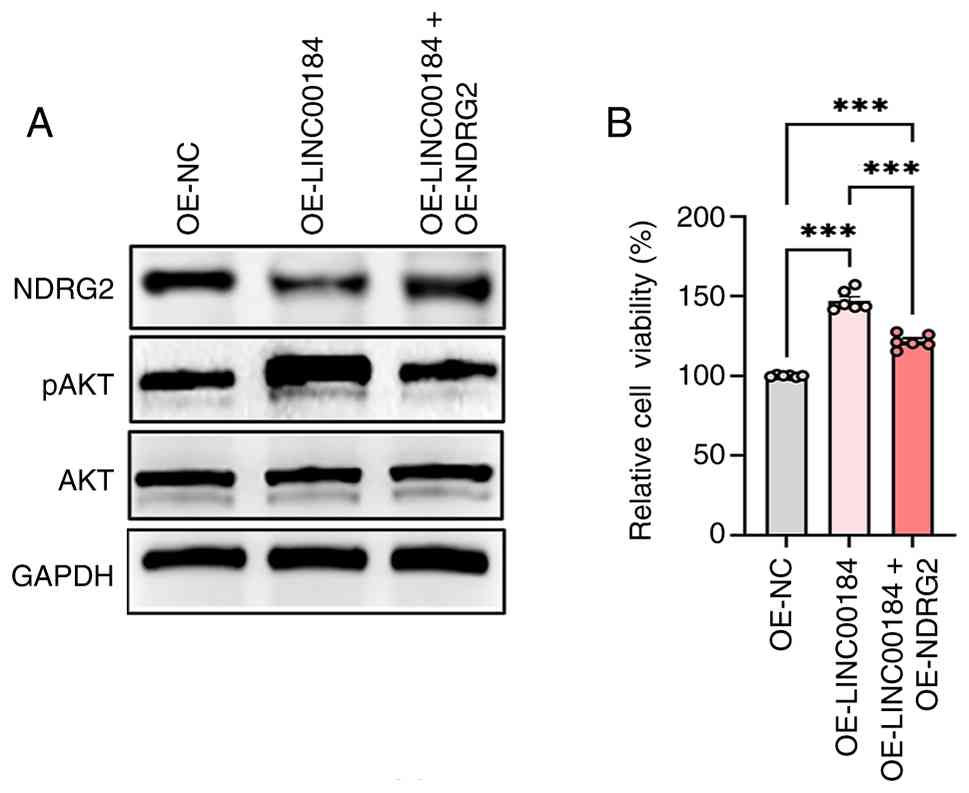
Figure 3

Restoration of NDRG2 rescues
LINC00184-driven PI3K/AKT activation and proliferation in
esophageal squamous cell carcinoma cells. (A) Western blotting
analysis of NDRG2 and phosphorylated AKT (p-AKT) protein levels in
TE-1 cells under the following conditions: Control, overexpression
of LINC00184 alone (OE-LINC00184), and co-overexpression of
LINC00184 and NDRG2. GAPDH serves as the loading control. (B) Cell
viability measured by Cell Counting Kit-8 assay in TE-1 cells under
the same treatment conditions as in (A). Data in (B) are presented
as mean ± SEM (n=6). Comparisons among multiple groups were
analyzed by one-way analysis of variance. ***P<0.001. OE,
overexpression; NC, negative control; NDRG2, N-Myc downstream
regulated gene.

Figure 4

LINC00184 regulates NDRG2 expression
through DNMT1-mediated methylation of the NDRG2 promoter. (A)
Expression level of LINC00184 in KYSE-150 cells following treatment
with siRNA targeting LINC00184 (n=3). (B) Expression level of
LINC00184 in TE-1 cells following treatment with siRNA targeting
LINC00184 (n=3). (C) Methylation level of the NDRG2 promoter in
KYSE-150 cells detected via MSP assay after overexpression or
silencing of LINC00184. (D) Methylation level of the NDRG2 promoter
in TE-1 cells detected via MSP assay after overexpression or
silencing of LINC00184. (E) Enrichment of DNMT1 at the NDRG2
promoter region detected by chromatin immunoprecipitation assay and
quantified using RT-qPCR in KYSE-150 cells with overexpression or
silencing of LINC00184 (n=3). (F) Enrichment of LINC00184 bound to
DNMT1 detected by RNA immunoprecipitation assay and quantified
using RT-qPCR in KYSE-150 cells after overexpression or silencing
of LINC00184 (n=3). (G) Enrichment of LINC00184 bound to DNMT1
detected by RNA immunoprecipitation assay and quantified using
RT-qPCR in TE-1 cells after overexpression or silencing of
LINC00184 (n=3). (H) Methylation level of the NDRG2 promoter in
KYSE-150 cells measured by MSP assay following LINC00184
overexpression combined with 5-AZA treatment. (I) Methylation level
of the NDRG2 promoter in TE-1 cells measured by MSP assay following
LINC00184 overexpression combined with 5-AZA treatment. (J) Western
blotting analysis of NDRG2 protein expression in KYSE-150 cells
after LINC00184 overexpression and 5-AZA intervention. (K)
Quantitative analysis of NDRG2 protein grayscale values obtained
from the western blotting results in (J) (n=3). (L) Western
blotting analysis of NDRG2 protein expression in TE-150 cells after
LINC00184 overexpression and 5-AZA intervention. (M) Quantitative
analysis of NDRG2 protein grayscale values obtained from the
western blotting results in (L) (n=3). (N) Western blotting
detection of NDRG2 protein levels under control conditions, single
overexpression of LINC00184, and combined treatment with
OE-LINC00184 + si-DNMT1. (O) RT-qPCR detection of relative DNMT1
mRNA levels in control cells and LINC00184-overexpressing cells
(n=6). (P) Western blotting analysis of total DNMT1 protein levels
in control cells and LINC00184-overexpressing cells; GAPDH was used
as the loading control (n=3). Data are presented as mean ± SEM
(n=3). Comparisons between two groups were performed using the
unpaired Student's t-test. Comparisons among multiple groups were
analyzed by one-way analysis of variance. Statistical significance
is indicated as *P<0.05 and ***P<0.001. OE, overexpression;
NC, negative control; NDRG2, N-Myc downstream regulated gene;
RT-qPCR, reverse transcription-quantitative PCR; DNMT1, DNA
methyltransferase 1; si/siRNA, small interfering RNA; lnc/lncRNA,
long non-coding RNA; 5-AZA, 5-azacytidine; MSP,
methylation-specific PCR. M, methylation; U, unmethylation.

Figure 5

Inhibition of DNMT1 abrogates
LINC00184-induced PI3K/AKT pathway activation and functional
phenotypes. (A) Western blotting analysis showing the protein
expression level of pAKT, AKT, pPI3K and PI3K in KYSE-150 cells
following overexpression of LINC00184 and treatment with 5-AZA. (B)
Quantitative analysis of the pAKT/AKT protein expression level
derived from the immunoblots in (A). (C) Quantitative analysis of
the pPI3K/PI3K protein expression level derived from the
immunoblots in (A). (D) Western blotting analysis showing the
protein expression level of pAKT, AKT, pPI3K and PI3K in TE-1 cells
following overexpression of LINC00184 and treatment with 5-AZA. (E)
Quantitative analysis of the pAKT/AKT protein expression level
derived from the immunoblots in (D). (F) Quantitative analysis of
the pPI3K/PI3K protein expression level derived from the
immunoblots in (D). (G) Western blotting analysis of p-AKT and
total AKT levels in esophageal squamous cell carcinoma cells under
the following conditions: Control, OE-LINC00184 and OE-LINC00184 +
si-DNMT1. (H) Quantitative analysis of the pAKT/AKT protein
expression level corresponding to the immunoblots presented in (G).
Data are presented as mean ± SEM (n=3). Comparisons among multiple
groups were analyzed by one-way analysis of variance. Statistical
significance is indicated as *P<0.05, **P<0.01 and
***P<0.001. OE, overexpression; NC, negative control; NDRG2,
N-Myc downstream regulated gene; RT-qPCR, reverse
transcription-quantitative PCR; DNMT1, DNA methyltransferase 1;
si/siRNA, small interfering RNA; 5-AZA, 5-azacytidine.

Figure 6

DNMT1 inhibition reverses
LINC00184-induced malignant phenotypes in ESCC cells. (A) Cell
viability of KYSE-150 cells following LINC00184 overexpression and
treatment with 5-AZA (n=3). (B) Representative images of migrated
KYSE-150 cells following LINC00184 overexpression and treatment
with 5-AZA. (C) Representative flow cytometry dot plots showing the
apoptosis rate of KYSE-150 cells following LINC00184 overexpression
and treatment with 5-AZA. (D) Statistical counting of migrated
KYSE-150 cells corresponding to (B) (n=3). (E) Quantitative
analysis of the apoptosis rate of KYSE-150 cells corresponding to
(C) (n=3). (F) Cell viability of TE-1 cells following LINC00184
overexpression and treatment with 5-AZA (n=3). (G) Representative
images of migrated TE-1 cells following LINC00184 overexpression
and treatment with 5-AZA. (H) Representative flow cytometry dot
plots showing the apoptosis rate of TE-1 cells following LINC00184
overexpression and treatment with 5-AZA. (I) Statistical counting
of migrated TE-1 cells corresponding to (G) (n=3). (J) Quantitative
analysis of the apoptosis rate of TE-1 cells corresponding to (H)
(n=3). (K) Cell viability detected via Cell Counting Kit-8 assay in
ESCC cells under the conditions of control, OE-LINC00184 and
OE-LINC00184 + si-DNMT1. Data are presented as mean ± SEM (n=3),
Comparisons among multiple groups were analyzed by one-way analysis
of variance. Statistical significance is indicated as *P<0.05,
**P<0.01 and ***P<0.001. OE, overexpression; NC, negative
control; DNMT1, DNA methyltransferase 1; si/siRNA, small
interfering RNA; 5-AZA, 5-azacytidine; ESCC, esophageal squamous
cell carcinoma.
View References

1 

Abnet CC, Arnold M and Wei WQ: Epidemiology of esophageal squamous cell carcinoma. Gastroenterology. 154:360–373. 2018. View Article : Google Scholar : PubMed/NCBI

2 

Uhlenhopp DJ, Then EO, Sunkara T and Gaduputi V: Epidemiology of esophageal cancer: Update in global trends, etiology and risk factors. Clin J Gastroenterol. 13:1010–1021. 2020. View Article : Google Scholar : PubMed/NCBI

3 

Chang J, Zhao X, Wang Y, Liu T, Zhong C, Lao Y, Zhang S, Liao H, Bai F, Lin D and Wu C: Genomic alterations driving precancerous to cancerous lesions in esophageal cancer development. Cancer Cell. 41:2038–2050.e5. 2023. View Article : Google Scholar : PubMed/NCBI

4 

Liu WJ, Zhao Y, Chen X, Miao ML and Zhang RQ: Epigenetic modifications in esophageal cancer: An evolving biomarker. Front Genet. 13:10874792023. View Article : Google Scholar : PubMed/NCBI

5 

Zhang L, Wang Y, Gao J, Zhou X, Huang M, Wang X and He Z: Non-coding RNA: A promising diagnostic biomarker and therapeutic target for esophageal squamous cell carcinoma (review). Oncol Lett. 27:2552024. View Article : Google Scholar : PubMed/NCBI

6 

Karakas D and Ozpolat B: The role of LncRNAs in translation. Noncoding RNA. 7:162021.PubMed/NCBI

7 

Herman AB, Tsitsipatis D and Gorospe M: Integrated lncRNA function upon genomic and epigenomic regulation. Mol Cell. 82:2252–2266. 2022. View Article : Google Scholar : PubMed/NCBI

8 

Ferrer J and Dimitrova N: Transcription regulation by long non-coding RNAs: Mechanisms and disease relevance. Nat Rev Mol Cell Biol. 25:396–415. 2024. View Article : Google Scholar : PubMed/NCBI

9 

Piao HY, Guo S, Jin H, Wang Y and Zhang J: LINC00184 involved in the regulatory network of ANGPT2 via ceRNA mediated miR-145 inhibition in gastric cancer. J Cancer. 12:2336–2350. 2021. View Article : Google Scholar : PubMed/NCBI

10 

Yao Y, Zhang T, Qi L, Zhou C, Wei J, Feng F, Liu R and Sun C: Integrated analysis of co-expression and ceRNA network identifies five lncRNAs as prognostic markers for breast cancer. J Cell Mol Med. 23:8410–8419. 2019. View Article : Google Scholar : PubMed/NCBI

11 

Weisenberger DJ, Lakshminarasimhan R and Liang G: The role of DNA methylation and DNA methyltransferases in cancer. Adv Exp Med Biol. 1389:317–348. 2022. View Article : Google Scholar : PubMed/NCBI

12 

Zhao N, Lai C, Wang Y, Dai S and Gu H: Understanding the role of DNA methylation in colorectal cancer: Mechanisms, detection, and clinical significance. Biochim Biophys Acta Rev Cancer. 1879:1890962024. View Article : Google Scholar : PubMed/NCBI

13 

Li Z, Li B, Yu H, Wang P, Wang W, Hou P, Li M, Chu S, Zheng J, Mao L and Bai J: DNMT1-mediated epigenetic silencing of TRAF6 promotes prostate cancer tumorigenesis and metastasis by enhancing EZH2 stability. Oncogene. 41:3991–4002. 2022. View Article : Google Scholar : PubMed/NCBI

14 

Li A, Omura N, Hong SM and Goggins M: Pancreatic cancer DNMT1 expression and sensitivity to DNMT1 inhibitors. Cancer Biol Ther. 9:321–329. 2010. View Article : Google Scholar : PubMed/NCBI

15 

Etoh T, Kanai Y, Ushijima S, Nakagawa T, Nakanishi Y, Sasako M, Kitano S and Hirohashi S: Increased DNA methyltransferase 1 (DNMT1) protein expression correlates significantly with poorer tumor differentiation and frequent DNA hypermethylation of multiple CpG islands in gastric cancers. Am J Pathol. 164:689–699. 2004. View Article : Google Scholar : PubMed/NCBI

16 

Lee KW, Lim S and Kim KD: The function of N-Myc downstream-regulated gene 2 (NDRG2) as a negative regulator in tumor cell metastasis. Int J Mol Sci. 23:93652022. View Article : Google Scholar : PubMed/NCBI

17 

Li SJ, Wang WY, Li B, Chen B, Zhang B, Wang X, Chen CS, Zhao QC, Shi H and Yao L: Expression of NDRG2 in human lung cancer and its correlation with prognosis. Med Oncol. 30:4212013. View Article : Google Scholar : PubMed/NCBI

18 

Hu XL, Liu XP, Lin SX, Deng YC, Liu N, Li X and Yao LB: NDRG2 expression and mutation in human liver and pancreatic cancers. World J Gastroenterol. 10:3518–3521. 2004. View Article : Google Scholar : PubMed/NCBI

19 

Feng RB, Zhou QZ, Cheng R, Li P, Zhu ST, Min L and Zhang ST: Expression and significance of N-myc downstream regulated gene 2 in the process of esophageal squamous cell carcinogenesis. Bioengineered. 13:3275–3283. 2022. View Article : Google Scholar : PubMed/NCBI

20 

Ahn CH, Kim JH, Shim HW, Shin WJ, Cho YA and Yoon HJ: Biological and prognostic significance of NDRG2 downregulation in oral squamous cell carcinoma. Oral Dis. 30:4287–4302. 2024. View Article : Google Scholar : PubMed/NCBI

21 

Morishita K, Nakahata S and Ichikawa T: Pathophysiological significance of N-myc downstream-regulated gene 2 in cancer development through protein phosphatase 2A phosphorylation regulation. Cancer Sci. 112:22–30. 2021. View Article : Google Scholar : PubMed/NCBI

22 

Luo Q, Du R, Liu W, Huang G, Dong Z and Li X: PI3K/Akt/mTOR signaling pathway: Role in esophageal squamous cell carcinoma, regulatory mechanisms and opportunities for targeted therapy. Front Oncol. 12:8523832022. View Article : Google Scholar : PubMed/NCBI

23 

Huang W, Li H, Yu Q, Xiao W and Wang DO: LncRNA-mediated DNA methylation: An emerging mechanism in cancer and beyond. J Exp Clin Cancer Res. 41:1002022. View Article : Google Scholar : PubMed/NCBI

24 

Livak KJ and Schmittgen TD: Analysis of relative gene expression data using real-time quantitative PCR and the 2(−Delta Delta C(T)) method. Methods. 25:402–408. 2001. View Article : Google Scholar : PubMed/NCBI

25 

Han Y, You J, Han Y, Liu Y, Huang M, Lu X, Chen J and Zheng Y: LINC00184 promotes ovarian cancer cells proliferation and cisplatin resistance by elevating CNTN1 expression via sponging miR-1305. Onco Targets Ther. 14:2711–2726. 2021. View Article : Google Scholar : PubMed/NCBI

26 

Zhang W, Xin J, Lai J and Zhang W: LncRNA LINC00184 promotes docetaxel resistance and immune escape via miR-105-5p/PD-L1 axis in prostate cancer. Immunobiology. 227:1521632022. View Article : Google Scholar : PubMed/NCBI

27 

Sun HB, Zhang GC, Liu J and Nie CS: Long noncoding RNA LINC00184 facilitates the proliferation, metastasis, and adenine metabolism of cholangiocarcinoma via modulating hsa-miR-23b-3p/ANXA2 axis. Environ Toxicol. 36:1576–1590. 2021. View Article : Google Scholar : PubMed/NCBI

28 

Wang W, Li L and Zhao L: LINC00184 plays an oncogenic role in non-small cell lung cancer via regulation of the miR-524-5p/HMGB2 axis. J Cell Mol Med. 25:9927–9938. 2021. View Article : Google Scholar : PubMed/NCBI

29 

Yao L, Zhang J and Liu X: NDRG2: A Myc-repressed gene involved in cancer and cell stress. Acta Biochim Biophys Sin (Shanghai). 40:625–635. 2008. View Article : Google Scholar : PubMed/NCBI

30 

Feng L, Xie Y, Zhang H and Wu Y: Down-regulation of NDRG2 gene expression in human colorectal cancer involves promoter methylation and microRNA-650. Biochem Biophys Res Commun. 406:534–538. 2011. View Article : Google Scholar : PubMed/NCBI

31 

Tantai J, Pan X and Hu D: RNF4-mediated SUMOylation is essential for NDRG2 suppression of lung adenocarcinoma. Oncotarget. 7:26837–26843. 2016. View Article : Google Scholar : PubMed/NCBI

32 

Ma Z, Ma Y, Feng J, Xu Z, Cheng C, Qin J, Li S, Jiang J and Kong R: NDRG2 acts as a negative regulator of the progression of small-cell lung cancer through the modulation of the PTEN-AKT-mTOR signalling cascade. Toxicol Appl Pharmacol. 485:1169152024. View Article : Google Scholar : PubMed/NCBI

33 

Lee DC, Kang YK, Kim WH, Jang YJ, Kim DJ, Park IY, Sohn BH, Sohn HA, Lee HG, Lim JS, et al: Functional and clinical evidence for NDRG2 as a candidate suppressor of liver cancer metastasis. Cancer Res. 68:4210–4220. 2008. View Article : Google Scholar : PubMed/NCBI

34 

Zheng J, Liu Q, Li Y, Yang J, Ma J, Yu F, Shi H, Ren Q, Zhang R, Zhang J, et al: NDRG2 expression regulates CD24 and metastatic potential of breast cancer cells. Asian Pac J Cancer Prev. 11:1817–1821. 2020.PubMed/NCBI

35 

Liu B, Wang C, Chen P, Cheng B and Cheng Y: RACKI induces chemotherapy resistance in esophageal carcinoma by upregulating the PI3K/AKT pathway and Bcl-2 expression. Onco Targets Ther. 11:211–220. 2018. View Article : Google Scholar : PubMed/NCBI

36 

Shi N, Yu H and Chen T: Inhibition of esophageal cancer growth through the suppression of PI3K/AKT/mTOR signaling pathway. Onco Targets Ther. 12:7637–7647. 2019. View Article : Google Scholar : PubMed/NCBI

37 

Sigalotti L, Altomonte M, Colizzi F, Degan M, Rupolo M, Zagonel V, Pinto A, Gattei V and Maio M: 5-Aza-2′-deoxycytidine (decitabine) treatment of hematopoietic malignancies: A multimechanism therapeutic approach? Blood. 101:4644–4646. 2003. View Article : Google Scholar : PubMed/NCBI

Related Articles

  • Abstract
  • View
  • Download
  • Twitter
Copy and paste a formatted citation
Spandidos Publications style
Guo J, Fu S, Liu J, Li L, Zhao J, Wang F, Wu W, Chen X and Li E: LINC00184 promotes esophageal squamous cell carcinoma progression via DNMT1‑mediated methylation of the NDRG2 promoter and PI3K/AKT pathway activation. Oncol Lett 32: 272, 2026.
APA
Guo, J., Fu, S., Liu, J., Li, L., Zhao, J., Wang, F. ... Li, E. (2026). LINC00184 promotes esophageal squamous cell carcinoma progression via DNMT1‑mediated methylation of the NDRG2 promoter and PI3K/AKT pathway activation. Oncology Letters, 32, 272. https://doi.org/10.3892/ol.2026.15628
MLA
Guo, J., Fu, S., Liu, J., Li, L., Zhao, J., Wang, F., Wu, W., Chen, X., Li, E."LINC00184 promotes esophageal squamous cell carcinoma progression via DNMT1‑mediated methylation of the NDRG2 promoter and PI3K/AKT pathway activation". Oncology Letters 32.1 (2026): 272.
Chicago
Guo, J., Fu, S., Liu, J., Li, L., Zhao, J., Wang, F., Wu, W., Chen, X., Li, E."LINC00184 promotes esophageal squamous cell carcinoma progression via DNMT1‑mediated methylation of the NDRG2 promoter and PI3K/AKT pathway activation". Oncology Letters 32, no. 1 (2026): 272. https://doi.org/10.3892/ol.2026.15628
Copy and paste a formatted citation
x
Spandidos Publications style
Guo J, Fu S, Liu J, Li L, Zhao J, Wang F, Wu W, Chen X and Li E: LINC00184 promotes esophageal squamous cell carcinoma progression via DNMT1‑mediated methylation of the NDRG2 promoter and PI3K/AKT pathway activation. Oncol Lett 32: 272, 2026.
APA
Guo, J., Fu, S., Liu, J., Li, L., Zhao, J., Wang, F. ... Li, E. (2026). LINC00184 promotes esophageal squamous cell carcinoma progression via DNMT1‑mediated methylation of the NDRG2 promoter and PI3K/AKT pathway activation. Oncology Letters, 32, 272. https://doi.org/10.3892/ol.2026.15628
MLA
Guo, J., Fu, S., Liu, J., Li, L., Zhao, J., Wang, F., Wu, W., Chen, X., Li, E."LINC00184 promotes esophageal squamous cell carcinoma progression via DNMT1‑mediated methylation of the NDRG2 promoter and PI3K/AKT pathway activation". Oncology Letters 32.1 (2026): 272.
Chicago
Guo, J., Fu, S., Liu, J., Li, L., Zhao, J., Wang, F., Wu, W., Chen, X., Li, E."LINC00184 promotes esophageal squamous cell carcinoma progression via DNMT1‑mediated methylation of the NDRG2 promoter and PI3K/AKT pathway activation". Oncology Letters 32, no. 1 (2026): 272. https://doi.org/10.3892/ol.2026.15628
Follow us
  • Twitter
  • LinkedIn
  • Facebook
About
  • Spandidos Publications
  • Careers
  • Cookie Policy
  • Privacy Policy
How can we help?
  • Help
  • Live Chat
  • Contact
  • Email to our Support Team