Spandidos Publications Logo
  • About
    • About Spandidos
    • Aims and Scopes
    • Abstracting and Indexing
    • Editorial Policies
    • Reprints and Permissions
    • Job Opportunities
    • Terms and Conditions
    • Contact
  • Journals
    • All Journals
    • Oncology Letters
      • Oncology Letters
      • Information for Authors
      • Editorial Policies
      • Editorial Board
      • Aims and Scope
      • Abstracting and Indexing
      • Bibliographic Information
      • Archive
    • International Journal of Oncology
      • International Journal of Oncology
      • Information for Authors
      • Editorial Policies
      • Editorial Board
      • Aims and Scope
      • Abstracting and Indexing
      • Bibliographic Information
      • Archive
    • Molecular and Clinical Oncology
      • Molecular and Clinical Oncology
      • Information for Authors
      • Editorial Policies
      • Editorial Board
      • Aims and Scope
      • Abstracting and Indexing
      • Bibliographic Information
      • Archive
    • Experimental and Therapeutic Medicine
      • Experimental and Therapeutic Medicine
      • Information for Authors
      • Editorial Policies
      • Editorial Board
      • Aims and Scope
      • Abstracting and Indexing
      • Bibliographic Information
      • Archive
    • International Journal of Molecular Medicine
      • International Journal of Molecular Medicine
      • Information for Authors
      • Editorial Policies
      • Editorial Board
      • Aims and Scope
      • Abstracting and Indexing
      • Bibliographic Information
      • Archive
    • Biomedical Reports
      • Biomedical Reports
      • Information for Authors
      • Editorial Policies
      • Editorial Board
      • Aims and Scope
      • Abstracting and Indexing
      • Bibliographic Information
      • Archive
    • Oncology Reports
      • Oncology Reports
      • Information for Authors
      • Editorial Policies
      • Editorial Board
      • Aims and Scope
      • Abstracting and Indexing
      • Bibliographic Information
      • Archive
    • Molecular Medicine Reports
      • Molecular Medicine Reports
      • Information for Authors
      • Editorial Policies
      • Editorial Board
      • Aims and Scope
      • Abstracting and Indexing
      • Bibliographic Information
      • Archive
    • World Academy of Sciences Journal
      • World Academy of Sciences Journal
      • Information for Authors
      • Editorial Policies
      • Editorial Board
      • Aims and Scope
      • Abstracting and Indexing
      • Bibliographic Information
      • Archive
    • International Journal of Functional Nutrition
      • International Journal of Functional Nutrition
      • Information for Authors
      • Editorial Policies
      • Editorial Board
      • Aims and Scope
      • Abstracting and Indexing
      • Bibliographic Information
      • Archive
    • International Journal of Epigenetics
      • International Journal of Epigenetics
      • Information for Authors
      • Editorial Policies
      • Editorial Board
      • Aims and Scope
      • Abstracting and Indexing
      • Bibliographic Information
      • Archive
    • Medicine International
      • Medicine International
      • Information for Authors
      • Editorial Policies
      • Editorial Board
      • Aims and Scope
      • Abstracting and Indexing
      • Bibliographic Information
      • Archive
  • Articles
  • Information
    • Information for Authors
    • Information for Reviewers
    • Information for Librarians
    • Information for Advertisers
    • Conferences
  • Language Editing
Spandidos Publications Logo
  • About
    • About Spandidos
    • Aims and Scopes
    • Abstracting and Indexing
    • Editorial Policies
    • Reprints and Permissions
    • Job Opportunities
    • Terms and Conditions
    • Contact
  • Journals
    • All Journals
    • Biomedical Reports
      • Information for Authors
      • Editorial Policies
      • Editorial Board
      • Aims and Scope
      • Abstracting and Indexing
      • Bibliographic Information
      • Archive
    • Experimental and Therapeutic Medicine
      • Information for Authors
      • Editorial Policies
      • Editorial Board
      • Aims and Scope
      • Abstracting and Indexing
      • Bibliographic Information
      • Archive
    • International Journal of Epigenetics
      • Information for Authors
      • Editorial Policies
      • Editorial Board
      • Aims and Scope
      • Abstracting and Indexing
      • Bibliographic Information
      • Archive
    • International Journal of Functional Nutrition
      • Information for Authors
      • Editorial Policies
      • Editorial Board
      • Aims and Scope
      • Abstracting and Indexing
      • Bibliographic Information
      • Archive
    • International Journal of Molecular Medicine
      • Information for Authors
      • Editorial Policies
      • Editorial Board
      • Aims and Scope
      • Abstracting and Indexing
      • Bibliographic Information
      • Archive
    • International Journal of Oncology
      • Information for Authors
      • Editorial Policies
      • Editorial Board
      • Aims and Scope
      • Abstracting and Indexing
      • Bibliographic Information
      • Archive
    • Medicine International
      • Information for Authors
      • Editorial Policies
      • Editorial Board
      • Aims and Scope
      • Abstracting and Indexing
      • Bibliographic Information
      • Archive
    • Molecular and Clinical Oncology
      • Information for Authors
      • Editorial Policies
      • Editorial Board
      • Aims and Scope
      • Abstracting and Indexing
      • Bibliographic Information
      • Archive
    • Molecular Medicine Reports
      • Information for Authors
      • Editorial Policies
      • Editorial Board
      • Aims and Scope
      • Abstracting and Indexing
      • Bibliographic Information
      • Archive
    • Oncology Letters
      • Information for Authors
      • Editorial Policies
      • Editorial Board
      • Aims and Scope
      • Abstracting and Indexing
      • Bibliographic Information
      • Archive
    • Oncology Reports
      • Information for Authors
      • Editorial Policies
      • Editorial Board
      • Aims and Scope
      • Abstracting and Indexing
      • Bibliographic Information
      • Archive
    • World Academy of Sciences Journal
      • Information for Authors
      • Editorial Policies
      • Editorial Board
      • Aims and Scope
      • Abstracting and Indexing
      • Bibliographic Information
      • Archive
  • Articles
  • Information
    • For Authors
    • For Reviewers
    • For Librarians
    • For Advertisers
    • Conferences
  • Language Editing
Login Register Submit
  • This site uses cookies
  • You can change your cookie settings at any time by following the instructions in our Cookie Policy. To find out more, you may read our Privacy Policy.

    I agree
Search articles by DOI, keyword, author or affiliation
Search
Advanced Search
presentation
Oncology Letters
Join Editorial Board Propose a Special Issue
Print ISSN: 1792-1074 Online ISSN: 1792-1082
Journal Cover
January-February 2010 Volume 1 Issue 1

Full Size Image

Sign up for eToc alerts
Recommend to Library

Journals

International Journal of Molecular Medicine

International Journal of Molecular Medicine

International Journal of Molecular Medicine is an international journal devoted to molecular mechanisms of human disease.

International Journal of Oncology

International Journal of Oncology

International Journal of Oncology is an international journal devoted to oncology research and cancer treatment.

Molecular Medicine Reports

Molecular Medicine Reports

Covers molecular medicine topics such as pharmacology, pathology, genetics, neuroscience, infectious diseases, molecular cardiology, and molecular surgery.

Oncology Reports

Oncology Reports

Oncology Reports is an international journal devoted to fundamental and applied research in Oncology.

Experimental and Therapeutic Medicine

Experimental and Therapeutic Medicine

Experimental and Therapeutic Medicine is an international journal devoted to laboratory and clinical medicine.

Oncology Letters

Oncology Letters

Oncology Letters is an international journal devoted to Experimental and Clinical Oncology.

Biomedical Reports

Biomedical Reports

Explores a wide range of biological and medical fields, including pharmacology, genetics, microbiology, neuroscience, and molecular cardiology.

Molecular and Clinical Oncology

Molecular and Clinical Oncology

International journal addressing all aspects of oncology research, from tumorigenesis and oncogenes to chemotherapy and metastasis.

World Academy of Sciences Journal

World Academy of Sciences Journal

Multidisciplinary open-access journal spanning biochemistry, genetics, neuroscience, environmental health, and synthetic biology.

International Journal of Functional Nutrition

International Journal of Functional Nutrition

Open-access journal combining biochemistry, pharmacology, immunology, and genetics to advance health through functional nutrition.

International Journal of Epigenetics

International Journal of Epigenetics

Publishes open-access research on using epigenetics to advance understanding and treatment of human disease.

Medicine International

Medicine International

An International Open Access Journal Devoted to General Medicine.

Journal Cover
January-February 2010 Volume 1 Issue 1

Full Size Image

Sign up for eToc alerts
Recommend to Library

  • Article
  • Citations
    • Cite This Article
    • Download Citation
    • Create Citation Alert
    • Remove Citation Alert
    • Cited By
  • Similar Articles
    • Related Articles (in Spandidos Publications)
    • Similar Articles (Google Scholar)
    • Similar Articles (PubMed)
  • Download PDF
  • Download XML
  • View XML
Article

The Mantle Cell Lymphoma International Prognostic Index: Does it work in routine practice?

  • Authors:
    • S. Y. Lim
    • J. M. Horsman
    • B. W. Hancock
  • View Affiliations / Copyright

    Affiliations: Academic Unit of Clinical Oncology, Weston Park Hospital, Sheffield S10 2SJ, UK
  • Pages: 187-188
    |
    Published online on: January 1, 2010
       https://doi.org/10.3892/ol_00000034
  • Expand metrics +
Metrics: Total Views: 0 (Spandidos Publications: | PMC Statistics: )
Metrics: Total PDF Downloads: 0 (Spandidos Publications: | PMC Statistics: )
Cited By (CrossRef): 0 citations Loading Articles...

This article is mentioned in:


Abstract

The Mantle Cell Lymphoma International Prognostic Index (MIPI) combines four factors to differentiate low-, intermediate- and high-risk prognostic groups in advanced mantle cell lymphoma using data from patients treated in clinical trials. To evaluate its use in routine practice, we applied the simplified index retrospectively to 50 consecutive new patients attending our lymphoma service. In the log-rank and multiple comparison statistical tests there was favorable differentiation between survival curves, and particularly between the high- and low-risk groups. We concluded that the MIPI is of value in routine lymphoma practice.

Introduction

Mantle cell lymphoma (MCL) is an uncommon yet distinct entity accounting for approximately 3–6% of all non-Hodgkin lymphoma cases (1–3). It was added to the Revised European-American Classification of Lymphoid Neoplasms in 1994, two years after the name was coined by Banks and colleagues (4). It is characterized by a poor patient prognosis with a reported median overall survival (OS) of only 30–43 months (1,2,5).

In 2008, Hoster et al developed the Mantle Cell Lymphoma International Prognostic Index (MIPI) as the first prognostic index specific to patients with advanced stage MCL (6). The prognostic index is based on four independent factors: age, performance status, lactate dehydrogenase (LDH) and leukocyte count. Cell proliferation (Ki-67) was exploratively analyzed as an important biological marker and showed strong additional prognostic relevance. Using data from patients treated in clinical trials, the authors described the simplified prognostic index, which yielded high concordance (weighted κ=0.79) and good separation of the overall survival curves. However, no independent study is currently available to validate this index in routine clinical practice. We, therefore, retrospectively applied MIPI to our MCL patients.

Materials and methods

This was a retrospective study. All consecutive MCL patients treated in Weston Park Hospital from 1981 to 2008 were included. The patient population was obtained from a dedicated Lymphoma Database.

The four prognostic factors assessed were: age, performance status, LDH and leukocyte count. Simplified MIPI was applied to stratify patients into low- (score 0–3), intermediate- (score 4–5) or high-risk (score 6–11) groups (Table I). Survival was calculated from the date of diagnosis. The Kaplan-Meier survival curves were calculated for the three risk groups and compared using the log-rank test for trend.

Table I

The simplified Mantle Cell Lymphoma International Prognostic Index was used to stratify patients into risk groups according to the four prognostic factors.

Table I

The simplified Mantle Cell Lymphoma International Prognostic Index was used to stratify patients into risk groups according to the four prognostic factors.

PointsAgeECOG PSLDH (ULN)WBC (109/l)
0<500–1<0.67<6.700
150–59-0.67–0.996.700–9.999
260–692–41.0–1.4910.000–14.999
3≥70-≥1.5≥15.000

[i] ECOG PS, Eastern Cooperative Oncology Group Performance Status; LDH (ULN), lactate dehydrogenase (upper limit of the normal range); WBC, white blood cell (leukocyte) count. Total point score: 0–3, low; 4–5, intermediate and 6–11, high risk.

Results

Seventy-six patients attended from January 1981 to July 2008. Only 50 patients had complete data for MIPI scoring. The median age was 64 years. Thirty-eight of the patients (66%) were males.

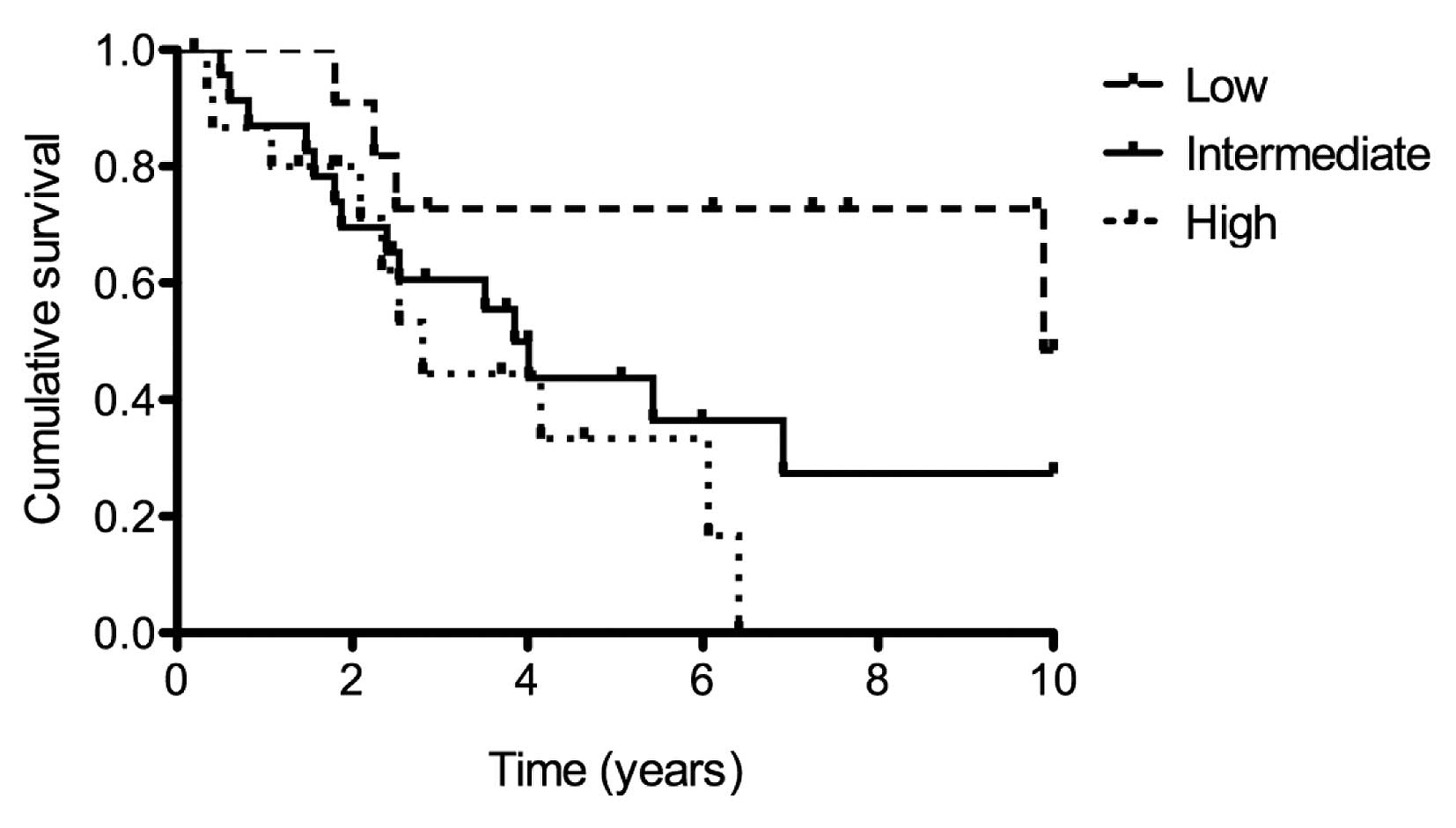
According to the simplified MIPI scoring system, 11 patients (22%) were in low-, 23 (46%) in intermediate- and 16 patients (32%) in high-risk groups.

There was a statistically significant trend in survival across the three groups (p=0.013), with median survival in the low-, intermediate- and high-risk groups being 9.89, 3.85 and 2.81 years, respectively (Fig. 1). Each risk group was compared with each of the other two using the Bonferroni corrected threshold to adjust for multiple comparisons. Survival time in the high-risk group was statistically significantly less than in the low-risk group (p=0.0112).

Figure 1

Cumulative patient survival in the low-, intermediate- and high-risk patient groups.

Discussion

Until 2007, there was no generally established prognostic index for patients with MCL. The International Prognostic Index (IPI) and Follicular Lymphoma International Prognostic Index (FLIPI) had been developed for diffuse large B-cell (DCBCL) and follicular lymphoma patients, respectively. IPI and FLIPI showed poor separation of survival curves for MCL patients (6). The IPI score classifies most patients in the two intermediate-risk groups and does not separate the outcomes. The FLIPI score places most patients into the high-risk group and does not separate low from intermediate in outcome (7). MIPI, derived using data of 455 advanced stage patients treated within three clinical trials, proved to be a suitable index for MCL patients (7).

We retrospectively applied the simplified MIPI to all of the consecutive patients (for whom full data were available) referred to our lymphoma service. MIPI proved a valuable guide to prognosis with a significant trend for difference between low-, intermediate- and high-risk groups, but in particular low- and high-risk.

Conventional non-trial treatment for younger patients with MCL is anthracycline-containing (CHOP-like) chemotherapy, which in responding patients proceeds to consolidative intensive chemotherapy with autologous stem cell rescue (recently with the addition of rituximab). In our series only 7 patients went on to have high-dose therapy. As expected, in this selected group, survival was favorable (mean overall survival, 97 months; range, 49–132). Four patients were in the best-risk group by MIPI. Only 1 patient was in the high-risk group and he had the shortest survival. On the other hand, Martin et al reported that it may be possible to select certain asymptomatic patients with MCL for deferred initial treatment (‘watch and wait’) (8). When we evaluated our patients there were 3 who had little or no previous treatment and had better than expected survival; the 3 patients had low-risk MIPIs.

Evidently there are factors at work other than those comprising MIPI, and a search for these continues. In the interim, the index provides us with a reasonable guide to prognosis which works in unselected cases of mantle cell lymphoma presenting to an orthodox lymphoma service.

References

1 

Andersen NS, Jensen MK, de Nully Brown P and Geisler CH: A Danish population-based analysis of 105 mantle cell lymphoma patients: incidences, clinical features, response, survival and prognostic factors. Eur J Cancer. 38:401–408. 2002. View Article : Google Scholar

2 

Velders GA, Kluin-Nelemans JC, de Boer CJ, et al: Mantle cell lymphoma: a population-based clinical study. J Clin Oncol. 14:1269–1274. 1996.PubMed/NCBI

3 

A clinical evaluation of the International Lymphoma Study Group Classification Project. Blood. 89:3909–3918. 1997.PubMed/NCBI

4 

Banks PM, Chan J, Cleary ML, et al: Mantle cell lymphoma. A proposal for unification of morphologic, immunologic and molecular data. Am J Surg Pathol. 16:637–640. 1993. View Article : Google Scholar : PubMed/NCBI

5 

Argatoff LH, Connors JM, Klasa RJ, et al: Mantle cell lymphoma: a clinicopathologic study of 80 cases. Blood. 89:2067–2078. 1997.PubMed/NCBI

6 

Hoster E, Dreyling M, Klapper W, et al: A new prognostic index (MIPI) for patients with advanced-stage mantle cell lymphoma. Blood. 111:558–565. 2008. View Article : Google Scholar : PubMed/NCBI

7 

Smith MR: Mantle cell lymphoma: advances in biology and therapy. Curr Opin Haematol. 15:415–421. 2008. View Article : Google Scholar : PubMed/NCBI

8 

Martin P, Chadburn A, Christos P, et al: Outcome of deferred initial therapy in mantle cell lymphoma. J Clin Oncol. 27:1209–1213. 2009. View Article : Google Scholar : PubMed/NCBI

Related Articles

  • Abstract
  • View
  • Download
  • Twitter
Copy and paste a formatted citation
Spandidos Publications style
Lim SY, Horsman JM and Hancock BW: The Mantle Cell Lymphoma International Prognostic Index: Does it work in routine practice? . Oncol Lett 1: 187-188, 2010.
APA
Lim, S.Y., Horsman, J.M., & Hancock, B.W. (2010). The Mantle Cell Lymphoma International Prognostic Index: Does it work in routine practice? . Oncology Letters, 1, 187-188. https://doi.org/10.3892/ol_00000034
MLA
Lim, S. Y., Horsman, J. M., Hancock, B. W."The Mantle Cell Lymphoma International Prognostic Index: Does it work in routine practice? ". Oncology Letters 1.1 (2010): 187-188.
Chicago
Lim, S. Y., Horsman, J. M., Hancock, B. W."The Mantle Cell Lymphoma International Prognostic Index: Does it work in routine practice? ". Oncology Letters 1, no. 1 (2010): 187-188. https://doi.org/10.3892/ol_00000034
Copy and paste a formatted citation
x
Spandidos Publications style
Lim SY, Horsman JM and Hancock BW: The Mantle Cell Lymphoma International Prognostic Index: Does it work in routine practice? . Oncol Lett 1: 187-188, 2010.
APA
Lim, S.Y., Horsman, J.M., & Hancock, B.W. (2010). The Mantle Cell Lymphoma International Prognostic Index: Does it work in routine practice? . Oncology Letters, 1, 187-188. https://doi.org/10.3892/ol_00000034
MLA
Lim, S. Y., Horsman, J. M., Hancock, B. W."The Mantle Cell Lymphoma International Prognostic Index: Does it work in routine practice? ". Oncology Letters 1.1 (2010): 187-188.
Chicago
Lim, S. Y., Horsman, J. M., Hancock, B. W."The Mantle Cell Lymphoma International Prognostic Index: Does it work in routine practice? ". Oncology Letters 1, no. 1 (2010): 187-188. https://doi.org/10.3892/ol_00000034
Follow us
  • Twitter
  • LinkedIn
  • Facebook
About
  • Spandidos Publications
  • Careers
  • Cookie Policy
  • Privacy Policy
How can we help?
  • Help
  • Live Chat
  • Contact
  • Email to our Support Team