Spandidos Publications Logo
  • About
    • About Spandidos
    • Aims and Scopes
    • Abstracting and Indexing
    • Editorial Policies
    • Reprints and Permissions
    • Job Opportunities
    • Terms and Conditions
    • Contact
  • Journals
    • All Journals
    • Oncology Letters
      • Oncology Letters
      • Information for Authors
      • Editorial Policies
      • Editorial Board
      • Aims and Scope
      • Abstracting and Indexing
      • Bibliographic Information
      • Archive
    • International Journal of Oncology
      • International Journal of Oncology
      • Information for Authors
      • Editorial Policies
      • Editorial Board
      • Aims and Scope
      • Abstracting and Indexing
      • Bibliographic Information
      • Archive
    • Molecular and Clinical Oncology
      • Molecular and Clinical Oncology
      • Information for Authors
      • Editorial Policies
      • Editorial Board
      • Aims and Scope
      • Abstracting and Indexing
      • Bibliographic Information
      • Archive
    • Experimental and Therapeutic Medicine
      • Experimental and Therapeutic Medicine
      • Information for Authors
      • Editorial Policies
      • Editorial Board
      • Aims and Scope
      • Abstracting and Indexing
      • Bibliographic Information
      • Archive
    • International Journal of Molecular Medicine
      • International Journal of Molecular Medicine
      • Information for Authors
      • Editorial Policies
      • Editorial Board
      • Aims and Scope
      • Abstracting and Indexing
      • Bibliographic Information
      • Archive
    • Biomedical Reports
      • Biomedical Reports
      • Information for Authors
      • Editorial Policies
      • Editorial Board
      • Aims and Scope
      • Abstracting and Indexing
      • Bibliographic Information
      • Archive
    • Oncology Reports
      • Oncology Reports
      • Information for Authors
      • Editorial Policies
      • Editorial Board
      • Aims and Scope
      • Abstracting and Indexing
      • Bibliographic Information
      • Archive
    • Molecular Medicine Reports
      • Molecular Medicine Reports
      • Information for Authors
      • Editorial Policies
      • Editorial Board
      • Aims and Scope
      • Abstracting and Indexing
      • Bibliographic Information
      • Archive
    • World Academy of Sciences Journal
      • World Academy of Sciences Journal
      • Information for Authors
      • Editorial Policies
      • Editorial Board
      • Aims and Scope
      • Abstracting and Indexing
      • Bibliographic Information
      • Archive
    • International Journal of Functional Nutrition
      • International Journal of Functional Nutrition
      • Information for Authors
      • Editorial Policies
      • Editorial Board
      • Aims and Scope
      • Abstracting and Indexing
      • Bibliographic Information
      • Archive
    • International Journal of Epigenetics
      • International Journal of Epigenetics
      • Information for Authors
      • Editorial Policies
      • Editorial Board
      • Aims and Scope
      • Abstracting and Indexing
      • Bibliographic Information
      • Archive
    • Medicine International
      • Medicine International
      • Information for Authors
      • Editorial Policies
      • Editorial Board
      • Aims and Scope
      • Abstracting and Indexing
      • Bibliographic Information
      • Archive
  • Articles
  • Information
    • Information for Authors
    • Information for Reviewers
    • Information for Librarians
    • Information for Advertisers
    • Conferences
  • Language Editing
Spandidos Publications Logo
  • About
    • About Spandidos
    • Aims and Scopes
    • Abstracting and Indexing
    • Editorial Policies
    • Reprints and Permissions
    • Job Opportunities
    • Terms and Conditions
    • Contact
  • Journals
    • All Journals
    • Biomedical Reports
      • Information for Authors
      • Editorial Policies
      • Editorial Board
      • Aims and Scope
      • Abstracting and Indexing
      • Bibliographic Information
      • Archive
    • Experimental and Therapeutic Medicine
      • Information for Authors
      • Editorial Policies
      • Editorial Board
      • Aims and Scope
      • Abstracting and Indexing
      • Bibliographic Information
      • Archive
    • International Journal of Epigenetics
      • Information for Authors
      • Editorial Policies
      • Editorial Board
      • Aims and Scope
      • Abstracting and Indexing
      • Bibliographic Information
      • Archive
    • International Journal of Functional Nutrition
      • Information for Authors
      • Editorial Policies
      • Editorial Board
      • Aims and Scope
      • Abstracting and Indexing
      • Bibliographic Information
      • Archive
    • International Journal of Molecular Medicine
      • Information for Authors
      • Editorial Policies
      • Editorial Board
      • Aims and Scope
      • Abstracting and Indexing
      • Bibliographic Information
      • Archive
    • International Journal of Oncology
      • Information for Authors
      • Editorial Policies
      • Editorial Board
      • Aims and Scope
      • Abstracting and Indexing
      • Bibliographic Information
      • Archive
    • Medicine International
      • Information for Authors
      • Editorial Policies
      • Editorial Board
      • Aims and Scope
      • Abstracting and Indexing
      • Bibliographic Information
      • Archive
    • Molecular and Clinical Oncology
      • Information for Authors
      • Editorial Policies
      • Editorial Board
      • Aims and Scope
      • Abstracting and Indexing
      • Bibliographic Information
      • Archive
    • Molecular Medicine Reports
      • Information for Authors
      • Editorial Policies
      • Editorial Board
      • Aims and Scope
      • Abstracting and Indexing
      • Bibliographic Information
      • Archive
    • Oncology Letters
      • Information for Authors
      • Editorial Policies
      • Editorial Board
      • Aims and Scope
      • Abstracting and Indexing
      • Bibliographic Information
      • Archive
    • Oncology Reports
      • Information for Authors
      • Editorial Policies
      • Editorial Board
      • Aims and Scope
      • Abstracting and Indexing
      • Bibliographic Information
      • Archive
    • World Academy of Sciences Journal
      • Information for Authors
      • Editorial Policies
      • Editorial Board
      • Aims and Scope
      • Abstracting and Indexing
      • Bibliographic Information
      • Archive
  • Articles
  • Information
    • For Authors
    • For Reviewers
    • For Librarians
    • For Advertisers
    • Conferences
  • Language Editing
Login Register Submit
  • This site uses cookies
  • You can change your cookie settings at any time by following the instructions in our Cookie Policy. To find out more, you may read our Privacy Policy.

    I agree
Search articles by DOI, keyword, author or affiliation
Search
Advanced Search
presentation
Oncology Reports
Join Editorial Board Propose a Special Issue
Print ISSN: 1021-335X Online ISSN: 1791-2431
Journal Cover
March 2013 Volume 29 Issue 3

Full Size Image

Sign up for eToc alerts
Recommend to Library

Journals

International Journal of Molecular Medicine

International Journal of Molecular Medicine

International Journal of Molecular Medicine is an international journal devoted to molecular mechanisms of human disease.

International Journal of Oncology

International Journal of Oncology

International Journal of Oncology is an international journal devoted to oncology research and cancer treatment.

Molecular Medicine Reports

Molecular Medicine Reports

Covers molecular medicine topics such as pharmacology, pathology, genetics, neuroscience, infectious diseases, molecular cardiology, and molecular surgery.

Oncology Reports

Oncology Reports

Oncology Reports is an international journal devoted to fundamental and applied research in Oncology.

Experimental and Therapeutic Medicine

Experimental and Therapeutic Medicine

Experimental and Therapeutic Medicine is an international journal devoted to laboratory and clinical medicine.

Oncology Letters

Oncology Letters

Oncology Letters is an international journal devoted to Experimental and Clinical Oncology.

Biomedical Reports

Biomedical Reports

Explores a wide range of biological and medical fields, including pharmacology, genetics, microbiology, neuroscience, and molecular cardiology.

Molecular and Clinical Oncology

Molecular and Clinical Oncology

International journal addressing all aspects of oncology research, from tumorigenesis and oncogenes to chemotherapy and metastasis.

World Academy of Sciences Journal

World Academy of Sciences Journal

Multidisciplinary open-access journal spanning biochemistry, genetics, neuroscience, environmental health, and synthetic biology.

International Journal of Functional Nutrition

International Journal of Functional Nutrition

Open-access journal combining biochemistry, pharmacology, immunology, and genetics to advance health through functional nutrition.

International Journal of Epigenetics

International Journal of Epigenetics

Publishes open-access research on using epigenetics to advance understanding and treatment of human disease.

Medicine International

Medicine International

An International Open Access Journal Devoted to General Medicine.

Journal Cover
March 2013 Volume 29 Issue 3

Full Size Image

Sign up for eToc alerts
Recommend to Library

  • Article
  • Citations
    • Cite This Article
    • Download Citation
    • Create Citation Alert
    • Remove Citation Alert
    • Cited By
  • Similar Articles
    • Related Articles (in Spandidos Publications)
    • Similar Articles (Google Scholar)
    • Similar Articles (PubMed)
  • Download PDF
  • Download XML
  • View XML
Article Open Access

The combination of an oxygen-dependent degradation domain-regulated adenovirus expressing the chemokine RANTES/CCL5 and NK-92 cells exerts enhanced antitumor activity in hepatocellular carcinoma

  • Authors:
    • Jiang Li
    • Hui Liu
    • Linfang Li
    • Hongping Wu
    • Chunhong Wang
    • Zi Yan
    • Ying Wang
    • Changqing Su
    • Huajun Jin
    • Fuping Zhou
    • Mengchao Wu
    • Qijun Qian
  • View Affiliations / Copyright

    Affiliations: Laboratory of Viral and Gene Therapy, Eastern Hepatobiliary Surgical Hospital and Institute, The Second Military Medical University, Shanghai 200438, P.R. China
    Copyright: © Li et al. This is an open access article distributed under the terms of Creative Commons Attribution License [CC BY_NC 3.0].
  • Pages: 895-902
    |
    Published online on: December 28, 2012
       https://doi.org/10.3892/or.2012.2217
  • Expand metrics +
Metrics: Total Views: 0 (Spandidos Publications: | PMC Statistics: )
Metrics: Total PDF Downloads: 0 (Spandidos Publications: | PMC Statistics: )
Cited By (CrossRef): 0 citations Loading Articles...

This article is mentioned in:


Abstract

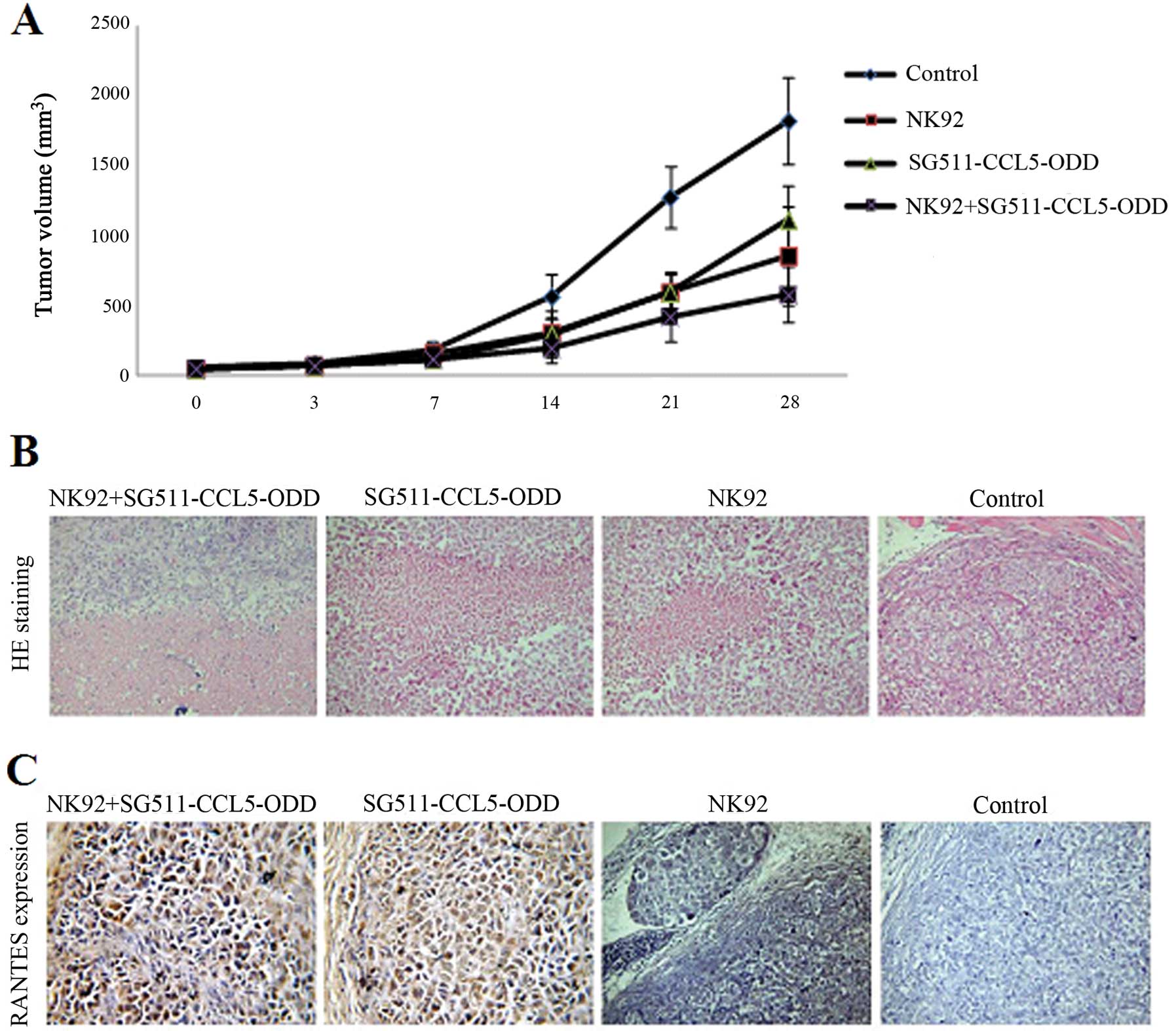
Oncolytic adenoviruses are modified based on adenovirus serotype 5 (Ad5), which belongs to subgroup C and depends on Coxsackie-adenovirus receptor (CAR) to recognize target cells. However, expression of CAR is generally low or lost in certain tumors including hepatocellular carcinoma (HCC). By contrast, CD46 is highly expressed in various types of malignant tumor cells. Therefore, we constructed an adenovirus vector expressing the human RANTES/CCL5 gene regulated by oxygen-dependent degradation domain (ODD) and analyzed its antitumor effects in vitro and in vivo. The human RANTES/CCL5 gene was fused with ODD by PCR and the recombinant oncolytic adenovirus containing RANTES-ODD, SG511-CCL5-ODD, was constructed by the Gateway system, which infected cells by binding CD46. Viral replication experiments were performed to evaluate the selective replication ability of SG511-CCL5-ODD. RANTES expression was determined by ELISA. The chemotactic test was used to analyze the ability of the expressed RANTES to recruit NK92 cells. The antitumor effects of SG511-CCL5-ODD were examined in HCC xenografts in nude mice. A chimeric oncolytic adenovirus, SG511-CCL5-ODD, was constructed successfully. Cells infected with the recombinant virus were able to express RANTES selectively in different environments controlled by ODD and the expressed RANTES was able to recruit NK92 cells by its chemotactic effect in vitro and improve the anticancer immune response in HCC xenografts in nude mice. The chimeric adenovirus SG511-CCL5-ODD highly expressed the RANTES-ODD fusion gene in the hypoxia of HCC under the control of the ODD and effectively attracted NK92 cells and a high number of immunocytes. These factors had complementary advantages and, in combination, exerted enhanced antitumor efficacy.
View Figures

Figure 1

Figure 2

Figure 3

Figure 4

Figure 5

View References

1 

Dudley ME, Yang JC, Sherry R, Hughes MS, Royal R, Kammula U, Robbins PF, Huang J, Citrin DE, Leitman SF, Wunderlich J, Restifo NP, Thomasian A, Downey SG, Smith FO, Klapper J, Morton K, Laurencot C, White DE and Rosenberg SA: Adoptive cell therapy for patients with metastatic melanoma: evaluation of intensive myeloablative chemoradiation preparative regimens. J Clin Oncol. 26:5233–5239. 2008. View Article : Google Scholar

2 

Dudley ME, Wunderlich JR, Shelton TE, Even J and Rosenberg SA: Generation of tumor-infiltrating lymphocyte cultures for use in adoptive transfer therapy for melanoma patients. J Immunother. 26:332–342. 2003. View Article : Google Scholar : PubMed/NCBI

3 

Dudley ME, Wunderlich JR, Yang JC, Sherry RM, Topalian SL, Restifo NP, Royal RE, Kammula U, White DE, Mavroukakis SA, Rogers LJ, Gracia GJ, Jones SA, Mangiameli DP, Pelletier MM, Gea-Banacloche J, Robinson MR, Berman DM, Filie AC, Abati A and Rosenberg SA: Adoptive cell transfer therapy following non-myeloablative but lymphodepleting chemotherapy for the treatment of patients with refractory metastatic melanoma. J Clin Oncol. 23:2346–2357. 2005. View Article : Google Scholar : PubMed/NCBI

4 

Wrzesinski C, Paulos CM, Kaiser A, Muranski P, Palmer DC, Gattinoni L, Yu Z, Rosenberg SA and Restifo NP: Increased intensity lymphodepletion enhances tumor treatment efficacy of adoptively transferred tumor-specific T cells. J Immunother. 33:1–7. 2010. View Article : Google Scholar

5 

Rosenberg SA, Yang JC, Sherry RM, Kammula US, Hughes MS, Phan GQ, Citrin DE, Restifo NP, Robbins PF, Wunderlich JR, Morton KE, Laurencot CM, Steinberg SM, White DE and Dudley ME: Durable complete responses in heavily pretreated patients with metastatic melanoma using T-cell transfer immunotherapy. Clin Cancer Res. 17:4550–4557. 2011. View Article : Google Scholar

6 

Ripley RT, Davis JL, Klapper JA, Mathur A, Kammula U, Royal RE, Yang JC, Sherry RM, Hughes MS, Libutti SK, White DE, Steinberg SM, Dudley ME, Rosenberg SA and Avital I: Liver resection for metastatic melanoma with postoperative tumor-infiltrating lymphocyte therapy. Ann Surg Oncol. 17:163–170. 2010. View Article : Google Scholar : PubMed/NCBI

7 

Rosenberg SA and Dudley ME: Adoptive cell therapy for the treatment of patients with metastatic melanoma. Curr Opin Immunol. 21:233–240. 2009. View Article : Google Scholar : PubMed/NCBI

8 

Pittet MJ and Mempel TR: Regulation of T-cell migration and effector functions: insights from in vivo imaging studies. Immunol Rev. 221:107–129. 2008. View Article : Google Scholar : PubMed/NCBI

9 

Braun SE, Chen K, Foster RG, Kim CH, Hromas R, Kaplan MH, Broxmeyer HE and Cornetta K: The CC chemokine CK beta-11/MIP-3 beta/ELC/Exodus 3 mediates tumor rejection of murine breast cancer cells through NK cells. J Immunol. 164:4025–4031. 2000. View Article : Google Scholar : PubMed/NCBI

10 

Hromas R, Cripe L, Hangoc G, Cooper S and Broxmeyer HE: The exodus subfamily of CC chemokines inhibits the proliferation of chronic myelogenous leukemia progenitors. Blood. 95:1506–1508. 2000.PubMed/NCBI

11 

Sharma S, Stolina M, Luo J, Strieter RM, Burdick M, Zhu LX, Batra RK and Dubinett SM: Secondary lymphoid tissue chemokine mediates T cell-dependent antitumor responses in vivo. J Immunol. 164:4558–4563. 2000. View Article : Google Scholar : PubMed/NCBI

12 

Kudo T, Lu H, Wu JY, Graham DY, Casola A and Yamaoka Y: Regulation of RANTES promoter activation in gastric epithelial cells infected with Helicobacter pylori. Infect Immun. 73:7602–7612. 2005. View Article : Google Scholar : PubMed/NCBI

13 

Lebovic DI, Chao VA and Taylor RN: Peritoneal macrophages induce RANTES (regulated on activation, normal T cell expressed and secreted) chemokine gene transcription in endometrial stromal cells. J Clin Endocrinol Metab. 89:1397–1401. 2004. View Article : Google Scholar

14 

Veillard NR, Kwak B, Pelli G, Mulhaupt F, James RW, Proudfoot AE and Mach F: Antagonism of RANTES receptors reduces atherosclerotic plaque formation in mice. Circ Res. 94:253–261. 2004. View Article : Google Scholar : PubMed/NCBI

15 

Rojas-Ramos E, Avalos AF, Pérez-Fernandez L, Cuevas-Schacht F, Valencia-Maqueda E and Terán LM: Role of the chemokines RANTES, monocyte chemotactic proteins-3 and -4 and eotaxins-1 and -2 in childhood asthma. Eur Respir J. 22:310–316. 2003. View Article : Google Scholar : PubMed/NCBI

16 

Chen CJ, Chen JH, Chen SY, Liao SL and Raung SL: Upregulation of RANTES gene expression in neuroglia by Japanese encephalitis virus infection. J Virol. 78:12107–12119. 2004. View Article : Google Scholar : PubMed/NCBI

17 

Oltmanns U, Issa R, Sukkar MB, John M and Chung KF: Role of c-jun N-terminal kinase in the induced release of GM-CSF, RANTES and IL-8 from human airway smooth muscle cells. Br J Pharmacol. 139:1228–1234. 2003. View Article : Google Scholar : PubMed/NCBI

18 

Teichmann JV, Ludwig WD and Thiel E: Cytotoxicity of interleukin 2-induced lymphokine-activated killer (LAK) cells against human leukemia and augmentation of killing by interferons and tumor necrosis factor. Leuk Res. 16:287–298. 1992. View Article : Google Scholar : PubMed/NCBI

19 

Pawelec G: MHC-unrestricted immune surveillance of leukemia. Cancer Biother. 9:265–288. 1994. View Article : Google Scholar : PubMed/NCBI

20 

Dokhelar MC, Wiels J, Lipinski M, Tetaud C, Devergie A, Gluckman E and Tursz T: Natural killer cell activity in human bone marrow recipients: early reappearance of peripheral natural killer activity in graft-versus-host disease. Transplantation. 31:61–65. 1981. View Article : Google Scholar : PubMed/NCBI

21 

Cerwenka A and Lanier LL: Natural killer cells, viruses and cancer. Nat Rev Immunol. 1:41–49. 2001. View Article : Google Scholar : PubMed/NCBI

22 

Lanier LL: NK cell recognition. Annu Rev Immunol. 23:225–274. 2005. View Article : Google Scholar : PubMed/NCBI

23 

Drexler HG and Matsuo Y: Malignant hematopoietic cell lines: in vitro models for the study of natural killer cell leukemia-lymphoma. Leukemia. 14:777–782. 2000. View Article : Google Scholar : PubMed/NCBI

24 

Yan Y, Steinherz P, Klingemann HG, Dennig D, Childs BH, McGuirk J and O’Reilly RJ: Antileukemia activity of a natural killer cell line against human leukemias. Clin Cancer Res. 4:2859–2868. 1998.PubMed/NCBI

25 

Gong JH, Maki G and Klingemann HG: Characterization of a human cell line (NK-92) with phenotypical and functional characteristics of activated natural killer cells. Leukemia. 8:652–658. 1994.PubMed/NCBI

26 

Reid GS, Bharya S, Klingemann HG and Schultz KR: Differential killing of pre-B acute lymphoblastic leukaemia cells by activated NK cells and the NK-92 ci cell line. Clin Exp Immunol. 129:265–271. 2002. View Article : Google Scholar : PubMed/NCBI

27 

Tam YK, Miyagawa B, Ho VC and Klingemann HG: Immunotherapy of malignant melanoma in a SCID mouse model using the highly cytotoxic natural killer cell line NK-92. J Hematother. 8:281–290. 1999. View Article : Google Scholar : PubMed/NCBI

28 

Tonn T, Becker S, Esser R, Schwabe D and Seifried E: Cellular immunotherapy of malignancies using the clonal natural killer cell line NK-92. J Hematother Stem Cell Res. 10:535–544. 2001. View Article : Google Scholar : PubMed/NCBI

29 

Bergelson JM, Cunningham JA, Droguett G, Kurt-Jones EA, Krithivas A, Hong JS, Horwitz MS, Crowell RL and Finberg RW: Isolation of a common receptor for Coxsackie B viruses and adenoviruses 2 and 5. Science. 275:1320–1323. 1997. View Article : Google Scholar : PubMed/NCBI

30 

Tomko RP, Xu R and Philipson L: HCAR and MCAR: the human and mouse cellular receptors for subgroup C adenoviruses and group B coxsackieviruses. Proc Natl Acad Sci USA. 94:3352–3356. 1997. View Article : Google Scholar : PubMed/NCBI

31 

Kim M, Zinn KR, Barnett BG, Sumerel LA, Krasnykh V, Curiel DT and Douglas JT: The therapeutic efficacy of adenoviral vectors for cancer gene therapy is limited by a low level of primary adenovirus receptors on tumour cells. Eur J Cancer. 38:1917–1926. 2002. View Article : Google Scholar : PubMed/NCBI

32 

Matsumoto K, Shariat SF, Ayala GE, Rauen KA and Lerner SP: Loss of coxsackie and adenovirus receptor expression is associated with features of aggressive bladder cancer. Urology. 66:441–446. 2005. View Article : Google Scholar : PubMed/NCBI

33 

Yamamoto H, Itoh F, Sakamoto H, Nakajima Y, Une Y, Hinoda Y and Imai K: Association of reduced cell adhesion regulator messenger RNA expression with tumor progression in human hepatocellular carcinoma. Int J Cancer. 74:251–254. 1997. View Article : Google Scholar : PubMed/NCBI

34 

Gaggar A, Shayakhmetov DM and Lieber A: CD46 is a cellular receptor for group B adenoviruses. Nat Med. 9:1408–1412. 2003. View Article : Google Scholar : PubMed/NCBI

35 

Hara T, Kojima A, Fukuda H, Masaoka T, Fukumori Y, Matsumoto M and Seya T: Levels of complement regulatory proteins, CD35 (CR1), CD46 (MCP) and CD55 (DAF) in human haematological malignancies. Br J Haematol. 82:368–373. 1992. View Article : Google Scholar : PubMed/NCBI

36 

Kinugasa N, Higashi T, Nouso K, Nakatsukasa H, Kobayashi Y, Ishizaki M, Toshikuni N, Yoshida K, Uematsu S and Tsuji T: Expression of membrane cofactor protein (MCP, CD46) in human liver diseases. Br J Cancer. 80:1820–1825. 1999. View Article : Google Scholar : PubMed/NCBI

37 

Murray KP, Mathure S, Kaul R, Khan S, Carson LF, Twiggs LB, Martens MG and Kaul A: Expression of complement regulatory proteins-CD 35, CD 46, CD 55 and CD 59-in benign and malignant endometrial tissue. Gynecol Oncol. 76:176–182. 2000. View Article : Google Scholar : PubMed/NCBI

38 

Thorsteinsson L, O’Dowd GM, Harrington PM and Johnson PM: The complement regulatory proteins CD46 and CD59, but not CD55, are highly expressed by glandular epithelium of human breast and colorectal tumour tissues. APMIS. 106:869–878. 1998. View Article : Google Scholar : PubMed/NCBI

39 

Vähä-Koskela MJ, Heikkilä JE and Hinkkanen AE: Oncolytic viruses in cancer therapy. Cancer Lett. 254:178–216. 2007.

40 

Liu X, Qian Q, Xu P, Wolf F, Zhang J, Zhang D, Li C and Huang Q: A novel conditionally replicating ‘armed’ adenovirus selectively targeting gastrointestinal tumors with aberrant wnt signaling. Hum Gene Ther. 22:427–437. 2011.

41 

Xie M, Niu JH, Chang Y, Qian QJ, Wu HP, Li LF, Zhang Y, Li JL, Huang XJ and Ruan GR: A novel triple-regulated oncolytic adenovirus carrying PDCD5 gene exerts potent antitumor efficacy on common human leukemic cell lines. Apoptosis. 14:1086–1094. 2009. View Article : Google Scholar : PubMed/NCBI

42 

Harada H, Hiraoka M and Kizaka-Kondoh S: Antitumor effect of TAT-oxygen-dependent degradation-caspase-3 fusion protein specifically stabilized and activated in hypoxic tumor cells. Cancer Res. 62:2013–2018. 2002.

43 

Teicher BA: Hypoxia and drug resistance. Cancer Metastasis Rev. 13:139–168. 1994. View Article : Google Scholar

44 

Kung AL, Wang S, Klco JM, Kaelin WG and Livingston DM: Suppression of tumor growth through disruption of hypoxia-inducible transcription. Nat Med. 6:1335–1340. 2000. View Article : Google Scholar : PubMed/NCBI

45 

Helmlinger G, Yuan F, Dellian M and Jain RK: Interstitial pH and pO2 gradients in solid tumors in vivo: high-resolution measurements reveal a lack of correlation. Nat Med. 3:177–182. 1997. View Article : Google Scholar : PubMed/NCBI

46 

Zhong H, De Marzo AM, Laughner E, Lim M, Hilton DA, Zagzag D, Buechler P, Isaacs WB, Semenza GL and Simons JW: Overexpression of hypoxia-inducible factor 1alpha in common human cancers and their metastases. Cancer Res. 59:5830–5835. 1999.PubMed/NCBI

47 

Zhang Q, Chen G, Peng L, Wang X, Yang Y, Liu C, Shi W, Su C, Wu H, Liu X, Wu M and Qian Q: Increased safety with preserved antitumoral efficacy on hepatocellular carcinoma with dual-regulated oncolytic adenovirus. Clin Cancer Res. 12:6523–6531. 2006. View Article : Google Scholar : PubMed/NCBI

Related Articles

  • Abstract
  • View
  • Download
  • Twitter
Copy and paste a formatted citation
Spandidos Publications style
Li J, Liu H, Li L, Wu H, Wang C, Yan Z, Wang Y, Su C, Jin H, Zhou F, Zhou F, et al: The combination of an oxygen-dependent degradation domain-regulated adenovirus expressing the chemokine RANTES/CCL5 and NK-92 cells exerts enhanced antitumor activity in hepatocellular carcinoma. Oncol Rep 29: 895-902, 2013.
APA
Li, J., Liu, H., Li, L., Wu, H., Wang, C., Yan, Z. ... Qian, Q. (2013). The combination of an oxygen-dependent degradation domain-regulated adenovirus expressing the chemokine RANTES/CCL5 and NK-92 cells exerts enhanced antitumor activity in hepatocellular carcinoma. Oncology Reports, 29, 895-902. https://doi.org/10.3892/or.2012.2217
MLA
Li, J., Liu, H., Li, L., Wu, H., Wang, C., Yan, Z., Wang, Y., Su, C., Jin, H., Zhou, F., Wu, M., Qian, Q."The combination of an oxygen-dependent degradation domain-regulated adenovirus expressing the chemokine RANTES/CCL5 and NK-92 cells exerts enhanced antitumor activity in hepatocellular carcinoma". Oncology Reports 29.3 (2013): 895-902.
Chicago
Li, J., Liu, H., Li, L., Wu, H., Wang, C., Yan, Z., Wang, Y., Su, C., Jin, H., Zhou, F., Wu, M., Qian, Q."The combination of an oxygen-dependent degradation domain-regulated adenovirus expressing the chemokine RANTES/CCL5 and NK-92 cells exerts enhanced antitumor activity in hepatocellular carcinoma". Oncology Reports 29, no. 3 (2013): 895-902. https://doi.org/10.3892/or.2012.2217
Copy and paste a formatted citation
x
Spandidos Publications style
Li J, Liu H, Li L, Wu H, Wang C, Yan Z, Wang Y, Su C, Jin H, Zhou F, Zhou F, et al: The combination of an oxygen-dependent degradation domain-regulated adenovirus expressing the chemokine RANTES/CCL5 and NK-92 cells exerts enhanced antitumor activity in hepatocellular carcinoma. Oncol Rep 29: 895-902, 2013.
APA
Li, J., Liu, H., Li, L., Wu, H., Wang, C., Yan, Z. ... Qian, Q. (2013). The combination of an oxygen-dependent degradation domain-regulated adenovirus expressing the chemokine RANTES/CCL5 and NK-92 cells exerts enhanced antitumor activity in hepatocellular carcinoma. Oncology Reports, 29, 895-902. https://doi.org/10.3892/or.2012.2217
MLA
Li, J., Liu, H., Li, L., Wu, H., Wang, C., Yan, Z., Wang, Y., Su, C., Jin, H., Zhou, F., Wu, M., Qian, Q."The combination of an oxygen-dependent degradation domain-regulated adenovirus expressing the chemokine RANTES/CCL5 and NK-92 cells exerts enhanced antitumor activity in hepatocellular carcinoma". Oncology Reports 29.3 (2013): 895-902.
Chicago
Li, J., Liu, H., Li, L., Wu, H., Wang, C., Yan, Z., Wang, Y., Su, C., Jin, H., Zhou, F., Wu, M., Qian, Q."The combination of an oxygen-dependent degradation domain-regulated adenovirus expressing the chemokine RANTES/CCL5 and NK-92 cells exerts enhanced antitumor activity in hepatocellular carcinoma". Oncology Reports 29, no. 3 (2013): 895-902. https://doi.org/10.3892/or.2012.2217
Follow us
  • Twitter
  • LinkedIn
  • Facebook
About
  • Spandidos Publications
  • Careers
  • Cookie Policy
  • Privacy Policy
How can we help?
  • Help
  • Live Chat
  • Contact
  • Email to our Support Team