Spandidos Publications Logo
  • About
    • About Spandidos
    • Aims and Scopes
    • Abstracting and Indexing
    • Editorial Policies
    • Reprints and Permissions
    • Job Opportunities
    • Terms and Conditions
    • Contact
  • Journals
    • All Journals
    • Oncology Letters
      • Oncology Letters
      • Information for Authors
      • Editorial Policies
      • Editorial Board
      • Aims and Scope
      • Abstracting and Indexing
      • Bibliographic Information
      • Archive
    • International Journal of Oncology
      • International Journal of Oncology
      • Information for Authors
      • Editorial Policies
      • Editorial Board
      • Aims and Scope
      • Abstracting and Indexing
      • Bibliographic Information
      • Archive
    • Molecular and Clinical Oncology
      • Molecular and Clinical Oncology
      • Information for Authors
      • Editorial Policies
      • Editorial Board
      • Aims and Scope
      • Abstracting and Indexing
      • Bibliographic Information
      • Archive
    • Experimental and Therapeutic Medicine
      • Experimental and Therapeutic Medicine
      • Information for Authors
      • Editorial Policies
      • Editorial Board
      • Aims and Scope
      • Abstracting and Indexing
      • Bibliographic Information
      • Archive
    • International Journal of Molecular Medicine
      • International Journal of Molecular Medicine
      • Information for Authors
      • Editorial Policies
      • Editorial Board
      • Aims and Scope
      • Abstracting and Indexing
      • Bibliographic Information
      • Archive
    • Biomedical Reports
      • Biomedical Reports
      • Information for Authors
      • Editorial Policies
      • Editorial Board
      • Aims and Scope
      • Abstracting and Indexing
      • Bibliographic Information
      • Archive
    • Oncology Reports
      • Oncology Reports
      • Information for Authors
      • Editorial Policies
      • Editorial Board
      • Aims and Scope
      • Abstracting and Indexing
      • Bibliographic Information
      • Archive
    • Molecular Medicine Reports
      • Molecular Medicine Reports
      • Information for Authors
      • Editorial Policies
      • Editorial Board
      • Aims and Scope
      • Abstracting and Indexing
      • Bibliographic Information
      • Archive
    • World Academy of Sciences Journal
      • World Academy of Sciences Journal
      • Information for Authors
      • Editorial Policies
      • Editorial Board
      • Aims and Scope
      • Abstracting and Indexing
      • Bibliographic Information
      • Archive
    • International Journal of Functional Nutrition
      • International Journal of Functional Nutrition
      • Information for Authors
      • Editorial Policies
      • Editorial Board
      • Aims and Scope
      • Abstracting and Indexing
      • Bibliographic Information
      • Archive
    • International Journal of Epigenetics
      • International Journal of Epigenetics
      • Information for Authors
      • Editorial Policies
      • Editorial Board
      • Aims and Scope
      • Abstracting and Indexing
      • Bibliographic Information
      • Archive
    • Medicine International
      • Medicine International
      • Information for Authors
      • Editorial Policies
      • Editorial Board
      • Aims and Scope
      • Abstracting and Indexing
      • Bibliographic Information
      • Archive
  • Articles
  • Information
    • Information for Authors
    • Information for Reviewers
    • Information for Librarians
    • Information for Advertisers
    • Conferences
  • Language Editing
Spandidos Publications Logo
  • About
    • About Spandidos
    • Aims and Scopes
    • Abstracting and Indexing
    • Editorial Policies
    • Reprints and Permissions
    • Job Opportunities
    • Terms and Conditions
    • Contact
  • Journals
    • All Journals
    • Biomedical Reports
      • Information for Authors
      • Editorial Policies
      • Editorial Board
      • Aims and Scope
      • Abstracting and Indexing
      • Bibliographic Information
      • Archive
    • Experimental and Therapeutic Medicine
      • Information for Authors
      • Editorial Policies
      • Editorial Board
      • Aims and Scope
      • Abstracting and Indexing
      • Bibliographic Information
      • Archive
    • International Journal of Epigenetics
      • Information for Authors
      • Editorial Policies
      • Editorial Board
      • Aims and Scope
      • Abstracting and Indexing
      • Bibliographic Information
      • Archive
    • International Journal of Functional Nutrition
      • Information for Authors
      • Editorial Policies
      • Editorial Board
      • Aims and Scope
      • Abstracting and Indexing
      • Bibliographic Information
      • Archive
    • International Journal of Molecular Medicine
      • Information for Authors
      • Editorial Policies
      • Editorial Board
      • Aims and Scope
      • Abstracting and Indexing
      • Bibliographic Information
      • Archive
    • International Journal of Oncology
      • Information for Authors
      • Editorial Policies
      • Editorial Board
      • Aims and Scope
      • Abstracting and Indexing
      • Bibliographic Information
      • Archive
    • Medicine International
      • Information for Authors
      • Editorial Policies
      • Editorial Board
      • Aims and Scope
      • Abstracting and Indexing
      • Bibliographic Information
      • Archive
    • Molecular and Clinical Oncology
      • Information for Authors
      • Editorial Policies
      • Editorial Board
      • Aims and Scope
      • Abstracting and Indexing
      • Bibliographic Information
      • Archive
    • Molecular Medicine Reports
      • Information for Authors
      • Editorial Policies
      • Editorial Board
      • Aims and Scope
      • Abstracting and Indexing
      • Bibliographic Information
      • Archive
    • Oncology Letters
      • Information for Authors
      • Editorial Policies
      • Editorial Board
      • Aims and Scope
      • Abstracting and Indexing
      • Bibliographic Information
      • Archive
    • Oncology Reports
      • Information for Authors
      • Editorial Policies
      • Editorial Board
      • Aims and Scope
      • Abstracting and Indexing
      • Bibliographic Information
      • Archive
    • World Academy of Sciences Journal
      • Information for Authors
      • Editorial Policies
      • Editorial Board
      • Aims and Scope
      • Abstracting and Indexing
      • Bibliographic Information
      • Archive
  • Articles
  • Information
    • For Authors
    • For Reviewers
    • For Librarians
    • For Advertisers
    • Conferences
  • Language Editing
Login Register Submit
  • This site uses cookies
  • You can change your cookie settings at any time by following the instructions in our Cookie Policy. To find out more, you may read our Privacy Policy.

    I agree
Search articles by DOI, keyword, author or affiliation
Search
Advanced Search
presentation
Oncology Reports
Join Editorial Board Propose a Special Issue
Print ISSN: 1021-335X Online ISSN: 1791-2431
Journal Cover
June 2013 Volume 29 Issue 6

Full Size Image

Sign up for eToc alerts
Recommend to Library

Journals

International Journal of Molecular Medicine

International Journal of Molecular Medicine

International Journal of Molecular Medicine is an international journal devoted to molecular mechanisms of human disease.

International Journal of Oncology

International Journal of Oncology

International Journal of Oncology is an international journal devoted to oncology research and cancer treatment.

Molecular Medicine Reports

Molecular Medicine Reports

Covers molecular medicine topics such as pharmacology, pathology, genetics, neuroscience, infectious diseases, molecular cardiology, and molecular surgery.

Oncology Reports

Oncology Reports

Oncology Reports is an international journal devoted to fundamental and applied research in Oncology.

Experimental and Therapeutic Medicine

Experimental and Therapeutic Medicine

Experimental and Therapeutic Medicine is an international journal devoted to laboratory and clinical medicine.

Oncology Letters

Oncology Letters

Oncology Letters is an international journal devoted to Experimental and Clinical Oncology.

Biomedical Reports

Biomedical Reports

Explores a wide range of biological and medical fields, including pharmacology, genetics, microbiology, neuroscience, and molecular cardiology.

Molecular and Clinical Oncology

Molecular and Clinical Oncology

International journal addressing all aspects of oncology research, from tumorigenesis and oncogenes to chemotherapy and metastasis.

World Academy of Sciences Journal

World Academy of Sciences Journal

Multidisciplinary open-access journal spanning biochemistry, genetics, neuroscience, environmental health, and synthetic biology.

International Journal of Functional Nutrition

International Journal of Functional Nutrition

Open-access journal combining biochemistry, pharmacology, immunology, and genetics to advance health through functional nutrition.

International Journal of Epigenetics

International Journal of Epigenetics

Publishes open-access research on using epigenetics to advance understanding and treatment of human disease.

Medicine International

Medicine International

An International Open Access Journal Devoted to General Medicine.

Journal Cover
June 2013 Volume 29 Issue 6

Full Size Image

Sign up for eToc alerts
Recommend to Library

  • Article
  • Citations
    • Cite This Article
    • Download Citation
    • Create Citation Alert
    • Remove Citation Alert
    • Cited By
  • Similar Articles
    • Related Articles (in Spandidos Publications)
    • Similar Articles (Google Scholar)
    • Similar Articles (PubMed)
  • Download PDF
  • Download XML
  • View XML
Article

HSPA9 overexpression inhibits apoptin-induced apoptosis in the HepG2 cell line

  • Authors:
    • Chuanmei Peng
    • Pu Yang
    • Yingbo Cui
    • Ming He
    • Leilei Liang
    • Yong Di
  • View Affiliations / Copyright

    Affiliations: Clinical Laboratory of Yanan Hospital of Kunming, Kunming 650051, P.R. China, Biomechanics Institute, Department of Biomedical Engineering, School of Biological Science and Engineering, South China University of Technology, Guangzhou 510006, P.R. China, Department of Biochemistry and Molecular Biology, Kunming Medical University, Kunming 650500, P.R. China
  • Pages: 2431-2437
    |
    Published online on: April 9, 2013
       https://doi.org/10.3892/or.2013.2399
  • Expand metrics +
Metrics: Total Views: 0 (Spandidos Publications: | PMC Statistics: )
Metrics: Total PDF Downloads: 0 (Spandidos Publications: | PMC Statistics: )
Cited By (CrossRef): 0 citations Loading Articles...

This article is mentioned in:


Abstract

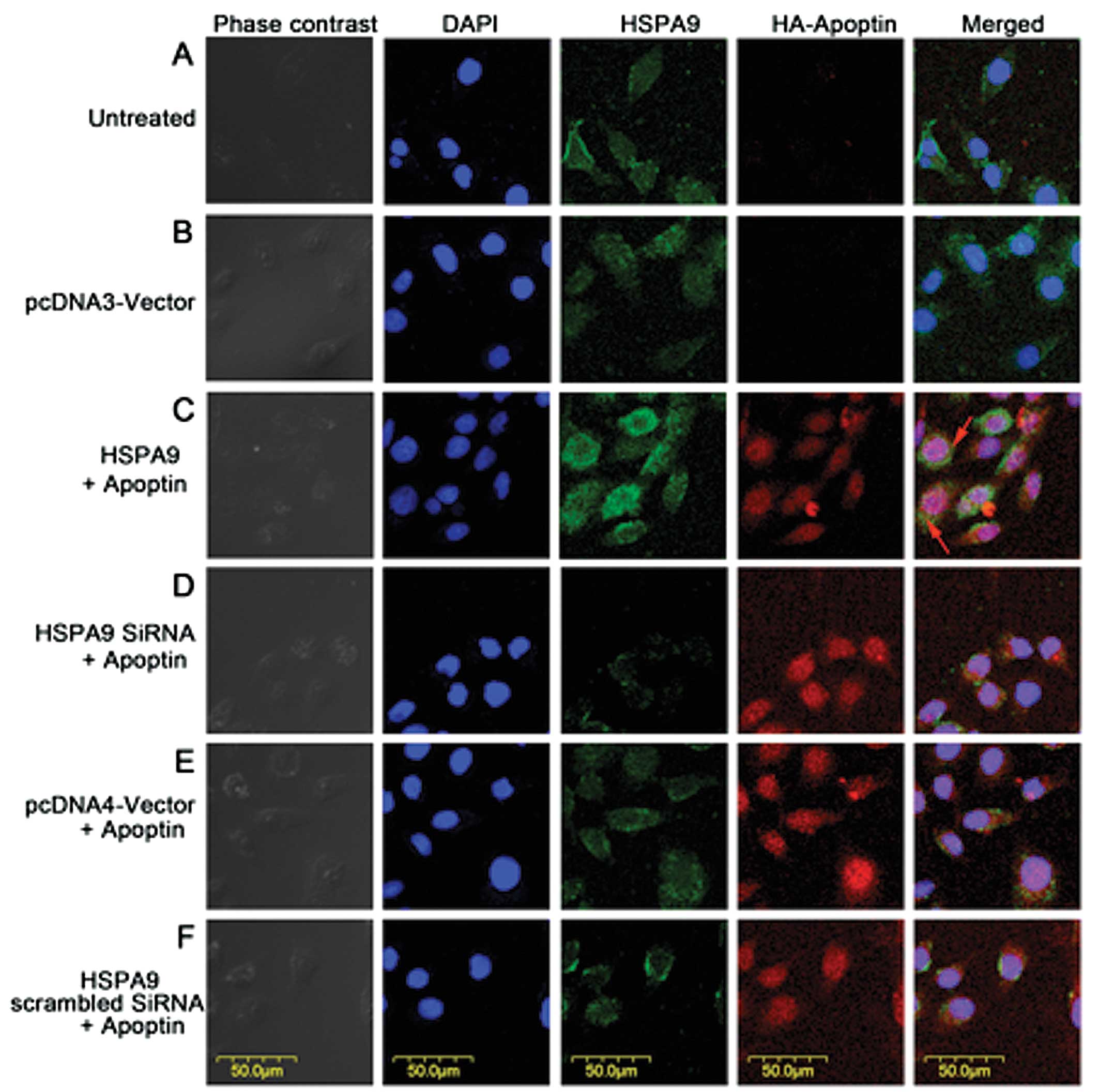
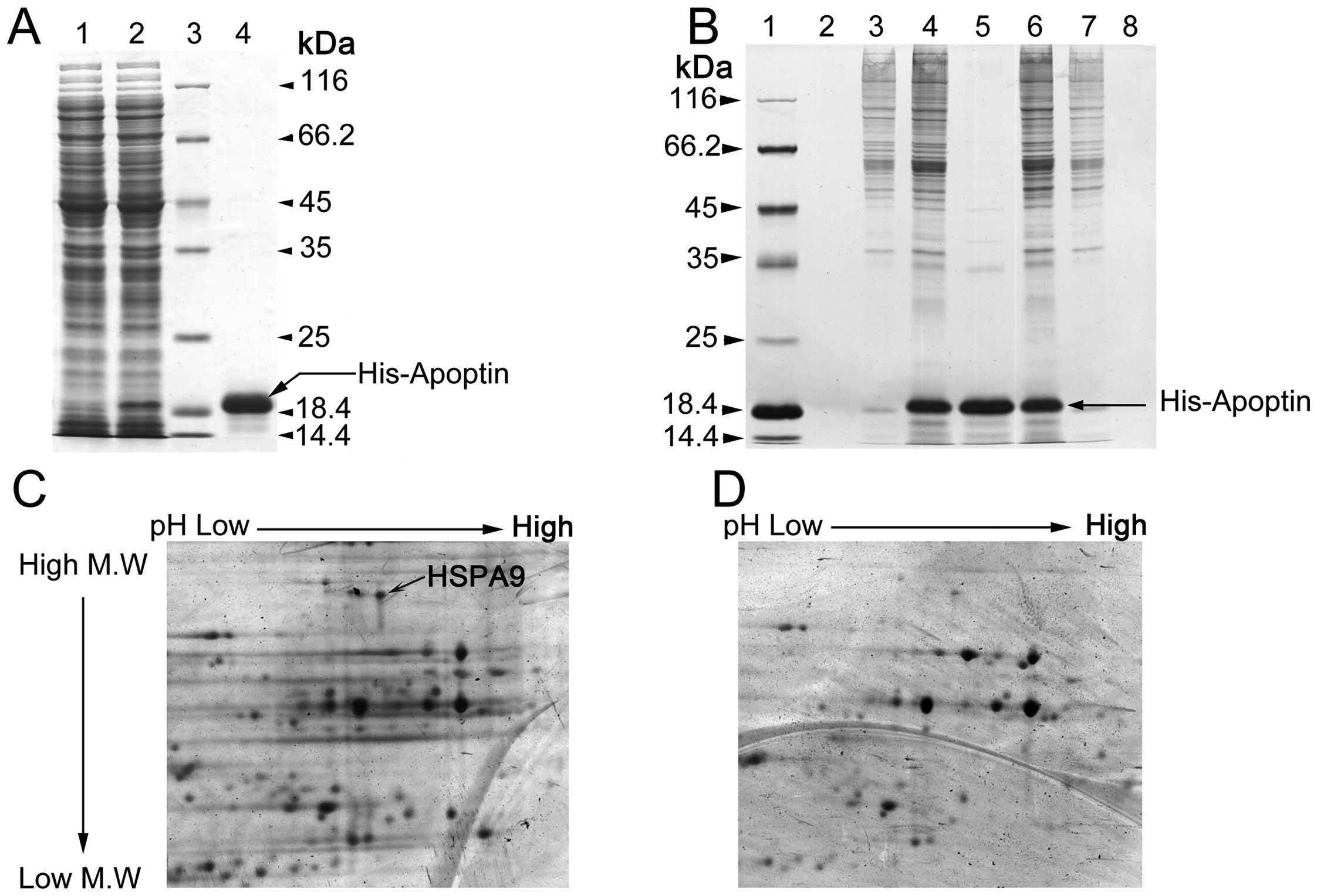
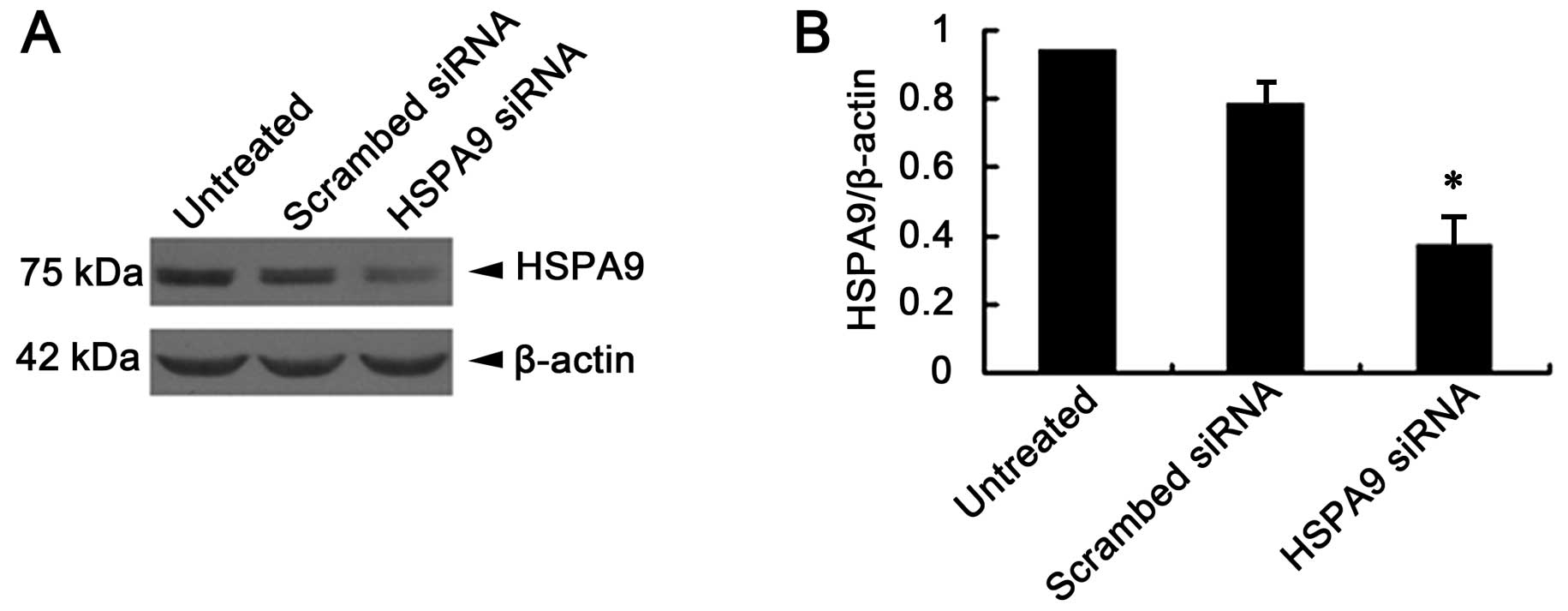
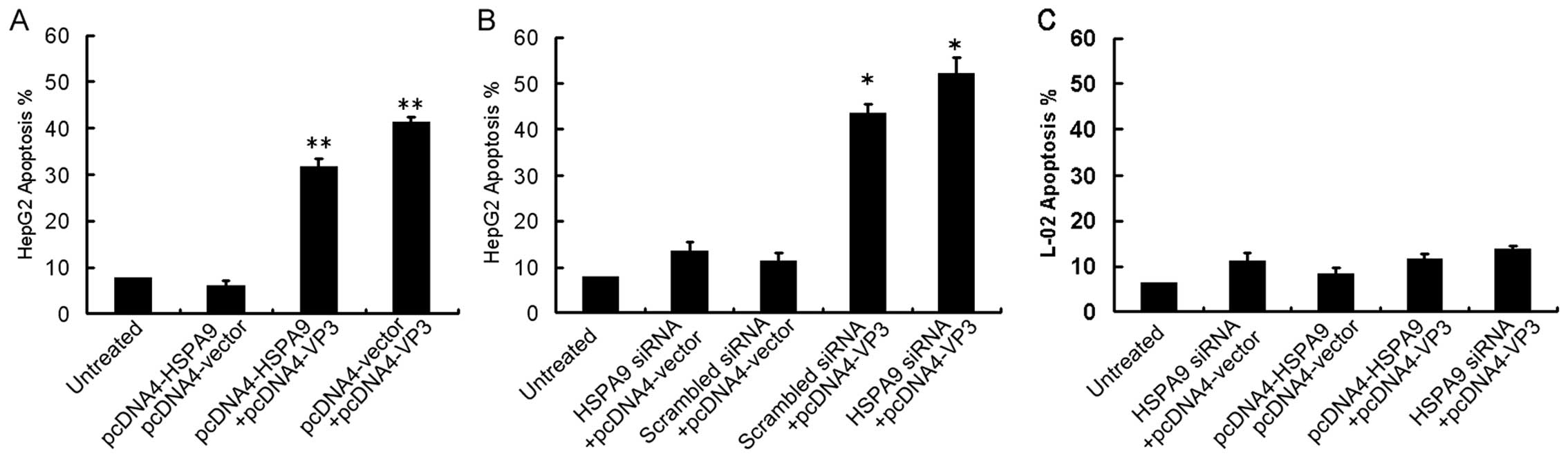
Apoptin, a small protein derived from chicken anemia virus, possesses the capacity to specifically kill tumor cells while leaving normal cells intact. Previous studies have indicated that the subcellular localization of apoptin appears to be crucial for this tumor-selective activity. Apoptin resides in the cytoplasm of normal cells; however, in cancer cells it translocates into the nucleus. In the present study, purified prokaryotic native His-apoptin served as a bait for capturing apoptin-associated proteins in both a hepatoma carcinoma cell line (HepG2) and a human fetal liver cell line (L-02). The captured proteins obtained from a pull-down assay were separated by two-dimensional gel electrophoresis. Mass spectrometry was employed to detect the effect of HSPA9 overexpression (one of the interacting proteins with apoptin in vitro) and downregulation of HSPA9 on HepG2 cells. The data revealed that HSPA9 overexpression resulted in partial distribution of apoptin in the cytoplasm. Notably, HSPA9 overexpression markedly decreased the apoptosis rate of HepG2 cells from 41.2 to 31.7%, while the downregulation of HSPA9 using small interfering RNA significantly enhanced the apoptosis of HepG2 cells. Our results suggest new insights into the localization mechanism of apoptin which is tightly associated with HSPA9 overexpression and its crucial role in cellular apoptosis both in a tumor cell line (HepG2) and a normal cell line (L-02). These findings shed new light on the elucidation of the underlying mechanism of anticancer action of apoptin.
View Figures

Figure 1

Figure 2

Figure 3

Figure 4

Figure 5

View References

1 

Noteborn MH, de Boer GF, van Roozelaar DJ, Karreman C, Kranenburg O, Vos JG, Jeurissen SH, Hoeben RC, Zantema A and Koch G: Characterization of cloned chicken anemia virus DNA that contains all elements for the infectious replication cycle. J Virol. 65:3131–3139. 1991.PubMed/NCBI

2 

Danen-Van Oorschot AA, Fischer DF, Grimbergen JM, Klein B, Zhuang S, Falkenburg JH, Backendorf C, Quax PH, Van der Eb AJ and Noteborn MH: Apoptin induces apoptosis in human transformed and malignant cells but not in normal cells. Proc Natl Acad Sci USA. 94:5843–5847. 1997.

3 

Rohn JL, Zhang YH, Aalbers RI, Otto N, Den Hertog J, Henriquez NV, Van De Velde CJ, Kuppen PJ, Mumberg D, Donner P and Noteborn MH: A tumor-specific kinase activity regulates the viral death protein apoptin. J Biol Chem. 277:50820–50827. 2004. View Article : Google Scholar : PubMed/NCBI

4 

Teodoro JG, Heilman DW, Parker AE and Green MR: The viral protein apoptin associates with the anaphase-promoting complex to induce G2/M arrest and apoptosis in the absence of p53. Gene Dev. 18:1952–1957. 2004. View Article : Google Scholar : PubMed/NCBI

5 

Danen-Van Oorschot AA, Zhang YH, Leliveld SR, Rohn JL, Seelen MC, Bolk MW, Van Zon A, Erkeland SJ, Abrahams JP, Mumberg D and Noteborn MH: Importance of nuclear localization of apoptin for tumor-specific induction of apoptosis. J Biol Chem. 278:27729–27736. 2003.PubMed/NCBI

6 

Sun GJ, Tong X, Dong Y, Mei ZZ and Sun ZX: Identification of a protein interacting with apoptin from human leucocyte cDNA library by using yeast two-hybrid screening. Sheng Wu Hua Xue Yu Sheng Wu Wu Li Xue Bao. 34:369–372. 2002.(In Chinese).

7 

Janssen K, Hofmann TG, Jans DA, Hay RT, Schulze-Osthoff K and Fischer U: Apoptin is modified by SUMO conjugation and targeted to promyelocytic leukemia protein nuclear bodies. Oncogene. 26:1557–1566. 2007.PubMed/NCBI

8 

Teodoro JG, Heilman DW, Parker AE and Green MR: The viral protein apoptin associates with the anaphase-promoting complex to induce G2/M arrest and apoptosis in the absence of p53. Gene Dev. 18:1952–1957. 2004.PubMed/NCBI

9 

Danen-van Oorschot AA, Voskamp P, Seelen MC, van Miltenburg MH, Bolk MW, Tait SW, Boesen-de Cock JG, Rohn JL, Borst J and Noteborn MH: Human death effector domain-associated factor interacts with the viral apoptosis agonist apoptin and exerts tumor-preferential cell killing. Cell Death Differ. 11:564–573. 2004.

10 

Liu X, Elojeimy S, El-Zawahry AM, Holman DH, Bielawska A, Bielawski J, Rubinchik S, Guo GW, Dong JY, Keane T, Hannun YA, Tavassoli M and Norris JS: Modulation of ceramide metabolism enhances viral protein apoptin’s cytotoxicity in prostate cancer. Mol Ther. 14:637–646. 2006.PubMed/NCBI

11 

Poon IK, Oro C, Dias MM, Zhang J and Jans DA: Apoptin nuclear accumulation is modulated by a CRM1-recognized nuclear export signal that is active in normal but not in tumor cells. Cancer Res. 65:7059–7064. 2005. View Article : Google Scholar : PubMed/NCBI

12 

Huo DH, Yi LN and Yang J: Interaction with Ppil3 leads to the cytoplasmic localization of apoptin in tumor cells. Biochem Biophys Res Commun. 372:14–18. 2008. View Article : Google Scholar

13 

Maddika S, Wiechec E, Ande SR, Poon IK, Fischer U, Wesselborg S, Jans DA, Schulze-Osthoff K and Los M: Interaction with PI3-kinase contributes to the cytotoxic activity of apoptin. Oncogene. 27:3060–3065. 2008. View Article : Google Scholar

14 

Maddika S, Bay GH, Kroczak TJ, Ande SR, Maddika S, Wiechec E, Gibson SB and Los M: Akt is transferred to the nucleus of cells treated with apoptin, and it participates in apoptin-induced cell death. Cell Prolif. 40:835–848. 2007. View Article : Google Scholar : PubMed/NCBI

15 

Maddika S, Panigrahi S, Wiechec E, Wesselborg S, Fischer U, Schulze-Osthoff K and Los M: Unscheduled Akt-triggered activation of CDK2 as a key effector mechanism of apoptin’s anticancer toxicity. Mol Cell Biol. 29:1235–1248. 2009.PubMed/NCBI

16 

Wadhwa R, Kaul SC, Ikawa Y and Sugimoto Y: Identification of a novel member of mouse hsp70 family. Its association with cellular mortal phenotype. J Biol Chem. 268:6615–6621. 1993.PubMed/NCBI

17 

Singh B, Soltys BJ, Wu ZC, Patel HV, Freeman KB and Gupta RS: Cloning and some novel characteristics of mitochondrial Hsp70 from Chinese hamster cells. Exp Cell Res. 234:205–216. 1997. View Article : Google Scholar : PubMed/NCBI

18 

Ran Q, Wadhwa R, Kawai R, Kaul SC, Sifers RN, Bick RJ, Smith JR and Pereira-Smith OM: Extramitochondrial localization of mortalin/mthsp70/PBP74/GRP75. Biochem Biophys Res Commun. 275:174–179. 2000. View Article : Google Scholar : PubMed/NCBI

19 

Craig EA, Kramer J, Shilling J, Werner-Washburne M, Holmes S, Kosic-Smithers J and Nicolet CM: SSC1, an essential member of the yeast HSP70 multigene family, encodes a mitochondrial protein. Mol Cell Biol. 9:3000–3008. 1989.PubMed/NCBI

20 

Kaul SC, Taira K, Pereira-Smith OM and Wadhwa R: Mortalin: present and prospective. Exp Gerontol. 37:1157–1164. 2002.PubMed/NCBI

21 

Merrick BA, Walker VR, He C, Patterson RM and Selkirk JK: Induction of novel Grp75 isoforms by 2-deoxyglucose in human and murine fibroblasts. Cancer Lett. 119:185–190. 1997. View Article : Google Scholar : PubMed/NCBI

22 

Wadhwa R, Taira K and Kaul SC: Mortalin: a potential candidate for biotechnology and biomedicine. Histol Histopathol. 17:1173–1177. 2002.PubMed/NCBI

23 

Wadhwa R, Takano S, Kaur K, Deocaris CC, Pereira-Smith OM, Reddel RR and Kaul SC: Upregulation of mortalin/mthsp70/Grp75 contributes to human carcinogenesis. Int J Cancer. 118:2973–2980. 2006. View Article : Google Scholar : PubMed/NCBI

24 

Peng DJ, Sun J, Wang YZ, Tian J, Zhang YH, Noteborn MH and Qu S: Inhibition of hepatocarcinoma by systemic delivery of apoptin gene via the hepatic asialoglycoprotein receptor. Cancer Gene Ther. 14:66–73. 2006. View Article : Google Scholar : PubMed/NCBI

25 

Drewes G, Ebneth A, Preuss U, Mandelkow EM and Mandelkow E: MARK, a novel family of protein kinases that phosphorylate microtubule-associated proteins and trigger microtubule disruption. Cell. 89:297–308. 1997. View Article : Google Scholar

26 

Rohn JL, Zhang YH, Aalbers RI, Otto N, Den Hertog J, Henriquez NV, Van De Velde CJ, Kuppen PJ, Mumberg D, Donner P and Noteborn MH: A tumor-specific kinase activity regulates the viral death protein apoptin. J Biol Chem. 227:50820–50827. 2002. View Article : Google Scholar : PubMed/NCBI

27 

Ohtsuka R, Abe Y, Fujii T, Yamamoto M, Nishimura J, Takayanagi R and Muta K: Mortalin is a novel mediator of erythropoietin signaling. Eur J Haematol. 79:114–125. 2007. View Article : Google Scholar : PubMed/NCBI

28 

Bhattacharyya T, Karnezis AN, Murphy SP, Hoang T, Freeman BC, Phillips B and Morimoto RI: Cloning and subcellular localization of human mitochondrial hsp70. J Biol Chem. 270:1705–1710. 1995. View Article : Google Scholar : PubMed/NCBI

29 

Koehler CM: New developments in mitochondrial assembly. Annu Rev Cell Dev Biol. 20:309–335. 2004. View Article : Google Scholar

30 

Rehling P, Brandner and Pfanner N: Mitochondrial import and the twin-pore translocase. Nat Rev Mol Cell Biol. 5:519–530. 2004. View Article : Google Scholar : PubMed/NCBI

31 

Wiedemann N, Frazier AE and Pfanner N: The protein import machinery of mitochondria. J Biol Chem. 279:14473–14476. 2004. View Article : Google Scholar : PubMed/NCBI

32 

Craig EA, Kramer J and Kosic-Smithers J: SSC1, a member of the 70-kDa heat shock protein multigene family of Saccharomyces cerevisiae, is essential for growth. Proc Natl Acad Sci USA. 84:4156–4160. 1987. View Article : Google Scholar : PubMed/NCBI

33 

Kawai A, Nishikawa S, Hirata A and Endo T: Loss of the mitochondrial Hsp70 functions causes aggregation of mitochondria in yeast cells. J Cell Sci. 114:3565–3574. 2001.PubMed/NCBI

34 

Kaul SC, Deocaris CC and Wadhwa R: Three faces of mortalin: a housekeeper, guardian and killer. Exp Gerontol. 42:263–274. 2007. View Article : Google Scholar : PubMed/NCBI

35 

Maddika S, Booy EP, Johar D, Gibson SB, Ghavami S and Los M: Cancer-specific toxicity of apoptin is independent of death receptors but involves the loss of mitochondrial membrane potential and the release of mitochondrial cell-death mediators by a Nur77-dependent pathway. J Cell Sci. 118:4485–4493. 2005. View Article : Google Scholar

Related Articles

  • Abstract
  • View
  • Download
  • Twitter
Copy and paste a formatted citation
Spandidos Publications style
Peng C, Yang P, Cui Y, He M, Liang L and Di Y: HSPA9 overexpression inhibits apoptin-induced apoptosis in the HepG2 cell line. Oncol Rep 29: 2431-2437, 2013.
APA
Peng, C., Yang, P., Cui, Y., He, M., Liang, L., & Di, Y. (2013). HSPA9 overexpression inhibits apoptin-induced apoptosis in the HepG2 cell line. Oncology Reports, 29, 2431-2437. https://doi.org/10.3892/or.2013.2399
MLA
Peng, C., Yang, P., Cui, Y., He, M., Liang, L., Di, Y."HSPA9 overexpression inhibits apoptin-induced apoptosis in the HepG2 cell line". Oncology Reports 29.6 (2013): 2431-2437.
Chicago
Peng, C., Yang, P., Cui, Y., He, M., Liang, L., Di, Y."HSPA9 overexpression inhibits apoptin-induced apoptosis in the HepG2 cell line". Oncology Reports 29, no. 6 (2013): 2431-2437. https://doi.org/10.3892/or.2013.2399
Copy and paste a formatted citation
x
Spandidos Publications style
Peng C, Yang P, Cui Y, He M, Liang L and Di Y: HSPA9 overexpression inhibits apoptin-induced apoptosis in the HepG2 cell line. Oncol Rep 29: 2431-2437, 2013.
APA
Peng, C., Yang, P., Cui, Y., He, M., Liang, L., & Di, Y. (2013). HSPA9 overexpression inhibits apoptin-induced apoptosis in the HepG2 cell line. Oncology Reports, 29, 2431-2437. https://doi.org/10.3892/or.2013.2399
MLA
Peng, C., Yang, P., Cui, Y., He, M., Liang, L., Di, Y."HSPA9 overexpression inhibits apoptin-induced apoptosis in the HepG2 cell line". Oncology Reports 29.6 (2013): 2431-2437.
Chicago
Peng, C., Yang, P., Cui, Y., He, M., Liang, L., Di, Y."HSPA9 overexpression inhibits apoptin-induced apoptosis in the HepG2 cell line". Oncology Reports 29, no. 6 (2013): 2431-2437. https://doi.org/10.3892/or.2013.2399
Follow us
  • Twitter
  • LinkedIn
  • Facebook
About
  • Spandidos Publications
  • Careers
  • Cookie Policy
  • Privacy Policy
How can we help?
  • Help
  • Live Chat
  • Contact
  • Email to our Support Team