Spandidos Publications Logo
  • About
    • About Spandidos
    • Aims and Scopes
    • Abstracting and Indexing
    • Editorial Policies
    • Reprints and Permissions
    • Job Opportunities
    • Terms and Conditions
    • Contact
  • Journals
    • All Journals
    • Oncology Letters
      • Oncology Letters
      • Information for Authors
      • Editorial Policies
      • Editorial Board
      • Aims and Scope
      • Abstracting and Indexing
      • Bibliographic Information
      • Archive
    • International Journal of Oncology
      • International Journal of Oncology
      • Information for Authors
      • Editorial Policies
      • Editorial Board
      • Aims and Scope
      • Abstracting and Indexing
      • Bibliographic Information
      • Archive
    • Molecular and Clinical Oncology
      • Molecular and Clinical Oncology
      • Information for Authors
      • Editorial Policies
      • Editorial Board
      • Aims and Scope
      • Abstracting and Indexing
      • Bibliographic Information
      • Archive
    • Experimental and Therapeutic Medicine
      • Experimental and Therapeutic Medicine
      • Information for Authors
      • Editorial Policies
      • Editorial Board
      • Aims and Scope
      • Abstracting and Indexing
      • Bibliographic Information
      • Archive
    • International Journal of Molecular Medicine
      • International Journal of Molecular Medicine
      • Information for Authors
      • Editorial Policies
      • Editorial Board
      • Aims and Scope
      • Abstracting and Indexing
      • Bibliographic Information
      • Archive
    • Biomedical Reports
      • Biomedical Reports
      • Information for Authors
      • Editorial Policies
      • Editorial Board
      • Aims and Scope
      • Abstracting and Indexing
      • Bibliographic Information
      • Archive
    • Oncology Reports
      • Oncology Reports
      • Information for Authors
      • Editorial Policies
      • Editorial Board
      • Aims and Scope
      • Abstracting and Indexing
      • Bibliographic Information
      • Archive
    • Molecular Medicine Reports
      • Molecular Medicine Reports
      • Information for Authors
      • Editorial Policies
      • Editorial Board
      • Aims and Scope
      • Abstracting and Indexing
      • Bibliographic Information
      • Archive
    • World Academy of Sciences Journal
      • World Academy of Sciences Journal
      • Information for Authors
      • Editorial Policies
      • Editorial Board
      • Aims and Scope
      • Abstracting and Indexing
      • Bibliographic Information
      • Archive
    • International Journal of Functional Nutrition
      • International Journal of Functional Nutrition
      • Information for Authors
      • Editorial Policies
      • Editorial Board
      • Aims and Scope
      • Abstracting and Indexing
      • Bibliographic Information
      • Archive
    • International Journal of Epigenetics
      • International Journal of Epigenetics
      • Information for Authors
      • Editorial Policies
      • Editorial Board
      • Aims and Scope
      • Abstracting and Indexing
      • Bibliographic Information
      • Archive
    • Medicine International
      • Medicine International
      • Information for Authors
      • Editorial Policies
      • Editorial Board
      • Aims and Scope
      • Abstracting and Indexing
      • Bibliographic Information
      • Archive
  • Articles
  • Information
    • Information for Authors
    • Information for Reviewers
    • Information for Librarians
    • Information for Advertisers
    • Conferences
  • Language Editing
Spandidos Publications Logo
  • About
    • About Spandidos
    • Aims and Scopes
    • Abstracting and Indexing
    • Editorial Policies
    • Reprints and Permissions
    • Job Opportunities
    • Terms and Conditions
    • Contact
  • Journals
    • All Journals
    • Biomedical Reports
      • Information for Authors
      • Editorial Policies
      • Editorial Board
      • Aims and Scope
      • Abstracting and Indexing
      • Bibliographic Information
      • Archive
    • Experimental and Therapeutic Medicine
      • Information for Authors
      • Editorial Policies
      • Editorial Board
      • Aims and Scope
      • Abstracting and Indexing
      • Bibliographic Information
      • Archive
    • International Journal of Epigenetics
      • Information for Authors
      • Editorial Policies
      • Editorial Board
      • Aims and Scope
      • Abstracting and Indexing
      • Bibliographic Information
      • Archive
    • International Journal of Functional Nutrition
      • Information for Authors
      • Editorial Policies
      • Editorial Board
      • Aims and Scope
      • Abstracting and Indexing
      • Bibliographic Information
      • Archive
    • International Journal of Molecular Medicine
      • Information for Authors
      • Editorial Policies
      • Editorial Board
      • Aims and Scope
      • Abstracting and Indexing
      • Bibliographic Information
      • Archive
    • International Journal of Oncology
      • Information for Authors
      • Editorial Policies
      • Editorial Board
      • Aims and Scope
      • Abstracting and Indexing
      • Bibliographic Information
      • Archive
    • Medicine International
      • Information for Authors
      • Editorial Policies
      • Editorial Board
      • Aims and Scope
      • Abstracting and Indexing
      • Bibliographic Information
      • Archive
    • Molecular and Clinical Oncology
      • Information for Authors
      • Editorial Policies
      • Editorial Board
      • Aims and Scope
      • Abstracting and Indexing
      • Bibliographic Information
      • Archive
    • Molecular Medicine Reports
      • Information for Authors
      • Editorial Policies
      • Editorial Board
      • Aims and Scope
      • Abstracting and Indexing
      • Bibliographic Information
      • Archive
    • Oncology Letters
      • Information for Authors
      • Editorial Policies
      • Editorial Board
      • Aims and Scope
      • Abstracting and Indexing
      • Bibliographic Information
      • Archive
    • Oncology Reports
      • Information for Authors
      • Editorial Policies
      • Editorial Board
      • Aims and Scope
      • Abstracting and Indexing
      • Bibliographic Information
      • Archive
    • World Academy of Sciences Journal
      • Information for Authors
      • Editorial Policies
      • Editorial Board
      • Aims and Scope
      • Abstracting and Indexing
      • Bibliographic Information
      • Archive
  • Articles
  • Information
    • For Authors
    • For Reviewers
    • For Librarians
    • For Advertisers
    • Conferences
  • Language Editing
Login Register Submit
  • This site uses cookies
  • You can change your cookie settings at any time by following the instructions in our Cookie Policy. To find out more, you may read our Privacy Policy.

    I agree
Search articles by DOI, keyword, author or affiliation
Search
Advanced Search
presentation
Oncology Reports
Join Editorial Board Propose a Special Issue
Print ISSN: 1021-335X Online ISSN: 1791-2431
Journal Cover
2014-February Volume 31 Issue 2

Full Size Image

Sign up for eToc alerts
Recommend to Library

Journals

International Journal of Molecular Medicine

International Journal of Molecular Medicine

International Journal of Molecular Medicine is an international journal devoted to molecular mechanisms of human disease.

International Journal of Oncology

International Journal of Oncology

International Journal of Oncology is an international journal devoted to oncology research and cancer treatment.

Molecular Medicine Reports

Molecular Medicine Reports

Covers molecular medicine topics such as pharmacology, pathology, genetics, neuroscience, infectious diseases, molecular cardiology, and molecular surgery.

Oncology Reports

Oncology Reports

Oncology Reports is an international journal devoted to fundamental and applied research in Oncology.

Experimental and Therapeutic Medicine

Experimental and Therapeutic Medicine

Experimental and Therapeutic Medicine is an international journal devoted to laboratory and clinical medicine.

Oncology Letters

Oncology Letters

Oncology Letters is an international journal devoted to Experimental and Clinical Oncology.

Biomedical Reports

Biomedical Reports

Explores a wide range of biological and medical fields, including pharmacology, genetics, microbiology, neuroscience, and molecular cardiology.

Molecular and Clinical Oncology

Molecular and Clinical Oncology

International journal addressing all aspects of oncology research, from tumorigenesis and oncogenes to chemotherapy and metastasis.

World Academy of Sciences Journal

World Academy of Sciences Journal

Multidisciplinary open-access journal spanning biochemistry, genetics, neuroscience, environmental health, and synthetic biology.

International Journal of Functional Nutrition

International Journal of Functional Nutrition

Open-access journal combining biochemistry, pharmacology, immunology, and genetics to advance health through functional nutrition.

International Journal of Epigenetics

International Journal of Epigenetics

Publishes open-access research on using epigenetics to advance understanding and treatment of human disease.

Medicine International

Medicine International

An International Open Access Journal Devoted to General Medicine.

Journal Cover
2014-February Volume 31 Issue 2

Full Size Image

Sign up for eToc alerts
Recommend to Library

  • Article
  • Citations
    • Cite This Article
    • Download Citation
    • Create Citation Alert
    • Remove Citation Alert
    • Cited By
  • Similar Articles
    • Related Articles (in Spandidos Publications)
    • Similar Articles (Google Scholar)
    • Similar Articles (PubMed)
  • Download PDF
  • Download XML
  • View XML
Article

Peroxisome proliferator-activated receptor γ ligand troglitazone and TRAIL synergistically induce apoptosis

  • Authors:
    • Makoto Koyama
    • Yoshihiro Sowa
    • Mano Horinaka
    • Ahmed E. Goda
    • Jun Fujiwara
    • Toshiyuki Sakai
  • View Affiliations / Copyright

    Affiliations: Department of Molecular-Targeting Cancer Prevention, Graduate School of Medical Science, Kyoto Prefectural University of Medicine, Kyoto 602-8566, Japan
  • Pages: 947-954
    |
    Published online on: November 25, 2013
       https://doi.org/10.3892/or.2013.2868
  • Expand metrics +
Metrics: Total Views: 0 (Spandidos Publications: | PMC Statistics: )
Metrics: Total PDF Downloads: 0 (Spandidos Publications: | PMC Statistics: )
Cited By (CrossRef): 0 citations Loading Articles...

This article is mentioned in:


Abstract

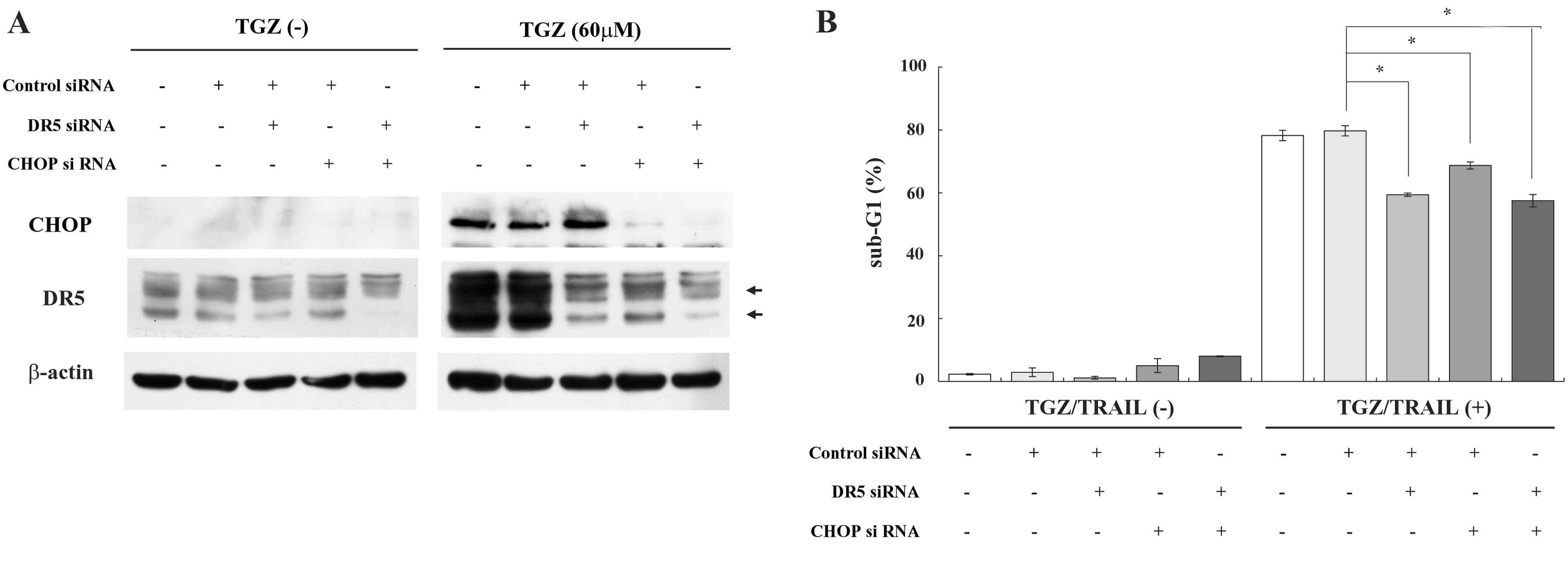
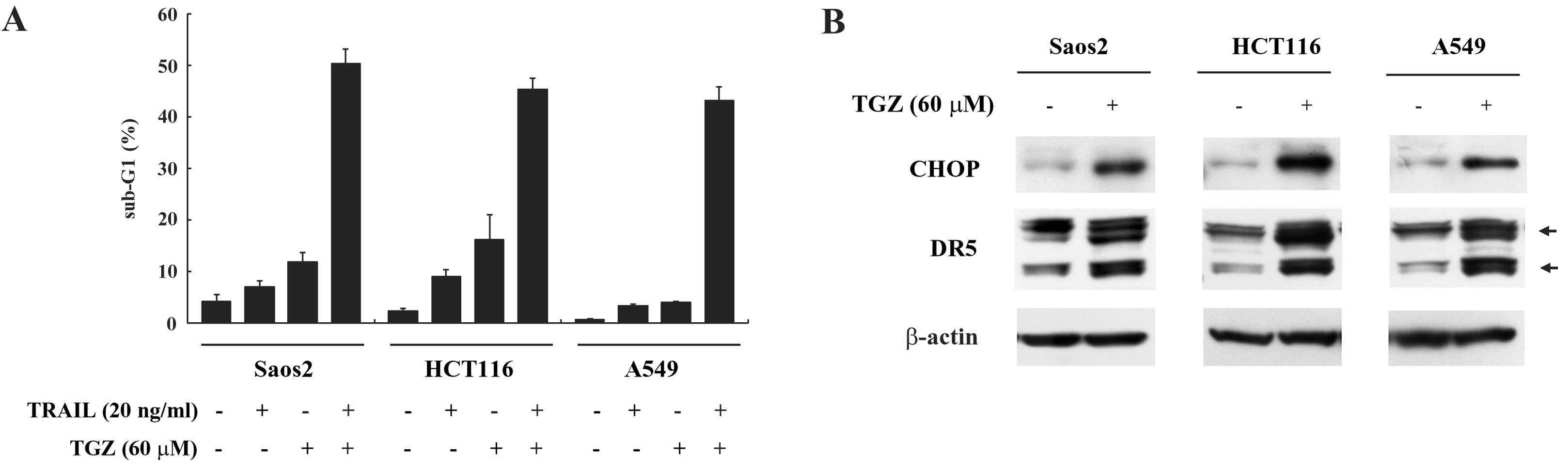
Tumor necrosis factor-related apoptosis-inducing ligand (TRAIL) is known to cause apoptosis in several types of malignant tumor cells through its interaction with the death domain-containing receptor, death receptor 5 (DR5). In the present study, we showed that co-treatment with troglitazone (TGZ), a synthetic ligand of peroxisome proliferator-activated receptor γ (PPARγ), and TRAIL synergistically induced apoptosis through DR5 upregulation in human colon cancer DLD-1 cells. TGZ elevated DR5 expression at the promoter level through the CCAAT/enhancer-binding protein homologous protein (CHOP) binding site. These results suggest that combined treatment with TGZ and TRAIL may be promising as a new therapy against malignant tumors.
View Figures

Figure 1

Figure 2

Figure 3

Figure 4

Figure 5

Figure 6

View References

1 

Wiley SR, Schooley K, Smolak PJ, et al: Identification and characterization of a new member of the TNF family that induces apoptosis. Immunity. 3:673–682. 1995. View Article : Google Scholar : PubMed/NCBI

2 

Ashkenazi A, Pai RC, Fong S, et al: Safety and antitumor activity of recombinant soluble Apo2 ligand. J Clin Invest. 104:155–162. 1999. View Article : Google Scholar : PubMed/NCBI

3 

Keane MM, Ettenberg SA, Nau MM, Russell EK and Lipkowitz S: Chemotherapy augments TRAIL-induced apoptosis in breast cell lines. Cancer Res. 59:734–741. 1999.PubMed/NCBI

4 

Schow P, Hooley J, Sherwood S, et al: Differential hepatocyte toxicity of recombinant Apo2L/TRAIL versions. Nat Med. 7:383–385. 2001. View Article : Google Scholar : PubMed/NCBI

5 

Pan G, O’Rourke K, Chinnaiyan AM, et al: The receptor for the cytotoxic ligand TRAIL. Science. 276:111–113. 1997. View Article : Google Scholar : PubMed/NCBI

6 

Pan G, Ni J, Wei YF, Yu G, Gentz R and Dixit VM: An antagonist decoy receptor and a death domain-containing receptor for TRAIL. Science. 277:815–818. 1997. View Article : Google Scholar : PubMed/NCBI

7 

Wang S and El-Deiry WS: TRAIL and apoptosis induction by TNF-family death receptors. Oncogene. 22:8628–8633. 2003. View Article : Google Scholar : PubMed/NCBI

8 

Kelley RF, Totpal K, Lindstrom SH, et al: Receptor-selective mutants of apoptosis-inducing ligand 2/tumor necrosis factor-related apoptosis inducing ligand reveal a greater contribution of death receptor (DR) 5 than DR4 to apoptosis signaling. J Biol Chem. 280:2205–2212. 2005. View Article : Google Scholar

9 

Ichikawa K, Liu W, Zhao L, et al: Tumoricidal activity of a novel anti-human DR5 monoclonal antibody without hepatocyte cytotoxicity. Nat Med. 7:954–960. 2001. View Article : Google Scholar : PubMed/NCBI

10 

Koornstra JJ, Kleibeuker JH, van Geelen CM, et al: Expression of TRAIL (TNF-related apoptosis-inducing ligand) and its receptors in normal colonic mucosa, adenomas, and carcinomas. J Pathol. 200:327–335. 2003. View Article : Google Scholar : PubMed/NCBI

11 

Herbst RS, Eckhardt SG, Kurzrock R, et al: Phase I dose-escalation study of recombinant human Apo2L/TRAIL, a dual proapoptotic receptor agonist, in patients with advanced cancer. J Clin Oncol. 28:2839–2846. 2010. View Article : Google Scholar : PubMed/NCBI

12 

Tontonoz P, Hu E, Graves RA, Budavari AI and Spiegelman BM: mPPAR gamma 2: tissue-specific regulator of an adipocyte enhancer. Genes Dev. 8:1224–1234. 1994. View Article : Google Scholar : PubMed/NCBI

13 

Tontonoz P, Hu E and Spiegelman BM: Stimulation of adipogenesis in fibroblasts by PPARγ2, a lipid-activated transcription factor. Cell. 79:1147–1156. 1994.

14 

Chawla A, Schwarz EJ, Dimaculangan DD and Lazar MA: Peroxisome proliferator-activated receptor (PPAR) gamma: adipose-predominant expression and induction early in adipocyte differentiation. Endocrinology. 135:798–800. 1994.

15 

Fujiwara T, Yoshioka S, Yoshioka T, Ushiyama I and Horikoshi H: Characterization of new oral antidiabetic agent CS-045. Studies in KK and ob/ob mice and Zucker fatty rats. Diabetes. 37:1549–1558. 1988. View Article : Google Scholar : PubMed/NCBI

16 

Lehmann JM, Moore LB, Smith-Oliver TA, Wilkison WO, Willson TM and Kliewer SA: An antidiabetic thiazolidinedione is a high affinity ligand for peroxisome proliferator-activated receptor γ (PPARγ). J Biol Chem. 270:12953–12956. 1995.

17 

Kubota T, Koshizuka K, Williamson EA, et al: Ligand for peroxisome proliferator-activated receptor γ (troglitazone) has potent antitumor effect against human prostate cancer both in vitro and in vivo. Cancer Res. 58:3344–3352. 1998.

18 

Grommes C, Landreth GE and Heneka MT: Antineoplastic effects of peroxisome proliferator-activated receptor γ agonists. Lancet Oncol. 5:419–429. 2004.

19 

Kulke MH, Demetri GD, Sharpless NE, et al: A phase II study of troglitazone, an activator of the PPARγ receptor, in patients with chemotherapy-resistant metastatic colorectal cancer. Cancer J. 8:395–399. 2002.PubMed/NCBI

20 

Burstein HJ, Demetri GD, Mueller E, Sarraf P, Spiegelman BM and Winer EP: Use of the peroxisome proliferator-activated receptor (PPAR) γ ligand troglitazone as treatment for refractory breast cancer: a phase II study. Breast Cancer Res Treat. 79:391–397. 2003.

21 

Xu C, Bailly-Maitre B and Reed JC: Endoplasmic reticulum stress: cell life and death decisions. J Clin Invest. 115:2656–2664. 2005. View Article : Google Scholar : PubMed/NCBI

22 

Oyadomari S and Mori M: Roles of CHOP/GADD153 in endoplasmic reticulum stress. Cell Death Differ. 11:381–389. 2004. View Article : Google Scholar : PubMed/NCBI

23 

Maniratanachote R, Minami K, Katoh M, Nakajima M and Yokoi T: Chaperone proteins involved in troglitazone-induced toxicity in human hepatoma cell lines. Toxicol Sci. 83:293–302. 2005. View Article : Google Scholar : PubMed/NCBI

24 

Satoh T, Toyoda M, Hoshino H, et al: Activation of peroxisome proliferator-activated receptor-γ stimulates the growth arrest and DNA-damage inducible 153 gene in non-small cell lung carcinoma cells. Oncogene. 21:2171–2180. 2002.

25 

Koyama M, Matsuzaki Y, Yogosawa S, Hitomi T, Kawanaka M and Sakai T: ZD1839 induces p15INK4b and causes G1 arrest by inhibiting the mitogen-activated protein kinase/extracellular signal-regulated kinase pathway. Mol Cancer Ther. 6:1579–1587. 2007.PubMed/NCBI

26 

Koyama M, Izutani Y, Goda AE, et al: Histone deacetylase inhibitors and 15-deoxy-Δ12,14-prostaglandin J2 synergistically induce apoptosis. Clin Cancer Res. 16:2320–2332. 2010.

27 

Elstner E, Müller C, Koshizuka K, et al: Ligands for peroxisome proliferator-activated receptor γ and retinoic acid receptor inhibit growth and induce apoptosis of human breast cancer cells in vitro and in BNX mice. Proc Natl Acad Sci USA. 95:8806–8811. 1998.

28 

Lu M, Kwan T, Yu C, et al: Peroxisome proliferator-activated receptor γ agonists promote TRAIL-induced apoptosis by reducing survivin levels via cyclin D3 repression and cell cycle arrest. J Biol Chem. 280:6742–6751. 2005.

29 

Ubeda M and Habener JF: CHOP gene expression in response to endoplasmic-reticular stress requires NFY interaction with different domains of a conserved DNA-binding element. Nucleic Acids Res. 28:4987–4997. 2000. View Article : Google Scholar : PubMed/NCBI

30 

Walczak H, Degli-Esposti MA, Johnson RS, et al: Cloning and characterization of TRAIL-R3, a novel member of the emerging TRAIL receptor family. J Exp Med. 186:1165–1170. 1997. View Article : Google Scholar : PubMed/NCBI

31 

Degli-Esposti MA, Dougall WC, Smolak PJ, Waugh JY, Smith CA and Goodwin RG: The novel receptor TRAIL-R4 induces NF-κB and protects against TRAIL-mediated apoptosis, yet retains an incomplete death domain. Immunity. 7:813–820. 1997.

32 

Emery JG, McDonnell P, Burke MB, et al: Osteoprotegerin is a receptor for the cytotoxic ligand TRAIL. J Biol Chem. 273:14363–14367. 1998. View Article : Google Scholar : PubMed/NCBI

33 

Mitsiades N, Poulaki V, Mitsiades C and Tsokos M: Ewing’s sarcoma family tumors are sensitive to tumor necrosis factor-related apoptosis-inducing ligand and express death receptor 4 and death receptor 5. Cancer Res. 61:2704–2712. 2001.

34 

Jang YJ, Park KS, Chung HY and Kim HI: Analysis of the phenotypes of Jurkat clones with different TRAIL-sensitivities. Cancer Lett. 194:107–117. 2003. View Article : Google Scholar : PubMed/NCBI

35 

Hellwig CT and Rehm M: TRAIL signaling and synergy mechanisms used in TRAIL-based combination therapies. Mol Cancer Ther. 11:3–13. 2012. View Article : Google Scholar : PubMed/NCBI

36 

Yee L, Fanale M, Dimick K, et al: A Phase IB safety and pharmacokinetic (PK) study of recombinant human Apo2L/TRAIL in combination with rituximab in patients with low-grade non-Hodgkin’s lymphoma. J Clin Oncol. 25:S4602007.

37 

Soria JC, Smit E, Khayat D, et al: Phase 1b study of dulanermin (recombinant human Apo2L/TRAIL) in combination with paclitaxel, carboplatin, and bevacizumab in patients with advanced non-squamous non-small-cell lung cancer. J Clin Oncol. 28:1527–1533. 2010. View Article : Google Scholar : PubMed/NCBI

38 

Soria JC, Márk Z, Zatloukal P, et al: Randomized phase II study of dulanermin in combination with paclitaxel, carboplatin, and bevacizumab in advanced non-small-cell lung cancer. J Clin Oncol. 29:4442–4451. 2011. View Article : Google Scholar : PubMed/NCBI

39 

Yoshida T, Shiraishi T, Nakata S, et al: Proteasome inhibitor MG132 induces death receptor 5 through CCAAT/enhancer-binding protein homologous protein. Cancer Res. 65:5662–5667. 2005. View Article : Google Scholar

40 

Shiraishi T, Yoshida T, Nakata S, et al: Tunicamycin enhances tumor necrosis factor-related apoptosis-inducing ligand-induced apoptosis in human prostate cancer cells. Cancer Res. 65:6364–6370. 2005. View Article : Google Scholar

41 

Gitlin N, Julie NL, Spurr CL, Lim KN and Juarbe HM: Two cases of severe clinical and histologic hepatotoxicity associated with troglitazone. Ann Intern Med. 129:36–38. 1998. View Article : Google Scholar : PubMed/NCBI

42 

Scheen AJ: Thiazolidinediones and liver toxicity. Diabetes Metab. 27:305–313. 2001.PubMed/NCBI

Related Articles

  • Abstract
  • View
  • Download
  • Twitter
Copy and paste a formatted citation
Spandidos Publications style
Koyama M, Sowa Y, Horinaka M, Goda AE, Fujiwara J and Sakai T: Peroxisome proliferator-activated receptor γ ligand troglitazone and TRAIL synergistically induce apoptosis. Oncol Rep 31: 947-954, 2014.
APA
Koyama, M., Sowa, Y., Horinaka, M., Goda, A.E., Fujiwara, J., & Sakai, T. (2014). Peroxisome proliferator-activated receptor γ ligand troglitazone and TRAIL synergistically induce apoptosis. Oncology Reports, 31, 947-954. https://doi.org/10.3892/or.2013.2868
MLA
Koyama, M., Sowa, Y., Horinaka, M., Goda, A. E., Fujiwara, J., Sakai, T."Peroxisome proliferator-activated receptor γ ligand troglitazone and TRAIL synergistically induce apoptosis". Oncology Reports 31.2 (2014): 947-954.
Chicago
Koyama, M., Sowa, Y., Horinaka, M., Goda, A. E., Fujiwara, J., Sakai, T."Peroxisome proliferator-activated receptor γ ligand troglitazone and TRAIL synergistically induce apoptosis". Oncology Reports 31, no. 2 (2014): 947-954. https://doi.org/10.3892/or.2013.2868
Copy and paste a formatted citation
x
Spandidos Publications style
Koyama M, Sowa Y, Horinaka M, Goda AE, Fujiwara J and Sakai T: Peroxisome proliferator-activated receptor γ ligand troglitazone and TRAIL synergistically induce apoptosis. Oncol Rep 31: 947-954, 2014.
APA
Koyama, M., Sowa, Y., Horinaka, M., Goda, A.E., Fujiwara, J., & Sakai, T. (2014). Peroxisome proliferator-activated receptor γ ligand troglitazone and TRAIL synergistically induce apoptosis. Oncology Reports, 31, 947-954. https://doi.org/10.3892/or.2013.2868
MLA
Koyama, M., Sowa, Y., Horinaka, M., Goda, A. E., Fujiwara, J., Sakai, T."Peroxisome proliferator-activated receptor γ ligand troglitazone and TRAIL synergistically induce apoptosis". Oncology Reports 31.2 (2014): 947-954.
Chicago
Koyama, M., Sowa, Y., Horinaka, M., Goda, A. E., Fujiwara, J., Sakai, T."Peroxisome proliferator-activated receptor γ ligand troglitazone and TRAIL synergistically induce apoptosis". Oncology Reports 31, no. 2 (2014): 947-954. https://doi.org/10.3892/or.2013.2868
Follow us
  • Twitter
  • LinkedIn
  • Facebook
About
  • Spandidos Publications
  • Careers
  • Cookie Policy
  • Privacy Policy
How can we help?
  • Help
  • Live Chat
  • Contact
  • Email to our Support Team