Spandidos Publications Logo
  • About
    • About Spandidos
    • Aims and Scopes
    • Abstracting and Indexing
    • Editorial Policies
    • Reprints and Permissions
    • Job Opportunities
    • Terms and Conditions
    • Contact
  • Journals
    • All Journals
    • Oncology Letters
      • Oncology Letters
      • Information for Authors
      • Editorial Policies
      • Editorial Board
      • Aims and Scope
      • Abstracting and Indexing
      • Bibliographic Information
      • Archive
    • International Journal of Oncology
      • International Journal of Oncology
      • Information for Authors
      • Editorial Policies
      • Editorial Board
      • Aims and Scope
      • Abstracting and Indexing
      • Bibliographic Information
      • Archive
    • Molecular and Clinical Oncology
      • Molecular and Clinical Oncology
      • Information for Authors
      • Editorial Policies
      • Editorial Board
      • Aims and Scope
      • Abstracting and Indexing
      • Bibliographic Information
      • Archive
    • Experimental and Therapeutic Medicine
      • Experimental and Therapeutic Medicine
      • Information for Authors
      • Editorial Policies
      • Editorial Board
      • Aims and Scope
      • Abstracting and Indexing
      • Bibliographic Information
      • Archive
    • International Journal of Molecular Medicine
      • International Journal of Molecular Medicine
      • Information for Authors
      • Editorial Policies
      • Editorial Board
      • Aims and Scope
      • Abstracting and Indexing
      • Bibliographic Information
      • Archive
    • Biomedical Reports
      • Biomedical Reports
      • Information for Authors
      • Editorial Policies
      • Editorial Board
      • Aims and Scope
      • Abstracting and Indexing
      • Bibliographic Information
      • Archive
    • Oncology Reports
      • Oncology Reports
      • Information for Authors
      • Editorial Policies
      • Editorial Board
      • Aims and Scope
      • Abstracting and Indexing
      • Bibliographic Information
      • Archive
    • Molecular Medicine Reports
      • Molecular Medicine Reports
      • Information for Authors
      • Editorial Policies
      • Editorial Board
      • Aims and Scope
      • Abstracting and Indexing
      • Bibliographic Information
      • Archive
    • World Academy of Sciences Journal
      • World Academy of Sciences Journal
      • Information for Authors
      • Editorial Policies
      • Editorial Board
      • Aims and Scope
      • Abstracting and Indexing
      • Bibliographic Information
      • Archive
    • International Journal of Functional Nutrition
      • International Journal of Functional Nutrition
      • Information for Authors
      • Editorial Policies
      • Editorial Board
      • Aims and Scope
      • Abstracting and Indexing
      • Bibliographic Information
      • Archive
    • International Journal of Epigenetics
      • International Journal of Epigenetics
      • Information for Authors
      • Editorial Policies
      • Editorial Board
      • Aims and Scope
      • Abstracting and Indexing
      • Bibliographic Information
      • Archive
    • Medicine International
      • Medicine International
      • Information for Authors
      • Editorial Policies
      • Editorial Board
      • Aims and Scope
      • Abstracting and Indexing
      • Bibliographic Information
      • Archive
  • Articles
  • Information
    • Information for Authors
    • Information for Reviewers
    • Information for Librarians
    • Information for Advertisers
    • Conferences
  • Language Editing
Spandidos Publications Logo
  • About
    • About Spandidos
    • Aims and Scopes
    • Abstracting and Indexing
    • Editorial Policies
    • Reprints and Permissions
    • Job Opportunities
    • Terms and Conditions
    • Contact
  • Journals
    • All Journals
    • Biomedical Reports
      • Information for Authors
      • Editorial Policies
      • Editorial Board
      • Aims and Scope
      • Abstracting and Indexing
      • Bibliographic Information
      • Archive
    • Experimental and Therapeutic Medicine
      • Information for Authors
      • Editorial Policies
      • Editorial Board
      • Aims and Scope
      • Abstracting and Indexing
      • Bibliographic Information
      • Archive
    • International Journal of Epigenetics
      • Information for Authors
      • Editorial Policies
      • Editorial Board
      • Aims and Scope
      • Abstracting and Indexing
      • Bibliographic Information
      • Archive
    • International Journal of Functional Nutrition
      • Information for Authors
      • Editorial Policies
      • Editorial Board
      • Aims and Scope
      • Abstracting and Indexing
      • Bibliographic Information
      • Archive
    • International Journal of Molecular Medicine
      • Information for Authors
      • Editorial Policies
      • Editorial Board
      • Aims and Scope
      • Abstracting and Indexing
      • Bibliographic Information
      • Archive
    • International Journal of Oncology
      • Information for Authors
      • Editorial Policies
      • Editorial Board
      • Aims and Scope
      • Abstracting and Indexing
      • Bibliographic Information
      • Archive
    • Medicine International
      • Information for Authors
      • Editorial Policies
      • Editorial Board
      • Aims and Scope
      • Abstracting and Indexing
      • Bibliographic Information
      • Archive
    • Molecular and Clinical Oncology
      • Information for Authors
      • Editorial Policies
      • Editorial Board
      • Aims and Scope
      • Abstracting and Indexing
      • Bibliographic Information
      • Archive
    • Molecular Medicine Reports
      • Information for Authors
      • Editorial Policies
      • Editorial Board
      • Aims and Scope
      • Abstracting and Indexing
      • Bibliographic Information
      • Archive
    • Oncology Letters
      • Information for Authors
      • Editorial Policies
      • Editorial Board
      • Aims and Scope
      • Abstracting and Indexing
      • Bibliographic Information
      • Archive
    • Oncology Reports
      • Information for Authors
      • Editorial Policies
      • Editorial Board
      • Aims and Scope
      • Abstracting and Indexing
      • Bibliographic Information
      • Archive
    • World Academy of Sciences Journal
      • Information for Authors
      • Editorial Policies
      • Editorial Board
      • Aims and Scope
      • Abstracting and Indexing
      • Bibliographic Information
      • Archive
  • Articles
  • Information
    • For Authors
    • For Reviewers
    • For Librarians
    • For Advertisers
    • Conferences
  • Language Editing
Login Register Submit
  • This site uses cookies
  • You can change your cookie settings at any time by following the instructions in our Cookie Policy. To find out more, you may read our Privacy Policy.

    I agree
Search articles by DOI, keyword, author or affiliation
Search
Advanced Search
presentation
Oncology Reports
Join Editorial Board Propose a Special Issue
Print ISSN: 1021-335X Online ISSN: 1791-2431
Journal Cover
May-2014 Volume 31 Issue 5

Full Size Image

Sign up for eToc alerts
Recommend to Library

Journals

International Journal of Molecular Medicine

International Journal of Molecular Medicine

International Journal of Molecular Medicine is an international journal devoted to molecular mechanisms of human disease.

International Journal of Oncology

International Journal of Oncology

International Journal of Oncology is an international journal devoted to oncology research and cancer treatment.

Molecular Medicine Reports

Molecular Medicine Reports

Covers molecular medicine topics such as pharmacology, pathology, genetics, neuroscience, infectious diseases, molecular cardiology, and molecular surgery.

Oncology Reports

Oncology Reports

Oncology Reports is an international journal devoted to fundamental and applied research in Oncology.

Experimental and Therapeutic Medicine

Experimental and Therapeutic Medicine

Experimental and Therapeutic Medicine is an international journal devoted to laboratory and clinical medicine.

Oncology Letters

Oncology Letters

Oncology Letters is an international journal devoted to Experimental and Clinical Oncology.

Biomedical Reports

Biomedical Reports

Explores a wide range of biological and medical fields, including pharmacology, genetics, microbiology, neuroscience, and molecular cardiology.

Molecular and Clinical Oncology

Molecular and Clinical Oncology

International journal addressing all aspects of oncology research, from tumorigenesis and oncogenes to chemotherapy and metastasis.

World Academy of Sciences Journal

World Academy of Sciences Journal

Multidisciplinary open-access journal spanning biochemistry, genetics, neuroscience, environmental health, and synthetic biology.

International Journal of Functional Nutrition

International Journal of Functional Nutrition

Open-access journal combining biochemistry, pharmacology, immunology, and genetics to advance health through functional nutrition.

International Journal of Epigenetics

International Journal of Epigenetics

Publishes open-access research on using epigenetics to advance understanding and treatment of human disease.

Medicine International

Medicine International

An International Open Access Journal Devoted to General Medicine.

Journal Cover
May-2014 Volume 31 Issue 5

Full Size Image

Sign up for eToc alerts
Recommend to Library

  • Article
  • Citations
    • Cite This Article
    • Download Citation
    • Create Citation Alert
    • Remove Citation Alert
    • Cited By
  • Similar Articles
    • Related Articles (in Spandidos Publications)
    • Similar Articles (Google Scholar)
    • Similar Articles (PubMed)
  • Download PDF
  • Download XML
  • View XML
Article

Induction of apoptosis by diphenyldifluoroketone in osteogenic sarcoma cells is associated with activation of caspases

  • Authors:
    • Seok-Jin Yang
    • Seul Ah Lee
    • Min-Gyeong Park
    • Jae-Sung Kim
    • Sun-Kyoung Yu
    • Chun Sung Kim
    • Jin-Soo Kim
    • Su-Gwan Kim
    • Ji-Su Oh
    • Heung-Joong Kim
    • Hong Sung Chun
    • Yong Hwan Kim
    • Do Kyung Kim
  • View Affiliations / Copyright

    Affiliations: Oral Biology Research Institute, Chosun University, Gwangju 501-75, Republic of Korea, Department of Biotechnology, Chosun University, Gwangju 501-759, Republic of Korea, Korea Institute of Planning and Evaluation for Technology in Food, Agriculture Forestry and Fisheries, Gyeonggi-do 431-810, Republic of Korea
  • Pages: 2286-2292
    |
    Published online on: March 6, 2014
       https://doi.org/10.3892/or.2014.3066
  • Expand metrics +
Metrics: Total Views: 0 (Spandidos Publications: | PMC Statistics: )
Metrics: Total PDF Downloads: 0 (Spandidos Publications: | PMC Statistics: )
Cited By (CrossRef): 0 citations Loading Articles...

This article is mentioned in:


Abstract

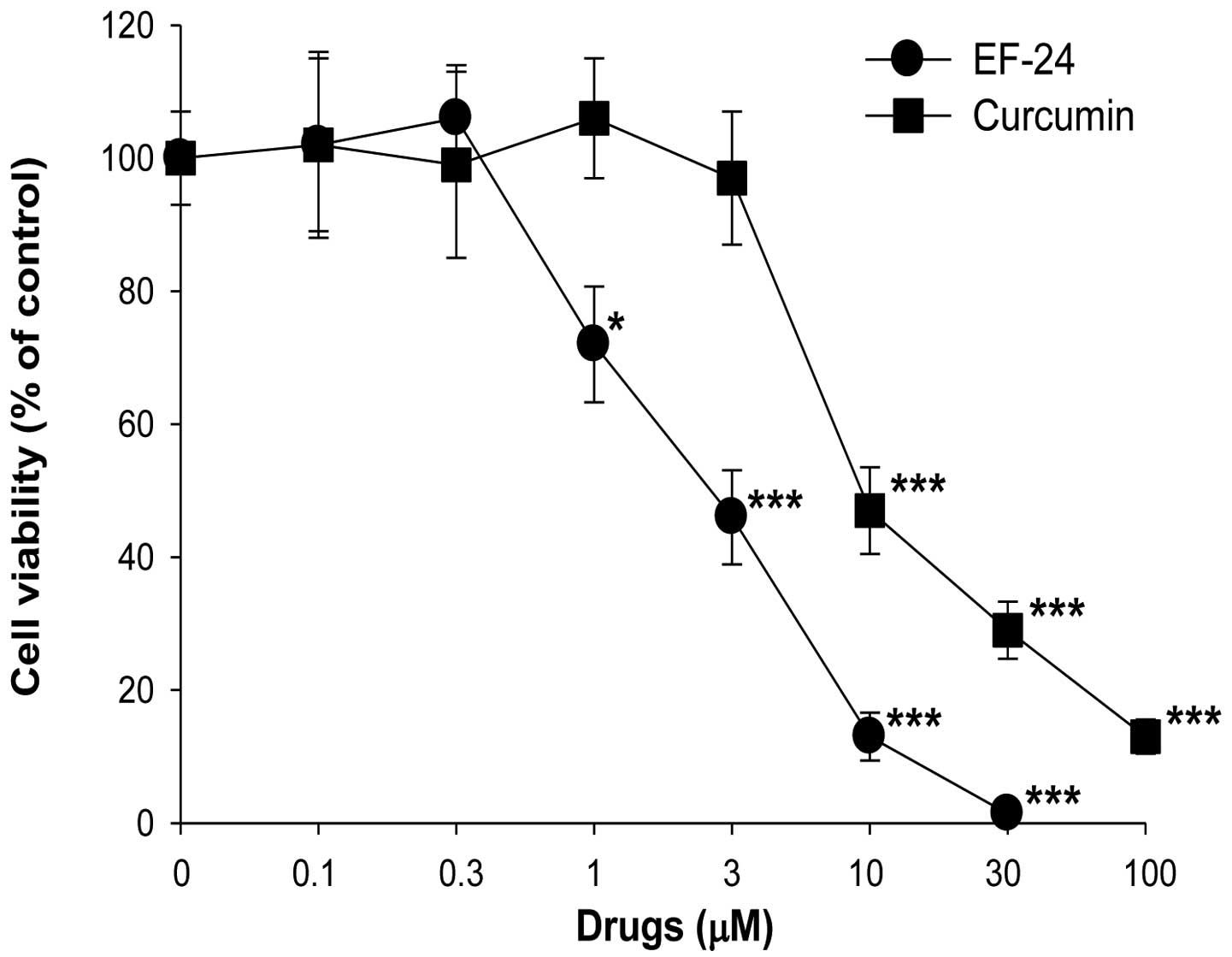
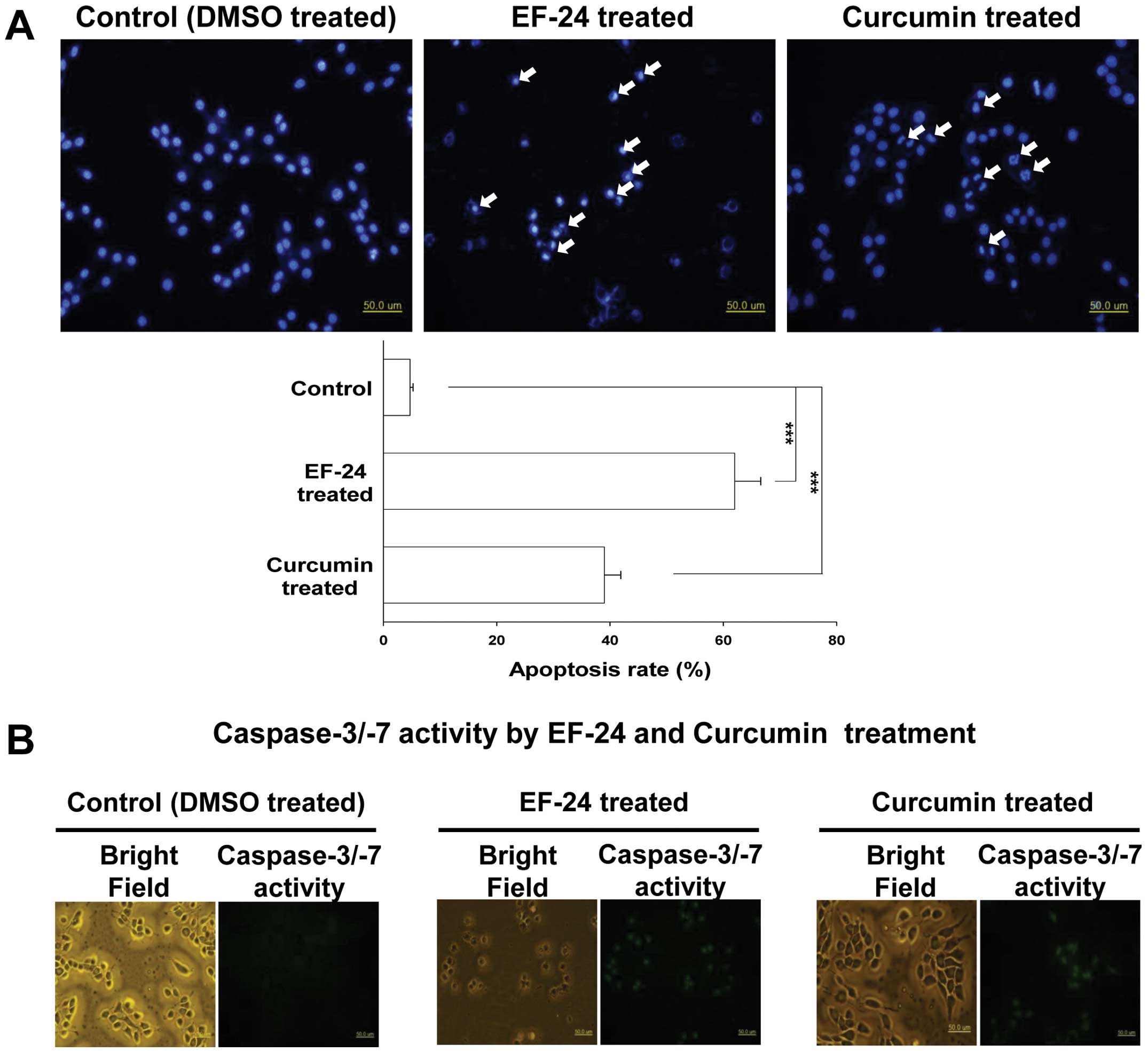
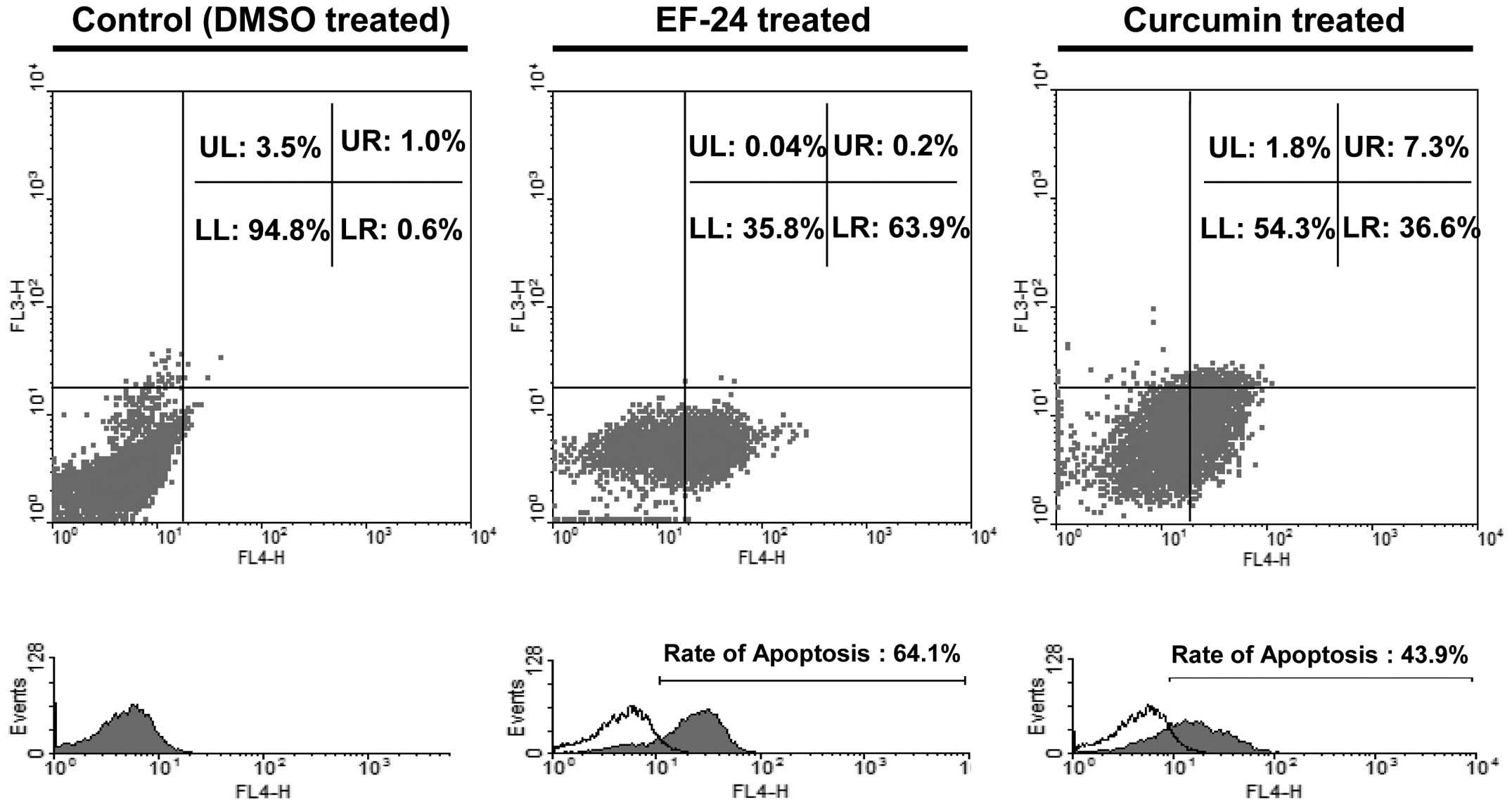
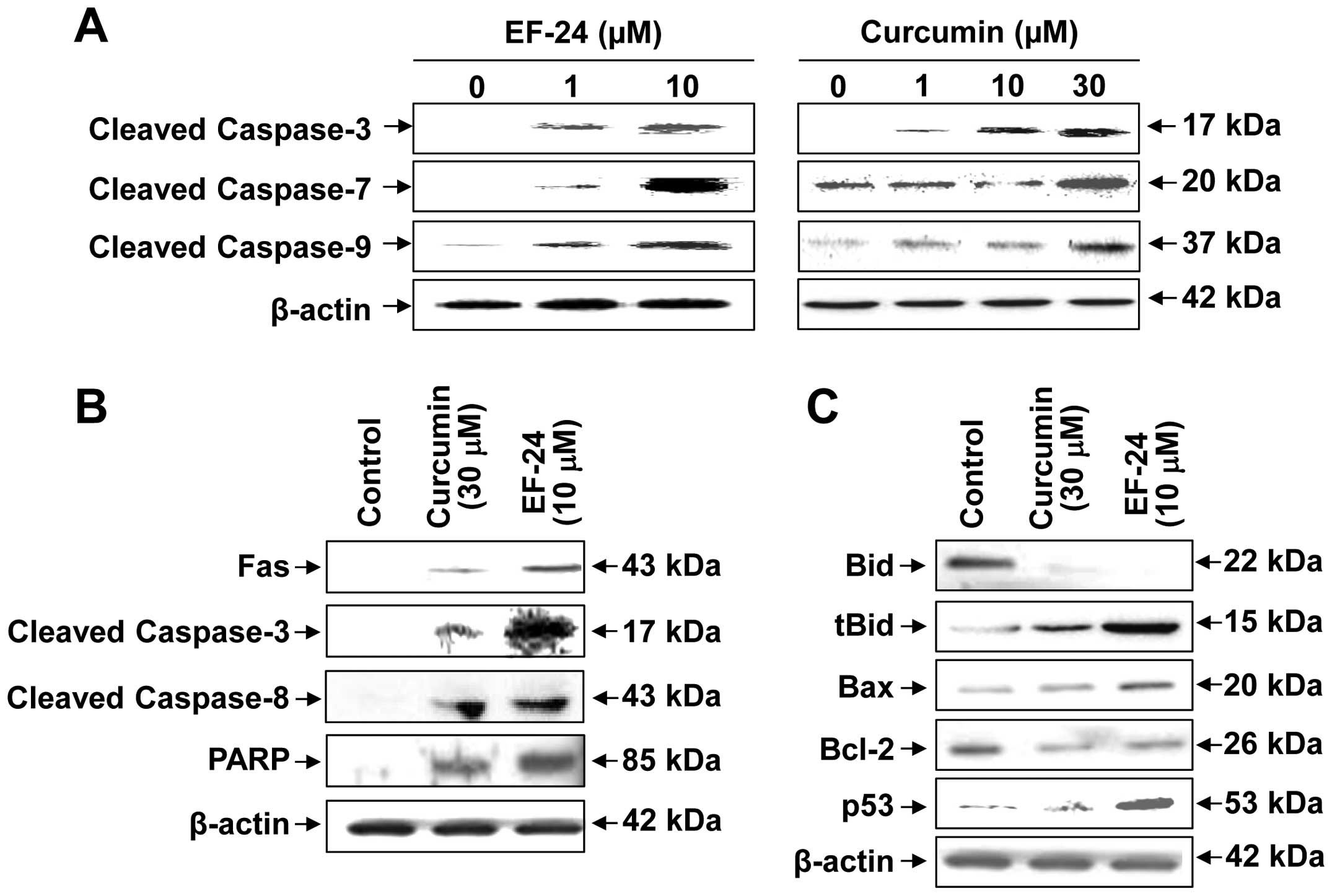
The aim of the present study was to investigate and compare the effects of diferuloylmethane (curcumin) and diphenyldifluoroketone (EF-24) on cell growth and apoptosis induction in human osteogenic sarcoma cells. This was examined by MTT assay, nuclear DAPI staining, caspase-activation assay, flow cytometry analysis and immunoblotting in Saos2 human osteogenic sarcoma cells. Curcumin and EF-24 inhibited the growth of Saos2 cells in a dose-dependent manner. The apparent potency of EF-24 was more than 3-fold higher that of curcumin. Treatment with curcumin or EF-24 resulted in nuclear condensation and fragmentation in the cells. The caspase-3/-7 activities were detected in living cells treated with curcumin or EF-24. Flow cytometry showed that the rate of apoptosis was increased by curcumin and EF-24 compared to the control. Curcumin and EF-24 promoted the proteolytic cleavages of procaspase-3/-7/-8/-9 with increases in the amount of cleaved caspase-3/-7/-8/-9. The curcumin- or EF-24-induced apoptosis in the Saos2 cells was mediated by the expression of Fas and activation of caspase-8, caspase-3 and poly(ADP-ribose) polymerase. Immunoblotting revealed the Bid and Bcl-2 proteins to be downregulated, and truncated-Bid, Bax and p53 proteins to be upregulated by curcumin and EF-24. Curcumin and EF-24 increased the Bax/Bcl-2 ratio significantly. These results suggest that the curcumin and EF-24 inhibit cell proliferation and induce apoptotic cell death in Saos2 human osteogenic sarcoma cells via both the mitochondria-mediated intrinsic pathway and the death receptor-mediated extrinsic pathway, and may have potential properties for anti-osteosarcoma drug discovery.
View Figures

Figure 1

Figure 2

Figure 3

Figure 4

View References

1 

Daiy H, Huangy Y, Li Y, Meng G, Wang Y and Guo QN: TSSC3 overexpression associates with growth inhibition, apoptosis induction and enhances chemotherapeutic effects in human osteosarcoma. Carcinogenesis. 33:30–40. 2012. View Article : Google Scholar : PubMed/NCBI

2 

Fuchs B and Pritchard DJ: Etiology of osteosarcoma. Clin Orthop Relat Res. 397:40–52. 2002. View Article : Google Scholar

3 

Gibbs CP Jr, Weber K and Scarborough MT: Malignant bone tumors. Instr Course Lect. 51:413–428. 2002.

4 

Zhao Q, Wang C, Zhu J, Wang L, Dong S, Zhang G and Tian J: RNAi-mediated knockdown of cyclooxygenase2 inhibits the growth, invasion and migration of Saos2 human osteosarcoma cells: a case control study. J Exp Clin Cancer Res. 30:262011. View Article : Google Scholar : PubMed/NCBI

5 

Mukherjee AK, Basu S, Sarkar N and Ghosh AC: Advances in cancer therapy with plant based natural products. Curr Med Chem. 8:1467–1486. 2001. View Article : Google Scholar : PubMed/NCBI

6 

Smets LA: Programmed cell death (apoptosis) and response to anti-cancer drugs. Anticancer Drugs. 5:3–9. 1994. View Article : Google Scholar : PubMed/NCBI

7 

Paschka AG, Butler R and Young CYF: Induction of apoptosis in prostate cancer cell lines by the green tea component, (−)-epigallocatechin-3-gallate. Cancer Lett. 130:1–7. 1998.

8 

Kaufmann SH and Hengartner MO: Programmed cell death: alive and well in the new millennium. Trends Cell Biol. 11:526–534. 2001. View Article : Google Scholar : PubMed/NCBI

9 

Kaufmann SH and Earnshaw WC: Induction of apoptosis by cancer chemotherapy. Exp Cell Res. 256:42–49. 2000. View Article : Google Scholar : PubMed/NCBI

10 

Reed JC: Apoptosis-regulating proteins as targets for drug discovery. Trends Mol Med. 7:314–319. 2001. View Article : Google Scholar : PubMed/NCBI

11 

Banerjee M, Tripathi LM, Srivastava VM, Puri A and Shukla R: Modulation of inflammatory mediators by profen and curcumin treatment during chronic inflammation in rat. Immunopharmacol Immunotoxicol. 25:213–224. 2003. View Article : Google Scholar : PubMed/NCBI

12 

Sahu RP, Batra1 S and Srivastava SK: Activation of ATM/Chk1 by curcumin causes cell cycle arrest and apoptosis in human pancreatic cancer cells. Br J Cancer. 100:1425–1433. 2009. View Article : Google Scholar : PubMed/NCBI

13 

Wahl H, Tan L, Griffith K, Choi M and Liu JR: Curcumin enhances Apo2L/TRAIL-induced apoptosis in chemoresistant ovarian cancer cells. Gynecol Oncol. 105:104–112. 2007. View Article : Google Scholar : PubMed/NCBI

14 

Goel A, Kunnumakkara AB and Aggarwal BB: Curcumin as ‘Curecumin’: from kitchen to clinic. Biochem Pharmacol. 75:787–809. 2008.

15 

Anand P, Kunnumakkara AB, Newman RA and Aggarwal BB: Bioavailability of curcumin: problems and promises. Mol Pharm. 4:807–818. 2007. View Article : Google Scholar : PubMed/NCBI

16 

Adams BK, Cai J, Armstrong J, et al: EF24, a novel synthetic curcumin analog, induces apoptosis in cancer cells via a redox-dependent mechanism. Anticancer Drugs. 16:263–275. 2005. View Article : Google Scholar : PubMed/NCBI

17 

Komatsu M, Kuroda M, Wang Y, et al: Manganese superoxide dismutase overexpression changes plating efficiency bidirectionally according to change in redox for SaOS2 human osteosarcoma cell line. Int J Oncol. 26:853–862. 2005.

18 

Kim SG, Kim HH, Kim HK, et al: Differential expression and functional characterization of system L amino acid transporters in human normal osteoblast cells and osteogenic sarcoma cells. Anticancer Res. 26:1989–1996. 2006.

19 

Hu W and Kavanagh JJ: Anticancer therapy targeting the apoptotic pathway. Lancet Oncol. 4:721–729. 2003. View Article : Google Scholar : PubMed/NCBI

20 

Herrnring C, Reimer T, Jeschke U, et al: Expression of the apoptosis-inducing ligands FasL and TRAIL in malignant and benign human breast tumors. Histochem Cell Biol. 113:189–194. 2000. View Article : Google Scholar : PubMed/NCBI

21 

Li HJ, Wang CY, Mi Y, et al: FasL-induced apoptosis in bovine oocytes via the Bax signal. Theriogenology. 80:248–255. 2013. View Article : Google Scholar : PubMed/NCBI

22 

Cheng YL, Lee SC, Lin SZ, et al: Anti-proliferative activity of Bupleurum scrozonerifolium in A549 human lung cancer cells in vitro and in vivo. Cancer Lett. 222:183–193. 2005.PubMed/NCBI

23 

Tian Z, Chen S, Zhang Y, et al: The cytotoxicity of naturally occurring styryl lactones. Phytomedicine. 13:181–186. 2006. View Article : Google Scholar : PubMed/NCBI

24 

Hauser PJ, Han Z, Sindhwani P and Hurst RE: Sensitivity of bladder cancer cells to curcumin and its derivatives depends on the extracellular matrix. Anticancer Res. 27:737–740. 2007.PubMed/NCBI

25 

Kikuchi T, Pan X, Ishii K, et al: Cytotoxic and apoptosis-inducing activities of 12-O-Acetylazedarachin B from the fruits of Melia azedarach in human cancer cell lines. Biol Pharm Bull. 36:135–139. 2013.PubMed/NCBI

26 

Martin SJ, Reutelingsperger CP, McGahon AJ, Rader JA, van Schie RCAA, LaFace DM and Green DR: Early redistribution of plasma membrane phosphatidylserine is a general feature of apoptosis regardless of the initiating stimulus: inhibition by overexpression of Bcl-2 and Abl. J Exp Med. 182:1545–1556. 1995. View Article : Google Scholar

27 

Liu X, Zou H, Slaughter C and Wang X: DFF, a heterodimeric protein that functions downstream of caspase-3 to trigger DNA fragmentation during apoptosis. Cell. 89:175–184. 1997. View Article : Google Scholar : PubMed/NCBI

28 

Ryu DS, Lee HS, Lee GS and Lee DS: Effects of the ethylacetate extract of Orostachys japonicus on induction of apoptosis through the p53-mediated signaling pathway in human gastric cancer cells. Biol Pharm Bull. 35:660–665. 2012.PubMed/NCBI

29 

Lavin MF and Gueven N: The complexity of p53 stabilization and activation. Cell Death Differ. 13:941–950. 2006. View Article : Google Scholar : PubMed/NCBI

30 

Heath-Engel HM, Chang NC and Shore GC: The endoplasmic reticulum in apoptosis and autophagy: role of the BCL-2 protein family. Oncogene. 27:6419–6433. 2008. View Article : Google Scholar : PubMed/NCBI

31 

Fisher DE: The p53 tumor suppressor: critical regulator of life & death in cancer. Apoptosis. 6:7–15. 2001. View Article : Google Scholar

32 

Kluck RM, Bossy-Wetzel E, Green DR and Newmeyer DD: The release of cytochrome c from mitochondria: a primary site for Bcl-2 regulation of apoptosis. Science. 275:1132–1136. 1997. View Article : Google Scholar : PubMed/NCBI

33 

Kluck RM, Esposti MD, Perkins G, et al: The pro-apoptotic proteins, Bid and Bax, cause a limited permeabilization of the mitochondrial outer membrane that is enhanced by cytosol. J Cell Biol. 147:809–822. 1999. View Article : Google Scholar : PubMed/NCBI

34 

Yu CS, Huang AC, Lai KC, Huang YP, Lin MW, Yang JS and Chung JG: Diallyl trisulfide induces apoptosis in human primary colorectal cancer cells. Oncol Rep. 28:949–954. 2012.PubMed/NCBI

35 

Luo X, Budihardjo I, Zou H, Slaughter C and Wang X: Bid, a Bcl2 interacting protein, mediates cytochrome c release from mitochondria in response to activation of cell surface death receptors. Cell. 94:481–490. 1998. View Article : Google Scholar : PubMed/NCBI

36 

Oltvai ZN, Milliman CL and Korsmeyer SJ: Bcl-2 heterodimerizes in vivo with a conserved homolog, Bax, that accelerates programmed cell death. Cell. 74:609–619. 1993. View Article : Google Scholar : PubMed/NCBI

Related Articles

  • Abstract
  • View
  • Download
  • Twitter
Copy and paste a formatted citation
Spandidos Publications style
Yang S, Lee SA, Park M, Kim J, Yu S, Kim CS, Kim J, Kim S, Oh J, Kim H, Kim H, et al: Induction of apoptosis by diphenyldifluoroketone in osteogenic sarcoma cells is associated with activation of caspases. Oncol Rep 31: 2286-2292, 2014.
APA
Yang, S., Lee, S.A., Park, M., Kim, J., Yu, S., Kim, C.S. ... Kim, D.K. (2014). Induction of apoptosis by diphenyldifluoroketone in osteogenic sarcoma cells is associated with activation of caspases. Oncology Reports, 31, 2286-2292. https://doi.org/10.3892/or.2014.3066
MLA
Yang, S., Lee, S. A., Park, M., Kim, J., Yu, S., Kim, C. S., Kim, J., Kim, S., Oh, J., Kim, H., Chun, H. S., Kim, Y. H., Kim, D. K."Induction of apoptosis by diphenyldifluoroketone in osteogenic sarcoma cells is associated with activation of caspases". Oncology Reports 31.5 (2014): 2286-2292.
Chicago
Yang, S., Lee, S. A., Park, M., Kim, J., Yu, S., Kim, C. S., Kim, J., Kim, S., Oh, J., Kim, H., Chun, H. S., Kim, Y. H., Kim, D. K."Induction of apoptosis by diphenyldifluoroketone in osteogenic sarcoma cells is associated with activation of caspases". Oncology Reports 31, no. 5 (2014): 2286-2292. https://doi.org/10.3892/or.2014.3066
Copy and paste a formatted citation
x
Spandidos Publications style
Yang S, Lee SA, Park M, Kim J, Yu S, Kim CS, Kim J, Kim S, Oh J, Kim H, Kim H, et al: Induction of apoptosis by diphenyldifluoroketone in osteogenic sarcoma cells is associated with activation of caspases. Oncol Rep 31: 2286-2292, 2014.
APA
Yang, S., Lee, S.A., Park, M., Kim, J., Yu, S., Kim, C.S. ... Kim, D.K. (2014). Induction of apoptosis by diphenyldifluoroketone in osteogenic sarcoma cells is associated with activation of caspases. Oncology Reports, 31, 2286-2292. https://doi.org/10.3892/or.2014.3066
MLA
Yang, S., Lee, S. A., Park, M., Kim, J., Yu, S., Kim, C. S., Kim, J., Kim, S., Oh, J., Kim, H., Chun, H. S., Kim, Y. H., Kim, D. K."Induction of apoptosis by diphenyldifluoroketone in osteogenic sarcoma cells is associated with activation of caspases". Oncology Reports 31.5 (2014): 2286-2292.
Chicago
Yang, S., Lee, S. A., Park, M., Kim, J., Yu, S., Kim, C. S., Kim, J., Kim, S., Oh, J., Kim, H., Chun, H. S., Kim, Y. H., Kim, D. K."Induction of apoptosis by diphenyldifluoroketone in osteogenic sarcoma cells is associated with activation of caspases". Oncology Reports 31, no. 5 (2014): 2286-2292. https://doi.org/10.3892/or.2014.3066
Follow us
  • Twitter
  • LinkedIn
  • Facebook
About
  • Spandidos Publications
  • Careers
  • Cookie Policy
  • Privacy Policy
How can we help?
  • Help
  • Live Chat
  • Contact
  • Email to our Support Team