Introduction
Various useful biomarkers for molecular targeted
drugs have recently been identified in advanced gastrointestinal
cancer chemotherapy. For example, human epidermal growth factor
receptor 2 (HER2) is involved in the pathogenesis and poor outcomes
of several cancer types, including advanced gastric cancer.
Molecular targeted drugs, such as trastuzumab, have been shown to
prolong overall survival and progression-free survival in
HER2-positive gastric cancer (1).
In colorectal cancer (CRC) chemotherapy, the Ras status is a very
useful biomarker for cetuximab and panitumumab treatment (2–13). The
discovery of such biomarkers has led to the advancement of
personalized medicine.
5-Fluorouracil (5-FU) is commonly used worldwide for
the treatment of various tumors and is a key drug in CRC treatment.
However, no useful biomarker is available to predict tumor response
to 5-FU treatment. Consequently, individualized therapy with 5-FU
is not available, despite extensive investigation on the
correlation between 5-FU metabolic enzymes and antitumor effects to
predict drug efficacy. Orotate phosphoribosyltransferase (OPRT)
mostly converts 5-FU into its active form in the first metabolizing
step, whereas dihydropyrimidine dehydrogenase (DPD) is the initial
enzyme of 5-FU catabolism. Additionally, these enzymes also convert
5-FU pro-drugs such as S-1 and capecitabine into their active or
inactive forms. Therefore, it is important to evaluate the
activities of these enzymes to better understand the antitumor
effects of 5-FU. Although there are several reports on the
correlation between these enzymes and response to 5-FU (14–23),
such a correlation has not been prospectively investigated in the
adjuvant chemotherapy setting.
In the present study, we aimed to prospectively
evaluate whether OPRT and DPD are predictive factors of 5-FU
response in patients with resectable CRC.
Patients and methods
Study population
Patients were enrolled in the present study based on
the following eligibility criteria: age of 18–75 years,
histologically confirmed colon adenocarcinoma after curative
surgery, Dukes’ clinical staging of B or C, Eastern Cooperative
Oncology Group performance status of 0–1, no prior chemotherapy or
radiotherapy, sufficient oral intake capability, and adequate major
organ function. Other exclusion criteria were the presence of
continuous double cancers and asynchronous multiple cancers.
Study design and treatment
The present investigation was designed as a
multicenter prospective cohort study, involving collaborative
efforts from 13 centers. All patients provided written informed
consent. The institutional review board or independent ethics
committees approved the study protocol at each center. The endpoint
of this study was the correlation between OPRT/DPD activity ratio
and 5-year disease-free survival (DFS) and overall survival (OS).
All patients underwent complete CRC resection without preoperative
chemotherapy. They subsequently received adjuvant chemotherapy with
5-FU/leucovorin (LV) regimens as follows: bolus 5-FU (333
mg/m2) and a 2-h infusion of LV (167 mg/m2)
on day 1 weekly for 6 consecutive weeks postoperatively.
Thereafter, the patients were treated with oral 5-FU tablets (200
mg/day) for 2 years. This treatment was changed to other
chemotherapy regimens when cancer recurrence was confirmed.
OPRT activity
A tissue sample weighing ~300 mg was obtained from
each resected tumor and immediately frozen and stored at −80°C
until radioassay for OPRT activity determination (24). Briefly, tissue samples were
homogenized and centrifuged to obtain the supernatant. The
supernatant was then mixed with an equal volume of a substrate
solution containing 100 mM Tris-HCl (pH 7.5), 100 mM
MgCl2, 10 mM phosphoribosyl pyrophosphate, 30 mM
2-glycerophosphate, 1.6 mM α,β-methylene adenosine diphosphate, and
8 mM [3H]-5-FU. The reaction was stopped at 0, 5, 10,
and 15 min after the addition of the substrate solution. The
reaction mixture was then centrifuged to remove unreacted
[3H]-5-FU. The reaction rate per minute was calculated
by measuring the production of 5-fluorouridine monophosphate over
time using a liquid scintillation counter.
DPD activity
A tissue sample weighing ~300 mg was obtained from
the resected tumor and immediately frozen and stored until
radioassay for DPD activity determination (25,26).
DPD activity was calculated by measuring the total production of
metabolites after [14C]-5-FU was added to the
homogenized tissue sample. These metabolites included
dihydrofluorouracil, 2-fluoro-β-ureidopropionate, and
α-fluoro-β-alanine. 5-FU and the metabolites were separated by
thin-layer chromatography.
Statistical analysis
The cut-off values for the OPRT/DPD ratio against
recurrence and death were calculated by using the maximal
χ2 statistic method (27,28).
Subsequently, patients were classified according to their OPRT/DPD
ratios into a group with ratios less than or equal to the cut-off
value and another group with ratios above this value. The Pearson’s
χ2 test was used to compare the recurrence and death
rates of the two cohorts. The OPRT/DPD ratio that yielded the
largest χ2 test result was selected as the optimal
cut-off value. The DFS and OS rates according to cut-off values of
OPRT and DPD activities were determined using Kaplan-Meier
analysis. The survival curves of the two cohorts, categorized by
cut-off values, were compared by the log-rank test. Cox’s
regression method was used for the multivariate analysis of
prognostic factors for DFS and OS. Data were analyzed using the
Statistical Package for the Social Sciences (SPSS) for Windows
version 21 (SPSS Inc., Chicago, IL, USA). A P-value <0.05 was
regarded as statistically significant.
Results
Patients
Sixty-eight patients were enrolled from July 2003 to
May 2005. Patient characteristics are summarized in Table I. The median follow-up period was
1925 days.
 | Table IDemography and baseline patient
characteristics. |
Table I
Demography and baseline patient
characteristics.
| Variables | Value |
|---|
| Number of patients
(n) | 68 |
| Age in years [mean
(range)] | 66 (35–75) |
| Gender
(male/female) | 42/26 |
| ECOG PS
(0/1/unknown) | 58/4/6 |
| Primary cancer site
(colon/rectum/unknown) | 40/24/4 |
| Dukes’ stage
(B/C/unknown) | 3/62/3 |
Enzyme activity
The enzyme activities and OPRT/DPD ratio are shown
in Table II.
| Table IIActivity of OPRT and DPD. |
Table II
Activity of OPRT and DPD.
| Variables | Mean | Range |
|---|
| OPRT (nmol/min/mg
protein) | 0.270 | 0.034–0.712 |
| DPD (pmol/min/mg
protein) | 36.5 | 6.0–156.0 |
| OPRT/DPD ratio | 0.01360 | 0.00082–0.057 |
Cut-off values
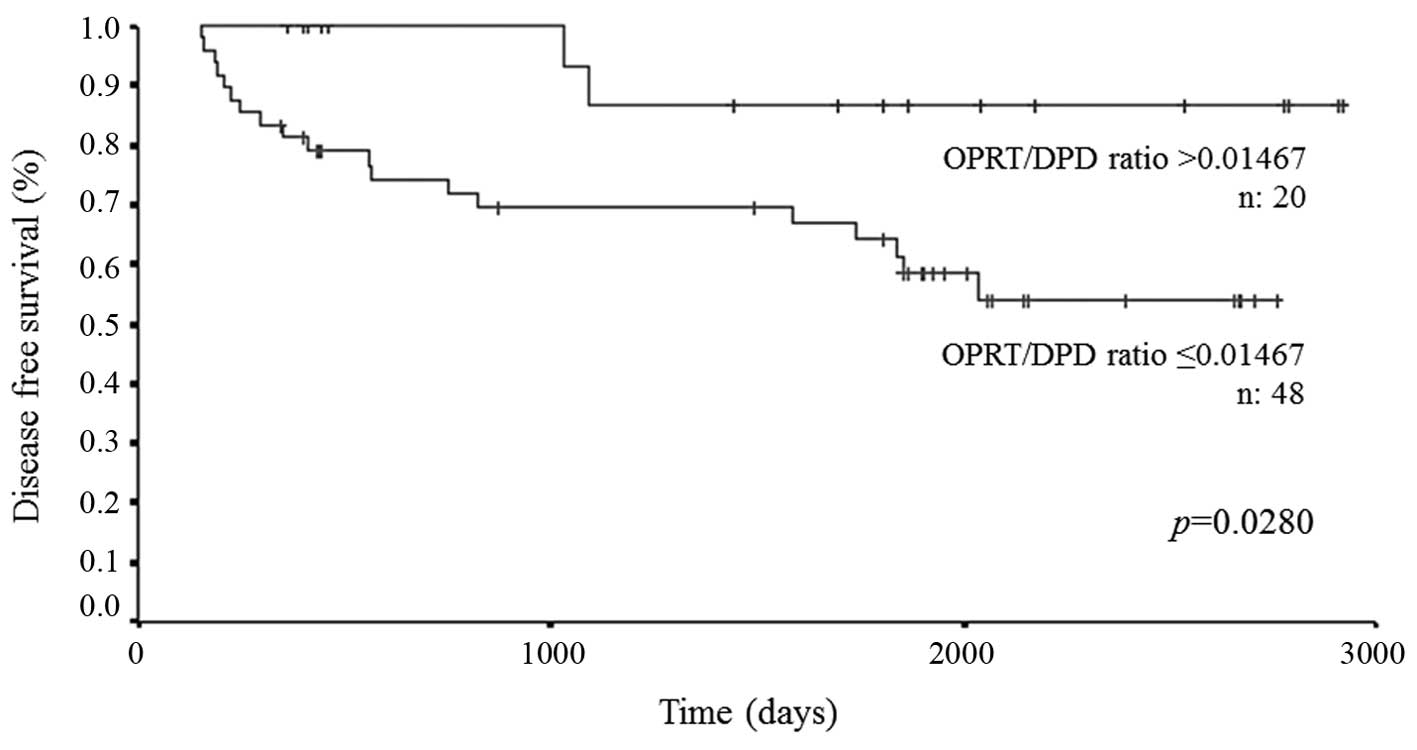
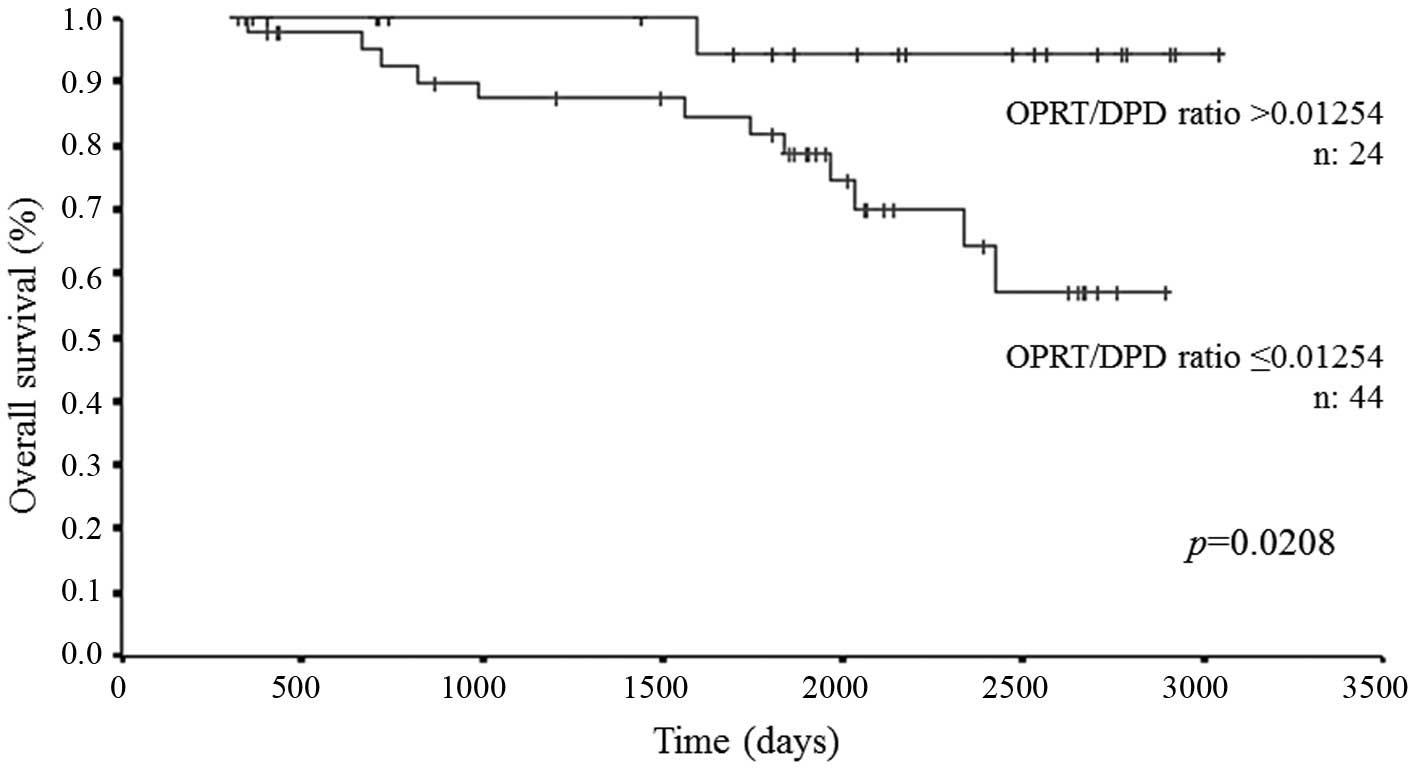
The cut-off values for the OPRT/DPD ratio against
DFS and OS obtained by maximal χ2 statistics were
0.01467 (χ2 value =7.863) and 0.01254 (χ2
value =8.05), respectively.
Correlation between OPRT/DPD ratio and
DFS
Patients were divided into high and low OPRT/DPD
ratio cohorts using a cut-off value of 0.01467. No significant
differences in patient characteristics were observed between the
two cohorts (Table III). The DFS
rates for each cohort are shown in Fig.
1. Patients in the high OPRT/DPD ratio cohort had a
significantly better prognosis for DFS than those in the low
OPRT/DPD ratio cohort (P=0.0280). In addition, a high OPRT/DPD
ratio [hazard ratio (HR), 0.85; 95% confidence interval (CI),
0.011–0.664; P=0.019] and node status (HR, 2.278; 95% CI,
1.175–4.416; P=0.015) were identified as independent predictive
factors for better DFS by multivariate analysis (Table IV).
| Table IIIPatient characteristics for
disease-free survival. |
Table III
Patient characteristics for
disease-free survival.
| Variables | ≤ Cut-off
value | > Cut-off
value | P-value |
|---|
| Mean age,
years | 65.5 | 66.0 | 0.929 |
| Gender
(male/female) | 29/19 | 13/7 | 0.723 |
| ECOG PS (0/1) | 42/3 | 16/1 | 0.911 |
| Primary cancer site
(colon/rectum) | 30/16 | 10/8 | 0.473 |
| pN
(0/1/2/3)a | 1/38/6/2 | 2/10/5/1 | 0.159 |
| Dukes’ stage
(B/C) | 1/46 | 2/16 | 0.183 |
| Table IVMultivariate analysis of disease-free
survival. |
Table IV
Multivariate analysis of disease-free
survival.
| Variables | Hazard ratio | 95% CI | P-value |
|---|
| Cut-off value
(≤0.01467/>0.01467) | 0.85 | 0.011–0.664 | 0.019 |
| Age in years | 1.013 | 0.957–1.072 | 0.679 |
| Gender
(male/female) | 0.519 | 0.193–1.400 | 0.195 |
| ECOG PS (0/1) | 0.573 | 0.072–4.544 | 0.598 |
| Primary cancer site
(colon/rectum) | 2.014 | 0.633–6.405 | 0.236 |
| pN
(0/1/2/3)a | 2.278 | 1.175–4.416 | 0.015 |
Correlation between OPRT/DPD ratio and
OS
Patients were divided into high and low OPRT/DPD
ratio cohorts using a cut-off value of 0.01254. No significant
differences in patient characteristics were observed between the
two cohorts (Table V). The OS rates
for each cohort are shown in Fig.
2. Patients in the high OPRT/DPD ratio cohort had a
significantly better prognosis for OS than those in the low
OPRT/DPD ratio cohort (P=0.0208). Furthermore, a high OPRT/DPD
ratio (HR, 0.112; 95% CI, 0.014–0.911; P=0.041) was identified as
an independent predictive factor for better OS by multivariate
analysis (Table VI).
| Table VPatient characteristics for overall
survival. |
Table V
Patient characteristics for overall
survival.
| Variables | ≤ Cut-off
value | > Cut-off
value | P-value |
|---|
| Mean age,
years | 67.0 | 64.5 | 0.682 |
| Gender
(male/female) | 28/16 | 14/10 | 0.667 |
| ECOG PS (0/1) | 38/3 | 20/1 | 1.00 |
| Primary cancer site
(colon/rectum) | 27/15 | 13/9 | 0.683 |
| pN
(0/1/2/3)a | 1/34/6/2 | 2/14/5/1 | 0.462 |
| Dukes’ stage
(B/C) | 1/42 | 2/20 | 0.263 |
| Table VIMultivariate analysis of overall
survival. |
Table VI
Multivariate analysis of overall
survival.
| Variables | Hazard ratio | 95% CI | P-value |
|---|
| Cut-off value
(≤0.01254/>0.01254) | 0.112 | 0.014–0.911 | 0.041 |
| Age in years | 1.009 | 0.940–1.083 | 0.813 |
| Gender
(male/female) | 1.568 | 0.465–5.293 | 0.468 |
| ECOG PS (0/1) | 2.350 | 0.254–21.716 | 0.452 |
| Primary cancer site
(colon/rectum) | 1.308 | 0.306–5.584 | 0.717 |
| pN
(0/1/2/3)a | 1.682 | 0.707–4.001 | 0.240 |
Discussion
OPRT is involved in the conversion of 5-FU to the
active nucleotide and is considered to be a key enzyme in the first
metabolizing step, leading to DNA synthesis inhibition and RNA
dysfunction. DPD is the initial enzyme of 5-FU catabolism. Thus,
OPRT and DPD are believed to be essentially associated with the
antitumor effect of 5-FU (14–23).
In the present cohort study, we prospectively evaluated the
correlation between tumor OPRT/DPD ratio and response to 5-FU in
CRC patients receiving 5-FU-based adjuvant chemotherapy.
We found that patients in the high OPRT/DPD ratio
cohort had significantly better DFS and OS than those in the low
ratio cohort. These results were consistent with the findings that
5-FU could be more easily metabolized to fluorodeoxyuridine
monophosphate in the high OPRT/DPD ratio cohort, thus resulting in
the induction of higher antitumor effects by 5-FU.
The nodal status and tumor OPRT/DPD ratio were
identified as significant predictive factors for DFS by
multivariate analysis in the present prospective study. The
identification of nodal status as a predictive factor was quite
logical. However, only the OPRT/DPD ratio was identified as a
significant independent predictive factor for OS by multivariate
analysis. The reason for this finding may be due to the influence
of treatment with multiple drug combinations (such as irinotecan,
oxaliplatin, molecularly targeted drugs) in addition to 5-FU after
disease recurrence.
For all cancer types, the primary purpose of
adjuvant chemotherapy is to eliminate traces of residual disease,
which are likely to exist in high-risk patients. This prospective
study revealed that the tumor OPRT/DPD ratio could be a useful
independent factor to select high-risk patients for adjuvant
chemotherapy. Thus, the OPRT/DPD ratio could be a predictive factor
for 5-FU-based adjuvant chemotherapy. Patients in the low OPRT/DPD
ratio cohort had significantly worse DFS and OS. A low OPRT/DPD
ratio could be due to low OPRT activity or high DPD activity. In
patients with low OPRT activity, the antitumor effects of 5-FU were
not expected. Therefore, adjuvant chemotherapy with multiple drug
combination (leucovorin and fluorouracil plus oxaliplatin; FOLFOX)
was recommended for low OPRT activity patient. In high DPD activity
patient, on the other hand, 5-FU involving a DPD inhibitor was
recommended (e.g. S-1, leucovorin and S-1 plus oxaliplatin; SOX).
S-1 involves gimeracil to inhibit DPD, therefore, the serum 5-FU
level is kept high. Recently, the safety profile of S-1 and SOX was
disclosed with adjuvant chemotherapy trials for colorectal cancer
(29). In advanced CRC
chemotherapy, moreover, there are several reports concerning the
efficacy of SOX (30,31).
There were several limitations to this prospective
study. First, the sample size was small. A larger sample size would
have improved the quality of the data. Second, in the present
study, 5-FU metabolic enzymes were evaluated in tumor tissue
instead of cancer cells. Although 5-FU metabolic enzymes in cancer
cells have been previously investigated using the microdissection
method, cancerous tissue includes not only cancer cells but also
stromal cells such as cancer-associated fibroblasts, tumor
endothelial cells, tumor associated macrophages, and many other
cells present in the tumor microenvironment. Recently, the tumor
microenvironment has been reported to play an extremely important
role in the progression of cancer, which suggests that cancer
stromal cells contribute to cancer progression (32–38).
Nagano et al reported that the DPD mRNA level in cancer
stromal tissues was significantly higher than that in cancer cells
(39). Since tumor tissue,
including cancer stromal cells, was evaluated in the present study,
our findings may be extremely important.
In conclusion, our results suggest that patients
with a high OPRT/DPD ratio had significantly better DFS and OS than
those with a low OPRT/DPD ratio. Moreover, the tumor OPRT/DPD ratio
was identified as a significant predictive factor for DFS and OS by
multivariate analysis. These results suggest that the tumor
OPRT/DPD ratio may be a predictive factor of 5-FU response in
patients with resectable CRC. In addition, the tumor OPRT/DPD ratio
may contribute to the individualization of 5-FU-based chemotherapy
in the clinical setting.
References
|
1
|
Bang YJ, Van Cutsem E, Feyereislova A, et
al: Trastuzumab in combination with chemotherapy versus
chemotherapy alone for treatment of HER2-positive advanced gastric
or gastro-oesophageal junction cancer (ToGA): a phase 3,
open-label, randomised controlled trial. Lancet. 376:687–697. 2010.
View Article : Google Scholar
|
|
2
|
Lièvre A, Bachet JB, Le Corre D, et al:
KRAS mutation status is predictive of response to cetuximab therapy
in colorectal cancer. Cancer Res. 66:3992–3995. 2006.PubMed/NCBI
|
|
3
|
Karapetis CS, Khambata-Ford S, Jonker DJ,
et al: K-ras mutations and benefit from cetuximab in advanced
colorectal cancer. N Engl J Med. 359:1757–1765. 2008. View Article : Google Scholar : PubMed/NCBI
|
|
4
|
Van Cutsem E, Köhne CH, Hitre E, et al:
Cetuximab and chemotherapy as initial treatment for metastatic
colorectal cancer. N Engl J Med. 360:1408–1417. 2009.PubMed/NCBI
|
|
5
|
Bokemeyer C, Bondarenko I, Makhson A, et
al: Fluorouracil, leucovorin, and oxaliplatin with and without
cetuximab in the first-line treatment of metastatic colorectal
cancer. J Clin Oncol. 27:663–671. 2009. View Article : Google Scholar : PubMed/NCBI
|
|
6
|
Folprecht G, Gruenberger T, Bechstein WO,
et al: Tumour response and secondary resectability of colorectal
liver metastases following neoadjuvant chemotherapy with cetuximab:
the CELIM randomised phase 2 trial. Lancet Oncol. 11:38–47. 2010.
View Article : Google Scholar
|
|
7
|
Hecht JR, Patnaik A, Berlin J, et al:
Panitumumab monotherapy in patients with previously treated
metastatic colorectal cancer. Cancer. 110:980–988. 2007. View Article : Google Scholar : PubMed/NCBI
|
|
8
|
Van Cutsem E, Peeters M, Siena S, et al:
Open-label phase III trial of panitumumab plus best supportive care
compared with best supportive care alone in patients with
chemotherapy-refractory metastatic colorectal cancer. J Clin Oncol.
25:1658–1664. 2007.PubMed/NCBI
|
|
9
|
Siena S, Peeters M, Van Cutsem E, et al:
Association of progression-free survival with patient-reported
outcomes and survival: results from a randomised phase 3 trial of
panitumumab. Br J Cancer. 97:1469–1474. 2007. View Article : Google Scholar : PubMed/NCBI
|
|
10
|
Weiner LM, Belldegrun AS, Crawford J, et
al: Dose and schedule study of panitumumab monotherapy in patients
with advanced solid malignancies. Clin Cancer Res. 14:502–508.
2008. View Article : Google Scholar : PubMed/NCBI
|
|
11
|
Amado RG, Wolf M, Peeters M, et al:
Wild-type KRAS is required for panitumumab efficacy in patients
with metastatic colorectal cancer. J Clin Oncol. 26:1626–1634.
2008. View Article : Google Scholar : PubMed/NCBI
|
|
12
|
Muro K, Yoshino T, Doi T, et al: A phase 2
clinical trial of panitumumab monotherapy in Japanese patients with
metastatic colorectal cancer. Jpn J Clin Oncol. 39:321–326. 2009.
View Article : Google Scholar : PubMed/NCBI
|
|
13
|
Lacouture ME, Mitchell EP, Piperdi B, et
al: Skin toxicity evaluation protocol with panitumumab (STEPP), a
phase II, open-label, randomized trial evaluating the impact of a
pre-emptive skin treatment regimen on skin toxicities and quality
of life in patients with metastatic colorectal cancer. J Clin
Oncol. 28:1351–1357. 2010. View Article : Google Scholar
|
|
14
|
Ochiai T, Sugitani M, Nishimura K, et al:
Correlation between 5-fluorouracil (5-FU) sensitivity as measured
by collagen gel droplet embedded culture drug sensitivity test
(CD-DST) and expression of orotate phosphoribosyl transferase
(OPRT), thymidylate synthase (TS), and dihydropyrimidine
dehydrogenase (DPD) in colorectal cancer. Gan To Kagaku Ryoho.
28:661–667. 2001.(In Japanese).
|
|
15
|
Ochiai T, Sugitani M, Nishimura K, et al:
Prognostic impact of orotate phosphoribosyl transferase (OPRT)
activity in resectable colorectal cancers (CRC) treated by
5-FU-based adjuvant chemotherapy. ASCO abstract. J Clin Oncol.
22:35742004.PubMed/NCBI
|
|
16
|
Ochiai1 T, Nishimura K, Noguchi1 H, et al:
Prognostic impact of orotate phosphoribosyl transferase among
5-fluorouracil metabolic enzymes in resectable colorectal cancers
treated by oral 5-fluorouracil-based adjuvant chemotherapy. Int J
Cancer. 118:3084–3088. 2006. View Article : Google Scholar
|
|
17
|
Kinoshita M, Kodera Y, Hibi K, et al: Gene
expression profile of 5-fluorouracil metabolic enzymes in primary
colorectal cancer: potential as predictive parameters for response
to fluorouracil-based chemotherapy. Anticancer Res. 27:851–856.
2007.
|
|
18
|
Tokunaga Y, Sasaki H and Saito T: Clinical
role of orotate phosphoribosyl transferase and dihydropyrimidine
dehydrogenase in colorectal cancer treated with postoperative
fluoropyrimidine. Surgery. 141:346–353. 2007. View Article : Google Scholar
|
|
19
|
Ishikawa M, Miyauchi T and Kashiwagi Y:
Clinical implications of thymidylate synthetase, dihydropyrimidine
dehydrogenase and orotate phosphoribosyl transferase activity
levels in colorectal carcinoma following radical resection and
administration of adjuvant 5-FU chemotherapy. BMC Cancer.
8:1882008. View Article : Google Scholar
|
|
20
|
Yamada H, Iinuma H and Watanabe T:
Prognostic value of 5-fluorouracil metabolic enzyme genes in Dukes’
stage B and C colorectal cancer patients treated with oral
5-fluorouracil-based adjuvant chemotherapy. Oncol Rep. 19:729–735.
2008.PubMed/NCBI
|
|
21
|
Koopman M, Venderbosch S, van Tinteren H,
et al: Predictive and prognostic markers for the outcome of
chemotherapy in advanced colorectal cancer, a retrospective
analysis of the phase III randomised CAIRO study. Eur J Cancer.
45:1999–2006. 2009. View Article : Google Scholar : PubMed/NCBI
|
|
22
|
Koizumi W, Tanabe S, Azuma M, et al:
Impacts of fluorouracil-metabolizing enzymes on the outcomes of
patients treated with S-1 alone or S-1 plus cisplatin for
first-line treatment of advanced gastric cancer. Int J Cancer.
126:162–170. 2010. View Article : Google Scholar : PubMed/NCBI
|
|
23
|
Jeung HC, Rha SY, Shin SJ, et al:
Predictive values of 5-fluorouracil pathway genes for S-1 treatment
in patients with advanced gastric cancer. Anticancer Drugs.
22:801–810. 2011. View Article : Google Scholar : PubMed/NCBI
|
|
24
|
Laskin JD, Evans RM, Slocum HK, Burke D
and Hakala MT: Basis for natural variation in sensitivity to
5-fluorouracil in mouse and human cells in culture. Cancer Res.
39:383–390. 1979.PubMed/NCBI
|
|
25
|
Diasio RB, Beavers TL and Carpenter JT:
Familial deficiency of dihydropyridine dehydrogenase: Biochemical
basis for familial pyrrimidinemia and severe 5-fluorouracil-
induced toxicity. J Clin Invest. 81:47–51. 1988. View Article : Google Scholar : PubMed/NCBI
|
|
26
|
Harris BE, Song R, Soong SJ and Diasio RB:
Relationship between dihydropyrimidine dehydrogenase activity and
plasma 5-fluorouracil levels with evidence for circadian variation
of enzyme activity and plasma drug levels in cancer patients
receiving 5-fluorouracil by protracted continuous infusion. Cancer
Res. 50:197–201. 1990.
|
|
27
|
Miller RG and Siegmund D: Maximally
selected Chi square statistics. Biometrics. 38:1011–1016. 1982.
View Article : Google Scholar
|
|
28
|
Halpern J: Maximally selected Chi square
statistics for small samples. Biometrics. 38:1017–1023. 1982.
View Article : Google Scholar
|
|
29
|
Yamada Y, Takahari D, Matsumoto H, et al:
Leucovorin, fluorouracil, and oxaliplatin plus bevacizumab versus
S-1 and oxaliplatin plus bevacizumab in patients with metastatic
colorectal cancer (SOFT): an open-label, non-inferiority,
randomised phase 3 trial. Lancet Oncol. 14:1278–1286. 2013.
View Article : Google Scholar
|
|
30
|
Hong YS, Park YS, Lim HY, et al: S-1 plus
oxaliplatin versus capecitabine plus oxaliplatin for first-line
treatment of patients with metastatic colorectal cancer: a
randomised, non-inferiority phase 3 trial. Lancet Oncol.
13:1125–1132. 2012. View Article : Google Scholar : PubMed/NCBI
|
|
31
|
Mochizuki I, Takiuchi H, Ikejiri K,
Nakamoto Y, et al: Safety of UFT/LV and S-1 as adjuvant therapy for
stage III colon cancer in phase III trial: ACTS-CC trial. Br J
Cancer. 106:1268–1273. 2012. View Article : Google Scholar : PubMed/NCBI
|
|
32
|
Orimo A, Gupta PB, Sgroi DC, et al:
Stromal fibroblasts present in invasive human breast carcinomas
promote tumor growth and angiogenesis through elevated SDF-1/CXCL12
secretion. Cell. 121:335–348. 2005. View Article : Google Scholar : PubMed/NCBI
|
|
33
|
Stuelten CH, DaCosta Byfield SD, Arany PR,
et al: Breast cancer cells induce stromal fibroblasts to express
MMP-9 via secretion of TNF-alpha and TGF-beta. J Cell Sci.
118:2143–2153. 2005. View Article : Google Scholar : PubMed/NCBI
|
|
34
|
Gaggioli C, Hooper S, Hidalgo-Carcedo C,
et al: Fibroblast-led collective invasion of carcinoma cells with
differing roles for RhoGTPases in leading and following cells. Nat
Cell Biol. 9:1392–1400. 2007. View
Article : Google Scholar : PubMed/NCBI
|
|
35
|
Allavena P, Sica A, Solinas G, Porta C and
Mantovani A: The inflammatory micro-environment in tumor
progression: the role of tumor-associated macrophages. Crit Rev
Oncol Hematol. 66:1–9. 2008. View Article : Google Scholar : PubMed/NCBI
|
|
36
|
Ricci-Vitiani L, Pallini R, Biffoni M, et
al: Tumour vascularization via endothelial differentiation of
glioblastoma stem-like cells. Nature. 468:824–828. 2010. View Article : Google Scholar : PubMed/NCBI
|
|
37
|
Erreni M, Mantovani A and Allavena P:
Tumor-associated macrophages (TAM) and inflammation in colorectal
cancer. Cancer Microenviron. 4:141–154. 2011. View Article : Google Scholar : PubMed/NCBI
|
|
38
|
Hoshino A, Ishii G, Ito T, et al:
Podoplanin-positive fibroblasts enhance lung adenocarcinoma tumor
formation: podoplanin in fibroblast functions for tumor
progression. Cancer Res. 71:4769–4779. 2011. View Article : Google Scholar : PubMed/NCBI
|
|
39
|
Nagano H, Ichikawa W, Simizu M, et al:
Thymidylate synthase and dihydropyrimidine dehydrogenase gene
expression in colorectal cancer using the Danenberg tumor profile
method. Gan To Kagaku Ryoho. 31:889–892. 2004.(In Japanese).
|