Spandidos Publications Logo
  • About
    • About Spandidos
    • Aims and Scopes
    • Abstracting and Indexing
    • Editorial Policies
    • Reprints and Permissions
    • Job Opportunities
    • Terms and Conditions
    • Contact
  • Journals
    • All Journals
    • Oncology Letters
      • Oncology Letters
      • Information for Authors
      • Editorial Policies
      • Editorial Board
      • Aims and Scope
      • Abstracting and Indexing
      • Bibliographic Information
      • Archive
    • International Journal of Oncology
      • International Journal of Oncology
      • Information for Authors
      • Editorial Policies
      • Editorial Board
      • Aims and Scope
      • Abstracting and Indexing
      • Bibliographic Information
      • Archive
    • Molecular and Clinical Oncology
      • Molecular and Clinical Oncology
      • Information for Authors
      • Editorial Policies
      • Editorial Board
      • Aims and Scope
      • Abstracting and Indexing
      • Bibliographic Information
      • Archive
    • Experimental and Therapeutic Medicine
      • Experimental and Therapeutic Medicine
      • Information for Authors
      • Editorial Policies
      • Editorial Board
      • Aims and Scope
      • Abstracting and Indexing
      • Bibliographic Information
      • Archive
    • International Journal of Molecular Medicine
      • International Journal of Molecular Medicine
      • Information for Authors
      • Editorial Policies
      • Editorial Board
      • Aims and Scope
      • Abstracting and Indexing
      • Bibliographic Information
      • Archive
    • Biomedical Reports
      • Biomedical Reports
      • Information for Authors
      • Editorial Policies
      • Editorial Board
      • Aims and Scope
      • Abstracting and Indexing
      • Bibliographic Information
      • Archive
    • Oncology Reports
      • Oncology Reports
      • Information for Authors
      • Editorial Policies
      • Editorial Board
      • Aims and Scope
      • Abstracting and Indexing
      • Bibliographic Information
      • Archive
    • Molecular Medicine Reports
      • Molecular Medicine Reports
      • Information for Authors
      • Editorial Policies
      • Editorial Board
      • Aims and Scope
      • Abstracting and Indexing
      • Bibliographic Information
      • Archive
    • World Academy of Sciences Journal
      • World Academy of Sciences Journal
      • Information for Authors
      • Editorial Policies
      • Editorial Board
      • Aims and Scope
      • Abstracting and Indexing
      • Bibliographic Information
      • Archive
    • International Journal of Functional Nutrition
      • International Journal of Functional Nutrition
      • Information for Authors
      • Editorial Policies
      • Editorial Board
      • Aims and Scope
      • Abstracting and Indexing
      • Bibliographic Information
      • Archive
    • International Journal of Epigenetics
      • International Journal of Epigenetics
      • Information for Authors
      • Editorial Policies
      • Editorial Board
      • Aims and Scope
      • Abstracting and Indexing
      • Bibliographic Information
      • Archive
    • Medicine International
      • Medicine International
      • Information for Authors
      • Editorial Policies
      • Editorial Board
      • Aims and Scope
      • Abstracting and Indexing
      • Bibliographic Information
      • Archive
  • Articles
  • Information
    • Information for Authors
    • Information for Reviewers
    • Information for Librarians
    • Information for Advertisers
    • Conferences
  • Language Editing
Spandidos Publications Logo
  • About
    • About Spandidos
    • Aims and Scopes
    • Abstracting and Indexing
    • Editorial Policies
    • Reprints and Permissions
    • Job Opportunities
    • Terms and Conditions
    • Contact
  • Journals
    • All Journals
    • Biomedical Reports
      • Information for Authors
      • Editorial Policies
      • Editorial Board
      • Aims and Scope
      • Abstracting and Indexing
      • Bibliographic Information
      • Archive
    • Experimental and Therapeutic Medicine
      • Information for Authors
      • Editorial Policies
      • Editorial Board
      • Aims and Scope
      • Abstracting and Indexing
      • Bibliographic Information
      • Archive
    • International Journal of Epigenetics
      • Information for Authors
      • Editorial Policies
      • Editorial Board
      • Aims and Scope
      • Abstracting and Indexing
      • Bibliographic Information
      • Archive
    • International Journal of Functional Nutrition
      • Information for Authors
      • Editorial Policies
      • Editorial Board
      • Aims and Scope
      • Abstracting and Indexing
      • Bibliographic Information
      • Archive
    • International Journal of Molecular Medicine
      • Information for Authors
      • Editorial Policies
      • Editorial Board
      • Aims and Scope
      • Abstracting and Indexing
      • Bibliographic Information
      • Archive
    • International Journal of Oncology
      • Information for Authors
      • Editorial Policies
      • Editorial Board
      • Aims and Scope
      • Abstracting and Indexing
      • Bibliographic Information
      • Archive
    • Medicine International
      • Information for Authors
      • Editorial Policies
      • Editorial Board
      • Aims and Scope
      • Abstracting and Indexing
      • Bibliographic Information
      • Archive
    • Molecular and Clinical Oncology
      • Information for Authors
      • Editorial Policies
      • Editorial Board
      • Aims and Scope
      • Abstracting and Indexing
      • Bibliographic Information
      • Archive
    • Molecular Medicine Reports
      • Information for Authors
      • Editorial Policies
      • Editorial Board
      • Aims and Scope
      • Abstracting and Indexing
      • Bibliographic Information
      • Archive
    • Oncology Letters
      • Information for Authors
      • Editorial Policies
      • Editorial Board
      • Aims and Scope
      • Abstracting and Indexing
      • Bibliographic Information
      • Archive
    • Oncology Reports
      • Information for Authors
      • Editorial Policies
      • Editorial Board
      • Aims and Scope
      • Abstracting and Indexing
      • Bibliographic Information
      • Archive
    • World Academy of Sciences Journal
      • Information for Authors
      • Editorial Policies
      • Editorial Board
      • Aims and Scope
      • Abstracting and Indexing
      • Bibliographic Information
      • Archive
  • Articles
  • Information
    • For Authors
    • For Reviewers
    • For Librarians
    • For Advertisers
    • Conferences
  • Language Editing
Login Register Submit
  • This site uses cookies
  • You can change your cookie settings at any time by following the instructions in our Cookie Policy. To find out more, you may read our Privacy Policy.

    I agree
Search articles by DOI, keyword, author or affiliation
Search
Advanced Search
presentation
Oncology Reports
Join Editorial Board Propose a Special Issue
Print ISSN: 1021-335X Online ISSN: 1791-2431
Journal Cover
June-2017 Volume 37 Issue 6

Full Size Image

Sign up for eToc alerts
Recommend to Library

Journals

International Journal of Molecular Medicine

International Journal of Molecular Medicine

International Journal of Molecular Medicine is an international journal devoted to molecular mechanisms of human disease.

International Journal of Oncology

International Journal of Oncology

International Journal of Oncology is an international journal devoted to oncology research and cancer treatment.

Molecular Medicine Reports

Molecular Medicine Reports

Covers molecular medicine topics such as pharmacology, pathology, genetics, neuroscience, infectious diseases, molecular cardiology, and molecular surgery.

Oncology Reports

Oncology Reports

Oncology Reports is an international journal devoted to fundamental and applied research in Oncology.

Experimental and Therapeutic Medicine

Experimental and Therapeutic Medicine

Experimental and Therapeutic Medicine is an international journal devoted to laboratory and clinical medicine.

Oncology Letters

Oncology Letters

Oncology Letters is an international journal devoted to Experimental and Clinical Oncology.

Biomedical Reports

Biomedical Reports

Explores a wide range of biological and medical fields, including pharmacology, genetics, microbiology, neuroscience, and molecular cardiology.

Molecular and Clinical Oncology

Molecular and Clinical Oncology

International journal addressing all aspects of oncology research, from tumorigenesis and oncogenes to chemotherapy and metastasis.

World Academy of Sciences Journal

World Academy of Sciences Journal

Multidisciplinary open-access journal spanning biochemistry, genetics, neuroscience, environmental health, and synthetic biology.

International Journal of Functional Nutrition

International Journal of Functional Nutrition

Open-access journal combining biochemistry, pharmacology, immunology, and genetics to advance health through functional nutrition.

International Journal of Epigenetics

International Journal of Epigenetics

Publishes open-access research on using epigenetics to advance understanding and treatment of human disease.

Medicine International

Medicine International

An International Open Access Journal Devoted to General Medicine.

Journal Cover
June-2017 Volume 37 Issue 6

Full Size Image

Sign up for eToc alerts
Recommend to Library

  • Article
  • Citations
    • Cite This Article
    • Download Citation
    • Create Citation Alert
    • Remove Citation Alert
    • Cited By
  • Similar Articles
    • Related Articles (in Spandidos Publications)
    • Similar Articles (Google Scholar)
    • Similar Articles (PubMed)
  • Download PDF
  • Download XML
  • View XML
Article

Plumbagin enhances TRAIL-induced apoptosis of human leukemic Kasumi‑1 cells through upregulation of TRAIL death receptor expression, activation of caspase-8 and inhibition of cFLIP

  • Authors:
    • Xiaoyang Kong
    • Jing Luo
    • Tongpeng Xu
    • Yunjiao Zhou
    • Zengkai Pan
    • Yinghua Xie
    • Limin Zhao
    • Yingting Lu
    • Xiyao Han
    • Zhixiong Li
    • Ligen Liu
  • View Affiliations / Copyright

    Affiliations: Department of Hematology, Shanghai No. 5 Hospital, Fudan University, Shanghai 200240, P.R. China, Central Laboratory, Shanghai No. 5 Hospital, Fudan University, Shanghai 200240, P.R. China, Department of Hematology, Hemostasis, Oncology and Stem Cell Transplantation, Hannover Medical School, D-30625 Hannover, Germany
  • Pages: 3423-3432
    |
    Published online on: May 4, 2017
       https://doi.org/10.3892/or.2017.5627
  • Expand metrics +
Metrics: Total Views: 0 (Spandidos Publications: | PMC Statistics: )
Metrics: Total PDF Downloads: 0 (Spandidos Publications: | PMC Statistics: )
Cited By (CrossRef): 0 citations Loading Articles...

This article is mentioned in:


Abstract

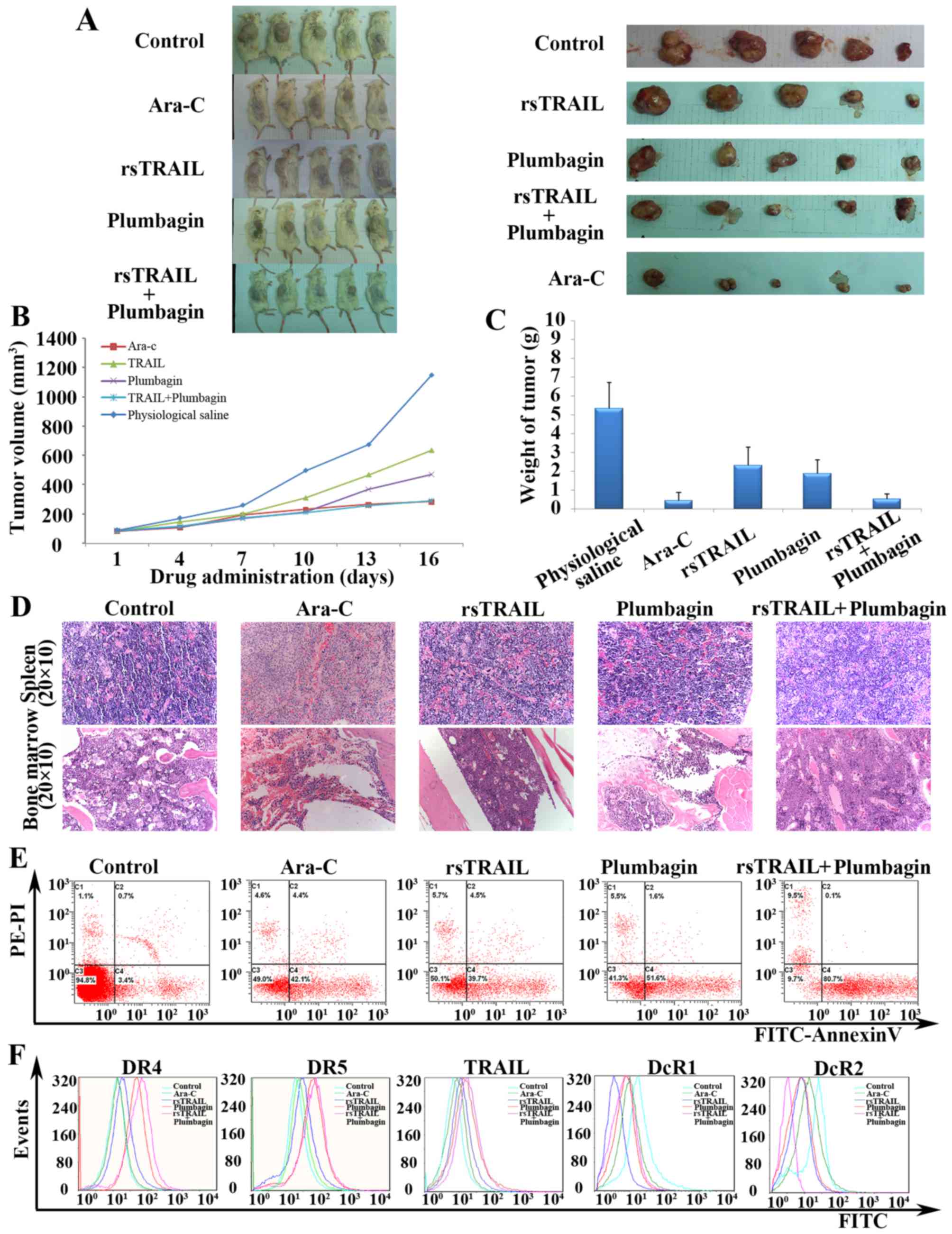
Although the patients with t(8;21) acute myeloid leukemia (AML) have a favorable prognosis compared with other non-acute promyelocytic leukemia AML patients, only ~50% patients with this relatively favorable subtype can survive for 5 years and refractory/relapse is common in clinical practice. So it is necessary to find novel agents to treat this type of AML. In this study, the effects and the mechanisms of plumbagin and recombinant soluble tumor necrosis factor‑α-related apoptosis-inducing ligand (rsTRAIL) on leukemic Kasumi‑1 cells were primarily investigated. Plumbagin and/or rsTRAIL could significantly inhibit the growth of Kasumi‑1 cells and induce apoptosis in vitro and in vivo. Plumbagin enhanced TRAIL-induced apoptosis of Kasumi‑1 cells in association with mitochondria damage, caspase activation, upregulation of death receptors (DRs) and decreased cFLIP expression. The effects of plumbagin on the expression of DR5, Bax and cFLIP could be partially abolished by the reactive oxygen species (ROS) scavenger NAC. Glutathione (GSH) depletion by plumbagin increased the production of ROS. In vivo, there was no obvious toxic pathologic change in the heart, liver and kidney tissues in any of the groups. Comparing with the control mice, a significantly increased number of apoptotic cells were observed in the combined treated mice by flow cytometry. Plumbagin also increased the expression of DR4 and DR5 in cells of xenograft tumors. Collectively, our results suggest that both plumbagin and rsTRAIL could be used as a single agent or synergistical agents to induce apoptosis of leukemic Kasumi‑1 cells in vitro and in vivo.
View Figures

Figure 1

Figure 2

Figure 3

Figure 4

Figure 5

View References

1 

LeBlanc HN and Ashkenazi A: Apo2L/TRAIL and its death and decoy receptors. Cell Death Differ. 10:66–75. 2003. View Article : Google Scholar : PubMed/NCBI

2 

Mahalingam D, Szegezdi E, Keane M, de Jong S and Samali A: TRAIL receptor signalling and modulation: Are we on the right TRAIL? Cancer Treat Rev. 35:280–288. 2009. View Article : Google Scholar : PubMed/NCBI

3 

Sessler T, Healy S, Samali A and Szegezdi E: Structural determinants of DISC function: New insights into death receptor-mediated apoptosis signalling. Pharmacol Ther. 140:186–199. 2013. View Article : Google Scholar : PubMed/NCBI

4 

Ashkenazi A, Holland P and Eckhardt SG: Ligand-based targeting of apoptosis in cancer: The potential of recombinant human apoptosis ligand 2/Tumor necrosis factor-related apoptosis-inducing ligand (rhApo2L/TRAIL). J Clin Oncol. 26:3621–3630. 2008. View Article : Google Scholar : PubMed/NCBI

5 

Ashkenazi A, Pai RC, Fong S, Leung S, Lawrence DA, Marsters SA, Blackie C, Chang L, McMurtrey AE, Hebert A, et al: Safety and antitumor activity of recombinant soluble Apo2 ligand. J Clin Invest. 104:155–162. 1999. View Article : Google Scholar : PubMed/NCBI

6 

Zhang L and Fang B: Mechanisms of resistance to TRAIL-induced apoptosis in cancer. Cancer Gene Ther. 12:228–237. 2005. View Article : Google Scholar : PubMed/NCBI

7 

Van Geelen CMM, de Vries EGE and de Jong S: Lessons from TRAIL-resistance mechanisms in colorectal cancer cells: Paving the road to patient-tailored therapy. Drug Resist Updat. 7:345–358. 2004. View Article : Google Scholar : PubMed/NCBI

8 

O'Kane HF, Watson CJ, Johnston SR, Petak I, Watson RW and KE; O Kane HF Williamson: Targeting death receptors in bladder, prostate and renal cancer. J Urol. 175:432–438. 2006. View Article : Google Scholar : PubMed/NCBI

9 

Cheng J, Hylander BL, Baer MR, Chen X and Repasky EA: Multiple mechanisms underlie resistance of leukemia cells to Apo2 Ligand/TRAIL. Mol Cancer Ther. 5:1844–1853. 2006. View Article : Google Scholar : PubMed/NCBI

10 

Padhye S, Dandawate P, Yusufi M, Ahmad A and Sarkar FH: Perspectives on medicinal properties of plumbagin and its analogs. Med Res Rev. 32:1131–1158. 2012. View Article : Google Scholar : PubMed/NCBI

11 

Krishnaswamy M and Purushothaman KK: Plumbagin: A study of its anticancer, antibacterial & antifungal properties. Indian J Exp Biol. 18:876–877. 1980.PubMed/NCBI

12 

Mishra BB, Singh DD, Kishore N, Tiwari VK and Tripathi V: Antifungal constituents isolated from the seeds of Aegle marmelos. Phytochemistry. 71:230–234. 2010. View Article : Google Scholar : PubMed/NCBI

13 

Abdul KM and Ramchender RP: Modulatory effect of plumbagin (5-hydroxy-2-methyl-1,4-naphthoquinone) on macrophage functions in BALB/c mice. I. Potentiation of macrophage bactericidal activity. Immunopharmacology. 30:231–236. 1995. View Article : Google Scholar : PubMed/NCBI

14 

Pradeepa V, Sathish-Narayanan S, Kirubakaran SA and Senthil-Nathan S: Antimalarial efficacy of dynamic compound of plumbagin chemical constituent from Plumbago zeylanica Linn (Plumbaginaceae) against the malarial vector Anopheles stephensi Liston (Diptera: Culicidae). Parasitol Res. 113:3105–3109. 2014. View Article : Google Scholar : PubMed/NCBI

15 

Checker R, Patwardhan RS, Sharma D, Menon J, Thoh M, Sandur SK, Sainis KB and Poduval TB: Plumbagin, a vitamin K3 analogue, abrogates lipopolysaccharide-induced oxidative stress, inflammation and endotoxic shock via NF-κB suppression. Inflammation. 37:542–554. 2014. View Article : Google Scholar : PubMed/NCBI

16 

Sharma I, Gusain D and Dixit VP: Hypolipidaemic and antiatherosclerotic effects of plumbagin in rabbits. Indian J Physiol Pharmacol. 35:10–14. 1991.PubMed/NCBI

17 

Sunil C, Duraipandiyan V, Agastian P and Ignacimuthu S: Antidiabetic effect of plumbagin isolated from Plumbago zeylanica L. root and its effect on GLUT4 translocation in streptozotocin-induced diabetic rats. Food Chem Toxicol. 50:4356–4363. 2012. View Article : Google Scholar : PubMed/NCBI

18 

Son TG, Camandola S, Arumugam TV, Cutler RG, Telljohann RS, Mughal MR, Moore TA, Luo W, Yu QS, Johnson DA, et al: Plumbagin, a novel Nrf2/ARE activator, protects against cerebral ischemia. J Neurochem. 112:1316–1326. 2010. View Article : Google Scholar : PubMed/NCBI

19 

Xu KH and Lu DP: Plumbagin induces ROS-mediated apoptosis in human promyelocytic leukemia cells in vivo. Leuk Res. 34:658–665. 2010. View Article : Google Scholar : PubMed/NCBI

20 

Gaascht F, Teiten MH, Cerella C, Dicato M, Bagrel D and Diederich M: Plumbagin modulates leukemia cell redox status. Molecules. 19:10011–10032. 2014. View Article : Google Scholar : PubMed/NCBI

21 

Hsu YL, Cho CY, Kuo PL, Huang YT and Lin CC: Plumbagin (5-hydroxy-2-methyl-1,4-naphthoquinone) induces apoptosis and cell cycle arrest in A549 cells through p53 accumulation via c-Jun NH2-terminal kinase-mediated phosphorylation at serine 15 in vitro and in vivo. J Pharmacol Exp Ther. 318:484–494. 2006. View Article : Google Scholar : PubMed/NCBI

22 

Shieh JM, Chiang TA, Chang WT, Chao CH, Lee YC, Huang GY, Shih YX and Shih YW: Plumbagin inhibits TPA-induced MMP-2 and u-PA expressions by reducing binding activities of NF-kappaB and AP-1 via ERK signaling pathway in A549 human lung cancer cells. Mol Cell Biochem. 335:181–193. 2010. View Article : Google Scholar : PubMed/NCBI

23 

Aziz MH, Dreckschmidt NE and Verma AK: Plumbagin, a medicinal plant-derived naphthoquinone, is a novel inhibitor of the growth and invasion of hormone-refractory prostate cancer. Cancer Res. 68:9024–9032. 2008. View Article : Google Scholar : PubMed/NCBI

24 

Kawiak A, Zawacka-Pankau J and Lojkowska E: Plumbagin induces apoptosis in Her2-overexpressing breast cancer cells through the mitochondrial-mediated pathway. J Nat Prod. 75:747–751. 2012. View Article : Google Scholar : PubMed/NCBI

25 

Kuo PL, Hsu YL and Cho CY: Plumbagin induces G2-M arrest and autophagy by inhibiting the AKT/mammalian target of rapamycin pathway in breast cancer cells. Mol Cancer Ther. 5:3209–3221. 2006. View Article : Google Scholar : PubMed/NCBI

26 

Lee JH, Yeon JH, Kim H, Roh W, Chae J, Park HO and Kim DM: The natural anticancer agent plumbagin induces potent cytotoxicity in MCF-7 human breast cancer cells by inhibiting a PI-5 kinase for ROS generation. PLoS One. 7:e450232012. View Article : Google Scholar : PubMed/NCBI

27 

Sinha S, Pal K, Elkhanany A, Dutta S, Cao Y, Mondal G, Iyer S, Somasundaram V, Couch FJ, Shridhar V, et al: Plumbagin inhibits tumorigenesis and angiogenesis of ovarian cancer cells in vivo. Int J Cancer. 132:1201–1212. 2013. View Article : Google Scholar : PubMed/NCBI

28 

Nair S, Nair RRK, Srinivas P, Srinivas G and Pillai MR: Radiosensitizing effects of plumbagin in cervical cancer cells is through modulation of apoptotic pathway. Mol Carcinog. 47:22–33. 2008. View Article : Google Scholar : PubMed/NCBI

29 

Wang CCC, Chiang YM, Sung SC, Hsu YL, Chang JK and Kuo PL: Plumbagin induces cell cycle arrest and apoptosis through reactive oxygen species/c-Jun N-terminal kinase pathways in human melanoma A375.S2 cells. Cancer Lett. 259:82–98. 2008. View Article : Google Scholar : PubMed/NCBI

30 

Marcucci G, Mrózek K, Ruppert AS, Maharry K, Kolitz JE, Moore JO, Mayer RJ, Pettenati MJ, Powell BL, Edwards CG, et al: Prognostic factors and outcome of core binding factor acute myeloid leukemia patients with t(8;21) differ from those of patients with inv(16): A Cancer and Leukemia Group B study. J Clin Oncol. 23:5705–5717. 2005. View Article : Google Scholar : PubMed/NCBI

31 

Asou H, Tashiro S, Hamamoto K, Otsuji A, Kita K and Kamada N: Establishment of a human acute myeloid leukemia cell line (Kasumi-1) with 8;21 chromosome translocation. Blood. 77:2031–2036. 1991.PubMed/NCBI

32 

Pan G, O'Rourke K, Chinnaiyan AM, Gentz R, Ebner R, Ni J and Dixit VM: The receptor for the cytotoxic ligand TRAIL. Science. 276:111–113. 1997. View Article : Google Scholar : PubMed/NCBI

33 

Walczak H, Degli-Esposti MA, Johnson RS, Smolak PJ, Waugh JY, Boiani N, Timour MS, Gerhart MJ, Schooley KA, Smith CA, et al: TRAIL-R2: A novel apoptosis-mediating receptor for TRAIL. EMBO J. 16:5386–5397. 1997. View Article : Google Scholar : PubMed/NCBI

34 

Ashkenazi A: Targeting death and decoy receptors of the tumour-necrosis factor superfamily. Nat Rev Cancer. 2:420–430. 2002. View Article : Google Scholar : PubMed/NCBI

35 

Fulda S: Cell death in hematological tumors. Apoptosis. 14:409–423. 2009. View Article : Google Scholar : PubMed/NCBI

36 

Castro FA, Mariani D, Panek AD, Eleutherio EC and Pereira MD: Cytotoxicity mechanism of two naphthoquinones (menadione and plumbagin) in Saccharomyces cerevisiae. PLoS One. 3:e39992008. View Article : Google Scholar : PubMed/NCBI

37 

Sun J and McKallip RJ: Plumbagin treatment leads to apoptosis in human K562 leukemia cells through increased ROS and elevated TRAIL receptor expression. Leuk Res. 35:1402–1408. 2011. View Article : Google Scholar : PubMed/NCBI

38 

Franco R and Cidlowski JA: Glutathione efflux and cell death. Antioxid Redox Signal. 17:1694–1713. 2012. View Article : Google Scholar : PubMed/NCBI

39 

Inbaraj JJ and Chignell CF: Cytotoxic action of juglone and plumbagin: A mechanistic study using HaCaT keratinocytes. Chem Res Toxicol. 17:55–62. 2004. View Article : Google Scholar : PubMed/NCBI

40 

Li J, Shen Q, Peng R, Chen R, Jiang P, Li Y, Zhang L and Lu J: Plumbagin enhances TRAIL-mediated apoptosis through up-regulation of death receptor in human melanoma A375 cells. J Huazhong Univ Sci Technol. 30:458–463. 2010. View Article : Google Scholar

41 

von Karstedt S, Conti A, Nobis M, Montinaro A, Hartwig T, Lemke J, Legler K, Annewanter F, Campbell AD, Taraborrelli L, et al: Cancer cell-autonomous TRAIL-R signaling promotes KRAS-driven cancer progression, invasion, and metastasis. Cancer Cell. 27:561–573. 2015. View Article : Google Scholar : PubMed/NCBI

42 

Turella P, Cerella C, Filomeni G, Bullo A, De Maria F, Ghibelli L, Ciriolo MR, Cianfriglia M, Mattei M, Federici G, et al: Proapoptotic activity of new glutathione S-transferase inhibitors. Cancer Res. 65:3751–3761. 2005. View Article : Google Scholar : PubMed/NCBI

43 

McKallip RJ, Lombard C, Sun J and Ramakrishnan R: Plumbagin-induced apoptosis in lymphocytes is mediated through increased reactive oxygen species production, upregulation of Fas, and activation of the caspase cascade. Toxicol Appl Pharmacol. 247:41–52. 2010. View Article : Google Scholar : PubMed/NCBI

44 

Wieder T, Essmann F, Prokop A, Schmelz K, Schulze-Osthoff K, Beyaert R, Dörken B and Daniel PT: Activation of caspase-8 in drug-induced apoptosis of B-lymphoid cells is independent of CD95/Fas receptor-ligand interaction and occurs downstream of caspase-3. Blood. 97:1378–1387. 2001. View Article : Google Scholar : PubMed/NCBI

Related Articles

  • Abstract
  • View
  • Download
  • Twitter
Copy and paste a formatted citation
Spandidos Publications style
Kong X, Luo J, Xu T, Zhou Y, Pan Z, Xie Y, Zhao L, Lu Y, Han X, Li Z, Li Z, et al: Plumbagin enhances TRAIL-induced apoptosis of human leukemic Kasumi‑1 cells through upregulation of TRAIL death receptor expression, activation of caspase-8 and inhibition of cFLIP. Oncol Rep 37: 3423-3432, 2017.
APA
Kong, X., Luo, J., Xu, T., Zhou, Y., Pan, Z., Xie, Y. ... Liu, L. (2017). Plumbagin enhances TRAIL-induced apoptosis of human leukemic Kasumi‑1 cells through upregulation of TRAIL death receptor expression, activation of caspase-8 and inhibition of cFLIP. Oncology Reports, 37, 3423-3432. https://doi.org/10.3892/or.2017.5627
MLA
Kong, X., Luo, J., Xu, T., Zhou, Y., Pan, Z., Xie, Y., Zhao, L., Lu, Y., Han, X., Li, Z., Liu, L."Plumbagin enhances TRAIL-induced apoptosis of human leukemic Kasumi‑1 cells through upregulation of TRAIL death receptor expression, activation of caspase-8 and inhibition of cFLIP". Oncology Reports 37.6 (2017): 3423-3432.
Chicago
Kong, X., Luo, J., Xu, T., Zhou, Y., Pan, Z., Xie, Y., Zhao, L., Lu, Y., Han, X., Li, Z., Liu, L."Plumbagin enhances TRAIL-induced apoptosis of human leukemic Kasumi‑1 cells through upregulation of TRAIL death receptor expression, activation of caspase-8 and inhibition of cFLIP". Oncology Reports 37, no. 6 (2017): 3423-3432. https://doi.org/10.3892/or.2017.5627
Copy and paste a formatted citation
x
Spandidos Publications style
Kong X, Luo J, Xu T, Zhou Y, Pan Z, Xie Y, Zhao L, Lu Y, Han X, Li Z, Li Z, et al: Plumbagin enhances TRAIL-induced apoptosis of human leukemic Kasumi‑1 cells through upregulation of TRAIL death receptor expression, activation of caspase-8 and inhibition of cFLIP. Oncol Rep 37: 3423-3432, 2017.
APA
Kong, X., Luo, J., Xu, T., Zhou, Y., Pan, Z., Xie, Y. ... Liu, L. (2017). Plumbagin enhances TRAIL-induced apoptosis of human leukemic Kasumi‑1 cells through upregulation of TRAIL death receptor expression, activation of caspase-8 and inhibition of cFLIP. Oncology Reports, 37, 3423-3432. https://doi.org/10.3892/or.2017.5627
MLA
Kong, X., Luo, J., Xu, T., Zhou, Y., Pan, Z., Xie, Y., Zhao, L., Lu, Y., Han, X., Li, Z., Liu, L."Plumbagin enhances TRAIL-induced apoptosis of human leukemic Kasumi‑1 cells through upregulation of TRAIL death receptor expression, activation of caspase-8 and inhibition of cFLIP". Oncology Reports 37.6 (2017): 3423-3432.
Chicago
Kong, X., Luo, J., Xu, T., Zhou, Y., Pan, Z., Xie, Y., Zhao, L., Lu, Y., Han, X., Li, Z., Liu, L."Plumbagin enhances TRAIL-induced apoptosis of human leukemic Kasumi‑1 cells through upregulation of TRAIL death receptor expression, activation of caspase-8 and inhibition of cFLIP". Oncology Reports 37, no. 6 (2017): 3423-3432. https://doi.org/10.3892/or.2017.5627
Follow us
  • Twitter
  • LinkedIn
  • Facebook
About
  • Spandidos Publications
  • Careers
  • Cookie Policy
  • Privacy Policy
How can we help?
  • Help
  • Live Chat
  • Contact
  • Email to our Support Team