Spandidos Publications Logo
  • About
    • About Spandidos
    • Aims and Scopes
    • Abstracting and Indexing
    • Editorial Policies
    • Reprints and Permissions
    • Job Opportunities
    • Terms and Conditions
    • Contact
  • Journals
    • All Journals
    • Oncology Letters
      • Oncology Letters
      • Information for Authors
      • Editorial Policies
      • Editorial Board
      • Aims and Scope
      • Abstracting and Indexing
      • Bibliographic Information
      • Archive
    • International Journal of Oncology
      • International Journal of Oncology
      • Information for Authors
      • Editorial Policies
      • Editorial Board
      • Aims and Scope
      • Abstracting and Indexing
      • Bibliographic Information
      • Archive
    • Molecular and Clinical Oncology
      • Molecular and Clinical Oncology
      • Information for Authors
      • Editorial Policies
      • Editorial Board
      • Aims and Scope
      • Abstracting and Indexing
      • Bibliographic Information
      • Archive
    • Experimental and Therapeutic Medicine
      • Experimental and Therapeutic Medicine
      • Information for Authors
      • Editorial Policies
      • Editorial Board
      • Aims and Scope
      • Abstracting and Indexing
      • Bibliographic Information
      • Archive
    • International Journal of Molecular Medicine
      • International Journal of Molecular Medicine
      • Information for Authors
      • Editorial Policies
      • Editorial Board
      • Aims and Scope
      • Abstracting and Indexing
      • Bibliographic Information
      • Archive
    • Biomedical Reports
      • Biomedical Reports
      • Information for Authors
      • Editorial Policies
      • Editorial Board
      • Aims and Scope
      • Abstracting and Indexing
      • Bibliographic Information
      • Archive
    • Oncology Reports
      • Oncology Reports
      • Information for Authors
      • Editorial Policies
      • Editorial Board
      • Aims and Scope
      • Abstracting and Indexing
      • Bibliographic Information
      • Archive
    • Molecular Medicine Reports
      • Molecular Medicine Reports
      • Information for Authors
      • Editorial Policies
      • Editorial Board
      • Aims and Scope
      • Abstracting and Indexing
      • Bibliographic Information
      • Archive
    • World Academy of Sciences Journal
      • World Academy of Sciences Journal
      • Information for Authors
      • Editorial Policies
      • Editorial Board
      • Aims and Scope
      • Abstracting and Indexing
      • Bibliographic Information
      • Archive
    • International Journal of Functional Nutrition
      • International Journal of Functional Nutrition
      • Information for Authors
      • Editorial Policies
      • Editorial Board
      • Aims and Scope
      • Abstracting and Indexing
      • Bibliographic Information
      • Archive
    • International Journal of Epigenetics
      • International Journal of Epigenetics
      • Information for Authors
      • Editorial Policies
      • Editorial Board
      • Aims and Scope
      • Abstracting and Indexing
      • Bibliographic Information
      • Archive
    • Medicine International
      • Medicine International
      • Information for Authors
      • Editorial Policies
      • Editorial Board
      • Aims and Scope
      • Abstracting and Indexing
      • Bibliographic Information
      • Archive
  • Articles
  • Information
    • Information for Authors
    • Information for Reviewers
    • Information for Librarians
    • Information for Advertisers
    • Conferences
  • Language Editing
Spandidos Publications Logo
  • About
    • About Spandidos
    • Aims and Scopes
    • Abstracting and Indexing
    • Editorial Policies
    • Reprints and Permissions
    • Job Opportunities
    • Terms and Conditions
    • Contact
  • Journals
    • All Journals
    • Biomedical Reports
      • Information for Authors
      • Editorial Policies
      • Editorial Board
      • Aims and Scope
      • Abstracting and Indexing
      • Bibliographic Information
      • Archive
    • Experimental and Therapeutic Medicine
      • Information for Authors
      • Editorial Policies
      • Editorial Board
      • Aims and Scope
      • Abstracting and Indexing
      • Bibliographic Information
      • Archive
    • International Journal of Epigenetics
      • Information for Authors
      • Editorial Policies
      • Editorial Board
      • Aims and Scope
      • Abstracting and Indexing
      • Bibliographic Information
      • Archive
    • International Journal of Functional Nutrition
      • Information for Authors
      • Editorial Policies
      • Editorial Board
      • Aims and Scope
      • Abstracting and Indexing
      • Bibliographic Information
      • Archive
    • International Journal of Molecular Medicine
      • Information for Authors
      • Editorial Policies
      • Editorial Board
      • Aims and Scope
      • Abstracting and Indexing
      • Bibliographic Information
      • Archive
    • International Journal of Oncology
      • Information for Authors
      • Editorial Policies
      • Editorial Board
      • Aims and Scope
      • Abstracting and Indexing
      • Bibliographic Information
      • Archive
    • Medicine International
      • Information for Authors
      • Editorial Policies
      • Editorial Board
      • Aims and Scope
      • Abstracting and Indexing
      • Bibliographic Information
      • Archive
    • Molecular and Clinical Oncology
      • Information for Authors
      • Editorial Policies
      • Editorial Board
      • Aims and Scope
      • Abstracting and Indexing
      • Bibliographic Information
      • Archive
    • Molecular Medicine Reports
      • Information for Authors
      • Editorial Policies
      • Editorial Board
      • Aims and Scope
      • Abstracting and Indexing
      • Bibliographic Information
      • Archive
    • Oncology Letters
      • Information for Authors
      • Editorial Policies
      • Editorial Board
      • Aims and Scope
      • Abstracting and Indexing
      • Bibliographic Information
      • Archive
    • Oncology Reports
      • Information for Authors
      • Editorial Policies
      • Editorial Board
      • Aims and Scope
      • Abstracting and Indexing
      • Bibliographic Information
      • Archive
    • World Academy of Sciences Journal
      • Information for Authors
      • Editorial Policies
      • Editorial Board
      • Aims and Scope
      • Abstracting and Indexing
      • Bibliographic Information
      • Archive
  • Articles
  • Information
    • For Authors
    • For Reviewers
    • For Librarians
    • For Advertisers
    • Conferences
  • Language Editing
Login Register Submit
  • This site uses cookies
  • You can change your cookie settings at any time by following the instructions in our Cookie Policy. To find out more, you may read our Privacy Policy.

    I agree
Search articles by DOI, keyword, author or affiliation
Search
Advanced Search
presentation
Oncology Reports
Join Editorial Board Propose a Special Issue
Print ISSN: 1021-335X Online ISSN: 1791-2431
Journal Cover
November-2020 Volume 44 Issue 5

Full Size Image

Sign up for eToc alerts
Recommend to Library

Journals

International Journal of Molecular Medicine

International Journal of Molecular Medicine

International Journal of Molecular Medicine is an international journal devoted to molecular mechanisms of human disease.

International Journal of Oncology

International Journal of Oncology

International Journal of Oncology is an international journal devoted to oncology research and cancer treatment.

Molecular Medicine Reports

Molecular Medicine Reports

Covers molecular medicine topics such as pharmacology, pathology, genetics, neuroscience, infectious diseases, molecular cardiology, and molecular surgery.

Oncology Reports

Oncology Reports

Oncology Reports is an international journal devoted to fundamental and applied research in Oncology.

Experimental and Therapeutic Medicine

Experimental and Therapeutic Medicine

Experimental and Therapeutic Medicine is an international journal devoted to laboratory and clinical medicine.

Oncology Letters

Oncology Letters

Oncology Letters is an international journal devoted to Experimental and Clinical Oncology.

Biomedical Reports

Biomedical Reports

Explores a wide range of biological and medical fields, including pharmacology, genetics, microbiology, neuroscience, and molecular cardiology.

Molecular and Clinical Oncology

Molecular and Clinical Oncology

International journal addressing all aspects of oncology research, from tumorigenesis and oncogenes to chemotherapy and metastasis.

World Academy of Sciences Journal

World Academy of Sciences Journal

Multidisciplinary open-access journal spanning biochemistry, genetics, neuroscience, environmental health, and synthetic biology.

International Journal of Functional Nutrition

International Journal of Functional Nutrition

Open-access journal combining biochemistry, pharmacology, immunology, and genetics to advance health through functional nutrition.

International Journal of Epigenetics

International Journal of Epigenetics

Publishes open-access research on using epigenetics to advance understanding and treatment of human disease.

Medicine International

Medicine International

An International Open Access Journal Devoted to General Medicine.

Journal Cover
November-2020 Volume 44 Issue 5

Full Size Image

Sign up for eToc alerts
Recommend to Library

  • Article
  • Citations
    • Cite This Article
    • Download Citation
    • Create Citation Alert
    • Remove Citation Alert
    • Cited By
  • Similar Articles
    • Related Articles (in Spandidos Publications)
    • Similar Articles (Google Scholar)
    • Similar Articles (PubMed)
  • Download PDF
  • Download XML
  • View XML

  • Supplementary Files
    • Supplementary_Data.pdf
Article

PARP‑1 inhibition sensitizes temozolomide‑treated glioblastoma cell lines and decreases drug resistance independent of MGMT activity and PTEN proficiency

  • Authors:
    • Ana P. Montaldi
    • Sarah C.G. Lima
    • Paulo R.D.V. Godoy
    • Danilo J. Xavier
    • Elza T. Sakamoto‑Hojo
  • View Affiliations / Copyright

    Affiliations: Department of Biology, Faculty of Philosophy, Sciences and Letters at Ribeirão Preto, University of São Paulo (USP), Ribeirão Preto, São Paulo 14040‑901, Brazil
  • Pages: 2275-2287
    |
    Published online on: September 7, 2020
       https://doi.org/10.3892/or.2020.7756
  • Expand metrics +
Metrics: Total Views: 0 (Spandidos Publications: | PMC Statistics: )
Metrics: Total PDF Downloads: 0 (Spandidos Publications: | PMC Statistics: )
Cited By (CrossRef): 0 citations Loading Articles...

This article is mentioned in:


Abstract

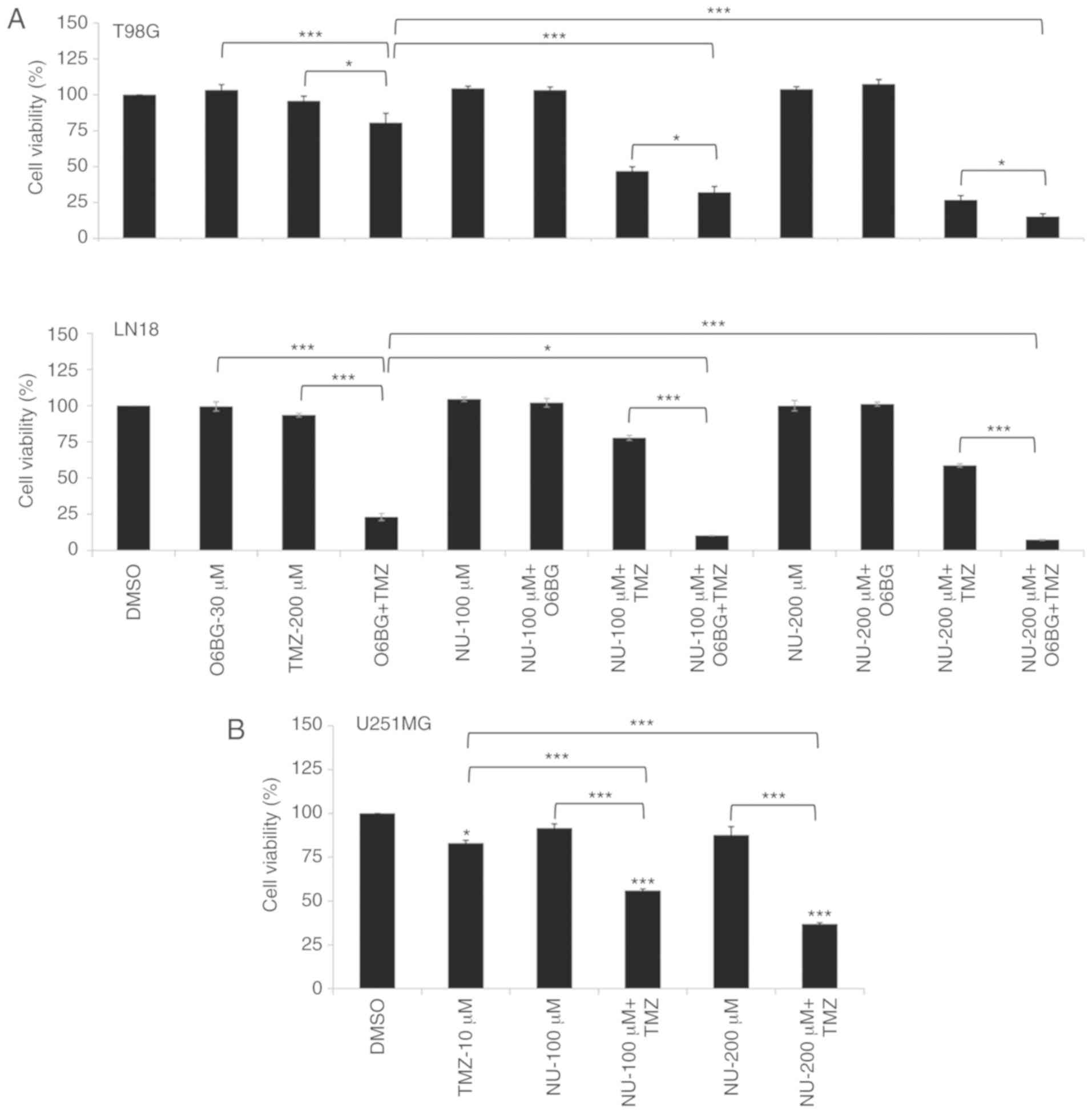
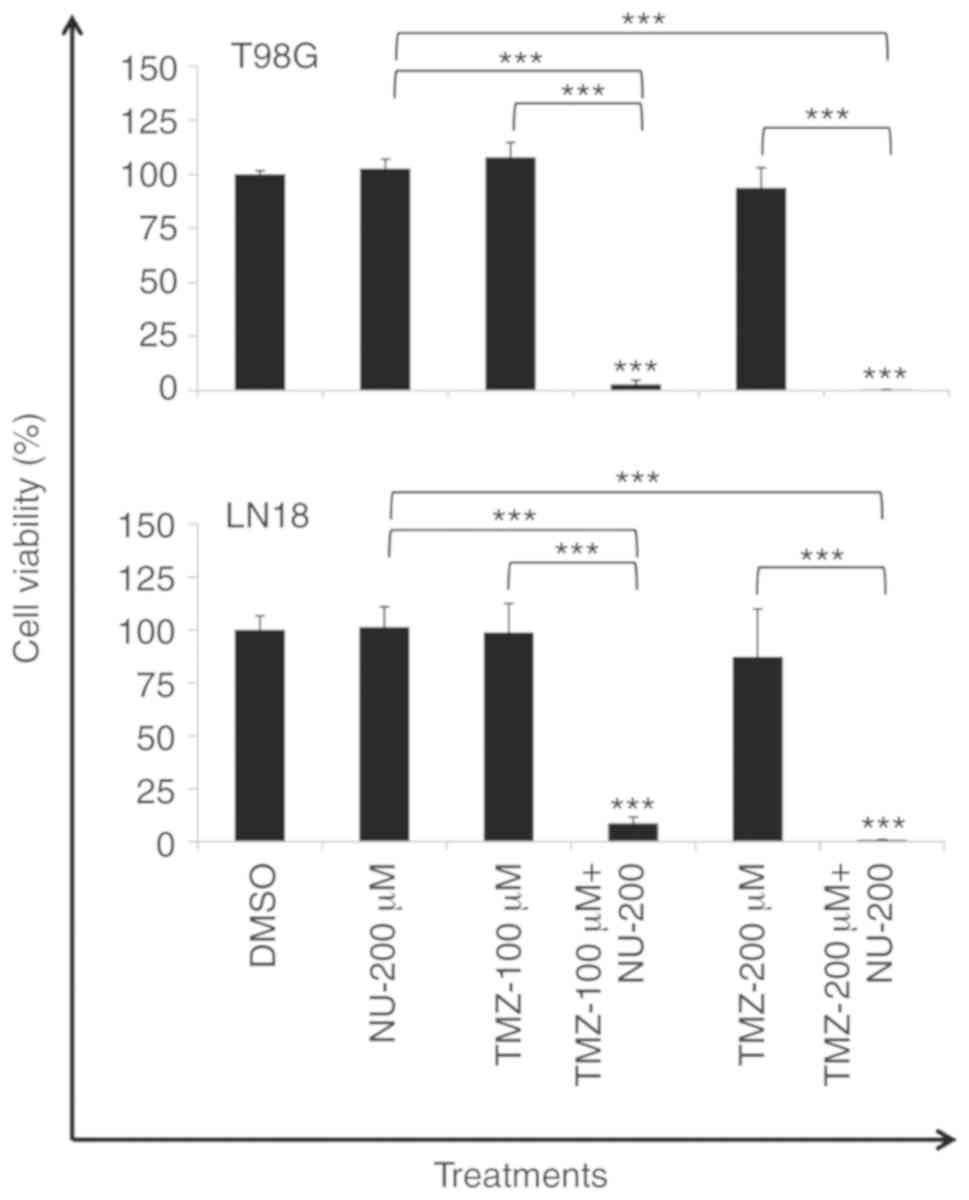
Information on the mechanisms that are associated with tumor resistance has the potential to provide the fundamental basis for novel therapeutic strategies. In glioblastoma (GBM), predictive biomarkers of cellular responses to temozolomide (TMZ) combined with poly‑ADP‑ribose polymerase inhibitor (PARPi) remain largely unidentified. In this context, the influence of MGMT (O6‑methylguanine DNA methyltransferase) and PTEN (phosphatase and tensin homologue deleted on chromosome ten) has been studied in addition to the occurrence of synthetic lethality involving PTEN and PARPi. The present study investigated whether PARP‑1 inhibition by NU1025 may increase the cytotoxicity of TMZ‑induced lesions in GBM cells, and whether these mechanisms can be influenced by MGMT and PTEN status. The impact of PTEN deficiency in repair pathways, and the effects of PARP‑1 inhibition and PTEN silencing, in terms of synthetic lethality, were also assessed. NU1025 combined with TMZ effectively sensitized TMZ‑resistant cells (T98G PTEN‑mutated and LN18 PTEN‑wild‑type) and TMZ‑sensitive cells (U251MG PTEN‑mutated), in contrast to NU1025 alone. However, the sensitizing effects were not observed in U87MG (PTEN‑mutated) cells, suggesting that specific genetic alterations may influence the response to drug treatment. The sensitizing effects occurred independently of MGMT activity, which was evaluated in O6‑BG‑treated cells. PTEN silencing using small interfering (si)RNA did not sensitize PTEN‑proficient cells to TMZ + NU1025, or NU1025 alone, indicating an absence of synthetic lethality. The responses to TMZ + NU1025 involved antiproliferative activity, G2/M arrest, double strand breaks and the induction of apoptosis. Following 20 days of recovery after three consecutive days of TMZ treatment, TMZ‑resistant cells were observed. However, when TMZ was combined with NU1025, the viability of T98G and LN18 cells was extremely decreased, indicating a lethal drug combination. Therefore, independently of MGMT proficiency and PTEN status, TMZ combined with PARPi may be a promising strategy that can be used to overcome TMZ acquired resistance in GBM cells.
View Figures

Figure 1

Figure 2

Figure 3

Figure 4

Figure 5

Figure 6

Figure 7

View References

1 

Ostrom QT, Gittleman H, Fulop J, Liu M, Blanda R, Kromer C, Wolinsky Y, Kruchko C and Barnholtz-Sloan JS: CBTRUS statistical report: Primary brain and central nervous system tumors diagnosed in the united states in 2008–2012. Neuro Oncol. 17 (Suppl 4):iv1–iv62. 2015. View Article : Google Scholar : PubMed/NCBI

2 

Thakkar JP, Dolecek TA, Horbinski C, Ostrom QT, Lightner DD, Barnholtz-Sloan JS and Villano JL: Epidemiologic and molecular prognostic review of glioblastoma. Cancer Epidemiol Biomarkers Prev. 23:1985–1996. 2014. View Article : Google Scholar : PubMed/NCBI

3 

Wick W, Osswald M, Wick A and Winkler F: Treatment of glioblastoma in adults. Ther Adv Neurol Disorder. 11:17562864187904522018.

4 

Dresemann G: Temozolomide in malignant glioma. OncoTargets Ther. 3:139–146. 2010. View Article : Google Scholar

5 

Mutter N and Stupp R: Temozolomide: A milestone in neuro-oncology and beyond? Expert Rev Anticancer Ther. 6:1187–1204. 2006. View Article : Google Scholar : PubMed/NCBI

6 

Cabrini G, Fabbri E, Lo Nigro C, Dechecchi MC and Gambari R: Regulation of expression of O6-methylguanine-DNA methyltransferase and the treatment of glioblastoma (Review). Int J Oncol. 47:417–428. 2015. View Article : Google Scholar : PubMed/NCBI

7 

Yoshimoto K, Mizoguchi M, Hata N, Murata H, Hatae R, Amano T, Nakamizo A and Sasaki T: Complex DNA repair pathways as possible therapeutic targets to overcome temozolomide resistance in glioblastoma. Front Oncol. 2:1862012. View Article : Google Scholar : PubMed/NCBI

8 

Wallace SS, Murphy DL and Sweasy JB: Base excision repair and cancer. Cancer Lett. 327:73–89. 2012. View Article : Google Scholar : PubMed/NCBI

9 

Montaldi AP and Sakamoto-Hojo ET: Methoxyamine sensitizes the resistant glioblastoma T98G cell line to the alkylating agent temozolomide. Clin Exp Med. 13:279–288. 2013. View Article : Google Scholar : PubMed/NCBI

10 

Montaldi AP, Godoy PR and Sakamoto-Hojo ET: APE1/REF-1 down-regulation enhances the cytotoxic effects of temozolomide in a resistant glioblastoma cell line. Mutat Res Genet Toxicol Environ Mutagen. 793:19–29. 2015. View Article : Google Scholar : PubMed/NCBI

11 

Liu L and Gerson SL: Therapeutic impact of methoxyamine: Blocking repair of abasic sites in the base excision repair pathway. Curr Opin Investig Drugs. 5:623–627. 2004.PubMed/NCBI

12 

Lord CJ, Tutt AN and Ashworth A: Synthetic lethality and cancer therapy: Lessons learned from the development of PARP inhibitors. Annu Rev Med. 66:455–470. 2015. View Article : Google Scholar : PubMed/NCBI

13 

Hartwell LH, Szankasi P, Roberts CJ, Murray AW and Friend SH: Integrating genetic approaches into the discovery of anticancer drugs. Science. 278:1064–1068. 1997. View Article : Google Scholar : PubMed/NCBI

14 

Bhattacharjee S and Nandi S: DNA damage response and cancer therapeutics through the lens of the fanconi anemia DNA repair pathway. Cell Commun Signal. 15:412017. View Article : Google Scholar : PubMed/NCBI

15 

Bryant HE, Schultz N, Thomas HD, Parker KM, Flower D, Lopez E, Kyle S, Meuth M, Curtin NJ and Helleday T: Specific killing of BRCA2-deficient tumours with inhibitors of poly(ADP-ribose) polymerase. Nature. 434:913–917. 2005. View Article : Google Scholar : PubMed/NCBI

16 

Farmer H, McCabe N, Lord CJ, Tutt AN, Johnson DA, Richardson TB, Santarosa M, Dillon KJ, Hickson I, Knights C, et al: Targeting the DNA repair defect in BRCA mutant cells as a therapeutic strategy. Nature. 434:917–921. 2005. View Article : Google Scholar : PubMed/NCBI

17 

Helleday T: The underlying mechanism for the PARP and BRCA synthetic lethality: Clearing up the misunderstandings. Mol Oncol. 5:387–393. 2011. View Article : Google Scholar : PubMed/NCBI

18 

Mendes-Pereira AM, Martin SA, Brough R, McCarthy A, Taylor JR, Kim JS, Waldman T, Lord CJ and Ashworth A: Synthetic lethal targeting of PTEN mutant cells with PARP inhibitors. EMBO Mol Med. 1:315–322. 2009. View Article : Google Scholar : PubMed/NCBI

19 

Weston VJ, Oldreive CE, Skowronska A, Oscier DG, Pratt G, Dyer MJ, Smith G, Powell JE, Rudzki Z, Kearns P, et al: The PARP inhibitor olaparib induces significant killing of ATM-deficient lymphoid tumor cells in vitro and in vivo. Blood. 116:4578–4587. 2010. View Article : Google Scholar : PubMed/NCBI

20 

Ohgaki H and Kleihues P: Genetic pathways to primary and secondary glioblastoma. Am J Pathol. 170:1445–1453. 2007. View Article : Google Scholar : PubMed/NCBI

21 

Verhaak RG, Hoadley KA, Purdom E, Wang V, Qi Y, Wilkerson MD, Miller CR, Ding L, Golub T, Mesirov JP, et al: Cancer genome atlas research network: Integrated genomic analysis identifies clinically relevant subtypes of glioblastoma characterized by abnormalities in PDGFRA, IDH1, EGFR, and NF1. Cancer Cell. 17:98–110. 2010. View Article : Google Scholar : PubMed/NCBI

22 

Salmena L, Carracedo A and Pandolfi PP: Tenets of PTEN tumor suppression. Cell. 133:403–414. 2008. View Article : Google Scholar : PubMed/NCBI

23 

Shen WH, Balajee AS, Wang J, Wu H, Eng C, Pandolfi PP and Yin Y: Essential role for nuclear PTEN in maintaining chromosomal integrity. Cell. 128:157–170. 2007. View Article : Google Scholar : PubMed/NCBI

24 

Lester A, Rapkins R, Nixdorf S, Khasraw M and McDonald K: Combining PARP inhibitors with radiation therapy for the treatment of glioblastoma: Is PTEN predictive of response? Clin Transl Oncol. 19:273–278. 2016. View Article : Google Scholar : PubMed/NCBI

25 

Quiros S, Roos WP and Kaina B: Rad51 and BRCA2-New molecular targets for sensitizing glioma cells to alkylating anticancer drugs. PLoS One. 6:e271832011. View Article : Google Scholar : PubMed/NCBI

26 

Filippi-Chiela EC, Thomé MP, Bueno e Silva MM, Pelegrini AL, Ledur PF, Garicochea B, Zamin LL and Lenz G: Resveratrol abrogates the temozolomide-induced G2 arrest leading to mitotic catastrophe and reinforces the temozolomide-induced senescence in glioma cells. BMC Cancer. 13:1472013. View Article : Google Scholar : PubMed/NCBI

27 

Hermisson M, Klumpp A, Wick W, Wischhusen J, Nagel G, Roos W, Kaina B and Weller M: O6-methylguanine DNA methyltransferase and p53 status predict temozolomide sensitivity in human malignant glioma cells. J Neurochem. 96:766–776. 2006. View Article : Google Scholar : PubMed/NCBI

28 

Ishii N, Maier D, Merlo A, Tada M, Sawamura Y, Diserens AC and Van Meir EG: Frequent co-alterations of TP53, p16/CDKN2A, p14ARF, PTEN tumor suppressor genes in human glioma cell lines. Brain Pathol. 9:469–479. 1999. View Article : Google Scholar : PubMed/NCBI

29 

Ostermann S, Csajka C, Buclin T, Leyvraz S, Lejeune F, Decosterd LA and Stupp R: Plasma and cerebrospinal fluid population pharmacokinetics of temozolomide in malignant glioma patients. Clin Cancer Res. 10:3728–3736. 2004. View Article : Google Scholar : PubMed/NCBI

30 

Patel M, McCully C, Godwin K and Balis FM: Plasma and cerebrospinal fluid pharmacokinetics of intravenous temozolomide in non-human primates. J Neurooncol. 61:203–207. 2003. View Article : Google Scholar : PubMed/NCBI

31 

Cimmino G, Pepe S, Laus G, Chianese M, Prece D, Penitente R and Quesada P: Poly(ADPR)polymerase-1 signalling of the DNA damage induced by DNA topoisomerase I poison in D54(p53wt) and U251(p53mut) glioblastoma cell lines. Pharmacol Res. 55:49–56. 2007. View Article : Google Scholar : PubMed/NCBI

32 

Sabisz M, Wesierska-Gadek J and Skladanowski A: Increased cytotoxicity of an unusual DNA topoisomerase II inhibitor compound C-1305 toward HeLa cells with downregulated PARP-1 activity results from re-activation of the p53 pathway and modulation of mitotic checkpoints. Biochem Pharmacol. 79:1387–1397. 2010. View Article : Google Scholar : PubMed/NCBI

33 

Zhang J, Stevens MF, Laughton CA, Madhusudan S and Bradshaw TD: Acquired resistance to temozolomide in glioma cell lines: Molecular mechanisms and potential translational applications. Oncology. 78:103–114. 2010. View Article : Google Scholar : PubMed/NCBI

34 

Cieślar-Pobuda A, Saenko Y and Rzeszowska-Wolny J: PARP-1 inhibition induces a late increase in the level of reactive oxygen species in cells after ionizing radiation. Mutat Res. 732:9–15. 2012. View Article : Google Scholar : PubMed/NCBI

35 

Sabbatino F, Fusciello C, Somma D, Pacelli R, Poudel R, Pepin D, Leonardi A, Carlomagno C, Della Vittoria Scarpati G, Ferrone S and Pepe S: Effect of p53 activity on the sensitivity of human glioblastoma cells to PARP-1 inhibitor in combination with topoisomerase I inhibitor or radiation. Cytometry A. 85:953–961. 2014. View Article : Google Scholar : PubMed/NCBI

36 

Franken NA, Rodermond HM, Stap J, Haveman J and van Bree C: Clonogenic assay of cells in vitro. Nat Protoc. 1:2315–2319. 2006. View Article : Google Scholar : PubMed/NCBI

37 

Livak KJ and Schmittgen TD: Analysis of relative gene expression data using real-time quantitative PCR and the 2(-Delta Delta C(T)) method. Methods. 25:402–408. 2001. View Article : Google Scholar : PubMed/NCBI

38 

Atkins RJ, Ng W, Stylli SS, Hovens CM and Kaye AH: Repair mechanisms help glioblastoma resist treatment. J Clin Neurosci. 22:14–20. 2015. View Article : Google Scholar : PubMed/NCBI

39 

Sandhu SK, Yap TA and de Bono JS: Poly(ADP-ribose) polymerase inhibitors in cancer treatment: A clinical perspective. Eur J Cancer. 46:9–20. 2010. View Article : Google Scholar : PubMed/NCBI

40 

Majuelos-Melguizo J, Rodríguez MI, López-Jiménez L, Rodríguez-Vargas JM, Martí Martín-Consuegra JM, Serrano-Sáenz S, Gavard J, de Almodóvar JM and Oliver FJ: PARP targeting counteracts gliomagenesis through induction of mitotic catastrophe and aggravation of deficiency in homologous recombination in PTEN-mutant glioma. Oncotarget. 6:4790–4803. 2015. View Article : Google Scholar : PubMed/NCBI

41 

Tentori L, Ricci-Vitiani L, Muzi A, Ciccarone F, Pelacchi F, Calabrese R, Runci D, Pallini R, Caiafa P and Graziani G: Pharmacological inhibition of poly(ADP-ribose) polymerase-1 modulates resistance of human glioblastoma stem cells to temozolomide. BMC Cancer. 14:1512014. View Article : Google Scholar : PubMed/NCBI

42 

Erice O, Smith MP, White R, Goicoechea I, Barriuso J, Jones C, Margison GP, Acosta JC, Wellbrock C and Arozarena I: MGMT expression predicts PARP-mediated resistance to temozolomide. Mol Cancer Ther. 14:1236–1246. 2015. View Article : Google Scholar : PubMed/NCBI

43 

Gupta A, Yang Q, Pandita RK, Hunt CR, Xiang T, Misri S, Zeng S, Pagan J, Jeffery J, Puc J, et al: Cell cycle checkpoint defects contribute to genomic instability in PTEN deficient cells independent of DNA DSB repair. Cell Cycle. 8:2198–2210. 2009. View Article : Google Scholar : PubMed/NCBI

44 

Balvers RK, Lamfers ML, Kloezeman JJ, Kleijn A, Berghauser Pont LM, Dirven CM and Leenstra S: ABT-888 enhances cytotoxic effects of temozolomide independent of MGMT status in serum free cultured glioma cells. J Transl Med. 13:742015. View Article : Google Scholar : PubMed/NCBI

45 

Godoy PR, Mello SS, Magalhães DA, Donaires FS, Nicolucci P, Donadi EA, Passos GA and Sakamoto-Hojo ET: Ionizing radiation-induced gene expression changes in TP53 proficient and deficient glioblastoma cell lines. Mutat Res. 756:46–55. 2013. View Article : Google Scholar : PubMed/NCBI

46 

Zaky A, Busso C, Izumi T, Chattopadhyay R, Bassiouny A, Mitra S and Bhakat KK: Regulation of the human AP-endonuclease (APE1/Ref-1) expression by the tumor suppressor p53 in response to DNA damage. Nucleic Acids Res. 36:1555–1566. 2008. View Article : Google Scholar : PubMed/NCBI

47 

Poletto M, Legrand AJ, Fletcher SC and Dianov GL: P53 coordinates base excision repair to prevent genomic instability. Nucleic Acids Res. 44:3165–3175. 2016. View Article : Google Scholar : PubMed/NCBI

48 

Ströbel T, Madlener S, Tuna S, Vose S, Lagerweij T, Wurdinger T, Vierlinger K, Wöhrer A, Price BD, Demple B, et al: Ape1 guides DNA repair pathway choice that is associated with drug tolerance in glioblastoma. Sci Rep. 7:96742017. View Article : Google Scholar : PubMed/NCBI

49 

Ming M and He YY: PTEN in DNA damage repair. Cancer Lett. 319:125–129. 2012. View Article : Google Scholar : PubMed/NCBI

50 

Mukherjee A and Karmakar P: Attenuation of PTEN perturbs genomic stability via activation of Akt and down-regulation of Rad51 in human embryonic kidney cells. Mol Carcinog. 52:611–618. 2013. View Article : Google Scholar : PubMed/NCBI

51 

Hunt CR, Gupta A, Horikoshi N and Pandita TK: Does PTEN loss impair DNA double-strand break repair by homologous recombination? Clin Cancer Res. 18:920–922. 2012. View Article : Google Scholar : PubMed/NCBI

52 

Fu D, Calvo JA and Samson LD: Balancing repair and tolerance of DNA damage caused by alkylating agents. Nat Rev Cancer. 12:104–120. 2012. View Article : Google Scholar : PubMed/NCBI

53 

Schuhwerk H, Atteya R, Siniuk K and Wang ZQ: PARPing for balance in the homeostasis of poly(ADP-ribosyl)ation. Semin Cell Dev Biol. 63:81–91. 2017. View Article : Google Scholar : PubMed/NCBI

54 

Chai KM, Wang CY, Liaw HJ, Fang KM, Yang CS and Tzeng SF: Downregulation of BRCA1-BRCA2-containing complex subunit 3 sensitizes glioma cells to temozolomide. Oncotarget. 5:10901–10915. 2014. View Article : Google Scholar : PubMed/NCBI

55 

Ray Chaudhuri A and Nussenzweig A: The multifaceted roles of PARP1 in DNA repair and chromatin remodelling (Review). Nat Rev Mol Cell Biol. 18:610–621. 2017. View Article : Google Scholar : PubMed/NCBI

56 

Polo SE and Jackson SP: Dynamics of DNA damage response proteins at DNA breaks: A focus on protein modifications. Genes Dev. 25:409–433. 2011. View Article : Google Scholar : PubMed/NCBI

57 

Nagel ZD, Kitange GJ, Gupta SK, Joughin BA, Chaim IA, Mazzucato P, Lauffenburger DA, Sarkaria JN and Samson LD: DNA repair capacity in multiple pathways predicts chemoresistance in glioblastoma multiforme. Cancer Res. 77:198–206. 2017. View Article : Google Scholar : PubMed/NCBI

Related Articles

  • Abstract
  • View
  • Download
  • Twitter
Copy and paste a formatted citation
Spandidos Publications style
Montaldi AP, Lima SC, Godoy PR, Xavier DJ and Sakamoto‑Hojo ET: PARP‑1 inhibition sensitizes temozolomide‑treated glioblastoma cell lines and decreases drug resistance independent of MGMT activity and PTEN proficiency. Oncol Rep 44: 2275-2287, 2020.
APA
Montaldi, A.P., Lima, S.C., Godoy, P.R., Xavier, D.J., & Sakamoto‑Hojo, E.T. (2020). PARP‑1 inhibition sensitizes temozolomide‑treated glioblastoma cell lines and decreases drug resistance independent of MGMT activity and PTEN proficiency. Oncology Reports, 44, 2275-2287. https://doi.org/10.3892/or.2020.7756
MLA
Montaldi, A. P., Lima, S. C., Godoy, P. R., Xavier, D. J., Sakamoto‑Hojo, E. T."PARP‑1 inhibition sensitizes temozolomide‑treated glioblastoma cell lines and decreases drug resistance independent of MGMT activity and PTEN proficiency". Oncology Reports 44.5 (2020): 2275-2287.
Chicago
Montaldi, A. P., Lima, S. C., Godoy, P. R., Xavier, D. J., Sakamoto‑Hojo, E. T."PARP‑1 inhibition sensitizes temozolomide‑treated glioblastoma cell lines and decreases drug resistance independent of MGMT activity and PTEN proficiency". Oncology Reports 44, no. 5 (2020): 2275-2287. https://doi.org/10.3892/or.2020.7756
Copy and paste a formatted citation
x
Spandidos Publications style
Montaldi AP, Lima SC, Godoy PR, Xavier DJ and Sakamoto‑Hojo ET: PARP‑1 inhibition sensitizes temozolomide‑treated glioblastoma cell lines and decreases drug resistance independent of MGMT activity and PTEN proficiency. Oncol Rep 44: 2275-2287, 2020.
APA
Montaldi, A.P., Lima, S.C., Godoy, P.R., Xavier, D.J., & Sakamoto‑Hojo, E.T. (2020). PARP‑1 inhibition sensitizes temozolomide‑treated glioblastoma cell lines and decreases drug resistance independent of MGMT activity and PTEN proficiency. Oncology Reports, 44, 2275-2287. https://doi.org/10.3892/or.2020.7756
MLA
Montaldi, A. P., Lima, S. C., Godoy, P. R., Xavier, D. J., Sakamoto‑Hojo, E. T."PARP‑1 inhibition sensitizes temozolomide‑treated glioblastoma cell lines and decreases drug resistance independent of MGMT activity and PTEN proficiency". Oncology Reports 44.5 (2020): 2275-2287.
Chicago
Montaldi, A. P., Lima, S. C., Godoy, P. R., Xavier, D. J., Sakamoto‑Hojo, E. T."PARP‑1 inhibition sensitizes temozolomide‑treated glioblastoma cell lines and decreases drug resistance independent of MGMT activity and PTEN proficiency". Oncology Reports 44, no. 5 (2020): 2275-2287. https://doi.org/10.3892/or.2020.7756
Follow us
  • Twitter
  • LinkedIn
  • Facebook
About
  • Spandidos Publications
  • Careers
  • Cookie Policy
  • Privacy Policy
How can we help?
  • Help
  • Live Chat
  • Contact
  • Email to our Support Team