Spandidos Publications Logo
  • About
    • About Spandidos
    • Aims and Scopes
    • Abstracting and Indexing
    • Editorial Policies
    • Reprints and Permissions
    • Job Opportunities
    • Terms and Conditions
    • Contact
  • Journals
    • All Journals
    • Oncology Letters
      • Oncology Letters
      • Information for Authors
      • Editorial Policies
      • Editorial Board
      • Aims and Scope
      • Abstracting and Indexing
      • Bibliographic Information
      • Archive
    • International Journal of Oncology
      • International Journal of Oncology
      • Information for Authors
      • Editorial Policies
      • Editorial Board
      • Aims and Scope
      • Abstracting and Indexing
      • Bibliographic Information
      • Archive
    • Molecular and Clinical Oncology
      • Molecular and Clinical Oncology
      • Information for Authors
      • Editorial Policies
      • Editorial Board
      • Aims and Scope
      • Abstracting and Indexing
      • Bibliographic Information
      • Archive
    • Experimental and Therapeutic Medicine
      • Experimental and Therapeutic Medicine
      • Information for Authors
      • Editorial Policies
      • Editorial Board
      • Aims and Scope
      • Abstracting and Indexing
      • Bibliographic Information
      • Archive
    • International Journal of Molecular Medicine
      • International Journal of Molecular Medicine
      • Information for Authors
      • Editorial Policies
      • Editorial Board
      • Aims and Scope
      • Abstracting and Indexing
      • Bibliographic Information
      • Archive
    • Biomedical Reports
      • Biomedical Reports
      • Information for Authors
      • Editorial Policies
      • Editorial Board
      • Aims and Scope
      • Abstracting and Indexing
      • Bibliographic Information
      • Archive
    • Oncology Reports
      • Oncology Reports
      • Information for Authors
      • Editorial Policies
      • Editorial Board
      • Aims and Scope
      • Abstracting and Indexing
      • Bibliographic Information
      • Archive
    • Molecular Medicine Reports
      • Molecular Medicine Reports
      • Information for Authors
      • Editorial Policies
      • Editorial Board
      • Aims and Scope
      • Abstracting and Indexing
      • Bibliographic Information
      • Archive
    • World Academy of Sciences Journal
      • World Academy of Sciences Journal
      • Information for Authors
      • Editorial Policies
      • Editorial Board
      • Aims and Scope
      • Abstracting and Indexing
      • Bibliographic Information
      • Archive
    • International Journal of Functional Nutrition
      • International Journal of Functional Nutrition
      • Information for Authors
      • Editorial Policies
      • Editorial Board
      • Aims and Scope
      • Abstracting and Indexing
      • Bibliographic Information
      • Archive
    • International Journal of Epigenetics
      • International Journal of Epigenetics
      • Information for Authors
      • Editorial Policies
      • Editorial Board
      • Aims and Scope
      • Abstracting and Indexing
      • Bibliographic Information
      • Archive
    • Medicine International
      • Medicine International
      • Information for Authors
      • Editorial Policies
      • Editorial Board
      • Aims and Scope
      • Abstracting and Indexing
      • Bibliographic Information
      • Archive
  • Articles
  • Information
    • Information for Authors
    • Information for Reviewers
    • Information for Librarians
    • Information for Advertisers
    • Conferences
  • Language Editing
Spandidos Publications Logo
  • About
    • About Spandidos
    • Aims and Scopes
    • Abstracting and Indexing
    • Editorial Policies
    • Reprints and Permissions
    • Job Opportunities
    • Terms and Conditions
    • Contact
  • Journals
    • All Journals
    • Biomedical Reports
      • Information for Authors
      • Editorial Policies
      • Editorial Board
      • Aims and Scope
      • Abstracting and Indexing
      • Bibliographic Information
      • Archive
    • Experimental and Therapeutic Medicine
      • Information for Authors
      • Editorial Policies
      • Editorial Board
      • Aims and Scope
      • Abstracting and Indexing
      • Bibliographic Information
      • Archive
    • International Journal of Epigenetics
      • Information for Authors
      • Editorial Policies
      • Editorial Board
      • Aims and Scope
      • Abstracting and Indexing
      • Bibliographic Information
      • Archive
    • International Journal of Functional Nutrition
      • Information for Authors
      • Editorial Policies
      • Editorial Board
      • Aims and Scope
      • Abstracting and Indexing
      • Bibliographic Information
      • Archive
    • International Journal of Molecular Medicine
      • Information for Authors
      • Editorial Policies
      • Editorial Board
      • Aims and Scope
      • Abstracting and Indexing
      • Bibliographic Information
      • Archive
    • International Journal of Oncology
      • Information for Authors
      • Editorial Policies
      • Editorial Board
      • Aims and Scope
      • Abstracting and Indexing
      • Bibliographic Information
      • Archive
    • Medicine International
      • Information for Authors
      • Editorial Policies
      • Editorial Board
      • Aims and Scope
      • Abstracting and Indexing
      • Bibliographic Information
      • Archive
    • Molecular and Clinical Oncology
      • Information for Authors
      • Editorial Policies
      • Editorial Board
      • Aims and Scope
      • Abstracting and Indexing
      • Bibliographic Information
      • Archive
    • Molecular Medicine Reports
      • Information for Authors
      • Editorial Policies
      • Editorial Board
      • Aims and Scope
      • Abstracting and Indexing
      • Bibliographic Information
      • Archive
    • Oncology Letters
      • Information for Authors
      • Editorial Policies
      • Editorial Board
      • Aims and Scope
      • Abstracting and Indexing
      • Bibliographic Information
      • Archive
    • Oncology Reports
      • Information for Authors
      • Editorial Policies
      • Editorial Board
      • Aims and Scope
      • Abstracting and Indexing
      • Bibliographic Information
      • Archive
    • World Academy of Sciences Journal
      • Information for Authors
      • Editorial Policies
      • Editorial Board
      • Aims and Scope
      • Abstracting and Indexing
      • Bibliographic Information
      • Archive
  • Articles
  • Information
    • For Authors
    • For Reviewers
    • For Librarians
    • For Advertisers
    • Conferences
  • Language Editing
Login Register Submit
  • This site uses cookies
  • You can change your cookie settings at any time by following the instructions in our Cookie Policy. To find out more, you may read our Privacy Policy.

    I agree
Search articles by DOI, keyword, author or affiliation
Search
Advanced Search
presentation
Oncology Reports
Join Editorial Board Propose a Special Issue
Print ISSN: 1021-335X Online ISSN: 1791-2431
Journal Cover
November-2025 Volume 54 Issue 5

Full Size Image

Sign up for eToc alerts
Recommend to Library

Journals

International Journal of Molecular Medicine

International Journal of Molecular Medicine

International Journal of Molecular Medicine is an international journal devoted to molecular mechanisms of human disease.

International Journal of Oncology

International Journal of Oncology

International Journal of Oncology is an international journal devoted to oncology research and cancer treatment.

Molecular Medicine Reports

Molecular Medicine Reports

Covers molecular medicine topics such as pharmacology, pathology, genetics, neuroscience, infectious diseases, molecular cardiology, and molecular surgery.

Oncology Reports

Oncology Reports

Oncology Reports is an international journal devoted to fundamental and applied research in Oncology.

Experimental and Therapeutic Medicine

Experimental and Therapeutic Medicine

Experimental and Therapeutic Medicine is an international journal devoted to laboratory and clinical medicine.

Oncology Letters

Oncology Letters

Oncology Letters is an international journal devoted to Experimental and Clinical Oncology.

Biomedical Reports

Biomedical Reports

Explores a wide range of biological and medical fields, including pharmacology, genetics, microbiology, neuroscience, and molecular cardiology.

Molecular and Clinical Oncology

Molecular and Clinical Oncology

International journal addressing all aspects of oncology research, from tumorigenesis and oncogenes to chemotherapy and metastasis.

World Academy of Sciences Journal

World Academy of Sciences Journal

Multidisciplinary open-access journal spanning biochemistry, genetics, neuroscience, environmental health, and synthetic biology.

International Journal of Functional Nutrition

International Journal of Functional Nutrition

Open-access journal combining biochemistry, pharmacology, immunology, and genetics to advance health through functional nutrition.

International Journal of Epigenetics

International Journal of Epigenetics

Publishes open-access research on using epigenetics to advance understanding and treatment of human disease.

Medicine International

Medicine International

An International Open Access Journal Devoted to General Medicine.

Journal Cover
November-2025 Volume 54 Issue 5

Full Size Image

Sign up for eToc alerts
Recommend to Library

  • Article
  • Citations
    • Cite This Article
    • Download Citation
    • Create Citation Alert
    • Remove Citation Alert
    • Cited By
  • Similar Articles
    • Related Articles (in Spandidos Publications)
    • Similar Articles (Google Scholar)
    • Similar Articles (PubMed)
  • Download PDF
  • Download XML
  • View XML

  • Supplementary Files
    • Supplementary_Data1.pdf
    • Supplementary_Data2.pdf
Article Open Access

DBN1‑mediated upregulation of GAB2 facilitates the migration and invasion of T‑cell acute lymphoblastic leukemia cells

  • Authors:
    • Jiaxing Sun
    • Xiaoxing Huang
    • Xingruo Zeng
    • Yufei Lei
    • Hengjing He
    • Zimeng Wei
    • Di Xiao
    • Qiuping Zhang
    • Xinran Li
    • Fuling Zhou
    • Liang Shao
  • View Affiliations / Copyright

    Affiliations: Department of Hematology, Zhongnan Hospital of Wuhan University, Wuhan, Hubei 430071, P.R. China, Department of Blood Transfusion, Zhongnan Hospital of Wuhan University, Wuhan, Hubei 430071, P.R. China, Department of Immunology, School of Basic Medical Science, Wuhan University, Wuhan, Hubei 430071, P.R. China, Department of Laboratory Medicine, Zhongnan Hospital of Wuhan University, Wuhan, Hubei 430071, P.R. China
    Copyright: © Sun et al. This is an open access article distributed under the terms of Creative Commons Attribution License.
  • Article Number: 149
    |
    Published online on: September 3, 2025
       https://doi.org/10.3892/or.2025.8982
  • Expand metrics +
Metrics: Total Views: 0 (Spandidos Publications: | PMC Statistics: )
Metrics: Total PDF Downloads: 0 (Spandidos Publications: | PMC Statistics: )
Cited By (CrossRef): 0 citations Loading Articles...

This article is mentioned in:


Abstract

T-cell acute lymphoblastic leukemia (T‑ALL) is an aggressive hematological malignancy. The poor prognosis of T‑ALL is closely associated with extensive leukemic infiltration into critical organs. Therefore, the mechanism underlying T‑ALL infiltration is worth investigating. Databases and clinical samples were utilized to examine drebrin 1 (DBN1) expression in T‑ALL. DBN1 knockdown cell lines were established by lentivirus transfection, and cell migration and invasion were examined using Transwell and Matrigel‑Transwell assays. The molecular mechanism was investigated by RNA sequencing and further validated at the molecular level. Reverse transcription‑quantitative PCR and western blotting were employed to examine the expression of downstream molecules following DBN1 knockdown, with subsequent rescue experiments. DBN1‑targeting microRNA (miR) predicted using bioinformatics websites was confirmed using dual‑luciferase assays. In T‑ALL cells, miRNA mimics transfection enabled functional validation, and investigations into the underlying molecular mechanisms encompassing rescue experiments. Clinical samples and publicly available databases revealed that DBN1 was upregulated in patients with T‑ALL patients. DBN1 knockdown significantly decreased the migration and invasion of T‑ALL cells in vitro. RNA sequencing revealed that downregulation of DBN1 could reduce Grb2‑associated binding protein 2 (GAB2) expression. Western blotting revealed that GAB2 expression, and PI3K/AKT and MAPK/ERK signaling were decreased in DBN1‑knockdown cells. GAB2 overexpression restored the phosphorylation of downstream effectors (AKT and ERK1/2). Bioinformatics and dual‑luciferase reporter experiments identified miR‑218‑5p binding to the 3'-untranslated region of DBN1, which suppressed DBN1 expression. In addition, the experiments demonstrated that miR‑218‑5p acted as an upstream regulator of DBN1, and was involved in cell migration and invasion. Overall, DBN1 was upregulated in T‑ALL, and its depletion inhibited cell migration and invasion through downregulation of GAB2 and consequent inhibition of AKT and ERK signaling cascades. The present data suggested that DBN1 could be a novel biomarker of T‑ALL infiltration, which is a novel perspective in the field of leukemia research.
View Figures

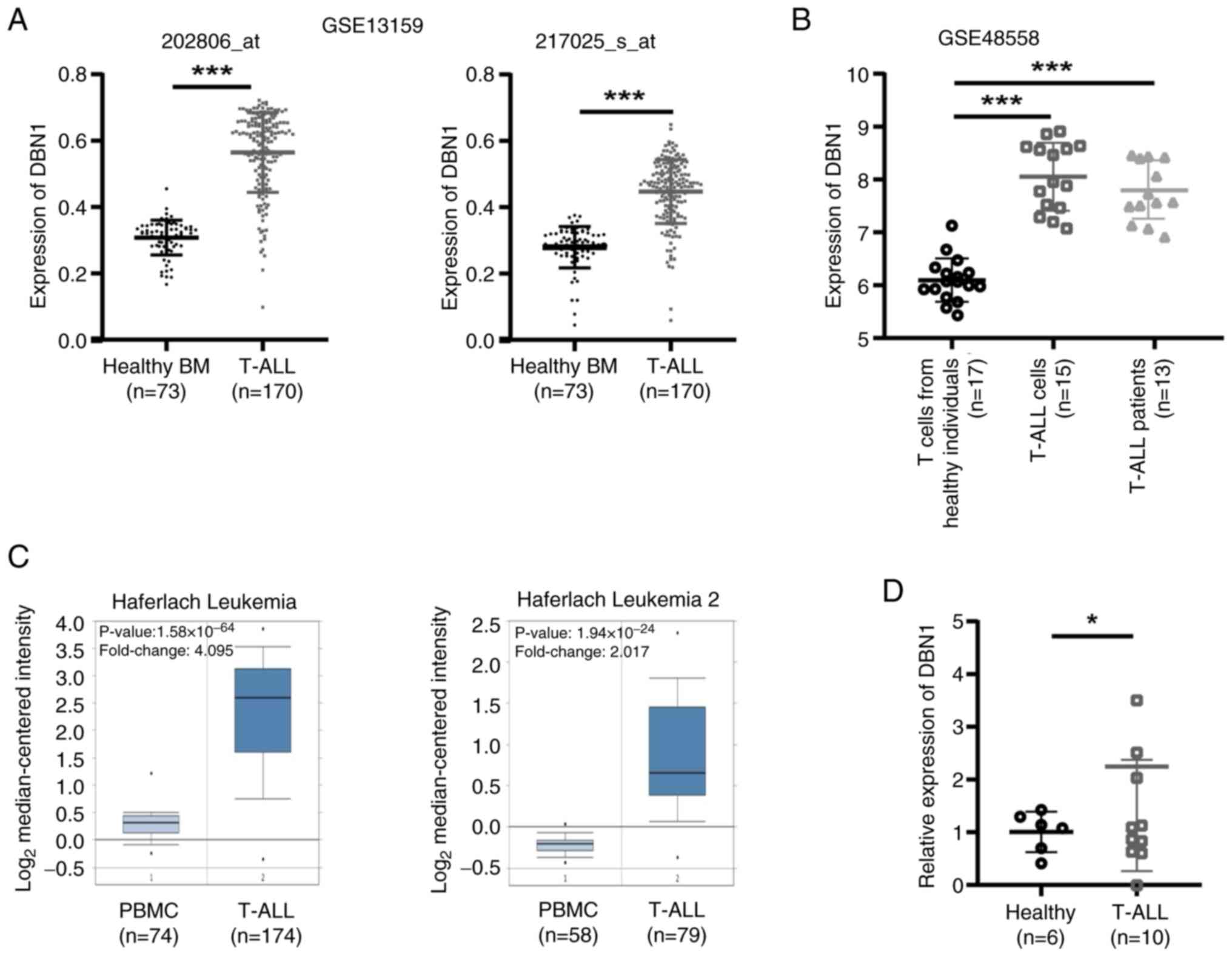
Figure 1

DBN1 is highly expressed in T-ALL.
(A) DBN1 expression in BM cells from patients with T-ALL (n=170)
and healthy individuals (n=73) (GSE13159). 202806_at and
217025_s_at are the probe names of DBN1. Statistical significance
was determined using the Wilcoxon rank sum test. (B) DBN1
expression in T cells from healthy individuals (n=17), T-ALL cells
(n=15) and samples from patients with T-ALL (n=13) (GSE48558).
Statistical significance was determined using the Kruskal-Wallis
test followed by the Bonferroni post hoc test. (C) DBN1 expression
in samples from patients with T-ALL and healthy PBMCs in Oncomine
datasets (Haferlach leukemia and Haferlach leukemia 2). Statistical
significance was determined using the Wilcoxon rank sum test. (D)
DBN1 expression in the PBMCs from 10 patients with T-ALL and 6
healthy individuals. Statistical significance was determined using
an unpaired t-test. *P<0.05, ***P<0.001. BM, bone marrow;
DBN1, drebrin 1; PBMC, peripheral blood mononuclear cell; T-ALL,
T-cell acute lymphoblastic leukemia.

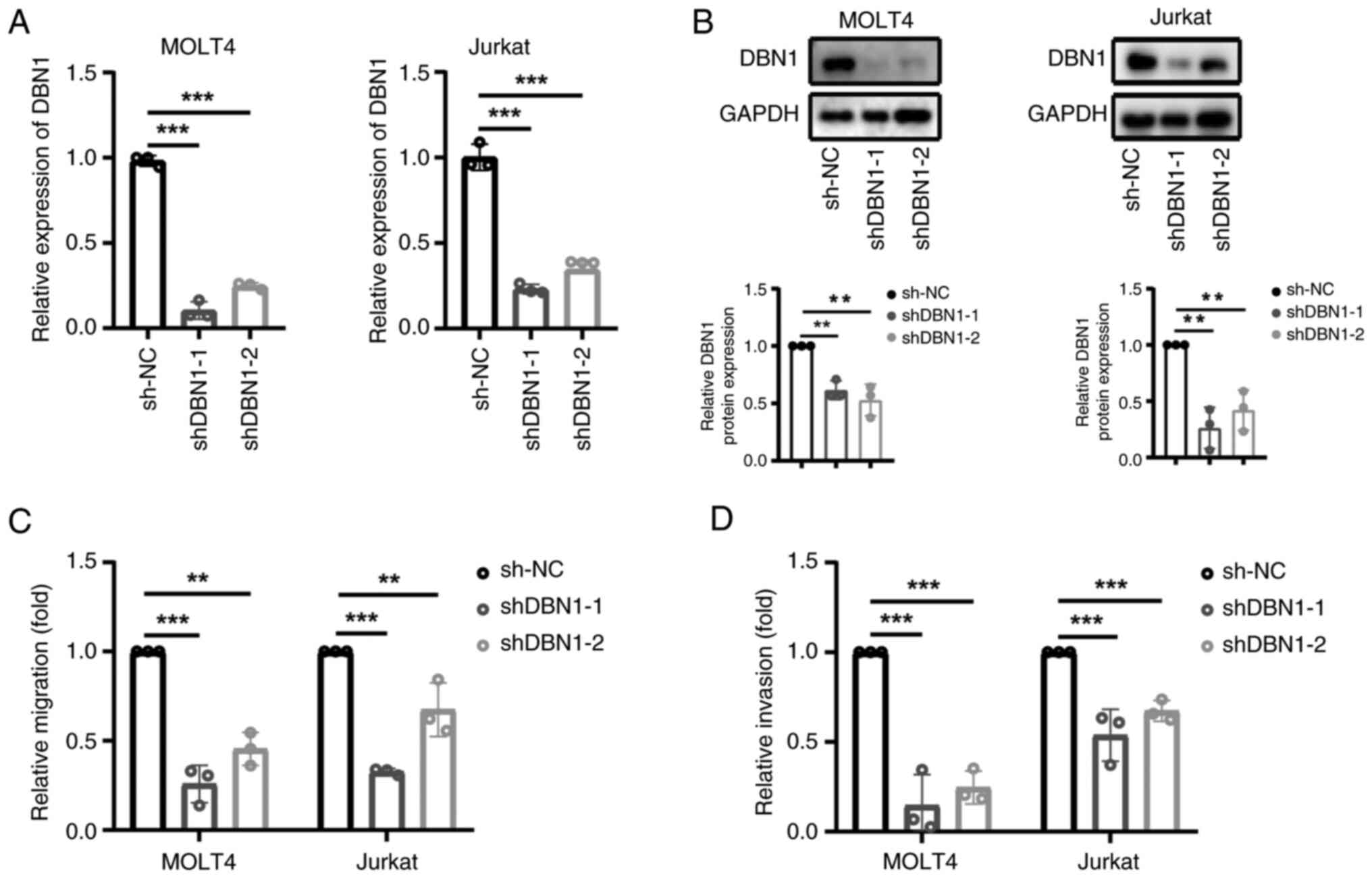
Figure 2

Knockdown of DBN1 inhibits cell
migration and invasion in vitro. (A) Reverse
transcription-quantitative PCR analysis of DBN1 mRNA expression in
DBN1-knockdown MOLT4 and Jurkat cells (sh-1 and sh-2). (B) Western
blot analysis of DBN1 protein expression in DBN1-knockdown MOLT4
and Jurkat cells (sh-1 and sh-2). The intensities of the protein
bands were determined using ImageJ. (C) Transwell assays showing
the migration tendency of DBN1-knockdown cells. (D)
Matrigel-Transwell assays showing the invasion tendency of leukemia
cells after DBN1 knockdown. The data were normalized and compared
with those in the sh-NC control group. Statistical significance was
determined using one-way ANOVA followed by the Bonferroni test.
**P<0.01, ***P<0.001. DBN1, drebrin 1; NC, negative control;
sh, short hairpin RNA.

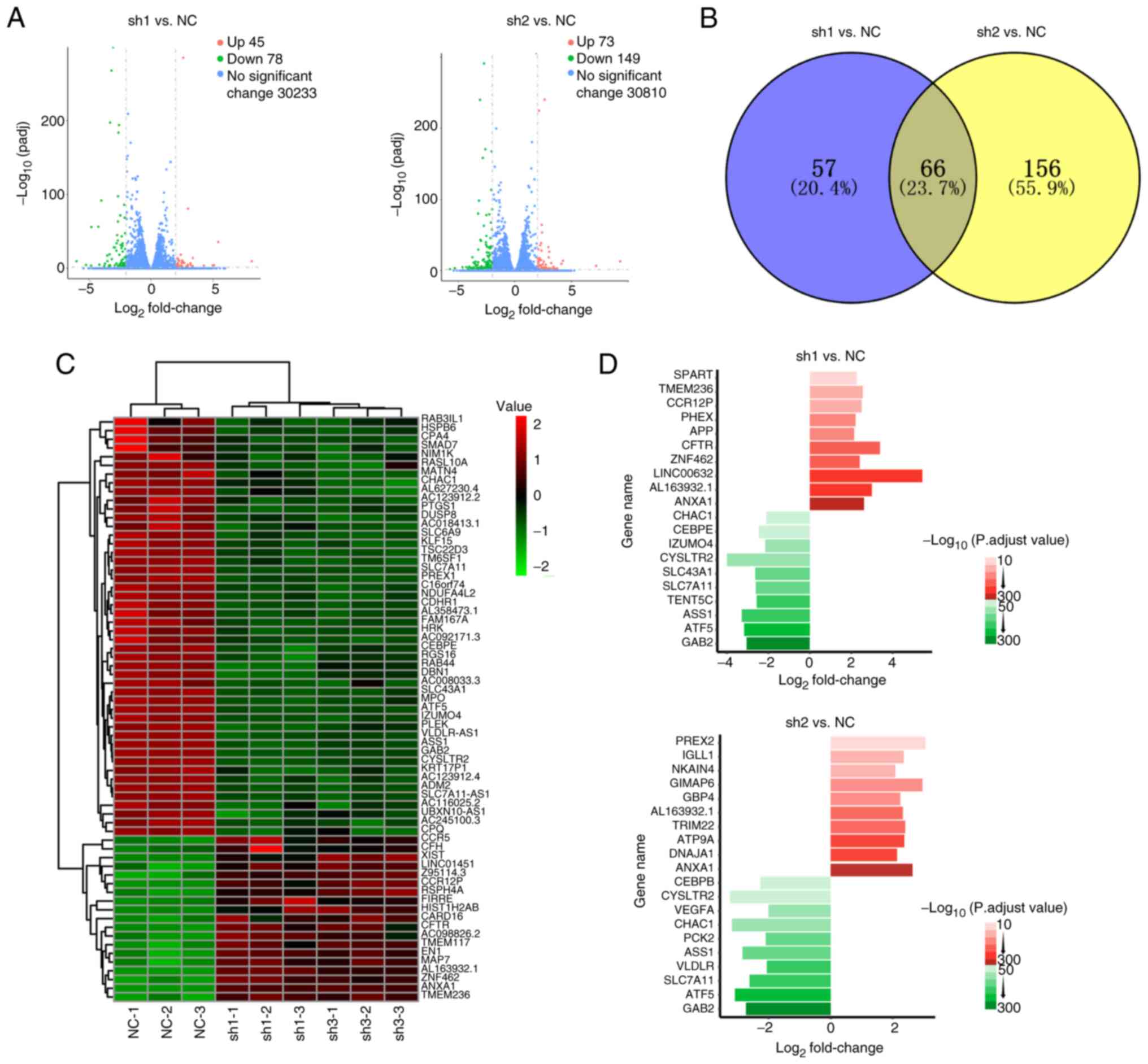
Figure 3

RNA-seq analysis in DBN1-knockdown
MOLT4 cells. (A) Volcano plot of transcriptome profiling in MOLT4
shDBN1-1 cells vs. NC cells (left). Genes significantly upregulated
(red) or downregulated (green) following DBN1 silencing are
highlighted. Volcano plot for the MOLT4 shDBN1-2 group (right). (B)
Venn diagram of DEGs downstream of DBN1 in shDBN1-1 and shDBN1-2
cells. (C) Heatmap of 66 statistically significant DEGs between
DBN1 knockdown and control samples based on RNA-seq data. The
‘value’ represents the relative expression value (Z-score) obtained
after normalization. (D) Top 10 genes with the most significant
upregulation or downregulation in the shDBN1-1 group (left) and
shDBN1-2 group (right). Red and green bars represent upregulated
and downregulated DEGs, respectively. The color gradient reflects
significance levels, with darker shades denoting lower P-values.
DBN1, drebrin 1; DEG, differentially expressed gene; NC, negative
control; padj, adjusted P-value; RNA-seq, RNA sequencing; sh, short
hairpin RNA.

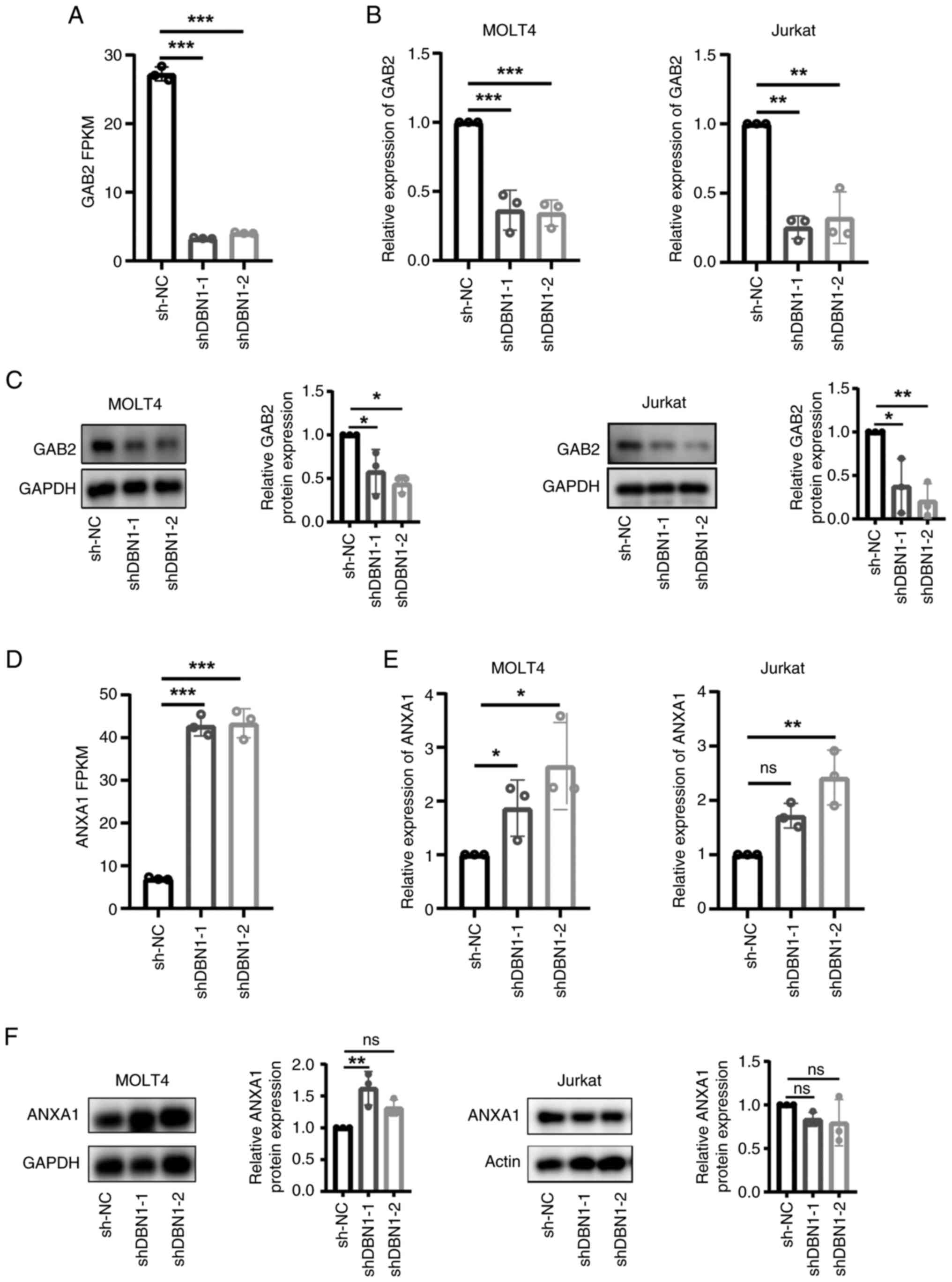
Figure 4

DBN1 regulates GAB2 expression. (A)
GAB2 FPKM in the NC and DBN1 knockdown groups. (B) RT-qPCR was
performed to assess the levels of GAB2 transcripts after DBN1
silencing. (C) Western blot analysis of GAB2 in NC and DBN1
knockdown cells. The intensities of the protein bands were
determined using ImageJ. (D) ANXA1 FPKM in the NC and DBN1
knockdown groups. (E) RT-qPCR was performed to determine the levels
of ANXA1 transcripts after DBN1 silencing. (F) Western blot
analysis of ANXA1 in NC and DBN1-knockdown cells. The intensities
of the protein bands were determined using ImageJ. Statistical
significance was determined using one-way ANOVA followed by the
Bonferroni test. *P<0.05, **P<0.01, ***P<0.001. ANXA1,
annexin A1; DBN1, drebrin 1; FPKM, fragments per kilobase million;
GAB2, Grb2-associated binding protein 2; NC, negative control; ns,
not significant; RT-qPCR, reverse transcription-quantitative PCR;
sh, short hairpin RNA.

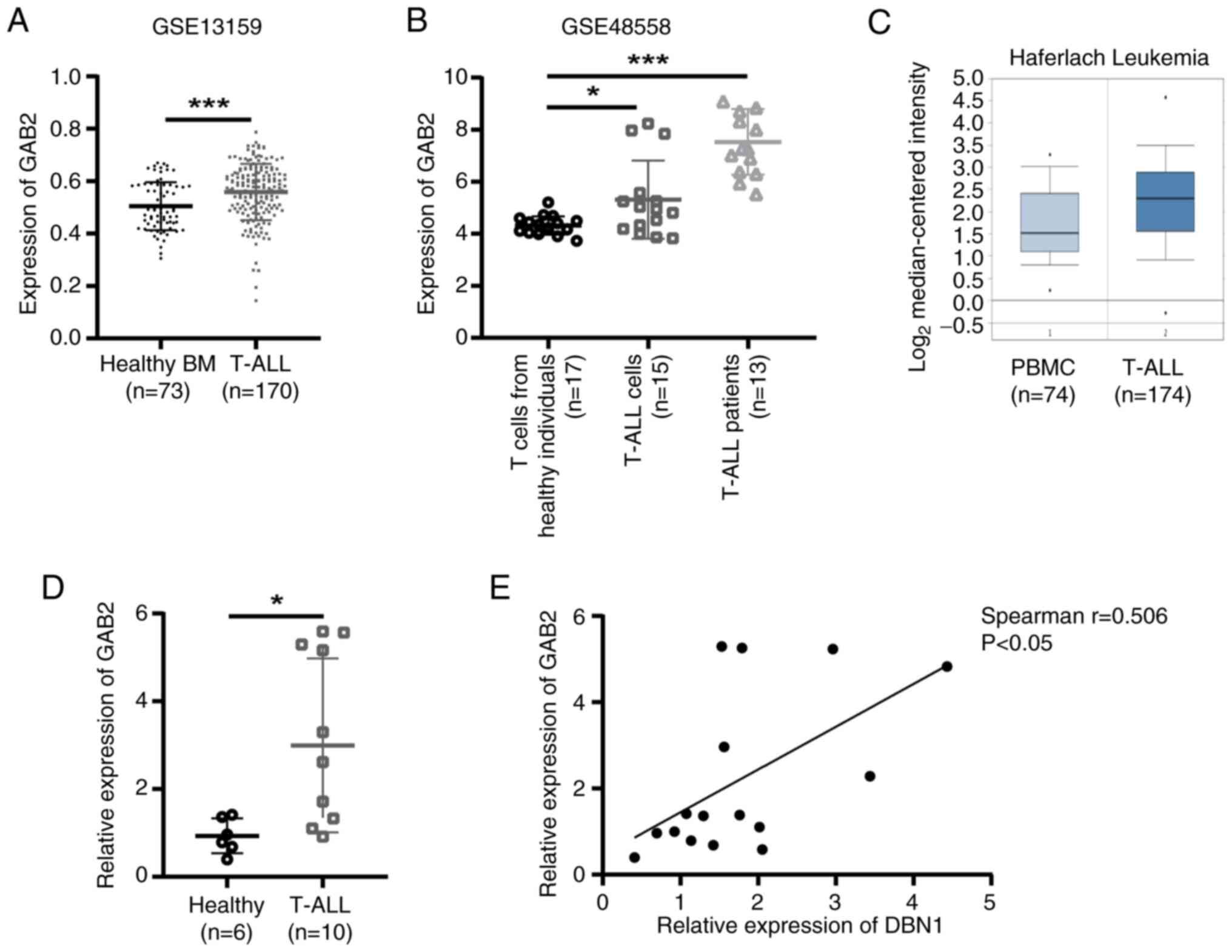
Figure 5

GAB2 is highly expressed in T-ALL.
(A) GAB2 expression in the GSE13159 dataset. BM from patients with
T-ALL (n=170) and BM from healthy individuals (n=73). Statistical
significance was determined using the Wilcoxon rank sum test. (B)
GSE48558. T cells from healthy individuals (n=17), T-ALL cells
(n=15) and samples from patients with T-ALL (n=13). Statistical
significance was determined using the Kruskal-Wallis test followed
by the Bonferroni post hoc test. (C) Oncomine dataset (Haferlach
leukemia). Statistical significance was determined using the
Wilcoxon rank sum test. (D) GAB2 expression in 10 T-ALL clinical PB
samples and 6 healthy donor PB samples. Statistical significance
was determined using an unpaired t-test. (E) Spearman's correlation
between DBN1 and GAB2 expression based on healthy and T-ALL
samples. *P<0.05, ***P<0.001. BM, bone marrow; DBN1, drebrin
1; GAB2, Grb2-associated binding protein 2; PB, peripheral blood;
PBMC, peripheral blood mononuclear cell; T-ALL, T-cell acute
lymphoblastic leukemia.

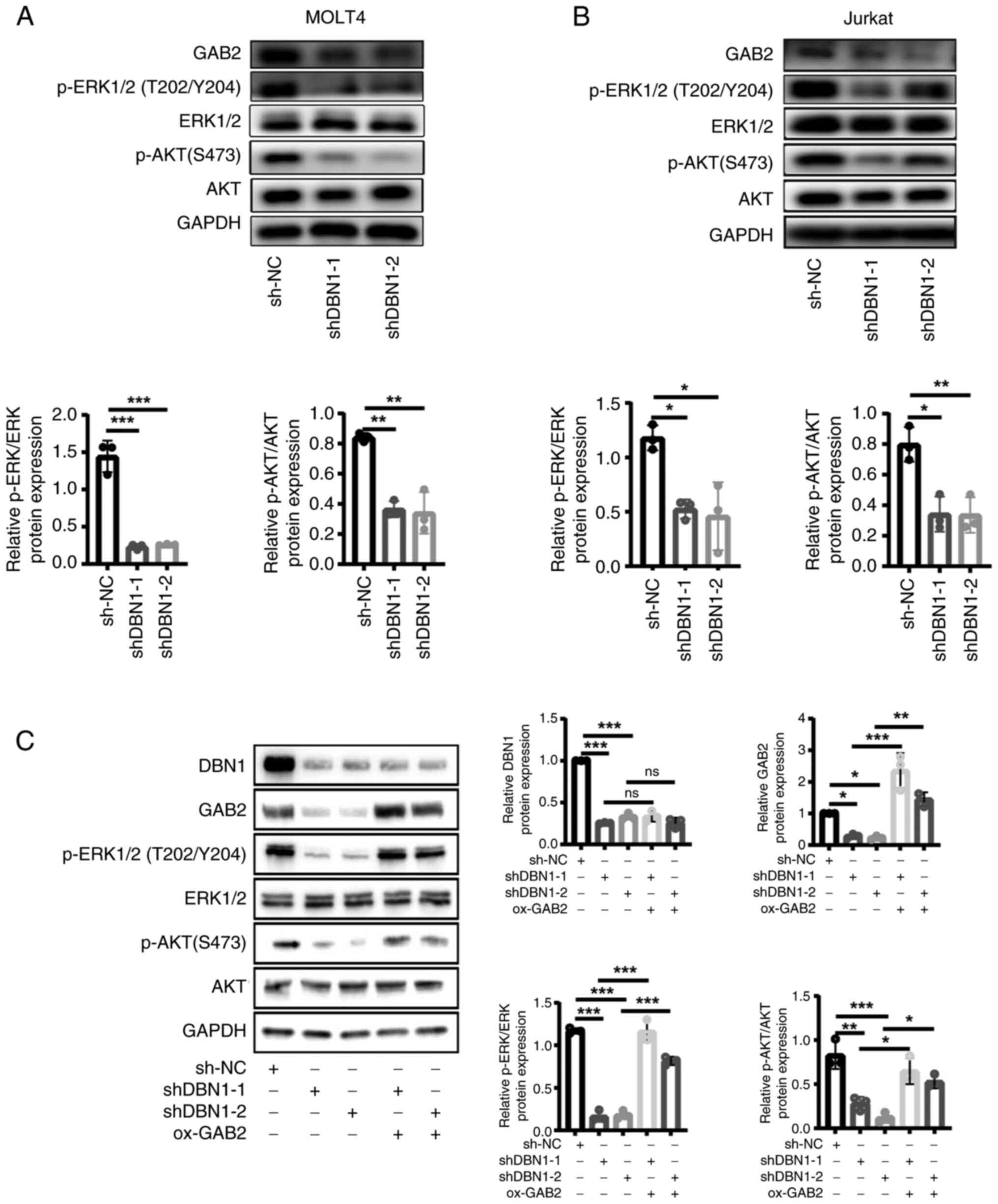
Figure 6

Downregulation of DBN1 inhibits both
GAB2 expression and the activation of the PI3K/AKT/ERK pathways.
(A) Inhibitory effects on the expression levels of GAB2, and
phosphorylated AKT and ERK1/2 in the DBN1-knockdown MOLT4 cells.
(B) Jurkat cells. (C) Overexpression of GAB2 rescued the expression
levels of phosphorylated AKT and ERK1/2 in DBN1-knockdown MOLT4
cells. The intensities of the protein bands were determined using
ImageJ. Statistical significance was determined using one-way ANOVA
followed by the Bonferroni test. *P<0.05, **P<0.01,
***P<0.001. DBN1, drebrin 1; GAB2, Grb2-associated binding
protein 2; NC, negative control; ns, not significant; ox-,
overexpression; p-, phosphorylated; sh, short hairpin RNA.

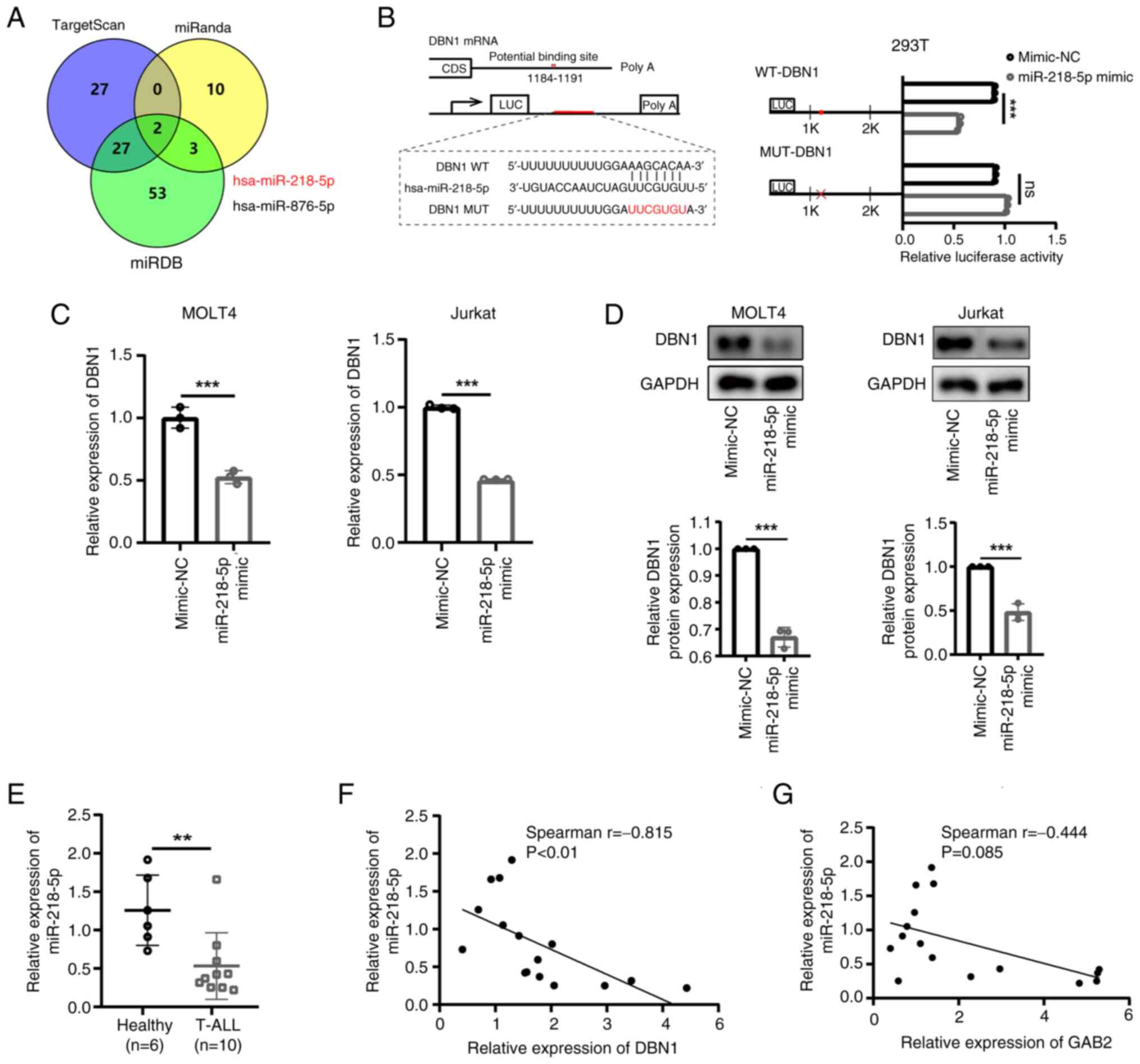
Figure 7

miR-218-5p regulates DBN1 expression
through direct binding to the 3′-untranslated region of DBN1. (A)
Bioinformatics analysis was performed using the TargetScan, miRanda
and miRDB databases. (B) Predicted miR-218-5p binding sites in DBN1
(WT) and the designed mutant sequence (MUT). Relative luciferase
activity was determined after cells were transfected with WT or
MUT. Statistical significance was determined using an unpaired
t-test. (C) Reverse transcription-quantitative PCR demonstrated
miR-218-5p-mediated suppression of DBN1 expression in T-ALL cells.
Statistical significance was determined using an unpaired t-test.
(D) Western blotting demonstrated miR-218-5p-mediated suppression
of DBN1 expression in T-ALL cells. The intensities of the protein
bands were determined using ImageJ. Statistical significance was
determined using an unpaired t-test. (E) Expression levels of
miR-218-5p in samples from healthy individuals and T-ALL samples.
Statistical significance was determined using an unpaired t-test.
(F) Spearman's correlation between miR-218-5p and DBN1 expression
in healthy individuals and patients with T-ALL. (G) Spearman's
correlation between miR-218-5p and GAB2 expression in healthy
individuals and patients with T-ALL. **P<0.01, ***P<0.001.
CDS, coding sequence; DBN1, drebrin 1; GAB2, Grb2-associated
binding protein 2; LUC, luciferase; miR, microRNA; MUT, mutant; NC,
negative control; ns, not significant; T-ALL, T-cell acute
lymphoblastic leukemia; WT, wild-type.

Figure 8

miR-218-5p is involved in T-ALL cell
migration and invasion. (A) Effects of miR-218-5p mimics
transfection on T-ALL cell migration and invasion. Statistical
significance was determined by one-way ANOVA followed by the
Bonferroni test. (B) Western blot analysis of GAB2, and
phosphorylated and total AKT and ERK1/2 in the MOLT4 cells after
miR-218-5p mimic transfection. Statistical significance was
determined using an unpaired t-test. (C) Western blot analysis of
the effects of GAB2 overexpression on the levels of phosphorylated
AKT and ERK1/2 in MOLT4 cells transfected with miR-218-5p mimic.
The intensities of the protein bands were determined using ImageJ.
Statistical significance was determined using one-way ANOVA
followed by the Bonferroni test. *P<0.05, **P<0.01,
***P<0.001. DBN1, drebrin 1; GAB2, Grb2-associated binding
protein 2; miR, microRNA; NC, negative control; ns, not
significant; ox-, overexpression; p-, phosphorylated; T-ALL, T-cell
acute lymphoblastic leukemia.
View References

1 

Raetz EA and Teachey DT: T-cell acute lymphoblastic leukemia. Hematology Am Soc Hematol Educ Program. 2016:580–588. 2016. View Article : Google Scholar : PubMed/NCBI

2 

Sanchez-Martin M and Ferrando A: The NOTCH1-MYC highway toward T-cell acute lymphoblastic leukemia. Blood. 129:1124–1133. 2017. View Article : Google Scholar : PubMed/NCBI

3 

Passaro D, Quang CT and Ghysdael J: Microenvironmental cues for T-cell acute lymphoblastic leukemia development. Immunol Rev. 271:156–172. 2016. View Article : Google Scholar : PubMed/NCBI

4 

Terwilliger T and Abdul-Hay M: Acute lymphoblastic leukemia: A comprehensive review and 2017 update. Blood Cancer J. 7:e5772017. View Article : Google Scholar : PubMed/NCBI

5 

Marks DI and Rowntree C: Management of adults with T-cell lymphoblastic leukemia. Blood. 129:1134–1142. 2017. View Article : Google Scholar : PubMed/NCBI

6 

Vadillo E, Dorantes-Acosta E, Pelayo R and Schnoor M: T cell acute lymphoblastic leukemia (T-ALL): New insights into the cellular origins and infiltration mechanisms common and unique among hematologic malignancies. Blood Rev. 32:36–51. 2018. View Article : Google Scholar : PubMed/NCBI

7 

Shirao T, Hanamura K, Koganezawa N, Ishizuka Y, Yamazaki H and Sekino Y: The role of drebrin in neurons. J Neurochem. 141:819–834. 2017. View Article : Google Scholar : PubMed/NCBI

8 

Ishikawa R, Hayashi K, Shirao T, Xue Y, Takagi T, Sasaki Y and Kohama K: Drebrin, a development-associated brain protein from rat embryo, causes the dissociation of tropomyosin from actin filaments. J Biol Chem. 269:29928–29933. 1994. View Article : Google Scholar : PubMed/NCBI

9 

Shirao T and Sekino Y: General introduction to drebrin. Adv Exp Med Biol. 1006:3–22. 2017. View Article : Google Scholar : PubMed/NCBI

10 

Rocha-Perugini V, Gordon-Alonso M and Sanchez-Madrid F: Role of drebrin at the immunological synapse. Adv Exp Med Biol. 1006:271–280. 2017. View Article : Google Scholar : PubMed/NCBI

11 

Shan Y, Farmer SM and Wray S: Drebrin regulates cytoskeleton dynamics in migrating neurons through interaction with CXCR4. Proc Natl Acad Sci USA. 118:e20094931182021. View Article : Google Scholar : PubMed/NCBI

12 

Shirao T, Hayashi K, Ishikawa R, Isa K, Asada H, Ikeda K and Uyemura K: Formation of thick, curving bundles of actin by drebrin A expressed in fibroblasts. Exp Cell Res. 215:145–153. 1994. View Article : Google Scholar : PubMed/NCBI

13 

Peitsch WK, Hofmann I, Prätzel S, Grund C, Kuhn C, Moll I, Langbein L and Franke WW: Drebrin particles: Components in the ensemble of proteins regulating actin dynamics of lamellipodia and filopodia. Eur J Cell Biol. 80:567–579. 2001. View Article : Google Scholar : PubMed/NCBI

14 

Ridley AJ, Schwartz MA, Burridge K, Firtel RA, Ginsberg MH, Borisy G, Parsons JT and Horwitz AR: Cell migration: Integrating signals from front to back. Science. 302:1704–1709. 2003. View Article : Google Scholar : PubMed/NCBI

15 

Dart AE, Worth DC, Muir G, Chandra A, Morris JD, McKee C, Verrill C, Bryant RJ and Gordon-Weeks PR: The drebrin/EB3 pathway drives invasive activity in prostate cancer. Oncogene. 36:4111–4123. 2017. View Article : Google Scholar : PubMed/NCBI

16 

Terakawa Y, Agnihotri S, Golbourn B, Nadi M, Sabha N, Smith CA, Croul SE and Rutka JT: The role of drebrin in glioma migration and invasion. Exp Cell Res. 319:517–528. 2013. View Article : Google Scholar : PubMed/NCBI

17 

Alfarsi LH, El Ansari R, Masisi BK, Parks R, Mohammed OJ, Ellis IO, Rakha EA and Green AR: Integrated analysis of key differentially expressed genes identifies DBN1 as a predictive marker of response to endocrine therapy in luminal breast cancer. Cancers (Basel). 12:15492020. View Article : Google Scholar : PubMed/NCBI

18 

Horst B, Gruvberger-Saal SK, Hopkins BD, Bordone L, Yang Y, Chernoff KA, Uzoma I, Schwipper V, Liebau J, Nowak NJ, et al: Gab2-mediated signaling promotes melanoma metastasis. Am J Pathol. 174:1524–1533. 2009. View Article : Google Scholar : PubMed/NCBI

19 

Bentires-Alj M, Gil SG, Chan R, Wang ZC, Wang Y, Imanaka N, Harris LN, Richardson A, Neel BG and Gu H: A role for the scaffolding adapter GAB2 in breast cancer. Nat Med. 12:114–121. 2006. View Article : Google Scholar : PubMed/NCBI

20 

Adams SJ, Aydin IT and Celebi JT: GAB2-a scaffolding protein in cancer. Mol Cancer Res. 10:1265–1270. 2012. View Article : Google Scholar : PubMed/NCBI

21 

Wöhrle FU, Daly RJ and Brummer T: Function, regulation and pathological roles of the Gab/DOS docking proteins. Cell Commun Signal. 7:222009. View Article : Google Scholar : PubMed/NCBI

22 

Wang C, Gu C, Jeong KJ, Zhang D, Guo W, Lu Y, Ju Z, Panupinthu N, Yang JY, Gagea MM, et al: YAP/TAZ-mediated upregulation of GAB2 leads to increased sensitivity to growth factor-induced activation of the PI3K pathway. Cancer Res. 77:1637–1648. 2017. View Article : Google Scholar : PubMed/NCBI

23 

Cheng J, Zhong Y, Chen S, Sun Y, Huang L, Kang Y, Chen B, Chen G, Wang F, Tian Y, et al: Gab2 mediates hepatocellular carcinogenesis by integrating multiple signaling pathways. FASEB J. 31:5530–5542. 2017. View Article : Google Scholar : PubMed/NCBI

24 

Shi X, Gong L, Liu Y, Hou K, Fan Y, Li C, Wen T, Qu X and Che X: 4-Phenylbutyric acid promotes migration of gastric cancer cells by histone deacetylase inhibition-mediated IL-8 upregulation. Epigenetics. 15:632–645. 2020. View Article : Google Scholar : PubMed/NCBI

25 

Gu S, Sayad A, Chan G, Yang W, Lu Z, Virtanen C, Van Etten RA and Neel BG: SHP2 is required for BCR-ABL1-induced hematologic neoplasia. Leukemia. 32:203–213. 2018. View Article : Google Scholar : PubMed/NCBI

26 

Spohr C, Poggio T, Andrieux G, Schönberger K, Cabezas-Wallscheid N, Boerries M, Halbach S, Illert AL and Brummer T: Gab2 deficiency prevents Flt3-ITD driven acute myeloid leukemia in vivo. Leukemia. 36:970–982. 2022. View Article : Google Scholar : PubMed/NCBI

27 

Sies K, Spohr C, Gründer A, Todorova R, Uhl FM, Huber J, Zeiser R, Pahl HL, Becker H, Aumann K, et al: Gab2 is essential for transformation by FLT3-ITD in acute myeloid leukemia. Hemasphere. 3:e1842019. View Article : Google Scholar : PubMed/NCBI

28 

Gong R, Li H, Liu Y, Wang Y, Ge L, Shi L, Wu G, Lyu J, Gu H and He L: Gab2 promotes acute myeloid leukemia growth and migration through the SHP2-Erk-CREB signaling pathway. J Leukoc Biol. 112:669–677. 2022. View Article : Google Scholar : PubMed/NCBI

29 

Haferlach T, Kohlmann A, Wieczorek L, Basso G, Kronnie GT, Béné MC, De Vos J, Hernandez JM, Hofmann WK, Mills KI, et al: Clinical utility of microarray-based gene expression profiling in the diagnosis and subclassification of leukemia: report from the International microarray innovations in leukemia study group. J Clin Oncol. 28:2529–2537. 2010. View Article : Google Scholar : PubMed/NCBI

30 

Cramer-Morales K, Nieborowska-Skorska M, Scheibner K, Padget M, Irvine DA, Sliwinski T, Haas K, Lee J, Geng H and Roy D: Personalized synthetic lethality induced by targeting RAD52 in leukemias identified by gene mutation and expression profile. Blood. 122:1293–1304. 2013. View Article : Google Scholar : PubMed/NCBI

31 

Ng OH, Erbilgin Y, Firtina S, Celkan T, Karakas Z, Aydogan G, Turkkan E, Yildirmak Y, Timur C, Zengin E, et al: Deregulated WNT signaling in childhood T-cell acute lymphoblastic leukemia. Blood Cancer J. 4:e1922014. View Article : Google Scholar : PubMed/NCBI

32 

Homminga I, Pieters R, Langerak AW, de Rooi JJ, Stubbs A, Verstegen M, Vuerhard M, Buijs-Gladdines J, Kooi C, Klous P, et al: Integrated transcript and genome analyses reveal NKX2-1 and MEF2C as potential oncogenes in T cell acute lymphoblastic leukemia. Cancer Cell. 19:484–497. 2011. View Article : Google Scholar : PubMed/NCBI

33 

Kohlmann A, Kipps TJ, Rassenti LZ, Downing JR, Shurtleff SA, Mills KI, Gilkes AF, Hofmann WK, Basso G, Dell'orto MC, et al: An international standardization programme towards the application of gene expression profiling in routine leukaemia diagnostics: The microarray innovations in leukemia study prephase. Br J Haematol. 142:802–807. 2008. View Article : Google Scholar : PubMed/NCBI

34 

Livak KJ and Schmittgen TD: Analysis of relative gene expression data using real-time quantitative PCR and the 2(−Delta Delta C(T)) method. Methods. 25:402–408. 2001. View Article : Google Scholar : PubMed/NCBI

35 

Zeng X, Lei Y, Pan S, Sun J, He H, Xiao D, Jamal M, Shen H, Zhou F, Shao L and Zhang Q: LncRNA15691 promotes T-ALL infiltration by upregulating CCR9 via increased MATR3 stability. J Leukoc Biol. 113:203–215. 2023. View Article : Google Scholar : PubMed/NCBI

36 

Jamal M, Lei Y, He H, Zeng X, Bangash HI, Xiao D, Shao L, Zhou F and Zhang Q: CCR9 overexpression promotes T-ALL progression by enhancing cholesterol biosynthesis. Front Pharmacol. 14:12572892023. View Article : Google Scholar : PubMed/NCBI

37 

Li G, Gao L, Zhao J, Liu D, Li H and Hu M: LncRNA ANRIL/miR-7-5p/TCF4 axis contributes to the progression of T cell acute lymphoblastic leukemia. Cancer Cell Int. 20:3352020. View Article : Google Scholar : PubMed/NCBI

38 

Guoren Z, Zhaohui F, Wei Z, Mei W, Yuan W, Lin S, Xiaoyue X, Xiaomei Z and Bo S: TFAP2A induced ITPKA serves as an oncogene and interacts with DBN1 in lung adenocarcinoma. Int J Biol Sci. 16:504–514. 2020. View Article : Google Scholar : PubMed/NCBI

39 

Ding C, Luo J, Li L, Li S, Yang L, Pan H, Liu Q, Qin H, Chen C and Feng J: Gab2 facilitates epithelial-to-mesenchymal transition via the MEK/ERK/MMP signaling in colorectal cancer. J Exp Clin Cancer Res. 35:52016. View Article : Google Scholar : PubMed/NCBI

40 

Bhojwani D and Pui CH: Relapsed childhood acute lymphoblastic leukaemia. Lancet Oncol. 14:e205–e217. 2013. View Article : Google Scholar : PubMed/NCBI

41 

Stock W, Johnson JL, Stone RM, Kolitz JE, Powell BL, Wetzler M, Westervelt P, Marcucci G, DeAngelo DJ, Vardiman JW, et al: Dose intensification of daunorubicin and cytarabine during treatment of adult acute lymphoblastic leukemia: Results of cancer and leukemia group B study 19802. Cancer. 119:90–98. 2013. View Article : Google Scholar : PubMed/NCBI

42 

Wei M, Haney MG, Rivas DR and Blackburn JS: Protein tyrosine phosphatase 4A3 (PTP4A3/PRL-3) drives migration and progression of T-cell acute lymphoblastic leukemia in vitro and in vivo. Oncogenesis. 9:62020. View Article : Google Scholar : PubMed/NCBI

43 

Nourshargh S, Hordijk PL and Sixt M: Breaching multiple barriers: Leukocyte motility through venular walls and the interstitium. Nat Rev Mol Cell Biol. 11:366–378. 2010. View Article : Google Scholar : PubMed/NCBI

44 

Krummel MF, Friedman RS and Jacobelli J: Modes and mechanisms of T cell motility: Roles for confinement and Myosin-IIA. Curr Opin Cell Biol. 30:9–16. 2014. View Article : Google Scholar : PubMed/NCBI

45 

Dun XP and Chilton JK: Control of cell shape and plasticity during development and disease by the actin-binding protein Drebrin. Histol Histopathol. 25:533–540. 2010.PubMed/NCBI

46 

Dang E, Yang S, Song C, Jiang D, Li Z, Fan W, Sun Y, Tao L, Wang J, Liu T, et al: BAP31, a newly defined cancer/testis antigen, regulates proliferation, migration, and invasion to promote cervical cancer progression. Cell Death Dis. 9:7912018. View Article : Google Scholar : PubMed/NCBI

47 

Iyama S, Ono M, Kawai-Nakahara H, Husni RE, Dai T, Shiozawa T, Sakata A, Kohrogi H and Noguchi M: Drebrin: A new oncofetal biomarker associated with prognosis of lung adenocarcinoma. Lung Cancer. 102:74–81. 2016. View Article : Google Scholar : PubMed/NCBI

48 

Peitsch WK, Hofmann I, Bulkescher J, Hergt M, Spring H, Bleyl U, Goerdt S and Franke WW: Drebrin, an actin-binding, cell-type characteristic protein: Induction and localization in epithelial skin tumors and cultured keratinocytes. J Invest Dermatol. 125:761–774. 2005. View Article : Google Scholar : PubMed/NCBI

49 

Lin Q, Tan HT, Lim TK, Khoo A, Lim KH and Chung MCM: iTRAQ analysis of colorectal cancer cell lines suggests Drebrin (DBN1) is overexpressed during liver metastasis. Proteomics. 14:1434–1443. 2014. View Article : Google Scholar : PubMed/NCBI

50 

Jasek-Gajda E, Jurkowska H, Jasińska M and Lis GJ: Targeting the MAPK/ERK and PI3K/AKT signaling pathways affects NRF2, Trx and GSH antioxidant systems in leukemia cells. Antioxidants (Basel). 9:6332020. View Article : Google Scholar : PubMed/NCBI

51 

Guo JR, Li W, Wu Y, Wu LQ, Li X, Guo YF, Zheng XH, Lian XL, Huang HF and Chen YZ: Hepatocyte growth factor promotes proliferation, invasion, and metastasis of myeloid leukemia cells through PI3K-AKT and MAPK/ERK signaling pathway. Am J Transl Res. 8:3630–3644. 2016.PubMed/NCBI

52 

Jiang H, Tang J, Qiu L, Zhang Z, Shi S, Xue L, Kui L, Huang T, Nan W, Zhou B, et al: Semaphorin 4D is a potential biomarker in pediatric leukemia and promotes leukemogenesis by activating PI3K/AKT and ERK signaling pathways. Oncol Rep. 45:12021. View Article : Google Scholar : PubMed/NCBI

53 

Chiang YJ, Liao WT, Ho KC, Wang SH, Chen YG, Ho CL, Huang SF, Shih LY, Yang-Yen HFY and Yen JJY: CBAP modulates Akt-dependent TSC2 phosphorylation to promote Rheb-mTORC1 signaling and growth of T-cell acute lymphoblastic leukemia. Oncogene. 38:1432–1447. 2019. View Article : Google Scholar : PubMed/NCBI

54 

Saliminejad K, Khorram Khorshid HR, Soleymani Fard S and Ghaffari SH: An overview of microRNAs: Biology, functions, therapeutics, and analysis methods. J Cell Physiol. 234:5451–5465. 2019. View Article : Google Scholar : PubMed/NCBI

55 

Bartel DP: MicroRNAs: Target recognition and regulatory functions. Cell. 136:215–233. 2009. View Article : Google Scholar : PubMed/NCBI

56 

Bartel DP and Chen CZ: Micromanagers of gene expression: The potentially widespread influence of metazoan microRNAs. Nat Rev Genet. 5:396–400. 2004. View Article : Google Scholar : PubMed/NCBI

57 

Huang W, Wang WT, Fang K, Chen ZH, Sun YM, Han C, Sun LY, Luo XQ and Chen YQ: MIR-708 promotes phagocytosis to eradicate T-ALL cells by targeting CD47. Mol Cancer. 17:122018. View Article : Google Scholar : PubMed/NCBI

58 

Deng M, Zeng C, Lu X, He X, Zhang R, Qiu Q, Zheng G, Jia X, Liu H and He Z: miR-218 suppresses gastric cancer cell cycle progression through the CDK6/Cyclin D1/E2F1 axis in a feedback loop. Cancer Lett. 403:175–185. 2017. View Article : Google Scholar : PubMed/NCBI

59 

Li Y, Shi B, Dong F, Zhu X, Liu B and Liu Y: LncRNA KCNQ1OT1 facilitates the progression of bladder cancer by targeting MiR-218-5p/HS3ST3B1. Cancer Gene Ther. 28:212–220. 2021. View Article : Google Scholar : PubMed/NCBI

60 

Liu Z, Mao L, Wang L, Zhang H and Hu X: miR-218 functions as a tumor suppressor gene in cervical cancer. Mol Med Rep. 21:209–219. 2020.PubMed/NCBI

Related Articles

  • Abstract
  • View
  • Download
  • Twitter
Copy and paste a formatted citation
Spandidos Publications style
Sun J, Huang X, Zeng X, Lei Y, He H, Wei Z, Xiao D, Zhang Q, Li X, Zhou F, Zhou F, et al: DBN1‑mediated upregulation of GAB2 facilitates the migration and invasion of T‑cell acute lymphoblastic leukemia cells. Oncol Rep 54: 149, 2025.
APA
Sun, J., Huang, X., Zeng, X., Lei, Y., He, H., Wei, Z. ... Shao, L. (2025). DBN1‑mediated upregulation of GAB2 facilitates the migration and invasion of T‑cell acute lymphoblastic leukemia cells. Oncology Reports, 54, 149. https://doi.org/10.3892/or.2025.8982
MLA
Sun, J., Huang, X., Zeng, X., Lei, Y., He, H., Wei, Z., Xiao, D., Zhang, Q., Li, X., Zhou, F., Shao, L."DBN1‑mediated upregulation of GAB2 facilitates the migration and invasion of T‑cell acute lymphoblastic leukemia cells". Oncology Reports 54.5 (2025): 149.
Chicago
Sun, J., Huang, X., Zeng, X., Lei, Y., He, H., Wei, Z., Xiao, D., Zhang, Q., Li, X., Zhou, F., Shao, L."DBN1‑mediated upregulation of GAB2 facilitates the migration and invasion of T‑cell acute lymphoblastic leukemia cells". Oncology Reports 54, no. 5 (2025): 149. https://doi.org/10.3892/or.2025.8982
Copy and paste a formatted citation
x
Spandidos Publications style
Sun J, Huang X, Zeng X, Lei Y, He H, Wei Z, Xiao D, Zhang Q, Li X, Zhou F, Zhou F, et al: DBN1‑mediated upregulation of GAB2 facilitates the migration and invasion of T‑cell acute lymphoblastic leukemia cells. Oncol Rep 54: 149, 2025.
APA
Sun, J., Huang, X., Zeng, X., Lei, Y., He, H., Wei, Z. ... Shao, L. (2025). DBN1‑mediated upregulation of GAB2 facilitates the migration and invasion of T‑cell acute lymphoblastic leukemia cells. Oncology Reports, 54, 149. https://doi.org/10.3892/or.2025.8982
MLA
Sun, J., Huang, X., Zeng, X., Lei, Y., He, H., Wei, Z., Xiao, D., Zhang, Q., Li, X., Zhou, F., Shao, L."DBN1‑mediated upregulation of GAB2 facilitates the migration and invasion of T‑cell acute lymphoblastic leukemia cells". Oncology Reports 54.5 (2025): 149.
Chicago
Sun, J., Huang, X., Zeng, X., Lei, Y., He, H., Wei, Z., Xiao, D., Zhang, Q., Li, X., Zhou, F., Shao, L."DBN1‑mediated upregulation of GAB2 facilitates the migration and invasion of T‑cell acute lymphoblastic leukemia cells". Oncology Reports 54, no. 5 (2025): 149. https://doi.org/10.3892/or.2025.8982
Follow us
  • Twitter
  • LinkedIn
  • Facebook
About
  • Spandidos Publications
  • Careers
  • Cookie Policy
  • Privacy Policy
How can we help?
  • Help
  • Live Chat
  • Contact
  • Email to our Support Team