Spandidos Publications Logo
  • About
    • About Spandidos
    • Aims and Scopes
    • Abstracting and Indexing
    • Editorial Policies
    • Reprints and Permissions
    • Job Opportunities
    • Terms and Conditions
    • Contact
  • Journals
    • All Journals
    • Oncology Letters
      • Oncology Letters
      • Information for Authors
      • Editorial Policies
      • Editorial Board
      • Aims and Scope
      • Abstracting and Indexing
      • Bibliographic Information
      • Archive
    • International Journal of Oncology
      • International Journal of Oncology
      • Information for Authors
      • Editorial Policies
      • Editorial Board
      • Aims and Scope
      • Abstracting and Indexing
      • Bibliographic Information
      • Archive
    • Molecular and Clinical Oncology
      • Molecular and Clinical Oncology
      • Information for Authors
      • Editorial Policies
      • Editorial Board
      • Aims and Scope
      • Abstracting and Indexing
      • Bibliographic Information
      • Archive
    • Experimental and Therapeutic Medicine
      • Experimental and Therapeutic Medicine
      • Information for Authors
      • Editorial Policies
      • Editorial Board
      • Aims and Scope
      • Abstracting and Indexing
      • Bibliographic Information
      • Archive
    • International Journal of Molecular Medicine
      • International Journal of Molecular Medicine
      • Information for Authors
      • Editorial Policies
      • Editorial Board
      • Aims and Scope
      • Abstracting and Indexing
      • Bibliographic Information
      • Archive
    • Biomedical Reports
      • Biomedical Reports
      • Information for Authors
      • Editorial Policies
      • Editorial Board
      • Aims and Scope
      • Abstracting and Indexing
      • Bibliographic Information
      • Archive
    • Oncology Reports
      • Oncology Reports
      • Information for Authors
      • Editorial Policies
      • Editorial Board
      • Aims and Scope
      • Abstracting and Indexing
      • Bibliographic Information
      • Archive
    • Molecular Medicine Reports
      • Molecular Medicine Reports
      • Information for Authors
      • Editorial Policies
      • Editorial Board
      • Aims and Scope
      • Abstracting and Indexing
      • Bibliographic Information
      • Archive
    • World Academy of Sciences Journal
      • World Academy of Sciences Journal
      • Information for Authors
      • Editorial Policies
      • Editorial Board
      • Aims and Scope
      • Abstracting and Indexing
      • Bibliographic Information
      • Archive
    • International Journal of Functional Nutrition
      • International Journal of Functional Nutrition
      • Information for Authors
      • Editorial Policies
      • Editorial Board
      • Aims and Scope
      • Abstracting and Indexing
      • Bibliographic Information
      • Archive
    • International Journal of Epigenetics
      • International Journal of Epigenetics
      • Information for Authors
      • Editorial Policies
      • Editorial Board
      • Aims and Scope
      • Abstracting and Indexing
      • Bibliographic Information
      • Archive
    • Medicine International
      • Medicine International
      • Information for Authors
      • Editorial Policies
      • Editorial Board
      • Aims and Scope
      • Abstracting and Indexing
      • Bibliographic Information
      • Archive
  • Articles
  • Information
    • Information for Authors
    • Information for Reviewers
    • Information for Librarians
    • Information for Advertisers
    • Conferences
  • Language Editing
Spandidos Publications Logo
  • About
    • About Spandidos
    • Aims and Scopes
    • Abstracting and Indexing
    • Editorial Policies
    • Reprints and Permissions
    • Job Opportunities
    • Terms and Conditions
    • Contact
  • Journals
    • All Journals
    • Biomedical Reports
      • Information for Authors
      • Editorial Policies
      • Editorial Board
      • Aims and Scope
      • Abstracting and Indexing
      • Bibliographic Information
      • Archive
    • Experimental and Therapeutic Medicine
      • Information for Authors
      • Editorial Policies
      • Editorial Board
      • Aims and Scope
      • Abstracting and Indexing
      • Bibliographic Information
      • Archive
    • International Journal of Epigenetics
      • Information for Authors
      • Editorial Policies
      • Editorial Board
      • Aims and Scope
      • Abstracting and Indexing
      • Bibliographic Information
      • Archive
    • International Journal of Functional Nutrition
      • Information for Authors
      • Editorial Policies
      • Editorial Board
      • Aims and Scope
      • Abstracting and Indexing
      • Bibliographic Information
      • Archive
    • International Journal of Molecular Medicine
      • Information for Authors
      • Editorial Policies
      • Editorial Board
      • Aims and Scope
      • Abstracting and Indexing
      • Bibliographic Information
      • Archive
    • International Journal of Oncology
      • Information for Authors
      • Editorial Policies
      • Editorial Board
      • Aims and Scope
      • Abstracting and Indexing
      • Bibliographic Information
      • Archive
    • Medicine International
      • Information for Authors
      • Editorial Policies
      • Editorial Board
      • Aims and Scope
      • Abstracting and Indexing
      • Bibliographic Information
      • Archive
    • Molecular and Clinical Oncology
      • Information for Authors
      • Editorial Policies
      • Editorial Board
      • Aims and Scope
      • Abstracting and Indexing
      • Bibliographic Information
      • Archive
    • Molecular Medicine Reports
      • Information for Authors
      • Editorial Policies
      • Editorial Board
      • Aims and Scope
      • Abstracting and Indexing
      • Bibliographic Information
      • Archive
    • Oncology Letters
      • Information for Authors
      • Editorial Policies
      • Editorial Board
      • Aims and Scope
      • Abstracting and Indexing
      • Bibliographic Information
      • Archive
    • Oncology Reports
      • Information for Authors
      • Editorial Policies
      • Editorial Board
      • Aims and Scope
      • Abstracting and Indexing
      • Bibliographic Information
      • Archive
    • World Academy of Sciences Journal
      • Information for Authors
      • Editorial Policies
      • Editorial Board
      • Aims and Scope
      • Abstracting and Indexing
      • Bibliographic Information
      • Archive
  • Articles
  • Information
    • For Authors
    • For Reviewers
    • For Librarians
    • For Advertisers
    • Conferences
  • Language Editing
Login Register Submit
  • This site uses cookies
  • You can change your cookie settings at any time by following the instructions in our Cookie Policy. To find out more, you may read our Privacy Policy.

    I agree
Search articles by DOI, keyword, author or affiliation
Search
Advanced Search
presentation
Oncology Reports
Join Editorial Board Propose a Special Issue
Print ISSN: 1021-335X Online ISSN: 1791-2431
Journal Cover
February-2026 Volume 55 Issue 2

Full Size Image

Sign up for eToc alerts
Recommend to Library

Journals

International Journal of Molecular Medicine

International Journal of Molecular Medicine

International Journal of Molecular Medicine is an international journal devoted to molecular mechanisms of human disease.

International Journal of Oncology

International Journal of Oncology

International Journal of Oncology is an international journal devoted to oncology research and cancer treatment.

Molecular Medicine Reports

Molecular Medicine Reports

Covers molecular medicine topics such as pharmacology, pathology, genetics, neuroscience, infectious diseases, molecular cardiology, and molecular surgery.

Oncology Reports

Oncology Reports

Oncology Reports is an international journal devoted to fundamental and applied research in Oncology.

Experimental and Therapeutic Medicine

Experimental and Therapeutic Medicine

Experimental and Therapeutic Medicine is an international journal devoted to laboratory and clinical medicine.

Oncology Letters

Oncology Letters

Oncology Letters is an international journal devoted to Experimental and Clinical Oncology.

Biomedical Reports

Biomedical Reports

Explores a wide range of biological and medical fields, including pharmacology, genetics, microbiology, neuroscience, and molecular cardiology.

Molecular and Clinical Oncology

Molecular and Clinical Oncology

International journal addressing all aspects of oncology research, from tumorigenesis and oncogenes to chemotherapy and metastasis.

World Academy of Sciences Journal

World Academy of Sciences Journal

Multidisciplinary open-access journal spanning biochemistry, genetics, neuroscience, environmental health, and synthetic biology.

International Journal of Functional Nutrition

International Journal of Functional Nutrition

Open-access journal combining biochemistry, pharmacology, immunology, and genetics to advance health through functional nutrition.

International Journal of Epigenetics

International Journal of Epigenetics

Publishes open-access research on using epigenetics to advance understanding and treatment of human disease.

Medicine International

Medicine International

An International Open Access Journal Devoted to General Medicine.

Journal Cover
February-2026 Volume 55 Issue 2

Full Size Image

Sign up for eToc alerts
Recommend to Library

  • Article
  • Citations
    • Cite This Article
    • Download Citation
    • Create Citation Alert
    • Remove Citation Alert
    • Cited By
  • Similar Articles
    • Related Articles (in Spandidos Publications)
    • Similar Articles (Google Scholar)
    • Similar Articles (PubMed)
  • Download PDF
  • Download XML
  • View XML

  • Supplementary Files
    • Supplementary_Data.pdf
Article Open Access

Prognostic significance of fibroblast senescence and senescence-associated secretory phenotype factor expression in the tumor microenvironment of pancreatic ductal adenocarcinoma

  • Authors:
    • Yuto Kitano
    • Tomoharu Miyashita
    • Takeo Shimasaki
    • Isamu Makino
    • Yoshio Endo
    • Yasuhiko Yamamoto
    • Noriyuki Inaki
    • Shintaro Yagi
  • View Affiliations / Copyright

    Affiliations: Department of Hepato‑Biliary‑Pancreatic Surgery and Transplantation/Pediatric Surgery, Kanazawa University, Kanazawa, Ishikawa 920‑8641, Japan, Medical Research Institute, Kanazawa Medical University, Uchinada, Ishikawa 920‑0293, Japan, Central Research Resource Branch, Cancer Research Institute, Kanazawa University, Kanazawa, Ishikawa 920‑1192, Japan, Department of Biochemistry and Molecular Vascular Biology, Graduate School of Medical Sciences, Kanazawa University, Kanazawa, Ishikawa 920‑8641, Japan, Department of Gastrointestinal Surgery/Breast Surgery, Kanazawa University, Kanazawa, Ishikawa 920‑8641, Japan
    Copyright: © Kitano et al. This is an open access article distributed under the terms of Creative Commons Attribution License.
  • Article Number: 26
    |
    Published online on: December 3, 2025
       https://doi.org/10.3892/or.2025.9031
  • Expand metrics +
Metrics: Total Views: 0 (Spandidos Publications: | PMC Statistics: )
Metrics: Total PDF Downloads: 0 (Spandidos Publications: | PMC Statistics: )
Cited By (CrossRef): 0 citations Loading Articles...

This article is mentioned in:


Abstract

Pancreatic ductal adenocarcinoma (PDAC) is characterized by a dense fibrous stroma, within which a subset of fibroblasts function as cancer‑associated fibroblasts (CAFs) and contribute to tumor progression. Some of these fibroblasts undergo senescence and promote malignancy through the senescence‑associated secretory phenotype (SASP). The present study investigated SASP factor expression in senescent fibroblasts within the PDAC microenvironment and evaluated their impact on tumor progression. The expression levels of the senescence marker p16 and the SASP factor interleukin‑6 (IL‑6) were assessed using fluorescence immunostaining in resected specimens from 90 patients with PDAC who underwent pancreaticoduodenectomy. Senescence was induced in primary human pancreatic fibroblasts via X‑ray irradiation in vitro, followed by evaluation of SASP factor expression. These senescent fibroblasts were then co‑cultured with human pancreatic cancer Panc‑1 cells to assess their effects on cancer cell invasion, migration and proliferation. Immunostaining demonstrated the presence of p16‑ and IL‑6‑expressing fibroblasts in the PDAC stroma of patient samples. A positive correlation was observed between p16 and IL‑6 expression levels in fibroblasts. Notably, increased expression levels of IL‑6‑positive fibroblasts were associated with reduced postoperative survival. Multivariate analysis identified high IL‑6 expression and lymph node metastasis as independent prognostic indicators of poor outcome. In co‑culture experiments, senescent fibroblasts enhanced Panc‑1 cell invasion, migration and proliferation. These findings suggested that senescent fibroblasts within the PDAC stroma, with high SASP factor expression, contribute to tumor aggressiveness and are associated with poor prognosis. The present study demonstrated that IL‑6‑expressing senescent fibroblasts are potential prognostic markers and therapeutic targets in PDAC, therefore the targeted elimination of senescent cells may represent a promising therapeutic strategy.
View Figures

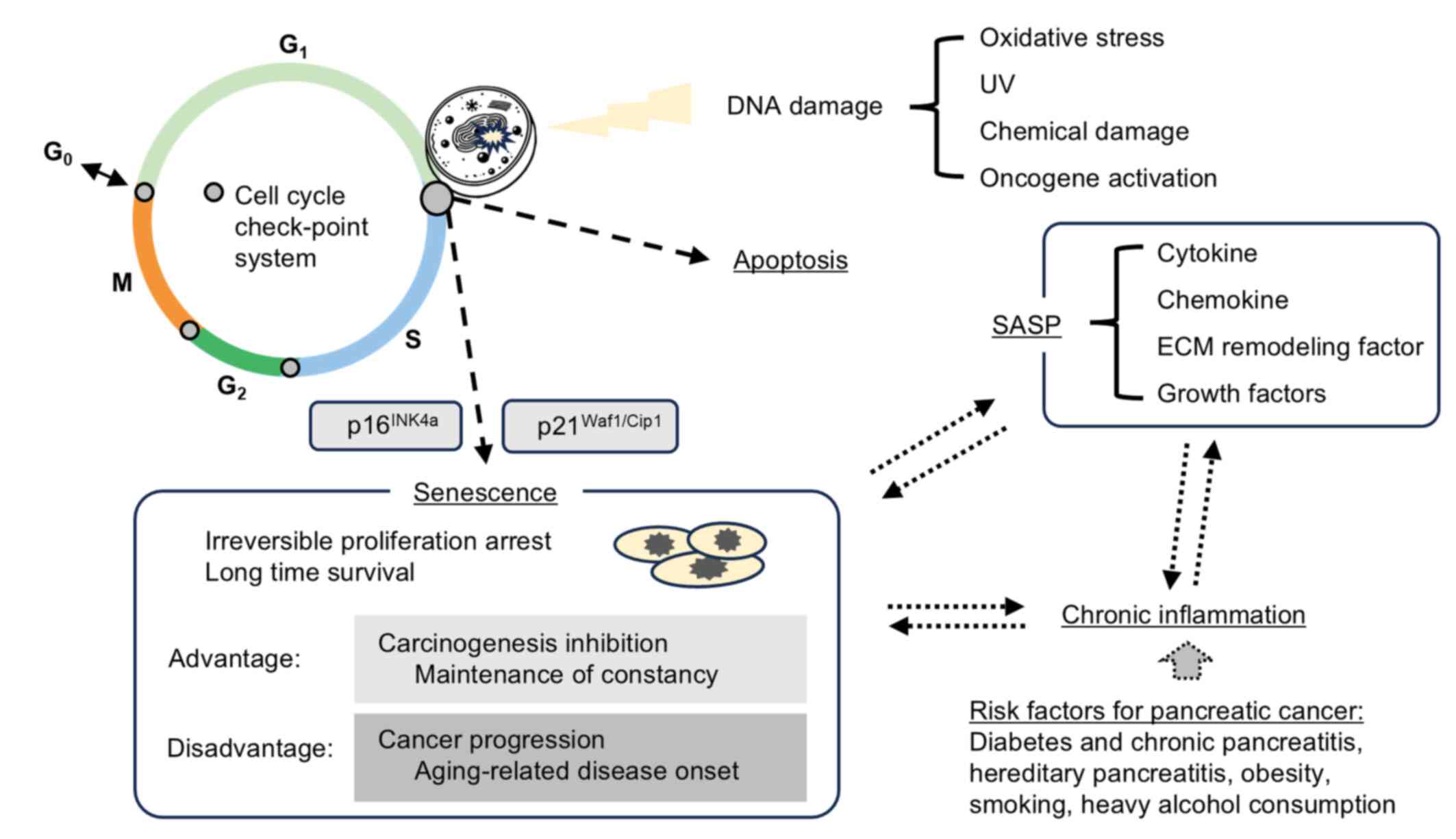
Figure 1

Molecular mechanisms of cellular
senescence. DNA damage induces cellular senescence, characterized
by either apoptosis or irreversible cell cycle arrest. Senescent
cells release SASP factors, which promote chronic inflammation and
are involved in carcinogenesis and the development of age-related
diseases. SASP, senescence-associated secretory phenotype.

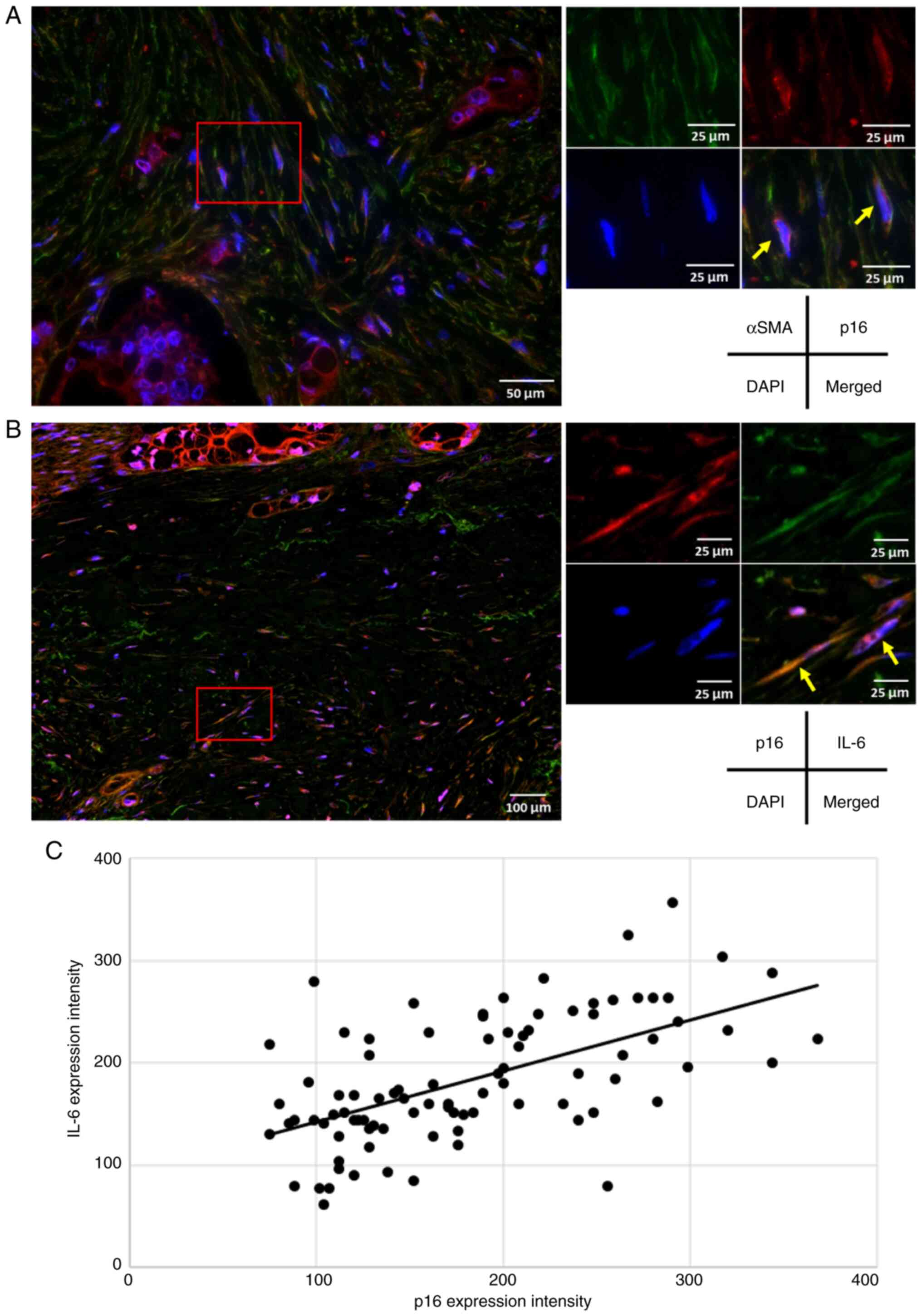
Figure 2

Evaluation of p16- and IL-6-positive
cells in the stroma of pancreatic ductal adenocarcinoma. (A)
Representative immunofluorescence staining of a pancreatic cancer
resection specimen (αSMA, green; p16, red; DAPI, blue; scale bar,
50 and 25 µm). In the pancreatic cancer stroma, pancreatic
fibroblasts (αSMA-positive) expressing the senescence marker p16
were identified (yellow arrows). (B) Representative
immunofluorescence staining of a pancreatic cancer resection
specimen (p16, red; IL-6, green; DAPI, blue; scale bar, 100 and 25
µm). Fibroblasts positive for p16 and the senescence-associated
secretory phenotype factor IL-6 were observed in the pancreatic
cancer stroma (yellow arrows). (C) A significant positive
correlation between the expression intensity of p16- and
IL-6-positive fibroblasts in the pancreatic cancer stroma
(Pearson's correlation coefficient, r=0.585; P<0.0001).

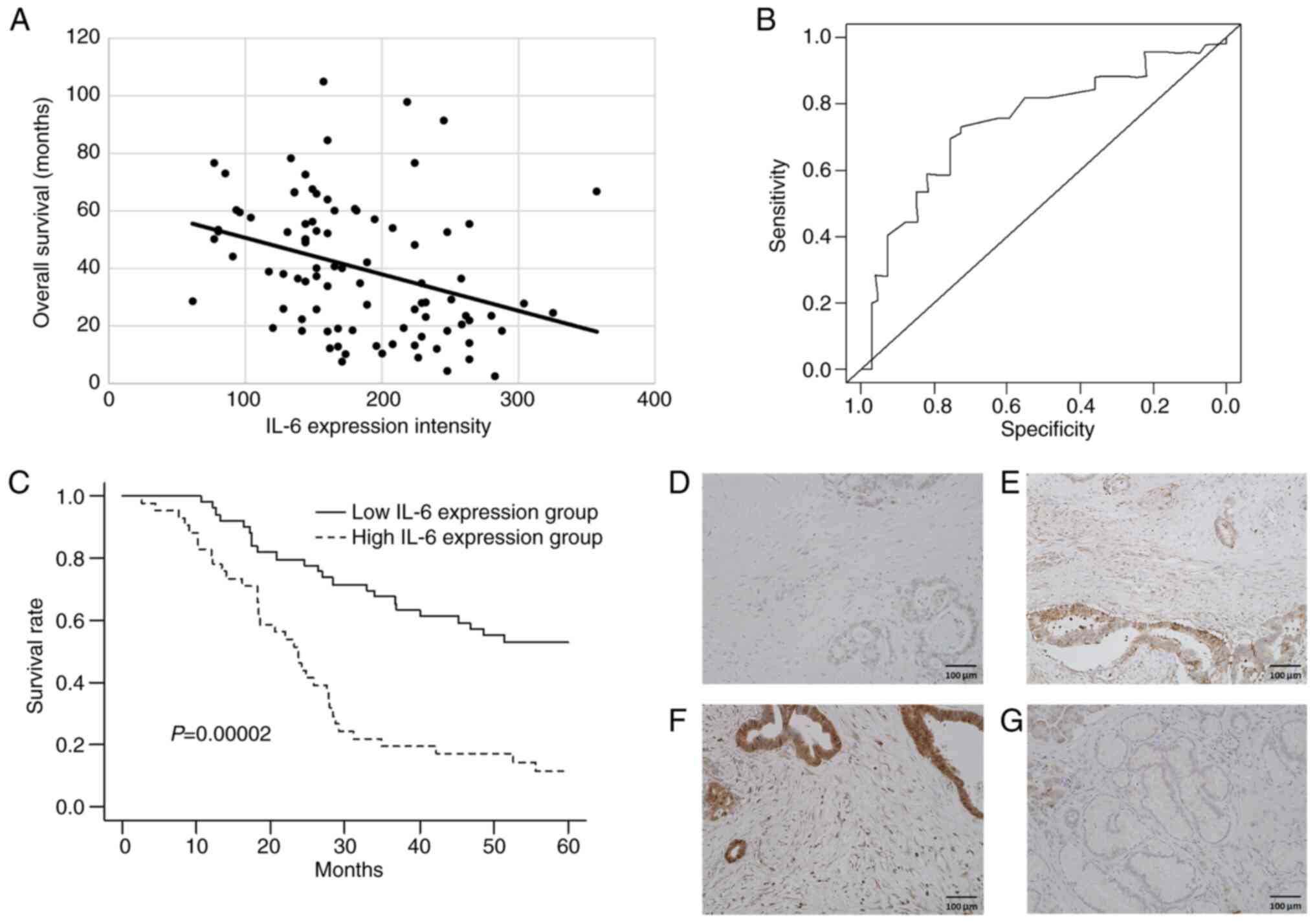
Figure 3

Relationship between IL-6 expression
intensity in the pancreatic ductal adenocarcinoma stroma and
prognosis after pancreaticoduodenectomy. (A) A significant negative
correlation between the expression intensity of IL-6-positive
fibroblasts in the pancreatic cancer stroma and overall survival
(Pearson's correlation coefficient, r=−0.336; P=0.0012). (B) A
receiver operating characteristic curve based on the expression
intensity of IL-6-positive fibroblasts in the pancreatic cancer
stroma and overall survival (AUC=0.754, sensitivity=0.736,
specificity=0.734). The IL-6 H-score cut-off value was 179;
patients with H-scores <179 were defined as the IL-6 low
expression group, and those with scores ≥179 as the IL-6 high
expression group. (C) Survival curves for patients with pancreatic
cancer with low (solid line) and high (dotted line) -IL-6
expression (log-rank test, P=0.00002). Representative pancreatic
cancer specimen with (D) weak, (E) moderate and (F) strong IL-6
positivity (scale bar, 100 µm). (G) Non-tumorous pancreatic
specimen (scale bar, 100 µm).

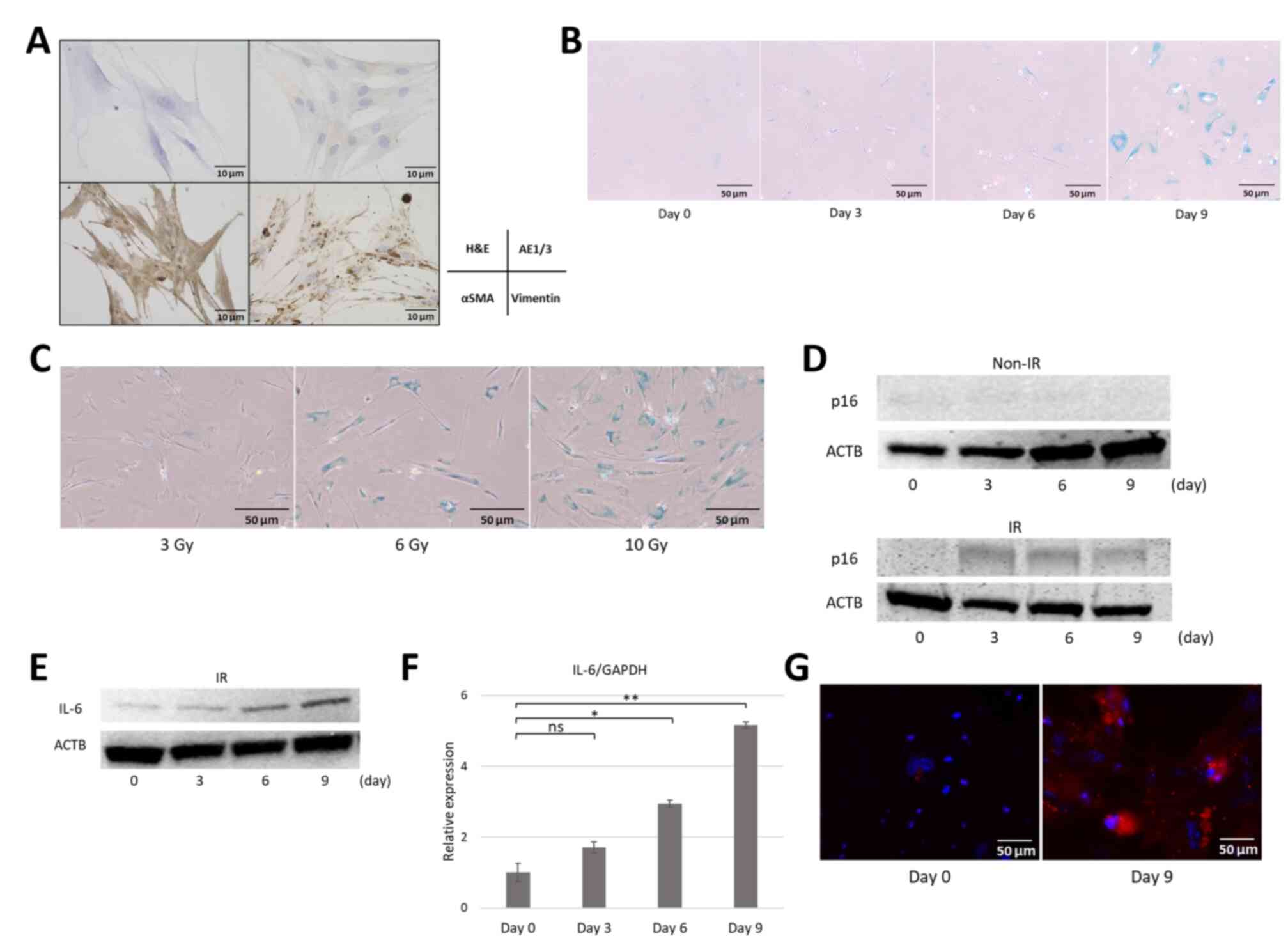
Figure 4

Establishment of human pancreatic
fibroblast cell lines and induction of cellular senescence and the
senescence-associated secretory phenotype. (A) Pancreatic
fibroblasts established from resected pancreatic specimens. Cells
showed a spindle-shaped morphology with cytoplasmic protrusions
(AE1/3-negative, αSMA- and vimentin-positive; scale bar, 10 µm).
(B) SA-β-gal staining of IR pancreatic fibroblasts (10 Gy)
increased over time (scale bar, 50 µm). (C) SA-β-gal staining of
pancreatic fibroblasts 9 days increased with gradient irradiation
(3, 6 and 10 Gy; scale bar, 50 µm). (D) Western blot analysis of
p16 protein expression in IR pancreatic fibroblasts (10 Gy X-rays
on days 0, 3, 6 and 9) showed increased p16 protein expression from
day 3 onward compared with the non-IR group. (E) Western blot
analysis showed a gradual increase of IL-6 protein expression from
day 3 onwards to day 9 post-irradiation. (F) Reverse
transcription-quantitative PCR confirmed increased IL-6 mRNA
expression after irradiation over 9 days of culture. Data are
presented as mean ± SD (n=6). (G) Immunofluorescence of pancreatic
fibroblasts. IL-6 expression was increased on day 9 (IL-6, red;
DAPI, blue; scale bar, 50 µm). *P<0.01 and **P<0.001. ns, not
significant; H&E, hemoxylin and eosin; SA-β-gal,
senescence-associated β-galactosidase; aSMA, a smooth muscle actin;
ACTB, β-actin; IR, irradiated.

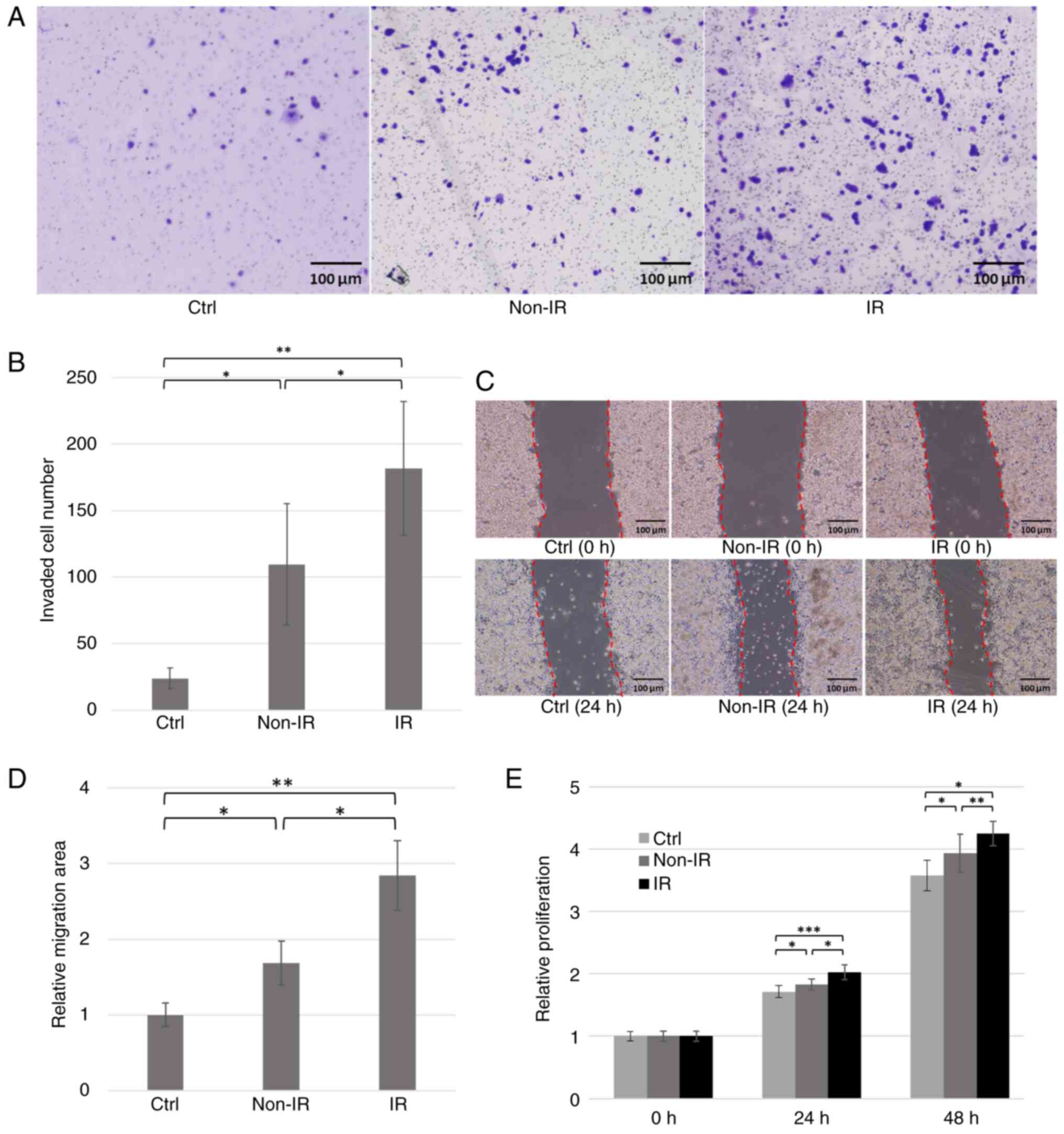
Figure 5

Co-culture experiments of Panc-1
cells with IR human pancreatic fibroblasts or their culture
supernatants. (A) Representative images of pancreatic fibroblasts
(10 Gy IR or non-IR) that were co-cultured with Panc-1 cells (scale
bar, 100 µm), and (B) the number of cells that invaded through the
gel and membrane was counted (n=6). (C) A confluent monolayer of
Panc-1 cells was scratched with a pipette, and the culture
supernatant of IR or non-IR pancreatic fibroblasts was added (scale
bar, 100 µm). (D) After 12 h, the area of cell migration was
measured (n=6). *P<0.05 and **P<0.01. (E) Panc-1 cells were
cultured with culture supernatants of IR or non-IR pancreatic
fibroblasts, and proliferation was assessed after 24 and 48 h using
the MTT assay (n=8). Data are presented as mean ± SD. *P<0.05,
**P<0.01 and ***P<0.001. aSMA, a smooth muscle actin; Ctrl,
control; IR, irradiated.
View References

1 

Hayflick L and Moorhead PS: The serial cultivation of human diploid cell strains. Exp Cell Res. 25:585–621. 1961. View Article : Google Scholar : PubMed/NCBI

2 

Campisi J and d'Adda di Fagagna F: Cellular senescence: When bad things happen to good cells. Nat Rev Mol Cell Biol. 8:729–740. 2007. View Article : Google Scholar : PubMed/NCBI

3 

Ohtani N, Mann DJ and Hara E: Cellular senescence: Its role in tumor suppression and aging. Cancer Sci. 100:792–797. 2009. View Article : Google Scholar : PubMed/NCBI

4 

Dimri GP, Lee X, Basile G, Acosta M, Scott G, Roskelley C, Medrano EE, Linskens M, Rubelj I, Pereira-Smith O, et al: A biomarker that identifies senescent human cells in culture and in aging skin in vivo. Proc Natl Acad Sci USA. 92:9363–9367. 1995. View Article : Google Scholar : PubMed/NCBI

5 

Kuilman T, Michaloglou C, Mooi WJ and Peeper DS: The essence of senescence. Genes Dev. 24:2463–2479. 2010. View Article : Google Scholar : PubMed/NCBI

6 

Harper JW and Elledge SJ: The DNA damage response: Ten years after. Mol Cell. 28:739–745. 2007. View Article : Google Scholar : PubMed/NCBI

7 

Mallette FA and Ferbeyre G: The DNA damage signaling pathway connects oncogenic stress to cellular senescence. Cell Cycle. 6:1831–1836. 2007. View Article : Google Scholar : PubMed/NCBI

8 

Coppé JP, Desprez PY, Krtolica A and Campisi J: The senescence-associated secretory phenotype: The dark side of tumor suppression. Annu Rev Pathol. 5:99–118. 2010. View Article : Google Scholar : PubMed/NCBI

9 

Tchkonia T, Zhu Y, van Deursen J, Campisi J and Kirkland JL: Cellular senescence and the senescent secretory phenotype: Therapeutic opportunities. J Clin Invest. 123:966–972. 2013. View Article : Google Scholar : PubMed/NCBI

10 

Muñoz-Espín D, Cañamero M, Maraver A, Gómez-López G, Contreras J, Murillo-Cuesta S, Rodríguez-Baeza A, Varela-Nieto I, Ruberte J, Collado M and Serrano M: Programmed cell senescence during mammalian embryonic development. Cell. 155:1104–1118. 2013. View Article : Google Scholar : PubMed/NCBI

11 

Demaria M, Ohtani N, Youssef SA, Rodier F, Toussaint W, Mitchell JR, Laberge RM, Vijg J, Van Steeg H, Dollé ME, et al: An essential role for senescent cells in optimal wound healing through secretion of PDGF-AA. Dev Cell. 31:722–733. 2014. View Article : Google Scholar : PubMed/NCBI

12 

Laberge RM, Awad P, Campisi J and Desprez PY: Epithelial-mesenchymal transition induced by senescent fibroblasts. Cancer Microenviron. 5:39–44. 2012. View Article : Google Scholar : PubMed/NCBI

13 

Von Ahrens D, Bhagat TD, Nagrath D, Maitra A and Verma A: The role of stromal cancer-associated fibroblasts in pancreatic cancer. J Hematol Oncol. 10:762017. View Article : Google Scholar : PubMed/NCBI

14 

Kawase T, Yasui Y, Nishina S, Hara Y, Yanatori I, Tomiyama Y, Nakashima Y, Yoshida K, Kishi F, Nakamura M and Hino K: Fibroblast activation protein-α-expressing fibroblasts promote the progression of pancreatic ductal adenocarcinoma. BMC Gastroenterol. 15:1092015. View Article : Google Scholar : PubMed/NCBI

15 

Tabola R, Zaremba-Czogalla M, Baczynska D, Cirocchi R, Stach K, Grabowski K and Augoff K: Fibroblast activating protein-α expression in squamous cell carcinoma of the esophagus in primary and irradiated tumors: The use of archival FFPE material for molecular techniques. Eur J Histochem. 61:27932017.PubMed/NCBI

16 

Shindo K, Aishima S, Ohuchida K, Fujiwara K, Fujino M, Mizuuchi Y, Hattori M, Mizumoto K, Tanaka M and Oda Y: Podoplanin expression in cancer-associated fibroblasts enhances tumor progression of invasive ductal carcinoma of the pancreas. Mol Cancer. 12:1682013. View Article : Google Scholar : PubMed/NCBI

17 

Su S, Chen J, Yao H, Liu J, Yu S, Lao L, Wang M, Luo M, Xing Y, Chen F, et al: CD10+GPR77+ Cancer-associated fibroblasts promote cancer formation and chemoresistance by sustaining cancer stemness. Cell. 172:841–856.e16. 2018. View Article : Google Scholar : PubMed/NCBI

18 

Paulsson J, Rydén L, Strell C, Frings O, Tobin NP, Fornander T, Bergh J, Landberg G, Stål O and Östman A: High expression of stromal PDGFRβ is associated with reduced benefit of tamoxifen in breast cancer. J Pathol Clin Res. 3:38–43. 2016. View Article : Google Scholar : PubMed/NCBI

19 

Miyashita T, Tajima H, Makino I, Okazaki M, Yamaguchi T, Ohbatake Y, Nakanuma S, Hayashi H, Takamura H, Ninomiya I, et al: Neoadjuvant chemotherapy with gemcitabine plus nab-paclitaxel reduces the number of cancer-associated fibroblasts through depletion of pancreatic stroma. Anticancer Res. 38:337–343. 2018.PubMed/NCBI

20 

Miyashita T, Tajima H, Gabata R, Okazaki M, Shimbashi H, Ohbatake Y, Okamoto K, Nakanuma S, Sakai S, Makino I, et al: Impact of extravasated platelet activation and podoplanin-positive cancer-associated fibroblasts in pancreatic cancer stroma. Anticancer Res. 39:5565–5572. 2019. View Article : Google Scholar : PubMed/NCBI

21 

Lee JS, Yoo JE, Kim H, Rhee H, Koh MJ, Nahm JH, Choi JS, Lee KH and Park YN: Tumor stroma with senescence-associated secretory phenotype in steatohepatitic hepatocellular carcinoma. PLoS One. 12:e01719222017. View Article : Google Scholar : PubMed/NCBI

22 

Harper EI, Sheedy EF and Stack MS: With great age comes great metastatic ability: Ovarian cancer and the appeal of the aging peritoneal microenvironment. Cancers (Basel). 10:2302018. View Article : Google Scholar : PubMed/NCBI

23 

Mori JO, Elhussin I, Brennen WN, Graham MK, Lotan TL, Yates CC, De Marzo AM, Denmeade SR, Yegnasubramanian S, Nelson WG, et al: Prognostic and therapeutic potential of senescent stromal fibroblasts in prostate cancer. Nat Rev Urol. 21:258–273. 2024. View Article : Google Scholar : PubMed/NCBI

24 

Nakayama I: Therapeutic strategy for scirrhous type gastric cancer. Jpn J Clin Oncol. 55:860–870. 2025. View Article : Google Scholar : PubMed/NCBI

25 

Yamamoto Y, Kasashima H, Fukui Y, Tsujio G, Yashiro M and Maeda K: The heterogeneity of cancer-associated fibroblast subpopulations: Their origins, biomarkers, and roles in the tumor microenvironment. Cancer Sci. 114:16–24. 2023. View Article : Google Scholar : PubMed/NCBI

26 

Ministry of Education Culture Sports Science Technology Ministry of Health Labour Welfare, Ministry of Economy, TradeIndustry, . Ethical guidelines for medical and biological research involving human subjects (In Japanese). https://www.mhlw.go.jp/content/000757566.pdf2021.

27 

Brierley JD, Gospodarowicz MK and Wittekind C: Union for International Cancer Control (UICC). TNM Classification of Malignant Tumors. 8th Edition. Wiley-Blackwell; 2017

28 

Tsuta K, Wistuba II and Moran CA: Differential expression of somatostatin receptors 1–5 in neuroendocrine carcinoma of the lung. Pathol Res Pract. 208:470–474. 2012. View Article : Google Scholar : PubMed/NCBI

29 

Schmid HA, Lambertini C, van Vugt HH, Barzaghi-Rinaudo P, Schäfer J, Hillenbrand R, Sailer AW, Kaufmann M and Nuciforo P: Monoclonal antibodies against the human somatostatin receptor subtypes 1–5: Development and immunohistochemical application in neuroendocrine tumors. Neuroendocrinology. 95:232–247. 2012. View Article : Google Scholar : PubMed/NCBI

30 

Roncoroni L, Elli L, Doneda L, Piodi L, Ciulla MM, Paliotti R and Bardella MT: Isolation and culture of fibroblasts from endoscopic duodenal biopsies of celiac patients. J Transl Med. 7:402009. View Article : Google Scholar : PubMed/NCBI

31 

Seluanov A, Vaidya A and Gorbunova V: Establishing primary adult fibroblast cultures from rodents. J Vis Exp. 5:20332010.

32 

Livak KJ and Schmittgen TD: Analysis of relative gene expression data using real-time quantitative PCR and the 2(−Delta Delta C(T)) Method. Methods. 25:402–408. 2001. View Article : Google Scholar : PubMed/NCBI

33 

Rasband WS: ImageJ. U.S. National Institutes of Health. (Bethesda, MD). 2011.http://imagej.nih.gov/ij

34 

Hara E, Smith R, Parry D, Tahara H, Stone S and Peters G: Regulation of p16CDKN2 expression and its implications for cell immortalization and senescence. Mol Cell Biol. 16:859–867. 1996. View Article : Google Scholar : PubMed/NCBI

35 

Serrano M, Lin AW, McCurrach ME, Beach D and Lowe SW: Oncogenic ras provokes premature cell senescence associated with accumulation of p53 and p16INK4a. Cell. 88:593–602. 1997. View Article : Google Scholar : PubMed/NCBI

36 

Raimondi S, Lowenfels AB, Morselli-Labate AM, Maisonneuve P and Pezzilli R: Pancreatic cancer in chronic pancreatitis; aetiology, incidence, and early detection. Best Pract Res Clin Gastroenterol. 24:349–358. 2010. View Article : Google Scholar : PubMed/NCBI

37 

Qiu D, Kurosawa M, Lin Y, Inaba Y, Matsuba T, Kikuchi S, Yagyu K, Motohashi Y and Tamakoshi A; JACC Study Group, : Overview of the epidemiology of pancreatic cancer focusing on the JACC study. J Epidemiol. 15 (Suppl II):S157–S167. 2005. View Article : Google Scholar : PubMed/NCBI

38 

Iodice S, Gandini S, Maisonneuve P and Lowenfels AB: Tobacco and the risk of pancreatic cancer: A review and meta-analysis. Langenbecks Arch Surg. 393:535–545. 2008. View Article : Google Scholar : PubMed/NCBI

39 

Tramacere I, Scotti L, Jenab M, Bagnardi V, Bellocco R, Rota M, Corrao G, Bravi F, Boffetta P and La Vecchia C: Alcohol drinking and pancreatic cancer risk: A meta-analysis of the dose-risk relation. Int J Cancer. 126:1474–1486. 2010. View Article : Google Scholar : PubMed/NCBI

40 

Gosavi R, Jaya J, Yap R, Narasimhan V and Ooi G: Obesity and gastrointestinal cancer: A converging epidemic with surgical consequence. Eur J Surg Oncol. 51:1103582025. View Article : Google Scholar : PubMed/NCBI

41 

Cuomo RE: Distinct somatic mutation profiles in colon cancer by behavioral comorbidity. Future Sci OA. 11:25615012025. View Article : Google Scholar : PubMed/NCBI

42 

Wang J, Qiu K, Zhou S, Gan Y, Jiang K, Wang D and Wang H: Risk factors for hepatocellular carcinoma: An umbrella review of systematic review and meta-analysis. Ann Med. 57:24555392025. View Article : Google Scholar : PubMed/NCBI

43 

Ni L, Liu Z, Xiang L, Li Y and Zhang Y: Comprehensive evaluation of risk factors for LNM and distant metastasis in patients with NSCLC. Sci Rep. 15:308092025. View Article : Google Scholar : PubMed/NCBI

44 

Min SK, You Y, Choi DW, Han IW, Shin SH, Yoon S, Jung JH, Yoon SJ and Heo JS: Prognosis of pancreatic head cancer with different patterns of lymph node metastasis. J Hepatobiliary Pancreat Sci. 29:1004–1013. 2022. View Article : Google Scholar : PubMed/NCBI

45 

Nurmik M, Ullmann P, Rodriguez F, Haan S and Letellier E: In search of definitions: Cancer-associated fibroblasts and their markers. Int J Cancer. 146:895–905. 2020. View Article : Google Scholar : PubMed/NCBI

46 

Ohtani N, Imamura Y, Yamakoshi K, Hirota F, Nakayama R, Kubo Y, Ishimaru N, Takahashi A, Hirao A, Shimizu T, et al: Visualizing the dynamics of p21(Waf1/Cip1) cyclin-dependent kinase inhibitor expression in living animals. Proc Natl Acad Sci USA. 104:15034–15039. 2007. View Article : Google Scholar : PubMed/NCBI

47 

Kuilman T, Michaloglou C, Vredeveld LC, Douma S, van Doorn R, Desmet CJ, Aarden LA, Mooi WJ and Peeper DS: Oncogene-induced senescence relayed by an interleukin-dependent inflammatory network. Cell. 133:1019–1031. 2008. View Article : Google Scholar : PubMed/NCBI

48 

Ancrile B, Lim KH and Counter CM: Oncogenic Ras-induced secretion of IL6 is required for tumorigenesis. Genes Dev. 21:1714–1719. 2007. View Article : Google Scholar : PubMed/NCBI

49 

Coppé JP, Patil CK, Rodier F, Sun Y, Munoz DP, Goldstein J, Nelson PS, Desprez PY and Campisi J: Senescence-associated secretory phenotypes reveal cell-nonautonomous functions of oncogenic RAS and the p53 tumor suppressor. PLoS Biol. 6:2853–2868. 2008. View Article : Google Scholar : PubMed/NCBI

50 

Lu SY, Chang KW, Liu CJ, Tseng YH, Lu HH, Lee SY and Lin SC: Ripe areca nut extract induces G1 phase arrests and senescence-associated phenotypes in normal human oral keratinocyte. Carcinogenesis. 27:1273–1284. 2006. View Article : Google Scholar : PubMed/NCBI

51 

Sarkar D, Lebedeva IV, Emdad L, Kang DC, Baldwin AS Jr and Fisher PB: Human polynucleotide phosphorylase (hPNPaseold-35): A potential link between aging and inflammation. Cancer Res. 64:7473–7478. 2004. View Article : Google Scholar : PubMed/NCBI

52 

Holmer R, Goumas FA, Waetzig GH, Rose-John S and Kalthoff H: Interleukin-6: A villain in the drama of pancreatic cancer development and progression. Hepatobiliary Pancreat Dis Int. 13:371–380. 2014. View Article : Google Scholar : PubMed/NCBI

53 

Song M, Tang Y, Cao K, Qi L and Xie K: Unveiling the role of interleukin-6 in pancreatic cancer occurrence and progression. Front Endocrinol (Lausanne). 15:14083122024. View Article : Google Scholar : PubMed/NCBI

54 

Ara T and Declerck YA: Interleukin-6 in bone metastasis and cancer progression. Eur J Cancer. 46:1223–1231. 2010. View Article : Google Scholar : PubMed/NCBI

55 

Omori S, Wang TW, Johmura Y, Kanai T, Nakano Y, Kido T, Susaki EA, Nakajima T, Shichino S, Ueha S, et al: Generation of a p16 reporter mouse and its use to characterize and target p16high cells in vivo. Cell Metab. 32:814–828.e6. 2020. View Article : Google Scholar : PubMed/NCBI

56 

Hickson LJ, Langhi Prata LGP, Bobart SA, Evans TK, Giorgadze N, Hashmi SK, Herrmann SM, Jensen MD, Jia Q, Jordan KL, et al: Senolytics decrease senescent cells in humans: Preliminary report from a clinical trial of dasatinib plus quercetin in individuals with diabetic kidney disease. EBiomedicine. 47:446–456. 2019. View Article : Google Scholar : PubMed/NCBI

57 

Farr JN, Atkinson EJ, Achenbach SJ, Volkman TL, Tweed AJ, Vos SJ, Ruan M, Sfeir J, Drake MT, Saul D, et al: Effects of intermittent senolytic therapy on bone metabolism in postmenopausal women: A phase 2 randomized controlled trial. Nat Med. 30:2605–2612. 2024. View Article : Google Scholar : PubMed/NCBI

58 

Bussian TJ, Aziz A, Meyer CF, Swenson BL, van Deursen JM and Baker DJ: Clearance of senescent glial cells prevents tau-dependent pathology and cognitive decline. Nature. 562:578–582. 2018. View Article : Google Scholar : PubMed/NCBI

59 

Childs BG, Baker DJ, Wijshake T, Conover CA, Campisi J and van Deursen JM: Senescent intimal foam cells are deleterious at all stages of atherosclerosis. Science. 354:472–477. 2016. View Article : Google Scholar : PubMed/NCBI

60 

Paez-Ribes M, González-Gualda E, Doherty GJ and Muñoz-Espín D: Targeting senescent cells in translational medicine. EMBO Mol Med. 11:e102342019. View Article : Google Scholar : PubMed/NCBI

61 

Baar MP, Brandt RMC, Putavet DA, Klein JDD, Derks KWJ, Bourgeois BRM, Stryeck S, Rijksen Y, van Willigenburg H, Feijtel DA, et al: Targeted apoptosis of senescent cells restores tissue homeostasis in response to chemotoxicity and aging. Cell. 169:132–147.e16. 2017. View Article : Google Scholar : PubMed/NCBI

Related Articles

  • Abstract
  • View
  • Download
  • Twitter
Copy and paste a formatted citation
Spandidos Publications style
Kitano Y, Miyashita T, Shimasaki T, Makino I, Endo Y, Yamamoto Y, Inaki N and Yagi S: Prognostic significance of fibroblast senescence and senescence-associated secretory phenotype factor expression in the tumor microenvironment of pancreatic ductal adenocarcinoma. Oncol Rep 55: 26, 2026.
APA
Kitano, Y., Miyashita, T., Shimasaki, T., Makino, I., Endo, Y., Yamamoto, Y. ... Yagi, S. (2026). Prognostic significance of fibroblast senescence and senescence-associated secretory phenotype factor expression in the tumor microenvironment of pancreatic ductal adenocarcinoma. Oncology Reports, 55, 26. https://doi.org/10.3892/or.2025.9031
MLA
Kitano, Y., Miyashita, T., Shimasaki, T., Makino, I., Endo, Y., Yamamoto, Y., Inaki, N., Yagi, S."Prognostic significance of fibroblast senescence and senescence-associated secretory phenotype factor expression in the tumor microenvironment of pancreatic ductal adenocarcinoma". Oncology Reports 55.2 (2026): 26.
Chicago
Kitano, Y., Miyashita, T., Shimasaki, T., Makino, I., Endo, Y., Yamamoto, Y., Inaki, N., Yagi, S."Prognostic significance of fibroblast senescence and senescence-associated secretory phenotype factor expression in the tumor microenvironment of pancreatic ductal adenocarcinoma". Oncology Reports 55, no. 2 (2026): 26. https://doi.org/10.3892/or.2025.9031
Copy and paste a formatted citation
x
Spandidos Publications style
Kitano Y, Miyashita T, Shimasaki T, Makino I, Endo Y, Yamamoto Y, Inaki N and Yagi S: Prognostic significance of fibroblast senescence and senescence-associated secretory phenotype factor expression in the tumor microenvironment of pancreatic ductal adenocarcinoma. Oncol Rep 55: 26, 2026.
APA
Kitano, Y., Miyashita, T., Shimasaki, T., Makino, I., Endo, Y., Yamamoto, Y. ... Yagi, S. (2026). Prognostic significance of fibroblast senescence and senescence-associated secretory phenotype factor expression in the tumor microenvironment of pancreatic ductal adenocarcinoma. Oncology Reports, 55, 26. https://doi.org/10.3892/or.2025.9031
MLA
Kitano, Y., Miyashita, T., Shimasaki, T., Makino, I., Endo, Y., Yamamoto, Y., Inaki, N., Yagi, S."Prognostic significance of fibroblast senescence and senescence-associated secretory phenotype factor expression in the tumor microenvironment of pancreatic ductal adenocarcinoma". Oncology Reports 55.2 (2026): 26.
Chicago
Kitano, Y., Miyashita, T., Shimasaki, T., Makino, I., Endo, Y., Yamamoto, Y., Inaki, N., Yagi, S."Prognostic significance of fibroblast senescence and senescence-associated secretory phenotype factor expression in the tumor microenvironment of pancreatic ductal adenocarcinoma". Oncology Reports 55, no. 2 (2026): 26. https://doi.org/10.3892/or.2025.9031
Follow us
  • Twitter
  • LinkedIn
  • Facebook
About
  • Spandidos Publications
  • Careers
  • Cookie Policy
  • Privacy Policy
How can we help?
  • Help
  • Live Chat
  • Contact
  • Email to our Support Team