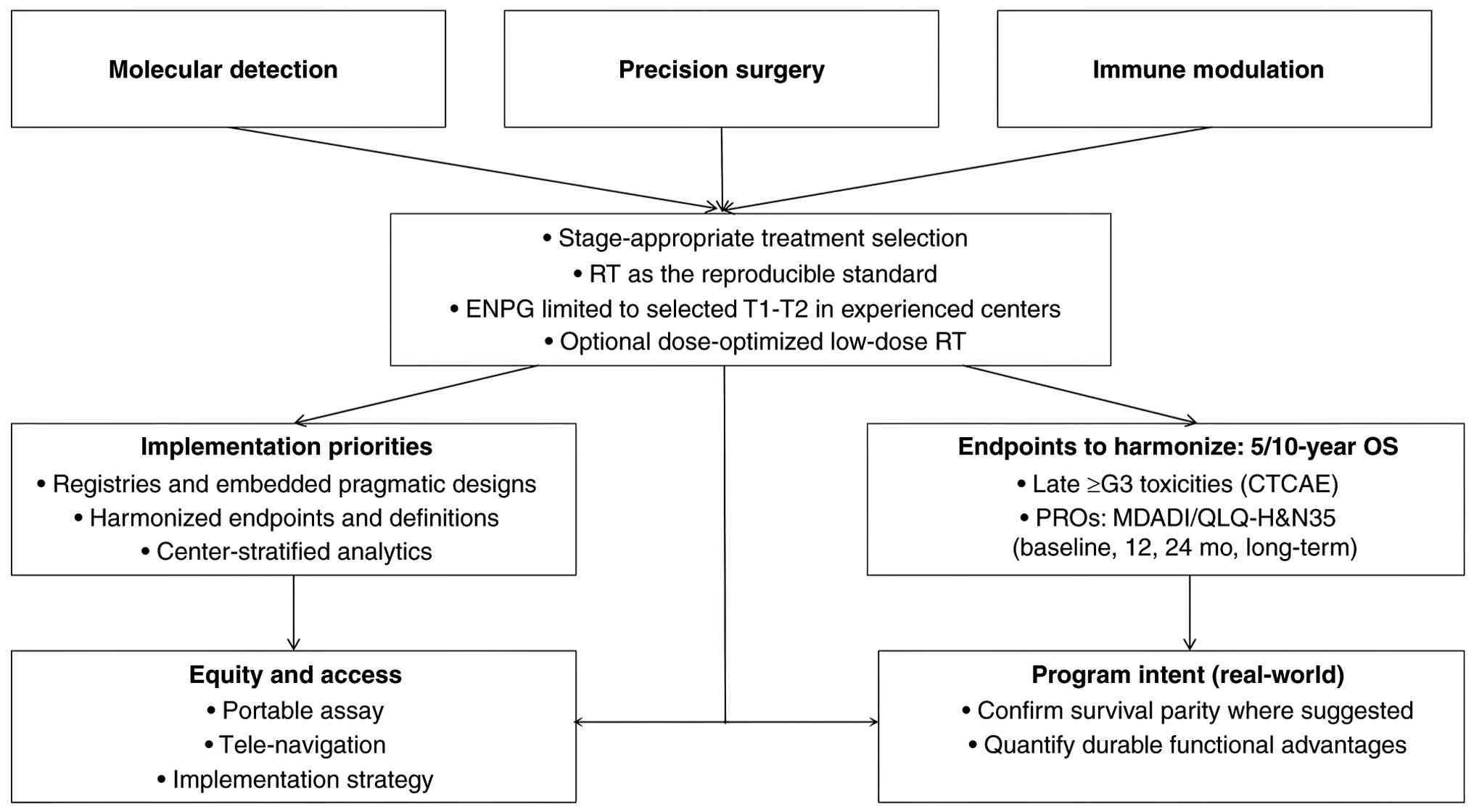
|
1
|
Tang LL, Chen YP, Chen CB, Chen MY, Chen
NY, Chen XZ, Du XJ, Fang WF, Feng M, Gao J, et al: The Chinese
society of clinical oncology (CSCO) clinical guidelines for the
diagnosis and treatment of nasopharyngeal carcinoma. Cancer Commun
(Lond). 41:1195–1227. 2021. View Article : Google Scholar : PubMed/NCBI
|
|
2
|
Bossi P, Chan AT, Licitra L, Trama A,
Orlandi E, Hui EP, Halámková J, Mattheis S, Baujat B, Hardillo J,
et al: Nasopharyngeal carcinoma: ESMO-EURACAN clinical practice
guidelines for diagnosis, treatment and follow-up. Ann Oncol.
32:452–465. 2021. View Article : Google Scholar : PubMed/NCBI
|
|
3
|
Chen YP, Ismaila N, Chua ML, Colevas AD,
Haddad R, Huang SH, Wee JT, Whitley AC, Yi JL, Yom SS, et al:
Chemotherapy in combination with radiotherapy for definitive-intent
treatment of stage II–IVA nasopharyngeal carcinoma: CSCO and ASCO
guideline. J Clin Oncol. 39:840–859. 2021. View Article : Google Scholar : PubMed/NCBI
|
|
4
|
Lam WJ, King AD, Miller JA, Liu Z, Yu KJ,
Chua ML, Ma BB, Chen MY, Pinsky BA, Lou PJ, et al: Recommendations
for Epstein-Barr virus-based screening for nasopharyngeal cancer in
high-and intermediate-risk regions. J Natl Cancer Inst.
115:355–364. 2023. View Article : Google Scholar : PubMed/NCBI
|
|
5
|
Cao SM, Liu Z, Jia WH, Huang QH, Liu Q,
Guo X, Huang TB, Ye W and Hong MH: Fluctuations of epstein-barr
virus serological antibodies and risk for nasopharyngeal carcinoma:
A prospective screening study with a 20-year follow-up. PLoS One.
6:e191002011. View Article : Google Scholar : PubMed/NCBI
|
|
6
|
Liu Y, Huang Q, Liu W, Liu Q, Jia W, Chang
E, Chen F, Liu Z, Guo X, Mo H, et al: Establishment of VCA and
EBNA1 IgA-based combination by enzyme-linked immunosorbent assay as
preferred screening method for nasopharyngeal carcinoma: A
two-stage design with a preliminary performance study and a mass
screening in southern China. Int J Cancer. 131:406–416. 2012.
View Article : Google Scholar : PubMed/NCBI
|
|
7
|
Li Y, Wang K, Yin SK, Zheng HL and Min DL:
Expression of Epstein-Barr virus antibodies EA-IgG, Rta-IgG, and
VCA-IgA in nasopharyngeal carcinoma and their use in a combined
diagnostic assay. Genet Mol Res. Mar 18–2016.(Epub ahead of
print).
|
|
8
|
Ai P, Wang T, Zhang H, Wang Y, Song C,
Zhang L, Li Z and Hu H: Determination of antibodies directed at EBV
proteins expressed in both latent and lytic cycles in
nasopharyngeal carcinoma. Oral Oncol. 49:326–331. 2013. View Article : Google Scholar : PubMed/NCBI
|
|
9
|
Jiang W, Zheng B and Wei H: Recent
advances in early detection of nasopharyngeal carcinoma. Discov
Oncol. 15:3652024. View Article : Google Scholar : PubMed/NCBI
|
|
10
|
Lo KW, To KF and Huang DP: Focus on
nasopharyngeal carcinoma. Cancer Cell. 5:423–428. 2004. View Article : Google Scholar : PubMed/NCBI
|
|
11
|
Wong KC, Hui EP, Lo KW, Lam WKJ, Johnson
D, Li L, Tao Q, Chan KCA, To KF, King AD, et al: Nasopharyngeal
carcinoma: An evolving paradigm. Nat Rev Clin Oncol. 18:679–695.
2021. View Article : Google Scholar : PubMed/NCBI
|
|
12
|
Zhang S, Zhou Y, Liu Z, Wang Y, Zhou X,
Chen H, Zhang X, Chen Y, Feng Q, Ye X, et al: Immunosequencing
identifies signatures of T cell responses for early detection of
nasopharyngeal carcinoma. Cancer Cell. 43:1423–1441. 2025.
View Article : Google Scholar : PubMed/NCBI
|
|
13
|
Ni XG and Wang GQ: The role of narrow band
imaging in head and neck cancers. Curr Oncol Rep. 18:102016.
View Article : Google Scholar : PubMed/NCBI
|
|
14
|
Chan JL, Lin L, Feiler M, Wolf AI, Cardona
DM and Gellad ZF: Comparative effectiveness of i-SCAN™ and
high-definition white light characterizing small colonic polyps.
World J Gastroenterol. 18:5905–5911. 2012. View Article : Google Scholar : PubMed/NCBI
|
|
15
|
Lam WKJ, Jiang P, Chan KCA, Cheng SH,
Zhang H, Peng W, Tse OYO, Tong YK, Gai W, Zee BCY, et al:
Sequencing-based counting and size profiling of plasma Epstein-Barr
virus DNA enhance population screening of nasopharyngeal carcinoma.
Proc Natl Acad Sci USA. 115:E5115–E5124. 2018. View Article : Google Scholar : PubMed/NCBI
|
|
16
|
Wu X, Tay JK, Goh CK, Chan C, Lee YH,
Springs SL, Wang Y, Loh KS, Lu TK and Yu H: Digital CRISPR-based
method for the rapid detection and absolute quantification of
nucleic acids. Biomaterials. 274:1208762021. View Article : Google Scholar : PubMed/NCBI
|
|
17
|
Jiang C, Zheng X, Lin L, Li X, Li X, Liao
Y, Jia W and Shu B: CRISPR Cas12a-mediated amplification-free
digital DNA assay improves the diagnosis and surveillance of
Nasopharyngeal carcinoma. Biosens Bioelectron. 237:1155462023.
View Article : Google Scholar : PubMed/NCBI
|
|
18
|
Li T, Li F, Guo X, Hong C, Yu X, Wu B,
Lian S, Song L, Tang J, Wen S, et al: Anti-Epstein-Barr virus
BNLF2b for mass screening for nasopharyngeal cancer. N Engl J Med.
389:808–819. 2023. View Article : Google Scholar : PubMed/NCBI
|
|
19
|
Pan YX, Huang Q, Xing S and Zhu QY: A
novel serum protein biomarker for the late-stage diagnosis of
nasopharyngeal carcinoma. BMC Cancer. 25:5852025. View Article : Google Scholar : PubMed/NCBI
|
|
20
|
Ji MF, He YQ, Tang MZ, Xue WQ, Yu X, Diao
H, Yang DW, Mai ZM, Cheong IH and Zhao ZY: Epstein Barr virus
antibody and cancer risk in two prospective cohorts in Southern
China. Nat Commun. 16:59402025. View Article : Google Scholar : PubMed/NCBI
|
|
21
|
Xu Y, Zhao W, Mo Y, Ma N, Midorikawa K,
Kobayashi H, Hiraku Y, Oikawa S, Zhang Z and Huang G: Combination
of RERG and ZNF671 methylation rates in circulating cell-free DNA:
A novel biomarker for screening of nasopharyngeal carcinoma. Cancer
Sci. 111:2536–2545. 2020. View Article : Google Scholar : PubMed/NCBI
|
|
22
|
Hsu CL, Chang YS and Li HP: Molecular
diagnosis of nasopharyngeal carcinoma: Past and future. Biomed J.
48:1007482025. View Article : Google Scholar : PubMed/NCBI
|
|
23
|
Islam KA, Chow LKY, Kam NW, Wang Y, Chiang
CL, Choi HCW, Xia YF, Lee AWM, Ng WT and Dai W: Prognostic
biomarkers for survival in nasopharyngeal carcinoma: A systematic
review of the literature. Cancers. 14:20222122.
|
|
24
|
Li G, Wu Z, Peng Y, Liu X, Lu J, Wang L,
Pan Q, He ML and Li XP: MicroRNA-10b induced by Epstein-Barr
virus-encoded latent membrane protein-1 promotes the metastasis of
human nasopharyngeal carcinoma cells. Cancer Lett. 299:29–36. 2010.
View Article : Google Scholar : PubMed/NCBI
|
|
25
|
Allaya N, Khabir A, Sallemi-Boudawara T,
Sellami N, Daoud J, Ghorbel A, Frikha M, Gargouri A,
Mokdad-Gargouri R and Ayadi W: Over-expression of miR-10b in NPC
patients: Correlation with LMP1 and Twist1. Tumor Biol.
36:3807–3814. 2015. View Article : Google Scholar : PubMed/NCBI
|
|
26
|
Chen Y, Lin T, Tang L, He L and He Y:
MiRNA signatures in nasopharyngeal carcinoma: Molecular mechanisms
and therapeutic perspectives. Am J Cancer Res. 13:5805–5824.
2023.PubMed/NCBI
|
|
27
|
Zhang Y and Xu Z: miR-93 enhances cell
proliferation by directly targeting CDKN1A in nasopharyngeal
carcinoma. Oncol Lett. 15:1723–1727. 2018.PubMed/NCBI
|
|
28
|
Zhou W, Chang A, Zhao H, Ye H, Li D and
Zhuo X: Identification of a novel microRNA profile including
miR-106b, miR-17, miR-20b, miR-18a and miR-93 in the metastasis of
nasopharyngeal carcinoma. Cancer Biomark. 27:533–539. 2020.
View Article : Google Scholar : PubMed/NCBI
|
|
29
|
Duan B, Shi S, Yue H, You B, Shan Y, Zhu
Z, Bao L and You Y: Exosomal miR-17-5p promotes angiogenesis in
nasopharyngeal carcinoma via targeting BAMBI. J Cancer.
10:6681–6692. 2019. View Article : Google Scholar : PubMed/NCBI
|
|
30
|
Zhang H, Zou X, Wu L, Zhang S, Wang T, Liu
P, Zhu W and Zhu J: Identification of a 7-microRNA signature in
plasma as promising biomarker for nasopharyngeal carcinoma
detection. Cancer Med. 9:1230–1241. 2020. View Article : Google Scholar : PubMed/NCBI
|
|
31
|
Zou X, Zhu D, Zhang H, Zhang S, Zhou X, He
X, Zhu J and Zhu W: MicroRNA expression profiling analysis in serum
for nasopharyngeal carcinoma diagnosis. Gene. 727:1442432020.
View Article : Google Scholar : PubMed/NCBI
|
|
32
|
Jiang C, Chen J, Xie S, Zhang L, Xiang Y,
Lung M, Kam NW, Kwong DL, Cao S and Guan XY: Evaluation of
circulating EBV microRNA BART2-5p in facilitating early detection
and screening of nasopharyngeal carcinoma. Int J Cancer.
143:3209–3217. 2018. View Article : Google Scholar : PubMed/NCBI
|
|
33
|
Lyu X, Fang W, Cai L, Zheng H, Ye Y, Zhang
L, Li J, Peng H, Cho WC, Wang E, et al: TGFβR2 is a major target of
miR-93 in nasopharyngeal carcinoma aggressiveness. Mol Cancer.
13:512014. View Article : Google Scholar : PubMed/NCBI
|
|
34
|
Yang W, Tan S, Yang L, Chen X, Yang R,
Oyang L, Lin J, Xia L, Wu N, Han Y, et al: Exosomal miR-205-5p
enhances angiogenesis and nasopharyngeal carcinoma metastasis by
targeting desmocollin-2. Mol Ther Oncolytics. 24:612–623. 2022.
View Article : Google Scholar : PubMed/NCBI
|
|
35
|
Hsia B, Sure A, Dongre R, Jo N, Kuzniar J,
Bitar G, Alshaka SA, Kim JD, Valencia-Sanchez BA, Brandel MG, et
al: Molecular profiling of nasopharyngeal carcinoma using the AACR
project GENIE repository. Cancers (Basel). 17:15442025. View Article : Google Scholar : PubMed/NCBI
|
|
36
|
Wan X, Liu Y, Peng Y, Wang J, Yan SM,
Zhang L, Wu W, Zhao L, Chen X, Ren K, et al: Primary and orthotopic
murine models of nasopharyngeal carcinoma reveal molecular
mechanisms underlying its malignant progression. Adv Sci (Weinh).
11:e24031612024. View Article : Google Scholar : PubMed/NCBI
|
|
37
|
Chen W, Yang KB, Zhang YZ, Lin ZS, Chen
JW, Qi SF, Wu CF, Feng GK, Yang DJ, Chen M, et al: Synthetic
lethality of combined ULK1 defection and p53 restoration induce
pyroptosis by directly upregulating GSDME transcription and
cleavage activation through ROS/NLRP3 signaling. J Exp Clin Cancer
Res. 43:2482024. View Article : Google Scholar : PubMed/NCBI
|
|
38
|
Agaoglu FY, Dizdar Y, Dogan O, Alatli C,
Ayan I, Savci N, Tas S, Dalay N and Altun M: P53 overexpression in
nasopharyngeal carcinoma. In Vivo. 18:555–560. 2004.PubMed/NCBI
|
|
39
|
Li YY, Chung GT, Lui VW, To KF, Ma BB,
Chow C, Woo JKS, Yip KY, Seo J, Hui EP, et al: Exome and genome
sequencing of nasopharynx cancer identifies NF-κB pathway
activating mutations. Nat Commun. 8:141212017. View Article : Google Scholar : PubMed/NCBI
|
|
40
|
Papa A and Pandolfi PP: The PTEN-PI3K axis
in cancer. Biomolecules. 9:1532019. View Article : Google Scholar : PubMed/NCBI
|
|
41
|
Zhang S, Hong HI, Mak VCY, Zhou Y, Lu Y,
Zhuang G and Cheung LWT: Vertical inhibition of p110α/AKT and
N-cadherin enhances treatment efficacy in PIK3CA-aberrated ovarian
cancer cells. Mol Oncol. 19:1132–1154. 2025. View Article : Google Scholar : PubMed/NCBI
|
|
42
|
Shamsuri AS and Sim EU: In silico
prediction of the action of bromelain on PI3K/Akt signalling
pathway to arrest nasopharyngeal cancer oncogenesis by targeting
phosphatidylinositol-4,5-bisphosphate 3-kinase catalytic subunit
alpha protein. BMC Res Notes. 17:3462024. View Article : Google Scholar : PubMed/NCBI
|
|
43
|
Zhou Z, Li P, Zhang X, Xu J, Xu J, Yu S,
Wang D, Dong W, Cao X, Yan H, et al: Mutational landscape of
nasopharyngeal carcinoma based on targeted next-generation
sequencing: Implications for predicting clinical outcomes. Mol Med.
28:552022. View Article : Google Scholar : PubMed/NCBI
|
|
44
|
Zhu Q, Duan XB, Hu H, You R, Xia TL, Yu T,
Xiang T and Chen MY: EBV-induced upregulation of CD55 reduces the
efficacy of cetuximab treatment in nasopharyngeal carcinoma. J
Transl Med. 22:11112024. View Article : Google Scholar : PubMed/NCBI
|
|
45
|
Piao Y, Yang Y, Wu S and Han L:
Toripalimab plus cetuximab combined with radiotherapy in a locally
advanced platinum-based chemotherapy-insensitive nasopharyngeal
carcinoma patient: A case report. Front Oncol. 14:13832502024.
View Article : Google Scholar : PubMed/NCBI
|
|
46
|
Fang Y, Lv X, Li G, Wang P, Zhang L, Wang
R, Jia L and Liang S: Schisandrin B targets CDK4/6 to suppress
proliferation and enhance radiosensitivity in nasopharyngeal
carcinoma by inducing cell cycle arrest. Sci Rep. 15:84522025.
View Article : Google Scholar : PubMed/NCBI
|
|
47
|
Li HP, Huang CY, Lui KW, Chao YK, Yeh CN,
Lee LY, Huang Y, Lin TL, Kuo YC, Huang MY, et al: Nasopharyngeal
carcinoma patient-derived xenograft mouse models reveal potential
drugs targeting cell cycle, mTOR, and autophagy pathways. Transl
Oncol. 38:1017852023. View Article : Google Scholar : PubMed/NCBI
|
|
48
|
Li HP, Huang CY, Lui KW, Chao YK, Yeh CN,
Lee LY, Huang Y, Lin TL, Kuo YC, Huang MY, et al: Combination of
epithelial growth factor receptor blockers and CDK4/6 inhibitor for
nasopharyngeal carcinoma treatment. Cancers (Basel). 13:29542021.
View Article : Google Scholar : PubMed/NCBI
|
|
49
|
Liao LJ, Hsu WL, Chen CJ and Chiu YL:
Feature reviews of the molecular mechanisms of nasopharyngeal
carcinoma. Biomedicines. 11:15282023. View Article : Google Scholar : PubMed/NCBI
|
|
50
|
Tao W, Jiang C, Velu P, Lv C and Niu Y:
Rosmanol suppresses nasopharyngeal carcinoma cell proliferation and
enhances apoptosis, the regulation of MAPK/NF-κB signaling pathway.
Biotechnol Appl Biochem. 72:e27502025. View Article : Google Scholar : PubMed/NCBI
|
|
51
|
Liang Y, Xiong XY, Lin GW, Bai X, Li F, Ko
JM, Zhou YH, Xu AY, Liu SQ, He S, et al: Integrative
transcriptome-wide association study with expression quantitative
trait loci colocalization identifies a causal VAMP8 variant for
nasopharyngeal carcinoma susceptibility. Adv Sci (Weinh).
12:e24125802025. View Article : Google Scholar : PubMed/NCBI
|
|
52
|
Wang Y, Chen Y, Liu Y, Zhao J, Wang G,
Chen H, Tang Y, Ouyang D, Xie S, You J, et al: Tumor vascular
endothelial cells promote immune escape by upregulating PD-L1
expression via crosstalk between NF-κB and STAT3 signaling pathways
in nasopharyngeal carcinoma. Cell Death Dis. 16:1292025. View Article : Google Scholar : PubMed/NCBI
|
|
53
|
Wang R, Hu Y, Yindom LM, Huang L, Wu R,
Wang D, Chang C, Rostron T, Dong T and Wang X: Association analysis
between HLA-A, -B, -C, -DRB1, and -DQB1 with nasopharyngeal
carcinoma among a Han population in Northwestern China. Hum
Immunol. 75:197–202. 2014. View Article : Google Scholar : PubMed/NCBI
|
|
54
|
Barber LD, Percival L, Valiante NM, Chen
L, Lee C, Gumperz JE, Phillips JH, Lanier LL, Bigge JC, Parekh RB
and Parham P: The inter-locus recombinant HLA-B*4601 has high
selectivity in peptide binding and functions characteristic of
HLA-C. J Exp Med. 184:735–740. 1996. View Article : Google Scholar : PubMed/NCBI
|
|
55
|
Su WH, Chiu CC and Shugart YY:
Heterogeneity revealed through meta-analysis might link
geographical differences with nasopharyngeal carcinoma incidence in
Han Chinese populations. BMC Cancer. 15:5982015. View Article : Google Scholar : PubMed/NCBI
|
|
56
|
Xu H, Liu J, Zhang Y, Zhou Y, Zhang L,
Kang J, Ning C, He Z and Song S: KIF23, under regulation by
androgen receptor, contributes to nasopharyngeal carcinoma
deterioration by activating the Wnt/β-catenin signaling pathway.
Funct Integr Genomics. 23:1162023. View Article : Google Scholar : PubMed/NCBI
|
|
57
|
Ji Y, Wang M, Li X and Cui F: The long
noncoding RNA NEAT1 targets miR-34a-5p and drives nasopharyngeal
carcinoma progression via Wnt/β-catenin signaling. Yonsei Med J.
60:336–345. 2019. View Article : Google Scholar : PubMed/NCBI
|
|
58
|
Song P, Ye LF, Zhang C, Peng T and Zhou
XH: Long non-coding RNA XIST exerts oncogenic functions in human
nasopharyngeal carcinoma by targeting miR-34a-5p. Gene. 592:8–14.
2016. View Article : Google Scholar : PubMed/NCBI
|
|
59
|
Yang S, Dai Z, Li W, Wang R and Huang D:
Aberrant promoter methylation reduced the expression of
protocadherin 17 in nasopharyngeal cancer. Biochem Cell Biol.
97:364–368. 2019. View Article : Google Scholar : PubMed/NCBI
|
|
60
|
Loyo M, Brait M, Kim MS, Ostrow KL, Jie
CC, Chuang AY, Califano JA, Liégeois NJ, Begum S, Westra WH, et al:
A survey of methylated candidate tumor suppressor genes in
nasopharyngeal carcinoma. Int J Cancer. 128:1393–1403. 2011.
View Article : Google Scholar : PubMed/NCBI
|
|
61
|
Li T, Patel KB, Yu X, Yao S, Wang L, Chung
CH and Wang X: Unveiling targeted cell-free DNA methylation regions
through paired methylome analysis of tumor and normal tissues.
bioRxiv. 29:10.1101/2023.06.27.546654. 2023.
|
|
62
|
Xu J, Chen D, Wu W, Ji X, Dou X, Gao X, Li
J, Zhang X, Huang WE and Xiong D: A metabolic map and artificial
intelligence-aided identification of nasopharyngeal carcinoma via a
single-cell Raman platform. Br J Cancer. 130:1635–1646. 2024.
View Article : Google Scholar : PubMed/NCBI
|
|
63
|
Yi L, Dong N, Shi S, Deng B, Yun Y, Yi Z
and Zhang Y: Metabolomic identification of novel biomarkers of
nasopharyngeal carcinoma. RSC Advances. 4:59094–59101. 2014.
View Article : Google Scholar
|
|
64
|
Liao Z, Zhao L, Zhong F, Zhou Y, Lu T, Liu
L, Gong X, Li J and Rao J: Serum and urine metabolomics analyses
reveal metabolic pathways and biomarkers in relation to
nasopharyngeal carcinoma. Rapid Commun Mass Spectrom. 37:e94692023.
View Article : Google Scholar : PubMed/NCBI
|
|
65
|
Zhou J, Deng Y, Huang Y, Wang Z, Zhan Z,
Cao X, Cai Z, Deng Y, Zhang L, Huang H, et al: An individualized
prognostic model in patients with locoregionally advanced
nasopharyngeal carcinoma based on serum metabolomic profiling. Life
(Basel). 13:11672023.PubMed/NCBI
|
|
66
|
Zhou Z, Tang T, Li N, Zheng Q, Xiao T,
Tian Y, Sun J, Zhang L, Wang X, Wang Y, et al: VLDL and LDL
subfractions enhance the risk stratification of individuals who
underwent epstein-barr virus-based screening for nasopharyngeal
carcinoma: A multicenter cohort study. Adv Sci (Weinh).
11:e23087652024. View Article : Google Scholar : PubMed/NCBI
|
|
67
|
Liu H, Wang J, Wang L, Tang W, Hou X, Zhu
YZ and Chen X: Multi-omics exploration of the mechanism of curcumol
to reduce invasion and metastasis of nasopharyngeal carcinoma by
inhibiting NCL/EBNA1-mediated UBE2C upregulation. Biomolecules.
14:11422024. View Article : Google Scholar : PubMed/NCBI
|
|
68
|
Nie RC, Zhao CB, Xia XW, Luo YS, Wu T,
Zhou ZW, Yuan SQ, Wang Y and Li YF: The efficacy and safety of
PD-1/PD-L1 inhibitors in combination with conventional therapies
for advanced solid tumors: A meta-analysis. Biomed Res Int.
2020:50590792020. View Article : Google Scholar : PubMed/NCBI
|
|
69
|
Zhou S, Zhu J, Xu J, Gu B, Zhao Q, Luo C,
Gao Z, Chin YE and Cheng X: Anti-tumour potential of PD-L1/PD-1
post-translational modifications. Immunology. 167:471–481. 2022.
View Article : Google Scholar : PubMed/NCBI
|
|
70
|
Lu MM and Yang Y: Exosomal PD-L1 in cancer
and other fields: Recent advances and perspectives. Front Immunol.
15:13953322024. View Article : Google Scholar : PubMed/NCBI
|
|
71
|
Hsu C, Lee SH, Ejadi S, Even C, Cohen RB,
Le Tourneau C, Mehnert JM, Algazi A, van Brummelen EMJ, Saraf S, et
al: Safety and antitumor activity of pembrolizumab in patients with
programmed death-ligand 1-positive nasopharyngeal carcinoma:
Results of the KEYNOTE-028 study. J Clin Oncol. 35:4050–4056. 2017.
View Article : Google Scholar : PubMed/NCBI
|
|
72
|
Ma BBY, Lim WT, Goh BC, Hui EP, Lo KW,
Pettinger A, Foster NR, Riess JW, Agulnik M, Chang AYC, et al:
Antitumor activity of nivolumab in recurrent and metastatic
nasopharyngeal carcinoma: An international, multicenter study of
the mayo clinic phase 2 consortium (NCI-9742). J Clin Oncol.
36:1412–1418. 2018. View Article : Google Scholar : PubMed/NCBI
|
|
73
|
Yang Y, Zhou T, Chen X, Li J, Pan J, He X,
Lin L, Shi YR, Feng W, Xiong J, et al: Efficacy, safety, and
biomarker analysis of camrelizumab in previously treated recurrent
or metastatic nasopharyngeal carcinoma (CAPTAIN study). J
Immunother Cancer. 9:e0037902021. View Article : Google Scholar : PubMed/NCBI
|
|
74
|
Yang Y, Qu S, Li J, Hu C, Xu M, Li W, Zhou
T, Shen L, Wu H, Lang J, et al: Camrelizumab versus placebo in
combination with gemcitabine and cisplatin as first-line treatment
for recurrent or metastatic nasopharyngeal carcinoma (CAPTAIN-1st):
A multicentre, randomised, double-blind, phase 3 trial. Lancet
Oncol. 22:1162–1174. 2021. View Article : Google Scholar : PubMed/NCBI
|
|
75
|
Shi Y, Han G, Zhou J, Shi X, Jia W, Cheng
Y, Jin Y, Hua X, Wen T, Wu J, et al: Toripalimab plus bevacizumab
versus sorafenib as first-line treatment for advanced
hepatocellular carcinoma (HEPATORCH): A randomised, open-label,
phase 3 trial. Lancet Gastroenterol Hepatol. 10:658–670. 2025.
View Article : Google Scholar : PubMed/NCBI
|
|
76
|
Xue J, Ma T and Zhang X: TRA2: The
dominant power of alternative splicing in tumors. Heliyon.
9:e155162023. View Article : Google Scholar : PubMed/NCBI
|
|
77
|
Xiao M, Xue J and Jin E: SPOCK: Master
regulator of malignant tumors (Review). Mol Med Rep. 30:2312024.
View Article : Google Scholar : PubMed/NCBI
|
|
78
|
Briante R, Zhai Q, Mohanty S, Zhang P,
O'Connor A, Misker H, Wang W, Tan C, Abuhay M, Morgan J, et al:
Successful targeting of multidrug-resistant tumors with bispecific
antibodies. Mabs. 17:24922382025. View Article : Google Scholar : PubMed/NCBI
|
|
79
|
Li D, Wang J, Li X, Wang Z, Yu Q, Koh SB,
Wu R, Ye L, Guo Y, Okoli U, et al: Interactions between
radiotherapy resistance mechanisms and the tumor microenvironment.
Crit Rev Oncol Hematol. 210:1047052025. View Article : Google Scholar : PubMed/NCBI
|
|
80
|
Kumazawa Y, Ikenoyama Y, Takamatsu M, Kido
K, Namikawa K, Tokai Y, Yoshimizu S, Horiuchi Y, Ishiyama A, Yoshio
T, et al: ]Differences in clinical characteristics between missed
and detected laryngopharyngeal cancers. J Gastroenterol Hepatol.
40:2037–2045. 2025. View Article : Google Scholar : PubMed/NCBI
|
|
81
|
He R, Jie P, Hou W, Long Y, Zhou G, Wu S,
Liu W, Lei W, Wen W and Wen Y: Real-time artificial
intelligence-assisted detection and segmentation of nasopharyngeal
carcinoma using multimodal endoscopic data: A multi-center,
prospective study. EClinicalMedicine. 81:1031202025. View Article : Google Scholar : PubMed/NCBI
|
|
82
|
Si YF, Deng ZX, Weng JJ, Si JY, Lan GP,
Zhang BJ, Yang Y, Huang B, Han X, Qin Y, et al: A study on the
value of narrow-band imaging (NBI) for the general investigation of
a high-risk population of nasopharyngeal carcinoma (NPC). World J
Surg Oncol. 16:1262018. View Article : Google Scholar : PubMed/NCBI
|
|
83
|
Filauro M, Vallin A, Fragale M, Sampieri
C, Guastini L, Mora F and Peretti G: Office-based procedures in
laryngology. Acta Otorhinolaryngol Ital. 41:243–247. 2021.
View Article : Google Scholar : PubMed/NCBI
|
|
84
|
Wu KP, Li QQ, Luo XQ, Wang XX, Lai YZ,
Tian D, Yang HC, Wei XL, Wang LY, Li QM, et al: Chemoimmunotherapy
as induction treatment in concurrent chemoradiotherapy for patients
with nasopharyngeal carcinoma stage IVa. Ann Med. 57:24530912025.
View Article : Google Scholar : PubMed/NCBI
|
|
85
|
Lan K, Liu S, Li S, Sun X, Xie S, Jia G,
Sun R and Mai H: Comparing outcomes and toxicities among patients
with nasopharyngeal carcinoma treated with daytime versus evening
radiotherapy: A retrospective analysis with propensity score
matching. Int J Cancer. 157:345–354. 2025. View Article : Google Scholar : PubMed/NCBI
|
|
86
|
Liang YJ, Luo MJ, Wen DX, Wang P, Tang LQ,
Mai HQ and Liu LT: Optimal induction chemotherapy courses in
nasopharyngeal carcinoma in the IMRT era: A recursive partitioning
risk stratification analysis based on EBV DNA and AJCC staging.
Oral Oncol. 167:1074042025. View Article : Google Scholar : PubMed/NCBI
|
|
87
|
Lin SJ, Guo QJ, Liu Q, Ng WT, Ahn YC,
AlHussain H, Chan AW, Chow J, Chua M, Corry J, et al: International
consensus guideline on delineation of the clinical target volumes
(CTV) at different dose levels for nasopharyngeal carcinoma (2024
Version). Int J Radiat Oncol Biol Phys. 123:415–421. 2025.
View Article : Google Scholar : PubMed/NCBI
|
|
88
|
Qiu QH, Li N, Zhang QH, Chen Z, Huang Y,
Jiang Y and Yang XT: Clinical efficacy of endoscopic
nasopharyngectomy for initially diagnosed advanced nasopharyngeal
carcinoma. Zhonghua Er Bi Yan Hou Tou Jing Wai Ke Za Zhi.
52:365–371. 2017.(In Chinese). PubMed/NCBI
|
|
89
|
Emanuelli E, Albu S, Cazzador D, Pedruzzi
B, Babighian G and Martini A: Endoscopic surgery for recurrent
undifferentiated nasopharyngeal carcinoma. J Craniofac Surg.
25:1003–1008. 2014. View Article : Google Scholar : PubMed/NCBI
|
|
90
|
Liu YP, Wen YH, Tang J, Wei Y, You R, Zhu
XL, Li J, Chen L, Ling L, Zhang N, et al: Endoscopic surgery
compared with intensity-modulated radiotherapy in resectable
locally recurrent nasopharyngeal carcinoma: A multicentre,
open-label, randomised, controlled, phase 3 trial. Lancet Oncol.
22:381–390. 2021. View Article : Google Scholar : PubMed/NCBI
|
|
91
|
You R, Liu YP, Xie YL, Lin C, Duan CY,
Chen DP, Pan Y, Qi B, Zou X, Guo L, et al: Hyperfractionation
compared with standard fractionation in intensity-modulated
radiotherapy for patients with locally advanced recurrent
nasopharyngeal carcinoma: A multicentre, randomised, open-label,
phase 3 trial. Lancet. 401:917–927. 2023. View Article : Google Scholar : PubMed/NCBI
|
|
92
|
Weng J, Gao J, Li M, Wei J, Zhang S, Lan
G, Li B, Qin D, Huang B, Zhu Z, et al: Effect of endoscopic surgery
combined with chemotherapy and radiotherapy on prognosis of early
nasopharyngeal carcinoma patients in high incidence area. Lin
Chuang Er Bi Yan Hou Tou Jing Wai Ke Za Zhi. 38:472–476.
2024.PubMed/NCBI
|
|
93
|
Liu YP, Lv X, Zou X, Hua YJ, You R, Yang
Q, Xia L, Guo SY, Hu W, Zhang MX, et al: Minimally invasive surgery
alone compared with intensity-modulated radiotherapy for primary
stage I nasopharyngeal carcinoma. Cancer Commun (Lond). 39:752019.
View Article : Google Scholar : PubMed/NCBI
|
|
94
|
Liu J, Zeng Z, Wang D and Qin G: Minimally
invasive surgery for early-stage nasopharyngeal carcinoma. J
Craniofac Surg. 33:e834–e837. 2022. View Article : Google Scholar : PubMed/NCBI
|
|
95
|
Chen YP, Wang YQ, Li WF, Chen L, Xu C, Lu
TX, Lin AH, Yao JJ, Li YC, Sun Y, et al: Critical evaluation of the
quality and recommendations of clinical practice guidelines for
nasopharyngeal carcinoma. J Natl Compr Canc Netw. 15:336–344. 2017.
View Article : Google Scholar : PubMed/NCBI
|
|
96
|
Zhang B, Li Y, Weng J, Huang B, Ban M, Lan
G, Lu Y, Luo J, Qu S and Si Y: Efficacy and safety of endoscopic
nasopharyngectomy combined with low-dose radiotherapy for primary
T1-2 nasopharyngeal carcinoma. Technol Cancer Res Trea. Apr
26–2021.(Epub ahead of print).
|
|
97
|
Weng JJ, Wei JZ, Li M, Zhang SJ, Wei YZ,
Wang HW, Qin DX, Lu JL, Jiang H and Qu SH: Effects of surgery
combined with chemoradiotherapy on short- and long-term outcomes of
early-stage nasopharyngeal carcinoma. Cancer Manag Res.
12:7813–7826. 2020. View Article : Google Scholar : PubMed/NCBI
|
|
98
|
Su SF, Han F, Zhao C, Chen CY, Xiao WW, Li
JX and Lu TX: Long-term outcomes of early-stage nasopharyngeal
carcinoma patients treated with intensity-modulated radiotherapy
alone. Int J Radiat Oncol Biol Phys. 82:327–333. 2012. View Article : Google Scholar : PubMed/NCBI
|
|
99
|
Wu LR, Liu YT, Jiang N, Fan YX, Wen J,
Huang SF, Guo WJ, Bian XH, Wang FJ, Li F, et al: Ten-year survival
outcomes for patients with nasopharyngeal carcinoma receiving
intensity-modulated radiotherapy: An analysis of 614 patients from
a single center. Oral Oncol. 69:26–32. 2017. View Article : Google Scholar : PubMed/NCBI
|
|
100
|
Niu X, Xue F, Liu P, Hu C and He X:
Long-term outcomes of nasopharyngeal carcinoma patients with T1-2
stage in intensity-modulated radiotherapy era. Int J Med Sci.
19:267–273. 2022. View Article : Google Scholar : PubMed/NCBI
|
|
101
|
Chan KA, Woo JK, King A, Zee BC, Lam WJ,
Chan SL, Chu SW, Mak C, Tse IO, Leung SY, et al: Analysis of plasma
Epstein-Barr virus DNA to screen for nasopharyngeal cancer. N Engl
J Med. 377:513–522. 2017. View Article : Google Scholar : PubMed/NCBI
|
|
102
|
Zheng XH, Li XZ, Tang CL, Zhang YM, Zhou
T, Yang XJ, Liao Y, He YQ, Wang TM, Xue WQ and Jia WH: Detection of
Epstein-Barr virus DNA methylation as tumor markers of
nasopharyngeal carcinoma patients in saliva, oropharyngeal swab,
oral swab, and mouthwash. MedComm (2020). 5:e6732024. View Article : Google Scholar : PubMed/NCBI
|
|
103
|
Sun J, Yong J and Zhang H: microRNA-93,
upregulated in serum of nasopharyngeal carcinoma patients, promotes
tumor cell proliferation by targeting PDCD4. Exp Ther Med.
19:2579–2587. 2020.PubMed/NCBI
|
|
104
|
Siak PY, Khoo ASB, Leong CO, Hoh BP and
Cheah SC: Current status and future perspectives about molecular
biomarkers of nasopharyngeal carcinoma. Cancers. 13:34902021.
View Article : Google Scholar : PubMed/NCBI
|
|
105
|
He Q, Zhou Y, Zhou J, Zhao D, Li L, Li X,
Huang Y, Wang Q, Zou H, Zhang K, et al: Clinical relevance of
plasma EBV DNA as a biomarker for nasopharyngeal carcinoma in
non-endemic areas: A multicenter study in southwestern China. Clin
Chim Acta. 541:1172442023. View Article : Google Scholar : PubMed/NCBI
|
|
106
|
Lee VHF, Adham M, Kridis WB, Bossi P, Chen
MY, Chitapanarux I, Gregoire V, Hao SP, Ho C, Ho GF, et al:
International recommendations for plasma Epstein-Barr virus DNA
measurement in nasopharyngeal carcinoma in resource-constrained
settings: Lessons from the COVID-19 pandemic. Lancet Oncol.
23:e544–e551. 2022. View Article : Google Scholar : PubMed/NCBI
|
|
107
|
Lam WKJ and Lo YMD: Plasma epstein-barr
virus DNA analysis for personalised management of nasopharyngeal
carcinoma-current opportunities and challenges. Ann Nasopharynx
Cancer. 6:1–8. 2022. View Article : Google Scholar : PubMed/NCBI
|
|
108
|
Economopoulou P, Lianidou E and Psyrri A:
Epstein-Barr virus DNA detection by targeted sequencing in
post-treatment plasma samples and prognosis of locally advanced
nasopharyngeal cancer: Implications for clinical research. Ann
Oncol. 33:747–749. 2022. View Article : Google Scholar : PubMed/NCBI
|
|
109
|
Chen AY, Frankowski R, Bishop-Leone J,
Hebert T, Leyk S, Lewin J and Goepfert H: The development and
validation of a dysphagia-specific quality-of-life questionnaire
for patients with head and neck cancer: The MD Anderson dysphagia
inventory. Arch Otolaryngol Head Neck Surg. 127:870–876.
2001.PubMed/NCBI
|
|
110
|
Bjordal K, Hammerlid E, Ahlner-Elmqvist M,
de Graeff A, Boysen M, Evensen JF, Biorklund A, de Leeuw JRJ,
Fayers PM, Jannert M, et al: Quality of life in head and neck
cancer patients: Validation of the European Organization for
research and treatment of cancer quality of life
questionnaire-H&N35. J Clin Oncol. 17:1008. 1999. View Article : Google Scholar : PubMed/NCBI
|