Spandidos Publications Logo
  • About
    • About Spandidos
    • Aims and Scopes
    • Abstracting and Indexing
    • Editorial Policies
    • Reprints and Permissions
    • Job Opportunities
    • Terms and Conditions
    • Contact
  • Journals
    • All Journals
    • Oncology Letters
      • Oncology Letters
      • Information for Authors
      • Editorial Policies
      • Editorial Board
      • Aims and Scope
      • Abstracting and Indexing
      • Bibliographic Information
      • Archive
    • International Journal of Oncology
      • International Journal of Oncology
      • Information for Authors
      • Editorial Policies
      • Editorial Board
      • Aims and Scope
      • Abstracting and Indexing
      • Bibliographic Information
      • Archive
    • Molecular and Clinical Oncology
      • Molecular and Clinical Oncology
      • Information for Authors
      • Editorial Policies
      • Editorial Board
      • Aims and Scope
      • Abstracting and Indexing
      • Bibliographic Information
      • Archive
    • Experimental and Therapeutic Medicine
      • Experimental and Therapeutic Medicine
      • Information for Authors
      • Editorial Policies
      • Editorial Board
      • Aims and Scope
      • Abstracting and Indexing
      • Bibliographic Information
      • Archive
    • International Journal of Molecular Medicine
      • International Journal of Molecular Medicine
      • Information for Authors
      • Editorial Policies
      • Editorial Board
      • Aims and Scope
      • Abstracting and Indexing
      • Bibliographic Information
      • Archive
    • Biomedical Reports
      • Biomedical Reports
      • Information for Authors
      • Editorial Policies
      • Editorial Board
      • Aims and Scope
      • Abstracting and Indexing
      • Bibliographic Information
      • Archive
    • Oncology Reports
      • Oncology Reports
      • Information for Authors
      • Editorial Policies
      • Editorial Board
      • Aims and Scope
      • Abstracting and Indexing
      • Bibliographic Information
      • Archive
    • Molecular Medicine Reports
      • Molecular Medicine Reports
      • Information for Authors
      • Editorial Policies
      • Editorial Board
      • Aims and Scope
      • Abstracting and Indexing
      • Bibliographic Information
      • Archive
    • World Academy of Sciences Journal
      • World Academy of Sciences Journal
      • Information for Authors
      • Editorial Policies
      • Editorial Board
      • Aims and Scope
      • Abstracting and Indexing
      • Bibliographic Information
      • Archive
    • International Journal of Functional Nutrition
      • International Journal of Functional Nutrition
      • Information for Authors
      • Editorial Policies
      • Editorial Board
      • Aims and Scope
      • Abstracting and Indexing
      • Bibliographic Information
      • Archive
    • International Journal of Epigenetics
      • International Journal of Epigenetics
      • Information for Authors
      • Editorial Policies
      • Editorial Board
      • Aims and Scope
      • Abstracting and Indexing
      • Bibliographic Information
      • Archive
    • Medicine International
      • Medicine International
      • Information for Authors
      • Editorial Policies
      • Editorial Board
      • Aims and Scope
      • Abstracting and Indexing
      • Bibliographic Information
      • Archive
  • Articles
  • Information
    • Information for Authors
    • Information for Reviewers
    • Information for Librarians
    • Information for Advertisers
    • Conferences
  • Language Editing
Spandidos Publications Logo
  • About
    • About Spandidos
    • Aims and Scopes
    • Abstracting and Indexing
    • Editorial Policies
    • Reprints and Permissions
    • Job Opportunities
    • Terms and Conditions
    • Contact
  • Journals
    • All Journals
    • Biomedical Reports
      • Information for Authors
      • Editorial Policies
      • Editorial Board
      • Aims and Scope
      • Abstracting and Indexing
      • Bibliographic Information
      • Archive
    • Experimental and Therapeutic Medicine
      • Information for Authors
      • Editorial Policies
      • Editorial Board
      • Aims and Scope
      • Abstracting and Indexing
      • Bibliographic Information
      • Archive
    • International Journal of Epigenetics
      • Information for Authors
      • Editorial Policies
      • Editorial Board
      • Aims and Scope
      • Abstracting and Indexing
      • Bibliographic Information
      • Archive
    • International Journal of Functional Nutrition
      • Information for Authors
      • Editorial Policies
      • Editorial Board
      • Aims and Scope
      • Abstracting and Indexing
      • Bibliographic Information
      • Archive
    • International Journal of Molecular Medicine
      • Information for Authors
      • Editorial Policies
      • Editorial Board
      • Aims and Scope
      • Abstracting and Indexing
      • Bibliographic Information
      • Archive
    • International Journal of Oncology
      • Information for Authors
      • Editorial Policies
      • Editorial Board
      • Aims and Scope
      • Abstracting and Indexing
      • Bibliographic Information
      • Archive
    • Medicine International
      • Information for Authors
      • Editorial Policies
      • Editorial Board
      • Aims and Scope
      • Abstracting and Indexing
      • Bibliographic Information
      • Archive
    • Molecular and Clinical Oncology
      • Information for Authors
      • Editorial Policies
      • Editorial Board
      • Aims and Scope
      • Abstracting and Indexing
      • Bibliographic Information
      • Archive
    • Molecular Medicine Reports
      • Information for Authors
      • Editorial Policies
      • Editorial Board
      • Aims and Scope
      • Abstracting and Indexing
      • Bibliographic Information
      • Archive
    • Oncology Letters
      • Information for Authors
      • Editorial Policies
      • Editorial Board
      • Aims and Scope
      • Abstracting and Indexing
      • Bibliographic Information
      • Archive
    • Oncology Reports
      • Information for Authors
      • Editorial Policies
      • Editorial Board
      • Aims and Scope
      • Abstracting and Indexing
      • Bibliographic Information
      • Archive
    • World Academy of Sciences Journal
      • Information for Authors
      • Editorial Policies
      • Editorial Board
      • Aims and Scope
      • Abstracting and Indexing
      • Bibliographic Information
      • Archive
  • Articles
  • Information
    • For Authors
    • For Reviewers
    • For Librarians
    • For Advertisers
    • Conferences
  • Language Editing
Login Register Submit
  • This site uses cookies
  • You can change your cookie settings at any time by following the instructions in our Cookie Policy. To find out more, you may read our Privacy Policy.

    I agree
Search articles by DOI, keyword, author or affiliation
Search
Advanced Search
presentation
World Academy of Sciences Journal
Join Editorial Board Propose a Special Issue
Print ISSN: 2632-2900 Online ISSN: 2632-2919
Journal Cover
March-April 2026 Volume 8 Issue 2

Full Size Image

Sign up for eToc alerts
Recommend to Library

Journals

International Journal of Molecular Medicine

International Journal of Molecular Medicine

International Journal of Molecular Medicine is an international journal devoted to molecular mechanisms of human disease.

International Journal of Oncology

International Journal of Oncology

International Journal of Oncology is an international journal devoted to oncology research and cancer treatment.

Molecular Medicine Reports

Molecular Medicine Reports

Covers molecular medicine topics such as pharmacology, pathology, genetics, neuroscience, infectious diseases, molecular cardiology, and molecular surgery.

Oncology Reports

Oncology Reports

Oncology Reports is an international journal devoted to fundamental and applied research in Oncology.

Experimental and Therapeutic Medicine

Experimental and Therapeutic Medicine

Experimental and Therapeutic Medicine is an international journal devoted to laboratory and clinical medicine.

Oncology Letters

Oncology Letters

Oncology Letters is an international journal devoted to Experimental and Clinical Oncology.

Biomedical Reports

Biomedical Reports

Explores a wide range of biological and medical fields, including pharmacology, genetics, microbiology, neuroscience, and molecular cardiology.

Molecular and Clinical Oncology

Molecular and Clinical Oncology

International journal addressing all aspects of oncology research, from tumorigenesis and oncogenes to chemotherapy and metastasis.

World Academy of Sciences Journal

World Academy of Sciences Journal

Multidisciplinary open-access journal spanning biochemistry, genetics, neuroscience, environmental health, and synthetic biology.

International Journal of Functional Nutrition

International Journal of Functional Nutrition

Open-access journal combining biochemistry, pharmacology, immunology, and genetics to advance health through functional nutrition.

International Journal of Epigenetics

International Journal of Epigenetics

Publishes open-access research on using epigenetics to advance understanding and treatment of human disease.

Medicine International

Medicine International

An International Open Access Journal Devoted to General Medicine.

Journal Cover
March-April 2026 Volume 8 Issue 2

Full Size Image

Sign up for eToc alerts
Recommend to Library

  • Article
  • Citations
    • Cite This Article
    • Download Citation
    • Create Citation Alert
    • Remove Citation Alert
    • Cited By
  • Similar Articles
    • Related Articles (in Spandidos Publications)
    • Similar Articles (Google Scholar)
    • Similar Articles (PubMed)
  • Download PDF
  • Download XML
  • View XML

  • Supplementary Files
    • Supplementary_Data.pdf
Article Open Access

Clinical efficacy of prostatic apex preservation vs. the non‑preserving method in the management of BPH: A systematic review and meta‑analysis

  • Authors:
    • Dhirajaya Dharma Kadar
    • Branson Thamran
    • Krisna Adhitya Wilantara Yusuf
  • View Affiliations / Copyright

    Affiliations: Department of Urology, Haji Adam Malik Hospital, Medan, North Sumatra 20136, Indonesia, Department of Urology, Dr. Cipto Mangunkusumo Hospital, Jakarta 10320, Indonesia
    Copyright: © Kadar et al. This is an open access article distributed under the terms of Creative Commons Attribution License [CC BY 4.0].
  • Article Number: 22
    |
    Published online on: February 10, 2026
       https://doi.org/10.3892/wasj.2026.437
  • Expand metrics +
Metrics: Total Views: 0 (Spandidos Publications: | PMC Statistics: )
Metrics: Total PDF Downloads: 0 (Spandidos Publications: | PMC Statistics: )
Cited By (CrossRef): 0 citations Loading Articles...

This article is mentioned in:


Abstract

The present study was carried out to determine the efficacy of the apex preservation technique in the management of benign prostatic hyperplasia (BPH) complications following surgery. For this purpose, the PubMed, Embase and Cochrane Library electronic databases were widely searched for controlled trials published up to 2025. The ROBINS‑I tool was used to assess the risk of bias in the included studies. Funnel plots and Egger's regression test were applied for publication bias in the present study. GRADEpro was used to assess the quality of evidence. The results revealed that the surgery duration of the preserving technique was significantly shorter [mean difference (MD), ‑9.82; 95% confidence interval (CI), ‑13.91 to ‑5.73; P<0.00001]. The preserving technique method was associated with a lower incontinence rate (relative risk, 0.18; 95% CI, 0.07 to 0.46; P=0.0004). Blood loss in the preserving technique group was also less (MD, ‑65.37; 95% CI, ‑121.97 to ‑8.77; P=0.02). On the whole, as demonstrated herein, preserving the prostatic apex is also more time‑efficient, leading to a markedly lower risk of developing complications such as blood loss and quicker urinary continence recovery following catheter removal. This leads to improved patient satisfaction, while maintaining similar International Prostate Symptom Score, quality of life and peak urinary flow rate values. Therefore, further research is required in order to fully determine the clinical effects of prostatic apex preservation in BPH surgery in minimizing the rate of complications.
View Figures

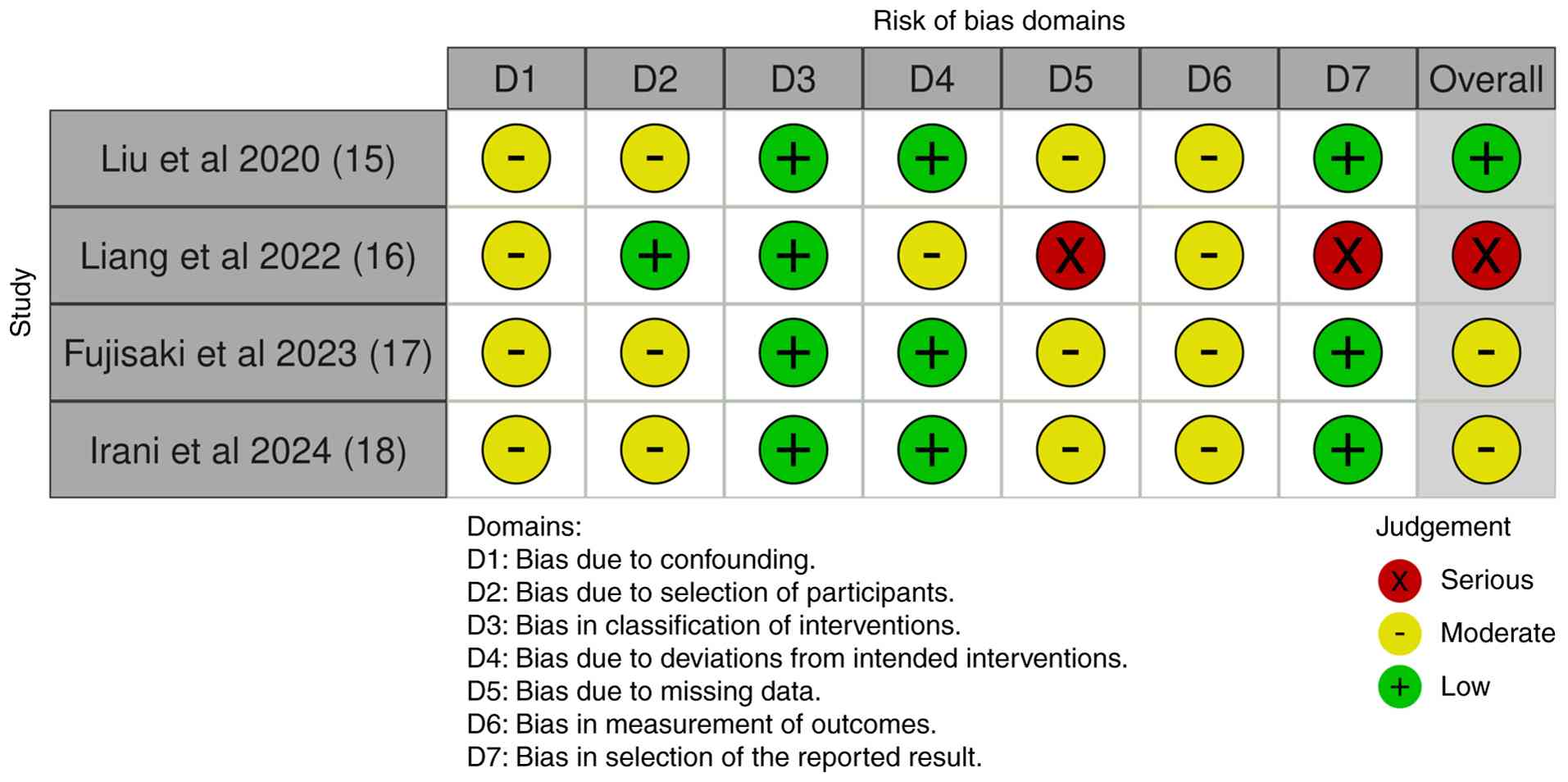
Figure 1

Risk-of-bias assessment using the
ROBINS-I tool for included non-randomized studies. The domains
evaluated include confounding, selection of participants,
classification of interventions, deviations from intended
interventions, missing data, measurement of outcomes, and selection
of reported results. ROBINS, Risk of Bias in Non-randomized Studies
of Interventions.

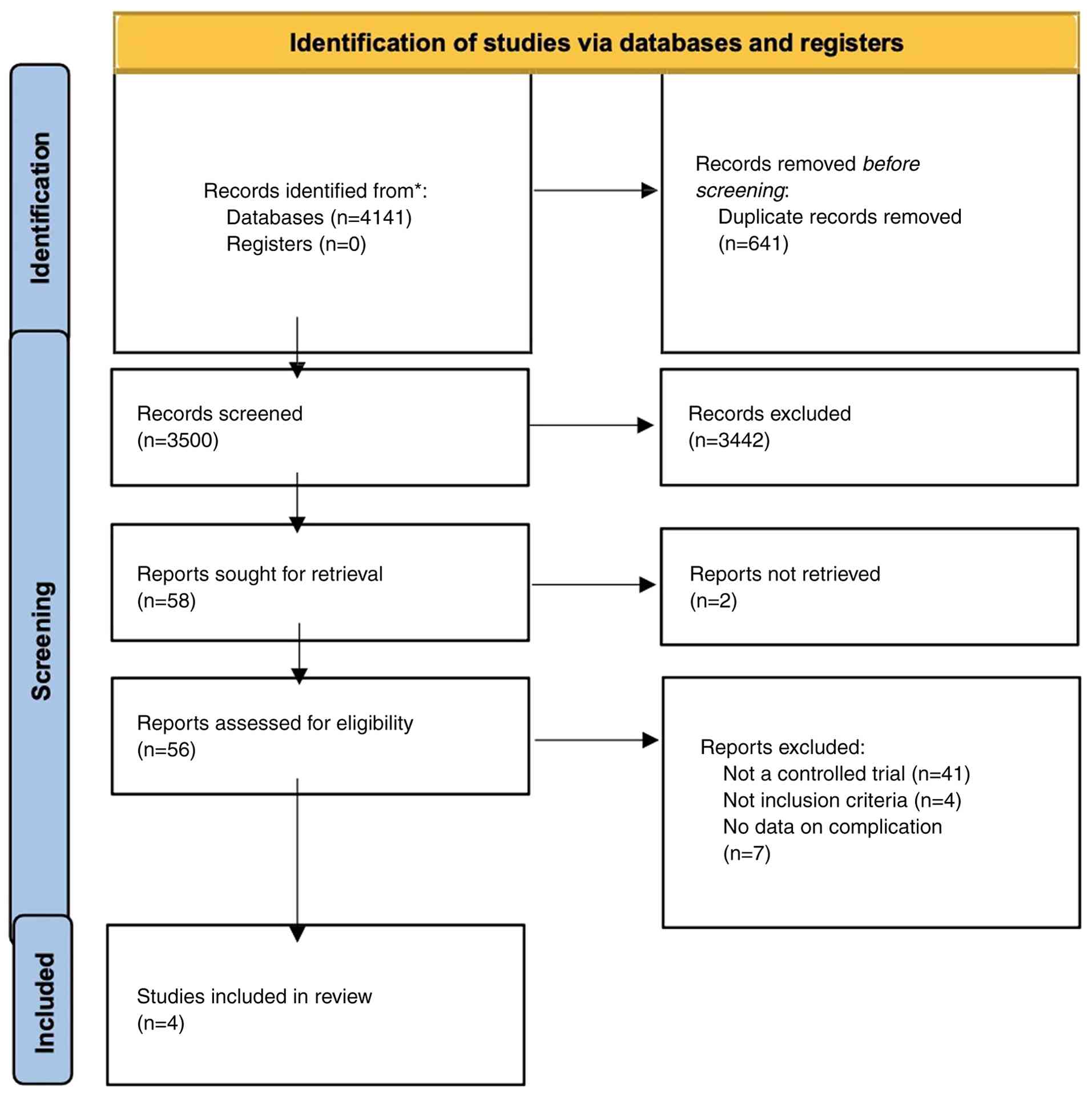
Figure 2

PRISMA flow diagram of the study
selection process. The diagram depicts the identification,
screening, eligibility assessment and inclusion of studies for the
systematic review and meta-analysis.

Figure 3

Forest plot comparing duration of
surgery between apex-preserving and apex-dissection techniques.
Apex preservation was associated with a significantly shorter
duration of surgery (MD, -9.82 min; 95% CI, -13.91 to -5.73). The
studies shown are the following: Liu and Yang (15), Liang et al (16), Fujisaki et al (17) and Irani et al (18). PUMPA, preserved urethral mucosa at
the prostatic apex; TURP, transurethral resection of the prostate;
MD, mean difference; CI, confidence interval.

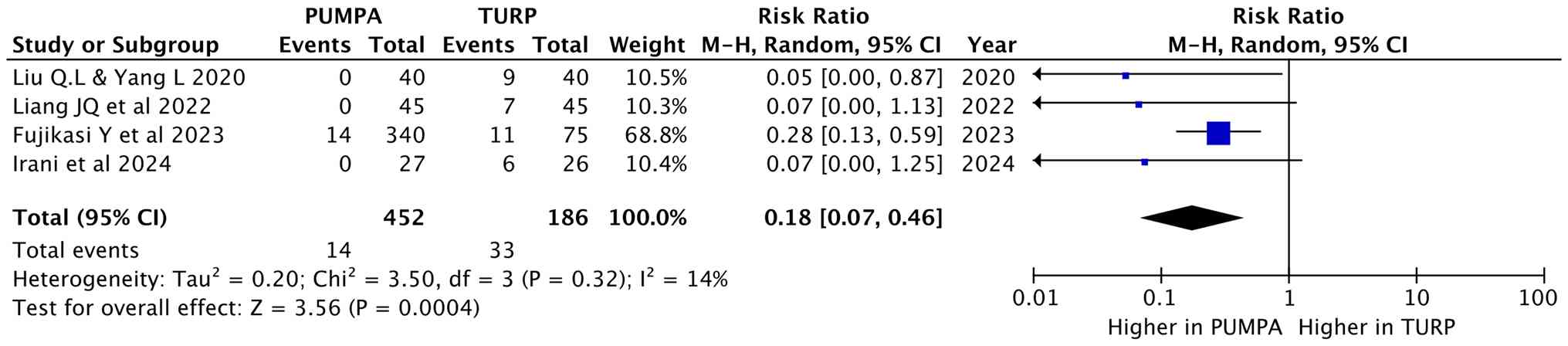
Figure 4

Forest plot of post-operative urinary
incontinence comparing preservation vs. non-preservation groups.
The apex-preservation group demonstrated significantly lower rates
of early postoperative incontinence (RR, 0.18; 95% CI, 0.07-0.46).
The studies shown are the following: Liu and Yang (15), Liang et al (16), Fujisaki et al (17) and Irani et al (18). PUMPA, preserved urethral mucosa at
the prostatic apex; TURP, transurethral resection of the prostate;
RR, relative risk; CI, confidence interval.

Figure 5

Forest plot of intraoperative blood
loss. Apex-preserving procedures showed reduced blood loss compared
with conventional dissection (MD, -65.37 ml; 95% CI, -121.97 to
-8.77). The studies shown are the following: Liu and Yang (15), Liang et al (16) and Irani et al (18). PUMPA, preserved urethral mucosa at
the prostatic apex; TURP, transurethral resection of the prostate;
MD, mean difference; CI, confidence interval.

Figure 6

Forest plot comparing prostate tissue
volume excised. No significant difference in resected prostate
volume was observed between the groups (MD, 0.69 g; 95% CI, -5.96
to 7.34). The studies shown are the following: Liang et al
(16) and Fujisaki et al
(17). PUMPA, preserved urethral
mucosa at the prostatic apex; TURP, transurethral resection of the
prostate; MD, mean difference; CI, confidence interval.

Figure 7

Forest plot of IPSS following
surgery. Postoperative IPSS values were comparable between
apex-preserving and apex-dissection groups (MD, -0.02; 95% CI,
-0.65 to 0.62). The studies shown are the following: Liu and Yang
(15), Liang et al
(16) and Irani et al
(18). IPSS, International
Prostate Symptom Score; PUMPA, preserved urethral mucosa at the
prostatic apex; TURP, transurethral resection of the prostate; MD,
mean difference; CI, confidence interval.

Figure 8

Forest plot of postoperative QoL
scores. QoL outcomes did not differ significantly between groups
(MD, -0.30; 95% CI, -0.50 to -0.11). The studies shown are the
following: Liu and Yang (15) and
Liang et al (16). QoL,
quality-of-life; PUMPA, preserved urethral mucosa at the prostatic
apex; TURP, transurethral resection of the prostate; MD, mean
difference; CI, confidence interval.

Figure 9

Forest plot of post-operative Qmax.
Qmax outcomes were similar between the two surgical techniques (MD,
0.11 ml/sec; 95% CI, -0.38 to 0.59). The studies shown are the
following: Liu and Yang (15),
Liang et al (16), Fujisaki
et al (17) and Irani et
al (18). Qmax, peak urinary
flow rate; PUMPA, preserved urethral mucosa at the prostatic apex;
TURP, transurethral resection of the prostate; MD, mean difference;
CI, confidence interval.

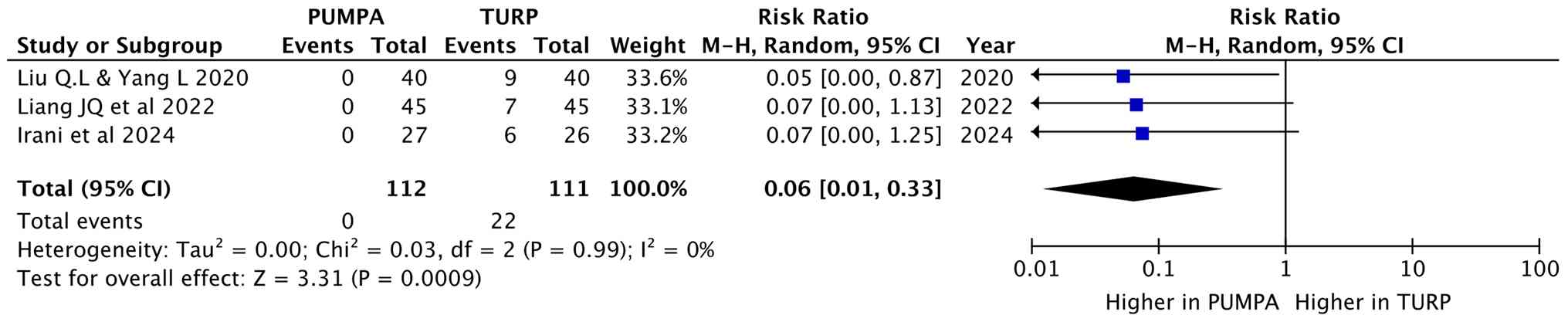
Figure 10

Leave-one-out sensitivity analysis
for post-operative urinary incontinence. The studies included are
the following: Liu and Yang (15),
Liang et al (16) and Irani
et al (18). Excluding the
study by Fujisaki et al (17) reduced heterogeneity and yielded a
pooled incontinence estimate of 0.06 (95% CI, 0.01 to 0.33),
confirming robustness.

Figure 11

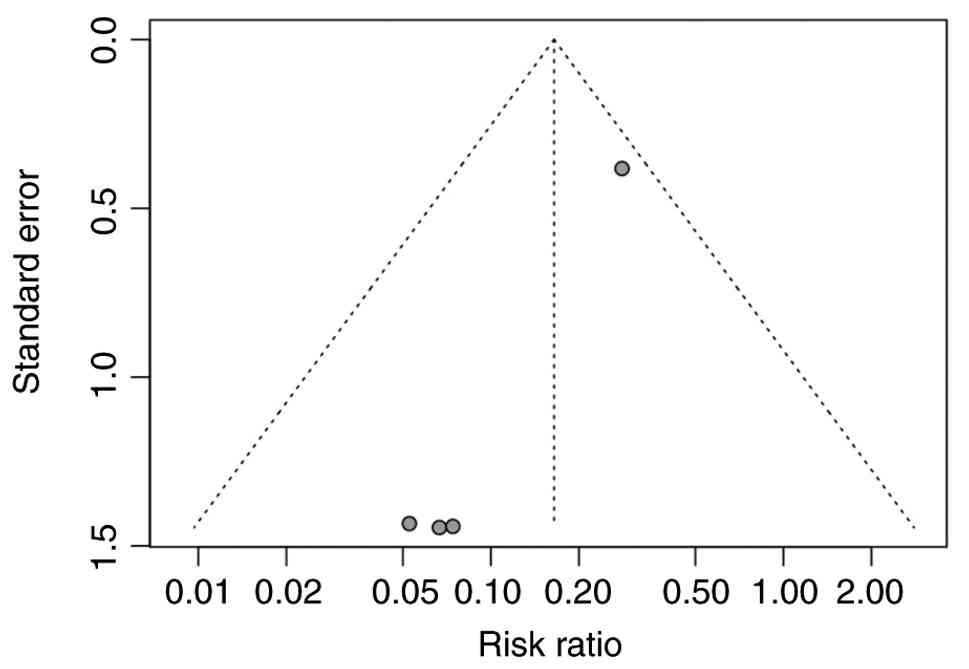
Funnel plot assessing publication
bias for urinary incontinence outcomes. Demonstrates mild asymmetry
suggestive of small-study effects, although interpretation is
limited by the small number of included studies.
View References

1 

Michalak J, Tzou D and Funk J: HoLEP: The gold standard for the surgical management of BPH in the 21(st) century. Am J Clin Exp Urol. 3:36–42. 2015.PubMed/NCBI

2 

Shvero A, Calio B, Humphreys MR and Das AK: HoLEP: The new gold standard for surgical treatment of benign prostatic hyperplasia. Can J Urol. 28:6–10. 2021.PubMed/NCBI

3 

Miernik A and Gratzke C: Current treatment for benign prostatic hyperplasia. Dtsch Arztebl Int. 117:843–854. 2020.PubMed/NCBI View Article : Google Scholar

4 

Qian X, Liu H and Xu D, Xu L, Huang F, He W, Qi J, Zhu Y and Xu D: Functional outcomes and complications following B-TURP versus HoLEP for the treatment of benign prostatic hyperplasia: A review of the literature and meta-analysis. Aging Male. 20:184–191. 2017.PubMed/NCBI View Article : Google Scholar

5 

Licari LC, Bologna E, Manfredi C, Franco A, Ditonno F, DE Nunzio C, Franco G, Cindolo L, Leonardo C, Adelstein SA, et al: Postoperative urinary incontinence following BPH surgery: Insights from a comprehensive national database analysis. Minerva Urol Nephrol. 76:618–624. 2024.PubMed/NCBI View Article : Google Scholar

6 

Rassweiler J, Teber D, Kuntz R and Hofmann R: Complications of trans urethral resection of the prostate (TURP)-incidence, management, and prevention. Eur Urol. 50:969–979; discussion 980. 2006.PubMed/NCBI View Article : Google Scholar

7 

Partin AW, Peters CA, Kavoussi LR, Dmochowski RR and Wein AJ: The prostate. In: Campbell-Walsh Urology. Wein AJ, Kavoussi LR, Peters CA, Partin AW, Dmochowski RR (Eds). 12th edition.: Elsevier, Philadelphia, PA, pp3410-3416, 2020.

8 

Valenzi FM, Fuschi A, Al Salhi Y, Sequi MB, Suraci PP, Pacini M, Scalzo S, Rera OA, Antonioni A, Graziani D, et al: Is early continence recovery related to the length of the spared urethra? A prospective multicenter study comparing preoperative MRI and histologic specimen measurements after robotic radical prostatectomy. Eur J Surg Oncol. 50(108319)2024.PubMed/NCBI View Article : Google Scholar

9 

Walz J, Burnett AL, Costello AJ, Eastham JA, Graefen M, Guillonneau B, Menon M, Montorsi F, Myers RP, Rocco B and Villers A: A critical analysis of the current knowledge of surgical anatomy related to optimization of cancer control and preservation of continence and erection in candidates for radical prostatectomy. Eur Urol. 57:179–192. 2010.PubMed/NCBI View Article : Google Scholar

10 

Walz J, Epstein JI, Ganzer R, Graefen M, Guazzoni G, Kaouk J, Menon M, Mottrie A, Myers RP, Patel V, et al: A critical analysis of the current knowledge of surgical anatomy of the prostate related to optimization of cancer control and preservation of continence and erection in candidates for radical prostatectomy: An update. Eur Urol. 70:301–311. 2016.PubMed/NCBI View Article : Google Scholar

11 

Katsimperis S, Juliebø-Jones P, Ta A, Tandogdu Z, Al-Bermani O, Bellos T, Esperto F, Tonyali S, Mitsogiannis I, Skolarikos A, et al: Surgical techniques to preserve continence after robot-assisted radical prostatectomy. Front Surg. 10(1289765)2023.PubMed/NCBI View Article : Google Scholar

12 

Dalpiaz O and Anderhuber F: The fascial suspension of the prostate: A cadaveric study. Neurourol Urodyn. 36:1131–1135. 2017.PubMed/NCBI View Article : Google Scholar

13 

Van der Poel HG, de Blok W, Joshi N and van Muilekom E: Preservation of lateral prostatic fascia is associated with urine continence after robotic-assisted prostatectomy. Eur Urol. 55:892–900. 2009.PubMed/NCBI View Article : Google Scholar

14 

Hoyland K, Vasdev N, Abrof A and Boustead G: Post-radical prostatectomy incontinence: Etiology and prevention. Rev Urol. 16:181–188. 2014.PubMed/NCBI

15 

Liu QL and Yang L: Comparison of the transurethral resection of the prostate by traditional versus preserved urethral mucosa of the prostatic apex. J Endourol. 34:482–486. 2020.PubMed/NCBI View Article : Google Scholar

16 

Liang JQ, Ma WT, Lu BW, Dai L, Zhao YM, Zhang JD, Tian B and Liu QL: Clinical study on the application of preserved urethral mucosa at the prostatic apex in transurethral plasmakinetic resection of the prostate. Front Surg. 9(922479)2022.PubMed/NCBI View Article : Google Scholar

17 

Fujisaki Y, Otsuka I, Kobayashi T, Miyake N, Ito K, Terada N, Kamoto T and Iwamoto H: Use of the anterior prostatic urethral mucosa preservation technique during holmium laser enucleation of the prostate can reduce postoperative stress urinary incontinence. Asian J Endosc Surg. 17(e13256)2024.PubMed/NCBI View Article : Google Scholar

18 

Irani D, Saadatfar A, Aminsharifi A, Ahmed F, Mirzakhanlouei A, Afrasiabi M, Adib A and Shamohammadi I: Influence of urethral mucosa preservation of prostatic apex during monopolar transurethral resection of the prostate on postoperative functional outcomes: A retrospective comparative study. Urol Sci. 35:75–79. 2024.

19 

Page MJ, McKenzie JE, Bossuyt PM, Boutron I, Hoffmann TC, Mulrow CD, Shamseer L, Tetzlaff JM, Akl EA, Brennan SE, et al: The PRISMA 2020 statement: An updated guideline for reporting systematic reviews. BMJ. 372(n71)2021.PubMed/NCBI View Article : Google Scholar

20 

Higgins J, Savović J, Page MJ and Sterne JAC: RoB 2: A revised Cochrane risk-of-bias tool for randomized trials. Br Med J. 366(l4898)2019.PubMed/NCBI View Article : Google Scholar

21 

Cumpston M, Li T, Page MJ, Chandler J, Welch VA, Higgins JP and Thomas J: Updated guidance for trusted systematic reviews: A new edition of the cochrane handbook for systematic reviews of interventions. Cochrane Database Syst Rev. 10(ED000142)2019.PubMed/NCBI View Article : Google Scholar

22 

DerSimonian R and Laird N: Meta-analysis in clinical trials revisited. Contemp Clin Trials. 45:139–145. 2015.PubMed/NCBI View Article : Google Scholar

23 

Page MJ, McKenzie JE, Bossuyt PM, Boutron I, Hoffmann TC, Mulrow CD, Shamseer L, Tetzlaff JM, Akl EA, Brennan SE, et al: The PRISMA 2020 statement: An updated guideline for reporting systematic reviews. BMJ. 372(n71)2021.PubMed/NCBI View Article : Google Scholar

24 

Zinner NR, Sterling AM and Ritter RC: Role of inner urethral softness in urinary continence. Urology. 16:115–117. 1980.PubMed/NCBI View Article : Google Scholar

25 

Carnevale FC, Iscaife A, Yoshinaga EM, Moreira AM, Antunes AA and Srougi M: Transurethral resection of the prostate (TURP) versus original and PErFecTED prostate artery embolization (PAE) due to benign prostatic hyperplasia (BPH): Preliminary results of a single center, prospective, urodynamic-controlled analysis. Cardiovasc Intervent Radiol. 39:44–52. 2016.PubMed/NCBI View Article : Google Scholar

26 

Guyatt GH, Oxman AD, Schünemann HJ, Tugwell P and Knottnerus A: GRADE guidelines: A new series of articles in the journal of clinical epidemiology. J Clin Epidemiol. 64:380–382. 2011.PubMed/NCBI View Article : Google Scholar

27 

Deng T, Wang Y, Wang Y, Li B, Jin Y, Ren X and Wang X: Methodology for clinical practice guidelines-Application of GRADEpro GDT in Evidence Grading of Systematic Reviews of Interventional trial. Chin J Evid-Based Cardiovasc Med. 11:1–5. 2019.(In Chinese).

Related Articles

  • Abstract
  • View
  • Download
Copy and paste a formatted citation
Spandidos Publications style
Kadar DD, Thamran B and Yusuf KA: Clinical efficacy of prostatic apex preservation vs. the non‑preserving method in the management of BPH: A systematic review and meta‑analysis. World Acad Sci J 8: 22, 2026.
APA
Kadar, D.D., Thamran, B., & Yusuf, K.A. (2026). Clinical efficacy of prostatic apex preservation vs. the non‑preserving method in the management of BPH: A systematic review and meta‑analysis. World Academy of Sciences Journal, 8, 22. https://doi.org/10.3892/wasj.2026.437
MLA
Kadar, D. D., Thamran, B., Yusuf, K. A."Clinical efficacy of prostatic apex preservation vs. the non‑preserving method in the management of BPH: A systematic review and meta‑analysis". World Academy of Sciences Journal 8.2 (2026): 22.
Chicago
Kadar, D. D., Thamran, B., Yusuf, K. A."Clinical efficacy of prostatic apex preservation vs. the non‑preserving method in the management of BPH: A systematic review and meta‑analysis". World Academy of Sciences Journal 8, no. 2 (2026): 22. https://doi.org/10.3892/wasj.2026.437
Copy and paste a formatted citation
x
Spandidos Publications style
Kadar DD, Thamran B and Yusuf KA: Clinical efficacy of prostatic apex preservation vs. the non‑preserving method in the management of BPH: A systematic review and meta‑analysis. World Acad Sci J 8: 22, 2026.
APA
Kadar, D.D., Thamran, B., & Yusuf, K.A. (2026). Clinical efficacy of prostatic apex preservation vs. the non‑preserving method in the management of BPH: A systematic review and meta‑analysis. World Academy of Sciences Journal, 8, 22. https://doi.org/10.3892/wasj.2026.437
MLA
Kadar, D. D., Thamran, B., Yusuf, K. A."Clinical efficacy of prostatic apex preservation vs. the non‑preserving method in the management of BPH: A systematic review and meta‑analysis". World Academy of Sciences Journal 8.2 (2026): 22.
Chicago
Kadar, D. D., Thamran, B., Yusuf, K. A."Clinical efficacy of prostatic apex preservation vs. the non‑preserving method in the management of BPH: A systematic review and meta‑analysis". World Academy of Sciences Journal 8, no. 2 (2026): 22. https://doi.org/10.3892/wasj.2026.437
Follow us
  • Twitter
  • LinkedIn
  • Facebook
About
  • Spandidos Publications
  • Careers
  • Cookie Policy
  • Privacy Policy
How can we help?
  • Help
  • Live Chat
  • Contact
  • Email to our Support Team