|
1
|
Kidney Disease: Improving Global Outcomes
(KDIGO) Glomerular Diseases Work Group: KDIGO 2021 clinical
practice guideline for the management of glomerular diseases.
Kidney Int. 100:S1–S276. 2021.PubMed/NCBI View Article : Google Scholar
|
|
2
|
Trautmann A, Boyer O, Hodson E, Bagga A,
Gipson DS, Samuel S, Wetzels J, Alhasan K, Banerjee S, Bhimma R, et
al: IPNA clinical practice recommendations for the diagnosis and
management of children with steroid-sensitive nephrotic syndrome.
Pediatr Nephrol. 38:877–919. 2023.PubMed/NCBI View Article : Google Scholar
|
|
3
|
Floege J, Gibson KL, Vivarelli M, Liew A,
Radhakrishnan J, Rovin BH and Kidney Disease: Improving Global
Outcomes (KDIGO) Nephrotic Syndrome In Children Work Group: KDIGO
2025 clinical practice guideline for the management of nephrotic
syndrome in children. Kidney Int. 107:S241–S289. 2025.
|
|
4
|
Ngo QC, Tran HD, Nguyen NBT, Nguyen THT
and Mai TT: Hypomagnesemia as a reversible complication of
cyclosporine in pediatric nephrotic syndrome: A case report. Child
Kidney Dis. 29:142–148. 2025.
|
|
5
|
Leung AK, Wong AH and Barg SS: Proteinuria
in children: Evaluation and differential diagnosis. Am Fam
Physician. 95:248–254. 2017.PubMed/NCBI
|
|
6
|
Huang Y, Yang X, Zhang Y, Yue S, Mei X, Bi
L, Zhai W, Ren X, Ding Y, Zhang S, Deng Z and Sun Y: Correlation of
urine protein/creatinine ratios to 24-h urinary protein for
quantitating proteinuria in children. Pediatr Nephrol. 35:463–468.
2020.PubMed/NCBI View Article : Google Scholar
|
|
7
|
Singh R, Bhalla K, Nanda S, Gupta A and
Mehra S: Correlation of spot urinary protein/creatinine ratio and
quantitative proteinuria in pediatric patients with nephrotic
syndrome. J Family Med Prim Care. 8:2343–2346. 2019.PubMed/NCBI View Article : Google Scholar
|
|
8
|
Lane C, Brown M, Dunsmuir W, Kelly J and
Mangos G: Can spot urine protein/creatinine ratio replace 24 h
urine protein in usual clinical nephrology? Nephrology (Carlton).
11:245–249. 2006.PubMed/NCBI View Article : Google Scholar
|
|
9
|
Kobayashi S, Amano H, Terawaki H, Ogura M,
Kawaguchi Y and Yokoo T: Spot urine protein/creatinine ratio as a
reliable estimate of 24-hour proteinuria in patients with
immunoglobulin A nephropathy, but not membranous nephropathy. BMC
Nephrol. 20(306)2019.PubMed/NCBI View Article : Google Scholar
|
|
10
|
Huynh BA, Ho NHH, Bui TTA, Hoang KC and
Tran TTT: New equation for estimating glomerular filtration rate in
Vietnamese kidney transplant recipients. Int Urol Nephrol.
57:2657–2667. 2025.PubMed/NCBI View Article : Google Scholar
|
|
11
|
Leslie SW, Rathi BM, Sharif S and Rout P:
24-hour urine collection and analysis. In: StatPearls. Treasure
Island (FL): StatPearls Publishing, 2025.
|
|
12
|
Hellerstein S, Simon SD, Berenbom M, Erwin
P and Nickell E: Creatinine excretion rates for renal clearance
studies. Pediatr Nephrol. 16:637–643. 2001.PubMed/NCBI View Article : Google Scholar
|
|
13
|
Ghazali S and Barratt TM: Urinary
excretion of calcium and magnesium in children. Arch Dis Child.
49:97–101. 1974.PubMed/NCBI View Article : Google Scholar
|
|
14
|
Cockcroft DW and Gault MH: Prediction of
creatinine clearance from serum creatinine. Nephron. 16:31–41.
1976.PubMed/NCBI View Article : Google Scholar
|
|
15
|
Eddy AA and Symons JM: Nephrotic syndrome
in childhood. Lancet. 362:629–639. 2003.PubMed/NCBI View Article : Google Scholar
|
|
16
|
Kerlin BA, Haworth K and Smoyer WE: Venous
thromboembolism in pediatric nephrotic syndrome. Pediatr Nephrol.
29:989–997. 2014.PubMed/NCBI View Article : Google Scholar
|
|
17
|
Ellis D: Pathophysiology, evaluation, and
management of edema in childhood nephrotic syndrome. Front Pediatr.
3(111)2016.PubMed/NCBI View Article : Google Scholar
|
|
18
|
Parker K, Ragy O, Hamilton P, Thachil J
and Kanigicherla D: Thromboembolism in nephrotic syndrome:
Controversies and uncertainties. Res Pract Thromb Haemost.
7(102162)2023.PubMed/NCBI View Article : Google Scholar
|
|
19
|
Sun LY, Xu K, Yao Y, Xiao HJ, Liu XY, Su
BG, Zhong XH, Guan N, Zhang HW, Ding J and Wang F: Suitability of
estimated urine protein using different estimated 24 h urine
creatinine equations in children with glomerular diseases. Zhonghua
Er Ke Za Zhi. 60:1178–1184. 2022.PubMed/NCBI View Article : Google Scholar
|
|
20
|
Zhai P, Huang Y, Yue S, Yang X, Luo J,
Zhang Y, Mei X, Bi L, Zhai W, Ren X, et al: Diagnostic efficacy and
influencing factors of urinary protein/creatinine ratio replacing
24-h urine protein as an evaluator of proteinuria in children. Int
Urol Nephrol. 54:1409–1416. 2022.PubMed/NCBI View Article : Google Scholar
|
|
21
|
Yang CY, Chen FA, Chen CF, Liu WS, Shih
CJ, Ou SM, Yang WC, Lin CC and Yang AH: Diagnostic accuracy of
urine protein/creatinine ratio is influenced by urine
concentration. PLoS One. 10(e0137460)2015.PubMed/NCBI View Article : Google Scholar
|
|
22
|
Chuang GT, Tsai IJ and Tsau YK: Serum
creatinine reference limits in pediatric population: A
single-center electronic health record-based database in Taiwan.
Front Pediatr. 9(793446)2021.PubMed/NCBI View Article : Google Scholar
|
|
23
|
Suwanrungroj S, Pattarapanitchai P,
Chomean S and Kaset C: Establishing age- and gender-specific serum
creatinine reference ranges for the Thai pediatric population. PLoS
One. 19(e0300369)2024.PubMed/NCBI View Article : Google Scholar
|
|
24
|
Filler G and Huang SHS: Spot urine protein
to creatinine ratio. Pediatr Nephrol. 32:917–919. 2017.PubMed/NCBI View Article : Google Scholar
|
|
25
|
Yang F, Shi JS, Gong SW, Xu XD and Le W:
An equation to estimate 24-hour total urine protein excretion rate
in patients who underwent urine protein testing. BMC Nephrol.
23(49)2022.PubMed/NCBI View Article : Google Scholar
|
|
26
|
Patil P, Shah V and Shah B: Comparison of
spot urine protein/creatinine ratio with 24-hour urine protein for
estimation of proteinuria. J Assoc Physicians India. 62:406–410.
2014.PubMed/NCBI
|
|
27
|
Shimizu S, Saito H, Takahashi S, Morohashi
T, Hamada R, Hataya H, Kondo Y and Morioka I: Fractional excretion
of total protein in patients with nephrotic syndrome. Pediatr Int.
66(e15722)2024.PubMed/NCBI View Article : Google Scholar
|
|
28
|
Hogan MC, Reich HN, Nelson PJ, Adler SG,
Cattran DC, Appel GB, Gipson DS, Kretzler M, Troost JP and Lieske
JC: The relatively poor correlation between random and 24-hour
urine protein excretion in patients with biopsy-proven glomerular
diseases. Kidney Int. 90:1080–1089. 2016.PubMed/NCBI View Article : Google Scholar
|
|
29
|
Kapur G, Valentini RP, Imam AA and Mattoo
TK: Treatment of severe edema in children with nephrotic syndrome
with diuretics alone: A prospective study. Clin J Am Soc Nephrol.
4:907–913. 2009.PubMed/NCBI View Article : Google Scholar
|
|
30
|
Collins GS, Reitsma JB, Altman DG and
Moons KGM: Transparent reporting of a multivariable prediction
model for individual prognosis or diagnosis (TRIPOD): The TRIPOD
statement. Ann Intern Med. 162:55–63. 2015.PubMed/NCBI View Article : Google Scholar
|
|
31
|
Moons KGM, Altman DG, Reitsma JB,
Ioannidis JP, Macaskill P, Steyerberg EW, Vickers AJ, Ransohoff DF
and Collins GS: Transparent reporting of a multivariable prediction
model for individual prognosis or diagnosis (TRIPOD): Explanation
and elaboration. Ann Intern Med. 162:W1–W73. 2015.PubMed/NCBI View Article : Google Scholar
|
|
32
|
Wolff RF, Moons KGM, Riley RD, Whiting PF,
Westwood M, Collins GS, Reitsma JB, Kleijnen J and Mallett S:
PROBAST: A tool to assess the risk of bias and applicability of
prediction model studies. Ann Intern Med. 170:51–58.
2019.PubMed/NCBI View Article : Google Scholar
|
















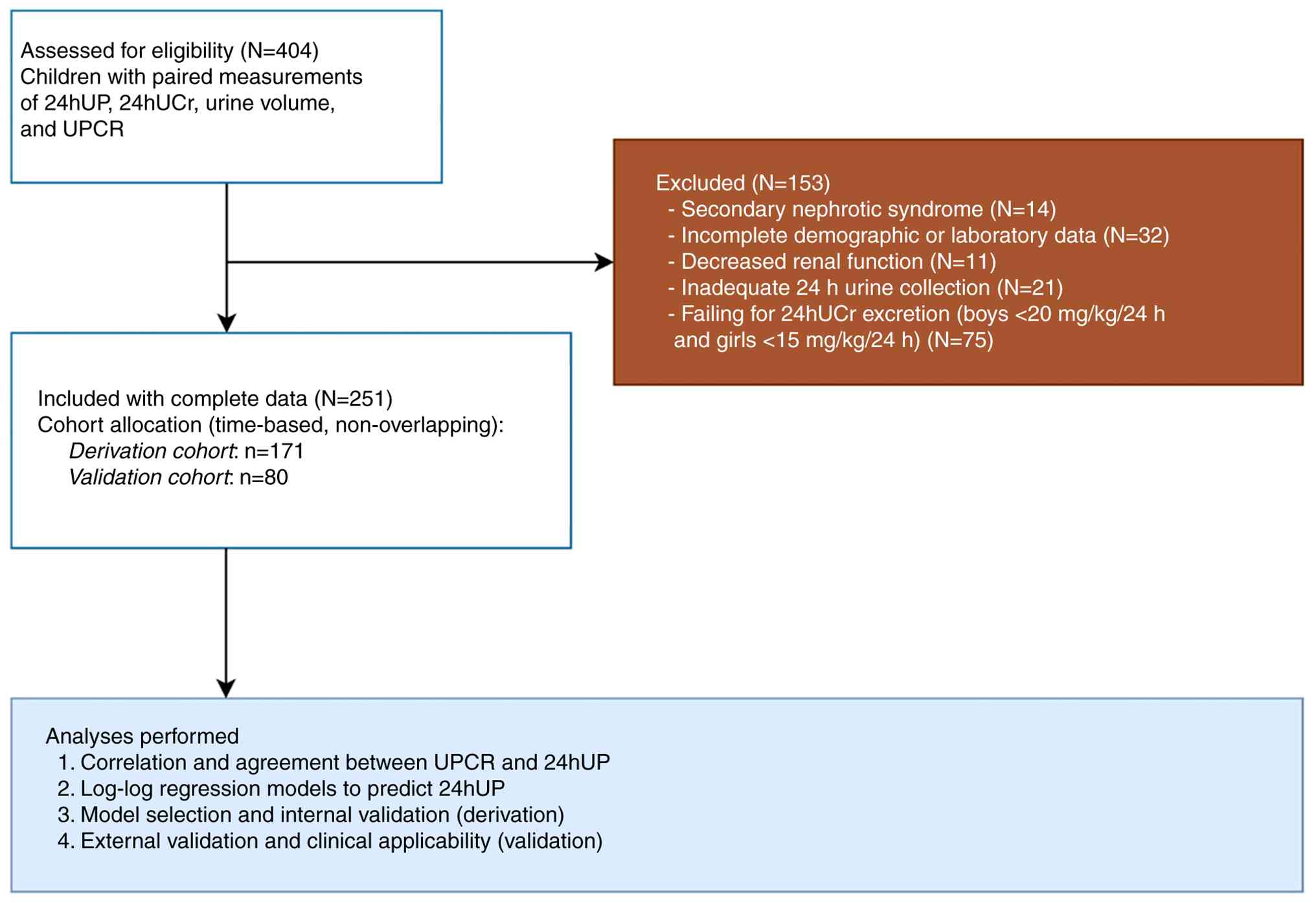
![Calibration for model M6:
Observed Log10(24hUP) vs. predicted
Log10(24hUP). The 45˚ line is the ideal reference. The
solid line shows the apparent fit; the dashed line shows the
optimism-corrected fit from bootstrap (B=2,000). The two lines
nearly overlap (slope=0.999; intercept=0.002). Model M6:
Log10[24hUP (mg/m2/h)]=0.291 + 0.880 x
Log10 (adjusted UPCR)-0.006xage (years)+0.057xsex
(0=boy, 1=girl). Adjusted
UPCR=mUPCRxe24hUCrCockcroft-Gault; n=171; adjusted
R2=0.80. 24hUP, 24-h urine protein; lm, linear model;
OP-corr, optimism-corrected.](/article_images/wasj/8/2/wasj-08-02-00448-g02.jpg)