1. Introduction
The oral-gut axis has emerged as a key-biological
pathway through which periodontitis modulates gut microbiota
composition and systemic immune-metabolic responses (1-3).
This axis denotes a bidirectional network linking the oral and
gastrointestinal microbiomes, whereby microbial translocation,
microbially derived metabolites and immune signalling jointly
influence systemic health (2,4,5). In
periodontitis, oral dysbiosis, characterised by the expansion of
pathogensm such as Porphyromonas gingivalis (P.
gingivalis) and Fusobacterium nucleatum (F. nucleatum),
leads to the continuous seeding of the gut via swallowed saliva,
disrupting intestinal homeostasis and sustaining low-grade
inflammation (6-9).
Conversely, established gut dysbiosis can intensify periodontal
tissue breakdown by altering host immune responses and bone
metabolism, thereby reinforcing a self-perpetuating loop that
contributes to the development and progression of systemic
diseases, such as rheumatoid arthritis (RA), diabetes and
cardiovascular disease (3,10,11).
The underlying mechanisms include the direct migration of oral taxa
to the intestine, the disruption of short-chain fatty acid (SCFA)
profiles, and an imbalance between T helper 17 (Th17) cells and
regulatory T cells (Tregs). Collectively, these findings emphasise
the oral cavity as a major gateway influencing the composition and
function of the gut microbiome (1,2,12).
A central component of this axis is microbial
translocation, whereby oral pathobionts survive gastric conditions
and colonise the intestine, particularly when gut barrier function
is compromised (4,6,9).
Individuals with periodontitis are estimated to ingest
109-1010 bacteria daily, a burden that may
exceed the colonisation resistance of the gut and favour the
enrichment of organisms such as P. gingivalis. This pathogen
downregulates tight junction proteins, including zonula occludens-1
(ZO-1) and occludin, thereby increasing intestinal permeability and
endotoxemia (6,13,14).
Murine models receiving oral gavage of P. gingivalis have
demonstrated persistent gut colonisation, reduced microbial
diversity, elevated levels of interleukin (IL)-17 and tumour
necrosis factor-α (TNF-α), and bile-acid disturbances that
predispose the host to non-alcoholic fatty liver disease and
impaired glucose tolerance (2,6,15).
F. nucleatum similarly exploits adhesins, such as
Fusobacterium adhesin (FadA), to bind E-cadherin, activate
β-catenin signalling pathways, and evade host immune responses
through interactions between FadA protein 2 (Fap2) and T-cell
immunoreceptor with immunoglobulin and immunoreceptor
tyrosine-based inhibitory motif domains (TIGIT). These mechanisms
exacerbate colitis and colorectal carcinogenesis via the oral-gut
route (7,16,17).
Findings from human microbiota-associated mouse models and paired
saliva-faeces sequencing analyses have shown that salivary taxa can
account for up to 5.88% of the gut microbes in individuals with
periodontitis, compared with only 0.6% in healthy subjects
(8). Immune crosstalk constitutes
another major pillar of the oral-gut axis, whereby dysbiotic oral
communities prime systemic Th17 responses that recirculate to both
gut and periodontal tissues, as detailed in subsequent sections
(12,18). In models of high-fat-diet or
antibiotic-induced gut dysbiosis, the expansion of Th17 cells and
suppression of Tregs, together with upregulated IL-17 and receptor
activator of nuclear factor κB ligand (RANKL), enhance
osteoclastogenesis, alveolar bone loss and impaired
osseointegration (10,11,19).
Periodontal pathogens further aggravate these effects through the
translocation of lipopolysaccharides (LPS) and gingipains, which
compromise epithelial barrier integrity and create a
pro-inflammatory milieu favouring the expansion of
Enterobacteriaceae, while depleting SCFAs, particularly butyrate
(4,14,20).
The evaluation and modulation of the oral-gut microbiomes using
probiotics and precision dietary interventions may help reduce the
burden of systemic diseases. The present review aimed to clarify
the role of the bidirectional oral-gut axis in periodontitis
pathogenesis and to appraise emerging host- and microbiota-targeted
therapeutic strategies for disrupting this inflammatory circuit.
Furthermore, it integrates evidence from Mendelian randomisation
studies with current understanding of oral-gut-bone axis
mechanisms, including implant failure, within the broader context
of the Sustainable Development Goals and global health
priorities.
2. Literature search strategy and scope of
the review
A literature search was conducted using the PubMed,
Scopus and Web of Science databases up to January, 2026, focusing
on studies published from 2000 onwards that examined oral-gut
microbial crosstalk in the context of periodontitis. Search terms
comprised a combination of Medical Subject Headings (MeSH) and
free-text key words related to periodontitis, oral microbiome, gut
microbiota, oral-gut axis, microbial translocation and
probiotics/synbiotics, combined using Boolean operators. Original
human and experimental studies, as well as key narrative and
systematic reviews reporting data on microbial translocation,
immune-metabolic signalling, barrier dysfunction, or therapeutic
modulation of the oral-gut axis, were included. Moreover, case
reports and non-English publications were excluded. The present
review is narrative rather than systematic in nature. Therefore,
the substantial heterogeneity in study designs, populations and
microbiome analysis methodologies precluded a formal quantitative
comparison of the reported findings.
3. Evidence for oral-gut translocation and
colonisation of periodontal pathobionts
The oral cavity harbours a diverse microbial
community that continuously supplies bacteria to the
gastrointestinal tract via swallowed saliva. Under healthy
conditions, this microbial flux contributes to the maintenance of a
stable ecological equilibrium. By contrast, periodontal diseases,
such as periodontitis enrich pathogenic species, including P.
gingivalis, F. nucleatum, and Treponema
denticola, which can translocate and establish within the
intestine (4,6,7).
SourceTracker analyses have shown that saliva-derived
Porphyromonadaceae account for ~5.88% of the faecal
microbiota in patients with periodontitis, compared with only 0.6%
in healthy individuals, confirming distal intestinal seeding by
oral pathobionts (8,21).
Mechanistic insights from animal models strongly
support the enteral translocation and mucosal persistence of oral
microorganisms (10). The oral
gavage of P. gingivalis in mice has been shown to lead to
its persistence throughout the gastrointestinal tract and induces
alterations in the resident microbial communities by downregulating
the tight-junction proteins, ZO-1 and occludin, thereby weakening
intestinal barrier function (6,13,14).
Proof-of-concept analyses using carboxyfluorescein succinimidyl
ester (CFSE)-labelled salivary bacteria have further demonstrated
that fluorescent oral microbes remain detectable within the gut
lumen and mucosa for >24 h, providing direct evidence of
survival after oral-gut migration (8). P. gingivalis exhibits acid
tolerance and adherence to the colonic epithelium via
gingipain-mediated mechanisms, while F. nucleatum employs
FadA-E-cadherin and Fap2-TIGIT interactions to facilitate ectopic
colonisation, particularly in the presence of pre-existing gut
dysbiosis (13,16,17,22).
Human cohort studies have corroborated these
findings. Individuals with periodontitis display an increased
faecal abundance of oral taxa, including Prevotella
intermedia, Treponema and Porphyromonas, which is
associated with reduced microbial diversity and altered
Bacteroidetes/Firmicutes ratios (23-25).
Longitudinal follow-up studies following non-surgical periodontal
therapy have demonstrated a partial reversal of these changes, with
reductions in salivary pathobionts paralleling improved faecal
composition and lower systemic levels of IL-17 and TNF-α (26,27).
In addition, Mendelian randomisation analyses support a causal
contribution of specific oral-gut migrants to the risk of
developing periodontitis. For example, taxa such as
Anaerotruncus were found to be inversely associated with
periodontitis through genetically determined abundance (28-30).
Colonisation by these oral pathobionts drives
functional dysbiosis with systemic consequences. These effects
include the remodelling of gut metabolic pathways, elevated
trimethylamine N-oxide levels and diminished SCFA production. In
addition, faecal microbiota transplantation (FMT) from donors with
periodontitis has been shown to transfer the dysbiotic phenotype to
germ-free recipients, resulting in barrier leakage and the
upregulation of the chemokines, CXCL2 and CCL5 (12,20,31,32).
Despite this substantial evidence, the durability of engraftment
and its dependence on host diet, baseline gut ecology, and
medication exposure remain incompletely defined (33).
Bidirectional causality is evident in clinical
cohorts. Patients with periodontitis exhibit persistent gut
dysbiosis, characterised by an enrichment of Erysipelotrichaceae
and a depletion of Akkermansia. These alterations mirror the
overgrowth of salivary Porphyromonadaceae. Notably,
periodontal therapy realigns both the oral and gut microbiomes
toward a healthy state (8,24,25).
Furthermore, Mendelian randomisation studies have revealed that gut
microbes, such as Prevotella increase the risk of developing
periodontitis, whereas Butyricicoccus exerts a protective
effect, emphasising a causal association between the gut microbiota
and periodontitis rather than a simple association (28,29).
In individuals with comorbid RA and periodontitis, the enrichment
of salivary Prevotella and Streptococcus is
associated with Disease Activity Score-28 (DAS28) values.
Conversely, gut Fusobacterium abundance is inversely related
to the inflammatory status, suggesting oral-specific biomarkers
(27). Experimental models of
periodontitis extend these observations to the oral-gut-brain axis,
where the gavage of P. gingivalis induces cognitive deficits
via gut-mediated neuroinflammation in mice (34,35).
Taken together, evidence from both clinical and experimental
studies provides strong support for sustained oral-to-gut
colonisation in periodontitis. Nevertheless, the long-term
microbial engraftment and its dependence on factors, such as diet,
baseline gut ecology and medication exposure remain incompletely
understood.
4. Oral microbiome dysbiosis and gut
alterations in periodontitis
Oral microbiome dysbiosis plays a central role in
periodontitis, driving a shift from symbiotic communities to
pathogenic biofilms that sustain chronic inflammation and
progressive tissue destruction. Health-associated supragingival
sites are typically dominated by commensals, such as
Streptococcus and Neisseria, whereas
disease-associated plaque maturation favours the proliferation of
Gram-negative anaerobic bacteria, including P. gingivalis,
Tannerella forsythia, Treponema denticola,
Fusobacterium and Prevotella. These microorganisms
thrive in the low-oxygen environment of deep periodontal pockets
(5,21). Periodontitis is consistently linked
to the enrichment of Porphyromonadaceae and Treponema
species in saliva and plaque. Their increased abundance is
associated with probing depth and bleeding on probing, thus
exemplifying the polymicrobial synergy and dysbiosis model.
Accordingly, keystone pathogens, such as P. gingivalis
subvert host defences, increase the production of virulence factors
(e.g., gingipains), disrupt epithelial junctions and promote
osteoclastogenesis. Overall, these shifts in the oral community
create a reservoir of pathobionts capable of subsequently reshaping
gut microbial ecology (22).
Alterations in the oral microbiome are accompanied
by distinct changes in gut microbial composition in individuals
with periodontitis. Faecal microbiome analyses reveal an enrichment
of taxa, such as Erysipelotrichaceae, Lachnospiraceae and
Blautia, alongside a reduction in beneficial genera,
including Akkermansia. These alterations in gut composition
have been linked to systemic inflammatory status and may be
associated with the severity of periodontal disease (36). Emerging evidence from Mendelian
randomisation and experimental models suggests that specific gut
taxa can modulate susceptibility to periodontitis, with certain
genera (e.g., Anaerotruncus and Eisenbergiella)
demonstrating protective associations, while others (e.g.,
Lachnospiraceae UCG-008 and Fusicatenibacter) have
been linked to enhanced inflammatory responses and an increased
risk of disease development. Furthermore, gut dysbiosis may
influence periodontal outcomes through immune and metabolic
pathways, including Th17/Treg imbalance, altered bone metabolism
and systemic inflammatory priming (37). Notably, dysbiotic gut profiles may
persist even after periodontal therapy, indicating that gut
alterations can become established over time and contribute to a
self-sustaining oral-gut inflammatory axis.
5. Gut barrier dysfunction and mucosal
inflammation
Periodontal dysbiosis exerts profound effects on gut
barrier integrity and the local inflammatory status (8). In mice receiving salivary microbiota
from patients with periodontitis, the colonic mucosal barrier was
impaired (8,9). This is evidenced by a significant
reduction in crypt depth and decreased ZO-1 expression, as
determined by immunofluorescence staining, despite a compensatory
upregulation of tight-junction-related gene transcripts (8,9). The
levels of pro-inflammatory mediators, including IL-1β, TNF-α and
IL-17, and various chemokines, were elevated, indicating the
presence of low-grade inflammation and impaired neutrophil
function. The administration of P. gingivalis further
decreases the expression of ZO-1 and occludin, thus promoting
endotoxemia and skewing toward Th17-dominant immune responses
(6,13,14).
The resulting barrier disruption facilitates the translocation of
LPS into the systemic circulation, amplifying systemic inflammation
and contributing to the development of comorbidities such as RA and
implant failure (27,38). Locally, Fusobacterium
adheres to intestinal epithelium and forms biofilms that perpetuate
dysbiosis. Persistence assays confirm that CFSE-labelled salivary
bacteria can survive gastric passage and remain viable in the gut
for at least 24 h, thereby enabling colonisation. Probiotic
interventions have been shown to restore microbial balance,
attenuate inflammation, and support epithelial barrier repair in
experimental models (39,40). Thus, periodontal dysbiosis promotes
a state of low-grade colonic inflammation and barrier dysfunction
that facilitates systemic dissemination of microbial products.
6. Immune and molecular mechanisms linking
oral-gut dysbiosis and periodontitis
Salivary pathobionts that translocate across the gut
barrier reprogramme local and systemic immune responses towards a
pro-inflammatory, Th17-dominant profile. This invasion amplifies
inflammation through the upregulation of IL-1β, TNF-α and IL-17,
and drives systemic Th17 responses, which recirculate to both gut
and periodontal tissues (12,18).
In murine models, oral exposure to P.
gingivalis results in its persistence for >24 h. This
colonisation is accompanied by an enrichment of
Porphyromonadaceae and Fusobacterium, shallower
crypts and heightened chemokine expression, reflecting mucosal
disruption and immune activation (8,13).
Conversely, gut dysbiosis intensifies periodontal damage.
High-fat-diet-induced imbalances elevate serum uric acid levels and
drive alveolar bone resorption through hyperuricemia and Th17/Treg
dysregulation. In addition, neutrophil defects arising from gut
dysbiosis, such as impaired chemotaxis and the excessive formation
of neutrophil extracellular traps, compromise gingival defence. The
trafficking of T-cells from the gut to the gingiva via adhesion
molecules, such as intercellular adhesion molecule-1 and vascular
cell adhesion molecule-1, further contributes to oral inflammation
(41). Collectively, these
findings demonstrate that the oral-gut axis mediates bidirectional
immune crosstalk in which oral pathobionts prime intestinal
macrophages for inflammasome activation, thereby amplifying
systemic Th17 responses that subsequently re-enter periodontal
tissues and perpetuate a self-sustaining inflammatory loop.
This immunological dysregulation carries direct
consequences for bone metabolism and implant outcomes. However, it
should be acknowledged that the majority of available human data
remain observational, warranting cautious mechanistic
interpretation. A gut-primed Th17/Treg imbalance facilitates
elevated RANKL signalling, osteoclast hyperactivation and
compromised osseointegration. Consistent with this, germ-free mice
colonised with saliva from individuals with periodontitis exhibit
increased serum C-terminal telopeptide of type I collagen (CTX)
levels, reduced osteocalcin concentrations and impaired implant
osseointegration, reflecting disrupted SCFA homeostasis (42). Mechanistically, dysbiotic
gut-expanded Th17 cells secrete IL-17 and TNF-α to directly enhance
osteoclast differentiation. Concurrently, it suppresses the
production of Treg-derived IL-10 and TGF-β. In addition, LPS
translocation elevates the systemic RANKL/OPG ratio, establishing a
coherent molecular framework through which oral-gut dysbiosis
orchestrates pathological bone remodelling at both periodontal and
implant interfaces.
7. Systemic immune dysregulation
Periodontitis imposes a substantial global health
burden, and its association with systemic inflammation underscores
the importance of integrating oral health into broader strategies
for the prevention of non-communicable diseases. Epidemiological
and mechanistic evidence converges to demonstrate that
periodontitis co-clusters with cardiovascular disease, type 2
diabetes mellitus (T2DM), RA inflammatory bowel disease (IBD) and
colorectal cancer. These conditions share common pathophysiological
mechanisms, encompassing gut microbial dysbiosis, chronic
endotoxemia and immune dysregulation propagated via the oral-gut
axis (43,44). The clinical relevance of this
framework is particularly apparent in the dissemination of
periodontal pathobionts and the disruption of gut barrier
integrity. These processes manifest as discrete, yet
mechanistically interconnected pathological consequences across
multiple organ systems and disease categories.
Autoimmune/inflammatory diseases
In RA-periodontitis cohorts, salivary
Porphyromonas levels are strongly associated with the
erythrocyte sedimentation rate, C-reactive protein (CRP) levels,
probing depth and DAS28 scores (27). Similarly, patients with IBD
demonstrate exacerbated colitis severity and increased relapse
rates linked to periodontal pathogen colonisation (45).
Metabolic disorders
Periodontitis has been shown to be associated with
insulin resistance, obesity, T2DM progression and non-alcoholic
fatty liver disease through chronic low-grade endotoxemia, elevated
IL-6/CRP levels, and visceral adiposity mediated by gut-derived LPS
(12,18,19).
Gastrointestinal/oncological conditions. Oral
pathobionts, specifically F. nucleatum, contribute to the
progression of colorectal cancer by promoting tumour proliferation,
metastatic potential and chemoresistance. These effects are
mediated via gut colonisation and the activation of
Fusobacterium-Toll-like receptor 4 (TLR4) signalling
pathways. Furthermore, the severity of colitis has been reported to
increase when periodontal disease remains untreated (7,16).
Neurological manifestations
Emerging evidence from oral-gut-brain axis research
demonstrates that periodontitis is linked to cognitive decline,
altered Alzheimer's disease biomarkers (phosphorylated
tau/amyloid-β ratios) and neuroinflammation. These effects are
considered to arise from microglial priming by circulating
pathobionts and systemic cytokines (34,35,46,47).
Despite these converging mechanistic insights, the
interplay between oral, gut and systemic diseases remains
critically underrepresented in global clinical and public health
frameworks. Moreover, the supporting evidence spanning
cross-sectional associations, animal models, and Mendelian
randomisation studies underscores the urgent need for robust
prospective trials to substantiate causal inference and guide the
development of integrated preventive strategies.
8. Microbial metabolites and host
signalling
Microbial metabolites and host signalling pathways
constitute a third, interconnected axis through which oral-gut
dysbiosis alters SCFA availability, bile acid and amino acid
metabolism and hormone-related pathways, thereby perpetuating
immune imbalance and skeletal and metabolic dysfunction. The levels
of SCFAs, such as butyrate, are markedly reduced in
periodontitis-associated dysbiosis, which impairs Treg
differentiation, diminishes colonocyte energy supply and increases
osteoclast activity via histone deacetylase inhibition (20,31,48).
Concurrently, gut dysbiosis elevates the levels of oxidative stress
markers, including malondialdehyde and 8-hydroxy-2'-deoxyguanosine.
These changes sensitise gingival tissues to infection and promote
reactive oxygen species-driven osteoclast activation. In addition,
LPS derived from translocated Fusobacterium stimulates
TLR4/NF-κB signalling, inducing IL-6 and IL-1β production and
amplifying the existing cytokine milieu to reinforce systemic
inflammation (16,27).
The disruption of the estrobolome by shared oral-gut
taxa, including β-glucuronidase-producing microorganisms, may alter
oestrogen metabolism and increase the risk of periodontitis in
women. Conversely, metabolites produced by Eisenbergiella
support barrier function by replenishing SCFAs (37). Microbiota-targeted therapies,
including probiotics that restore Lactobacillus and
Bifidobacterium populations, have been shown to reduce Th17
cell expansion and RANKL expression, highlighting the potential of
metabolite-focused interventions (40,49).
Taken together, the available evidence suggests that both
gut-directed approaches (e.g., FMT) and oral-biofilm-directed
interventions may beneficially modulate systemic metabolic and
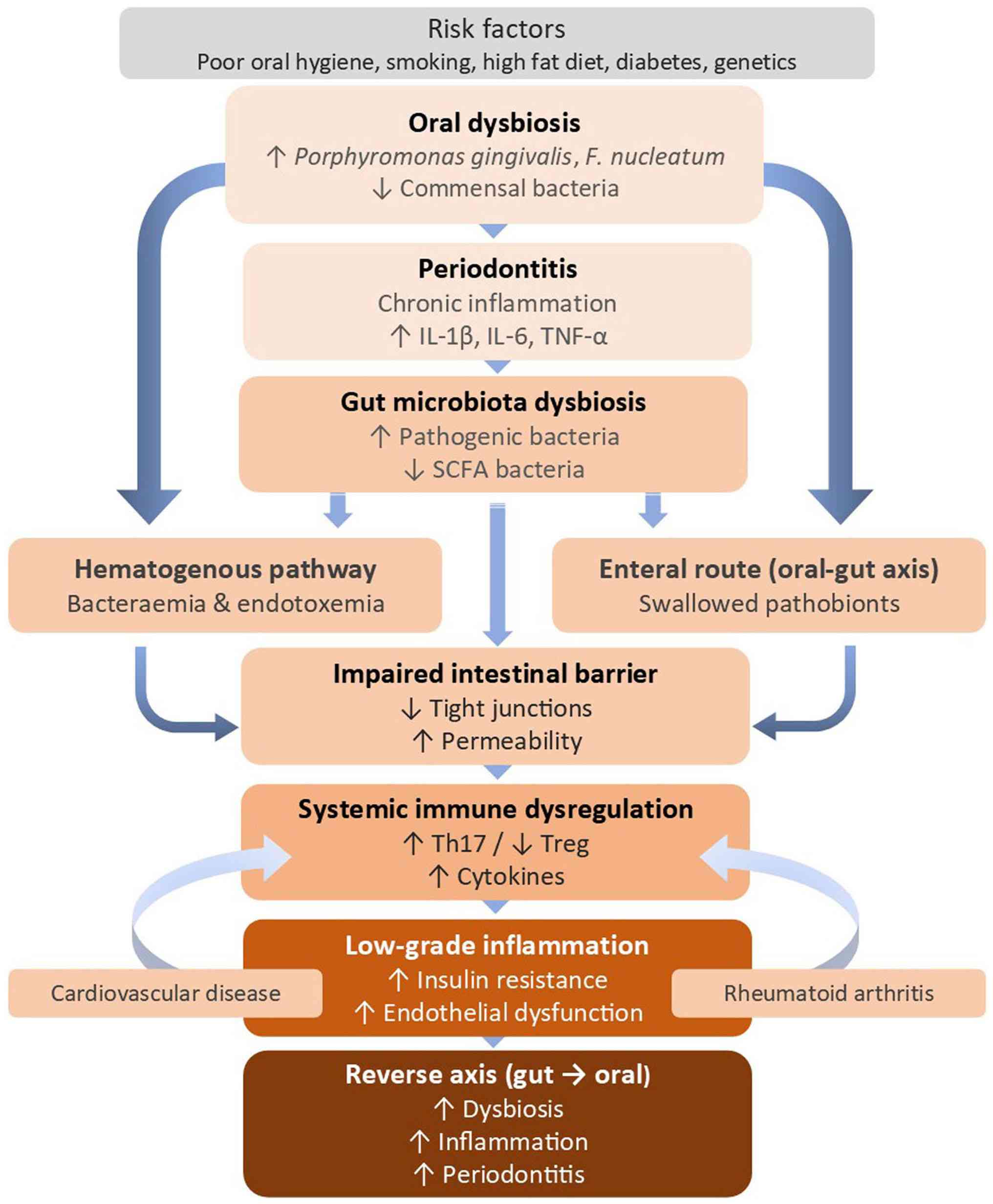
inflammatory profiles. The schematic diagram depicted in Fig. 1 illustrates the bidirectional
oral-gut axis involved in periodontitis pathogenesis, depicting
risk factors leading to oral dysbiosis, gut barrier impairment and
systemic inflammation, as well as the reverse feedback loops
exacerbating periodontal disease.
9. Emerging host- and microbiota-targeted
therapies
Therapeutic strategies targeting the oral-gut axis
in periodontitis focus on addressing both host immune dysregulation
and microbial dysbiosis. These approaches are designed to restore
barrier integrity, reduce systemic inflammation and prevent the
risk of associated comorbidities, such as implant failure. The
following sections discuss host-focused, microbiota-centred and
integrated therapeutic interventions aimed at modulating the
oral-gut axis.
Host-focused approaches
Host-focused approaches aim to modulate immune
responses and promote tissue repair through the oral-gut axis.
Therapeutic selection should be guided by patient-specific
comorbidity profiles and immunological phenotypes. Non-surgical
periodontal therapy, including scaling and root planing, serves as
a first-line intervention across all patient strata. The method
reduces oral pathogen loads and partially normalises gut
microbiota. In ApoE mice, such treatment has been shown to improve
intestinal barrier function and reduce the levels of inflammatory
markers (50). In patients with
concurrent RA, systemic agents, such as methotrexate attenuate IL-6
and IL-1β-mediated pathways. These agents have also been associated
with improvements in periodontal status through the restoration of
Th17/Treg balance, although current evidence is derived primarily
from animal models (27,33). This patient subgroup may
additionally benefit from biologic therapies targeting TNF, which
limit osteoclast activation, a pathogenic mechanism shared by both
conditions. In postmenopausal or oestrogen-deficient patients
exhibiting disproportionate alveolar bone loss, oestrogen-based
interventions may be considered to address the dysregulation of gut
microbial genera, such as Fusicatenibacter, that are
implicated in the gut-bone axis (51). Patients with IBD or T2DM represent
a distinct high-risk stratum. In these individuals, gut microbiome
profiling may further refine the selection of host-targeted
therapeutic regimens by identifying those most likely to benefit
from combination-based approaches (52,53).
Microbiota-centred therapies
Microbiota-centred therapies should be stratified
according to disease severity, the burden of systemic
comorbidities, and individual gut microbial composition. A summary
of key clinical trials and reviews evaluating probiotics,
prebiotics and synbiotics in periodontitis is presented in Table I. In patients with mild-to-moderate
periodontitis and peri-implant mucositis, probiotic formulations
containing Lactobacillus and Bifidobacterium
represent a clinically accessible first-line adjunct, promoting
Treg differentiation through butyrate production and improving
microbial diversity (1,40,46).
16S rRNA profiling has revealed a significant reduction in
SCFA-producing taxa, such as Anaerotruncus and
Phascolarctobacterium; in such instances, targeted prebiotic
fibre supplementation may be indicated, given its association with
a lower risk of periodontitis and improved osseointegration
outcomes (40,44). Synbiotic formulations may be
preferentially reserved for patients with high-fat diet-associated
metabolic comorbidities or those demonstrating an inadequate
response to probiotic monotherapy, with experimental data
indicating augmented Eubacterium xylanophilum enrichment and
reduced gingival bleeding (40).
In refractory cases characterised by confirmed pathobiont
dominance, emerging therapeutic strategies, including oral
microbiota transplantation, phage therapy targeting P.
gingivalis and dietary patterns preferentially supporting
SCFA-producing microbial communities, warrant consideration
(54). The rationale for FMT as a
microbiome-targeted intervention remains predominantly preclinical.
Animal models have demonstrated that lower gastrointestinal tract
FMT eliminates orally derived F. nucleatum and its virulence
factor, FadA, restores microbial diversity and enriches
anti-inflammatory taxa, hence attenuating colonic inflammation
(32). Similarly, the
Akkermansia muciniphila-mediated restoration of gut
microbial homeostasis has been reported to alleviate periodontal
inflammation in murine models (36). However, the complete absence of
human periodontal trial data implies that FMT remains an
investigational approach. Its clinical application should therefore
be confined to rigorously designed, placebo-controlled randomised
trials incorporating comprehensive safety surveillance until
sufficient evidence is available to support its broader clinical
adoption (55).
 | Table IKey clinical trials and reviews
evaluating probiotics, prebiotics and synbiotics in
periodontitis. |
Table I
Key clinical trials and reviews
evaluating probiotics, prebiotics and synbiotics in
periodontitis.
| Authors, year of
publication | Study design and
sample size (N) |
Intervention(s) | Main outcomes | Clinical
significance | (Refs.) |
|---|
| Hardan et
al, 2022 | Systematic review
and meta-analysis of RCTs; pooled n=600 patients with chronic
periodontitis | Lactobacillus
reuteri lozenges (probiotics), 2x10⁸ CFU/day, used
as an adjunct to scaling and root planing | Additional
reductions in probing pocket depth (PPD), clinical attachment level
(CAL) gain, bleeding on probing (BOP), and gingival index (GI)
compared with SRP alone; decreased salivary IL-1β levels in several
included trials | Supports L.
reuteri as an evidence-based adjunct to SRP in chronic
periodontitis, with the largest benefit in moderate-severe cases
and added anti-inflammatory effects | (49) |
| Sachelarie et
al, 2025 | Narrative review of
RCTs and open-label clinical studies; individual trial N typically
20-120 participants | Various
multi-strain probiotic supplements containing Lactobacillus and
Bifidobacterium species, with different delivery forms, regimens
and durations | Reported reductions
in BOP and PPD, lower plaque indices, and improved peri-implant
mucositis indices in several reviewed trials; some heterogeneity in
response across strains and protocols | Indicates promising
utility of multi-strain probiotics in both periodontal and
peri-implant therapy, while emphasizing that optimal strain
combinations, dosing and treatment duration still need
standardization | (40) |
| Yang et al,
2025 | Experimental murine
RCT-equivalent model of diabetic periodontitis plus translational
human correlation study; n=60 mice and 40 human participants | Butyrate
supplementation as a prebiotic/synbiotic-type strategy targeting
butyrate-producing microbiota in the context of diabetic
periodontitis | Restoration of
Treg/Th17 balance, reduction in alveolar bone loss, and decreased
IL-17 and RANKL expression in mice; human data suggested
association between improved butyrate status, better glycemic
control (HbA1c), and periodontal parameters | Suggests that
strategies enhancing butyrate production (prebiotics/synbiotics)
may benefit diabetic patients with periodontitis via combined
immunomodulatory and metabolic effects along the oral-gut axis | (31) |
| Di Stefano et
al, 2023 | Systematic review
of clinical trials evaluating probiotics as adjuncts in
periodontitis; pooled >400 patients | Probiotic strains
such as L. acidophilus, L. rhamnosus, and B.
longum used as adjuncts to SRP in different formulations and
regimens | Overall reductions
in periodontal pocket depth and improvements in clinical
periodontal indices; several studies reported decreases in
subgingival dysbiotic taxa and early evidence of shifts in gut
microbial diversity markers | Reinforces the
biological rationale for probiotic therapy in periodontitis within
an oral-gut axis framework, while noting that gut microbiome
endpoints remain underreported and require more systematic
inclusion in future trials | (1) |
Combined interventions
Combined interventions targeting both host responses
and microbial ecosystems exhibit considerable promise, particularly
when patient selection is guided by systemic comorbidity status and
oral-gut microbial signatures. In patients with moderate-to-severe
periodontitis accompanied by systemic inflammation, clinical trials
have demonstrated that periodontal therapy augmented with
probiotics, such as Lactobacillus reuteri, yields
significantly greater reductions in probing depth and lower
systemic CRP levels than mechanical debridement alone. These
findings support the application of this approach in this specific
patient subgroup (40,46). In patients with causally implicated
microbial deficiencies, Mendelian randomisation analyses support
the targeted supplementation of protective bacterial genera,
including Eisenbergiella and Lachnoclostridium, as a
rational precision-medicine strategy (29,37).
Nevertheless, the interpretation of these findings should consider
the inherent limitations of Mendelian randomisation, including
susceptibility to weak instrument bias, horizontal pleiotropy and
population stratification bias, all of which may influence causal
relevance (56-59).
For implant patients with a history of implant failure or
established gut dysbiosis, personalised therapeutic regimens guided
by 16S rRNA gene sequencing or metagenomic profiling may optimise
treatment selection by correcting dysbiotic patterns predictive of
peri-implant complications (38).
However, the majority of available data are derived from
small-scale trials or animal models. Consequently, robust clinical
evidence supporting the routine personalised approaches remains
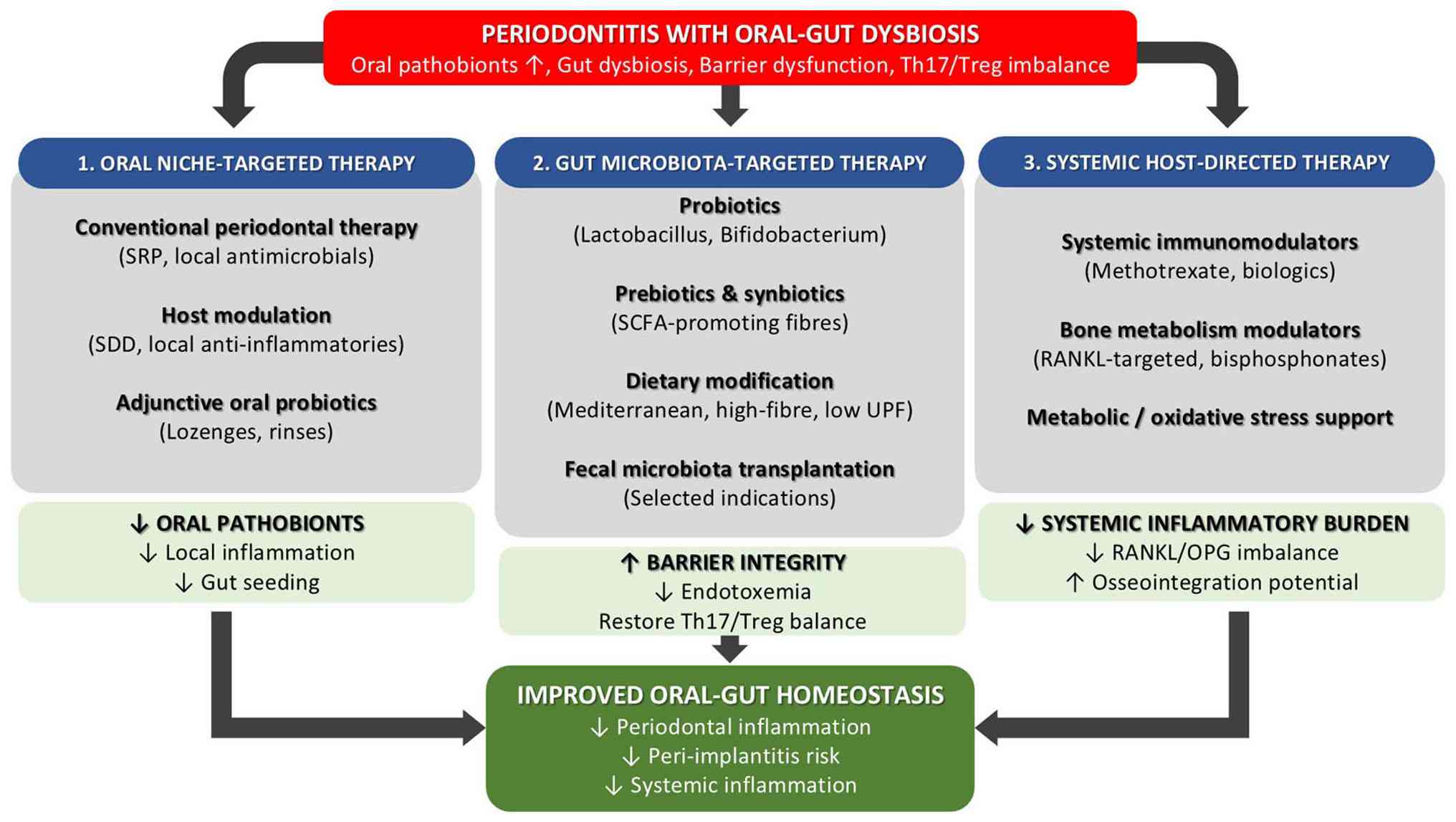
limited. The schematic diagram depicted in Fig. 2 illustrates a therapeutic framework
for periodontitis-associated oral-gut dysbiosis, integrating oral
niche-targeted, gut microbiota-targeted, and systemic host-directed
interventions to reduce pathobiont burden, restore barrier
integrity and improve oral-gut homeostasis.
10. Implications for clinical periodontal
practice
Periodontal risk assessment should extend beyond
conventional local factors to incorporate oral-gut considerations,
as gut dysbiosis, gastrointestinal disorders, poor dietary quality
and systemic inflammation can influence disease severity and
therapeutic response. Referral to a gastroenterologist should be
considered for patients with periodontitis presenting with
recurrent or refractory disease that is disproportionate to local
plaque burden. This is particularly relevant for individuals with
concomitant IBD, unexplained gastrointestinal symptoms, or
documented treatment failure despite optimal local periodontal
care. Patients with comorbid RA, T2DM, obesity, or prior antibiotic
exposure represent a high-risk dysbiotic subgroup that may benefit
from early interdisciplinary consultation. Identification and
management of underlying gut pathology may interrupt the
bidirectional oral-gut inflammatory cycle, thereby improving
periodontal therapeutic outcomes (60).
Dietary fibre recommendations
Patients with established gut comorbidities,
metabolic syndrome, or T2DM should be prioritised for dietitian
referral, as this subgroup demonstrates the greatest degree of
dysbiosis and is likely to derive the greatest benefit from
targeted dietary modification. Across all periodontal patient
groups, a daily dietary fibre intake of ≥25-30 g is recommended,
with an emphasis on diverse plant-based sources, legumes and whole
grains. Such dietary patterns support SCFA-producing taxa,
including Anaerotruncus, Butyricicoccus and
Phascolarctobacterium, reduce systemic inflammatory markers,
and promote periodontal stability (44). Furthermore, the reduction of
ultra-processed food consumption should be strongly encouraged,
particularly in obese and insulin-resistant patients, owing to its
disproportionately detrimental effects on gut microbial
diversity.
11. Future directions
Despite the growing body of evidence substantiating
the involvement of the oral-gut axis in periodontitis, major
knowledge gaps remain regarding dose-response associations, the
temporal sequence of microbial and immune changes, and the extent
to which oral-gut dysbiosis can be reversed through targeted
interventions. Future research is thus warranted to prioritise
large-scale longitudinal human studies employing standardised
sampling protocols and analytical approaches to facilitate the
transition from association-based observations to causal inference.
Further investigations are warranted to integrate multi-omics
approaches, including metagenomics, metabolomics, immunomics and
proteomics, with systems biology frameworks, to elucidate how
specific oral pathobionts alter gut barrier function, the Th17/Treg
balance, and systemic inflammation responses. From a therapeutic
perspective, priority should be given to rigorously designed
randomised controlled trials (RCTs) assessing defined probiotic and
prebiotic regimens, paraprobiotic mouth rinses, and diet-based
strategies as adjuncts to scaling and root planning. Outcome
measures should span periodontal clinical parameters, SCFA profiles
and systemic cytokine levels. Non-invasive approaches that enhance
SCFA production and support gut-bone homeostasis are particularly
attractive compared with more invasive options, such as faecal
microbiota transplantation. Mechanistic models should evolve toward
gnotobiotic and humanised microbiota designs, incorporating
labelled oral inocula to track the persistence and metabolic impact
of oral taxa in the gut.
Oral microbiota transplantation, defined as the
standardised transfer of a healthy donor oral microbiome to
recipients with established oral dysbiosis, represents an emerging
and conceptually compelling frontier. However, it warrants rigorous
preclinical validation and, ultimately, well-controlled human
trials to assess its capacity to re-establish commensal oral
microbial communities and to disrupt pathobiont-driven
gut-periodontal inflammatory cascades. Future studies are required
to adopt standardised case definitions for periodontitis, based on
established clinical criteria, such as clinical attachment loss,
probing depth, bleeding on probing, and radiographic bone loss.
Likewise, gut dysbiosis should be defined using consistent
microbiological and functional criteria, including alterations in
alpha and beta diversity, the
Bacteroidetes-to-Firmicutes ratios, and shifts in
functionally relevant taxa, to enable reproducible and comparable
assessments of the oral-gut axis. Achieving these goals will
require close collaboration across dentistry, gastroenterology,
immunology, and nutrition to translate mechanistic insights into
practical, microbiome-centric clinical protocols.
12. Conclusion
The oral-gut axis represents a bidirectional
biological framework in which periodontitis-associated dysbiosis
promotes intestinal microbial imbalance, impairs gut barrier
integrity and sustains systemic inflammation. Conversely, gut
dysbiosis exacerbates periodontal tissue destruction through
Th17/Treg imbalance, altered SCFA production, and upregulated
RANKL-mediated osteoclastogenesis. Strong mechanistic evidence
demonstrates that oral pathobionts, particularly P.
gingivalis and F. nucleatum, translocate to the gut,
disrupt tight-junction proteins and amplify mucosal immune
activation. The durability of oral pathobiont engraftment in the
gut, along with its clinical determinants, remains poorly defined.
It is also unclear whether oral or gut dysbiosis serves as the
primary driver within the bidirectional oral-gut axis across
distinct patient subgroups. Although Mendelian randomisation
studies provide hypothesis-generating evidence, their
interpretation is constrained by weak instrumental variables,
pleiotropy, and limited population diversity. In addition, the
safety, regulatory and ethical frameworks governing FMT in
periodontal contexts are underdeveloped. At present, personalised
microbiome-based treatment algorithms lack a robust evidence base
for routine clinical implementation. Addressing these gaps will
require well-designed longitudinal studies, standardised
multi-omics methodologies, and rigorously conducted RCTs to
translate the biological plausibility of oral-gut interactions into
measurable improvements in both periodontal and systemic patient
outcomes.
Acknowledgements
Not applicable.
Funding
Funding: No funding was received.
Availability of data and materials
Not applicable.
Authors' contributions
All authors (STP, NS and BG) contributed to the
conceptualisation of the study, data collection, data analysis,
literature data review, writing the first draft of the manuscript,
preparation of graphical work and drawing figures. NS and BG
critically revised the manuscript. All authors have read and agreed
to the published version of the manuscript. Data authentication is
not applicable.
Ethics approval and consent to
participate
Not applicable.
Patient consent for publication
Not applicable.
Competing interests
The authors declare that they have no competing
interests.
Use of artificial intelligence tools
During the preparation of this work, AI tools were
used to improve the readability and language of the manuscript or
to generate images, and subsequently, the authors revised and
edited the content produced by the AI tools as necessary, taking
full responsibility for the ultimate content of the present
manuscript.
References
|
1
|
Di Stefano M, Santonocito S, Polizzi A,
Mauceri R, Troiano G, Lo Giudice A, Romano A, Mascitti M and Isola
G: A reciprocal link between oral, gut microbiota during
periodontitis: The potential role of probiotics in reducing
dysbiosis-induced inflammation. Int J Mol Sci.
24(1084)2023.PubMed/NCBI View Article : Google Scholar
|
|
2
|
Yamazaki K: Oral-gut axis as a novel
biological mechanism linking periodontal disease and systemic
diseases: A review. Jpn Dent Sci Rev. 59:258–271. 2023.PubMed/NCBI View Article : Google Scholar
|
|
3
|
Harrandah AM: The oral-gut-systemic axis:
Emerging insights into periodontitis, microbiota dysbiosis, and
systemic disease interplay. Diagnostics. 15(2784)2025.PubMed/NCBI View Article : Google Scholar
|
|
4
|
Xi M, Ruan Q, Zhong S, Li J, Qi W, Xie C,
Wang X, Abuduxiku N and Ni J: Periodontal bacteria influence
systemic diseases through the gut microbiota. Front Cell Infect
Microbiol. 14(1478362)2024.PubMed/NCBI View Article : Google Scholar
|
|
5
|
Azzolino D, Carnevale-Schianca M,
Santacroce L, Colella M, Felicetti A, Terranova L, Castrejón-Pérez
R, García-Godoy F, Lucchi T and Passarelli P: The oral-gut
microbiota axis across the lifespan: New insights on a forgotten
interaction. Nutrients. 17(2538)2025.PubMed/NCBI View Article : Google Scholar
|
|
6
|
Kato T and Yamazaki K, Nakajima M, Date Y,
Kikuchi J, Hase K, Ohno H and Yamazaki K: Oral administration of
Porphyromonas gingivalis alters the gut microbiome and serum
metabolome. mSphere. 3:e00460–e00418. 2018.PubMed/NCBI View Article : Google Scholar
|
|
7
|
Sulaiman Y, Pacauskienė I, Šadzevičienė R
and Anužytė R: Oral and gut microbiota dysbiosis due to
periodontitis: Systemic implications and links to gastrointestinal
cancer: A narrative review. Medicina (Kaunas).
60(1416)2024.PubMed/NCBI View Article : Google Scholar
|
|
8
|
Bao J, Li L, Zhang Y, Wang M, Chen F, Ge
S, Chen B and Yan F: Periodontitis may induce gut microbiota
dysbiosis via salivary microbiota. Int J Oral Sci.
14(32)2022.PubMed/NCBI View Article : Google Scholar
|
|
9
|
Kitamoto S and Kamada N: The oral-gut
axis: A missing piece in the IBD puzzle. Inflamm Regen.
43(30)2023.PubMed/NCBI View Article : Google Scholar
|
|
10
|
Zhao Y, Liu Y and Jia L: Gut microbial
dysbiosis and inflammation: Impact on periodontal health. J
Periodontal Res. 59:1129–1142. 2024.PubMed/NCBI View Article : Google Scholar
|
|
11
|
Jia X, Yang R, Li J, Zhao L, Zhou X and Xu
X: Gut-bone axis: A non-negligible contributor to periodontitis.
Front Cell Infect Microbiol. 11(752708)2021.PubMed/NCBI View Article : Google Scholar
|
|
12
|
Jia L, Jiang Y, Wu L, Fu J, Du J, Luo Z,
Guo L, Xu J and Liu Y: : Porphyromonas gingivalis aggravates
colitis via a gut microbiota-linoleic acid metabolism-Th17/Treg
cell balance axis. Nat Commun. 15(1350)2024.PubMed/NCBI View Article : Google Scholar
|
|
13
|
Tsuzuno T, Takahashi N, Yamada-Hara M,
Yokoji-Takeuchi M, Sulijaya B, Aoki-Nonaka Y, Matsugishi A,
Katakura K, Tabeta K and Yamazaki K: Ingestion of Porphyromonas
gingivalis exacerbates colitis via intestinal epithelial
barrier disruption in mice. J Periodontal Res. 56:275–288.
2021.PubMed/NCBI View Article : Google Scholar
|
|
14
|
Nonaka S, Okamoto R, Katsuta Y, Kanetsuki
S and Nakanishi H: Gingipain-carrying outer membrane vesicles from
Porphyromonas gingivalis cause barrier dysfunction of Caco-2
cells by releasing gingipain into the cytosol. Biochem Biophys Res
Commun. 703(149783)2024.PubMed/NCBI View Article : Google Scholar
|
|
15
|
Sohn J, Li L, Zhang L, Settem PR, Honma K,
Sharma A, Falkner K, Novak JM, Sun Y and Kirkwood K: :
Porphyromonas gingivalis indirectly elicits intestinal
inflammation by altering the gut microbiota and disrupting
epithelial barrier function through IL9-producing CD4+ T
cells. Mol Oral Microbiol. 37:78–91. 2022.PubMed/NCBI View Article : Google Scholar
|
|
16
|
Pignatelli P, Nuccio F, Piattelli A and
Curia MC: The role of Fusobacterium nucleatum in oral and
colorectal carcinogenesis. Microorganisms. 11(2358)2023.PubMed/NCBI View Article : Google Scholar
|
|
17
|
Yang X, Zhang S, Ning T and Wu J: :
Fusobacterium nucleatum in health and disease. MedComm.
6(e70465)2025.
|
|
18
|
Nagao J, Kishikawa S, Tanaka H, Toyonaga
K, Narita Y, Negoro-Yasumatsu K, Tasaki S, Arita-Morioka K,
Nakayama J and Tanaka Y: Pathobiont-responsive Th17 cells in
gut-mouth axis provoke inflammatory oral disease and are modulated
by intestinal microbiome. Cell Rep. 41(111314)2022.PubMed/NCBI View Article : Google Scholar
|
|
19
|
Yuan X, Zhou F, Wang H, Xu X, Xu S, Zhang
C, Zhang Y, Lu M, Zhang Y, Zhou M, et al: Systemic antibiotics
increase microbiota pathogenicity and oral bone loss. Int J Oral
Sci. 15(4)2023.PubMed/NCBI View Article : Google Scholar
|
|
20
|
Sun J, Wang X, Xiao J, Yang Q, Huang X,
Yang Z, Liu H, Liu Y, Wang H, Huang Z, et al: Autophagy mediates
the impact of Porphyromonas gingivalis on short-chain fatty
acids metabolism in periodontitis-induced gut dysbiosis. Sci Rep.
14(26291)2024.PubMed/NCBI View Article : Google Scholar
|
|
21
|
Siddiqui R, Badran Z, Boghossian H,
Alharbi AM, Alfahemi H and Khan NA: The increasing importance of
the oral microbiome in periodontal health and disease. Future Sci
OA. 9(FSO856)2023.PubMed/NCBI View Article : Google Scholar
|
|
22
|
Mukherjee S, Chopra A, Karmakar S and Bhat
S: Periodontitis increases the risk of gastrointestinal
dysfunction: An update on the plausible pathogenic molecular
mechanisms. Crit Rev Microbiol. 50:882–905. 2024.PubMed/NCBI View Article : Google Scholar
|
|
23
|
Lourenço TGB, Spencer SJ, Alm E and
Colombo A: Defining the gut microbiota in individuals with
periodontal diseases: An exploratory study. J Oral Microbiol.
10(1487741)2018.PubMed/NCBI View Article : Google Scholar
|
|
24
|
Baima G, Ferrocino I, Del Lupo V, Colonna
E, Thumbigere-Math V, Caviglia G, Franciosa I, Mariani G, Romandini
M, Ribaldone D, et al: Effect of periodontitis and periodontal
therapy on oral and gut microbiota. J Dent Res. 103:644–652.
2024.PubMed/NCBI View Article : Google Scholar
|
|
25
|
Miyauchi E, Yamazaki K, Tsuboi Y, Nakajima
T, Ono S, Mizuno K, Takahashi N, Imamura K, Morita H, Miura N, et
al: Patients with periodontitis exhibit persistent dysbiosis of the
gut microbiota and distinct serum metabolome. J Oral Microbiol.
17(2499284)2025.PubMed/NCBI View Article : Google Scholar
|
|
26
|
Mutafcilar Velioğlu EM, Arslan U, Kayış
SA, Maçin S, Kamada N and Hakki SS: Correlation in the change of
gut microbiota with clinical periodontal parameters in grade C
periodontitis patients after non-surgical periodontal therapy. J
Med Microbiol. 74(002065)2025.PubMed/NCBI View Article : Google Scholar
|
|
27
|
Wang X, Long T, Shen L, Hu Y, Zou Y, Wang
Z, Yang K, Dai F and Song L: Periodontal disease-associated oral
and gut microbiome changes in female rheumatoid arthritis patients.
BMC Oral Health. 26(447)2026.PubMed/NCBI View Article : Google Scholar
|
|
28
|
Luo S, Li W, Li Q, Zhang M, Wang X, Wu S
and Li Y: Causal effects of gut microbiota on the risk of
periodontitis: A two-sample Mendelian randomization study. Front
Cell Infect Microbiol. 13(1160993)2023.PubMed/NCBI View Article : Google Scholar
|
|
29
|
Chen H, Peng L, Wang Z, He Y and Zhang X:
Exploring the causal relationship between periodontitis and gut
microbiome: Unveiling the oral-gut and gut-oral axes through
bidirectional Mendelian randomization. J Clin Periodontol.
50:1576–1588. 2023.PubMed/NCBI View Article : Google Scholar
|
|
30
|
Song J, Wu Y, Yin X, Ma H and Zhang J:
Mendelian randomisation study on association of gut microbiota and
periodontitis. Int Dent J. 73:652–659. 2023.PubMed/NCBI View Article : Google Scholar
|
|
31
|
Yang W, Zhang Y, Xu Y, Diao J, Zheng S and
Yuan C: Gut microbial metabolite butyrate regulates Treg/Th17 cell
balance to alleviate diabetic periodontitis. J Clin Periodontol.
52:680–693. 2025.PubMed/NCBI View Article : Google Scholar
|
|
32
|
Li D, Li Z, Sun Q, Wang L and Ning SB:
Lower fecal microbiota transplantation ameliorates ulcerative
colitis by eliminating oral-derived Fusobacterium nucleatum
and virulence factor. Gut Pathog. 16(31)2024.PubMed/NCBI View Article : Google Scholar
|
|
33
|
Zhou T, Xu W, Wang Q, Jiang C, Li H, Chao
Y, Sun Y and Lan A: The effect of the ‘Oral-Gut’ axis on
periodontitis in inflammatory bowel disease: A review of microbe
and immune mechanism associations. Front Cell Infect Microbiol.
13(1132420)2023.PubMed/NCBI View Article : Google Scholar
|
|
34
|
Chi L and Teng W: Porphyromonas
gingivalis harms cognition via gut-brain immune pathway. Int
Dent J. 75(104090)2025.
|
|
35
|
Sansores-España L, Melgar-Rodríguez S,
Olivares-Sagredo K, Cafferata EA, Martínez-Aguilar V, Vernal R,
Paula-Lima A and Díaz-Zúñiga J: Oral-gut-brain axis in experimental
models of periodontitis: Associating gut dysbiosis with
neurodegenerative diseases. Front Aging. 2(781582)2021.PubMed/NCBI View Article : Google Scholar
|
|
36
|
Zhang S, Zhang T, Zhang Y, Ye C, Mu L, He
Q, Huang T, Wang G, Li Y, Xie S and Tang X: : Akkermansia
muciniphila regulates the gut microenvironment and alleviates
periodontal inflammation in mice with periodontitis. Front
Microbiol. 16(1643691)2025.PubMed/NCBI View Article : Google Scholar
|
|
37
|
Xu M, Shao Q, Zhou Y, Yu Y, Wang S, Wang A
and Cai Y: Potential effects of specific gut microbiota on
periodontal disease: A two-sample bidirectional Mendelian
randomization study. Front Microbiol. 15(1322947)2024.PubMed/NCBI View Article : Google Scholar
|
|
38
|
Jha A, Krishnamoorthy G and Narayana AI:
The gut-bone axis: Gut microbiota dysbiosis and dental implant
failures-is there a link? A systematic review. F1000Research.
14(169788)2025.
|
|
39
|
Zhang X, Lv X, Zhang L, Jia T and Zhao S:
Association between a novel Dietary Index for Gut Microbiota and
periodontitis: A cross-sectional study. Front Nutr.
13(1714913)2026.PubMed/NCBI View Article : Google Scholar
|
|
40
|
Sachelarie L, Scrobotă I, Romanul I,
Iurcov R, Cicalău GI and Todor L: Probiotic therapy as an adjuvant
in the treatment of periodontal disease: An innovative approach.
Medicina. 61(126)2025.PubMed/NCBI View Article : Google Scholar
|
|
41
|
Li L, Wang M, Bao J, Wang N, Huang Y, He
S, Chen B and Yan F: Periodontitis may impair the homeostasis of
systemic bone through regulation of gut microbiota in
ApoE-/- mice. J Clin Periodontol. 49:1170–1181.
2022.PubMed/NCBI View Article : Google Scholar
|
|
42
|
Yamazaki K, Miyamoto Y, Kamada N,
Shinohara M, Inoue R, Kikuchi J, Hasegawa-Ishii S, Naito M, Ohno H
and Numabe Y: Dysbiotic human oral microbiota alters systemic
metabolism via modulation of gut microbiota in germ-free mice. J
Oral Microbiol. 14(2110194)2022.PubMed/NCBI View Article : Google Scholar
|
|
43
|
Nascimento GG, Alves-Costa S and Romandini
M: Burden of severe periodontitis and edentulism in. 2021, with
projections up to 2050: The global burden of disease 2021 study. J
Periodontal Res. 59:823–867. 2024.PubMed/NCBI View Article : Google Scholar
|
|
44
|
World Health Organization: Global oral
health status report: Towards universal health coverage for oral
health by 2030. WHO, Geneva, 2022. https://www.who.int/publications/i/item/9789240061484.
Accessed March 3, 2026.
|
|
45
|
Lee YC, Liu CY, Lee CL, Zhang RH, Huang CJ
and Yen TL: The periodontopathic pathogen, Porphyromonas
gingivalis, involves a gut inflammatory response and
exacerbates inflammatory bowel disease. Pathogens.
11(84)2022.PubMed/NCBI View Article : Google Scholar
|
|
46
|
Pravin V, Vellapandian C and Kumar VN: The
oral-gut-brain axis in periodontitis: Microbial signaling in
systemic and neuroinflammatory disease. Brain Res.
1854(150168)2026.PubMed/NCBI View Article : Google Scholar
|
|
47
|
Alkhaldi SS, Mohamed MO, Alyahya RA,
Al-Azzawi OM, Karmy HM, Shehata AM, Alnefaie R, Attia OA,
Abdelmonaem N, Mansour RM, et al: Gut microbiota alterations in
autism spectrum disorder: Implications for microbiota-gut-brain
axis mechanisms and therapeutic strategies. World Acad Sci J.
8(49)2026.
|
|
48
|
Quintero S, Ait-Aissa K, Munkhsaikhan U,
Sahyoun AM, Hoque Apu E, Abidi A and Kassan M: Exploring the
relationship between periodontal diseases and osteoporosis:
Potential role of butyrate. Biomed Pharmacother.
181(117791)2024.PubMed/NCBI View Article : Google Scholar
|
|
49
|
Hardan L, Bourgi R, Cuevás-Suarez C,
Flores-Rodríguez M, Omaña-Covarrubias A, Nicastro M, Lăzărescu F,
Zurow M, Monteiro P, Jakubowicz N, et al: The use of probiotics as
adjuvant therapy of periodontal treatment: A systematic review and
meta-analysis of clinical trials. Pharmaceutics.
14(1017)2022.PubMed/NCBI View Article : Google Scholar
|
|
50
|
Huang Y, Liao Y, Luo B, Li L, Zhang Y and
Yan F: Non-surgical periodontal treatment restored the gut
microbiota and intestinal barrier in apolipoprotein E-/-
mice with periodontitis. Front Cell Infect Microbiol.
10(498)2020.PubMed/NCBI View Article : Google Scholar
|
|
51
|
Xiong J and Li L, Ao M, Tu Y, Tu K and Li
L: Effects of menopausal hormone therapy on gut microbiota in
postmenopausal women and the relationship with bone metabolism.
Front Med (Lausanne). 12(1682925)2025.PubMed/NCBI View Article : Google Scholar
|
|
52
|
Mousa WK and Al Ali A: The gut microbiome
advances precision medicine and diagnostics for inflammatory bowel
diseases. Int J Mol Sci. 25(11259)2024.PubMed/NCBI View Article : Google Scholar
|
|
53
|
Jiang R, Zheng L, Fang J, Guan Q, Yuan H,
Liang J, Zhang J, Han Q and Liu M: Targeting the gut microbiome for
type 2 diabetes management: A scoping review of systematic reviews
and meta-analyses. Front Endocrinol (Lausanne).
17(1682174)2026.PubMed/NCBI View Article : Google Scholar
|
|
54
|
Kabwe M, Tucci J, Darby I and Dashper S:
Oral bacteriophages and their potential as adjunctive treatments
for periodontitis: A narrative review. J Oral Microbiol.
17(2469890)2025.PubMed/NCBI View Article : Google Scholar
|
|
55
|
Huang B, An H, Qiu Y, Ye T, Huang Y, Zheng
M, Shi D, Su Y and Wang R: Comparative effectiveness and safety of
fecal microbiota transplantation in ulcerative colitis: An updated
systematic review and meta-analysis. Adv Ther. 43:2645–2667.
2026.PubMed/NCBI View Article : Google Scholar
|
|
56
|
Sanderson E, Spiller W and Bowden J:
Testing and correcting for weak and pleiotropic instruments in
two-sample multivariable Mendelian randomization. Stat Med.
40:5434–5452. 2021.PubMed/NCBI View Article : Google Scholar
|
|
57
|
Hemani G, Bowden J and Davey Smith G:
Evaluating the potential role of pleiotropy in Mendelian
randomization studies. Hum Mol Genet. 27:R195–R208. 2018.PubMed/NCBI View Article : Google Scholar
|
|
58
|
Burgess S, Smith GD, Davies NM, Dudbridge
F, Gill D, Glymour MM, Hartwig FP, \Kutalik Z, Holmes MV, Minelli
C, et al: Guidelines for performing Mendelian randomization
investigations. Wellcome Open Res. 4(186)2020.PubMed/NCBI View Article : Google Scholar
|
|
59
|
Lawson DJ, Davies NM, Haworth S, Ashraf B,
Howe L, Crawford A, Hemani G, Smith GD and Timpson NJ: Is
population structure in the genetic biobank era irrelevant, a
challenge, or an opportunity? Hum Genet. 139:23–41. 2020.PubMed/NCBI View Article : Google Scholar
|
|
60
|
Tanwar H, Gnanasekaran JM, Allison D,
Chuang LS, He X, Aimetti M, Baima G, Costalonga M, Cross RK, Sears
C, et al: Unravelling the oral-gut axis: interconnection between
periodontitis and inflammatory bowel disease, current challenges,
and future perspective. J Crohns Colitis. 18:1319–1341.
2024.PubMed/NCBI View Article : Google Scholar
|