Introduction
Cryptosporidium spp. are apicomplexan
protozoan parasites that cause acute gastroenteritis and are a
major cause of childhood morbidity and mortality in low-resource
settings (1). According to
findings from the Global Enteric Multicenter Study (GEMS),
Cryptosporidium is the second most common cause of
moderate-to-severe diarrhea among infants and young children in
Sub-Saharan Africa and South Asia, responsible for ~202,000 deaths
each year (2). The pathogen is
transmitted by the fecal-oral route through ingestion of
contaminated water or food, or through direct contact with infected
animals or humans (3). A
characteristic feature of Cryptosporidium species is their
exceptional environmental resistance due to the presence of oocysts
with high resistance to chlorine disinfection. According to the
World Health Organization (WHO), the log reduction value (LRV)
achieved by free chlorine against Cryptosporidium oocysts is
only 0-1, which renders conventional chlorination ineffective
against this pathogen (4).
Membrane filtration technologies, on the other hand, are highly
effective against Cryptosporidium oocysts, capable of
achieving LRVs of ≥6(4). Chlorine
resistance has been responsible for several waterborne outbreaks,
notably a major one in Milwaukee (WI, USA) in 1993 involving
>400,000 individuals (5).
Another critical aspect related to
Cryptosporidium infections is the zoonotic transmission of
the parasite. Cryptosporidium parvum is a zoonotic species
commonly found in cattle. Contact with infected animals is
considered a well-established risk factor for infection (5). Several studies published in recent
years have demonstrated the circulation of zoonotic
Cryptosporidium species in rural agricultural communities
among both animals and humans (6).
For instance, a survey conducted in Cameroon reported a high
prevalence (41.5%) of Cryptosporidium spp. in calves, with
age and water source identified as important contributing factors
(7). In Iraq, particularly in
Thi-Qar Province, a high prevalence of Cryptosporidium
infection has been reported among immunocompromised populations,
reaching 54.0% in patients with cancer (8). Although substantial evidence
highlights the global importance of Cryptosporidium spp. as
human pathogens, epidemiological studies have predominantly focused
on pediatric populations, particularly children <5 years of age,
who account for the greatest burden of cryptosporidiosis (1,2).
Risk factors associated with Cryptosporidium infections
among adolescents and adults remain relatively understudied.
Therefore, the present study aimed to identify environmental and
behavioral risk factors associated with Cryptosporidium
infection in a community setting.
Subjects and methods
Study design and population
A cross-sectional study was conducted among
residents of Thi-Qar Province, Iraq. Participant enrollment,
questionnaire interviews, stool sample collection, microscopic
examination and molecular confirmation were conducted between
January 28 and April 30, 2026 following approval by the Thi-Qar
Health Directorate. Data verification and coding were performed
progressively as participant recruitment and laboratory results
became available. Following completion of participant enrollment
and laboratory investigations on April 30, 2026, final data
validation, statistical analyses, interpretation of the findings
and manuscript preparation were completed during early May, 2026. A
total of 420 participants presenting with gastrointestinal symptoms
and attending primary healthcare centers were enrolled.
Participants were classified into two groups according to the
presence of Cryptosporidium infection in their stool
samples, as determined by modified Ziehl-Neelsen staining and
nested polymerase chain reaction (PCR):
Cryptosporidium-positive cases (n=296) and
Cryptosporidium-negative controls (n=124).
Ethics approval
The study protocol was approved by the Research
Ethics Committee of Thi-Qar Health Directorate, Ministry of Health
(Approval no. 2026/27, approved on January 27, 2026), following the
official institutional authorization issued by the College of
Science, University of Thi-Qar (Reference no. 97, dated January 20,
2026), which supported the ethical review and approval process by
the Health Directorate. Written informed consent was obtained from
all adult participants and from the parents or legal guardians of
minors before enrollment. Participant recruitment, questionnaire
interviews, and stool sample collection commenced only after all
required institutional and ethical approvals had been obtained.
Data collection
Data were collected through direct face-to-face
interviews using a structured questionnaire between January 28 and
April 30, 2026. Questionnaire interviews and stool sample
collection were performed during the same participant visit,
thereby ensuring direct linkage between the demographic and
epidemiological information of the participants, and their
corresponding laboratory findings. Information obtained included
age, sex, education level (illiterate/educated), residence
(rural/urban), the presence of domestic animals (animal contact:
Yes/no) and the source of drinking water. Water sources were
categorized as verified reverse osmosis (RO)-treated water or
non-RO water. Commercial bottled water and filtered tap water were
grouped together as information regarding RO treatment was not
available for all products, and their level of protection against
Cryptosporidium oocysts could not be assumed to be
equivalent to that provided by verified RO-treated water.
Stool sample collection and
microscopic examination
Fresh stool samples were collected in sterile
wide-mouthed containers between January 28 and April 30, 2026
during the same visit in which participants completed the study
questionnaire.
Thin fecal smears were prepared on clean glass
slides by mixing a small amount of stool with a few drops of water
and allowed to air dry. Smears were stained using a modified
Ziehl-Neelsen stain kit (REF BS0243250; Bio Research for Medical
Diagnostics). Slides were covered with carbol fuchsin for 5 min
with gentle heating until steam appeared, rinsed with tap water,
decolorized with acid alcohol for 10-15 sec, rinsed again with
water, counterstained with methylene blue for 1 min, washed with
water, and air dried. Slides were examined using an light
microscope (Olympus Corporation) at x40 magnification and
subsequently under 100X oil immersion objective.
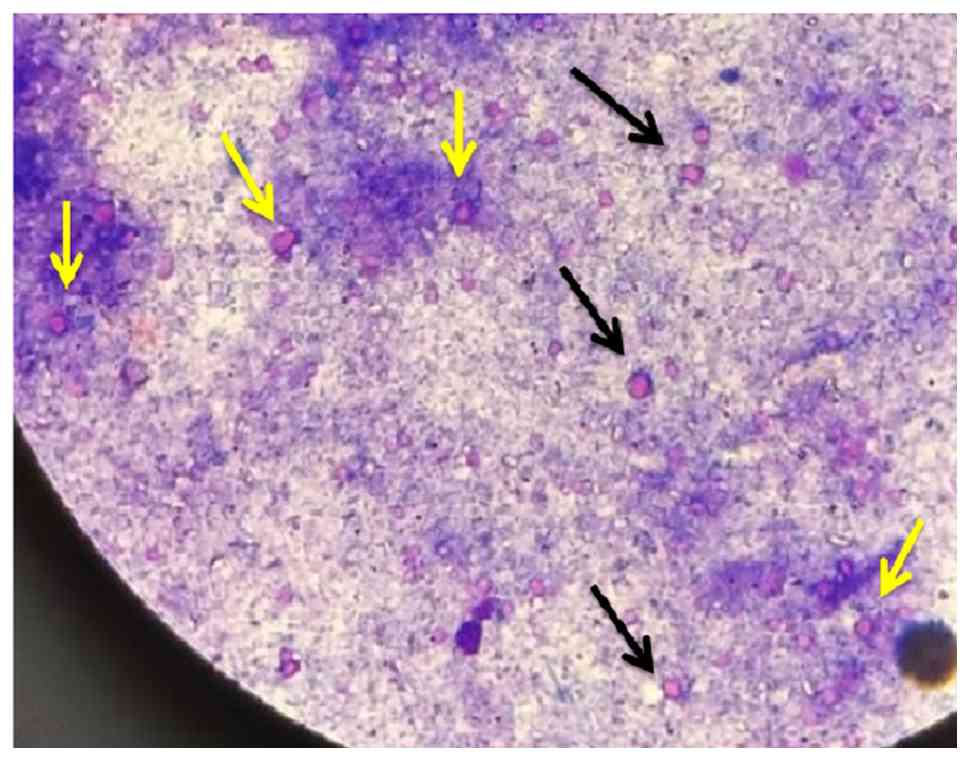
Cryptosporidium oocysts appeared as bright pink to red
spherical bodies (4-6 µm) against a blue-green background (9).
Nested PCR was performed only on microscopy-positive
samples to confirm the presence of Cryptosporidium DNA (this
was a limitation to the present study, as discussed below).
DNA extraction and nested PCR
Genomic DNA was extracted from 200 mg stool samples
using the Presto™ Stool DNA Extraction kit (cat. no. STLD100;
Geneaid Biotech Ltd.). Nested PCR targeting the SSU rRNA gene was
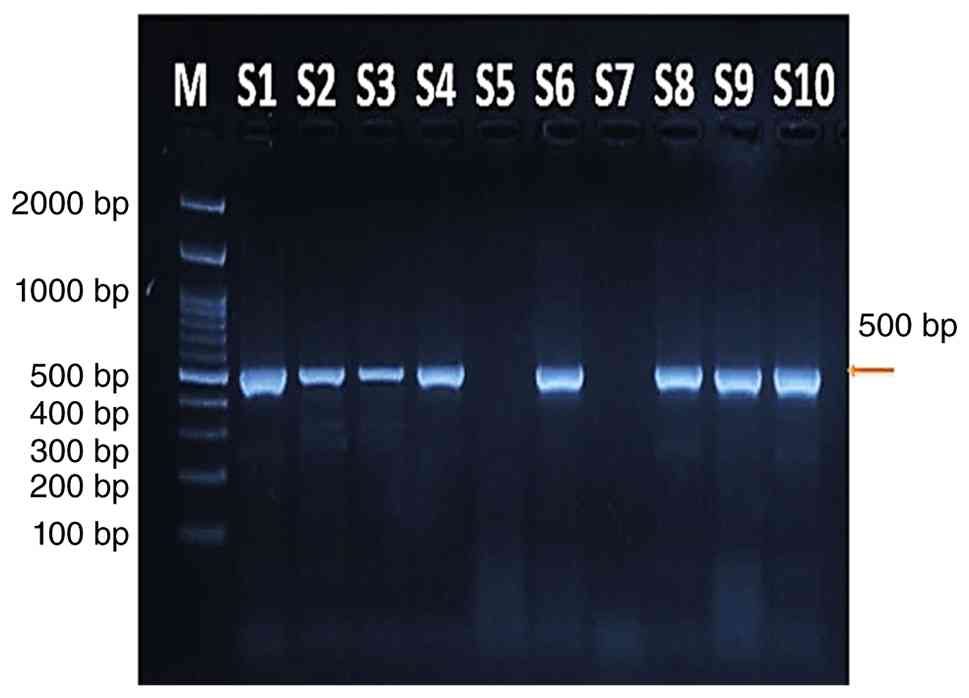
performed using outer primers (Crypto Outer F/R, 608 bp) and inner
primers (Crypto Inner F/R, 500 bp) based on the reference sequence
GenBank accession number LC844811.1. Reactions were performed using
GoTaq® Green Master Mix (Promega Corporation) in a T100
Thermal Cycler (Bio-Rad Laboratories, Inc.). The cycling conditions
consisted of an initial denaturation 95˚C/5 min; 35 cycles of
95˚C/30 sec, annealing 58˚°C (first round) or 60˚C (second
round)/30 sec, extension 72˚C/60 sec (first) or 45 sec (nested);
final extension 72˚C/5 min. PCR products were analyzed on 2%
agarose gel, stained with ethidium bromide and visualized under
ultraviolet illumination.
A representative subset of nested PCR-positive
amplicons was submitted to Macrogen Inc. (Seoul, Korea) for
bidirectional Sanger sequencing to confirm species identification.
The obtained nucleotide sequences were compared with reference
sequences available in the NCBI GenBank database using the BLAST
program. Multiple sequence alignment was performed using ClustalW
implemented in MEGA version 11.0.13, and phylogenetic associations
were inferred using the UPGMA method. The representative sequences
were deposited in the NCBI GenBank database under accession nos.
PZ245405, PZ245406, PZ245407, PZ245408, PZ245409, PZ245410,
PZ245411, PZ245412 and PZ245413.
Statistical analysis
Data were analyzed using SPSS software version 26.
Categorical variables are summarized as frequencies and
percentages. Associations between variables were evaluated using
Pearson's Chi-squared test. Independent predictors of
Cryptosporidium infection were identified using
multivariable logistic regression analysis, including animal
contact (yes/no), drinking water source (non-RO vs. RO), age
category (1-5),
residence (rural vs. urban), sex (female vs. male) and education
level (educated vs. illiterate). Adjusted odds ratios (AORs) and
their corresponding 95% confidence intervals (CIs) were calculated.
Model fit was assessed using the Hosmer-Lemeshow goodness-of-fit
test, with a value of P>0.05 indicating adequate model fit. In
addition, a P-value <0.05 was considered to indicate a
statistically significant difference.
Results
Characteristics of the study
participants
Cryptosporidium infection was detected in 296
participants, whereas 124 participants tested negative, yielding an
overall prevalence of 70.5%. The sociodemographic characteristics
and potential risk factors of the study participants are presented
in Table I. The frequency of
exposure to animals and the ingestion of non-RO water was higher
among the infected participants compared with the non-infected
participants. Age distribution differed significantly between the
two groups (P<0.001), indicating a significant univariate
association. However, following multivariable adjustment, age was
not independently associated with Cryptosporidium infection
(P=0.097; Table II).
 | Table ISociodemographic characteristics and
potential risk factors of the study participants (n=420). |
Table I
Sociodemographic characteristics and
potential risk factors of the study participants (n=420).
| Variable | Controls (n=124)
(%) | Cases (n=296)
(%) | Total (n=420)
(%) | P-valuea |
|---|
| Age | | | | <0.001 |
|
≤5
years | 18 (14.5) | 22 (7.4) | 40 (9.5) | |
|
5-14
years | 12 (9.7) | 40 (13.6) | 52 (12.4) | |
|
15-29
years | 40 (32.3) | 96 (32.4) | 136 (32.4) | |
|
30-49
years | 38 (30.6) | 92 (31.1) | 130 (31.0) | |
|
≥50
years | 16 (12.9) | 46 (15.5) | 62 (14.8) | |
| Sex | | | | 0.281 |
|
Female | 72 (58.1) | 162 (54.7) | 234 (55.7) | |
|
Male | 52(41.9) | 134 (45.3) | 186 (44.3) | |
| Residence | | | | <0.001 |
|
Rural | 60 (48.4) | 208 (70.3) | 268 (63.8) | |
|
Urban | 64(51.6) | 88 (29.7) | 152 (36.2) | |
| Animal contact | | | | <0.001 |
|
Yes | 68 (54.8) | 216 (73.0) | 284 (67.6) | |
|
No | 56 (45.2) | 80 (27.0) | 136 (32.4) | |
| Water source | | | | 0.007 |
|
RO | 98 (79.0) | 198 (66.9) | 296 (70.5) | |
|
Non-RO
(bottled/filtered tap) | 26 (21.0) | 98 (33.1) | 124 (29.5) | |
| Education | | | | 0.612 |
|
Educated
(primary education or higher) | 78 (62.9) | 194 (65.5) | 272 (64.8) | |
|
Illiterate | 46 (37.1) | 102 (34.5) | 148(35.2) | |
| Table IIMultivariate logistic regression
analysis of factors associated with Cryptosporidium
infection. |
Table II
Multivariate logistic regression
analysis of factors associated with Cryptosporidium
infection.
| Variable | Adjusted OR
(AOR) | 95% CI | P-value |
|---|
| Animal contact (yes
vs. no) | 2.98 | 1.75-5.02 | <0.001 |
| Non-RO water (vs.
RO) | 2.05 | 1.10-3.82 | 0.024 |
| Age (per one-category
increase) | 1.18 | 0.97-1.42 | 0.097 |
| Residence (rural vs.
urban) | 0.69 | 0.41-1.18 | 0.175 |
| Sex (female vs.
male) | 0.91 | 0.58-1.42 | 0.676 |
| Education (primary
education or higher vs. illiterate) | 1.05 | 0.66-1.67 | 0.851 |
Microscopic and molecular
confirmation
Microscopy-positive samples subjected to nested PCR
yielded the expected 500-bp amplicon. Representative microscopic
and electrophoretic findings are presented in Fig. 1 (microscopy) and Fig. 2 (gel electrophoresis),
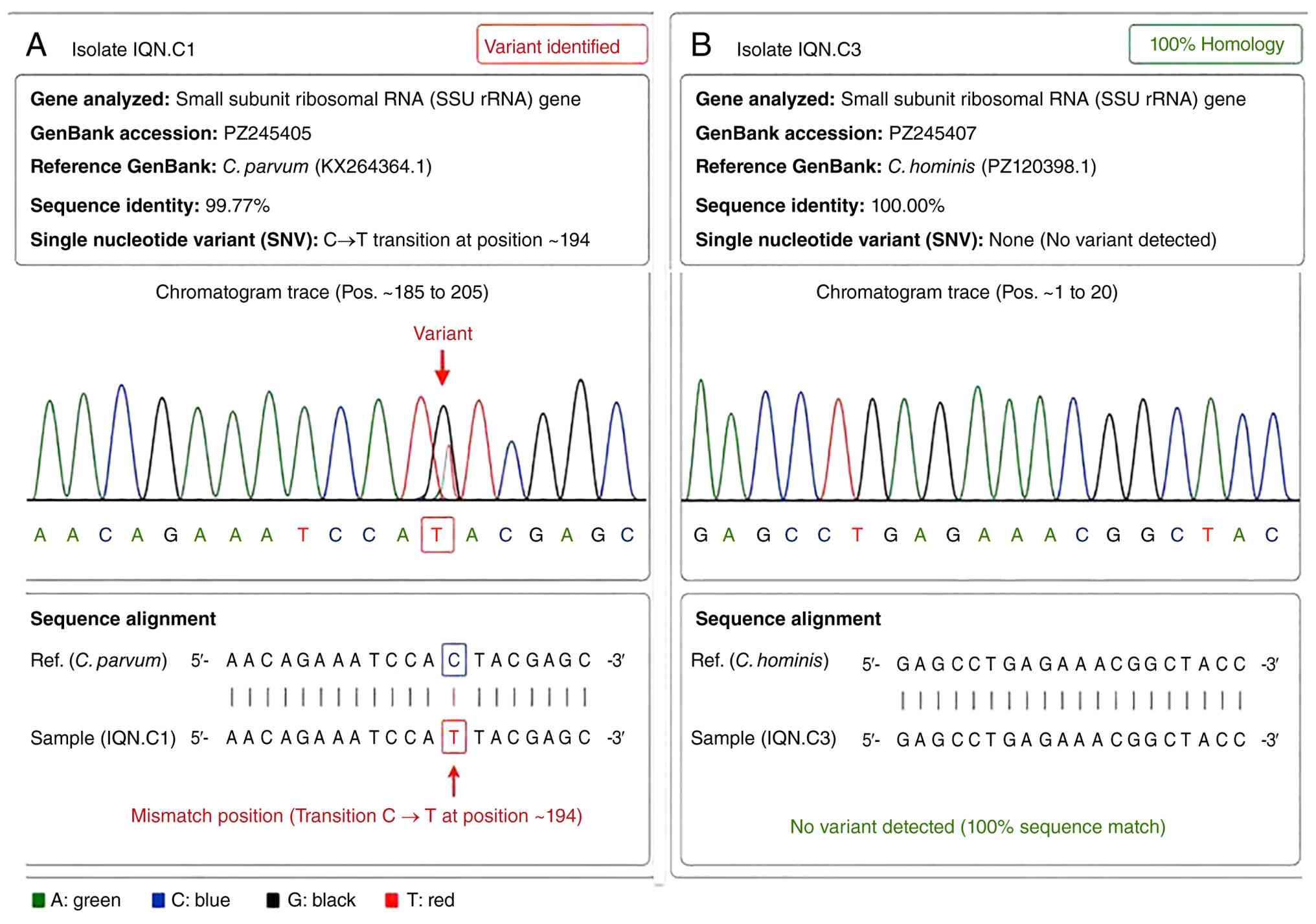
respectively. Sanger sequencing of selected isolates confirmed
species-level identification of Cryptosporidium hominis and
Cryptosporidium parvum among study samples. Among the
sequenced isolates, 77.8% were identified as Cryptosporidium
parvum and 22.2% as Cryptosporidium hominis.
Representative Sanger sequencing chromatograms with sequence
alignment and variant annotation are presented in Fig. 3. Sequence data were deposited in
the NCBI GenBank database under accession nos. PZ245405, PZ245406,
PZ245407, PZ245408, PZ245409, PZ245410, PZ245411, PZ245412 and
PZ245413.
Multivariate logistic regression
analysis
The results of the multivariable logistic regression
analysis are presented in Table
II. Following adjustment for all covariates, two variables
remained significantly associated with Cryptosporidium
infection. Participants with animal contact had significantly
higher odds of acquiring the infection compared with those without
animal contact (AOR=2.98; 95% CI, 1.75-5.02; P<0.001).
Similarly, the consumption of non-RO water was associated with an
~a 2-fold increase in the odds of infection (AOR=2.05; 95% CI,
1.10-3.82; P=0.024). Age exhibited a positive, yet statistically
non-significant association with infection (AOR=1.18 per category
increase; 95% CI, 0.97-1.42; P=0.097). Residence, sex and
educational status were not significantly associated with infection
(P>0.05 for all variables). The Hosmer-Lemeshow goodness-of-fit
test indicated that the final model demonstrated an adequate fit to
the observed data (χ²=10.89, df=8; P=0.208).
Discussion
The present study identified animal contact and the
consumption of non-RO drinking water as independent factors
associated with molecularly confirmed Cryptosporidium
infection. These findings highlight the importance of zoonotic
exposure and water quality in the transmission of cryptosporidiosis
within the study area. The significant association between animal
contact and infection (AOR=2.98) suggests that zoonotic
transmission may substantially contribute to the spread of the
disease (5). The detection of both
Cryptosporidium hominis and Cryptosporidium parvum
suggests the coexistence of anthroponotic and zoonotic transmission
pathways within the study. Furthermore, the predominance of
Cryptosporidium parvum (77.8%) among the sequenced isolates
is consistent with the observed association between animal contact
and infection and suggests a possible zoonotic contribution to
transmission. However, as only a subset of isolates was sequenced,
this finding should be interpreted with caution. Similar findings
have been reported in studies from Cameroon and Romania (7,10).
These observations emphasize the importance of hand hygiene
following animal contact and measures that reduce environmental
contamination around households. The consumption of non-RO water
was also independently associated with infection (AOR=2.05). This
finding supports the importance of effective water treatment in
preventing cryptosporidiosis. Cryptosporidium oocysts are
resistant to conventional chlorination, whereas reverse osmosis and
other membrane filtration technologies are highly effective in
their removal (4). The increased
risk associated with bottled water and filtered tap water may
reflect inadequate treatment, the insufficient removal of oocysts,
or post-treatment contamination (3,5).
Where RO systems are unavailable or unaffordable, boiling drinking
water remains a practical and effective household alternative.
However, the high cost of RO systems may limit their accessibility
in low-income rural settings; boiling water is a practical and
affordable alternative. Age exhibited a positive, yet
non-significant association with infection following adjustment
(P=0.097). Although younger children are generally considered to be
at a greater risk of developing cryptosporidiosis worldwide
(1,2), one possible explanation is that
repeated exposure in endemic settings may reduce age-related
differences through the development of partial acquired immunity
(6). Furthermore, Iraqi children
are exposed to various microbial threats in their everyday
environment (11). In the present
study, residence, sex and educational status were not independently
associated with infection. The loss of significance for rural
residence following adjustment suggests that the higher infection
rates observed in rural areas may be explained largely by
differences in animal exposure and water source rather than
residence itself. These findings are consistent with those of
previous reports from Iraq demonstrating the presence of
Cryptosporidium in domestic geese in Nineveh Governorate
(12) and in river water and
sewage in Basra Governorate (13),
supporting the role of animal exposure and contaminated water in
transmission.
The present study has certain limitations which
should be mentioned. The cross-sectional design does not permit
causal inference. Modified Ziehl-Neelsen staining is less sensitive
than molecular diagnostic methods and may fail to detect
low-intensity infections (14). In
addition, nested PCR was performed only on microscopy-positive
samples, not on all samples, potentially leading to underestimation
of the true prevalence. Consequently, some associations between
risk factors and infection may also have been underestimated.
Therefore, some low-burden infections may have been missed (false
negatives), potentially underestimating the true prevalence of
Cryptosporidium infection. This limitation should be
considered when interpreting the findings. The relatively low
Nagelkerke R2 value (0.085) suggests that additional
unmeasured factors, such as detailed hygiene practices, household
crowding, or nutritional status, may contribute to infection risk.
Although species identification was performed for selected
isolates, subtype analysis was not conducted, limiting conclusions
regarding specific transmission pathways. Finally, as the
participants were symptomatic individuals attending healthcare
facilities, the findings may not be generalizable to asymptomatic
carriers or the wider community.
As regards public health implications, improving
access to adequately treated drinking water, promoting household
water treatment methods such as reverse osmosis or boiling, and
encouraging proper hygiene following animal contact may be
effective in reducing Cryptosporidium transmission. A One
Health approach integrating human, animal, and environmental health
sectors is likely to provide the most effective framework for
prevention and control (5).
In conclusion, animal contact and consumption of
non-RO drinking water were independently associated with
Cryptosporidium infection. The predominance of C.
parvum among sequenced isolates suggests a possible zoonotic
contribution to transmission; however, further molecular
epidemiological studies including subtype analysis are required to
confirm transmission pathways. Improving water safety and reducing
exposure to animal-associated sources of infection should be
central components of prevention strategies. A One Health approach
may contribute to reducing the burden of cryptosporidiosis in the
study area.
Acknowledgements
Not applicable.
Funding
Funding: No funding was received.
Availability of data and materials
The data generated in the present study may be
requested from the corresponding author. Sequence data were
deposited in the NCBI GenBank database under accession nos.
PZ245405, PZ245406, PZ245407, PZ245408, PZ245409, PZ245410,
PZ245411, PZ245412 and PZ245413.
Authors' contributions
SRN was involved in the conceptualization of the
study, and in the study methodology, investigation and formal
analysis, as well as in the writing of the original draft of the
manuscript and in figure preparation . BAAA supervised the study,
was involved in data validation, provision of laboratory
facilities, equipment, reagents and technical support, and in the
writing, reviewing and editing of the manuscript. SRN and BAAA
confirm the authenticity of all the raw data. Both authors have
read and approved the final version of the manuscript.
Ethics approval and consent to
participate
The present study protocol was approved by the
Research Ethics Committee of Thi-Qar Health Directorate, Ministry
of Health (Approval no. 2026/27, approved on January 27, 2026),
following the official institutional authorization issued by the
College of Science, University of Thi-Qar (Reference no. 97, dated
January 20, 2026), which supported the ethical review and approval
process by the Health Directorate. Written informed consent was
obtained from all adult participants and from the parents or legal
guardians of minors prior to enrollment. Participant recruitment,
questionnaire interviews and stool sample collection commenced only
after all required institutional and ethical approvals had been
obtained.
Patient consent for publication
Not applicable.
Competing Interests
The authors declare that they have no competing
interests.
References
|
1
|
Khalil IA, Troeger C, Rao PC, Blacker BF,
Brown A, Brewer TG, Colombara DV, De Hostos EL, Engmann C, Guerrant
RL, et al: Morbidity, mortality, and long-term consequences
associated with diarrhoea from Cryptosporidium infection in
children younger than 5 years: A meta-analyses study. Lancet Glob
Health. 6:e758–e768. 2018.PubMed/NCBI View Article : Google Scholar
|
|
2
|
Sow SO, Muhsen K, Nasrin D, Blackwelder
WC, Wu Y, Farag TH, Panchalingam S, Sur D, Zaidi AK, Faruque AS, et
al: The burden of Cryptosporidium diarrheal disease among
children <24 months of age in Moderate/High mortality regions of
Sub-Saharan Africa and south Asia, utilizing data from the global
enteric multicenter study (GEMS). PLoS Negl Trop Dis.
10(e0004729)2026.PubMed/NCBI View Article : Google Scholar
|
|
3
|
Gharpure R, Perez A, Miller AD, Wikswo ME,
Silver R and Hlavsa MC: Cryptosporidiosis outbreaks-United States,
2009-2017. MMWR Morb Mortal Wkly Rep. 68:568–572. 2019.PubMed/NCBI View Article : Google Scholar
|
|
4
|
World Health Organization: Guidelines for
drinking water quality: Fourth edition incorporating the first
addendum. Geneva, World Health Organization, 2017. https://www.ncbi.nlm.nih.gov/books/NBK442381/.
|
|
5
|
Ali M, Ji Y, Xu C, Hina Q, Javed U and Li
K: Food and waterborne cryptosporidiosis from a One Health
perspective: A comprehensive review. Animals (Basel).
14(3287)2024.PubMed/NCBI View Article : Google Scholar
|
|
6
|
Salman Al-Adilee YM, Shather MM, Kalef DA,
Maxamhud S, Akdur Öztürk E, Gentekaki E and Tsaousis AD: Intestinal
microbial eukaryotes at the human, animal and environment interface
in rural Iraq. Parasitologia. 5(34)2025.
|
|
7
|
Siama A, Kalmobe J, Simonet Poueme Namegni
R, Abah S and Njan Nlôga AM: Prevalence, distribution, and risk
factors of Cryptosporidium spp. infection among calves in
the Far North Region of Cameroon. J Vet Sci. 26(e41)2005.PubMed/NCBI View Article : Google Scholar
|
|
8
|
Alsafi Z and AL-Aboody B: Detection of
Cryptosporidium parvum by modified acid-fast stain among
cancer patients in Thi-Qar province. Univ Thi Qar J Sci. 10:10–15.
2023.
|
|
9
|
Garcia LS: Diagnostic Medical Parasitology
(5th edition.). ASM Press, 2007.
|
|
10
|
Dărăbuș RG, Imre M, Dărăbuș G, Ilie MS,
Olariu AT, Dărăbuș DM, Lăzureanu V, Roșca O and Olariu TR: First
detection of Cryptosporidium Canis and occurrence of
Cryptosporidium spp. in hospitalized patients in Romania.
Microorganisms. 13(931)2025.PubMed/NCBI View Article : Google Scholar
|
|
11
|
AL-Jobouri MM, Alzamily IA and Al-Shibly
MK: Phylogeny of Aspergillus clavatus isolated from primary schools
of Iraq and detection of its ability for production of Patulin.
Agric Biotechnol J. 18:173–188. 2026.
|
|
12
|
Mohammed RG: Epidemiological study of
cryptosporidiosis in (Anser anser domesticus) geese in
Nineveh Governorate. University of Thi-Qar Journal of Science.
2:1–5. 2010.https://jsci.utq.edu.iq/index.php/main/article/view/415.
|
|
13
|
Thamer MS, Shanoot MH and Al-Rmadhan WA:
The Prevalence of Cryptosporidium in Rivers Water in Basra
Province. Proceedings of the 2nd International Multi-Disciplinary
Conference (IMDC-IST 2021), Sakarya, Turkey, 2022.
doi:10.4108/eai.7-9-2021.2315643.
|
|
14
|
Chalmers RM, Campbell BM, Crouch N,
Charlett A and Davies AP: Comparison of diagnostic sensitivity and
specificity of seven Cryptosporidium assays used in the UK.
J Med Microbiol. 60:1598–1608. 2011.PubMed/NCBI View Article : Google Scholar
|