Introduction
Oral squamous cell carcinoma (OSCC) represents a
heterogeneous group of malignancies arising from the mucosal lining
of the tongue, floor of the mouth, gingiva and buccal mucosa
(1). Originating from the
stratified squamous epithelium, these lesions exhibit a high
propensity for local invasion and lymphatic metastasis if not
intercepted in the early stages. While clinical hallmarks include
persistent ulcerative lesions, dysphagia, localized induration and
cervical lymphadenopathy, the symptomatic overlap with benign
inflammatory conditions necessitates a rigorous diagnostic
framework to ensure timely intervention and improve survival
outcomes (1,2).
Global statistics indicate that OSCC accounts for
>350,000 new diagnoses annually, with a substantial mortality
rate (3,4). A concerning trend is the increasing
incidence among young adults (≤40-45 years of age), many of whom
present without traditional environmental exposures (5,6).
This demographic shift has sparked a critical debate: Whether
early-onset OSCC constitutes a distinct disease entity with unique
molecular drivers or simply a chronological variant of the
traditional malignancy (3).
Understanding these biological nuances is essential for tailoring
precision interventions for this vulnerable patient population.
The global concerns regarding oral oncogenesis are
mirrored in regional epidemiological data. In the Republic of
Kazakhstan, recent statistics reveal a distressing upward trend in
the incidence of orofacial malignancies. According to national
registry data, the combined incidence of cancers of the tongue,
oral cavity and oropharynx (including Kaposi's sarcoma of the
palate) increased from 483 cases in 2022 to 547 cases in 2023,
representing a significant 11.0% growth rate in only 1 year
(https://onco.kz/oncohelp/pokazateli-en.html). This
surge exceeds the overall 3.5% growth rate for all malignant
neoplasms in the country, highlighting the escalating burden of
oral cavity cancers. While certain anatomical sites, such as the
lips and nasopharynx, exhibit a slight decline in crude rates (-9.5
and -6.5% respectively), the marked increase in intraoral
malignancies emphasizes the urgent need for enhanced diagnostic
vigilance and targeted screening programs within the region
(7).
The pathogenesis of OSCC is linked to a
multifactorial synergistic interaction of risk factors, most
notably chronic tobacco use (both combustible and smokeless), heavy
alcohol consumption, and high-risk human papillomavirus (HPV)
infection (8). For lip-specific
malignancies, cumulative ultraviolet radiation remains a primary
oncogenic driver. Given the aggressive nature of these lesions,
early detection via standardized screening protocols and
comprehensive clinical examinations is the most significant
prognostic determinant for long-term survival.
Accumulating evidence suggests that OSCC in younger
cohorts may exhibit a more aggressive biological phenotype, often
resulting in suboptimal oncologic outcomes compared to late-onset
disease. Despite presenting at comparable or even earlier clinical
stages, several retrospective studies have identified elevated
rates of local recurrence and inferior disease-specific survival
(DSS) in younger patients (3,9).
These findings challenge the conventional paradigm that youth
confers a physiological advantage and suggest that early-onset OSCC
may represent a molecularly distinct, high-risk entity. However,
the prognostic weight of age remains highly contentious. While some
data indicate equivalent or superior survival (9), a significant body of literature
reports increased cancer-specific mortality and locoregional
failure (10,11). Such discrepancies are reflected in
existing systematic reviews, which fail to reach a consensus on
whether age serves as an independent adverse prognosticator
(5,6). This lack of definitive evidence
necessitates a more granular characterization of the young-onset
OSCC phenotype.
Despite the clinical significance of the
aforementioned trends, the lack of consensus regarding the
prognostic impact of age in oral squamous cell carcinoma continues
to hinder the development of standardized, age-specific treatment
protocols. Existing studies often suffer from small sample sizes,
heterogeneous inclusion criteria, and inconsistent adjustments for
confounding risk factors, such as HPV status and depth of invasion.
Consequently, there is an urgent need to synthesize the current
evidence to determine whether young patients indeed harbor a more
aggressive disease phenotype. Therefore, the present scoping review
aimed to evaluate and compare the oncologic outcomes specifically
overall survival (OS), DSS and local recurrence (LR) rates between
younger adults (≤45 years) and their older counterparts. By
providing a comprehensive assessment of the available literature,
the present scoping review aimed to clarify the prognostic
significance of age and provide insight into whether early-onset
OSCC necessitates more intensified therapeutic strategies.
Data and methods
Literature search methods. Study
selection and Preferred Reporting Items for Systematic Reviews and
Meta-Analyses (PRISMA) flow
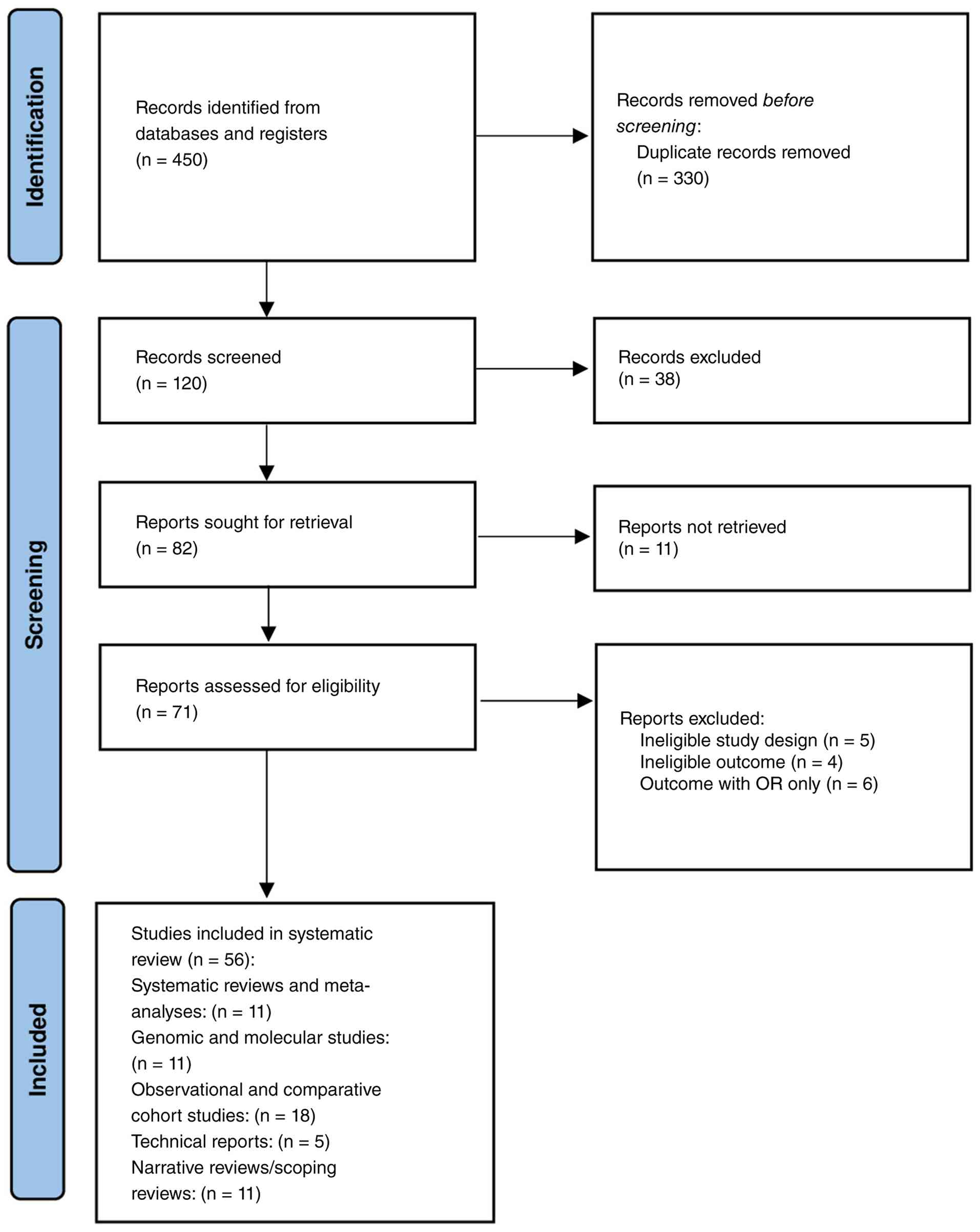
The study selection process followed the PRISMA 2020
guidelines (12). An initial
comprehensive search was conducted across major electronic
databases, including PubMed/MEDLINE, Scopus, Web of Science and the
Cochrane Library, supplemented by regional statistical reports from
the Kazakh Institute of Oncology and Radiology. As illustrated in
Fig. 1, the systematic workflow
transitioned through four phases: i) Identification: Records were
identified through database searching and manual citation mining;
ii) screening: Duplicate records were removed and titles/abstracts
were screened against the inclusion criteria; iii) Eligibility:
full-text articles were assessed for methodological rigor and
relevance to the ‘young-onset’ and ‘never-smokers and
never-drinkers’ (NSND) phenotypes; iv) inclusion: A final library
of 56 studies was selected for qualitative and quantitative
synthesis.
The search strategy utilized a combination of
medical subject headings (MeSH) and free-text terms tailored to
each database's syntax. The primary Boolean search query was
structured as follows: (‘oral squamous cell carcinoma’ OR ‘OSCC’ OR
‘oral tongue squamous cell carcinoma’ OR ‘oral tongue squamous cell
carcinoma’ (‘OTSCC’) AND (‘young adult’ OR ‘early-onset’ OR ‘under
45’ OR ‘never-smokers and never-drinkers’ OR ‘NSND’) AND (‘risk
factors’ OR ‘prognosis’ OR ‘genomic profiling’ OR ‘mechanical
irritation’ OR ‘tumor microenvironment’ OR ‘immunotherapy’) NOT
(‘oropharyngeal’). As illustrated in the PRISMA 2020 flow diagram
(Fig. 1), the systematic selection
process resulted in a final library of 56 high-quality sources.
Literature search strategy. A systematic and
comprehensive search of the literature was conducted to identify
studies characterizing the clinicopathological and molecular
landscape of OSCC, with a specific focus on young-onset and NSND
phenotypes. The search encompassed major electronic databases,
including PubMed/MEDLINE, Scopus, Web of Science and the Cochrane
Library, covering the period from 2000 to early 2026. To ensure the
inclusion of regional epidemiological trends and public health data
relevant to Central Asia, specialized searches were performed in
regional databases (G-Science) and official statistical
repositories, such as the Kazakh Institute of Oncology and
Radiology.
The search strategy utilized a combination of MeSH
terms and free-text key words tailored to the specific syntax of
each database. The primary search strings integrated three core
thematic blocks: i) Anatomical and pathological focus: ‘Oral
squamous cell carcinoma’, ‘mouth neoplasms’, ‘tongue neoplasms’,
‘oral tongue squamous cell carcinoma (OTSCC)’. ii) Demographic and
phenotypic focus: ‘Young adult’, ‘early-onset’, ‘under 45’,
‘never-smokers’, ‘NSND’. iii) Etiological and prognostic focus:
‘Risk factors’, ‘prognosis’, ‘genomic profiling’, ‘mechanical
irritation’, ‘survival’.
Specific filters and limits were applied to maintain
high evidentiary standards, as detailed in Table I. These included restricting
results to human studies, peer-reviewed articles (meta-analyses,
systematic reviews and clinical trials), and documents published in
English or Russian. To isolate oral cavity cancers from the
distinct HPV-driven oropharyngeal group, Boolean operators (e.g.,
AND NOT ‘oropharyngeal’) were employed where necessary.
 | Table IDetailed literature search
strategy. |
Table I
Detailed literature search
strategy.
| Database | Search query
(search strings) | Filters/limits |
|---|
| PubMed/MEDLINE | (‘oral squamous
cell carcinoma’[MeSH] OR ‘mouth neoplasms’[MeSH] OR ‘tongue
neoplasms’[MeSH]) AND (‘young adult’[MeSH] OR ‘early-onset’ OR
‘under 45’) AND (‘risk factors’ OR ‘prognosis’ OR ‘genomic
profiling’ OR ‘mechanical irritation’) | Language: English;
Species: Humans; Timeframe: 2000-2026; Article types:
Meta-Analysis, Systematic Review, Clinical Trial. |
| Scopus | TITLE-ABS-KEY
[‘oral cancer’ AND ‘young patients’ AND (‘smoking’ OR ‘non-smoker’)
AND (‘survival’ OR ‘mortality’) AND NOT ‘oropharyngeal’] | Document Type:
Article, Review; Subject Area: Medicine, Dentistry,
Biochemistry/Genetics. |
| Web of Science | TS=(‘oral cavity
cancer’ OR ‘OTSCC’) AND TS= (‘molecular biomarkers’ OR ‘NGS’ OR
‘somatic mutations’) AND TS=(‘never-smokers’ OR ‘NSND’) | Timespan: All
years; Language: English; Category: Oncology, Surgery,
Otorhinolaryngology. |
| Cochrane
Library | [mesh ‘Mouth
Neoplasms’] AND [mesh ‘Age Factors’] AND ‘prognostic
indicators’ | Review Type:
Intervention, Diagnostic; Date: Last 10 years. |
| Regional Databases
(G-Science/Kazakhstan) | (‘oral cancer’ OR
‘oncology service’) AND ‘Kazakhstan’ AND ‘epidemiology’ | Focus: Statistical
and analytical materials (2023-2027); Language:
English/Russian. |
Inclusion and exclusion criteria
To ensure the methodological rigor and thematic
focus of the present scoping review, a set of predefined
eligibility criteria was established based on the Population,
Intervention, Comparison, Outcome, and Study Design (PICOS)
framework.
Inclusion criteria. Studies were considered
eligible for inclusion if they met the following requirements: i)
Population: Patients diagnosed with primary OSCC, with a specific
emphasis on young adults (typically defined as ≤45 years) and NSND.
ii) Study design: High-level secondary evidence (systematic reviews
and meta-analyses), genomic and molecular profiling studies
(next-generation sequencing, targeted sequencing), observational
cohort studies (prospective and retrospective) and official
technical or regional health reports. iii) Outcomes: Studies
reporting on survival rates [OS and disease-free survival (DFS)],
recurrence patterns, mutational landscapes [cyclin-dependent kinase
inhibitor 2A (CDKN2A), tumor protein p53 (TP53) and epidermal
growth factor receptor (EGFR)], or the impact of non-canonical risk
factors (e.g., chronic mechanical irritation). iv) Language and
timeline: Peer-reviewed articles published in English or Russian
between January, 2000 and early 2026. v) Geographic scope: Global
studies with additional inclusion of regional data from Central
Asia (Kazakhstan) to provide epidemiological context.
Exclusion criteria. Studies were excluded
from the final synthesis based on the following parameters: i)
Anatomical misalignment: Research focusing exclusively on
oropharyngeal squamous cell carcinoma (OPSCC), particularly
HPV-positive cases involving the tonsils or base of tongue, to
avoid confounding with the distinct OSCC phenotype. ii)
Insufficient data: Case reports with limited follow-up or studies
lacking a comparative control group (e.g., studies that did not
compare young vs. aged or NSND vs. smokers). iii) Publication type:
Conference abstracts, editorials, pre-prints and non-peer-reviewed
articles (with the exception of official government statistical
materials). iv) Redundancy: Duplicate publications or updated
versions of the same study where only the most recent or
comprehensive data were retained. v) In vitro/animal models:
Studies conducted solely on cell lines or animal models that did
not provide direct clinical or genomic correlates to human
OSCC.
Data selection and analysis
process
The data selection and extraction process was
conducted in a standardized manner to ensure the reproducibility
and internal validity of the systematic review findings.
Study selection and screening
The selection process was performed in two
successive stages. In the first stage, two independent reviewers
(NK and AS) screened the titles and abstracts of all identified
records against the predefined inclusion and exclusion criteria. In
the second stage, the full texts of potentially eligible studies
were retrieved and independently reviewed for final inclusion. Any
discrepancies between reviewers (NK and AS) regarding study
eligibility were resolved through consensus or, if necessary, by
consultation with a senior oncologist/researcher (NK) to maintain
thematic consistency.
Data extraction and management
Data from the final 56 included studies were
extracted using a standardized data collection form. The following
variables were systematically recorded: i) Study characteristics:
Author, year of publication, geographic region and study design
(e.g., meta-analysis, cohort or genomic study); ii) patient
demographics: Age cohorts (focusing on ≤45 years), sex distribution
and risk factor profiles (smoking/drinking vs. NSND); iii)
clinicopathological data: Anatomical subsite (specifically the
mobile tongue), TNM stage and histological grade; iv) molecular
data: Mutational frequency (CDKN2A, TP53, EGFR and PIK3CA),
epigenetic modifications, and microRNA expression patterns; v)
outcome measures: 5-year OS, DFS and LR.
Qualitative and quantitative
synthesis
Given the heterogeneity of the study designs ranging
from high-level meta-analyses to technical regional reports, a
narrative synthesis approach was primarily employed. i) Comparative
analysis: Data were stratified to compare the clinical and
biological behavior of OSCC in young vs. older patients and NSND
vs. traditional cohorts; ii) genomic mapping: Molecular findings
were synthesized to identify distinct ‘biological signatures’ of
young-onset OSCC, utilizing data from bioinformatic platforms
(e.g., cBioPortal) cited in the included technology reports; iii)
epidemiological trends: Regional data from Kazakhstan were
integrated with global epidemiological trends to contextualize the
‘rejuvenation’ of OSCC within the Central Asian healthcare
landscape.
Quality assessment (risk of bias)
The methodological quality of the included studies
was appraised using validated tools appropriate for each study
design. Systematic reviews and meta-analyses were evaluated using
the AMSTAR 2 tool (https://researchgold.org/resources/amstar-2-tool),
while observational cohort studies were assessed using the
Newcastle-Ottawa Scale (NOS). This ensured that the synthesis
prioritized high-quality evidence, particularly in the evaluation
of survival outcomes and prognostic factors.
Results
Data synthesis approach
A multi-step synthesis approach was employed to
integrate the clinical, epidemiological and molecular findings from
the 56 included studies (1-5,7-11,13-58).
The main characteristics, study designs, sample sizes, and primary
focuses of the 56 key included studies are systematically
summarized in Table II. Due to
the methodological heterogeneity of the source material ranging
from large-scale meta-analyses to specialized genomic reports a
narrative and thematic synthesis was prioritized, supplemented by
comparative data mapping (Table
III).
| Table IISummary of primary studies included
in the synthesis (n=56). |
Table II
Summary of primary studies included
in the synthesis (n=56).
| Author(s) | Year of
publication | Study
type/design | Cohort size
(n) | Main
clinical/biological focus | (Refs.) |
|---|
| Saini et
al | 2025 | Systematic review
and meta-analysis | Meta-analysis | Efficacy of oral
rehabilitation techniques post-oral cancer treatment | (1) |
| Da Conceição et
al | 2021 | Narrative
literature review | Review | Acute oral
radiation-induced manifestations in head and neck cancer | (2) |
| Saade et
al | 2026 | Systematic review
and meta-analysis | 24 studies | Prognostic factors
and survival in young oral cavity cancer cohorts | (3) |
| Kumar | 2025 | Comprehensive
review | Review | Comprehensive
evaluation of risk factors, diagnosis, and treatment in OSCC | (4) |
| Kaminagakura et
al | 2022 | Systematic review
and meta-analysis | Meta-analysis | Oncologic outcomes
in adolescents and young adults with OSCC | (5) |
| KazIOR
Repository | 2024 | National Cancer
Registry/Report |
Population-based | Epidemiological
trends and oncology metrics in Kazakhstan (2023) | (7) |
| Aghiorghiesei et
al | 2022 | Narrative
review | Review | MicroRNA expression
patterns and oral cancer risk factor interaction | (8) |
| Bello et
al | 2020 | Multicenter
matched-pair analysis | Matched cohort | Histopathological
features of early-stage OTSCC in young vs. old | (9) |
| Lenoci et
al | 2024 | Review and
biomarker synthesis | Review | Molecular
biomarkers, incidence, and prognosis in young OSCC | (10) |
| Panda et
al | 2022 | Systematic review
and meta-analysis | Meta-analysis | Survival outcomes
comparison between young and older patients in OSCC/OPSCC | (11) |
| Koo et
al | 2021 | Genomic profiling
study | NGS Cohort | Genomic signature
and mutation spectrum in non-smoking non-drinking OSCC | (13) |
| Xie and Li | 2021 | Letter/Scientific
commentary | Commentary | Critical evaluation
of chronic mechanical irritation meta-analyses | (14) |
| Mello et
al | 2019 | Systematic review
and meta-analysis | Meta-analysis | Synergistic effect
of tobacco and alcohol consumption on OSCC risk | (15) |
| Gupta et
al | 2021 | Systematic review
and meta-analysis | Meta-analysis | Chronic mechanical
irritation as an independent risk factor for OSCC | (16) |
| Piemonte and
Lazos | 2018 | Critical review
(Bradford Hill) | Review | Causal evaluation
of chronic mechanical irritation (CMI) in OSCC | (17) |
| Mroueh et
al | 2017 | Population-based
nationwide study | Finnish
registry | Longitudinal
survival trends and outcomes in OTSCC in Finland | (18) |
| Mohideen et
al | 2019 | Meta-analysis | Meta-analysis | Risk factors
associated with tongue SCC in young adults | (19) |
| Zhao et
al | 2017 | Tissue
engineering/in vitro | Bio-models | Decellularized
tongue tissue models for studying tumor invasion | (20) |
| Gao et
al | 2013 | Bioinformatics
platform article | Framework | Integrative
analysis of complex cancer genomics using cBioPortal | (21) |
| Mansour et
al | 2013 | Experimental
mechanistic study | Cell lines | miR-421
overexpression, ATM downregulation, and DSB repair defects | (22) |
| Paderno et
al | 2018 | Narrative
literature review | Review | Comprehensive
literature review on tongue carcinoma in young adults | (23) |
| Satgunaseelan et
al | 2020 | International
multi-center cohort |
Multi-institutional | Rising incidence of
OTSCC in young non-smoking women | (24) |
| Hussein et
al | 2017 | Systematic
review | Global
database | Global
age-stratified incidence trends in young (<45 years) OSCC | (25) |
| Lin et
al | 2020 | Retrospective
single-center cohort | Clinical
cohort | Sex-based
clinicopathological differences in OSCC in Taiwan | (26) |
| Kourelis et
al | 2013 | Retrospective
clinical study | Clinical
cohort | Negative prognostic
indicators in young head and neck cancer patients | (27) |
| Kawecki et
al | 2019 | Population
cross-sectional survey | Survey cohort | Public mouth cancer
awareness and symptom recognition in Scotland | (28) |
| Pang et
al | 2018 | Narrative
review | Review | Microbiota, mucosal
inflammation, and TGF-β signaling in oncogenesis | (29) |
| Almasri et
al | 2007 | In vitro
experimental study | Cell line | Effects of nicotine
and LPS on cytokine expression in gingival fibroblasts | (30) |
| Gilligan et
al | 2017 |
Theoretical/narrative review | Review | Role of mechanical
irritation in facilitating epithelial HPV entry | (31) |
| Lazos et
al | 2017 | Observational
clinical study | Clinical
cohort | Clinical and
histological characterization of CMI in oral mucosal lesions | (32) |
| Andersen et
al | 2022 | Population-based
retrospective | Population
cohort | Impact of tobacco
smoking on survival metrics in OSCC | (33) |
| Tran et
al | 2023 | Contemporary
review | Review | Oral cavity cancer
in young, non-smoking and non-drinking patients | (34) |
| Gamez et
al | 2018 | Retrospective
cohort study | Young adult
cohort | Treatment outcomes
and patterns of recurrence in young OSCC patients | (35) |
| Hilly et
al | 2013 | Matched
retrospective cohort | <30 vs. >60
years | Comparative
survival analysis of OTSCC in patients <30 vs. >60 years | (36) |
| Park et
al | 2010 | Stage-matched
comparative study | Stage-matched | Stage-matched
clinical outcome analysis of young patients with OTSCC | (37) |
| Patel et
al | 2011 | Population registry
analysis (SEER) | SEER registry | Epidemiological
analysis of rising OTSCC incidence in young women | (38) |
| Blanchard et
al | 2017 | Case-matched
single-center cohort | Case-matched | Outcomes and
prognostic drivers in young adult OTSCC | (39) |
| Kandoth et
al | 2013 | Pan-cancer genomic
synthesis | TCGA cohort | Mutational
landscape and driver identification across 12 cancer types | (40) |
| Cerami et
al | 2012 | Bioinformatics
platform paper | Framework | cBioPortal
framework for multidimensional cancer genomics data | (41) |
| Pickering et
al | 2014 | Whole-exome
sequencing study | NGS cohort | Genomic comparison
of OTSCC in young non-smokers vs. older smokers | (42) |
| Knopf et
al | 2015 | Molecular
alteration study | Clinical
cohort | Oncogenes and tumor
suppressor gene alterations in young OTSCC | (43) |
| Sankunny et
al | 2014 | Experimental cell
line/in vitro | Cell lines | ATR/CHEK1
inhibition in reversing radioresistance with 11q loss | (44) |
| Joo et
al | 2013 | Retrospective
molecular study | Clinical
cohort | Loss of FHIT gene
expression and lymphatic metastasis in early OSCC | (45) |
| Lee et
al | 2014 | Experimental/cancer
stem cell | Functional
assays | Wnt/β-catenin
signaling and Oct4 activation in HNSCC stem cells | (46) |
| Lee et
al | 2021 | Systematic review
and meta-analysis | Meta-analysis | Survival comparison
between young and old patients with OSCC | (47) |
| Adeoye et
al | 2021 | Retrospective
cohort study | Clinical
cohort | Prognostic
implications of non-smoking, non-drinking status in OSCC | (48) |
| Dediol et
al | 2016 | Clinical biomarker
cohort | Clinical
cohort | HPV prevalence and
p16INK4a overexpression in NSND OSCC | (49) |
| Yang et
al | 2021 | Comparative
clinical cohort | NSND vs.
Controls | Clinical and
biological distinctiveness of NSND OSCC patients | (50) |
| Bao et
al | 2020 | Propensity
score-matched analysis | PSM cohort | Impact of smoking
and alcohol consumption on OSCC prognosis | (51) |
| Thomson | 2018 | Expert
commentary/review | Review | Prevention,
proliferation, and progression paradigms in OSCC | (52) |
| Al-Jaber et
al | 2016 | Epidemiological
systematic review | Regional
studies | Epidemiology and
risk factor profile of oral cancer in Arab countries | (53) |
| Coelho | 2012 | Epidemiological
review | Review | Health burden and
unique risk factors of oral cancer in India | (54) |
| Ng et
al | 2017 | Global multi-center
registry study | Global dataset | Changing global
epidemiology of oral tongue squamous cell carcinoma | (55) |
| Ayers et
al | 2017 | Biomarker/clinical
trial study | Clinical trial
cohort | IFN-γ gene
expression signature predicting response to PD-1 blockade | (56) |
| Vos et
al | 2021 | Phase II clinical
trial (IMCISION) | Clinical trial | Neoadjuvant
nivolumab plus ipilimumab in resectable HNSCC | (57) |
| Schoenfeld et
al | 2020 | Phase II randomized
clinical trial | Clinical trial | Neoadjuvant
nivolumab vs. nivolumab + ipilimumab in oral cavity SCC | (58) |
| Table IIISummary of pathogenetic categories
and evidence in OSCC. |
Table III
Summary of pathogenetic categories
and evidence in OSCC.
| Pathogenetic
category | Study types | Primary findings
and manifestations | (Refs.) |
|---|
| Classical
toxicological axis | Meta-analyses and
prospective cohorts | Dose-dependent
synergy: ATE >60 PYs significantly elevates mortality risk (aHR
1.89). 98.5% male predominance in SD groups. | (16,26,51) |
| Young-onset and
NSND phenotype | Multi-center
matched-pair and systematic reviews | Epidemiological
shift: Rising incidence in females ≤45 years. Predominant lingual
involvement; superior OS (HR 0.47) despite higher recurrence. | (3,12,13,27,47,50) |
| Oncogenic
parallelogram (CMI) | Systematic reviews
and biological synthesis | Mechanical
promotion: Chronic irritation (dentures/sharp teeth) acts as a
‘sufficient component cause’ (RR, 2.56) via NF-κB and TGF-β
pathways. | (18,20,22,25) |
| Molecular and
genomic drivers | Targeted NGS and
genomic characterization | Distinct
signatures: NSND tumors enriched with CDKN2A mutations and EGFR
amplifications. Young patients show dysregulated WNT/STK11
axes. | (36,39,45,48) |
| Environmental and
occupational | Statistical
materials and systematic reviews | Inhalation risks:
Significant correlation with coal dust, formaldehyde, and asbestos.
Critical for industrial regions (e.g., Central Asia). | (7,17) |
| Viral and
microbiological | Systematic reviews
and narrative synthesis | Low HPV prevalence:
HPV (p16) plays a limited role in OSCC compared to OPC; dysbiosis
modulates epithelial barrier permeability. | (22,24,49) |
Thematic stratification
Data were synthesized across four primary thematic
pillars to characterize the OSCC landscape: i) Epidemiological
trends: Synthesis of global and regional (Kazakhstan) incidence
data to map the ‘rejuvenation’ of OTSCC, specifically in the female
and NSND populations (7,13,14).
ii) Etiological clustering: Evaluation of canonical (tobacco,
alcohol) vs. non-canonical risk factors, with a focused synthesis
on the ‘oncogenic parallelogram’ involving chronic mechanical
irritation (CMI), oral dysbiosis and chronic inflammation (15-17).
iii) Molecular signatures: Integration of genomic data to identify
distinct mutational profiles (e.g., CDKN2A and TP53 frequency) that
differentiate young-onset OSCC from traditional tobacco-related
cases (18,59). iv) Prognostic outcomes: Comparison
of 5-year OS and DFS across different age cohorts and habit-related
phenotypes (3,19,20).
Qualitative and quantitative
integration
To ensure a robust synthesis, the following
analytical techniques were applied: i) Weighting of evidence:
Findings from high-level secondary evidence (meta-analyses) were
used as the ‘gold standard’ to validate observations reported in
smaller cohort studies and case reports. ii) Comparative mapping:
Data were tabulated to highlight discrepancies and commonalities in
the clinical behavior of OSCC in young vs. older patients,
emphasizing subsite predilections and nodal metastasis risk. iii)
Pathogenetic synthesis: A conceptual framework was developed to
link molecular drivers with clinical manifestations and therapeutic
resistance patterns reported in the literature (21,22).
Discrepancy analysis
Conflicting findings regarding the prognosis of
young patients with OSCC where some studies suggest superior
outcomes (23) and others report
increased biological aggression (3,24)
were synthesized by accounting for stage-matching, anatomical
subsite variations, and the presence or absence of traditional risk
factors.
Discussion
The epidemiological shift and
prognostic paradox of early-onset OSCC: Demographic, racial and sex
perspectives
While the classical demographic profile of OSCC is
centered on the sixth and seventh decades of life (Fig. 2), a compelling epidemiological
shift is manifesting globally, with an inreasing incidence among
adults aged ≤40-45 years (4-6).
A notable methodological consideration across the head and neck
oncology literature is the inconsistency in defining ‘young’ or
‘early-onset’ OSCC, with thresholds ranging between ≤40 and ≤45
years. To reconcile these variations during data synthesis, studies
were stratified based on habit exposure (NSND status) and genomic
profiles. High-volume meta-analyses and TCGA subgroup analyses
indicate that the molecular landscape [e.g., CDKN2A
alterations, low tumor mutational burden (TMB), EGFR
amplifications] and survival metrics remain highly consistent
across the 18-45 age spectrum in NSND cohorts. Thus, applying a
≤45-year threshold captures the full demographic transition without
introducing statistical bias or obscuring prognostic outcomes
(13). This transition is
particularly noteworthy as younger cohorts frequently lack the
cumulative exposure to traditional carcinogens, such as tobacco and
alcohol, which historically defined the risk profile of the disease
(4). The absence of these
‘canonical’ triggers has led to a growing consensus that
early-onset OSCC may represent a biologically and molecularly
distinct clinical entity. Identifying the unique oncogenic drivers
in these patients is now a critical mandate, as their disease
appears to follow a different pathogenetic trajectory than the
age-related malignancies seen in older populations (3).
A comprehensive meta-analysis of 31 independent
cohorts, encompassing >28,000 patients, revealed a complex
prognostic landscape for early-onset OTSCC (6). That study highlighted a notable
paradox: While younger patients (aged ≤45 years) demonstrate
superior OS compared to their older counterparts after adjusting
for confounders, they concurrently face a significantly higher risk
of local recurrence. This divergence suggests that the biological
aggressiveness of the tumor in the young may be offset by a lack of
age-related comorbidities and a greater physiological reserve.
Furthermore, the significant discrepancy between adjusted and
unadjusted risk estimates (P<0.01) underscores the critical
necessity of accounting for confounding variables when evaluating
age as an independent prognosticator (6). Recent multi-center epidemiological
registries from the Asia-Pacific region (2023-2025), including
updated data from Singapore, Taiwan, Australia and Korea,
demonstrate a continued, statistically significant annual increase
in mobile tongue SCC among non-smoking women <45 years of age
(P<0.001), reinforcing the global nature of this epidemiological
paradigm shift (6).
A recent large-scale meta-analysis encompassing
6,965 young patients further clarifies the multifactorial nature of
prognosis in early-onset oral cancer (3). While demographic factors, such as age
and sex exhibited no significant association with OS, racial
disparities were evident, with patients of African origin
demonstrating significantly poorer outcomes [adjusted hazard ratio
(aHR), 2.79]. From a clinicopathological perspective, that study
identified nodal involvement (aHR, 2.05), high-grade tumors (aHR,
2.15) and poorly differentiated histology (aHR, 7.75) as the most
formidable adverse prognosticators (3). These findings align with the
observations of the present scoping review, suggesting that tumor
biology and stage at presentation, rather than age-related
physiological factors, remain the primary determinants of mortality
in the younger cohort.
A notable sex-specific divergence is observed in
OSCC, where younger females (aged ≤45 years) are increasingly
represented, primarily presenting with lingual malignancies
(24-26).
This is in contrast to the male population (ages 51-60 years),
where buccal mucosa involvement remains more frequent (26). While the higher incidence in women
>70 years of age suggests a classical cumulative etiological
model, the rising trend in younger females points toward an
alternative oncogenic pathway. Nevertheless, the lack of
significant variance in OS between male and female cohorts suggests
that while etiology and localization may differ, the ultimate
oncologic outcome remains consistent across the sex spectrum,
necessitating a standardized therapeutic approach despite varying
clinical presentations.
Beyond the established role of tobacco and alcohol,
the identification of novel oncogenic drivers in young adults is
essential for redefining risk stratification and tailoring
surveillance protocols (27).
Younger patients often present a unique clinical paradox: While
they may possess a greater physiological reserve for recovery, the
anatomical and functional impairments following treatment can
devastatingly affect their future personal and professional
prospects. This necessitated a shift in the therapeutic paradigm
toward ‘function-preserving’ interventions. Establishing specific
prevention measures and post-operative follow-up programs for this
vulnerable population remains a paramount challenge, as early
intervention must be balanced with the preservation of social
skills and long-term quality of life (27).
The higher documented rates of recurrence in younger
patients with OSCC must be critically evaluated alongside the
‘competing risk’ of mortality in older populations. In elderly
cohorts, non-cancer-related deaths driven by age-related frailty
and preexisting comorbidities often occur before a clinical relapse
can be detected or managed (6).
Conversely, the relative absence of such competing mortalities in
younger adults allows for a longer observation window, during which
local failures are more likely to manifest. Furthermore, the robust
physical status of younger patients facilitates a more rapid
recovery and a higher probability of successful rescue therapy,
which ultimately contributes to their favorable OS profile
notwithstanding the heightened risk of initial treatment failure
(6).
Beyond the tobacco-alcohol axis:
Chronic mechanical irritation, occupational hazards and the
‘oncogenic parallelogram’
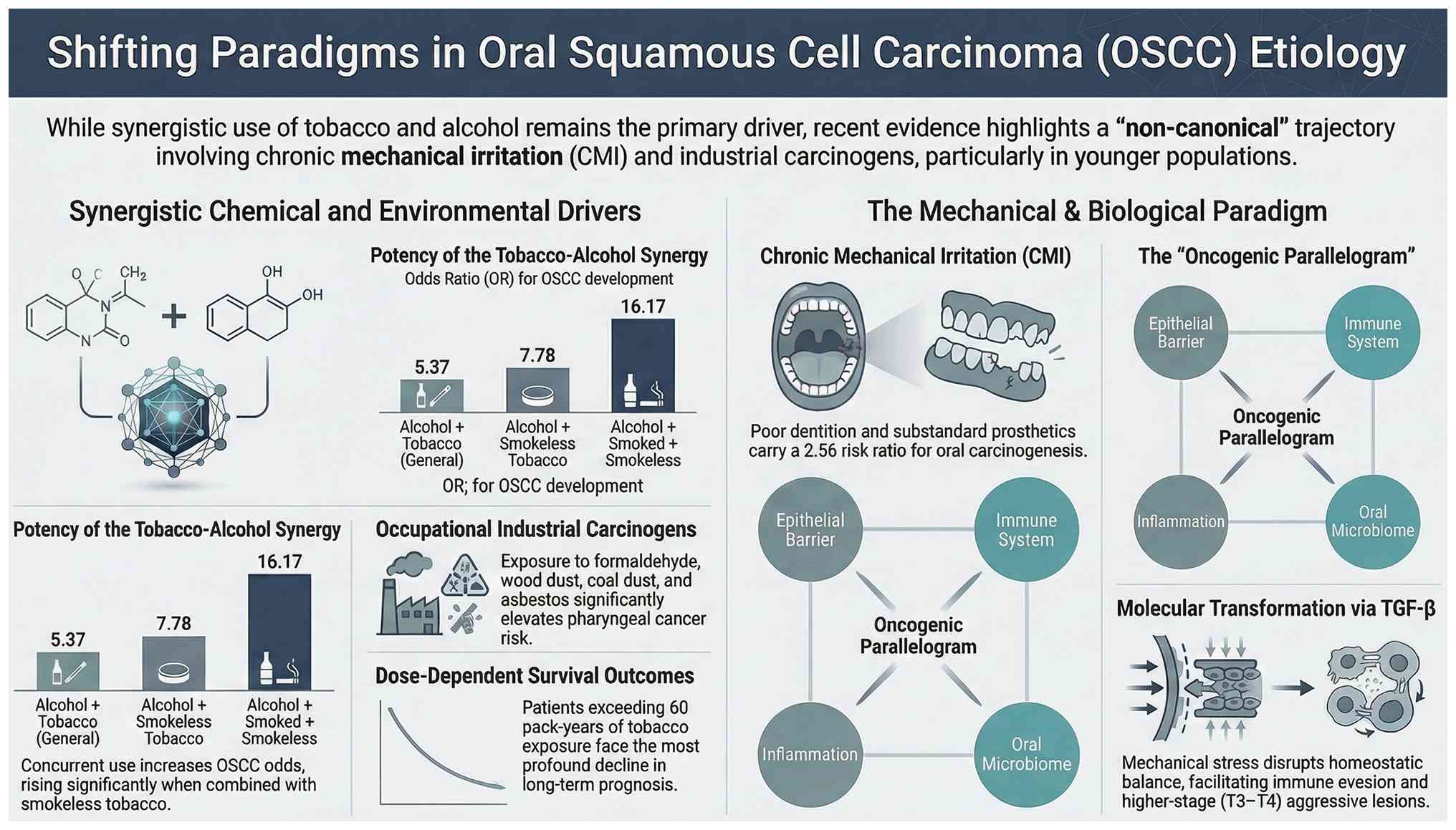
As illustrated in Fig.
3, beyond traditional lifestyle-related triggers, poorly
explored factors, such as chronic trauma and microbial dysbiosis
are increasingly recognized in the pathogenesis of OSCC (15,16,60).
While emerging evidence highlights non-canonical drivers in
young-onset oral cancer, the synergistic consumption of alcohol and
tobacco remains the most potent classical risk profile for OSCC, as
also demonstrated in Table IV. A
previous comprehensive systematic review of observational studies
confirmed that the concurrent use of these substances dramatically
elevates the odds of developing OSCC [odds ratio (OR), 5.37; 95%
CI, 3.54-8.14) (15). This
pathogenic synergy is even more pronounced when combining alcohol
with smokeless tobacco (OR, 7.78) or a triple combination of
alcohol, smoked and smokeless tobacco (OR, 16.17). These data serve
as a critical baseline: While older cohorts are predominantly
driven by this intense chemical synergy, the increasing incidence
of OSCC in young, non-smoking females suggests a distinct
biological trajectory that bypasses this traditional toxicological
axis (15).
| Table IVEvidence-based synthesis of
non-canonical risk factors. |
Table IV
Evidence-based synthesis of
non-canonical risk factors.
| Risk category | Specific
trigger | Impact/risk
ratio | Scientific
evidence | (Refs.) |
|---|
| Mechanical | Sharp teeth,
ill-fitting dentures (CMI) | RR 2.56 | Induced chronic
inflammation via NF-κB | (18,20) |
| Occupational | Coal dust,
asbestos, formaldehyde | High
correlation | Significant in
industrial and welding environments | (17) |
| Viral | Human
Papillomavirus (HPV) | Rare in OSCC | p16 is a poor
prognosticator in NSND OSCC | (48,49) |
| Biological | Oral Microbiota
Dysbiosis | Barrier
disruption | Interplay with
TGF-β signaling in oncogenesis | (22) |
| Genetic | DNA repair pathway
alterations | Predisposition | Widespread
epigenetic alterations (CpG hypermethylation) | (27,45) |
The geographical and demographic shifts in oral and
pharyngeal cancers incidence mandate a broader evaluation of
environmental and occupational risk factors. The systematic review
by Awan et al (60)
identified a significant association between exposure to industrial
carcinogens specifically formaldehyde, wood dust, coal dust and
asbestos, and an increased risk of developing oral and pharyngeal
cancers, highlighting the critical role of occupational hazards in
non-canonical oncogenesis. The topographical distribution of OSCC
is frequently associated with areas of high mechanical stress, such
as the lateral borders of the tongue and the buccal mucosa. Recent
systematic evidence involving high-quality studies (low risk of
bias per JBI criteria) identifies edentulous subjects and those
with substandard prosthetics as a high-risk group (16). With an estimated risk ratio of
2.56, chronic irritation emerges as a significant contributor to
oral carcinogenesis. Given the increasing incidence of tongue SCC
in younger cohorts, the role of CMI as a dependent risk factor
necessitates a more comprehensive dental evaluation during routine
screenings, moving beyond the traditional focus on chemical
carcinogens alone (16).
CMI, resulting from poor dentition, parafunctional
habits (e.g., cheek biting), or substandard prosthetics, represents
a preventable yet under-researched etiological component (16,28).
Although previous qualitative assessments utilizing the Bradford
Hill criteria found existing studies to be limited by confounding
variables, the potential for CMI to induce frictional keratosis and
subsequent malignant transformation cannot be dismissed (17,61).
In light of the rising incidence of orofacial malignancies in
regions such as Kazakhstan, where dental hygiene standards vary,
addressing CMI through regular examinations and the removal of
traumatic dental factors could prove as effective as traditional
de-addiction programs in preventing OSCC.
The role of CMI in oral oncogenesis is increasingly
viewed through the lens of the ‘oncogenic parallelogram’, a complex
interplay between the epithelial barrier, the immune system,
chronic inflammation, and the oral microbiome (29). Recent evidence suggests that these
three components are not isolated factors, but form a tightly
interdependent network during carcinogenesis. Central to this
reciprocal crosstalk is the transforming growth factor-β (TGF-β)
signaling pathway, which appears to modulate every facet of this
triangle. In younger patients, where traditional carcinogens may be
absent, the disruption of this homeostatic balance, potentially
triggered by chronic mechanical irritation could serve as a primary
driver for cellular transformation and immune evasion (29). While CMI alone may not possess
independent mutagenic potential, it functions as a potent promoter
that significantly lowers the threshold for malignant
transformation. For instance, tobacco exposure on a chronically
irritated mucosa aggravates the inflammatory cascade by
upregulating pro-inflammatory cytokines, such as IL-1, IL-6 and TNF
(30). Furthermore, CMI disrupts
the epithelial barrier and increases the expression of syndecan-1,
which facilitates HPV attachment and internalization a critical
step for persistent viral infection and subsequent oncogenesis
(31). These synergistic
mechanisms explain why patients with long-standing dental trauma
(mean duration of 49 months) exhibit a 1.7-fold increased risk of
OSCC, often presenting with more aggressive, higher-stage (T3-T4)
lesions (16,32).
Evidence from a large-scale longitudinal study of
>1,700 patients with OSCC demonstrated a clear linear
association between accumulated tobacco exposure and diminished
survival outcomes (33).
Multivariable Cox regression analyses revealed that current smokers
face significantly higher hazard ratios for both OS and DFS
compared to never-smokers (33).
Notably, this detrimental effect is dose-dependent, with patients
exceeding 60 pack-years exhibiting the most profound decline in
long-term prognosis. Furthermore, the impact of tobacco on survival
appears to be modulated by the specific tumor subsite and the
presence of excessive alcohol consumption, suggesting that the
chemical synergy between these carcinogens varies across the oral
cavity (33).
The recent genomic characterization of OSCC in NSND
highlights a molecular landscape that is distinctly divergent from
traditional, habit-driven malignancies. While a definitive genetic
etiology remains elusive, NSND tumors are frequently characterized
by widespread epigenetic alterations, specifically CpG island
hypermethylation and subsequent gene silencing (34). Furthermore, genomic profiling
reveals unique mutational frequencies in genes, such as
CASP8, suggesting a different pathogenetic trajectory.
Notably, the presence of a robust interferon-γ (IFN-γ) response and
the activation of immune checkpoint ligands in these patients point
toward a potential viral etiology or a distinct immune-mediated
oncogenic pathway that warrants further investigation in younger,
low-risk cohorts (34).
In the complex, multistep process of oral
carcinogenesis, CMI functions as a critical ‘effect modifier’ or
enhancer. Applying the Bradford Hill criteria to current clinical
data reveals that while CMI may not function as an independent
initiator, it serves as a ‘sufficient component cause’ a factor
that, when eliminated, significantly diminishes the overall risk of
malignancy (17). This is
particularly relevant for high-risk populations where CMI interacts
synergistically with sub-clinical triggers. By stimulating the
nuclear factor κ-light-chain-enhancer of activated B cells (NF-κB)
and cyclooxygenase-2 (COX-2) pathways, chronic mechanical trauma
from dental or prosthetic factors provides the necessary
promotional stimulus following an initial predisposed state. Thus,
treating CMI is not merely a palliative measure but a primary
preventive strategy that could reduce OSCC morbidity and mortality
(17).
The clinical and molecular paradox of
young-onset OTSCC: From etiological divergence to prognostic
uncertainty
The prognostic significance of age in OTSCC remains
one of the most contentious issues in head and neck oncology
(6,35). While traditional paradigms suggest
that younger patients may have a physiological advantage, several
cohorts have reported paradoxically poorer outcomes in this
demographic, particularly regarding regional recurrence and DFS
(27,36,62)
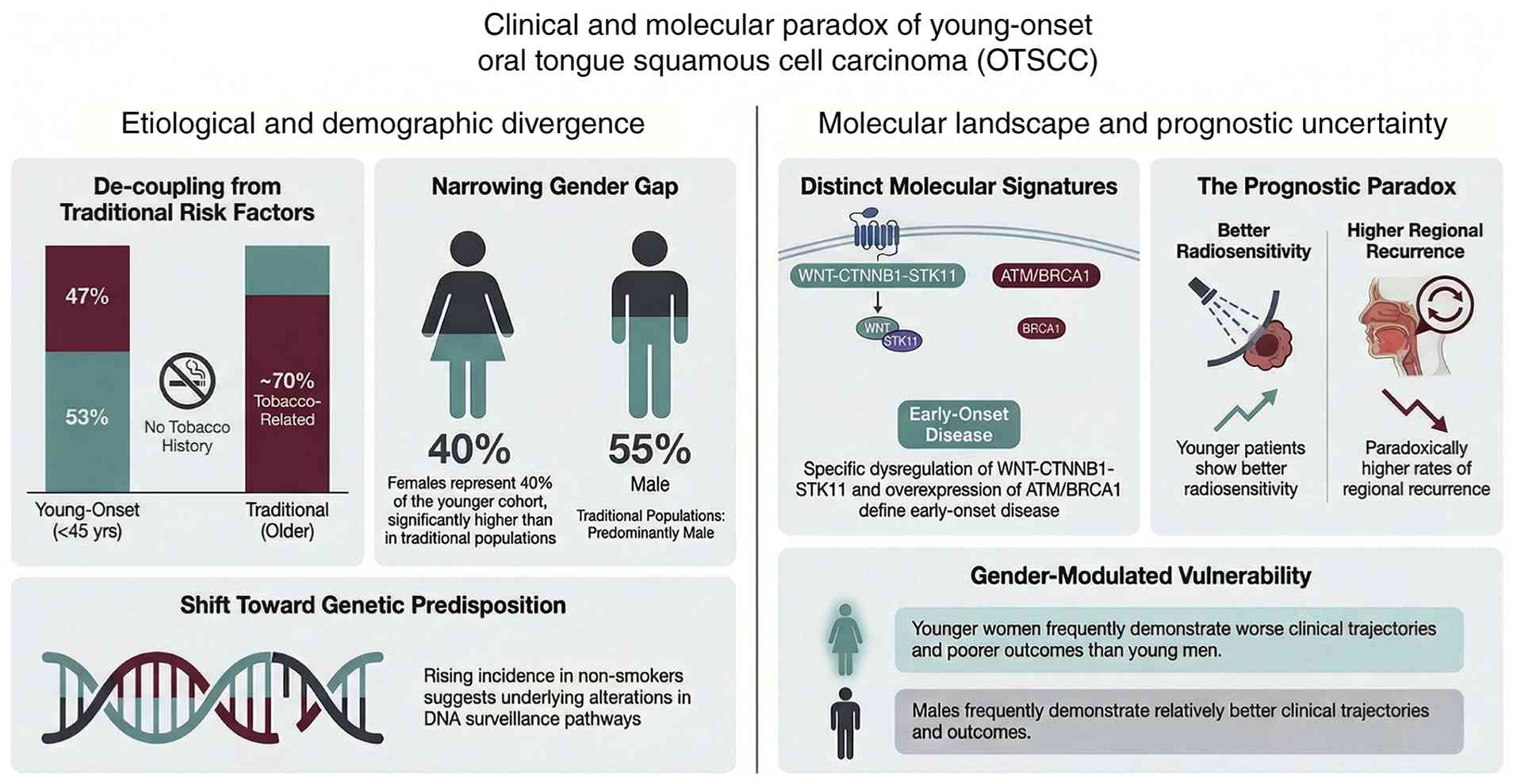
(Fig. 4). For instance,
advanced-stage OTSCC in patients <45 years of age has been shown
to be associated with significantly higher rates of locoregional
failure compared to older counterparts (37). This prognostic vulnerability
appears to be further modulated by sex, with younger women
frequently demonstrating worse clinical trajectories than men
(27,38). Conversely, a substantial body of
evidence maintains that survival rates in the young are comparable,
if not superior, to those in the elderly (18,39).
Such persistent inconsistencies mandate a deeper investigation into
the molecular and histopathological alterations unique to
‘young-onset’ disease to optimize risk-stratified therapeutic
interventions (20,59) (Table
V).
| Table VComparative clinicopathological and
molecular profiles: NSND vs. SD patients. |
Table V
Comparative clinicopathological and
molecular profiles: NSND vs. SD patients.
| Parameter | Smoking and
drinking (SD) group |
Non-smoking/non-drinking (NSND) group | (Refs.) |
|---|
| Gender
distribution | Predominantly male
(up to 98%) | Predominantly
female | (14,51) |
| Anatomical
subsite | Floor of mouth,
buccal mucosa | Mobile tongue,
lateral borders | (13,27,50) |
| Molecular
markers | High p53, p63
expression | CDKN2A mutations,
EGFR amplifications | (48,50) |
| Tumor
differentiation | More likely poorly
differentiated | Well to moderately
differentiated | (50) |
| Proliferation
index | Higher Ki-67 index
(~35.7%) | Lower Ki-67 index
(~24.5%) | (50) |
| Survival outcome
(OS) | Inferior survival
(HR, ~1.8) | Superior overall
survival (HR ~0.47) | (26,47,51) |
From a molecular perspective, OTSCC in patients
<45 years of age often presents a biological paradox. While
traditional mutational signatures (e.g., TP53, CDKN2A
and NOTCH1) appear largely comparable to those in elderly
populations (21,40,41),
recent evidence identifies specific pathway alterations predominant
in the younger cohort (42).
Notably, the dysregulation of the WNT-CTNNB1-STK11 and
CDKN2A-HGF-MET axes, alongside the overexpression of ATM and BRCA1,
suggests a distinct molecular landscape in early-onset disease
(43). These biological signatures
may translate into enhanced radiosensitivity, providing critical
prognostic and therapeutic advantages for this patient demographic
(22,44-46).
However, the absence of age-related genomic divergence in
large-scale databases such as The Cancer Genome Atlas (TCGA)
underscores the necessity of accounting for population
heterogeneity in molecular reporting (21,41).
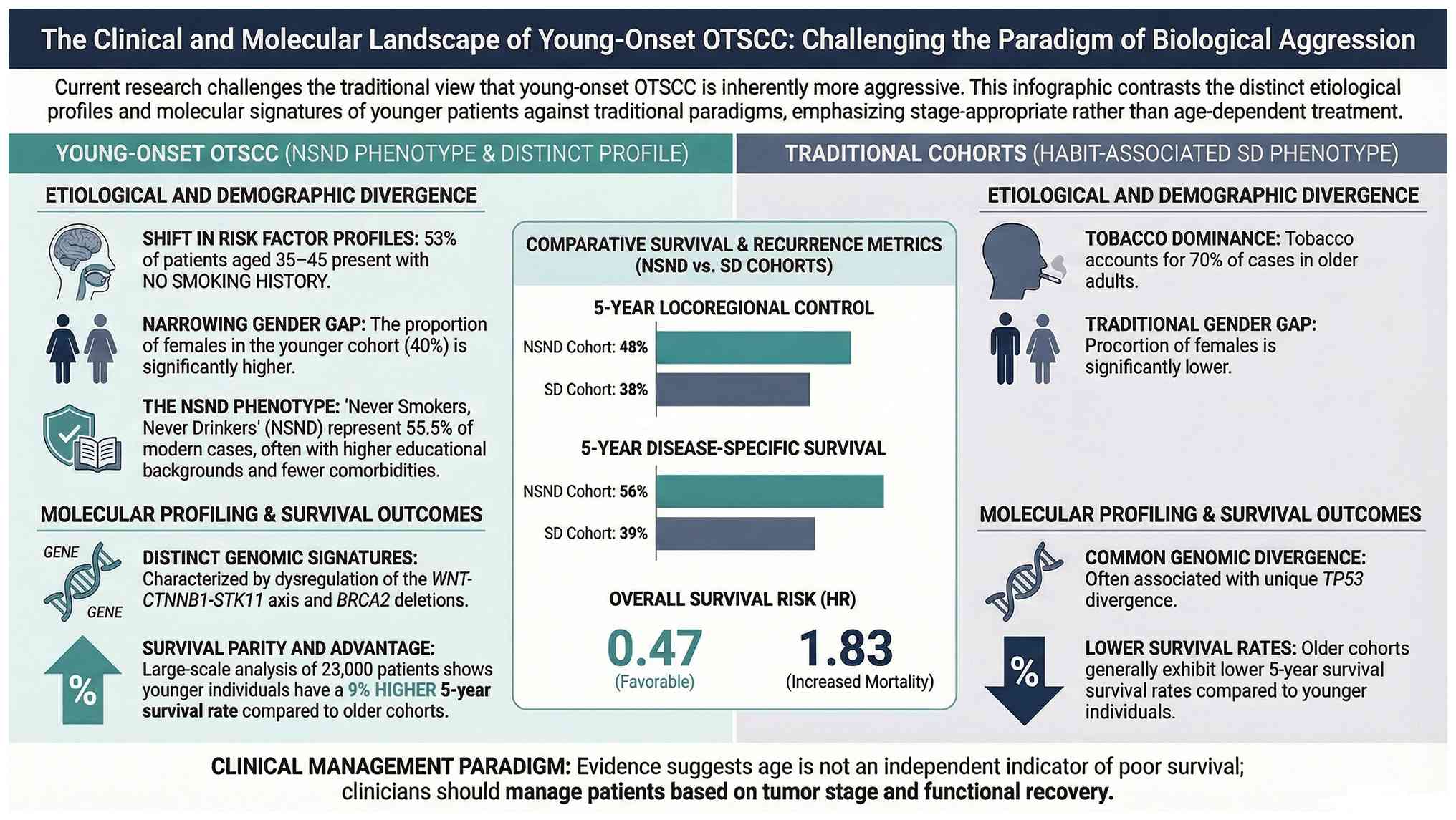
A previous systematic analysis of 23 high-quality
studies underscored a profound etiological divergence in tongue
squamous cell carcinoma (TSCC) across different age cohorts. While
traditional risk factors, primarily tobacco use, accounted for ~70%
of cases in older adults, a striking 53% of younger patients
(typically defined as those aged 35-45 years) present without any
history of smoking (19). This
demographic shift was further characterized by a narrowing sex gap;
although a slight male predominance persists (55%), the proportion
of affected females in the younger group (40%) was significantly
higher than that observed in classical head and neck oncology
populations. These findings support the emerging classification of
young-onset TSCC as a distinct biological entity, necessitating the
identification of novel, non-canonical risk factors to mitigate its
rising incidence (19).
The progressive increase in OTSCC among young
adults, a group frequently lacking traditional risk factors,
suggests a complex etiopathogenesis that may involve an underlying
genetic predisposition. Alterations in pathways governing genetic
stability and DNA surveillance may render certain individuals more
susceptible to head and neck cancers at an earlier age (23). However, current molecular evidence
indicates that the mutational landscape of these tumors remains
largely comparable across age groups, challenging the long-held
belief that young-onset OTSCC is a distinct, highly aggressive
biological subtype (23). Given
the conflicting prognostic data in the recent literature, a
specialized ‘aggressive’ treatment protocol based solely on age is
currently unjustified; rather, the focus should shift toward
identifying subtle markers of genetic susceptibility and optimizing
functional recovery.
Diagnostic pitfalls of p16INK4a
testing in young OSCC
A critical diagnostic nuance in evaluating young
patients with OSCC involves the interpretation of p16INK4a
immunohistochemistry (IHC). While p16 overexpression is a
validated, robust surrogate marker for transcriptionally active
high-risk HPV in OPSCC, its diagnostic utility in OSCC is
significantly constrained. In young OSCC cohorts, p16 positivity
frequently occurs via HPV-independent pathways, such as mutations
or dysregulation in the Retinoblastoma protein or downstream
CDKN2A alterations (59).
Relying solely on p16 IHC without confirmatory HPV-DNA PCR or RNA
in situ hybridization introduces a substantial risk of
misclassifying HPV-negative OSCC as an HPV-driven lesion, which
could lead to the inappropriate de-escalation of therapeutic
protocols.
Molecular mechanisms of CMI-induced
carcinogenesis
While CMI from substandard dental prosthetics or
sharp malposed teeth is not a direct mutagen, it functions as a
potent tissue-remodeling promoter within the ‘oncogenic
parallelogram’. Chronic physical trauma continuously disrupts the
mucosal epithelial barrier, leading to the release of
damage-associated molecular patterns and persistent activation of
the NF-κB and COX-2 pro-inflammatory signaling cascades. Sustained
mechanical stress induces the local accumulation of reactive oxygen
species, promoting oxidative DNA damage in keratinocytes (63). Concurrently, mechanical trauma
causes the degradation of syndecan-1, downregulates epithelial
cadherins, and activates TGF-β/SMAD signaling, which drives
epithelial-mesenchymal transition. This chronically inflamed,
hyperplastic microenvironment significantly lowers the activation
energy threshold for malignant transformation in cells harbor
non-canonical epigenetic or genomic alterations (20).
Survival outcomes and molecular
profiling in the habit-free cohort: Challenging the paradigm of
biological aggression
Contrary to earlier, smaller retrospective cohorts
that reported mixed outcomes, a comprehensive meta-analysis of 22
studies encompassing >23,000 patients confirmed that a young age
(≤40 years) is not an independent indicator of poor survival in
OSCC (47). When pooling the
available literature, the 5-year OS for younger patients revealed
no significant disadvantage compared to older cohorts [hazard ratio
(HR), 0.97; 95% CI, 0.66-1.41]. These findings are corroborated by
large-scale database analyses, such as the pooled cohort of nearly
23,000 patients with OTSCC, where younger individuals actually
demonstrated a 9% higher 5-year survival rate (HR, 0.59) (48). Consequently, the traditional
perception of ‘biological aggression’ in early-onset oral cancer is
not supported by high-volume data, suggesting that clinicians
should manage these patients based on tumor stage rather than
chronological age (47).
The prognostic landscape for OSCC in NSND remains a
subject of intense debate, often confounded by the inconsistent use
of age as a proxy for risk-free status. Emerging evidence suggests
that when cohorts are strictly defined by habit history rather than
chronological age, NSND patients frequently exhibit superior or
equivalent survival outcomes compared to their counterparts with
extensive smoking and drinking histories (13,33,48-50).
Notably, large-scale adjusted analyses have demonstrated that
cumulative tobacco exposure is associated with a poorer OS and DFS
in a dose-dependent manner, with current smokers facing a
significantly higher risk of mortality (HR, 1.83) (33). Targeted next-generation sequencing
of OSCC cohorts has revealed that NSND patients possess a distinct
genomic profile compared to traditional high-risk groups. While
TP53 (60%) and CDKN2A (24%) mutations remain prevalent across the
entire spectrum, the NSND subgroup exhibits a significant
enrichment of CDKN2A mutations, EGFR amplifications and BRCA2
deletions (13). Notably, a
younger subset of these NSND patients exhibits a higher mutational
burden, suggesting that in the absence of exogenous carcinogens,
genomic instability may be driven by endogenous or hereditary
factors. These molecular alterations are not merely incidental;
CDKN2A mutations and EGFR amplifications are strongly associated
with advanced tumor stage, perineural invasion, and extracapsular
spread, providing a biological rationale for the aggressive
clinical behavior sometimes observed in low-risk cohorts (13).
A longitudinal analysis of >300 OSCC patients
suggests that the perceived aggressiveness of oral cancer does not
significantly differ between NSND individuals and those with
traditional risk factors (SD). While NSND patients predominantly
elderly females exhibit a markedly superior overall survival (HR,
0.47; P=0.002), their DSS and relapse-free survival remain
comparable to the SD group (48).
This prognostic divergence indicates that the survival advantage in
NSND cohorts is likely a reflection of a lower burden of chronic
comorbidities rather than inherently less virulent tumor biology.
Notably, advanced features, such as extracapsular extension remain
potent negative predictors across both groups, reinforcing the need
for stage-appropriate rather than habit-stratified treatment
planning (48). The demographic
and clinical profile of NSND patients significantly deviates from
the traditional OSCC paradigm, with a higher prevalence among
younger individuals (≤40 years), females and those with higher
educational backgrounds (50).
Anatomically, NSND tumors are less likely to involve the lower
gingiva and floor of the mouth (15.1% vs. 35.6% in smokers),
typically presenting at less advanced stages. These clinical
characteristics translate into superior oncological outcomes: NSND
patients demonstrate significantly higher 5-year locoregional
control (LRC) (48% vs. 38%) and DSS (56% vs. 39%) rates. Cox
proportional hazards models confirm that the absence of smoking and
drinking is an independent predictor of favorable LRC and DSS,
further distinguishing this cohort from habit-driven oral
malignancies (50). The
clinicopathological profile of oral cancer continues to exhibit a
marked divergence between habit-associated and habit-free cases.
While the SD cohort is overwhelmingly male (98.5%) and tends to
present with more advanced clinical stages, the NSND group accounts
for more than half (55.5%) of the modern oral cancer population
(51). Even following rigorous
statistical matching, the association between traditional risk
factors and increased mortality remains potent, with SD patients
exhibiting a nearly two-fold increase in the risk of death. This
robust correlation underscores the necessity of aggressive primary
prevention and highlights the inherently more favorable survival
trajectory of the emerging NSND phenotype (51).
The emerging phenotype of young-onset
OSCC: Geographical disparities and the shift toward non-canonical
drivers
The global epidemiological landscape of oral
malignancy remains heterogenous, with ~300,000 new diagnoses and
145,000 related deaths reported annually (14,52).
The findings of some researchers on the increasing incidence in
Central Asia should be interpreted in the context of
high-prevalence regions, particularly Southeast Asia, which
continues to have the highest mortality rates globally (53).
The marked heterogeneity in the incidence of OTSCC
ranging from endemic levels in South Asia to relatively low
frequencies in the Middle East reflects a complex interplay of
regional risk factors (54). In
India, where OSCC accounts for almost one-third of the total
oncological burden, the epidemiological profile is fundamentally
shaped by widespread habit-driven carcinogens (54). Conversely, the significantly lower
prevalence in Western and Middle Eastern populations (3 and <2%,
respectively) highlights a distinct etiological landscape. These
marked discrepancies in incidence and clinical presentation
necessitate a shift toward region-specific diagnostic frameworks,
as the ‘global’ paradigm of oral cancer may not adequately address
the unique pathological drivers identified in high-incidence zones
(54). Regional studies in Central
Asia have noted a trend towards the ‘rejuvenation’ of cancer
profiles, with an increasing proportion of patients being diagnosed
in the 30-49 age group, particularly in ecologically sensitive
zones (7). This aligns with the
finding of an emerging younger cohort in Kazakhstan that deviates
from the global mean age of onset. The escalating burden of oral
cancer has been recognized as a public health priority in
Kazakhstan's ‘Comprehensive Plan for Combating Oncological Diseases
(2023-2027)’, which emphasizes the urgent need for early detection
of visual-location tumors to mitigate the high proportion of
advanced-stage (III-IV) presentations (7).
However, while the mean age of onset in these
high-prevalence areas remains ~55 years, the current synthesis
highlights a concerning demographic shift toward younger cohorts
(≤45 years). This suggests that while traditional risk factors
drive the epidemic in South Asia, distinct etiological drivers may
be emerging in other geographic regions, necessitating tailored
screening strategies (14). Recent
epidemiological shifts have prompted a reassessment of OSCC
patterns globally, with increasing reports of early-onset disease
across both Western and Eastern populations (24,25,55).
This rising trend in Scotland, North America and Scandinavia, as
well as in high-prevalence zones such as India and China, suggests
a potential change in the etiopathogenesis of the disease. Despite
this surge in ‘young-onset’ cases, the oncological community has
yet to reach a definitive consensus on the exact age cutoff ranging
in the literature from ≤40 to ≤45 years.
The rising incidence of orofacial malignancies
observed in Kazakhstan indicates a striking parallel in developed
Asia-Pacific nations. Multi-institutional analyses involving
>1,800 patients in Australia and Singapore have demonstrated a
statistically significant surge in tongue SCC among the cohort aged
≤45 years (P<0.001) (24). The
fact that this trend is most pronounced in young females, often in
the absence of a significant smoking history, suggests a global
epidemiological shift. This ‘emerging phenotype’ young, female and
non-smoking challenges existing screening protocols, which
traditionally target older, high-risk males. Consequently, the
integration of these international findings with regional Central
Asian data underscores the necessity for a universal re-evaluation
of OSCC etiology in the post-tobacco era (24).
A previous comprehensive systematic review covering
four decades of global data confirmed a significant upward
trajectory in the incidence of OSCC and oropharyngeal squamous cell
carcinoma among patients <45 years of age (25). Notably, this rising trend is
globally pervasive, with the exception of The Netherlands, and is
characterized by a distinct demographic shift: A prominent increase
in mobile tongue cancer among females and oropharyngeal
malignancies in males. Furthermore, the relative burden of
early-onset disease exhibits a profound geographical disparity,
with the proportion of young patients in Africa (17.2%) and the
Middle East (14.5%) significantly exceeding that in North America
(5.5%). These findings reinforce the hypothesis that OSCC and
oropharyngeal squamous cell carcinoma in the younger cohort may
represent a biologically distinct clinical entity, potentially
driven by non-canonical etiological factors beyond traditional
tobacco and alcohol exposure (25).
Therapeutic implications and future
directions: Tumor microenvironment, immune profiles, and targeted
interventions
The distinct biological profile of young-onset and
NSND OSCC mandates a transition toward personalized,
microenvironment-driven therapeutic strategies. As regards the
programmed death-ligand 1 (PD-L1) expression and the IFN-γ axis,
although young NSND patients with OSCC typically exhibit a lower
TMB due to the absence of tobacco-induced neoantigens, genomic
profiling reveals a robust IFN-γ gene expression signature
(56). IFN-γ is a pivotal cytokine
that upregulates PD-L1 expression on tumor cells and
tumor-infiltrating lymphocytes. Consequently, young NSND patients
often present with elevated combined positive scores (≥1 or ≥20),
rendering them highly responsive to immune checkpoint inhibitors
(ICIs), such as anti-PD-1 monoclonal antibodies (e.g.,
pembrolizumab, nivolumab), despite low TMB (56).
As regards the immune microenvironment, ‘hot’ vs.
‘cold’ phenotypes and the recurrence stratification of early-onset
OSCC by the tumor microenvironment (TME) provides critical insights
into the ‘prognostic paradox’ of high local recurrence rates
alongside favorable overall survival (34). Young OSCC tumors span a spectrum
from ‘hot’ (inflamed, highly infiltrated by CD8+
T-cells) to ‘cold’ (immune-excluded or immunosuppressed)
phenotypes. Immune-excluded tumors, characterized by dense stromal
fibrosis driven by TGF-β signaling, prevent cytotoxic T-lymphocytes
from reaching the tumor core. Recognizing these TME subtypes allows
for the targeted application of TME-modulating agents (e.g., TGF-β
inhibitors) to convert ‘cold’ non-responsive tumors into ‘hot’
immunogenic substrates (34).
Perioperative (neoadjuvant) immunotherapy is used
for functional preservation. Given the long-life expectancy and
functional demands of young adults, preserving speech, deglutition
and facial esthetics is a top clinical priority (57). The emergence of neoadjuvant
(preoperative) ICI regimens either as monotherapy or combined with
short-course induction chemotherapy has demonstrated marked
pathological complete response and major pathological response
rates in locally advanced head and neck cancers. Achieving
significant tumor downstaging prior to surgery enables
function-sparing, minimal-resection surgical techniques,
drastically reducing long-term morbidity while maintaining
oncologic safety (57).
Synergy between EGFR amplification and immune
checkpoint inhibition molecular characterization indicates that
young NSND OSCC is enriched with EGFR gene amplifications and
over-expression. Elevated EGFR signaling not only drives
proliferation, but also promotes immune evasion by upregulating
PD-L1 and immunosuppressive cytokines (58). Combining anti-EGFR targeted therapy
(e.g., cetuximab) with anti-PD-1 ICIs creates a potent dual
mechanism: anti-EGFR therapy induces antibody-dependent cellular
cytotoxicity and restores immune susceptibility, while ICIs relieve
T-cell exhaustion, offering a promising chemo-sparing regimen for
this demographic (58).
Strengths and limitations of the
systematic synthesis
Despite the comprehensive nature of this synthesis,
several limitations should be acknowledged: i) Heterogeneity of age
cut-off values: A primary challenge in synthesizing data on
‘young-onset’ OSCC is the lack of a standardized age threshold.
While the present scoping review primarily focuses on patients aged
40-45 years, variations in age categorization across the cited
studies (ranging from 35 to 50 years) may introduce subtle
inconsistencies in the reported prognostic and etiological trends.
ii) Retrospective nature and confounding factors: A number of the
analyzed cohorts, particularly those investigating non-canonical
risk factors such as CMI, rely on retrospective data. This
inherently limits the ability to control for all confounding
variables, such as dietary habits, environmental pollutants beyond
the workplace and silent viral co-factors. iii) Geographical data
imbalance: While the present scoping review integrated regional
data from Kazakhstan and Central Asia, the majority of large-scale
genomic and database studies (e.g., TCGA, NCDB) originate from
Western or East Asian populations. This geographical bias
underscores the need for more localized molecular research in
industrialized Central Asian regions to confirm the prevalence of
the identified; young-onset' genomic signatures. iv) Methodological
limitations in CMI assessment: The evaluation of mechanical trauma
often lacks objective quantification (e.g., duration and intensity
of irritation). The majority of studies utilize qualitative
assessments, which may underestimate the synergistic potential of
CMI when combined with sub-clinical chemical exposures. v)
Evolution of the nomenclature: The recent shift in head and neck
cancer classification and nomenclature (e.g., the distinction
between OSCC and OPC regarding HPV status) suggests that older
literature may not consistently separate these entities,
potentially masking some subsite-specific trends.
Concluding remarks. Epidemiological
transformation
There is a sustained global trend toward the
‘rejuvenation’ of OSCC. The increasing incidence among individuals
<45 years of age, particularly non-smoking females, suggests the
existence of alternative pathogenetic pathways that bypass
classical cumulative chemical mutagenesis.
Biological uniqueness of the NSND phenotype.
OSCC in NSND is a distinct biological entity. It is characterized
by a specific genomic landscape enriched with CDKN2A mutations and
EGFR amplifications and widespread epigenetic silencing,
distinguishing it from the traditional ‘tobacco-type’ OSCC.
Deconstructing prognostic myths. Data from
large-scale cohorts (>23,000 patients) refute the long-held
perception of increased biological aggression in the young. Age
alone is not an independent predictor of poor survival; higher
recurrence rates in younger patients are offset by a lack of
comorbidities and a better response to rescue therapy, resulting in
favorable overall survival.
The ‘oncogenic parallelogram’ concept. CMI
from poor dentition or ill-fitting prosthetics acts as a critical
‘effect modifier’. By disrupting the epithelial barrier and
triggering chronic inflammation via NF-κB and COX-2 pathways, CMI
functions as a potent promoter that lowers the threshold for
malignant transformation.
Regional public health priorities. The
increasing burden of oral cancer in Central Asia, as highlighted in
Kazakhstan's ‘Comprehensive Plan for Combating Oncological Diseases
(2023-2027)’ (7), necessitates the
integration of occupational and environmental risks into diagnostic
frameworks. The early detection of visual-location tumors must be
prioritized to reduce advanced-stage presentations.
Shift in therapeutic paradigm. Given the high
life expectancy of younger patients, treatment should prioritize
functional preservation. Aggressive escalation of therapy based
solely on chronological age lacks high-quality evidentiary support
and may unnecessarily diminish the long-term quality of life and
social integration of survivors.
Acknowledgements
Not applicable.
Funding
Funding: No funding was received.
Availability of data and materials
The data generated in the present study may be
requested from the corresponding author.
Authors' contributions
NK, AS and AB were involved in the writing,
reviewing and editing of the manuscript, as well as in the writing
and preparation of the original draft of the manuscript, and the
conceptualization of the study. NK, NU and MN supervised the study,
and were also involved in project administration, in the literature
search and in the conceptualization of the study. All authors have
read and approved the final manuscript. NK and AS confirm the
authenticity of all the raw data.
Ethics approval and consent to
participate
Not applicable.
Patient consent for publication
Not applicable.
Competing interests
The authors declare that they have no competing
interests.
Use of artificial intelligence tools
During the preparation of this work, AI tools
(AMSTAR 2 tool and Gemini Notebook) were used to improve the
readability and language of the manuscript or to generate images,
and subsequently, the authors revised and edited the content
produced by the AI tools as necessary, taking full responsibility
for the ultimate content of the present manuscript.
References
|
1
|
Saini RS, Vyas R, Mosaddad SA and Heboyan
A: Efficacy of oral rehabilitation techniques in patients with oral
cancer: A systematic review and meta-analysis. J Surg Oncol.
131:1272–1283. 2025.PubMed/NCBI View Article : Google Scholar
|
|
2
|
Da Conceição TC, Sanches ACB, Freire TFC,
Martins GB, Marques MVC and Dantas JB de L: Acute oral
manifestations in patients submitted to radiotherapy in the head
and neck region: Literature narrative review. J Health Sci.
23:92–98. 2021.
|
|
3
|
Saade R, Khoury R, Hassan J, Atwi G,
Ghanem H, Jabbour C and Shayya A: Prognostic factors in young
patients with oral cavity cancer: A systematic review and
meta-analysis of 24 studies. Front Oncol.
16(1512345)2026.PubMed/NCBI View Article : Google Scholar
|
|
4
|
Kumar V: A comprehensive review of risk
factors, diagnosis, and treatment options for oral squamous cell
carcinoma. Curr Cancer Therapy Rev. 21:101–115. 2025.
|
|
5
|
Kaminagakura E, Tango RN, Cruz-Perez D,
Bonan R, Yamamoto de Almeida L, de Almeida Lança ML, Bonan P,
Martins H, Takahama A Jr, Ito FA, et al: Oral squamous cell
carcinoma outcome in adolescent/young adult: Systematic review and
meta-analysis. Head Neck. 44:548–561. 2022.PubMed/NCBI View Article : Google Scholar
|
|
6
|
Tagliabue M, Belloni P, De Berardinis R,
Gandini S, Chu F, Zorzi S, Fumagalli C, Santoro L, Chiocca S and
Ansarin M: A systematic review and meta-analysis of the prognostic
role of age in oral tongue cancer. Cancer Med. 10:2566–2578.
2021.PubMed/NCBI View Article : Google Scholar
|
|
7
|
Kazakh Institute of Oncology and
Radiology: Indicators of the Oncology Service of the Republic of
Kazakhstan, 2023: Statistical and Analytical Materials. Ministry of
Healthcare of the Republic of Kazakhstan, Almaty, 2024.
|
|
8
|
Aghiorghiesei O, Zanoaga O, Nutu A, Braicu
C, Campian RS, Lucaciu O and Berindan Neagoe I: The world of oral
cancer and its risk factors viewed from the aspect of microRNA
expression patterns. Genes (Basel). 13(533)2022.PubMed/NCBI View Article : Google Scholar
|
|
9
|
Bello IO, Almangush A, Heikkinen I,
Haglund C, Coletta RD, Kowalski LP, Mäkitie AA, Nieminen P, Leivo I
and Salo T: Histological characteristics of early-stage oral tongue
cancer in young versus older patients: A multicenter matched-pair
analysis. Oral Dis. 26:1081–1085. 2020.PubMed/NCBI View Article : Google Scholar
|
|
10
|
Lenoci D, Moresco E, Cavalieri S,
Bergamini C, Torchia E, Botta L, Canevari S, Trama A, Licitra L and
De Cecco L: Oral cancer in young adults: Incidence, risk factors,
prognosis, and molecular biomarkers. Front Oncol.
14(1412011)2024.PubMed/NCBI View Article : Google Scholar
|
|
11
|
Panda S, Mohanty N, Panda S, Mishra L,
Gopinath D, Sahoo A, Nagraj SK and Lapinska B: Are survival
outcomes different for young and old patients with oral and
oropharyngeal squamous cell carcinoma? A systematic review and
meta-analysis. Cancers (Basel). 14(1986)2022.PubMed/NCBI View Article : Google Scholar
|
|
12
|
Tricco AC, Lillie E, Zarin W, O'Brien KK,
Colquhoun H, Levac D, Moher D, Peters MDJ, Horsley T, Weeks L, et
al: PRISMA extension for scoping reviews (PRISMA-ScR): Checklist
and explanation. Ann Intern Med. 169:467–473. 2018.PubMed/NCBI View Article : Google Scholar
|
|
13
|
Koo K, Mouradov D, Angel CM, Iseli TA,
Wiesenfeld D, McCullough MJ, Burgess AW and Sieber OM: Genomic
signature of oral squamous cell carcinomas from non-smoking
non-drinking patients. Cancers (Basel). 13(1113)2021.PubMed/NCBI View Article : Google Scholar
|
|
14
|
Xie J and Li L: Letter regarding ‘Chronic
mechanical irritation and oral squamous cell carcinoma: A
systematic review and meta-analysis’. Bosn J Basic Med Sci.
21(788)2021.PubMed/NCBI View Article : Google Scholar
|
|
15
|
Mello FW, Melo G, Pasetto JJ, Silva CAB,
Warnakulasuriya S and Rivero ERC: The synergistic effect of tobacco
and alcohol consumption on oral squamous cell carcinoma: A
systematic review and meta-analysis. Clin Oral Investig.
23:2849–2859. 2019.PubMed/NCBI View Article : Google Scholar
|
|
16
|
Gupta AA, Kheur S, Varadarajan S, Parveen
S, Dewan H, Alhazmi YA, Raj TA, Testarelli L and Patil S: Chronic
mechanical irritation and oral squamous cell carcinoma: A
systematic review and meta-analysis. Bosn J Basic Med Sci.
21:647–658. 2021.PubMed/NCBI View Article : Google Scholar
|
|
17
|
Piemonte ED and Lazos J: Evidence for
chronic mechanical irritation as a causative factor in oral cancer:
Application of Bradford Hill criteria. Transl Res Oral Oncol.
3:1–10. 2018.
|
|
18
|
Mroueh R, Haapaniemi A, Grénman R, Laranne
J, Pukkila M, Almangush A, Salo T and Mäkitie A: Improved outcomes
with oral tongue squamous cell carcinoma in Finland. Head Neck.
39:1306–1312. 2017.PubMed/NCBI View Article : Google Scholar
|
|
19
|
Mohideen K, Krithika C, Jeddy N, Bharathi
R, Thayumanavan B and Sankari SL: Meta-analysis on risk factors of
squamous cell carcinoma of the tongue in young adults. J Oral
Maxillofac Pathol. 23:450–457. 2019.PubMed/NCBI View Article : Google Scholar
|
|
20
|
Zhao L, Huang L, Yu S, Zheng J, Wang H and
Zhang Y: Decellularized tongue tissue as an in vitro model for
studying tongue cancer and tongue regeneration. Acta Biomater.
58:122–135. 2017.PubMed/NCBI View Article : Google Scholar
|
|
21
|
Gao J, Aksoy BA, Dogrusoz U, Dresdner G,
Gross B, Sumer SO, Sun Y, Jacobsen A, Sinha R, Larsson E, et al:
Integrative analysis of complex cancer genomics and clinical
profiles using the cBioPortal. Sci Signal. 6(pl1)2013.PubMed/NCBI View Article : Google Scholar
|
|
22
|
Mansour WY, Bogdanova NV, Kasten-Pisula U,
Rieckmann T, Köcher S, Borgmann K, Baumann M, Krause M, Petersen C,
Hu H, et al: Aberrant overexpression of miR-421 downregulates ATM
and leads to a pronounced DSB repair defect and clinical
hypersensitivity in SKX squamous cell carcinoma. Radiother Oncol.
106:147–154. 2013.PubMed/NCBI View Article : Google Scholar
|
|
23
|
Paderno A, Morello R and Piazza C: Tongue
carcinoma in young adults: A review of the literature. Acta
Otorhinolaryngol Ital. 38:175–180. 2018.PubMed/NCBI View Article : Google Scholar
|
|
24
|
Satgunaseelan L, Allanson BM, Asher R,
Reddy R, Low HTH, Veness M, Gopal Iyer N, Smee RI, Palme CE, Gupta
R and Clark JR: The incidence of squamous cell carcinoma of the
oral tongue is rising in young non-smoking women: An international
multi-institutional analysis. Oral Oncol.
110(104875)2020.PubMed/NCBI View Article : Google Scholar
|
|
25
|
Hussein AA, Helder MN, de Visscher JG,
Leemans CR, Braakhuis BJ, de Vet HCW and Forouzanfar T: Global
incidence of oral and oropharynx cancer in patients younger than 45
years versus older patients: A systematic review. Eur J Cancer.
82:115–127. 2017.PubMed/NCBI View Article : Google Scholar
|
|
26
|
Lin NC, Hsu JT and Tsai KY: Difference
between female and male patients with oral squamous cell carcinoma:
A single-center retrospective study in Taiwan. Int J Environ Res
Public Health. 17(3978)2020.PubMed/NCBI View Article : Google Scholar
|
|
27
|
Kourelis K, Tsue T, Girod D, Tawfik O,
Sykes K and Shnayder Y: Negative prognostic factors for head and
neck cancer in the young. J BUON. 18:459–464. 2013.PubMed/NCBI
|
|
28
|
Kawecki MM, Nedeva IR, Iloya J and
Macfarlane TV: Mouth cancer awareness in general population:
Results from Grampian Region of Scotland, United Kingdom. J Oral
Maxillofac Res. 10(e3)2019.PubMed/NCBI View Article : Google Scholar
|
|
29
|
Pang X, Tang YJ, Ren XH, Chen QM, Tang YL
and Liang XH: Microbiota, epithelium, inflammation, and TGF-β
signaling: An intricate interaction in oncogenesis. Front
Microbiol. 9(1353)2018.PubMed/NCBI View Article : Google Scholar
|
|
30
|
Almasri A, Wisithphrom K, Windsor LJ and
Olson B: Nicotine and lipopolysaccharide affect cytokine expression
from gingival fibroblasts. J Periodontol. 78:533–541.
2007.PubMed/NCBI View Article : Google Scholar
|
|
31
|
Gilligan GM, Galindez Costa MFF, Moine L,
Panico RL and Piemonte ED: Could chronic mechanical irritation
facilitate entry of human papillomavirus (HPV) facilitating oral
HPV infection? Transl Res Oral Oncol. 2:1–6. 2017.
|
|
32
|
Lazos JP, Piemonte ED, Lanfranchi HE and
Brunotto MN: Characterization of chronic mechanical irritation in
oral cancer. Int J Dent. 2017(6784526)2017.PubMed/NCBI View Article : Google Scholar
|
|
33
|
Andersen AO, Jensen JS, Jakobsen KK,
Stampe H, Nielsen KJ, Wessel I, Christensen A, Andersen E, Friborg
J, Grønhøj C and von Buchwald C: The impact of tobacco smoking on
survival of patients with oral squamous cell carcinoma: A
population-based retrospective study. Acta Oncol. 61:449–458.
2022.PubMed/NCBI View Article : Google Scholar
|
|
34
|
Tran Q, Maddineni S, Arnaud EH, Divi V,
Megwalu UC, Topf MC and Sunwoo JB: Oral cavity cancer in young,
non-smoking, and non-drinking patients: A contemporary review. Crit
Rev Oncol Hematol. 190(104112)2023.PubMed/NCBI View Article : Google Scholar
|
|
35
|
Gamez ME, Kraus R, Hinni ML, Moore EJ, Ma
DJ, Ko SJ, Rwigema JCM, McGee LA, Halyard MY, Buras MR, et al:
Treatment outcomes of squamous cell carcinoma of the oral cavity in
young adults. Oral Oncol. 87:43–48. 2018.PubMed/NCBI View Article : Google Scholar
|
|
36
|
Hilly O, Shkedy Y, Hod R, Soudry E,
Mizrachi A, Hamzany Y, Bachar G and Shpitzer T: Carcinoma of the
oral tongue in patients younger than 30 years: Comparison with
patients older than 60 years. Oral Oncol. 49:987–990.
2013.PubMed/NCBI View Article : Google Scholar
|
|
37
|
Park JO, Sun DI, Cho KJ, Joo YH, Yoo HJ
and Kim MS: Clinical outcome of squamous cell carcinoma of the
tongue in young patients: A stage-matched comparative analysis.
Clin Exp Otorhinolaryngol. 3:161–165. 2010.PubMed/NCBI View Article : Google Scholar
|
|
38
|
Patel SC, Carpenter WR, Tyree S, Couch ME,
Weissler M, Hackman T, Hayes DN, Shores C and Chera BS: Increasing
incidence of oral tongue squamous cell carcinoma in young white
women, age 18 to 44 years. J Clin Oncol. 29:1488–1494.
2011.PubMed/NCBI View Article : Google Scholar
|
|
39
|
Blanchard P, Belkhir F, Temam S, El Khoury
C, De Felice F, Casiraghi O, Patrikidou A, Mirghani H, Levy A, Even
C, et al: Outcomes and prognostic factors for squamous cell
carcinoma of the oral tongue in young adults: A single-institution
case-matched analysis. Eur Arch Otorhinolaryngol. 274:1683–1690.
2017.PubMed/NCBI View Article : Google Scholar
|
|
40
|
Kandoth C, McLellan MD, Vandin F, Ye K,
Niu B, Lu C, Xie M, Zhang Q, McMichael JF, Wyczalkowski MA, et al:
Mutational landscape and significance across 12 major cancer types.
Nature. 502:333–339. 2013.PubMed/NCBI View Article : Google Scholar
|
|
41
|
Cerami E, Gao J, Dogrusoz U, Gross BE,
Sumer SO, Aksoy BA, Jacobsen A, Byrne CJ, Heuer ML, Larsson E, et
al: The cBio cancer genomics portal: An open platform for exploring
multidimensional cancer genomics data. Cancer Discov. 2:401–404.
2012.PubMed/NCBI View Article : Google Scholar
|
|
42
|
Pickering CR, Zhang J, Neskey DM, Zhao M,
Jasser SA, Wang J, Ward A, Tsai CJ, Ortega Alves MV, Zhou JH, et
al: Squamous cell carcinoma of the oral tongue in young non-smokers
is genomically similar to tumors in older smokers. Clin Cancer Res.
20:3842–3848. 2014.PubMed/NCBI View Article : Google Scholar
|
|
43
|
Knopf A, Lempart J, Bas M,
Slotta-Huspenina J, Mansour N and Fritsche MK: Oncogenes and tumor
suppressor genes in squamous cell carcinoma of the tongue in young
patients. Oncotarget. 6:3443–3451. 2015.PubMed/NCBI View Article : Google Scholar
|
|
44
|
Sankunny M, Parikh RA, Lewis DW, Gooding
WE, Saunders WS and Gollin SM: Targeted inhibition of ATR or CHEK1
reverses radioresistance in oral squamous cell carcinoma cells with
distal chromosome arm 11q loss. Genes Chromosomes Cancer.
53:129–143. 2014.PubMed/NCBI View Article : Google Scholar
|
|
45
|
Joo YH, Park SW, Jung SH, Lee YS, Nam IC,
Cho KJ, Park JO, Chung YJ and Kim MS: Recurrent loss of the FHIT
gene and its impact on lymphatic metastasis in early oral squamous
cell carcinoma. Acta Otolaryngol. 133:992–999. 2013.PubMed/NCBI View Article : Google Scholar
|
|
46
|
Lee SH, Koo BS, Kim JM, Huang S, Rho YS,
Bae WJ, Kang HJ, Kim YS, Moon JH and Lim YC: Wnt/β-catenin
signalling maintains self-renewal and tumourigenicity of head and
neck squamous cell carcinoma stem-like cells by activating Oct4. J
Pathol. 234:99–107. 2014.PubMed/NCBI View Article : Google Scholar
|
|
47
|
Lee DS, Ramirez RJ, Lee JJ, Valenzuela CV,
Zevallos JP, Mazul AL, Puram SV, Doering MM, Pipkorn P and Jackson
RS: Survival of young versus old patients with oral cavity squamous
cell carcinoma: A meta-analysis. Laryngoscope. 131:1310–1319.
2021.PubMed/NCBI View Article : Google Scholar
|
|
48
|
Adeoye J, Hui L, Tan JY, Koohi-Moghadam M,
Choi SW and Thomson P: Prognostic value of non-smoking, non-alcohol
drinking status in oral cavity cancer. Clin Oral Investig.
25:6909–6918. 2021.PubMed/NCBI View Article : Google Scholar
|
|
49
|
Dediol E, Sabol I, Virag M, Grce M, Muller
D and Manojlović S: HPV prevalence and p16INK4a overexpression in
non-smoking non-drinking oral cavity cancer patients. Oral Dis.
22:517–522. 2016.PubMed/NCBI View Article : Google Scholar
|
|
50
|
Yang Z, Du W, Zhang X, Chen D, Fang Q, He
Y, Yang Y, Li D and Fan J: Nonsmoking and nondrinking oral squamous
cell carcinoma patients: A different entity. Front Oncol.
11(558320)2021.PubMed/NCBI View Article : Google Scholar
|
|
51
|
Bao X, Liu F, Chen Q, Chen L, Lin J, Chen
F, Wang J, Qiu Y, Shi B, Pan L, et al: Propensity score analysis
exploring the impact of smoking and drinking on the prognosis of
patients with oral cancer. Head Neck. 42:1837–1847. 2020.PubMed/NCBI View Article : Google Scholar
|
|
52
|
Thomson PJ: Perspectives on oral squamous
cell carcinoma prevention-proliferation, position, progression and
prediction. J Oral Pathol Med. 47:803–807. 2018.PubMed/NCBI View Article : Google Scholar
|
|
53
|
Al-Jaber A, Al-Nasser L and El-Metwally A:
Epidemiology of oral cancer in Arab countries. Saudi Med J.
37:249–255. 2016.PubMed/NCBI View Article : Google Scholar
|
|
54
|
Coelho KR: Challenges of the oral cancer
burden in India. J Cancer Epidemiol. 2012(701932)2012.PubMed/NCBI View Article : Google Scholar
|
|
55
|
Ng JH, Iyer NG, Tan MH and Edgren G:
Changing epidemiology of oral squamous cell carcinoma of the
tongue: A global study. Head Neck. 39:297–304. 2017.PubMed/NCBI View Article : Google Scholar
|
|
56
|
Ayers M, Lunceford J, Nebozhyn M, Murphy
E, Loboda A, Kaufman DR, Albright A, Cheng JD, Kang SP, Shankaran
V, et al: IFN-γ-related mRNA profile predicts clinical response to
PD-1 blockade. J Clin Invest. 127:2930–2940. 2017.PubMed/NCBI View Article : Google Scholar
|
|
57
|
Vos JL, Elbers JBW, Krijgsman O, Traets
JJH, Qiao X, van der Leun AM, Lubeck Y, Seignette IM, Smit LA,
Willems SM, et al: Neoadjuvant immunotherapy with nivolumab and
ipilimumab induces major pathological responses in patients with
head and neck squamous cell carcinoma. Nat Commun.
12(7348)2021.PubMed/NCBI View Article : Google Scholar
|
|
58
|
Schoenfeld JD, Hanna GJ, Jo VY, Rawal B,
Chen YH, Catalano PS, Lako A, Ciantra Z, Weirather JL, Criscitiello
S, et al: Neoadjuvant nivolumab or nivolumab plus ipilimumab in
untreated oral cavity squamous cell carcinoma: A Phase 2 open-label
randomized clinical trial. JAMA Oncol. 6:1563–1570. 2020.PubMed/NCBI View Article : Google Scholar
|
|
59
|
Mirghani H, Amen F, Moreau F and Lacau St
Guily J: Do high-risk human papillomaviruses cause oral cavity
squamous cell carcinoma? Oral Oncol. 51:229–236. 2015.PubMed/NCBI View Article : Google Scholar
|
|
60
|
Awan KH, Hegde R, Cheever VJ, Carroll W,
Khan S, Patil S and Warnakulasuriya S: Oral and pharyngeal cancer
risk associated with occupational carcinogenic substances:
Systematic review. Head Neck. 40:2724–2732. 2018.PubMed/NCBI View Article : Google Scholar
|
|
61
|
Anura A: Traumatic oral mucosal lesions: A
mini review and clinical update. Oral Health Dent Manag.
13:254–259. 2014.PubMed/NCBI
|
|
62
|
Zhang YY, Wang DC, Su JZ, Jia LF, Peng X
and Yu GY: Clinicopathological characteristics and outcomes of
squamous cell carcinoma of the tongue in different age groups. Head
Neck. 39:2276–2282. 2017.PubMed/NCBI View Article : Google Scholar
|
|
63
|
Piemonte E, Lazos J, Belardinelli P,
Secchi D, Brunotto M and Lanfranchi-Tizeira H: Oral cancer
associated with chronic mechanical irritation of the oral mucosa.
Med Oral Patol Oral Cir Bucal. 23:e151–e160. 2018.PubMed/NCBI View Article : Google Scholar
|