Introduction
Chronic kidney disease (CKD) is a public health
problem, and a major risk factor for end-stage kidney disease,
cardiovascular disease and premature death. In HIV-infected
subjects, CKD is the fourth cause of death for non-AIDS-related
diseases, after malignancies, cardiovascular and liver disease
(1–20). With the prolonged survival of
HIV-infected individuals, the prevalence of CKD is expected to
increase along with the burden of comorbidities, such as diabetes
and hypertension (21).
In recent years, it has been suggested that
inflammatory cytokines play a role in the pathogenesis of CKD
(22). Angiopoietin-like protein 2
(ANGPTL2) is an adipokine belonging to the recently characterized
family of ANGPTLs (23). Although
structurally similar to angiopoietin, ANGPTLs do not bind to the
classical angiopoietin receptors, and several members of the family
are involved, not only in the regulation of angiogenesis, but also
in glucose and lipid metabolism (23). ANGPTL2 is abundantly produced in fat
tissue and its levels are increased in the setting of insulin
resistance, obesity, and diabetes (23,24).
Excess ANGPTL2 secretion leads to chronic inflammation and
endothelial dysfunction. Interestingly, in a recent report of Usui
et al elevated circulating levels of ANGPTL2 were associated
with the likelihood of CKD in a large Japanese cohort of uninfected
individuals (25). To date, however,
no studies have investigated the link between serum ANGPTL2 levels
and renal function in HIV-positive individuals.
The aim of the present study was to assess the
relationship between circulating ANGPTL2 levels and renal function
in a cohort of HIV-positive subjects on combination antiretroviral
therapy (cART).
Subjects and methods
Study population
In this cross-sectional study, we consecutively
enrolled 72 HIV-positive patients attending the HIV Outpatient
Clinic of the Division of Infectious Diseases in Catania, Italy,
who were on cART for at least one year. All the participants
provided written informed consent to participate in the study,
which was conducted in accordance with the Declaration of
Helsinki.
We extracted the following parameters from medical
records: patient demographics, time since HIV diagnosis and
initiation of cART, type of cART, HCV and/or HBV coinfection, body
mass index (BMI), smoking, and presence/treatment for
comorbidities, such as diabetes mellitus, hypertension, and
dyslipidemia. At the time of enrollment, urine and blood samples
were collected to evaluate CD4+ and CD8+ T
cell count, plasma HIV RNA, highly sensitive (hs)-C reactive
protein (CRP), presence of proteinuria and microalbuminuria.
Estimated glomerular filtration rate (eGFR) was calculated by using
the Chronic Kidney Disease Epidemiology Collaboration (CKD-EPI)
equation. Plasma samples were stored at −80°C and then used to
measure sCD14 (Quantikine sCD14 Immunoassay; R&D Systems, Inc.,
Minneapolis, MN, USA) with a detection range of 40–3,200 ng/ml and
ANGPTL2 (Uscn Life Science Inc., Wuhan, China) with a detection
range of 0.313–20 ng/ml levels, according to manufacturer's
protocol.
Statistical analysis
Data were analyzed using the Statistical Package for
Social Sciences version 22.0 (SPSS, Inc., Chicago, IL, USA). Data
are presented as mean ± standard deviation for continuous variables
with normal distribution or median (interquartile range) for
continuous variables with skewed distribution. Categorical
variables are expressed as number (%). Variables that were normally
distributed, continuous but not normally distributed, or
categorical were compared using Student's t-test, Mann-Whitney
test, or χ2 test, respectively. Pearson's correlation
test was used to assess the correlation of CKD-EPI values and
demographic, biochemical and viro-immunological variables.
Statistically significant variables in the univariate analysis
(P<0.1) were included in the multivariate regression analysis,
the dependent variable being CKD-EPI. In the multivariate
regression model, both sCD14 and ANGPTL2 were log-transformed (ln)
to approximate normality. Presence of multicollinearity was checked
by examining the variance inflation factor (VIF) and variables
included in the final model if VIF was <5.
Results
Subject characteristics
The main demographic and clinical characteristics of
the study population are reported in Table I. In total, 72 patients were enrolled,
and all were Caucasian, with a median age of 47 (range, 36–53)
years. As for risk factors for HIV acquisition, 26 individuals
(36.1%) were heterosexual, and 40 (55.6%) were men having sex with
men. In addition, 14 (19.4%) women were included in the study.
Median time since HIV diagnosis was 122 (range, 59–200) months, and
median time since cART initiation was 72 (31–191) months. Median
current CD4+ T cell count was 605 (409–789) cells/µl,
while HIV viral load was <50 copies/ml in 59 patients (82%). Of
the 72 patients, 27 patients (37.5%) received a protease inhibitor
(PI)-based regimen, 57 (79.2%) were on tenofovir (TDF), and 10
(13.9%) on raltegravir. In addition, 26 (36.1%) were smokers, and 6
patients (8.3%) were co-infected with hepatitis C. In terms of
comorbidities, 34 subjects (47.2%) had a BMI >25
kg/m2, 6.9% of the study population had diabetes, 18.1%
hypertension, 30.5% dyslipidemia. A total of 10 individuals (13.9%)
had a high cardiovascular risk (i.e., Framingham risk score
>20%), and 13.9% were taking lipid-lowering drugs.
 | Table I.Demographics and clinical
characteristics of the study population. |
Table I.
Demographics and clinical
characteristics of the study population.
| Variable | No. (n=72) |
|---|
| Age (years) | 47 (36–53) |
| Sex, female [n
(%)] | 14 (19.4) |
| MSM [n (%)] | 40 (56) |
| Time since HIV
diagnosis (months) | 122 (59–200) |
| Current
CD4+ T-cell count (cells/µl) | 605 (409–789) |
| HIV viral load <50
copies/ml [n (%)] | 59 (82) |
| Time on cART
(months) | 72 (31–191) |
| Current use of PI [n
(%)] | 27 (37.5) |
| Current use of TDF [n
(%)] | 57 (79.2) |
| Current use of
raltegravir [n (%)] | 10 (13.9) |
| BMI
(kg/m2) | 24 (22–26.6) |
| Current smoking [n
(%)] | 26 (36.1) |
| Hepatitis C
coinfection [n (%)] | 6 (8.3) |
| Diabetes mellitus [n
(%)] | 5 (6.9) |
| Hypertension [n
(%)] | 13 (18.1) |
| Dyslipidemia [n
(%)] | 22 (30.6) |
| Framingham risk score
(%) | 4.5 (1–11.2) |
| eGFR (ml/min/1.73
m2), based on CKD-EPI formula | 96.9±18.5 |
| Proteinuria [n
(%)] | 23 (32) |
| Microalbuminuria [n
(%)] | 18 (25) |
| hs-CRP (ng/ml) | 0.18 (0.07–0.47) |
| ANGPTL2 (ng/ml) | 2.09 (1.45–3.03) |
| sCD14 (ng/ml) | 1,969
(1,747–2,292) |
Renal function and predictors of
reduced CKD-EPI
Mean CKD-EPI was 96.9±18.5 ml/min; 25 patients
(34.7%) had CKD-EPI <90 ml/min, while 2.8% had values <60
ml/min. In addition, 23 individuals (32%) had proteinuria, while 18
(25%) had microalbuminuria.
Individuals with high cardiovascular risk had
decreased renal function compared to low-risk subjects (85 vs. 99
ml/min, P=0.03). As expected, patients on treatment for
hypertension had lower CKD-EPI values (87 vs. 99 ml/min, P=0.07);
similarly, individuals taking lipid-lowering drugs had lower
CKD-EPI values when compared to those without dyslipidemia (86 vs.
98 ml/min, P=0.06).
All individuals had detectable levels of ANGPTL2.
Median ANGPTL2 circulating level was 2.09 (1.45–3.03) ng/ml. Median
sCD14 levels was 1,969 (1,747–2,292) ng/ml. Interestingly, we found
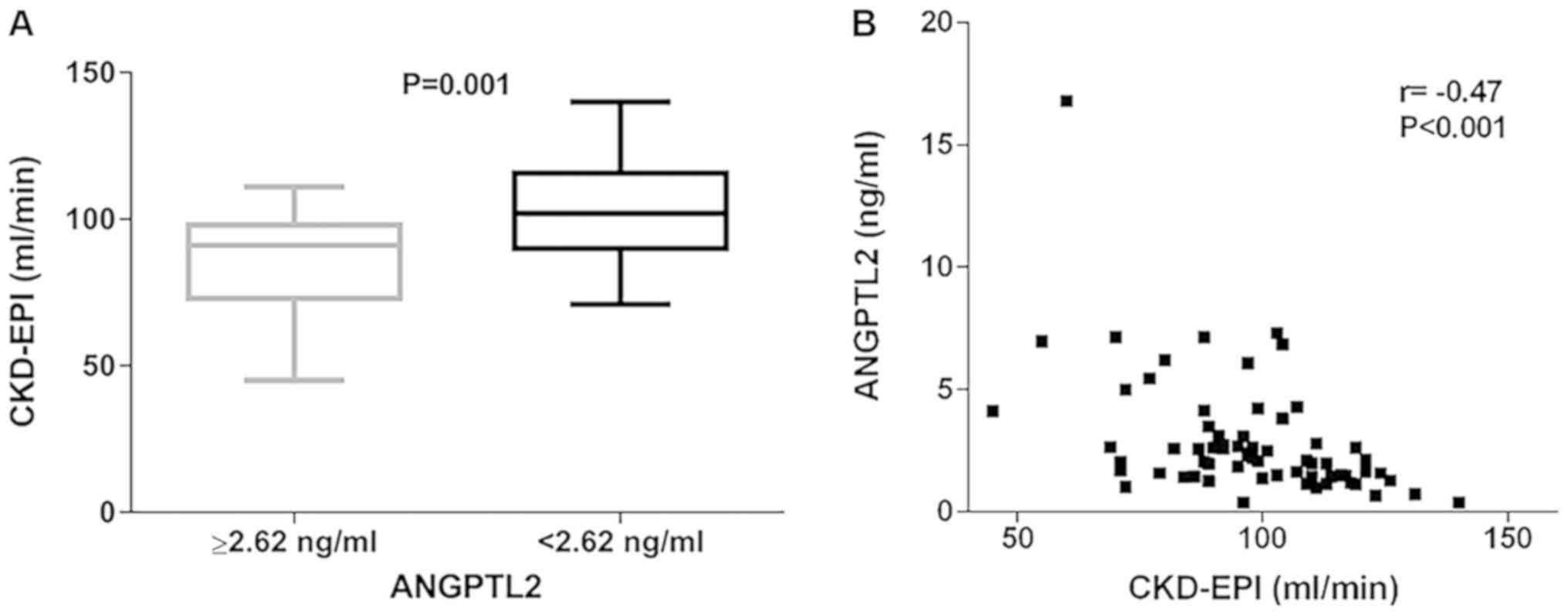
that patients with ANGPTL2 values in the highest tertile (i.e.,
ANGPTL2 values ≥2.62 ng/ml) had significantly lower CKD-EPI values
when compared to the rest of the cohort (86 vs. 103 ml/min,
P=0.001) (Fig. 1A). Analogously,
individuals with sCD14 values in the upper tertile (i.e., sCD14
values ≥2,072 ng/ml) had lower CKD-EPI values (89 vs. 101 ml/min,
P=0.02) (data not shown).
As expected, CKD-EPI values were negatively
correlated with age (r=−0.56, P<0.001). Moreover, they were
negatively correlated with Framingham risk score (r=−0.37,
P=0.001), sCD14 levels (r=−0.37, P=0.002) and ANGPTL2 (r=−0.47,
P<0.001; Fig. 1B).
In multivariate analysis, only older age (β=−0.42,
P=0.013) and higher circulating ANGPTL2 (β=−0.29, P=0.024) remained
significantly associated with reduced CKD-EPI values (Table II).
| Table II.Multivariate regression model for
CKD-EPI, including factors associated with reduced renal function
in univariate analysis. |
Table II.
Multivariate regression model for
CKD-EPI, including factors associated with reduced renal function
in univariate analysis.
| Variables | β | B (SE) | P-value |
|---|
| Age (per year) | −0.42 | −0.67 (0.26) | 0.013 |
| ANGPTL2 (ln,
ng/ml) | −0.29 | −7.7 (3.3) | 0.024 |
| sCD14 (ln,
ng/ml) | −0.19 | −21.9 (12.9) | 0.095 |
| Framingham risk score
(%) | 0.15 | 0.31
(0.29) | 0.29 |
| Antihypertensive
therapy, yes | −0.03 | −1.1 (5.3) | 0.83 |
| Lipid-lowering
drugs, yes | 0.002 | 0.11 (5.9) | 0.98 |
Discussion
In the present study, we found an independent
association between reduced renal function and elevated levels of
ANGPTL2 in a cohort of HIV-positive individuals on cART. ANGPTL2 is
a recently characterized adipokine, which has been associated with
several metabolic disorders, including insulin resistance, obesity
and diabetes (23,24). Existing studies have shown that
ANGPTL2 can act as a mediator of chronic inflammation (23). ANGPTL2 is mainly produced in visceral
adipose tissue, where it promotes macrophage recruitment and
neoangiogenesis. In obese mice, elevated levels of ANGPTL2 led to
chronic adipose tissue inflammation and remodeling, and finally to
systemic insulin resistance (24).
Similarly, in obese humans, elevated levels of ANGPTL2 have been
associated with the presence of insulin resistance as well as the
risk of developing diabetes (24,26).
Moreover, both in animal and human studies, elevated ANGPTL2 levels
have been positively correlated with vascular inflammation and
atherosclerosis progression (24).
Inflammatory cytokines and adipokines, such as resistin, visfatin
and adiponectin, have been suggested to play a role in the
development of CKD. In a large population-based study recently
conducted in Japan, the authors found that circulating ANGPTL2
levels were independently associated with the likelihood of CKD
(25). In this study, CKD was defined
as the presence of albuminuria or eGFR <60 ml/min. The authors
reported that the odds ratio (OR) for CKD increased with elevated
circulating ANGPTL2. The OR for CKD was analyzed across quintiles
and found to be significantly higher in the second quintile
[ANGPTL2 values 2.01–2.48 ng/ml, OR=1.67, 95% confidence interval
(CI): 1.24–2.24], and thereafter to plateau to the fifth quintile
(OR=1.79, 95% CI: 1.32–2.43). The association remained significant
after correcting for known cardiovascular risk factors and hs-CRP
levels. However, when separating eGFR and albuminuria as markers of
reduced renal function, only the latter remained significantly
associated with circulating ANGPTL2 levels. In our study, the
limited sample size did not allow us to evaluate whether ANGPTL2
was a predictor of albuminuria or not. By immunochemistry, ANGPT2
has been shown to be upregulated in the glomeruli of subjects with
diabetes (25). Moreover, ANGPTL2 has
been reported to activate the NF-κB pathway in endothelial cells.
As NF-κB upregulation in the glomerulus has been correlated with
albuminuria, it can be hypothesized that increased ANGPTL2 levels
may represent a marker of endothelial dysfunction and chronic
inflammation in multiple organs, including the kidney (24,27,28).
The presence of abnormalities in renal function is
frequent in HIV-positive individuals (21). Up to 30% of HIV-positive individuals
have proteinuria and 4% of them can develop CKD over time. In
addition to traditional risk factors, such as aging, diabetes,
chronic hepatitis, hypertension, and black ethnicity, several
HIV-related factors can increase the risk of CKD, including low
CD4+ T cell nadir, elevated HIV viral load, and exposure
to some antiretroviral drugs, especially TDF and PIs (21). HIV-positive individuals are known to
have increased levels of chronic inflammation and immune activation
compared to the general population (29). We hypothesize therefore that elevated
levels of ANGPTL2 may reflect this proinflammatory status. Although
the design of the study is not appropriate to assess causality,
ANGPTL2 may be a multiorgan marker of endothelial dysfunction and,
more specifically, a marker of renal impairment in this case. With
the increase in life expectancy and comorbidities in HIV-infected
individuals, identification of a novel marker of renal dysfunction
can help design more effective strategies to prevent or delay the
progression towards CKD.
Our study has several limitations: first, the small
sample size, which limits the statistical power of our analysis;
second, the lack of a control group of uninfected individuals;
third, its cross-sectional design, which does not allow to
establish causal relationships. In fact, we cannot exclude that
increased ANGPTL2 results from reduced renal function, although
ANGPTL2 should not be filtered by the glomerulus, considering its
molecular weight of 57 kDa (25). On
the basis of our findings, we are currently enrolling a larger
cohort of individuals on cART and a matched group of HIV-negative
subjects in order to validate the results of this pilot study.
Moreover, we are currently interested in evaluating ANGPTL2 levels
in untreated HIV infection and establishing whether circulating
ANGPTL2 levels change over time after starting cART.
In conclusion, to the best of our knowledge, this is
the first study to identify an association between renal
dysfunction and increased circulating ANGPTL2. Further research is
needed to clarify the potential pathogenetic mechanisms underlying
this association as well as assess whether ANGPTL2 may represent a
novel marker of declining renal function in HIV infection.
Acknowledgements
We would like to thank all the patients who
participated to the study.
Funding
No funding was received.
Availability of data and materials
The datasets used and/or analyzed during the current
study are available from the corresponding author on reasonable
request.
Authors' contributions
GN and MRP designed the study. MM, RB, BMC and BC
recruited the patients and gathered data and informed consent
modules. MDR, MRP and EVR statistically analyzed the patients'
clinical and laboratory data. GN, MRP and MC wrote the manuscript,
and GFP, FC, EF, GM and AC revised the manuscript.
Ethics approval and consent to
participate
All procedures performed in studies involving human
participants were in accordance with the ethical standards of the
institutional and/or national research committee and with the 1964
Helsinki Declaration and its later amendments or comparable ethical
standards.
Patient consent for publication
Written informed consent was obtained from the
individual participants included in the study.
Competing interests
The authors declare that they have no conflict of
interest.
References
|
1
|
Pomerantz RJ and Nunnari G: HIV and GB
virus C - can two viruses be better than one? N Engl J Med.
350:963–965. 2004. View Article : Google Scholar : PubMed/NCBI
|
|
2
|
Nunnari G, Coco C, Pinzone MR, Pavone P,
Berretta M, Di Rosa M, Schnell M, Calabrese G and Cacopardo B: The
role of micronutrients in the diet of HIV-1-infected individuals.
Front Biosci (Elite Ed). 4:2442–2456. 2012. View Article : Google Scholar : PubMed/NCBI
|
|
3
|
Pinzone MR, Berretta M, Cacopardo B and
Nunnari G: Epstein-barr virus- and Kaposi sarcoma-associated
herpesvirus-related malignancies in the setting of human
immunodeficiency virus infection. Semin Oncol. 42:258–271. 2015.
View Article : Google Scholar : PubMed/NCBI
|
|
4
|
Pinzone MR, Di Rosa M, Celesia BM,
Condorelli F, Malaguarnera M, Madeddu G, Martellotta F, Castronuovo
D, Gussio M, Coco C, et al: LPS and HIV gp120 modulate
monocyte/macrophage CYP27B1 and CYP24A1 expression leading to
vitamin D consumption and hypovitaminosis D in HIV-infected
individuals. Eur Rev Med Pharmacol Sci. 17:1938–1950.
2013.PubMed/NCBI
|
|
5
|
Pinzone MR, Cacopardo B, Condorelli F, Di
Rosa M and Nunnari G: Sirtuin-1 and HIV-1: An overview. Curr Drug
Targets. 14:648–652. 2013. View Article : Google Scholar : PubMed/NCBI
|
|
6
|
Capetti A, Landonio S, Meraviglia P, Di
Biagio A, Lo Caputo S, Sterrantino G, Ammassari A, Menzaghi B,
Franzetti M, De Socio GV, et al: 96 Week follow-up of HIV-infected
patients in rescue with raltegravir plus optimized backbone
regimens: A multicentre Italian experience. PLoS One. 7:e392222012.
View Article : Google Scholar : PubMed/NCBI
|
|
7
|
Visalli G, Paiardini M, Chirico C, Cervasi
B, Currò M, Ferlazzo N, Bertuccio MP, Favaloro A, Pellicanò G,
Sturniolo G, et al: Intracellular accumulation of cell cycle
regulatory proteins and nucleolin re-localization are associated
with pre-lethal ultrastructural lesions in circulating T
lymphocytes: The HIV-induced cell cycle dysregulation revisited.
Cell Cycle. 9:2130–2140. 2010. View Article : Google Scholar : PubMed/NCBI
|
|
8
|
Celesia BM, Nigro L, Pinzone MR, Coco C,
La Rosa R, Bisicchia F, Mavilla S, Gussio M, Pellicanò G, Milioni
V, et al: High prevalence of undiagnosed anxiety symptoms among
HIV-positive individuals on cART: A cross-sectional study. Eur Rev
Med Pharmacol Sci. 17:2040–2046. 2013.PubMed/NCBI
|
|
9
|
Visalli G, Bertuccio MP, Currò M,
Pellicanò G, Sturniolo G, Carnevali A, Spataro P, Ientile R,
Picerno I, Cavallari V, et al: Bioenergetics of T cell activation
and death in HIV type 1 infection. AIDS Res Hum Retroviruses.
28:1110–1118. 2012. View Article : Google Scholar : PubMed/NCBI
|
|
10
|
Trovato M, Ruggeri RM, Sciacchitano S,
Vicchio TM, Picerno I, Pellicanò G, Valenti A and Visalli G: Serum
interleukin-6 levels are increased in HIV-infected patients that
develop autoimmune disease during long-term follow-up.
Immunobiology. 223:264–268. 2018. View Article : Google Scholar : PubMed/NCBI
|
|
11
|
D'Aleo F, Ceccarelli M, Venanzi Rullo E,
Facciolà A, Di Rosa M, Pinzone MR, Condorelli F, Visalli G, Picerno
I, Berretta M, et al: Hepatitis C-related hepatocellular carcinoma:
Diagnostic and therapeutic management in HIV-patients. Eur Rev Med
Pharmacol Sci. 21:5859–5867. 2017.PubMed/NCBI
|
|
12
|
Squillace N, Ricci E, Quirino T, Gori A,
Bandera A, Carenzi L, De Socio GV, Orofino G, Martinelli C, Madeddu
G, et al: CISAI Study Group: Safety and tolerability of
Elvitegravir/Cobicistat/Emtricitabine/Tenofovir Disoproxil fumarate
in a real life setting: Data from surveillance cohort long-term
toxicity antiretrovirals/antivirals (SCOLTA) project. PLoS One.
12:e01792542017. View Article : Google Scholar : PubMed/NCBI
|
|
13
|
Facciolà A, Venanzi Rullo E, Ceccarelli M,
D'Aleo F, Di Rosa M, Pinzone MR, Condorelli F, Visalli G, Picerno
I, Fisichella R, et al: Kaposi's sarcoma in HIV-infected patients
in the era of new antiretrovirals. Eur Rev Med Pharmacol Sci.
21:5868–5869. 2017.PubMed/NCBI
|
|
14
|
Nunnari G, Sullivan J, Xu Y, Nyirjesy P,
Kulkosky J, Cavert W, Frank I and Pomerantz RJ: HIV type 1
cervicovaginal reservoirs in the era of HAART. AIDS Res Hum
Retroviruses. 21:714–718. 2005. View Article : Google Scholar : PubMed/NCBI
|
|
15
|
Nunnari G, Leto D, Sullivan J, Xu Y,
Mehlman KE, Kulkosky J and Pomerantz RJ: Seminal reservoirs during
an HIV type 1 eradication trial. AIDS Res Hum Retroviruses.
21:768–775. 2005. View Article : Google Scholar : PubMed/NCBI
|
|
16
|
Martellotta F, Berretta M, Cacopardo B,
Fisichella R, Schioppa O, Zanghì A, Spartà D, Cappellani A,
Talamini R, Izzi I, et al: Clinical presentation and outcome of
squamous cell carcinoma of the anus in HIV-infected patients in the
HAART-era: A GICAT experience. Eur Rev Med Pharmacol Sci.
16:1283–1291. 2012.PubMed/NCBI
|
|
17
|
Celesia BM, Castronuovo D, Pinzone MR,
Bellissimo F, Mughini MT, Lupo G, Scarpino MR, Gussio M, Palermo F,
Cosentino S, et al: Late presentation of HIV infection: Predictors
of delayed diagnosis and survival in Eastern Sicily. Eur Rev Med
Pharmacol Sci. 17:2218–2224. 2013.PubMed/NCBI
|
|
18
|
Nuvoli S, Caruana G, Babudieri S, Solinas
P, Pellicanò G, Piras B, Fiore V, Bagella P, Calia GM, Yue M, et
al: Body fat changes in HIV patients on highly active
antiretroviral therapy (HAART): A longitudinal DEXA study. Eur Rev
Med Pharmacol Sci. 22:1852–1859. 2018.PubMed/NCBI
|
|
19
|
Ceccarelli M, Condorelli F, Venanzi Rullo
E and Pellicanò GF: Editorial - Improving access and adherence to
screening tests for cancers: A new, though old, challenge in the
HIV epidemics. WCRJ. 5:e10302018.
|
|
20
|
Ceccarelli M, Rullo EV, Facciolà A,
Madeddu G, Cacopardo B, Taibi R, D'Aleo F, Pinzone MR, Picerno I,
di Rosa M, et al: Head and neck squamous cell carcinoma and its
correlation with human papillomavirus in people living with HIV: A
systematic review. Oncotarget. 9:17171–17180. 2018. View Article : Google Scholar : PubMed/NCBI
|
|
21
|
Scarpino M, Pinzone MR, Di Rosa M, Madeddu
G, Focà E, Martellotta F, Schioppa O, Ceccarelli G, Celesia BM,
d'Ettorre G, et al: Kidney disease in HIV-infected patients. Eur
Rev Med Pharmacol Sci. 17:2660–2667. 2013.PubMed/NCBI
|
|
22
|
Fried L, Solomon C, Shlipak M, Seliger S,
Stehman-Breen C, Bleyer AJ, Chaves P, Furberg C, Kuller L and
Newman A: Inflammatory and prothrombotic markers and the
progression of renal disease in elderly individuals. J Am Soc
Nephrol. 15:3184–3191. 2004. View Article : Google Scholar : PubMed/NCBI
|
|
23
|
Kadomatsu T, Endo M, Miyata K and Oike Y:
Diverse roles of ANGPTL2 in physiology and pathophysiology. Trends
Endocrinol Metab. 25:245–254. 2014. View Article : Google Scholar : PubMed/NCBI
|
|
24
|
Tabata M, Kadomatsu T, Fukuhara S, Miyata
K, Ito Y, Endo M, Urano T, Zhu HJ, Tsukano H, Tazume H, et al:
Angiopoietin-like protein 2 promotes chronic adipose tissue
inflammation and obesity-related systemic insulin resistance. Cell
Metab. 10:178–188. 2009. View Article : Google Scholar : PubMed/NCBI
|
|
25
|
Usui T, Ninomiya T, Nagata M, Takahashi O,
Doi Y, Hata J, Fukuhara M, Kitazono T, Oike Y and Kiyohara Y:
Angiopoietin-like protein 2 is associated with chronic kidney
disease in a general Japanese population: The Hisayama Study. Circ
J. 77:2311–2317. 2013. View Article : Google Scholar : PubMed/NCBI
|
|
26
|
Doi Y, Ninomiya T, Hirakawa Y, Takahashi
O, Mukai N, Hata J, Iwase M, Kitazono T, Oike Y and Kiyohara Y:
Angiopoietin-like protein 2 and risk of type 2 diabetes in a
general Japanese population: The Hisayama study. Diabetes Care.
36:98–100. 2013. View Article : Google Scholar : PubMed/NCBI
|
|
27
|
Sanz AB, Sanchez-Niño MD, Ramos AM, Moreno
JA, Santamaria B, Ruiz-Ortega M, Egido J and Ortiz A: NF-kappaB in
renal inflammation. J Am Soc Nephrol. 21:1254–1262. 2010.
View Article : Google Scholar : PubMed/NCBI
|
|
28
|
Mezzano S, Aros C, Droguett A, Burgos ME,
Ardiles L, Flores C, Schneider H, Ruiz-Ortega M and Egido J:
NF-kappaB activation and overexpression of regulated genes in human
diabetic nephropathy. Nephrol Dial Transplant. 19:2505–2512. 2004.
View Article : Google Scholar : PubMed/NCBI
|
|
29
|
Deeks SG: HIV infection, inflammation,
immunosenescence, and aging. Annu Rev Med. 62:141–155. 2011.
View Article : Google Scholar : PubMed/NCBI
|