Introduction
Mycoplasma pneumoniae (M. pneumoniae) is one
of the most common pathogens causing pneumonia, especially neonatal
pneumonia. The typical clinical manifestation is cough without
runny nose, but the symptoms vary widely from asymptomatic
respiratory infections to severe pulmonary infections (1). M. pneumoniae is sensitive to
macrolide or tetracycline antibiotics, but because of the lack of
appropriate diagnostic methods, these antibiotics are not used in a
timely manner. M. pneumoniae is also sensitive to
fluoroquinolone antibiotics, but fluoroquinolones cannot be used in
neonates because of cytotoxic side effects (2). In recent years, the extensive use of
macrolide antibiotics has led to the increase of
macrolide-resistant M. pneumoniae around the world (3). The proportion of macrolide-resistant
M. pneumoniae in Asia is 10–20% (4,5), whereas
in some parts of China it is as high as 90%. Therefore, there is an
urgent need for a rapid and accurate diagnosis method of M.
pneumoniae infection to choose appropriate antibiotics to treat
M. pneumoniae-associated pneumonia, thereby reducing the
abuse of antibiotics and drug-resistant strains.
Anti-M. pneumoniae immunoglobulin M (IgM) is
used to detect acute infection. However, the levels of IgM antibody
in blood were too low to be detected in some patients in the early
stage of acute infection and in reinfection (6). In addition, the IgM antibody can only
be detected several months after infection in the blood of some
patients (7). So, the clinical
diagnosis of M. pneumoniae infection is very difficult. In
the last few decades, only a small number of studies have reported
the use of M. pneumoniae IgA antibodies to diagnose M.
pneumoniae infection. Reports indicate that detection of anti
M. pneumoniae IgA antibodies in adults is more sensitive
than IgM in the diagnosis of acute mycoplasma-associated pneumonia
(8). However, the sensitivity of
M. pneumoniae IgA was low for diagnosing of
mycoplasma-associated pneumonia in neonates (9).
The incidence of M. pneumoniae-associated
pneumonia is high in neonates, but no studies have reported the
clinical value of anti-M. pneumoniae Ig in the diagnosis of
M. pneumoniae-associated pneumonia in neonates. The purpose
of this study was to assess the clinical significance and efficacy
of anti-M. pneumoniae Ig in the diagnosis of M.
pneumoniae in neonates.
Patients and methods
Study subjects
We recruited 80 newborns in Shanghai Ninth People's
Hospital, Shanghai JiaoTong University School of Medicine from May
2013 to June 2016. The cohort included 31 boys and 49 girls. Mean
age: 16.6±5.3 months, age ranged from 8–27 days. All newborns had
cough and fever. Bronchial pneumonia or lobar pneumonia was
identified in all newborns by chest X-ray. Body temperature was
measured with an infrared tympanic thermometer and temperature
above 38.0°C was considered as fever. The patients had continued
fever (≥38°C) for 4.3±2.7 days before admission (information
provided by the relatives of the patients). All patients with M.
pneumoniae infection showed serum antibody positive or
increased antibody potency at least two weeks after the infection:
26 were serum positive, in 72 IgM potency increased 2-fold, and in
31 IgG potency increased 4-fold. The patients involved in this
study had no other disease that could alter the clinical disease
process. The clinical data of the patients included age, fever
duration, length of hospitalization, laboratory examination, liver
zymogram and CRP test results (Table
I). This study was approved by the Ethics Committee of Shanghai
Ninth People's Hospital. Signed written informed consents were
obtained from the patients and/or guardians before the study.
 | Table I.Clinical data and blood test results
of neonates with mycoplasma-associated pneumonia. |
Table I.
Clinical data and blood test results
of neonates with mycoplasma-associated pneumonia.
| Clinical data | Mean ± standard error
(range) | P-value |
|---|
| Age (days) | 16.6±5.3 (8–27) | 0.859 |
| Sex
(Male/Female) | 31/49 |
|
| Pre-hospital fever
duration (days) | 4.3±2.7 (0–10) | 0.014 |
| Total fever duration
(days) | 5.7±3.4 (0–15) | 0.426 |
| Days of
hospitalization | 7.3±5.0 (2–14) | 0.210 |
| Red blood cells
(million/µl) | 4.6±0.4
(3.4–5.7) | 0.526 |
| Hemoglobin
(g/dl) | 12.6±1.0
(10.1–14.4) | 0.855 |
| Platelets
(1,000/µl) | 271.2±76.4
(114.0–454.0) | 0.004 |
| White blood cells
(1,000/µl) | 9.2±3.9
(3.8–20.7) | 0.158 |
| Lymphocytes (%) | 26.3±11.3
(5.0–65.0) | 0.465 |
| Eosinophils (%) | 1.9±2.8
(0.0–8.6) | 0.100 |
| Basophils (%) | 0.3±0.4
(0.0–3.0) | 0.216 |
| Monocytes (%) | 7.0±3.0
(1.8–14.0) | 0.089 |
| AST (µ/l) | 34.6±11.3
(22.0–65.0) | 0.634 |
| ALT (µ/l) | 20.2±13.2
(9.0–66.0) | 0.603 |
| CRP (mg/l) | 43.5±42.6
(1.4–215.4) | 0.328 |
Methods
All children received macrolide antibiotics and the
clinical symptoms improved after treatment. The levels of
anti-M. pneumoniae IgA, IgM, and IgG in serum were measured
at different time points at early stages, during the development of
pneumonia, and after pneumonia. The levels of anti-M.
pneumoniae IgM and IgG in serum were measured by ELISA
(Ben-Bio, San Diego, CA, USA). The levels of anti-M.
pneumoniae IgA in serum were measured with the CHORUS kit
according to the manufacturers instructions (Diesse Diagnostica
Senese, Siena, Italy). The positive cutoff values for anti-M.
pneumoniae IgA, IgM and IgG were 18 AU/ml (the upper and lower
limits were 10 and 100 AU/ml, respectively), 950 and 320 AU/ml,
respectively.
Continuous variables are expressed as mean ±
standard error of the mean (mean ± SEM). The initial positive rate
of IgA and IgM in M. pneumoniae was analyzed by chi-square
test. M. pneumoniae IgM potency, clinical features, blood
laboratory test results, and the correlation with CPR were analyzed
using Pearson's correlation analysis and multivariate logistic
regression analysis. All experimental data were analyzed with SPSS
13.0. P<0.05 was considered to be statistically significant.
Results
M. pneumoniae IgM potency and
pre-hospital fever duration
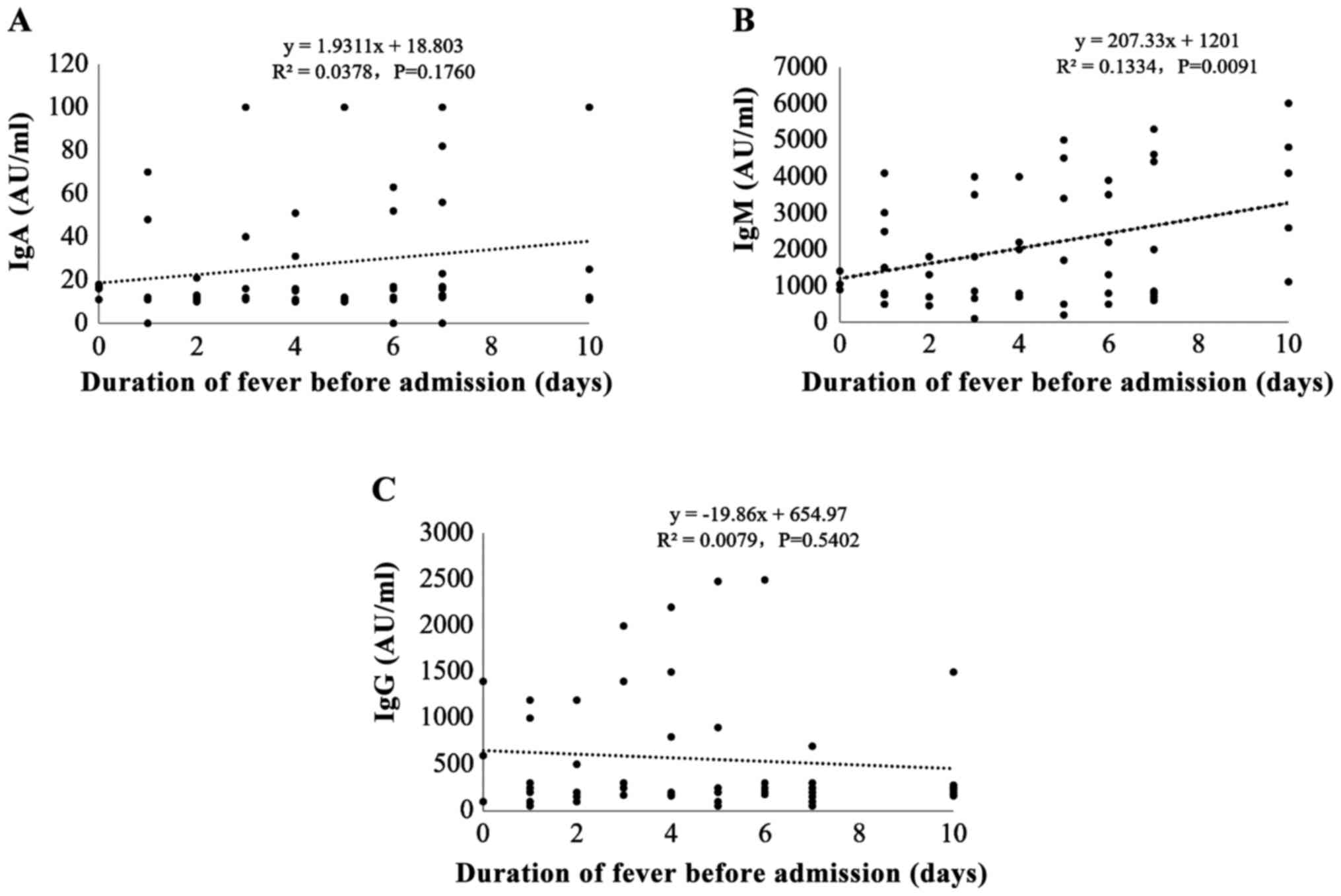
To investigate the correlation between M.
pneumoniae IgM potency and pre-hospital fever duration, we
divided the patients into three groups according to the duration of
fever before admission: ⅰ) 0–3 days, ⅱ) 4–6 days, and ⅲ) 7–10 days.
Most children (40%; 32/80) had <3 days of fever before
admission; 27 patients (33.8%) had 4–6 days of pre-hospital fever;
and 21 patients (26.3%) had 7–10days of pre-hospital fever. The
results showed that the potency of M. pneumoniae IgM, but
not IgA or IgG, was positively correlated with pre-hospital fever
duration (r=0.377, P=0.002) (Fig.
1).
M. pneumoniae patients show a higher
positive rate for IgM
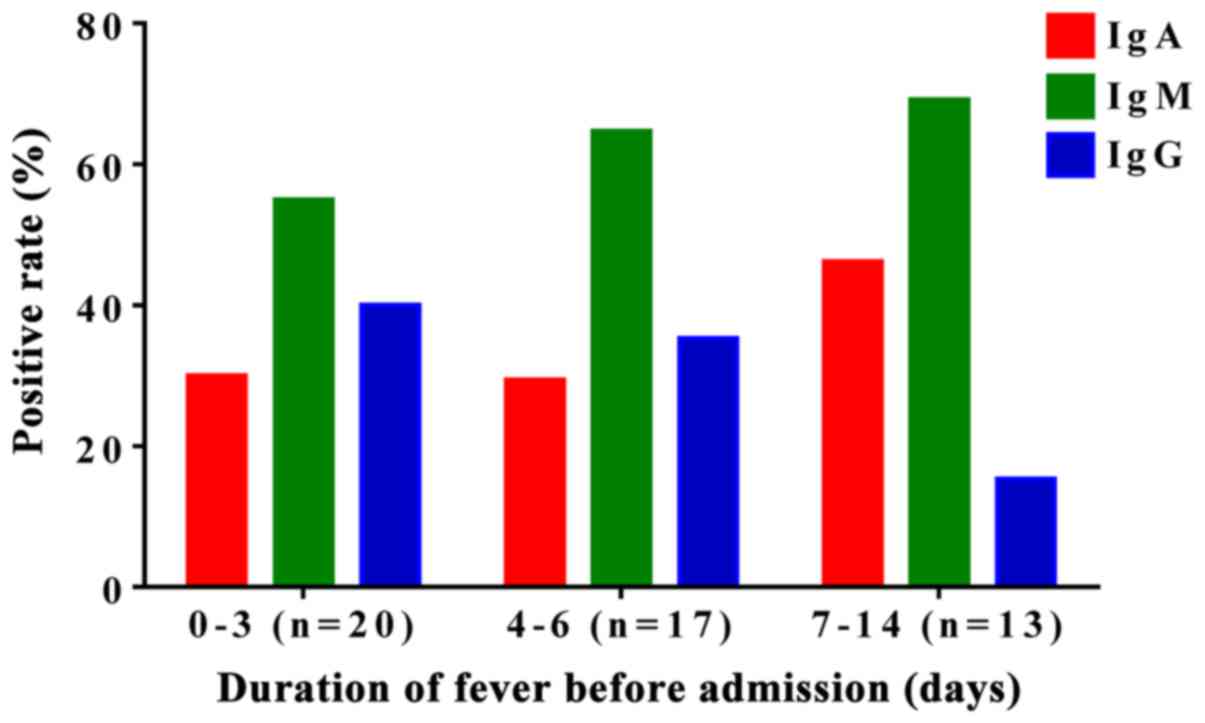
The positive rates for anti-M. pneumoniae
IgA, IgM, and IgG were 33.8 (27/80), 63.8 (51/80) and 32.5%
(26/80), respectively, in the 80 newborns before admission. IgA and
IgM showed relatively higher positive rate. In addition, the
positive rates of M. pneumoniae IgM were higher than those
of M. pneumoniae IgA in all groups (Fig. 2), indicating that anti-M.
pneumoniae IgM had a higher positive rate than that of
anti-M. pneumoniae IgA in the diagnosis of neonatal
mycoplasma-associated pneumonia.
Two sera test of the patients with
clinical symptoms and M. pneumoniae IgM negative
To compare the cumulative positive rates of M.
pneumoniae IgA, IgM, and IgG, we compared the values within 14
days after admission. We collected blood samples at different time
points before and after admission. The samples were divided into 5
groups according to the time of sampling: ⅰ) the day of admission,
ⅱ) 2–4 days after admission, ⅲ) 5–7 days after admission, ⅳ) 8–10
days after admission, and ⅴ) 11–14 days after admission. The
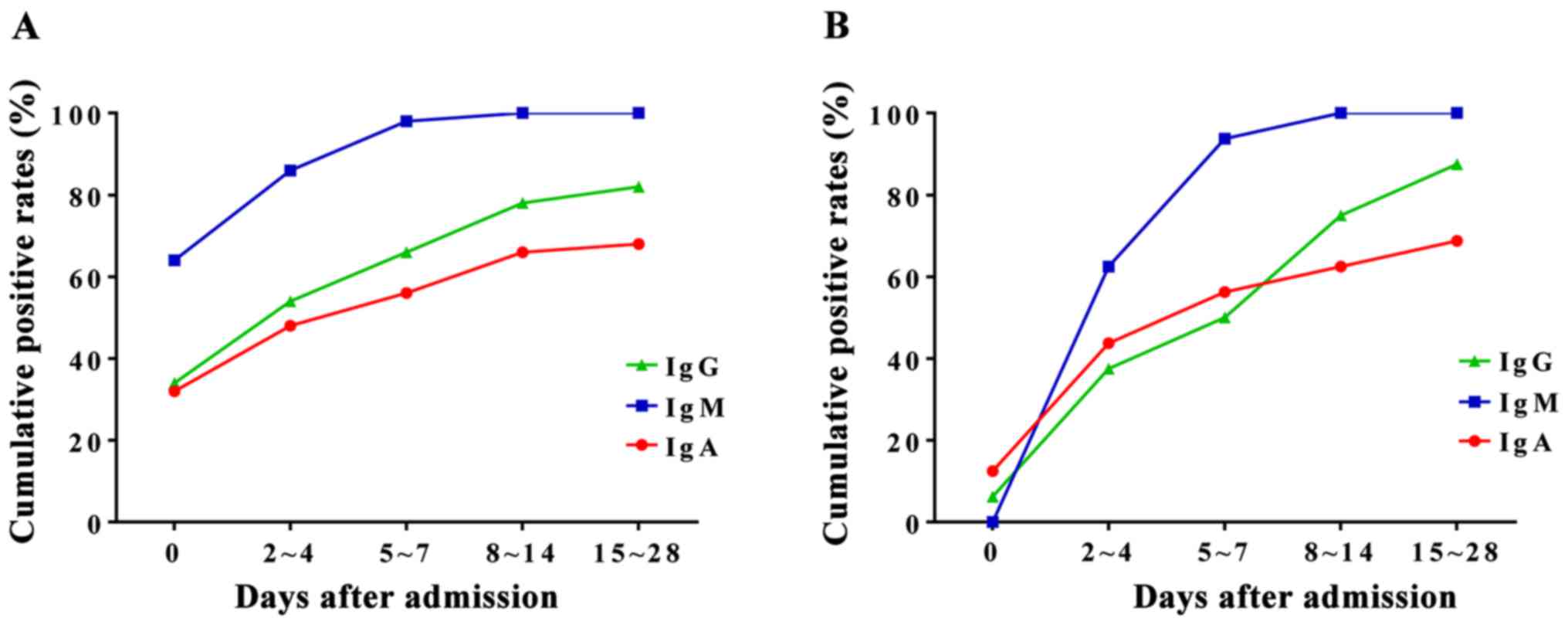
initial positive rate of M. pneumoniae IgM was 63.8% (51/80)
(Fig. 3A). The cumulative positive
rates of M. pneumoniae IgM in groups 2 and 3 were 85.0 and
97.5%, respectively (Fig. 3A). Serum
M. pneumoniae IgM for 26 cases (32.5%) turned positive one
week after admission. These results suggest that it is necessary to
collect double serum for patients with clinical symptoms, but
initially negative for anti-M. pneumoniae IgM. In addition,
the results also showed that the cumulative positive rate of serum
M. pneumoniae IgM was higher than that of IgA.
Of the 80 children, 26 (32.5%) cases had serum M.
pneumoniae IgM negative at admission and turned positive two
weeks after admission. Of these 26 patients, 4 (15.4%) had initial
serum M. pneumoniae IgA positive. However, the positive rate
of serum M. pneumoniae IgM was higher than that of IgA in
all patients 2–4 days after admission (61.5 vs. 46.2%) (Fig. 3B), indicating the importance of two
sera tests in the clinical diagnosis.
Discussion
The course of mycoplasma infection is often
relatively long. In adults, M. pneumoniae can still exist
one week after medical treatment (8). Our results showed that most newborns
with mycoplasma-associated pneumonia were admitted to the hospital
within one week (4.3±2.7 days) after M. pneumoniae
infection. The possible explanation is that fever is the main
clinical symptoms in children, but persistent cough is the typical
symptom in adults. Compared with adults, newborns with infection
can be admitted earlier to hospital. Our results showed that many
children (21/80, 26.3%) were negative for M.
pneumoniae-specific antibodies at admission. To avoid false
negatives, two serum samples were used to test M. pneumoniae
IgA, IgM and IgG after admission.
Previous studies reported that serum anti-M.
pneumoniae IgA is a good indicator for the detection of M.
pneumoniae infection in adults (10–12).
Detection of serum M. pneumoniae IgA in adults is more
sensitive for the diagnosis of M. pneumoniae infection than
detection of IgM (8). However, this
conclusion is inconsistent with the results reported by Yamazaki
et al (9) who found that
serum M. pneumoniae IgA was a poor indicator of M.
pneumoniae infection. Here, we examined the efficacy of M.
pneumoniae IgA in the diagnosis of neonatal
mycoplasma-associated pneumonia. The positive rates of serum M.
pneumoniae IgM and IgA were 63.8 and 33.8%, respectively, on
the day of admission. These rates were positively correlated with
the duration of fever before admission. We also found that the
positive rate of serum M. pneumoniae IgM was higher than
that of IgA in all the groups classified by pre-hospitalization
fever duration, suggesting that detection of serum M.
pneumoniae IgA is less sensitive than IgM in the diagnosis of
neonatal mycoplasma-associated pneumonia. This may be explained by
the immature immune system of newborns.
In our study, the positive rate of M.
pneumoniae IgM was 63.8% in patients with an average duration
of 4.3±2.7 days before admission. This result is consistent with a
previous report (13). That is, the
positive rate of M. pneumoniae IgM was 62.2% in the first
week after mycoplasma infection and ranged from 70.9 to 81.8% in
the second week after infection (14,15). The
sensitivity of serological testing is limited by the specimen, the
standard diagnostic method and the method of detection. This may be
used to explain the high sensitivity of M. pneumoniae IgM in
patients with longer hospitalization. We found that the positive
rate of M. pneumoniae IgA was positively correlated with the
pre-hospitalization fever duration, although this correlation was
lower than the correlation between IgM and pre-hospitalization
fever duration.
The 4-fold increase of M. pneumoniae IgG in
the acute phase and the reversion of the disease is considered the
gold standard for diagnosis of M. pneumoniae respiratory
tract infection (16). Medjo et
al (14) reported that 90% of
the patients with 4-fold increase of M. pneumoniae IgG
antibody potency in two sera also showed throat swab M.
pneumoniae positive in PCR detection. While Ma et al
(15) reported that only 2.4% of the
patients with a four-fold increase of M. pneumoniae IgG
antibody potency in two sera also showed throat swab M.
pneumoniae positive. However, 38.8% of patients in this study
had a 4-fold increase in M. pneumoniae IgG antibody potency
in two sera. Thus, anti-M. pneumoniae IgG cannot provide a
timely diagnosis of M. pneumoniae infection. Given the
complications of obtaining two sera from newborns, M.
pneumoniae IgG is not the best indicator to diagnose M.
pneumoniae infection.
In conclusion, detection of M. pneumoniae IgM
has higher sensitivity in the diagnosis of neonatal
mycoplasma-associated pneumonia than that of the detection of M.
pneumoniae IgA. Two sera detection can more effectively improve
the diagnostic accuracy.
References
|
1
|
Ali NJ, Sillis M, Andrews BE, Jenkins PF
and Harrison BD: The clinical spectrum and diagnosis of Mycoplasma
pneumoniae infection. Q J Med. 58:241–251. 1986.PubMed/NCBI
|
|
2
|
Bradley JS and Jackson MA: Committee on
Infectious Diseases; American Academy of Pediatrics: The use of
systemic and topical fluoroquinolones. Pediatrics. 128:e1034–e1045.
2011. View Article : Google Scholar : PubMed/NCBI
|
|
3
|
Pereyre S, Goret J and Bébéar C:
Mycoplasma pneumoniae: Current knowledge on macrolide resistance
and treatment. Front Microbiol. 7:9742016. View Article : Google Scholar : PubMed/NCBI
|
|
4
|
Wu PS, Chang LY, Lin HC, Chi H, Hsieh YC,
Huang YC, Liu CC, Huang YC and Huang LM: Epidemiology and clinical
manifestations of children with macrolide-resistant Mycoplasma
pneumoniae pneumonia in Taiwan. Pediatr Pulmonol. 48:904–911. 2013.
View Article : Google Scholar : PubMed/NCBI
|
|
5
|
Wu HM, Wong KS, Huang YC, Lai SH, Tsao KC,
Lin YJ and Lin TY: Macrolide-resistant Mycoplasma pneumoniae in
children in Taiwan. J Infect Chemother. 19:782–786. 2013.
View Article : Google Scholar : PubMed/NCBI
|
|
6
|
Sillis M: The limitations of IgM assays in
the serological diagnosis of Mycoplasma pneumoniae infections. J
Med Microbiol. 33:253–258. 1990. View Article : Google Scholar : PubMed/NCBI
|
|
7
|
Thacker WL and Talkington DF: Analysis of
complement fixation and commercial enzyme immunoassays for
detection of antibodies to Mycoplasma pneumoniae in human serum.
Clin Diagn Lab Immunol. 7:778–780. 2000.PubMed/NCBI
|
|
8
|
Granström M, Holme T, Sjögren AM, Ortqvist
A and Kalin M: The role of IgA determination by ELISA in the early
serodiagnosis of Mycoplasma pneumoniae infection, in relation to
IgG and mu-capture IgM methods. J Med Microbiol. 40:288–292. 1994.
View Article : Google Scholar : PubMed/NCBI
|
|
9
|
Yamazaki T, Narita M, Sasaki N, Kenri T,
Arakawa Y and Sasaki T: Comparison of PCR for sputum samples
obtained by induced cough and serological tests for diagnosis of
Mycoplasma pneumoniae infection in children. Clin Vaccine Immunol.
13:708–710. 2006. View Article : Google Scholar : PubMed/NCBI
|
|
10
|
Lieberman D, Lieberman D, Ben-Yaakov M,
Shmarkov O, Gelfer Y, Varshavsky R, Ohana B, Lazarovich Z and
Boldur I: Serological evidence of Mycoplasma pneumoniae infection
in acute exacerbation of COPD. Diagn Microbiol Infect Dis. 44:1–6.
2002. View Article : Google Scholar : PubMed/NCBI
|
|
11
|
Lieberman D, Lieberman D, Korsonsky I,
Ben-Yaakov M, Lazarovich Z, Friedman MG, Dvoskin B, Leinonen M,
Ohana B and Boldur I: A comparative study of the etiology of adult
upper and lower respiratory tract infections in the community.
Diagn Microbiol Infect Dis. 42:21–28. 2002. View Article : Google Scholar : PubMed/NCBI
|
|
12
|
Watkins-Riedel T, Stanek G and Daxboeck F:
Comparison of SeroMP IgA with four other commercial assays for
serodiagnosis of Mycoplasma pneumoniae pneumonia. Diagn Microbiol
Infect Dis. 40:21–25. 2001. View Article : Google Scholar : PubMed/NCBI
|
|
13
|
Chang HY, Chang LY, Shao PL, Lee PI, Chen
JM, Lee CY, Lu CY and Huang LM: Comparison of real-time polymerase
chain reaction and serological tests for the confirmation of
Mycoplasma pneumoniae infection in children with clinical diagnosis
of atypical pneumonia. J Microbiol Immunol Infect. 47:137–144.
2014. View Article : Google Scholar : PubMed/NCBI
|
|
14
|
Medjo B, Atanaskovic-Markovic M, Radic S,
Nikolic D, Lukac M and Djukic S: Mycoplasma pneumoniae as a
causative agent of community-acquired pneumonia in children:
Clinical features and laboratory diagnosis. Ital J Pediatr.
40:1042014. View Article : Google Scholar : PubMed/NCBI
|
|
15
|
Ma YJ, Wang SM, Cho YH, Shen CF, Liu CC,
Chi H, Huang YC, Huang LM, Huang YC, Lin HC, et al: Taiwan
Pediatric Infectious Disease Alliance: Clinical and epidemiological
characteristics in children with community-acquired mycoplasma
pneumonia in Taiwan: A nationwide surveillance. J Microbiol Immunol
Infect. 48:632–638. 2015. View Article : Google Scholar : PubMed/NCBI
|
|
16
|
Gavranich JB and Chang AB: Antibiotics for
community acquired lower respiratory tract infections (LRTI)
secondary to Mycoplasma pneumoniae in children. Cochrane Database
Syst Rev. 3:CD0048752005.
|