Introduction
Gastrointestinal (GI) bleeding usually originates
from peptic ulcers, acute gastric mucosal lesions, esoghageal
varices second to hepatic cirrhosis and primary digestive system
neoplasms. However, some potent asymptomatic diseases of the blood
system manifesting as GI hemorrhage may be clinically ignored. The
incidence of gastrointestinal bleeding has been reported as 10–30%
of patients with neoplastic diseases of the hematopoietic organ
(1). The pathogenesis of
gastrointestinal bleeding in these diseases is usually
multifactorial and may be caused by direct malignant hematopoietic
cell infiltrations, mucosal changes ensuing from bone marrow
suppression, immunodeficiency states, infections due to various
organisms, or preceding peptic ulcers (1).
Multiple myeloma (MM), also known as plasma cell
myeloma, is a malignant hematological neoplasm, characterized by
clonal proliferation of plasma cells in the bone marrow and
associated with the overproduction of structurally homogeneous
immunoglobulins. Anemia, renal failure, skeletal destruction,
recurrent infections and hypercalcemia are the most common features
of the disease. New diagnostic criteria of MM require the presence
of at least 10% plasma cells on examination of the bone marrow (or
biopsy of tissue with monoclonal plasma cells), monoclonal protein
in the serum or urine, and evidence of end-organ damage (2). Clinicopathological studies
demonstrated that clinically apparent extraosseous manifestations
were present in less than 5% of patients with MM. Liver, spleen and
lymph nodes were the most frequent sites of occurrence in
approximately two-thirds of these patients, while central nervous
system, kidney, skin, pleura, lung, testes, pancreas, thyroid,
adrenal glands and omental involvement had also been revealed
(3). Involvement of the GI system,
particularly demonstrating with GI hemorrhage, in the course of MM
is extremely rare.
In this report we describe a case which was finally
diagnosed as MM, but was initially manifested as gastrointestinal
hemorrhage. We also present a thorough review of the literature
with regard to the association between MM and GI bleeding. The
study was approved by the Ethics Committee of Taizhou People’s
Hospital, Jiangsu, China. Written informed consent was obtained
from the patient.
Case report
A 47-year-old male was admitted to the Taizhou
People’s Hospital (Jiangsu, China) with a two year history of
recurrent hematochezia. Two days prior to admission, the patient’s
symptoms deteriorated with three times the normal blood stool
passage. The patient also felt dizzy and experienced palpitations.
In April and July 2012, the patient experienced two instances of
hematochezia, and at that time, ulcers were identified in the
stomach and duodenum through a gastroscopy. Meanwhile, colorectal
polyps were identified through a colonoscopy and gastrointestinal
barium imaging revealed a normal small intestine. Following acid
suppression therapy, the patient’s stool recovered to normal, and
surgery was conducted five years ago to treat the intestinal
obstruction.
Upon physical examination, the positive signs
included the anemic appearance and a surgical scar on the left side
of the abdomen.
At the initial examination, laboratory results were
as follows: red blood cells, 1.87 × 10¹²/l (4–5.5 ×
1012/l); hemoglobin, 102 g/l (120–160 g/l); white blood
cells, 5.35 × 10⁹/l (4–10×109/l); platelets,
242 × 109/l (100–300 × 109/l); and
erythrocyte sedimentation rate (ESR), 125 mm/h (10–20 mm/h).
Biochemical examination revealed the following results: total serum
protein, 123.1 g/l (66–87 g/l); albumin, 25.6 g/l (35–54 g/l);
globulin, 97.5 g/l (20–40 g/l); IgG, 82.4 g/l (8–17 g/l); IgA, 0.23
g/l (0.7–4.0 g/l); and IgM, 0.34 g/l (0.4–2.3 g/l). Lactate
dehydrogenase (LDH), electrolytes, glucose, fat and renal function
tests were all normal, and the Bence-Jones protein was not detected
in the patient’s urine.
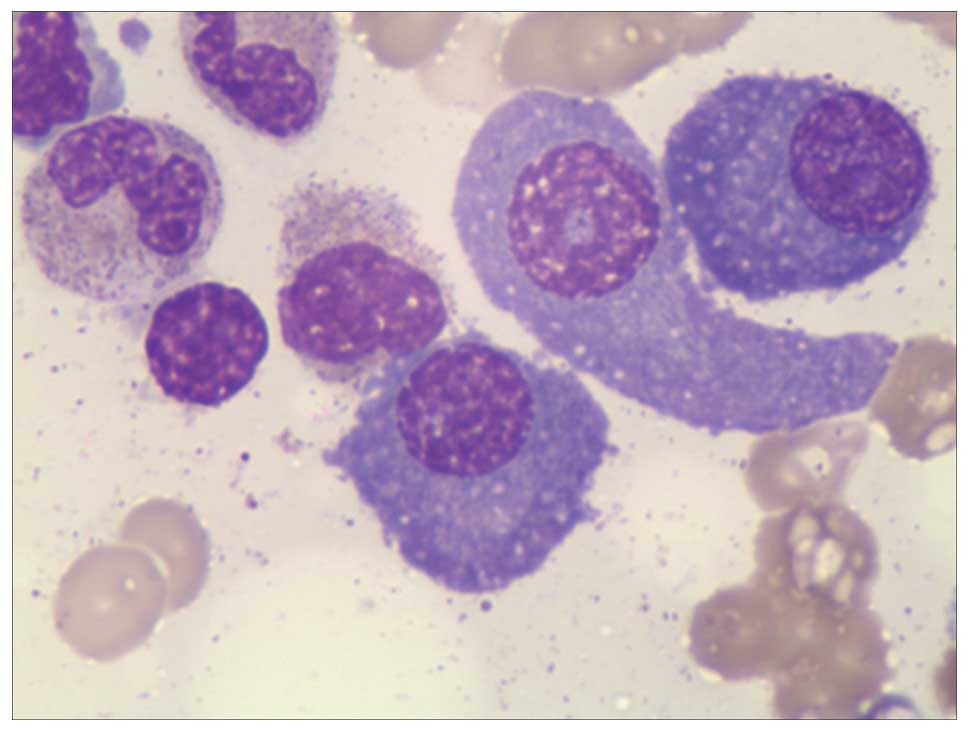
In the bone marrow aspirate, 20% plasma cells were
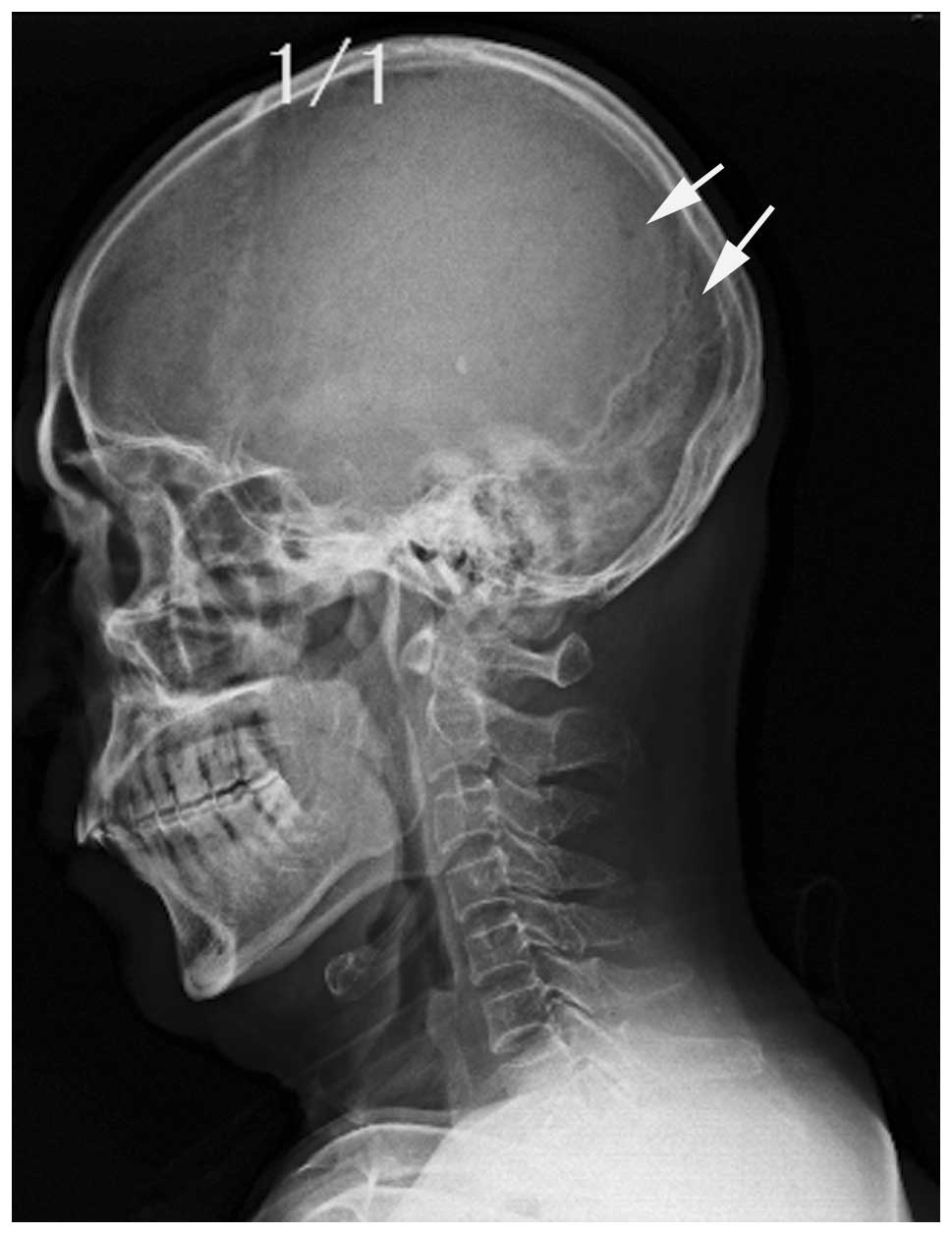
identified (Fig. 1). A plain
radiogram, shown in Fig. 2,
revealed that multiple lytic lesions were present in the skull,
while diffuse osteoporosis was present in the ilium, pubis and
sciatic and degeneration was present in the thoracic and lumbar
vertebra. Furthermore, the capsule endoscopy revealed edema in the
gastric mucosa and an ulcer in the duodenum. A gastroscopy and
colonoscopy identified no active hemorrhage in the digestive tract.
Thus, according to the diagnostic criteria, this patient was
finally diagnosed as MM, IgG type, grade III.
Following diagnosis, the patient received systemic
chemotherapy with mephalan, prednisone and oral thalidomide, and
acquired partial remission. Following 6 months of therapy, bone
marrow aspiration revealed that the number of plasma cells was less
than 5%, and globulin and IgG decreased to 64 g/l and 53 g/l,
respectively. To date, no GI bleeding has occurred.
Discussion
MM is the second most prevalent hematological
malignancy, representing 2% of all cancer mortalities (4). Although usually restricted to the bone
marrow, extramedullary involvement of this disease can occur in up
to 20% of cases. The most common extramedullary site is the upper
respiratory tract, including the oropharynx, nasopharynx, nasal
cavities, sinuses and larynx (2,5). Cases
of MM with GI features are uncommon. Some clinical manifestations
have identified nausea, vomiting and colic in 20% of cases, but
hematemesis and melena, in contrast to bleeding from the nose and
gums, are rare. The marked infrequency of GI hemorrhage in MM may
easily lead the clinician to make an erroneous diagnosis of common
peptic ulcer or gastric neoplasm, carcinoma or lymphoma. To the
best of our knowledge, only a few cases corresponding to GI
bleeding in MM have previously been published.
GI bleeding has been identified in 10–30% of
patients with neoplastic diseases of the hematopoietic organ,
including MM. Talamo et al(6) identified 24 patients with involvement
of the GI system documented in a database of 2,584 patients with MM
of which only two cases presented with GI hemorrhage. Through
reviewing the limited literatures associated with GI hemorrhage in
MM patients, we speculate that the potent pathogenesis of GI
bleeding in MM through several pathways including direct plasma
cell infiltrations in the form of plasmacytomas, amyloid
infiltration of the gut wall resulting in increased capillary
fragility, platelet or coagulation abnormalities, and preceding
peptic ulcers may sometimes be secondary to treatment with
anti-inflammatory medications and corticosteroids.
Daram et al(7) reported a case of a 53-year-old female
diagnosed with MM in 2005. The patient presented with acute upper
GI bleeding in the form of hematemesis, and underwent chemotherapy
and stem cell transplantation. An emergent
esophagogastroduodenoscopy identified a multilobulated, submucosal
mass on the proximal corpus along the greater curvature, and a
small erosion on the lateral wall of the second portion of
duodenum. Further biopsies revealed dense submucosal infiltrates of
highly atypical plasmacytic cells in the stomach and duodenum.
Additionally, Vicuña Arregui et al(8) and Suvannasankha et al(9) previously demonstrated that
plasmacytomas were present in cases with MM. Amyloid was identified
in other studies, which revealed another etiology of GI bleeding in
MM patients. Chang et al(10) revealed a case of MM presenting with
episodes of coffee-ground vomitus or massive hematochezia. A tissue
biopsy taken at the irregular mucosa beside the protruding vessels
in the duodenum, confirmed the diagnosis of GI amyloidosis. Alvares
et al(11) also reported the
case of a 45-year-old female who presented with hematemesis.
Further endoscopy identified nodular lesions and ulcers in the
gastric antrum, and histology of the lesions confirmed the
diagnosis of amyloidosis. Maza et al (12) reported an uncommon case of rectal
bleeding and anemia with polypoid lesions and ulcerations in the
colon, as the presenting symptom of amyloidosis and light chain MM.
All of these cases mentioned above demonstrated the absence of
systemic symptoms of amyloidosis, and non-specific endoscopic
findings may make diagnosis difficult. Therefore, we recommend that
a diagnosis of amyloidosis-induced GI bleeding should be considered
in patients with MM with an obscure hemorrhage. Abnormal
hemostasis, specifically the imbalance in function of all major
components of the coagulation cascade, may increase the risk of
bleeding in patients with MM. DiMinno et al(13) suggest that bleeding occurring in
dysproteinemia may be the result of a specific interaction of
monoclonal paraproteins with platelets. Saif et al(14) considered that patients with MM may
develop bleeding diathesis secondary to a variety of mechanisms.
One such mechanism is direct inhibition of fibrin monomer
aggregation due to the paraprotein, resulting in prolongation of
the thrombin and replitase time.
Finally, the most common etiology may be peptic
ulcer, which is usually secondary to treatment with
anti-inflammatory medications and corticosteroids. In 2006, Dawson
et al(15) reported a case
of a 60-year-old female with MM relapse. The patient presented with
hematemesis and melena following salvage chemotherapy with
dexamethasone, cyclophosphamide, etoposide and cisplatin, and
rescue therapy with single-agent bortezomib. However, in contrast
to the cases mentioned above, in the present study, the patient
manifested with recurrent GI hemorrhage. The only positive
signature was the duodenal ulcer and focus mucosal lesion in a
small bowl, without evidence of plasma cell infiltration or
amyloidosis, following tissue biopsy. Furthermore, no fatigue, bone
pain or recurrent infections were observed, while hyperproteinemia
and reversal of the albumin/globulin ratio was identified during
the period of present medical history, which fulfilled the criteria
for asymptomatic myeloma (16).
Additionally, prior to the patient’s hematochezia, no non-steroidal
anti-inflammatory drugs (NSAIDS) or corticosteroids were
administrated and no abnormal hemostasis was identified in
laboratory examinations. Thus, primary GI hemorrhage probably
attributed to duodenal ulcers and mucosal erosion complicated with
MM could explain this case. Following systemic chemotherapy with
mephalan and prednisone complying with administration of antacid
therapy, the patient acquired partial remission and no recurrence
of GI hemorrhage was observed. As a result, since no evidence of
related end-organ damage was present, atypical myeloma should be
paid more attention during our clinical diagnosis and treatment
process.
In conclusion, MM is a systemic disease which may be
rarely presented with GI involvement. It should be kept in mind
that recurrent GI bleeding is difficult to explain through complete
GI work-up using endoscopy, CT-scanning or MRI; thus, it may be
related to certain hematopoietic neoplasms, particularly the
asymptomatic myeloma involvement, and these patients should be
examined further. Furthermore, early diagnosis of this disease has
advantages of identifying preceding peptic ulcers and other lesions
in the GI tract, as well as providing prophylactic steps to the GI
mucosa, which is vulnerable to hemorrhage and further
chemotherapy.
References
|
1
|
Yoshida T: Complicated gastrointestinal
bleeding of neoplastic diseases of the hematopoietic system. Nihon
Rinsho. 56:2405–2410. 1998.(In Japanese).
|
|
2
|
Kyle RA and Rajkumar SV: Multiple myeloma.
N Engl J Med. 3518:1860–1873. 2004. View Article : Google Scholar
|
|
3
|
Kapadia SB: Multiple myeloma: A
clinicopathologic study of 62 consecutively autopsied cases.
Medicine. 59:380–392. 1980. View Article : Google Scholar : PubMed/NCBI
|
|
4
|
Cherpanath TGV, Nieuwdorp M, Hazenberg MD,
et al: Large nocturnal eyes causing gastrointestinal bleeding in
asymptomatic multiple myeloma. Neth J Med. 68:324–327.
2010.PubMed/NCBI
|
|
5
|
Dolin S and Dewer JP: Extramedullary
plasmacytoma. Am J Pathol. 32:83–103. 1956.
|
|
6
|
Talamo G, Cavallo F, Zangari M, et al:
Clinical and biological features of multiple myeloma involving the
gastrointestinal system. Haematologica. 91:964–967. 2006.PubMed/NCBI
|
|
7
|
Daram SR, Paine ER and Swingley AF: Upper
gastrointestinal bleeding in a patient with multiple myeloma.
Gastroenterology. 142:e8–e9. 2012. View Article : Google Scholar : PubMed/NCBI
|
|
8
|
Vicuña Arregui M, Borobio Aguilar E, Vila
Costas JJ, et al: Gastric plasmacytoma as an uncommon cause of
upper gastrointestinal bleeding. Gastroenterol Hepatol. 31:217–220.
2008.(In Spanish).
|
|
9
|
Suvannasankha A, Abonour R, Cummings OW
and Liangpunsakul S: Gastrointestinal plasmacytoma presenting as
gastrointestinal bleeding. Clin Lymphoma Myeloma. 8:309–311. 2008.
View Article : Google Scholar : PubMed/NCBI
|
|
10
|
Chang SS, Lu CL, Tsay SH, et al:
Amyloidosis-induced gastrointestinal bleeding in a patient with
multiple myeloma. J Clin Gastroenterol. 32:161–163. 2001.
View Article : Google Scholar : PubMed/NCBI
|
|
11
|
Alvares JF, Thomas J, Ramakrishna K, et
al: Multiple myeloma with amyloidosis presenting with recurrent
gastrointestinal bleeding. Indian J Gastroenterol.
22:1962003.PubMed/NCBI
|
|
12
|
Maza I, Vlodavsky E and Eliakim RA: Rectal
bleeding as a presenting symptom of AL amyloidosis and multiple
myeloma. World J Gastrointest Endosc. 2:44–46. 2010. View Article : Google Scholar : PubMed/NCBI
|
|
13
|
DiMinno G, Coraggio F, Cerbone AM, et al:
Myeloma paraprotein with specificity for platelet glycoprotein ilia
in a patient with a fatal bleeding disorder. J Clin Invest.
77:157–164. 1986. View Article : Google Scholar : PubMed/NCBI
|
|
14
|
Saif MW, Allegra CJ and Greenberg B:
Bleeding diathesis in multiple myeloma. J Hematother Stem Cell Res.
10:657–660. 2001. View Article : Google Scholar : PubMed/NCBI
|
|
15
|
Dawson MA, Polizzotto MN, Gordon A, et al:
Extramedullary relapse of multiple myeloma presenting as
hematemesis and melena. Nat Clin Pract Oncol. 3:223–226. 2006.
View Article : Google Scholar : PubMed/NCBI
|
|
16
|
Kyle RA and Rajkumar SV: Criteria for
diagnosis, staging, risk stratification and response assessment of
multiple myeloma. Leukemia. 23:3–9. 2009. View Article : Google Scholar : PubMed/NCBI
|