Introduction
Small cell lung cancer (SCLC), commonly classified
by the Veterans Administration Lung Cancer Study Group as Limited
stage and Extensive stage groups, constitutes ∼15% of all lung
cancer cases and is strongly associated with cigarette smoking
(1–3). The prognosis of SCLC, which has been
associated with extent of disease and other factors, is poor,
whereas the life expectancy of those with untreated SCLC is ∼3.5
months for the limited stage group and 6 weeks for the extensive
stage group (4–6). Although genetic factors have been
identified as prognostic factors for SCLC, the underlying mechanism
of this cancer remains unknown (7–9).
MicroRNAs (miRNAs) are RNA molecules that are ∼22
nucleotides long and are involved in various biological processes,
such as embryonic development, cell differentiation, proliferation,
apoptosis, cancer development and insulin secretion (10,11).
More than 700 miRNAs have been identified in humans and these
miRNAs are responsible for regulating at least 30% of
protein-coding gene expressions (12). A growing body of evidence suggests
that miRNAs play important roles in a broad range of biological
processes, as previously mentioned (9–11). In
the miRNA processing, long primary transcripts of miRNAs
(pri-miRNAs) are processed in the nucleus by RNase III
Drosha and transported to the cytoplasm by the nuclear
transport factor exportin-5 (XPO5) and RAN. In the
cytoplasm, RNase III Dicer and transactivation-responsive
RNA-binding protein (TRBP) mediate the processing of pre-miRNAs in
order to release a 21-bp dsRNA. Additionally, the RNA-induced
silencing complex (RISC) including GEMIN3 and GEMIN4
selects a single strand as the mature miRNA and guides the mature
miRNAs to their target mRNA sites (10,13–16).
miRNA-related single nucleotide polymorphisms (miR-SNPs), defined
as SNPs in miRNA genes, miRNA binding site and miRNA processing
machinery, are able to modulate miRNA and target gene expressions
in order to influence cancer risk, treatment efficacy and patient
prognosis (9,17–20).
A miR-SNP of rs11077 located in the 3′UTR of the
miRNA processing gene XPO5 has shown its association with
the chemotherapeutic response in metastatic colon cancer as well as
recurrence in resected non-small cell lung cancer (NSCLC) (9,19). In
the present study, we evaluated the predictive power of this SNP on
the overall survival of SCLC patients.
Materials and methods
Tissue specimens and DNA extraction
Blood samples were collected at the Fourth Hospital
of Hebei University from 42 SCLC patients who received treatment in
the Department of Respiratory Medicine between 2005 and 2009. The
genomic DNA was immediately extracted using the Wizard Genomic DNA
extraction kit (Promega, Madison, WI, USA) and stored at −20°C. The
procedures were supervised and approved by the Human Tissue
Research Committee at the hospital and informed consent was
obtained from all 42 participants.
Genotyping of miR-SNPs
The miR-SNP rs11077 of the miRNA processing genes
XPO5 was genotyped using the LDR method with the primers:
forward: 5′-GAATCTGG TCACCTGATGGGA-3′ and reverse: 5′-GTGCCTGAGTG
GACCTTGAG-3′, in order to amplify the DNA fragments flanking
miR-SNPs based on the NCBI SNP database (http://www.ncbi.nlm.nih.gov/snp/). PCR was performed
using a PCR master mix kit according to the manufacturer’s
instructions (Promega). The ligation was performed using the
different probes: S1: 5′-GTACCTCCAAGGACCAGGGCTGGGA-3′ or S2:
5′-TTTGTACCTCCAAGGACCAGGGCTGGGC-3′ matched to the alleles of
miR-SNPs. The S1 or S2 probe was ligated with S3:
5′-AGTCTTTAGTGCTAACATCCCCTTT-3′ downstream of the SNP site, and the
ligated products were separated using the ABI Prism Genetic
Analyzer 3730xl (Applied Biosystems, Foster City, CA, USA).
Polymorphisms were confirmed based on a 3 bp length difference of
ligated products.
Statistical analysis
Survival curves were calculated using the
Kaplan-Meier method, and comparisons between the curves were made
using the log-rank test. Multivariate survival analysis was
performed using a Cox proportional hazards model. The statistical
analyses were performed using the SPSS 18.0 software package (SPSS,
Inc., Chicago, IL, USA). P<0.05 was considered to indicate a
statistically significant difference.
Results
Analysis of clinical characteristics with
overall survival
A total of 42 patients enrolled in this study were
reviewed every 3 months for 2 years. The associations between
two-year survival data and clinical characteristics were compared
by the univariate and multivariate analysis in SCLC patients. Age
and smoking status were identified as independent predictors for
SCLC survival using the Cox proportional hazards model (Table I).
 | Table I.Univariate and multivariate analysis
of clinical factors associated with small cell lung cancer
survival. |
Table I.
Univariate and multivariate analysis
of clinical factors associated with small cell lung cancer
survival.
| Factors | No. of cases | 2-year survival rate
(%) | Univariate analysis
| Multivariate analysis
|
|---|
| P-value | RR | 95% CI | P-value |
|---|
| Age (years) | | | 0.122 | 1.269 | 0.611–2.634 | 0.523 |
| ≤60 | 26 | 26.9 | | | | |
| >60 | 16 | 18.8 | | | | |
| Gender | | | 0.113 | 0.167 | 0.047–0.588 | 0.005 |
| Male | 28 | 14.3 | | | | |
| Female | 14 | 42.9 | | | | |
| VALSG
classification | | | 0.229 | 1.410 | 0.691–2.876 | 0.345 |
| Limited | 19 | 26.3 | | | | |
| Extensive | 23 | 21.7 | | | | |
| Smoking | | | 0.771 | 3.581 | 1.110–11.555 | 0.033 |
| Yes | 23 | 17.4 | | | | |
| No | 19 | 31.6 | | | | |
| Treatment | | | 0.506 | 1.037 | 0.519–2.072 | 0.919 |
| Chemotherapy | 18 | 22.2 | | | | |
| Combination | 24 | 25.0 | | | | |
| Genotype | | | 0.023 | 2.469 | 1.088–5.603 | 0.031 |
| AA | 33 | 27.3 | | | | |
| AC+CC | 9 | 11.1 | | | | |
Association of rs11077 with outcome of
SCLC
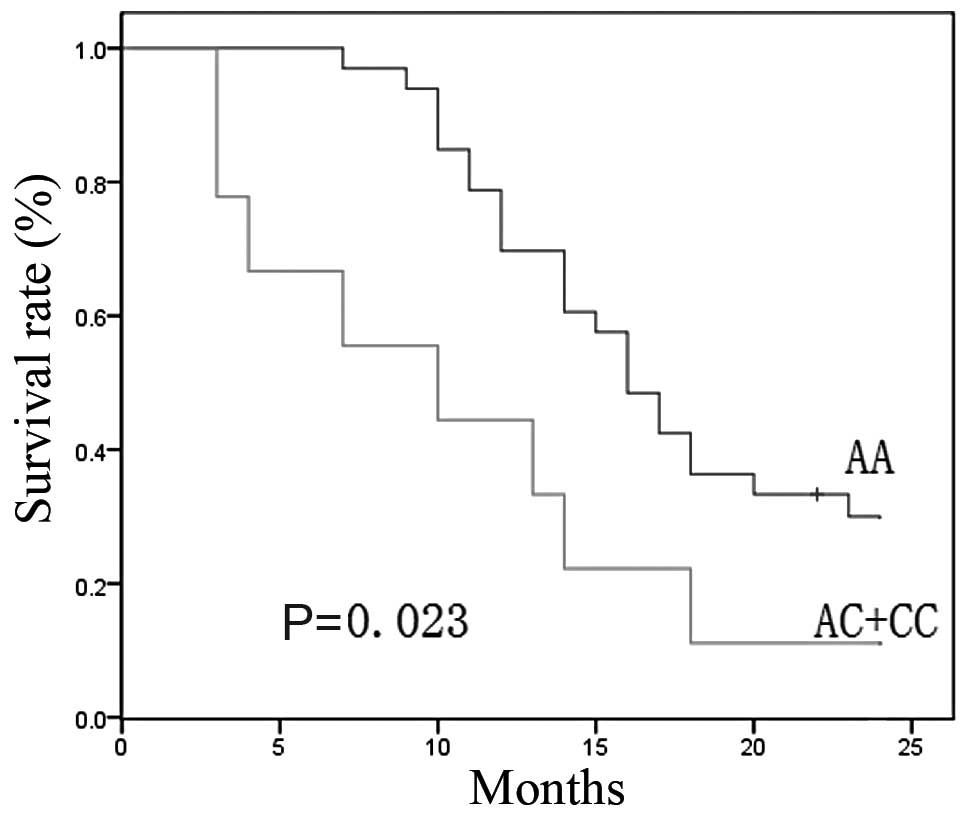
In total, 42 SCLC patients were genotyped for
rs11077. The rs11077 CC, AC and AA genotype frequencies were 1, 8
and 33, respectively. The SCLC patients were divided into two
groups on the basis of their rs11077 genotype, and their overall
survival curves were plotted using the Kaplan-Meier method. The
two-year survival rate of AC+CC and AA patients were 11.1 and
27.3%. A significant difference in overall survival was observed
between the two groups (Fig. 1).
Patients with the AA allele were associated with a significantly
longer survival time compared with that of AC+CC patients
(P=0.023).
A multivariate analysis with the Cox proportional
hazards model for clinical characteristics was performed. As shown
in Table I, the rs11077 SNP was
identified as an independent predictor for the overall survival of
SCLC patients (relative risk 2.649; 95% CI, 1.088–5.603;
P=0.031).
Discussion
The identification of predictive markers for tumor
outcome is a new field in cancer research. Investigations to
determine whether miRNA expression is associated with tumors has
attracted attention. The altered expression of a number of miRNAs
has been found to predict anticancer treatments (22). In previous reports (19), rs11077 has been identified to be
associated with recurrence in post-operative NSCLC patients. In the
present study, we report that the miR-SNP in miRNA processing
machinery genes of XPO5 are involved in the prognosis of
SCLC outcome.
XPO5 is found in the nuclear membrane and
mediates the transport of pre-miRNA in order to adjust the miRNA
expression (23). XPO5
inactivation resulted in reduced miRNA processing and decreased
miRNA target inhibition, while the restored XPO5 reverses
the impaired export of pre-miRNA (24). The miR-SNP of rs11077 of XPO5
has been identified for its association with the cancer risk of
esophageal cancer as well as the outcome of myeloma (20,25).
The mechanism of how this SNP affects SCLC survival remains
unclear. This finding suggests that SNP located in 3′UTR of
XPO5 may affect mRNA stability and is associated with an
altered expression of XPO5. The altered XPO5
expression may affect the expression of miRNAs, resulting in SCLC
survival.
Although miR-SNP studies for miRNA processing
machinery genes are at an early stage, our results are encouraging,
as they indicate that miR-SNPs affect cancer survival. However, the
results from this study require validation in other populations and
in laboratory-based functional studies. MicroRNAs have been
emphasized as a key factor in the susceptibility of patietns to the
therapeutic response in many complex diseases, including cancer
(26). In conclusion, a miR-SNP in
the 3′UTR region of XPO5 was found to be an independent
prognostic marker for survival of advanced SCLC patients.
References
|
1.
|
Adjei AA, Marks RS and Bonner JA: Current
guidelines for the management of small cell lung cancer. Mayo Clin
Proc. 74:809–816. 1999. View
Article : Google Scholar : PubMed/NCBI
|
|
2.
|
Simon GR and Wagner H: American College of
Chest Physicians. Small cell lung cancer. Chest. 123(Supp 1):
259S–271S. 2003. View Article : Google Scholar : PubMed/NCBI
|
|
3.
|
National Comprehensive Cancer Network:
National Comprehensive Cancer Network practice guidelines in
oncology v. 1.2007: small cell lung cancer. Available at:
http://www.nccn.org/professionals/physician_gls/PDF/sclc.pdfuri.
Accessed January 9, 2007.
|
|
4.
|
Hyde L, Yee J, Wilson R and Panto ME: Cell
type and the natural history of lung cancer. JAMA. 193:52–54. 1965.
View Article : Google Scholar : PubMed/NCBI
|
|
5.
|
Lassen U, Osterlind K, Hansen M,
Dombernowsky P, Bergman B and Hansen HH: Longterm survival in
small-cell lung cancer: posttreatment characteristics in patients
surviving 5 to 18+ years - an analysis of 1,714 consecutive
patients. J Clin Oncol. 13:1215–1220. 1995.PubMed/NCBI
|
|
6.
|
Rawson NS and Peto J: An overview of
prognostic factors in small cell lung cancer. A report from the
Subcommittee for the Management of Lung Cancer of the United
Kingdom Coordinating Committee on Cancer Research. Br J Cancer.
61:597–604. 1990. View Article : Google Scholar : PubMed/NCBI
|
|
7.
|
Knez L, Sodja E, Kern I, Košnik M and
Cufer T: Predictive value of multidrug resistance protein,
topoisomerases II and ERCC1 in small cell lung cancer: a systematic
review. Lung Cancer. 72:271–279. 2011. View Article : Google Scholar : PubMed/NCBI
|
|
8.
|
Kin YH, Ishii G, Goto K, Ota S, Kubota K,
Murata Y, Mishima M, Saijo N, Nishiwaki Y and Ochiai A: Expression
of the breast cancer resistance protein is associated with a poor
clinical outcome in patients with small-cell lung cancer. Lung
Cancer. 65:105–111. 2009. View Article : Google Scholar : PubMed/NCBI
|
|
9.
|
Ding C, Li R, Peng J, Li S and Guo Z: A
polymorphism at the miR-502 binding site in the 3′ untranslated
region of the SET8 gene is associated with the outcome of
small-cell lung cancer. Exp Ther Med. 3:689–692. 2012.
|
|
10.
|
Bartel DP: MicroRNAs: genomics,
biogenesis, mechanism, and function. Cell. 116:281–297. 2004.
View Article : Google Scholar : PubMed/NCBI
|
|
11.
|
Ambros V: The functions of animal
microRNAs. Nature. 431:350–355. 2004. View Article : Google Scholar : PubMed/NCBI
|
|
12.
|
Lewis BP, Burge CB and Bartel DP:
Conserved seed pairing, often flanked by adenosines, indicates that
thousands of human genes are microRNA targets. Cell. 120:15–20.
2005. View Article : Google Scholar : PubMed/NCBI
|
|
13.
|
Cullen BR: Transcription and processing of
human microRNA precursors. Mol Cell. 16:861–865. 2004. View Article : Google Scholar : PubMed/NCBI
|
|
14.
|
Lee Y, Ahn C, Han J, Choi H, Kim J, Yim J,
Lee J, Provost P, Rådmark O, Kim S and Kim VN: The nuclear RNase
III Drosha initiates microRNA processing. Nature.
425:415–419. 2003. View Article : Google Scholar : PubMed/NCBI
|
|
15.
|
Yi R, Qin Y, Macara IG and Cullen BR:
Exportin-5 mediates the nuclear export of pre-microRNAs and short
hairpin RNAs. Genes Dev. 17:3011–3016. 2003. View Article : Google Scholar : PubMed/NCBI
|
|
16.
|
Chendrimada TP, Gregory RI, Kumaraswamy E,
Norman J, Cooch N, Nishikura K and Shiekhattar R: TRBP recruits the
Dicer complex to Ago2 for microRNA processing and gene silencing.
Nature. 436:740–744. 2005. View Article : Google Scholar : PubMed/NCBI
|
|
17.
|
Ryan BM, Robles AI and Harris CC: Genetic
variation in microRNA networks: the implications for cancer
research. Nat Rev Cancer. 10:389–402. 2010. View Article : Google Scholar : PubMed/NCBI
|
|
18.
|
Guo Z, Wu C, Wang X, Wang C, Zhang R and
Shan B: A polymorphism at the miR-502 binding site in the
3′-untranslated region of the histone methyltransferase SET8 is
associated with hepatocellular carcinoma outcome. Int J Cancer.
131:1318–1322. 2012.
|
|
19.
|
Campayo M, Navarro A, Viñolas N, Tejero R,
Muñoz C, Diaz T, Marrades R, Cabanas ML, Gimferrer JM, Gascon P,
Ramirez J and Monzo M: A dual role for KRT81: a miR-SNP associated
with recurrence in non-small-cell lung cancer and a novel marker of
squamous cell lung carcinoma. PLoS One. 6:e225092011. View Article : Google Scholar : PubMed/NCBI
|
|
20.
|
de Larrea CF, Navarro A, Tejero R, Tovar
N, Díaz T, Cibeira MT, Rosiñol L, Ferrer G, Rovira M, Rozman M,
Monzó M and Bladé J: Impact of MiRSNPs on survival and progression
in patients with multiple myeloma undergoing autologous stem cell
transplantation. Clin Cancer Res. 18:3697–3704. 2012.PubMed/NCBI
|
|
21.
|
Therasse P, Arbuck SG, Eisenhauer EA,
Wanders J, Kaplan RS, Rubinstein L, Verweij J, Van Glabbeke M, van
Oosterom AT, Christian MC and Gwyther SG: New guidelines to
evaluate the response to treatment in solid tumors. European
Organization for Research and Treatment of Cancer, National Cancer
Institute of the United States, National Cancer Institute of
Canada. J Natl Cancer Inst. 92:205–216. 2000. View Article : Google Scholar
|
|
22.
|
Hummel R, Hussey DJ and Haier J:
MicroRNAs: predictors and modifiers of chemo- and radiotherapy in
different tumour types. Eur J Cancer. 46:298–311. 2010. View Article : Google Scholar : PubMed/NCBI
|
|
23.
|
Lund E, Güttinger S, Calado A, Dahlberg JE
and Kutay U: Nuclear export of microRNA precursors. Science.
303:95–98. 2004. View Article : Google Scholar
|
|
24.
|
Melo SA, Moutinho C, Ropero S, Calin GA,
Rossi S, Spizzo R, Fernandez AF, Davalos V, Villanueva A, Montoya
G, Yamamoto H, Schwartz S Jr and Esteller M: A genetic defect in
exportin-5 traps precursor microRNAs in the nucleus of cancer
cells. Cancer Cell. 18:303–315. 2010. View Article : Google Scholar : PubMed/NCBI
|
|
25.
|
Ye Y, Wang KK, Gu J, Yang H, Lin J, Ajani
JA and Wu X: Genetic variations in microRNA-related genes are novel
susceptibility loci for esophageal cancer risk. Cancer Prev Res
(Phila). 1:460–469. 2008. View Article : Google Scholar : PubMed/NCBI
|
|
26.
|
Iorio MV, Ferracin M, Liu CG, Veronese A,
Spizzo R, Sabbioni S, Magri E, Pedriali M, Fabbri M, Campiglio M,
Ménard S, Palazzo JP, Rosenberg A, Musiani P, Volinia S, Nenci I,
Calin GA, Querzoli P, Negrini M and Croce CM: MicroRNA gene
expression deregulation in human breast cancer. Cancer Res.
65:7065–7070. 2005. View Article : Google Scholar : PubMed/NCBI
|