Spandidos Publications Logo
  • About
    • About Spandidos
    • Aims and Scopes
    • Abstracting and Indexing
    • Editorial Policies
    • Reprints and Permissions
    • Job Opportunities
    • Terms and Conditions
    • Contact
  • Journals
    • All Journals
    • Oncology Letters
      • Oncology Letters
      • Information for Authors
      • Editorial Policies
      • Editorial Board
      • Aims and Scope
      • Abstracting and Indexing
      • Bibliographic Information
      • Archive
    • International Journal of Oncology
      • International Journal of Oncology
      • Information for Authors
      • Editorial Policies
      • Editorial Board
      • Aims and Scope
      • Abstracting and Indexing
      • Bibliographic Information
      • Archive
    • Molecular and Clinical Oncology
      • Molecular and Clinical Oncology
      • Information for Authors
      • Editorial Policies
      • Editorial Board
      • Aims and Scope
      • Abstracting and Indexing
      • Bibliographic Information
      • Archive
    • Experimental and Therapeutic Medicine
      • Experimental and Therapeutic Medicine
      • Information for Authors
      • Editorial Policies
      • Editorial Board
      • Aims and Scope
      • Abstracting and Indexing
      • Bibliographic Information
      • Archive
    • International Journal of Molecular Medicine
      • International Journal of Molecular Medicine
      • Information for Authors
      • Editorial Policies
      • Editorial Board
      • Aims and Scope
      • Abstracting and Indexing
      • Bibliographic Information
      • Archive
    • Biomedical Reports
      • Biomedical Reports
      • Information for Authors
      • Editorial Policies
      • Editorial Board
      • Aims and Scope
      • Abstracting and Indexing
      • Bibliographic Information
      • Archive
    • Oncology Reports
      • Oncology Reports
      • Information for Authors
      • Editorial Policies
      • Editorial Board
      • Aims and Scope
      • Abstracting and Indexing
      • Bibliographic Information
      • Archive
    • Molecular Medicine Reports
      • Molecular Medicine Reports
      • Information for Authors
      • Editorial Policies
      • Editorial Board
      • Aims and Scope
      • Abstracting and Indexing
      • Bibliographic Information
      • Archive
    • World Academy of Sciences Journal
      • World Academy of Sciences Journal
      • Information for Authors
      • Editorial Policies
      • Editorial Board
      • Aims and Scope
      • Abstracting and Indexing
      • Bibliographic Information
      • Archive
    • International Journal of Functional Nutrition
      • International Journal of Functional Nutrition
      • Information for Authors
      • Editorial Policies
      • Editorial Board
      • Aims and Scope
      • Abstracting and Indexing
      • Bibliographic Information
      • Archive
    • International Journal of Epigenetics
      • International Journal of Epigenetics
      • Information for Authors
      • Editorial Policies
      • Editorial Board
      • Aims and Scope
      • Abstracting and Indexing
      • Bibliographic Information
      • Archive
    • Medicine International
      • Medicine International
      • Information for Authors
      • Editorial Policies
      • Editorial Board
      • Aims and Scope
      • Abstracting and Indexing
      • Bibliographic Information
      • Archive
  • Articles
  • Information
    • Information for Authors
    • Information for Reviewers
    • Information for Librarians
    • Information for Advertisers
    • Conferences
  • Language Editing
Spandidos Publications Logo
  • About
    • About Spandidos
    • Aims and Scopes
    • Abstracting and Indexing
    • Editorial Policies
    • Reprints and Permissions
    • Job Opportunities
    • Terms and Conditions
    • Contact
  • Journals
    • All Journals
    • Biomedical Reports
      • Information for Authors
      • Editorial Policies
      • Editorial Board
      • Aims and Scope
      • Abstracting and Indexing
      • Bibliographic Information
      • Archive
    • Experimental and Therapeutic Medicine
      • Information for Authors
      • Editorial Policies
      • Editorial Board
      • Aims and Scope
      • Abstracting and Indexing
      • Bibliographic Information
      • Archive
    • International Journal of Epigenetics
      • Information for Authors
      • Editorial Policies
      • Editorial Board
      • Aims and Scope
      • Abstracting and Indexing
      • Bibliographic Information
      • Archive
    • International Journal of Functional Nutrition
      • Information for Authors
      • Editorial Policies
      • Editorial Board
      • Aims and Scope
      • Abstracting and Indexing
      • Bibliographic Information
      • Archive
    • International Journal of Molecular Medicine
      • Information for Authors
      • Editorial Policies
      • Editorial Board
      • Aims and Scope
      • Abstracting and Indexing
      • Bibliographic Information
      • Archive
    • International Journal of Oncology
      • Information for Authors
      • Editorial Policies
      • Editorial Board
      • Aims and Scope
      • Abstracting and Indexing
      • Bibliographic Information
      • Archive
    • Medicine International
      • Information for Authors
      • Editorial Policies
      • Editorial Board
      • Aims and Scope
      • Abstracting and Indexing
      • Bibliographic Information
      • Archive
    • Molecular and Clinical Oncology
      • Information for Authors
      • Editorial Policies
      • Editorial Board
      • Aims and Scope
      • Abstracting and Indexing
      • Bibliographic Information
      • Archive
    • Molecular Medicine Reports
      • Information for Authors
      • Editorial Policies
      • Editorial Board
      • Aims and Scope
      • Abstracting and Indexing
      • Bibliographic Information
      • Archive
    • Oncology Letters
      • Information for Authors
      • Editorial Policies
      • Editorial Board
      • Aims and Scope
      • Abstracting and Indexing
      • Bibliographic Information
      • Archive
    • Oncology Reports
      • Information for Authors
      • Editorial Policies
      • Editorial Board
      • Aims and Scope
      • Abstracting and Indexing
      • Bibliographic Information
      • Archive
    • World Academy of Sciences Journal
      • Information for Authors
      • Editorial Policies
      • Editorial Board
      • Aims and Scope
      • Abstracting and Indexing
      • Bibliographic Information
      • Archive
  • Articles
  • Information
    • For Authors
    • For Reviewers
    • For Librarians
    • For Advertisers
    • Conferences
  • Language Editing
Login Register Submit
  • This site uses cookies
  • You can change your cookie settings at any time by following the instructions in our Cookie Policy. To find out more, you may read our Privacy Policy.

    I agree
Search articles by DOI, keyword, author or affiliation
Search
Advanced Search
presentation
Experimental and Therapeutic Medicine
Join Editorial Board Propose a Special Issue
Print ISSN: 1792-0981 Online ISSN: 1792-1015
Journal Cover
February 2012 Volume 3 Issue 2

Full Size Image

Sign up for eToc alerts
Recommend to Library

Journals

International Journal of Molecular Medicine

International Journal of Molecular Medicine

International Journal of Molecular Medicine is an international journal devoted to molecular mechanisms of human disease.

International Journal of Oncology

International Journal of Oncology

International Journal of Oncology is an international journal devoted to oncology research and cancer treatment.

Molecular Medicine Reports

Molecular Medicine Reports

Covers molecular medicine topics such as pharmacology, pathology, genetics, neuroscience, infectious diseases, molecular cardiology, and molecular surgery.

Oncology Reports

Oncology Reports

Oncology Reports is an international journal devoted to fundamental and applied research in Oncology.

Experimental and Therapeutic Medicine

Experimental and Therapeutic Medicine

Experimental and Therapeutic Medicine is an international journal devoted to laboratory and clinical medicine.

Oncology Letters

Oncology Letters

Oncology Letters is an international journal devoted to Experimental and Clinical Oncology.

Biomedical Reports

Biomedical Reports

Explores a wide range of biological and medical fields, including pharmacology, genetics, microbiology, neuroscience, and molecular cardiology.

Molecular and Clinical Oncology

Molecular and Clinical Oncology

International journal addressing all aspects of oncology research, from tumorigenesis and oncogenes to chemotherapy and metastasis.

World Academy of Sciences Journal

World Academy of Sciences Journal

Multidisciplinary open-access journal spanning biochemistry, genetics, neuroscience, environmental health, and synthetic biology.

International Journal of Functional Nutrition

International Journal of Functional Nutrition

Open-access journal combining biochemistry, pharmacology, immunology, and genetics to advance health through functional nutrition.

International Journal of Epigenetics

International Journal of Epigenetics

Publishes open-access research on using epigenetics to advance understanding and treatment of human disease.

Medicine International

Medicine International

An International Open Access Journal Devoted to General Medicine.

Journal Cover
February 2012 Volume 3 Issue 2

Full Size Image

Sign up for eToc alerts
Recommend to Library

  • Article
  • Citations
    • Cite This Article
    • Download Citation
    • Create Citation Alert
    • Remove Citation Alert
    • Cited By
  • Similar Articles
    • Related Articles (in Spandidos Publications)
    • Similar Articles (Google Scholar)
    • Similar Articles (PubMed)
  • Download PDF
  • Download XML
  • View XML
Article

Increased susceptibility to ischemia-induced ventricular tachyarrhythmias in depressed rats: Involvement of reduction of connexin 43

  • Authors:
    • Wei Wu
    • Yan Li
    • Zhibing Lu
    • Xiaorong Hu
  • View Affiliations / Copyright

    Affiliations: Department of Clinical Laboratory, Renmin Hospital of Wuhan University, Wuhan, P.R. China, Department of Cardiology, Renmin Hospital of Wuhan University, Wuhan, P.R. China
  • Pages: 192-194
    |
    Published online on: November 30, 2011
       https://doi.org/10.3892/etm.2011.396
  • Expand metrics +
Metrics: Total Views: 0 (Spandidos Publications: | PMC Statistics: )
Metrics: Total PDF Downloads: 0 (Spandidos Publications: | PMC Statistics: )
Cited By (CrossRef): 0 citations Loading Articles...

This article is mentioned in:


Abstract

Connexin 43 (Cx43) has been reported to contribute to the occurrence of ventricular arrhythmias during myocardial ischemia (MI). In this study, we investigated the expression of Cx43 and the incidences of ventricular tachyarrhythmias [i.e., ventricular tachycardia (VT) and ventricular fibrillation (VF)] during acute MI in chronic mild stress (CMS) in rats. Male Sprague-Dawley (SD) control and CMS rats were assigned into a sham operation (SO) group and a MI group. Ventricular tachyarrhythmias were assessed and Cx43 protein expression was measured by Western blotting. During 30-min ischemia, the incidences of VT (7/12, 58.3%) and VF (5/12, 41.7%) in the CMS-MI group were significantly decreased compared with those in the control-MI group (12/12, 100.0% and 11/12, 91.7%; P<0.05). The amount of total Cx43 of the CMS-SO group was significantly decreased to approximately 50% compared with that of the control-SO group (P<0.05). The 30-min ischemia did not result in a significant change in the amount of total Cx43 (total Cx43 is defined as the non-phosphorylated Cx43 and phosphorylated Cx43) compared to that of the SO group in CMS rats (P>0.05). The amount of non-phosphorylated Cx43 in the CMS-MI group was markedly increased compared to that of the CMS-SO group (P<0.05), suggesting that the relative amount of phosphorylated Cx43 was significantly decreased in CMS rats. The gap junctional permeability in the CMS-MI group (50.4±4.9%) was significantly decreased compared with the normal non‑ischemic value in the CMS-SO group (100%). The present study suggested that the incidence of ischemia‑induced ventricular tachyarrhythmias was markedly increased in depressed rats, which may be associated with the reduction of Cx43 protein expression in the ventricle of depressed rats.

Introduction

Intercellular electrical coupling occurs through protein conduits and gap junctions that are formed by connexins. In the heart, the most important connexins are connexins 40, 43 (Cx43) and 45, while Cx43 is the main electrical coupling protein in the ventricles (1). Cx43 has been reported to contribute to the occurrence of ventricular arrhythmias during myocardial ischemia (MI) (2,3).

Grippo et al (4) demonstrated that chronic mild stress (CMS) rats exhibit an increased vulnerability to ventricular arrhythmias induced by electrical stimulation. However, the mechanism behind this remains unclear. Recent studies have revealed that alterations in the amount of Cx43 and Cx43 phosphoralation status are important in the genesis of ventricular arrhythmias during acute MI (5,6). In the present study, we investigated the expression of Cx43 and the incidences of ventricular tachyarrhythmias [i.e., ventricular tachycardia (VT) and ventricular fibrillation (VF)] during acute MI in CMS rats.

Materials and methods

Experimental animals

The experiment protocol conformed to the Guideline for the Care and Use of Laboratory Animals published by the US National Institutes of Health (NIH Publication, revised 1996) and was approved by the Institutional Animal Care and Use Committee. Male Sprague-Dawley (SD) rats were randomly assigned into the following groups: MI group (control-MI, n=12), ligation of the left anterior descending (LAD) coronary artery; sham operation (SO) group (control-SO, n=12), without coronary ligation; CMS + SO group (CMS-SO, n=12), without coronary ligation; CMS + MI group (CMS-MI, n=12), ligation of the LAD coronary artery. The CMS model was designed according to a previously described method (4).

VT was assessed and defined as ≥10 ventricular ectopic beats with a cycle length <100 ms; VF was defined as unidentifiable and low voltage QRS complexes; VF may be sustained or may revert spontaneously to normal sinus rhythm (5).

Immunoblot analysis

Regions of pulverized frozen ischemia from left ventricle samples were analyzed by quantitative immunoblotting using a goat polyclonal anti-Cx43 antibody (sc-56698; Santa Cruz Biotechnology, CA, USA) for total Cx43 protein and a non-phosphorylated mouse monoclonal anti-Cx43 antibody (13–8300; Zymed/Invitrogen, Carlsbad, CA, USA) for non-phosphorylated Cx43 content. The expressions of non-phosphorylated and total Cx43 protein were normalized to glyceraldehyde-3-phosphate dehydrogenase (GAPDH) expression. The relative amounts of non-phosphorylated and total Cx43 protein were expressed as a percentage of the SO group.

Immunofluorescence

For immunofluorescence of Cx43, a polyclonal rabbit anti-Cx43 antibody (Santa Cruz Biotechnology) was used. Frozen hearts were sectioned into 6 μm-thick slices; following permeabilization (0.25% Triton X-100), quenching and blocking (10% goat serum), samples were incubated with the antibody [1:100 diluted in phosphate-buffered saline (PBS)] overnight at room temperature. Primary antibody-bound Cx43 was visualized by fluorescein isothiocyanate (FITC)-conjugated anti-rabbit IgG and examined using a microscope (Leica, Germany).

Measurement of gap junctional permeability

Gap junctional permeability values, which were obtained from 5 samples in each group, were assessed using double dye-loading (6). The ratio of Lucifer yellow and rhodamine-dextran stained areas was calculated using a computer-assisted image analysis system (Image-Pro Plus 3.0). Gap junctional permeability within the ischemic area was expressed as the percentage of permeability measured within the non-ischemic area of the SO group.

Statistical analysis

Statistical analysis was performed using SPSS 13.0 software (SPSS Inc., Chicago, IL, USA). All values were expressed as the means ± SD or the percentage of incidence. The Student’s t-test was used for comparisons between the two groups. Fisher’s exact test or the Chi-square test were used for comparisons of the incidences of ventricular tachyarrhythmias (i.e., VT and VF). A P-value of <0.05 was considered to indicate a statistically significant difference.

Results

Incidences of VT and VF

The incidences of VT (7/12, 58.3%) and VF (5/12, 41.7%) in the CMS-MI group were significantly decreased compared to those in the control-MI group (12/12, 100.0% and 11/12, 91.7%; both P<0.05).

Changes in Cx43 protein expression

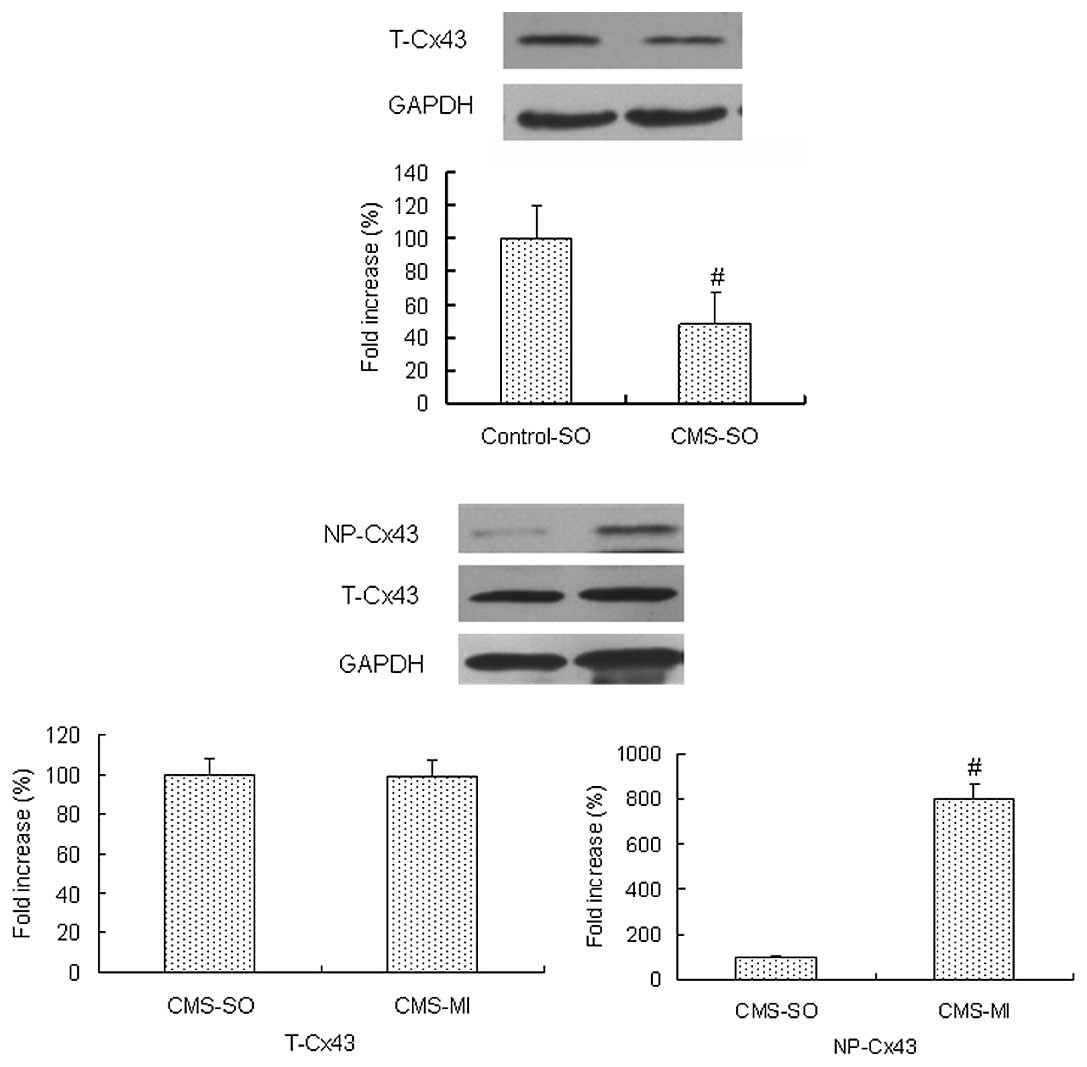
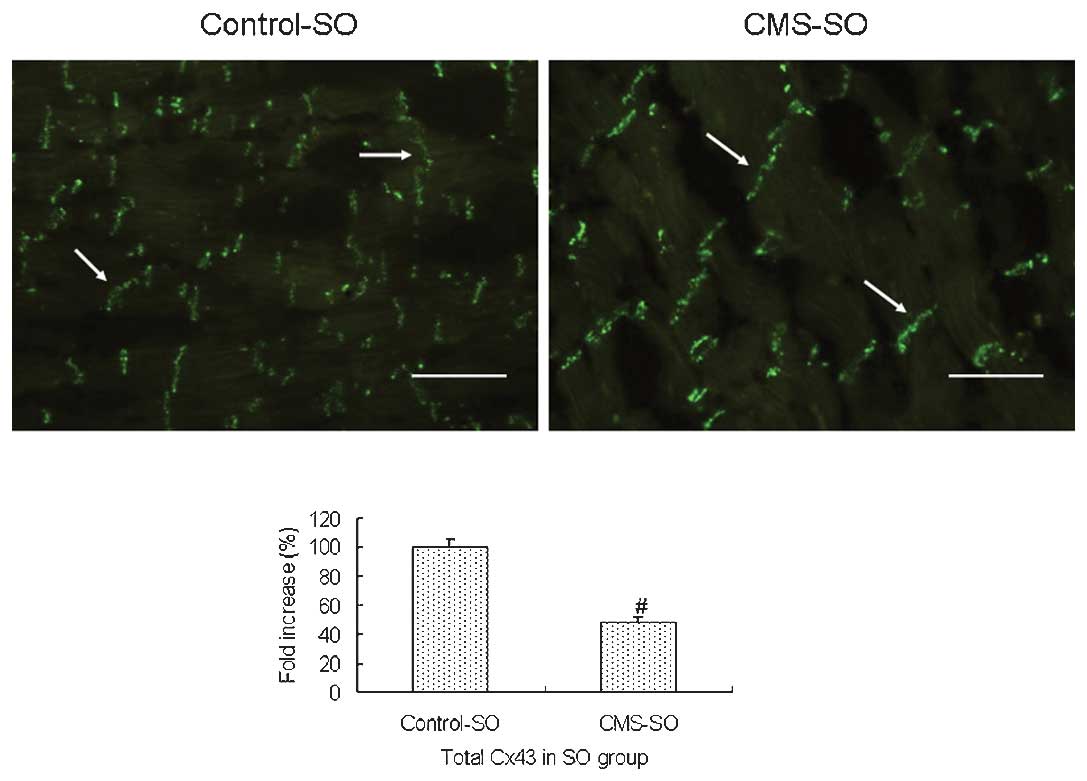
As shown in Fig. 1A, the amount of total Cx43 in the CMS-SO group was significantly decreased to ∼50% compared to that in the control-SO group (P<0.05). Immunofluorescence also revealed that the amount of total Cx43 in the CMS-SO group was significantly decreased compared to that in the control-SO group (P<0.05; Fig. 2).

Figure 1.

Representative immunoblots of the Cx43 protein. Quantitative densitometric analysis of the amount of NP-Cx43 and T-Cx43 normalized to GAPDH (NP-Cx43/GAPDH; T-Cx43/GAPDH). The relative amounts of NP-Cx43 and T-Cx43 were expressed as a percentage of the control-SO or CMS-SO groups. (A) Comparison of the amount of total Cx43 between the control-SO and CMS-SO groups. #P<0.05 vs. control-SO group. (B) Comparison of the amount of total Cx43 and NP-Cx43 between the control-SO and CMS-MI groups in CMS rats. #P<0.05 vs. CMI-SO group. T-Cx43 = NP-Cx43 + P-Cx43. NP-Cx43, non-phosphorylated Cx43; P-Cx43, phosphorylated Cx43; T-Cx43, total Cx43; GAPDH, glyceraldehyde-3-phosphate dehydrogenase; SO, sham-operated; MI, myocardial ischemia; CMS, chronic mild stress; Cx43, connexin 43.

Figure 2.

Representative immunofluorescence images of the Cx43 protein. SO, sham-operated; MI, myocardial ischemia; CMS, chronic mild stress. #P<0.05 vs. control-SO group. Bars, 100 μm. Cx43, connexin 43.

As shown in Fig. 1B, the 30-min ischemia did not result in a significant change in the amount of total Cx43 (total Cx43 = non-phosphorylated Cx43 + phosphorylated Cx43) in the CMS rats (P>0.05). The amount of non-phosphorylated Cx43 in the CMS-MI group was markedly increased compared to that in the CMS-SO group (P<0.05), suggesting that the relative amount of phosphorylated Cx43 was significantly decreased in the CMS rats.

Changes in gap junctional permeability

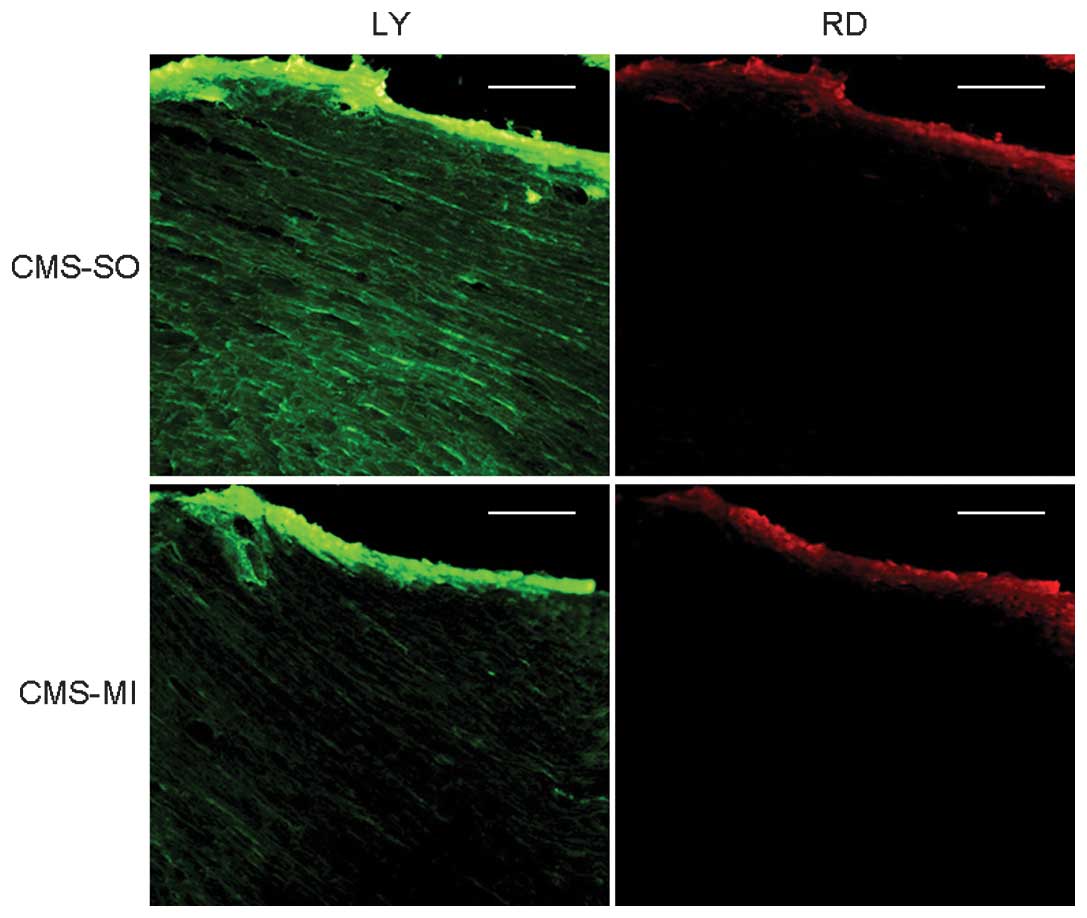
As shown in Fig. 3, following a 30-min LAD ligation, the gap junctional permeability in the CMS-MI group (50.4±4.9%) was significantly decreased compared with the normal non-ischemic value in the CMS-SO group (100%).

Figure 3.

Representative example of gap junctional permeability. LY, Lucifer yellow; RD, rhodamine-dextran; SO, sham-operated; MI, myocardial ischemia; CMS, chronic mild stress. Bars, 100 μm.

Discussion

The prevalence of depression in patients with coronary artery disease (such as myocardial infarction and heart failure) is approximately 5 times that of the general population (7). In the present study, we found that CMS rats were susceptible to ischemia-induced ventricular tachyarrhythmias. This indicates that depression may be a cause of susceptibility to the occurrence of ventricular arrhythmias.

Previous studies have demonstrated that reduced expression of Cx43 results in a significant reduction in conduction velocity during acute MI and accelerates the onset and increases the incidence of ischemia-induced ventricular arrhythmias (2,3,8–10). These results suggest that the changes in Cx43 expression may play a significant role in the genesis of ventricular arrhythmias during acute MI. Other studies have also shown that Cx43 underwent marked dephosphorylation during the process of electrical uncoupling induced by ischemia, which promoted the genesis of ischemia-induced ventricular arrhythmias (6,11). In the present study, the amount of total Cx43 in the CMS-SO group was significantly decreased to approximately 50% compared to that in the control-SO group. In addition, we found that ischemia did result in Cx43 dephosphorylation and that the gap junctional permeability, which could directly mediate the electrical coupling and conduction (6) in the MI group, was significantly decreased in the SO group in CMS rats, indicating that the relative amount of phosphorylated Cx43 in CMS rats was significantly lower than that in adult rats during MI (5,10). These results suggest that the increased susceptibility to ischemia-induced ventricular tachyarrhythmias may be associated with a reduction in Cx43 protein expression in depressed rats.

This study had several limitations, however. We first observed that the incidence of ischemia-induced ventricular tachyarrhythmias was markedly increased and that the Cx43 protein expression in the ventricle was significantly decreased in depressed rats; however, we did not have direct evidence demonstrating the relationship between the alteration in Cx43 expression and the occurrence of VT/VF, which was also a limitation of a previous study (10).

In conclusion, the present study suggests that the incidence of ischemia-induced ventricular tachyarrhythmias is markedly increased in depressed rats, which may be associated with the reduction in Cx43 protein expression in the ventricle of depressed rats.

Acknowledgements

This study was supported by grant no. 81070143 (to Z.L.) from the National Natural Science Foundation of China, grant no. 4101024 from the Fundamental Research Funds for the Central Universities (to Z.L.) and the Specialized Research Fund for the Doctoral Program of Higher Education of China (grant no. 20100141120072, to Z.L.).

References

1. 

K BoenglerR SchulzG HeuschConnexin 43 signalling and cardioprotectionHeart9217241727200610.1136/hrt.2005.06687816387816

2. 

WT Smith IVWF FleetTA JohnsonCL EngleWE CascioThe Ib phase of ventricular arrhythmias in ischemic in situ porcine heart is related to changes in cell-to-cell electrical coupling. Experimental Cardiology Group, University of North CarolinaCirculation9230513060199510.1161/01.CIR.92.10.3051

3. 

JE SaffitzRB SchuesslerKA YamadaMechanisms of remodeling of gap junction distributions and the development of anatomic substrates of arrhythmiasCardiovasc Res42309317199910.1016/S0008-6363(99)00023-110533569

4. 

AJ GrippoCM SantosRF JohnsonTG BeltzJB MartinsRB FelderAK JohnsonIncreased susceptibility to ventricular arrhythmias in a rodent model of experimental depressionAm J Physiol Heart Circ Physiol286H619H626200410.1152/ajpheart.00450.200314715499

5. 

W WuZ LuLoss of anti-arrhythmic effect of vagal nerve stimulation on ischemia-induced ventricular tachyarrhythmia in aged ratsTohoku J Exp Med2232733201110.1620/tjem.223.2721187697

6. 

R PappM GoncziM KovacsG SeprenyiA VeghGap junctional uncoupling plays a trigger role in the antiarrhythmic effect of ischaemic preconditioningCardiovasc Res74396405200710.1016/j.cardiores.2007.02.02117362896

7. 

SJ SchleiferMM Macari-HinsonDA CoyleWR SlaterM KahnR GorlinHD ZuckerThe nature and course of depression following myocardial infarctionArch Intern Med14917851789198910.1001/archinte.1989.003900800590142788396

8. 

DL LernerKA YamadaRB SchuesslerJE SaffitzAccelerated onset and increased incidence of ventricular arrhythmias induced by ischemia in Cx43-deficient miceCirculation101547552200010.1161/01.CIR.101.5.54710662753

9. 

DE GutsteinGE MorleyH TamaddonD VaidyaMD SchneiderJ ChenKR ChienH StuhlmannGI FishmanConduction slowing and sudden arrhythmic death in mice with cardiac-restricted inactivation of connexin43Circ Res88333339200110.1161/01.RES.88.3.33311179202

10. 

M AndoRG KatareY KakinumaD ZhangF YamasakiK MuramotoT SatoEfferent vagal nerve stimulation protects heart against ischemia-induced arrhythmias by preserving connexin43 proteinCirculation112164170200510.1161/CIRCULATIONAHA.104.52549315998674

11. 

H JiangX HuZ LuH WenD ZhaoQ TangB YangEffects of sympathetic nerve stimulation on ischemia-induced ventricular arrhythmias by modulating connexin43 in ratsArch Med Res39647654200810.1016/j.arcmed.2008.07.00518760192

Related Articles

  • Abstract
  • View
  • Download
  • Twitter
Copy and paste a formatted citation
Spandidos Publications style
Wu W, Li Y, Lu Z and Hu X: Increased susceptibility to ischemia-induced ventricular tachyarrhythmias in depressed rats: Involvement of reduction of connexin 43. Exp Ther Med 3: 192-194, 2012.
APA
Wu, W., Li, Y., Lu, Z., & Hu, X. (2012). Increased susceptibility to ischemia-induced ventricular tachyarrhythmias in depressed rats: Involvement of reduction of connexin 43. Experimental and Therapeutic Medicine, 3, 192-194. https://doi.org/10.3892/etm.2011.396
MLA
Wu, W., Li, Y., Lu, Z., Hu, X."Increased susceptibility to ischemia-induced ventricular tachyarrhythmias in depressed rats: Involvement of reduction of connexin 43". Experimental and Therapeutic Medicine 3.2 (2012): 192-194.
Chicago
Wu, W., Li, Y., Lu, Z., Hu, X."Increased susceptibility to ischemia-induced ventricular tachyarrhythmias in depressed rats: Involvement of reduction of connexin 43". Experimental and Therapeutic Medicine 3, no. 2 (2012): 192-194. https://doi.org/10.3892/etm.2011.396
Copy and paste a formatted citation
x
Spandidos Publications style
Wu W, Li Y, Lu Z and Hu X: Increased susceptibility to ischemia-induced ventricular tachyarrhythmias in depressed rats: Involvement of reduction of connexin 43. Exp Ther Med 3: 192-194, 2012.
APA
Wu, W., Li, Y., Lu, Z., & Hu, X. (2012). Increased susceptibility to ischemia-induced ventricular tachyarrhythmias in depressed rats: Involvement of reduction of connexin 43. Experimental and Therapeutic Medicine, 3, 192-194. https://doi.org/10.3892/etm.2011.396
MLA
Wu, W., Li, Y., Lu, Z., Hu, X."Increased susceptibility to ischemia-induced ventricular tachyarrhythmias in depressed rats: Involvement of reduction of connexin 43". Experimental and Therapeutic Medicine 3.2 (2012): 192-194.
Chicago
Wu, W., Li, Y., Lu, Z., Hu, X."Increased susceptibility to ischemia-induced ventricular tachyarrhythmias in depressed rats: Involvement of reduction of connexin 43". Experimental and Therapeutic Medicine 3, no. 2 (2012): 192-194. https://doi.org/10.3892/etm.2011.396
Follow us
  • Twitter
  • LinkedIn
  • Facebook
About
  • Spandidos Publications
  • Careers
  • Cookie Policy
  • Privacy Policy
How can we help?
  • Help
  • Live Chat
  • Contact
  • Email to our Support Team